


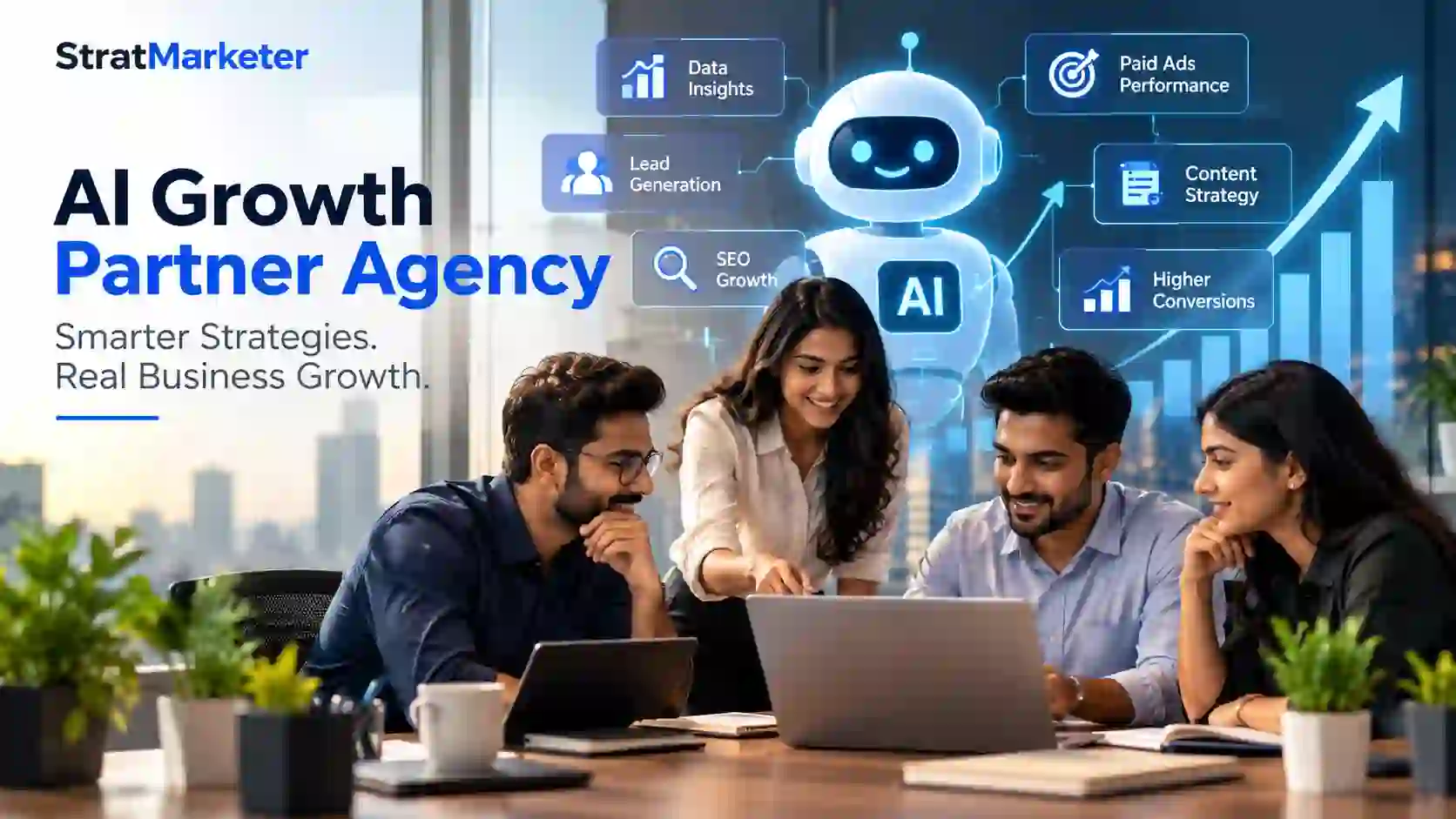
AI Growth Partner Agency for Smarter Business Growth
Why Businesses Are Looking for an AI Growth Partner Agency
There is a particular frustration I have noticed with businesses that have already spent money on digital marketing. They have an SEO agency handling rankings, someone running Google Ads, a social media person posting regularly, and sometimes a separate team looking after the website. On paper, everything looks busy. Yet the business owner still asks the same uncomfortable question: where is the growth?
That is one reason the idea of an AI growth partner agency has started getting more attention.
It is not simply because companies want to use AI. Most business owners have already tried ChatGPT, AI writing tools, automated reporting, or some form of AI advertising feature. The problem is that using ten different AI tools does not automatically create a better marketing system.
Growth usually gets stuck somewhere between the tools.
A company may generate hundreds of content ideas but still attract the wrong visitors. It may run thousands of ad impressions but receive weak enquiries. A B2B company may collect leads every month but have no useful way of identifying which ones are genuinely worth a sales call. An ecommerce brand may have good traffic and decent products but lose customers because the product page does not answer the questions buyers actually have.
This is where the role of an AI growth partner agency becomes more interesting.
The focus shifts from asking, “Which AI tool should we use?” to asking, “Which part of the customer journey is stopping the business from growing?”
That sounds like a small difference. It is not.
McKinsey’s 2025 research found that generative AI is being used most heavily in marketing and sales among the business functions surveyed, with 71 percent of respondents saying their organisations use generative AI in at least one business function. That tells us adoption is no longer limited to technology companies experimenting in a corner.
Indian businesses are seeing this shift too, although the way it happens is often quite practical. A manufacturer in Ahmedabad may use AI to qualify incoming enquiries. A D2C skincare company in Mumbai may use it to analyse customer questions and create product content. A local education business may use automation to follow up with leads that came through Google Ads.
The technology is different in each case.
The business problem is what matters.
I have a strong preference here. I would rather see a company use AI in three carefully selected parts of its growth process than install twenty AI tools that nobody properly manages. More software often creates more noise, not more sales.
And there is another reason companies are looking for an AI growth partner agency now. Search itself is changing.
Google has expanded AI Overviews and AI Mode in India, with AI Mode moving from Labs into Search for Indian users in 2025. Google has also reported that AI Overviews are increasing usage for the types of queries where they appear in markets including India.
So the old idea of getting a customer through one keyword, one landing page and one conversion path is becoming less reliable.
A buyer may search, compare, ask another question, watch a video, check reviews, return through an advertisement and then speak to a salesperson.
That messy behaviour is exactly where AI can become useful.
Not because AI understands customers perfectly. It does not.
But because it can help a business process large amounts of customer, campaign and content information faster than a small marketing team normally could.
What an AI Growth Partner Agency Actually Does
The phrase “AI growth partner agency” can mean almost anything these days, which is part of the problem.
One agency may mainly provide AI content. Another may sell chatbot development. Another may run paid advertising using automated bidding. A third may build internal AI agents. All of them could technically call themselves AI growth agencies.
That does not make them the same.
A genuine AI growth partner agency should sit somewhere between strategy, marketing execution, data interpretation and automation. It should understand what the business is trying to sell, who buys it, where customers are dropping out and which parts of the process can actually benefit from AI.
The work often starts with something quite unglamorous.
Looking at the existing numbers.
Suppose an Indian B2B manufacturer receives 400 website enquiries in a quarter. The obvious temptation is to ask how AI can generate 800 enquiries next quarter.
I would not start there.
I would first want to know how many of those 400 enquiries were relevant, how many were contacted, how quickly the sales team responded, how many reached a quotation stage and how many eventually became customers.
If only 20 of the 400 enquiries became serious opportunities, doubling enquiries could actually make the sales team’s life worse.
An AI growth partner agency should be able to identify that kind of problem before suggesting another campaign.
There is also a difference between automation and intelligence.
Automation can send an email after a form submission. AI can potentially classify the enquiry, understand the language used by the prospect, identify the likely product interest and assign some level of priority based on the available information.
But even that needs caution.
A model can misunderstand a lead. It can treat a price enquiry as a high-value opportunity when the person was simply comparing suppliers. It can also miss the importance of a small-looking enquiry from a company that later turns into a large account.
Human review still matters.
For StratMarketer, this distinction is important because growth does not happen inside one channel. SEO, paid advertising, content, social media, landing pages, CRM activity and customer follow-ups influence one another.
An AI growth partner agency should therefore look at the whole path rather than treating each marketing activity as a separate monthly deliverable.
There is a practical example I often think about.
A service company can have excellent Google rankings for commercial keywords and still generate poor business because the page attracts people looking for information rather than people ready to buy. If an agency only reports rankings, everything looks positive.
The sales team knows otherwise.
That gap between marketing reports and actual business reality is where a partner earns its value.
Where AI Fits Into Modern Growth and Marketing Decisions
AI is useful in marketing when there is enough information to make a better decision, or enough repetitive work to justify automation.
That sounds obvious, but it gets ignored surprisingly often.
Take content planning. A traditional content process might involve looking at keyword tools, competitor pages and Search Console data, then manually deciding what to publish.
AI can help process these inputs faster. It can group search queries by intent, identify recurring customer questions, compare existing pages and suggest content gaps. But someone still needs to decide whether those gaps matter commercially.
The same thing happens with paid advertising.
AI can help analyse campaign data, identify patterns in search terms, generate creative variations and assist with audience analysis. Modern advertising platforms already contain considerable automation themselves.
The agency’s job is not simply to switch those features on.
It is to decide what should be automated and what should remain under human control.
This distinction becomes even more important as AI moves closer to the actual customer journey.
For example, a business could use AI to:
Analyse website behaviour and identify pages where visitors frequently leave.
Group customers according to buying behaviour.
Find repeated objections in sales calls or enquiry messages.
Generate different versions of ad copy for testing.
Identify high intent search queries.
Personalise email follow ups.
Summarise large CRM datasets.
Suggest internal sales actions.
Support customer service teams.
Review content for missing information.
Create initial creative concepts.
Monitor campaign changes and flag unusual performance.
None of these automatically means the company will grow.
That is the part that gets lost in many AI discussions.
A 2025 McKinsey study on personalisation noted that companies are increasingly using AI to scale more relevant customer experiences across large and varied audiences. The useful word there is “relevant”. Generating more messages is easy. Making those messages useful to the right person at the right stage is harder.
Indian businesses have another layer to deal with.
Language and behaviour vary considerably between markets. A customer searching for a financial service in Delhi may phrase the query differently from someone searching in a smaller city. Someone shopping for a supplement may switch between English and Hindi. A B2B buyer may search using a technical product term but ask the salesperson a very different question.
Google has already expanded AI search experiences in India across languages. AI Mode was initially introduced in English and later expanded to Hindi and additional Indian languages.
That means content teams need to think beyond exact keyword matching.
People are asking longer questions now.
They are also asking follow-up questions.
A good growth system should account for that behaviour instead of producing another batch of short articles every month.
I might be wrong here, because this will not apply equally to every industry, but I think companies that treat AI purely as a content production machine will eventually get less value from it than companies that use it to understand customers and improve decisions.
Content is still important.
It just cannot carry the entire growth strategy.
AI Growth Strategy for Lead Generation and Customer Acquisition
Lead generation is probably one of the easiest places to understand the practical value of an AI growth partner agency.
Consider a typical Indian B2B company running Google Ads.
The campaign generates leads. Some contain a phone number and company name. Some ask for pricing. Some simply say “send details”. Some are irrelevant. A few are genuinely valuable.
Without a proper system, all of them enter the same spreadsheet or CRM pipeline.
That creates a strange situation. The marketing team reports lead volume while the sales team complains about lead quality.
AI can help connect those two sides.
The first step can be lead classification. Based on information already supplied by the prospect, AI can help categorise leads according to product interest, company type, location, enquiry intent or other business-defined signals.
The sales team can then prioritise.
That does not mean AI should decide who gets a call and who does not. I would be uncomfortable with that in many businesses, particularly where a small mistake could mean losing a serious customer.
It can instead act as a sorting layer.
There is a similar opportunity in customer acquisition.
Suppose an ecommerce business is spending ₹5 lakh a month across Meta and Google. One campaign produces cheap conversions. Another produces fewer conversions but customers with higher repeat purchase rates.
If the business only looks at cost per acquisition, the first campaign appears better.
But what happens after the first purchase?
That is where growth analysis needs to become more mature.
AI can help combine and interpret information from advertising, website analytics, customer records and purchase behaviour. The useful outcome is not another colourful dashboard. It is a better decision about where the next rupee should go.
B2B sales can benefit in another way.
A prospect may visit several service pages, download a document and return to the website two weeks later. They may not fill out a form until much later. A basic reporting system sees disconnected activities.
A stronger setup can connect those signals where the available data and privacy controls allow it.
This is also where personalisation becomes practical.
An existing customer should not always receive the same communication as a first-time visitor. Someone who has already requested a quotation probably should not be treated like someone who has only read a blog.
Simple things, but businesses miss them.
The bigger opportunity is identifying where customer acquisition is leaking.
Maybe the ads are fine but the landing page is weak.
Maybe the landing page works but the sales response takes two days.
Maybe leads are good but the follow-up message is generic.
Maybe there are enough enquiries but the product pricing page creates hesitation.
An AI growth partner agency should be willing to investigate these less glamorous problems.
There is evidence that this direction is gaining attention in B2B. McKinsey reported in 2025 that 19 percent of surveyed B2B decision makers were already implementing generative AI use cases for buying and selling, while another 23 percent were in the process of doing so.
Still, I would not recommend putting AI everywhere.
If a company gets 30 enquiries a month, has a sales team of two people and has no reliable CRM data, building a complicated AI lead scoring system may be unnecessary.
Fix the basics first.
Sometimes the smartest AI strategy is knowing where not to use AI.
Using AI Across SEO, Paid Ads, Content and Conversion
This is where the work becomes interconnected.
SEO cannot be treated as one activity, paid advertising as another, content as another and conversion optimisation as something the website team worries about later.
Customers do not behave that neatly.
Someone may discover a brand through a Google search, see a YouTube video later, click a Meta advertisement, read three articles and finally submit an enquiry from a branded search.
The final conversion may be credited to one channel.
The actual decision involved several.
An AI growth partner agency can help bring these signals together, but only when the underlying tracking is reasonably reliable.
For SEO, AI can assist with query clustering, content research, internal linking analysis, content briefs, competitor analysis and identifying areas where existing pages are weak.
But there is a serious line here.
Google explicitly says that using generative AI to produce many pages without adding value can fall under its scaled content abuse policy.
So generating 500 articles because an AI tool can generate 500 articles is not an SEO strategy.
It is a production decision.
A growth strategy asks a different question: which content deserves to exist?
That difference matters even more now that search results are becoming more conversational. Google says AI Mode can handle longer, more complex queries and break them into multiple searches to explore a topic more deeply.
For a business, this means useful content needs to answer the real question behind the search.
Paid advertising has a different use for AI.
Here, speed of testing can matter. Different headlines, offers, landing page messages and creative concepts can be produced and assessed more quickly. AI can also help spot patterns across search terms, audience behaviour and campaign performance.
But I would still insist on human judgement around the offer.
If the offer is weak, AI will simply help you produce more versions of a weak offer.
That is not progress.
Content marketing is where businesses often get carried away. AI can help with research, outlines, editing, repurposing and content analysis. It can also help a team understand hundreds of customer questions that would otherwise take days to organise manually.
But the final material should contain something that could only have come from actually understanding the business.
A supplement manufacturer, for instance, should be able to explain its manufacturing process, quality checks, packaging decisions and common buyer concerns with specifics. A generic AI article about “why quality matters” adds very little.
The same applies to conversion.
AI can analyse behaviour, identify common friction points, assist with A B testing ideas and help personalise certain experiences. Yet conversion problems are sometimes painfully simple.
The button is difficult to find.
The enquiry form asks for too much information.
The mobile page loads poorly.
The pricing information is unclear.
The visitor does not understand what happens after submitting the form.
I have seen businesses spend weeks discussing advanced automation while ignoring a contact form that nobody wanted to fill in.
That kind of thing is frustrating because it is avoidable.
And it brings us back to the actual meaning of an AI growth partner agency.
The value is not the word AI.
The value is having someone who can look across SEO, advertising, content, customer acquisition and conversion and ask which problem deserves attention first.
Sometimes the answer will involve AI.
Sometimes it will be a landing page rewrite.
Sometimes it will be better tracking.
Sometimes it will be telling the client to stop spending money on a campaign that looks impressive in the report but is not producing worthwhile customers.
That last conversation is usually not the easiest one.
But it is often the useful one.
The Role of Customer Data in AI Led Growth Decisions
AI becomes much more useful when a business has decent customer data to work with.
Not perfect data. Most companies do not have that.
But at least enough information to understand what is happening.
A business may have data sitting in Google Analytics, Search Console, Meta Ads, Google Ads, a CRM, WhatsApp conversations, enquiry forms and sales spreadsheets. The problem is that these systems rarely tell the same story.
One system says there were 2,000 leads.
Another says there were 1,700.
The sales team remembers several large enquiries that do not appear properly in the marketing report.
This is not unusual.
An AI growth partner agency needs to deal with this mess before making ambitious promises about AI led growth.
Customer data can reveal things that surface level campaign reports miss. Which customers buy repeatedly? Which locations produce better enquiries? Which pages are visited before a sale? Which products attract interest but rarely convert? Which advertising channels bring customers with better lifetime value?
These questions are far more useful than simply asking how many clicks a campaign received.
Take an Indian education company as an example. Suppose it receives enquiries from Delhi, Pune, Jaipur and smaller cities. At first glance, Delhi might appear to be the strongest market because it generates the most leads.
But perhaps Jaipur has fewer enquiries and a much higher enrolment rate.
If the business only watches lead volume, it may keep putting money into Delhi.
If it connects lead, sales and revenue data, the decision could change.
AI can help identify these patterns when the underlying information is available.
It can also help businesses process unstructured information. Sales calls, enquiry messages, customer reviews and support conversations contain useful clues. People often explain their objections in language that never appears in formal survey data.
“I don’t know whether this will work for my business.”
“Your competitor is cheaper.”
“I need this by next month.”
“Can you customise it?”
Those statements are valuable.
An AI system can help group hundreds of such comments into recurring themes. A marketing team can then use those themes in content, landing pages, sales scripts and campaigns.
But there is a warning here.
Bad data produces bad decisions faster.
I have seen companies become very excited about AI dashboards while their CRM had duplicate contacts, missing revenue values and leads marked as “converted” simply because somebody had spoken to them on the phone.
That data cannot support serious growth decisions.
Before asking what AI can predict, ask whether the business records what actually happened.
There is also the question of privacy and responsible data use. Customer information should not be pushed into AI tools casually just because a platform allows it. Businesses need clear internal rules about what information can be processed, who can access it and where it is stored.
This becomes especially important for sectors dealing with financial, health, education or other sensitive customer information.
An AI growth partner agency should be comfortable discussing these boundaries.
If an agency talks about AI as if customer data has no restrictions, I would be cautious.
Sometimes restraint is part of good strategy.
Common Problems Businesses Face With AI Growth Initiatives
The first problem is usually not the technology.
It is enthusiasm.
A company sees competitors talking about AI and decides it needs an AI strategy immediately. Someone recommends a chatbot. Another person suggests automated content. The marketing team starts testing AI ads. Suddenly there are several experiments running, but nobody can explain what business problem they were supposed to solve.
This happens more often than people admit.
The second problem is poor implementation.
An AI tool may be technically connected to a CRM, but the data entering the CRM is inconsistent. An automated lead scoring model may then classify prospects based on unreliable information.
The output looks sophisticated.
It is still wrong.
Another common problem is expecting AI to replace judgement.
It will not.
A marketing manager still needs to understand the customer. A salesperson still needs to speak to prospects. A content professional still needs to recognise when an article sounds generic. A business owner still needs to decide which market is worth pursuing.
AI can assist these decisions.
It cannot take responsibility for them.
There is also a content problem.
Because AI makes content production much faster, some businesses publish far too much. They create location pages, service pages, blog posts and social posts without checking whether any of them add useful information.
Google’s current spam policies specifically address scaled content abuse where large amounts of content are produced primarily to manipulate search rankings rather than help users. (developers.google.com)
So the old idea that more pages automatically means more traffic is increasingly risky.
A smaller website with genuinely useful pages can be in a healthier position than a huge website full of variations saying roughly the same thing.
There is another problem that is less technical and more irritating.
Teams sometimes use AI because they want to avoid difficult work.
Instead of speaking to customers, they ask AI what customers might want.
Instead of reading sales objections, they generate personas.
Instead of examining why an advertisement failed, they ask for ten new headlines.
That can create the appearance of activity without much learning.
An AI growth partner agency should push the other way.
Use customer conversations.
Look at real search behaviour.
Study actual conversion data.
Speak to the sales team.
Then use AI where it helps process or act on those findings.
I also think businesses underestimate change management. A new AI system may work perfectly and still fail because the people expected to use it do not trust it.
A salesperson who believes AI lead scoring is nonsense will simply ignore the score.
A content writer who thinks every AI recommendation is wrong will bypass the workflow.
A founder who wants every decision approved manually will slow the entire system down.
Technology cannot fix those internal habits by itself.
And this is where I want to contradict something from earlier.
I said AI can help connect different parts of growth.
That is true, but it does not mean everything should be connected into one enormous automated system. Sometimes keeping a process simple is safer and easier to manage.
A small company may need a good CRM, clean tracking and sensible automation.
Not an AI ecosystem.
How StratMarketer Approaches AI Growth Partnerships
At StratMarketer, the starting point should be the business problem rather than the AI tool.
That sounds straightforward, but it changes the work quite a lot.
If a company wants more qualified leads, the first question is not which AI software should be installed. It is where the existing acquisition process is losing potential customers.
If the company already receives plenty of leads, perhaps lead generation is not the problem at all.
Maybe qualification is weak.
Maybe the sales team is slow to respond.
Maybe the website does not explain the offer properly.
Maybe paid campaigns are attracting people with low buying intent.
This is where an AI growth partner agency needs to behave more like a growth team than a conventional campaign vendor.
StratMarketer can look across the major acquisition channels, including SEO, paid advertising, content, social media, landing pages and customer follow-up, then identify where AI has a sensible role.
For SEO, that could mean analysing large groups of queries, finding patterns in search intent, reviewing existing content and helping teams produce more useful content briefs.
It should not mean publishing hundreds of AI generated pages simply because the production capacity exists.
For paid campaigns, AI can support analysis, creative testing, audience insights and campaign workflows. But campaign objectives, offers and commercial priorities still need human decisions.
For lead generation, AI can help classify enquiries, identify patterns in lead quality and support faster follow-up.
For content, it can help researchers and writers work through large amounts of information while keeping the final material grounded in the company’s actual expertise.
And for conversion, AI can help identify recurring friction from behaviour data, customer feedback and enquiry patterns.
The important part is the connection between these activities.
Imagine a service business notices that a particular search term produces strong traffic but poor enquiries. Instead of simply trying to rank higher for that term, the team can examine the page, the search intent, the offer and the sales response.
That might reveal that the page is attracting people who want a free answer rather than a paid service.
The SEO problem was actually an intent problem.
This kind of diagnosis is where an AI growth partner agency can be useful.
There is also room for experimentation.
A company might test different landing page messages, analyse customer questions, create multiple ad concepts or automate part of its reporting workflow.
But experiments should have a reason.
Otherwise the business ends up with a long list of AI experiments and very little evidence about what worked.
I prefer fewer experiments with clear commercial questions.
Did qualified enquiries increase?
Did sales response time fall?
Did the cost of acquiring a customer become more reasonable?
Did existing traffic convert better?
Did the sales team spend less time sorting poor leads?
These are much better questions than asking whether the company is “using AI”.
StratMarketer’s role as an AI growth partner agency should therefore be practical. The agency should be able to work with the existing marketing setup rather than assuming every business needs to rebuild everything from scratch.
Sometimes the answer is advanced.
Sometimes it is surprisingly basic.
That is fine.
How to Evaluate an AI Growth Partner Agency Before Hiring
The easiest way to judge an AI growth partner agency is not by the number of AI tools it mentions.
Ask what it intends to change.
A serious agency should be able to explain the connection between the proposed work and the business outcome.
For example, if the agency recommends AI lead scoring, ask what information will be used for scoring and how success will be measured.
If it recommends AI content production, ask how it will prevent the website from becoming filled with repetitive material.
If it recommends AI automation, ask what happens when the automation makes a mistake.
These questions reveal quite a lot.
I would also ask the agency to show how it thinks about existing data. Not confidential client data, obviously. A sensible demonstration or anonymised example is enough.
You want to know whether the agency understands messy business information or only knows how to use polished AI tools.
Another useful question is simple:
“Where would you not use AI in our business?”
A thoughtful answer is a good sign.
An agency that says AI should be used everywhere is probably selling the technology more than the business outcome.
Look at the people doing the work too.
Do they understand SEO?
Can they read an advertising account?
Do they understand conversion tracking?
Can they discuss CRM processes?
Do they know how sales teams actually handle leads?
An AI growth partner agency does not need to be an expert in every software platform, but it should understand how the different pieces affect one another.
Ask about measurement as well.
Traffic is useful.
Leads are useful.
But revenue is usually more important.
If the agency cannot explain how its work will eventually be connected to qualified opportunities or revenue, I would pause before signing a long contract.
There is another thing worth checking.
Ask how much of the content and strategy is reviewed by humans.
This is not because AI content is automatically bad. It is because business content needs context. An AI model does not know which customer complaint keeps the founder awake at night unless someone provides that information.
It does not know that a particular product is frequently returned because of a packaging issue.
It does not know that customers in one city keep asking for a particular payment method.
Those details come from the business.
The best AI growth partner agency relationships usually have information moving both ways. The agency brings marketing and technology knowledge. The client brings product, customer and sales knowledge.
Neither side can do the whole thing alone.
And if an agency promises a fixed percentage increase in revenue before understanding your business, be careful.
I would be.
Frequently Asked Questions About AI Growth Partner Agency
What is an AI growth partner agency?
An AI growth partner agency combines marketing strategy, AI tools, automation, data analysis and growth execution to help businesses acquire and retain customers. The important distinction is that the agency should focus on business outcomes rather than simply supplying AI software or AI generated content.
Is an AI growth partner agency the same as an AI development company?
No. An AI development company may primarily build AI software, models, applications or integrations. An AI growth partner agency usually works closer to marketing and revenue, using AI alongside SEO, advertising, content, conversion and customer acquisition activities.
There can be overlap, but the objectives are different.
Can AI replace a digital marketing agency?
I would not look at it that way.
AI can automate parts of research, reporting, content production, analysis and campaign management. It can also make some tasks considerably faster.
But deciding what a business should say, whom it should target, which customers are valuable and why a campaign is failing still requires judgement.
Is an AI growth partner agency useful for small Indian businesses?
It can be, but the scope should match the business.
A small business may benefit from lead qualification, customer follow-up, content research, reporting automation or better campaign analysis. It may not need an elaborate AI system involving several platforms.
Start with the bottleneck.
Does AI automatically improve SEO?
No.
AI can help with keyword analysis, content research, clustering and other SEO tasks, but search performance still depends on usefulness, relevance, technical quality, authority and how well the content meets the user’s actual need.
Publishing more AI generated pages is not a substitute for good SEO.
How does an AI growth partner agency measure success?
The useful metrics depend on the business. They can include qualified leads, customer acquisition cost, conversion rate, sales pipeline value, revenue, repeat purchases and customer lifetime value.
For some businesses, reducing wasted leads or shortening sales response time may matter more than increasing website traffic.
How much AI should a business use?
There is no sensible universal percentage.
Use it where it solves a real problem, reduces repetitive work, helps analyse information or allows the team to make better decisions.
If a manual process is already simple and reliable, adding AI may create unnecessary complexity.
Can an AI growth partner agency work with an existing marketing team?
Yes, and in many cases that is preferable.
The agency can handle selected strategy, analysis, automation or execution while the internal team keeps control over areas where it has stronger product and customer knowledge.
A good working relationship should not depend on replacing everyone internally.
Is AI growth only about generating more leads?
No.
Sometimes the biggest opportunity comes after the lead arrives.
If a business is generating enough enquiries but losing customers because of slow follow-up, poor qualification or a weak sales process, generating more leads may simply increase the workload.
Growth can mean getting more value from the demand that already exists.
What should I ask before hiring an AI growth partner agency?
Ask what business problem the agency sees, what it proposes to change, what data it needs, which parts will be automated, where human review remains necessary and how success will be measured.
Also ask what it would not automate.
That answer can tell you more than a long presentation about AI.
Our Services
Contact Us
- Paonta Sahib, Himachal Pradesh, India
- +91-8700998508
- support@stratmarketer.com
Start From Here
These two options make it easy for you to get the information you want.