


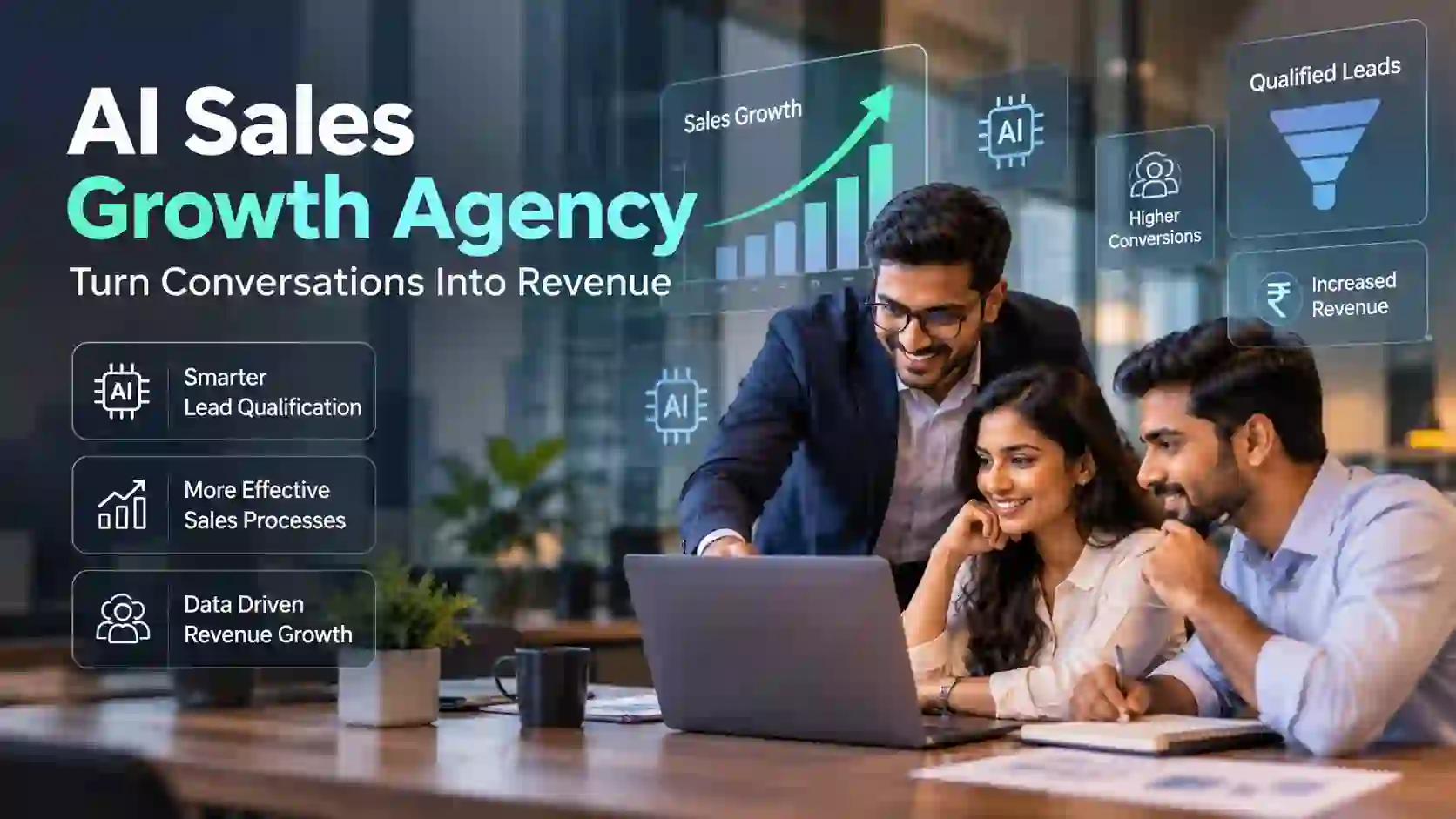
AI Sales Growth Agency for Smarter Revenue Growth
Why Businesses Are Looking for an AI Sales Growth Agency
The first reason is not really AI.
It is sales pressure.
Businesses want more revenue, but increasing the sales team’s workload is not always the answer. A company may already have five salespeople handling hundreds of enquiries every month. Asking them to make more calls can create another problem. Follow-ups become rushed, CRM records become incomplete and genuinely valuable prospects can get mixed up with people who were never serious buyers.
This is where an AI sales growth agency starts looking attractive.
AI can examine large amounts of customer and sales information much faster than a salesperson can. It can identify patterns in enquiry behaviour, previous conversations, response times, lead sources and movement through the sales pipeline.
But there is an important distinction.
An AI sales growth agency should not simply automate whatever a sales team currently does. If the existing sales process is badly designed, automation can make the bad process happen faster.
That has caused plenty of frustration for business owners.
For example, consider an Indian B2B manufacturer receiving enquiries from different parts of the country. A prospect submits an enquiry for a product, gets an automated email and is then passed to a salesperson. The salesperson calls two days later because the lead was sitting in a shared spreadsheet.
Nothing is wrong with the product.
Nothing is necessarily wrong with the salesperson either.
The problem is timing.
By the time the call happens, the buyer may already be speaking to another supplier.
An AI sales growth agency can look at this kind of situation and ask a more useful question: which leads require immediate human attention, and which ones can wait?
That small change can have a noticeable effect on sales operations.
There is another reason businesses are considering AI. Sales data is becoming too fragmented.
A company may have website enquiries in one place, CRM information somewhere else, WhatsApp conversations on employees’ phones, email discussions in individual inboxes and quotation details sitting in spreadsheets. A sales manager may technically have a lot of data but still struggle to answer a simple question: which opportunities are most likely to close this month?
This is one of the areas where an AI sales growth agency can bring practical value.
It can help connect the dots.
Not perfectly, and not automatically. Data quality still matters. If the CRM contains old phone numbers, duplicate records and missing deal stages, an AI system cannot magically turn that into reliable information.
I would actually be cautious about any AI sales growth agency that promises otherwise.
Good sales growth usually starts with understanding what is already happening.
What an AI Sales Growth Agency Actually Does
The phrase can sound broader than it really is.
An AI sales growth agency typically works across several parts of the sales and customer acquisition process. The exact work depends on the business, its sales cycle, its CRM setup and the quality of its existing data.
For one company, the biggest opportunity might be lead qualification.
For another, it could be sales forecasting.
For another, the issue might be poor follow-up after a quotation.
This is why copying another company’s AI setup rarely works well.
An AI sales growth agency may begin by studying the sales funnel. Where are enquiries coming from? How quickly are they contacted? How many become qualified opportunities? How many receive quotations? How many quotations receive follow-up? Where do prospects normally disappear?
These questions are not glamorous.
They are useful.
Once those gaps are visible, AI can be introduced where it makes sense.
Lead scoring is one common example. Instead of treating every enquiry equally, an AI system can assess different signals and help salespeople decide where to spend their time.
Customer communication is another area. AI can assist with drafting personalised follow-ups, summarising previous conversations and suggesting what a salesperson should discuss next.
There is also sales forecasting. Historical sales information, pipeline movement and customer behaviour can be analysed to give managers a clearer view of likely revenue.
For businesses with larger sales teams, AI can also help identify unusual changes. Suppose a normally active group of prospects suddenly stops progressing after the quotation stage. That may point to a pricing issue, a competitor, a product concern or simply a follow-up problem.
The system cannot always tell you the reason.
But it can help you notice the pattern earlier.
That distinction is important when choosing an AI sales growth agency. AI is very good at processing patterns. It is not automatically good at understanding every human reason behind those patterns.
A salesperson still needs to ask questions.
A manager still needs judgement.
A founder still needs to understand the market.
I prefer AI being used as an additional layer around the sales team rather than pretending it can replace the team. There are situations where automation works beautifully, especially for repetitive tasks. But a complicated B2B purchase involving trust, negotiation and several decision makers is not the same as buying a pair of headphones online.
The sales process needs room for both.
Where AI Fits Into the Modern Sales Process
AI can enter almost anywhere in the sales journey, but that does not mean it should.
At the awareness stage, AI can help businesses understand which content, campaigns or search queries are bringing in stronger commercial prospects. This becomes useful when marketing is generating a large volume of traffic but sales teams are complaining about poor lead quality.
Then comes enquiry handling.
A prospect may ask a question on a website at 10:30 at night. A well-designed AI system can respond immediately, collect basic information and route the enquiry appropriately.
That does not mean the chatbot should try to close a complicated industrial machinery order at 10:31 PM.
Sometimes its job is simply to capture the requirement properly.
This is where an AI sales growth agency needs some restraint.
I have seen businesses get excited about chatbots because they can answer hundreds of questions at once. Then customers start asking questions that require product knowledge, commercial judgement or a human explanation. The bot keeps responding, but the customer becomes irritated.
That is not sales automation.
That is just automation.
The next stage is qualification. AI can assess information submitted by prospects and compare it against characteristics of previous qualified opportunities. It can flag high intent prospects for immediate attention.
During the sales conversation, AI can help summarise calls, identify common objections and organise notes. After the call, it can assist with follow-up communication.
Then comes one of the most neglected areas: the period after a quotation.
A surprising amount of sales revenue sits there.
The quotation has been sent. Everyone feels the job is mostly done. The salesperson waits. The customer waits. A competitor follows up twice. The deal moves somewhere else.
An AI sales growth agency can help create better follow-up systems by tracking when quotations were sent, how long the prospect has been inactive and what the next appropriate action might be.
For a local distributor or service company, this could be as simple as reminding a salesperson that a high-value enquiry has not been contacted for four days.
For a larger organisation, the system might analyse hundreds of open opportunities and identify which ones have become inactive.
AI can also support existing customers.
This part is sometimes overlooked because discussions around sales AI usually focus on new leads. Yet existing customers may already represent the easiest opportunities for repeat purchases, upgrades or additional services.
If customer purchase history shows that a particular client normally orders every three months but has been inactive for six months, that is worth noticing.
It may be nothing.
Or it may be an opportunity.
The human still needs to make the call.
Finding Revenue Leaks Across the Sales Funnel
Most businesses do not lose revenue in one dramatic event.
It leaks out quietly.
A lead is contacted late. A salesperson forgets a follow-up. A quotation is sent without a clear next step. A prospect asks a technical question and waits too long for an answer. A sales manager reviews the pipeline only at the end of the month.
Each incident looks small.
Together, they become expensive.
An AI sales growth agency can be particularly useful when finding these leaks because sales teams often remember the visible problems, not the repeated small ones.
For example, a company might believe that it needs more leads because monthly sales have fallen. But after examining the funnel, the actual issue may be that qualified enquiries have remained stable while quotation-to-order conversion has dropped.
That changes the entire discussion.
More leads may not solve the problem.
Better quotation follow-up might.
Another business may have excellent website traffic but very poor lead qualification. The sales team spends time speaking with students, job seekers, price researchers and people outside the service area.
Again, buying more traffic would probably make things worse.
An AI sales growth agency can use customer and sales data to identify patterns like these. It can compare lead sources, response times, deal stages, customer profiles and conversion behaviour.
Suppose leads from one Google campaign convert at 8 percent while leads from another convert at 1.5 percent. Looking only at lead volume, both campaigns may appear successful. Looking at revenue, the picture is very different.
This is where sales and marketing need to stop operating like separate departments.
AI can help connect acquisition data with sales outcomes.
That matters because a marketing team may celebrate 1,000 leads while the sales team quietly struggles with them.
I have always been slightly uncomfortable with reports that make lead volume the hero metric. Ten thousand irrelevant enquiries do not automatically create a better sales pipeline. Sometimes they create a tired sales team.
The more useful question is what happens to the enquiry after it arrives.
This is also where an AI sales growth agency can help with customer segmentation. Different customers may need different sales approaches. A first-time buyer may need education. An experienced procurement manager may want specifications and pricing immediately. A small business owner may need reassurance around implementation.
Treating all three exactly the same is convenient for a CRM.
It is not necessarily good selling.
AI can identify these differences from past interactions, customer information and behaviour. But the business still needs to decide what those differences mean.
There is a human judgement layer that should not disappear.
One practical example is an Indian B2B service company that receives enquiries from multiple cities. The company may find that leads from Mumbai and Bengaluru behave differently from leads in smaller markets. Response expectations can differ. Buying authority can differ. Deal values can differ.
An AI sales growth agency can help surface that pattern from historical data.
The sales manager can then decide what to do with it.
That is the useful relationship between AI and sales. One finds patterns quickly. The other decides whether those patterns actually matter.
AI Lead Qualification and Sales Prioritisation
Lead qualification sounds simple until a business has several hundred enquiries.
Then it becomes a daily problem.
Who should be called first?
Who is genuinely interested?
Who is only comparing prices?
Who has the budget?
Who is ready this week?
Who may become valuable in three months?
An AI sales growth agency can help answer these questions by assigning priority based on multiple signals rather than relying only on the order in which leads arrived.
A lead that filled out a form six times, visited pricing pages, downloaded product information and replied to an email is probably behaving differently from someone who submitted a form once and never returned.
The system can recognise that difference.
Lead scoring can also include business size, location, industry, product interest, previous interactions and historical conversion patterns. The exact signals should depend on the business.
This is important because generic lead scoring models can be misleading.
A software company may care about employee count and technology usage. A real estate company may care about location, budget and buying timeline. An industrial supplier may care about production capacity, technical requirements and procurement cycle.
There is no universal score that works for everyone.
An AI sales growth agency should therefore spend time understanding what a qualified opportunity means for the particular business.
That sounds obvious, but it gets missed surprisingly often.
Another issue is that AI scores can become outdated. A prospect who looked highly promising two months ago may no longer be active. A company may have changed its requirements. A contact may have moved to another organisation.
So the score needs to change as behaviour changes.
This is where real-time or regularly updated qualification becomes more useful than a fixed spreadsheet score.
Sales prioritisation is also not always about who is most likely to buy.
Sometimes the most valuable lead is the one with the highest potential deal size. Sometimes it is the lead with the shortest buying cycle. Sometimes it is an existing customer who already trusts the business.
The business has to define the priority.
AI can then help apply that logic consistently.
I might be wrong here, but I think this is one of the strongest practical uses of AI in sales. Not because the technology magically knows who will buy, but because salespeople often have too many things competing for their attention. Giving them a clearer order of work can be more useful than giving them another dashboard.
There is also a risk.
If the AI model is trained on poor historical decisions, it may repeat those decisions. If a sales team has historically ignored certain types of customers, the system may learn that those customers are low priority even when they represent a good opportunity today.
That is why sales AI should be reviewed.
Not blindly trusted.
A sensible AI sales growth agency should be willing to question its own scoring model when the real sales results do not match what the system predicted.
And sometimes the numbers will be wrong.
That is not a failure of AI alone. It is a reminder that sales data contains human behaviour, incomplete records, changing markets and plenty of messy information that no model can fully understand.
One enquiry sitting in a CRM can represent a serious buyer, a curious visitor or someone who clicked the wrong button.
The salesperson still has to pick up the phone.
And sometimes that old fashioned part of selling is exactly where the answer is.
Using Customer Data Without Losing the Human Touch
Customer data can tell a sales team a lot, but it cannot tell the whole story.
A CRM might show that a prospect opened three emails, visited a pricing page twice and downloaded a product document. An AI system may reasonably interpret those actions as buying interest. But perhaps the prospect was simply forwarding information to a colleague. Maybe they were comparing suppliers. Maybe they are researching the market for a purchase six months from now.
This is where an AI sales growth agency needs to be careful.
Data should help a salesperson ask better questions. It should not become a substitute for asking questions.
For Indian businesses, this becomes especially important because buying behaviour is often relationship driven. A procurement manager may compare five suppliers online but eventually choose the company whose salesperson explained the process clearly over a phone call. A business owner may ignore automated emails but respond immediately to a WhatsApp message from someone they already know.
The data may look inconsistent.
The human behaviour is not necessarily inconsistent.
It just has context.
An AI sales growth agency can use customer information to understand previous interactions, purchase history, lead sources, response patterns and sales activity. That information can help salespeople prepare before a conversation instead of entering every call without knowing what happened previously.
For example, if an existing customer purchased a particular service nine months ago, the salesperson does not need to begin with a generic introduction. The conversation can start from the customer’s actual situation.
That feels very different from an automated sales message.
Personalisation also needs restraint. Nobody wants a sales email that mentions their company name five times simply because a marketing platform can insert it automatically.
I would rather see a salesperson receive three useful pieces of customer context than an AI system generate a long paragraph pretending to know the customer.
The difference sounds small. It is not.
Trust can disappear quickly when personalisation feels artificial.
There is another issue around data quality. If the CRM has duplicate customers, outdated contact details or incorrect deal stages, an AI system can produce confident recommendations based on bad information. The recommendation may look intelligent because it is presented neatly, but the underlying record is wrong.
That is one reason customer data needs regular attention before sophisticated AI is added.
An AI sales growth agency can help businesses organise and interpret data, but the business still owns the responsibility of deciding what information should be collected, how it should be used and when a human should take over.
AI should make the conversation more informed.
It should not make the conversation less human.
Common Problems When AI Is Added to Sales Teams
The first problem is usually excitement.
A company sees what AI can do and wants to automate everything at once. Lead scoring, email replies, CRM updates, sales forecasting, customer support, meeting summaries and follow-ups all get added to the plan.
Then the sales team has to use six new systems.
Nobody is happy.
This happens more often than people admit.
An AI sales growth agency can help avoid this by identifying the actual sales bottleneck first. If the main issue is slow lead response, there may be no reason to introduce an elaborate forecasting system on day one.
Fix the urgent problem.
Then move forward.
Another common issue is poor integration. The website captures a lead, the CRM stores it, the email platform sends a message, the salesperson follows up on WhatsApp and the final outcome is recorded nowhere.
AI cannot properly analyse a sales journey that is scattered across disconnected systems.
It needs usable information.
Then there is over-automation.
A business might create an automated sequence that sends four follow-up messages if a prospect does not respond. From the company’s perspective, the system is doing its job. From the customer’s perspective, they may be receiving increasingly irritating messages.
One business owner once described this type of automation to me as “the machine chasing the customer.”
That description stayed with me.
The sales team also needs to trust the system. If AI keeps marking poor quality leads as high priority, salespeople will eventually stop paying attention to its recommendations. Once that happens, even a technically capable system becomes useless.
There can also be resistance from salespeople.
This is understandable.
If someone has spent ten years building relationships through their own sales style, suddenly being told that an algorithm will decide which leads they should call first can feel intrusive. The answer is not to force adoption.
The sales team should understand why the system is making a recommendation and should have a way to challenge it.
AI should support sales judgement, not remove it.
Another problem is assuming that more automation means more sales. It does not.
Automation can reduce repetitive work. It can shorten response times. It can organise information. It can help salespeople prioritise.
But if the offer is weak, pricing is wrong or customers do not trust the company, automation will not magically solve those issues.
I am fairly firm about this.
AI is not a replacement for a bad sales strategy.
There are also privacy and compliance considerations. Customer data should not be copied casually between tools just because an integration is available. Businesses need to understand what information is being processed, where it goes and who can access it.
This becomes particularly important when sales teams handle financial information, personal details, business documents or confidential discussions.
The technology may be impressive.
The responsibility remains with the business.
How StratMarketer Approaches AI Sales Growth
For StratMarketer, the useful starting point is not the AI tool.
It is the sales problem.
A business may approach an AI sales growth agency because leads are not converting. But “leads are not converting” is only the surface problem. The actual issue could be poor lead quality, slow response, weak follow-up, unclear offers, poor sales messaging or a CRM that does not reflect what the sales team actually does.
These problems require different responses.
StratMarketer’s approach can begin by looking at the complete journey from acquisition to sales conversation and eventual conversion. That means examining where prospects come from, what happens after they enquire and where opportunities tend to stop moving.
For one company, the priority may be lead qualification.
For another, it may be sales automation.
For another, the business may already have enough leads but lack a reliable process for following up with them.
That difference matters.
An AI sales growth agency should not recommend the same technology stack to every business simply because that stack worked somewhere else.
StratMarketer can use AI where it has a clear operational role. Lead scoring can help sales teams prioritise prospects. Customer data can help identify patterns. Automated workflows can reduce repetitive administrative tasks. AI assisted communication can help salespeople prepare and follow up more consistently.
But the sales team remains involved.
This is particularly relevant for Indian companies where a sale may involve several conversations, negotiations and decision makers. A completely automated process may work for some low consideration products, but it can become awkward for complex B2B purchases.
Imagine a manufacturer selling equipment to another manufacturer. The buyer may ask about specifications, installation, maintenance, delivery schedules and payment terms. Those questions do not always fit neatly into an automated conversation.
A sensible system knows when to step aside.
That is an important part of AI sales growth.
StratMarketer can also look at the connection between marketing and sales. If marketing is generating leads but sales teams are not finding them useful, the answer may not be another advertising campaign. It may be better qualification and stronger communication between the two functions.
The uncomfortable part is that sometimes the data exposes a problem nobody wanted to discuss.
Maybe the campaign is producing poor leads.
Maybe the salesperson is not following up.
Maybe the pricing is causing prospects to disappear.
Maybe the sales cycle was assumed to be 30 days when it is actually 90.
AI can help make these patterns visible.
What the company does after seeing them is still a management decision.
That is where I think an AI sales growth agency should earn its place. Not by adding more technology, but by making the sales process easier to understand and easier to act on.
Measuring Sales Growth Beyond Leads and Conversion Rates
Sales reporting often becomes a collection of familiar numbers.
Leads.
Conversion rate.
Revenue.
Cost per lead.
Customer acquisition cost.
These metrics are useful, but they do not always explain what is happening.
Suppose a company generates 500 leads this month compared with 300 last month. On paper, that looks positive.
But what if qualified opportunities fell from 80 to 45?
The business has generated more activity and less useful demand.
This is why an AI sales growth agency should look deeper into the sales process rather than reporting only top-level numbers.
Response time is one metric worth watching. How long does it take for a new enquiry to receive a meaningful response? A five minute response and a two day response can represent very different sales situations.
Then there is opportunity velocity.
How quickly do qualified opportunities move from one stage to another? Where do they slow down?
Quotation follow-up is another overlooked metric. A business may have a healthy number of quotations but poor follow-up discipline. The problem is not necessarily demand. It may be what happens after the quotation is sent.
Average deal value matters too.
A campaign generating fewer leads may be more valuable if those leads produce larger and more profitable deals.
Customer retention also belongs in the discussion. If a company keeps acquiring customers but loses existing customers quickly, looking only at new sales can give a misleading picture.
An AI sales growth agency can bring these different signals together and help management understand how the sales system is behaving.
Forecast accuracy is another useful measure.
If the sales team repeatedly predicts ₹50 lakh in monthly revenue and closes ₹25 lakh, the issue is not just disappointing sales. It may indicate that pipeline stages are being interpreted incorrectly or that opportunities are being counted too optimistically.
AI can compare previous forecasts with actual outcomes and identify patterns.
It can also help identify dormant opportunities. A deal may have been sitting in the same CRM stage for 45 days. Nobody has closed it, but nobody has formally lost it either.
These deals create what I call pipeline clutter.
They make the sales pipeline look healthier than it actually is.
An AI system can flag such opportunities for review.
But there is a contradiction here. Earlier, I said AI can help businesses make better sales decisions. That is true. Yet I would not trust an AI sales dashboard simply because it looks sophisticated.
A dashboard can be beautifully designed and still be measuring the wrong things.
The business has to decide what sales growth actually means.
For some companies, it means higher revenue. For others, it means better margins, larger accounts, shorter sales cycles or stronger repeat business.
The metric should follow the business model, not the other way around.
Frequently Asked Questions About AI Sales Growth Agency
What does an AI sales growth agency do?
An AI sales growth agency helps businesses use artificial intelligence across sales and customer acquisition processes. This can include lead qualification, sales automation, customer data analysis, follow-up workflows, forecasting and pipeline analysis.
The exact work depends on the business.
Can an AI sales growth agency replace a sales team?
No, and businesses should be cautious about anyone making that promise.
AI can handle repetitive work and help salespeople prioritise opportunities, but relationship building, negotiation, judgement and complex conversations still require people.
Is AI useful for small businesses?
It can be.
A small business may benefit from relatively simple applications such as automated lead capture, follow-up reminders, enquiry qualification and CRM assistance. It does not necessarily need an expensive AI system with dozens of features.
Sometimes a small improvement in response time is enough to make the investment worthwhile.
How does AI qualify sales leads?
AI can analyse information such as lead source, company details, previous interactions, website behaviour, enquiry information and historical sales patterns. It can then assign a priority or score based on the criteria defined by the business.
The score should be treated as guidance, not a final decision.
How long does it take to see results?
There is no fixed timeline.
A simple lead routing or follow-up workflow may start showing operational benefits fairly quickly. More advanced systems that depend on historical customer data usually take longer to set up and validate.
Sales cycles also vary significantly between industries.
Does an AI sales growth agency only work with large companies?
No.
Smaller businesses can also use AI for sales work, particularly where a small team handles a large number of enquiries. The important question is not company size. It is whether there is a genuine sales problem that technology can help address.
Can AI improve sales forecasting?
It can help, particularly when the business has enough reliable historical data.
AI can identify patterns across previous deals, pipeline stages and customer behaviour. But forecasts remain estimates. Unexpected market changes, customer decisions and sales team behaviour can still affect the outcome.
Our Services
Contact Us
- Paonta Sahib, Himachal Pradesh, India
- +91-8700998508
- support@stratmarketer.com
Start From Here
These two options make it easy for you to get the information you want.