


AI ROI Focused Marketing Agency for Business Growth
1. Why Businesses Need an AI ROI Focused Marketing Agency Beyond Traffic and Impressions
Many businesses spend thousands of rupees every month on digital marketing but still struggle to understand whether that investment is bringing actual revenue. Website traffic increases, social media posts receive engagement, and advertising campaigns generate enquiries. Yet, when the business owner asks how many of those enquiries became paying customers, the answer is often unclear.
This is where an AI ROI focused marketing agency becomes relevant. Instead of treating clicks, impressions and website visitors as the final measure of success, the focus shifts towards qualified leads, customer acquisition costs, sales conversions and business profitability.
For Indian businesses, the challenge looks different across industries. A manufacturer in Gujarat may need five serious industrial enquiries, while an ecommerce company may require hundreds of profitable orders. Both businesses need marketing, but their financial objectives are not the same.
AI can help analyse campaign performance, identify patterns in customer behaviour and highlight areas where marketing expenditure may be wasted. However, technology alone cannot guarantee profitable results. Product pricing, customer demand, sales follow up and service quality also influence the outcome.
A business should not celebrate a campaign simply because it generates 500 leads. If most enquiries come from people who cannot afford the product or have no genuine buying intention, the campaign may be consuming resources without creating sufficient value.
An AI ROI focused marketing agency looks beyond the initial enquiry and examines what happens next. Which leads become customers? Which campaigns generate larger orders? Where do potential buyers abandon the process?
These questions help businesses make more sensible marketing decisions.
2. What ROI Focused AI Marketing Actually Means for Indian Businesses
ROI focused AI marketing combines marketing analytics, artificial intelligence and financial measurement to understand whether marketing activities justify their cost. The purpose is not to introduce AI into every process. It is to use technology where it can help a business make better decisions.
For example, an Indian education company might receive enquiries through Google Ads, organic search, social media and WhatsApp. Without consistent tracking, the company may struggle to determine which channel attracts students who eventually complete admissions.
An AI ROI focused marketing agency can help connect available campaign data with enquiry records and admission outcomes. This allows the business to examine lead quality rather than relying only on the number of forms submitted.
Marketing ROI can be calculated using the following formula.
Marketing ROI = (Financial Return Attributable to Marketing minus Marketing Investment) divided by Marketing Investment, multiplied by 100.
Suppose a company spends ₹1,00,000 on marketing and earns ₹1,60,000 in contribution profit attributable to that investment. Its marketing ROI would be 60%, assuming the calculation consistently accounts for the relevant costs.
It is important to distinguish contribution profit from sales revenue. If ₹1,60,000 represents revenue rather than profit, the calculation may overstate the financial return because product costs, delivery charges and other expenses have not been deducted.
An AI ROI focused marketing agency should clarify these definitions before setting performance targets.
Indian businesses also need to consider how customers move between channels. A buyer may first read a blog, later search for the company on Google and finally contact the sales team through WhatsApp. Giving all the credit to the last interaction can hide the contribution of earlier marketing activities.
Attribution models help estimate these contributions, although they cannot establish with complete certainty which interaction caused a sale. Consistent measurement is more useful than pretending every conversion can be attributed perfectly.
3. How AI Connects Marketing Spend With Revenue and Customer Acquisition Costs
Marketing expenditure becomes easier to evaluate when businesses connect campaign activity with their sales pipeline. Advertising platforms can report leads immediately, but a company may take several weeks to determine whether those leads generate revenue.
Consider a hypothetical industrial equipment supplier in Pune that spends ₹1,20,000 on digital marketing in one month. The campaigns generate 60 enquiries. After reviewing them, the sales team identifies 18 qualified opportunities, issues eight quotations and closes three customers.
The marketing expenditure divided by the three acquired customers gives an acquisition cost of ₹40,000 per customer, based on marketing expenditure alone. Sales salaries and other acquisition expenses are excluded from this simplified calculation.
Whether that cost is acceptable depends on the value of the equipment sold, the profit margin, servicing obligations and the possibility of repeat orders.
An AI ROI focused marketing agency can analyse campaign sources, search terms and landing page performance to identify which activities produce qualified opportunities. If one campaign generates fewer enquiries but a larger share of profitable customers, it may deserve more investment than a campaign producing many low quality leads.
AI can also help identify unusual increases in advertising costs, compare conversion patterns and support budget planning. However, the analysis depends on accurate records. If the sales team does not update lead status or record completed orders, the system cannot reliably connect marketing expenditure with revenue.
Businesses should also distinguish between acquiring a customer and retaining one. A new customer may initially generate limited profit but place repeat orders over time. Historical purchase records can help estimate that value, although forecasts should not be treated as guaranteed future revenue.
For StratMarketer, the practical priority should be making these connections understandable to business owners. Reports should explain the marketing expenditure, qualified opportunities, customers acquired and financial return without hiding important costs behind impressive looking metrics.
4. Using Customer Data to Identify High Value Leads and Better Sales Opportunities
More leads do not always mean more business. A company selling commercial solar installations may receive enquiries from factories, warehouses, housing societies and individuals looking for small residential systems. Each enquiry represents a different potential opportunity, with different requirements, budgets and sales timelines.
An AI ROI focused marketing agency can help businesses organise these enquiries using relevant information such as the requested service, purchase timeline, location and previous interactions.
Lead scoring is one possible application. A business can assign scores based on characteristics associated with successful sales. AI systems may also identify patterns in historical customer records and estimate which opportunities are more likely to progress.
For instance, a B2B supplier may find that enquiries containing specific technical requirements and a clear purchase timeline frequently progress to quotations. The sales team can prioritise similar enquiries while still reviewing each prospect individually.
The scoring process should not become an unquestioned decision maker. Historical records may contain biases. If a company has traditionally focused on large customers, its data might undervalue smaller businesses that could still be profitable.
An AI ROI focused marketing agency should therefore review whether its scoring criteria reflect actual commercial priorities.
Customer data can also help businesses communicate more appropriately. A potential buyer researching industrial machinery may need technical specifications and installation details, while someone comparing service providers may want pricing, timelines and examples of previous work.
Relevant communication can reduce unnecessary back and forth. However, businesses should respect customer preferences and applicable privacy requirements when collecting and using personal information.
For Indian businesses, this includes considering the Digital Personal Data Protection Act, 2023, and the applicable rules and commencement notifications in force. Customer details should not be copied into AI tools without reviewing the tool’s data handling arrangements and the business’s legal obligations.
Sometimes a simple CRM containing the enquiry source, customer requirement, sales status and order value provides enough information to begin. Advanced AI analysis becomes more useful when the underlying records are consistent and meaningful.
5. Where AI Improves Campaign Performance and Where Human Judgement Still Matters
AI can process campaign information quickly, compare audience behaviour and identify patterns that may be difficult to notice in separate reports. It can assist with search term analysis, content research, audience segmentation, advertising optimisation and performance forecasting.
But a marketing campaign does not operate independently of the business.
Imagine an ecommerce company selling office furniture. Its advertising system identifies a desk that generates more purchases than other products and begins allocating more budget towards it. The campaign appears successful, but the desk has a low profit margin and high delivery costs. Another product generates fewer orders but contributes more profit per sale.
If the system optimises only for purchase volume, the business may end up spending more money on the less profitable product.
An AI ROI focused marketing agency should consider the financial objective behind the campaign and use suitable conversion values wherever the advertising platform supports them. The team should also review cancellations, returns and other costs that affect the final result.
Human judgement becomes equally important when interpreting unexpected changes. A sudden decline in enquiries might indicate poor advertising performance, but it could also result from a broken form, an increase in product prices or a temporary stock shortage.
AI can flag the decline. Someone still needs to investigate the cause.
SEO and content marketing present another challenge. AI can help analyse search queries, identify content gaps and assess organic performance, but publishing more articles does not automatically create more customers. Content must answer genuine questions and attract people who are relevant to the business.
I might be wrong here, but businesses sometimes expect AI to solve problems that actually require better communication between their sales and marketing teams. A campaign may generate suitable enquiries, yet those enquiries remain unconverted because the sales team responds too late or provides unclear quotations.
An AI ROI focused marketing agency should use data to support decisions, not replace every business judgement with an automated recommendation. The technology is useful when it helps people understand what is happening and decide what deserves attention next.
6. Measuring SEO, Paid Advertising, Content Marketing and Lead Generation Through ROI
A business may invest in SEO for six months, spend money on Google Ads every day and publish blog posts regularly, yet still struggle to identify which activity is generating actual revenue. Each channel reports different numbers, and those numbers do not always tell the same story.
An AI ROI focused marketing agency helps connect these marketing activities with commercial outcomes. The objective is to understand which channels attract suitable customers, which campaigns generate qualified enquiries and how much revenue or profit can reasonably be attributed to the investment.
SEO should not be judged only by keyword rankings and organic traffic. A website may attract thousands of visitors without generating relevant enquiries. Another website may receive fewer visitors but attract business owners who are actively looking for a service. For a consultancy, manufacturer or professional service provider, the second situation may be commercially more valuable.
AI can help analyse search queries, identify pages associated with qualified enquiries and compare organic performance across different topics. However, the analysis should also consider that customers may interact with a website several times before contacting the business. The final click does not always tell the complete story.
Paid advertising requires a slightly different approach. Suppose a business spends ₹1,00,000 on Google Ads and generates ₹3,00,000 in attributed sales. Its return on ad spend is 3x. But this does not automatically mean the campaign is profitable. Product costs, shipping, discounts, returns and other expenses can reduce the actual financial return considerably.
An AI ROI focused marketing agency should examine campaign performance alongside the economics of the business. A campaign producing fewer sales may still be worthwhile if those sales generate better margins or lead to repeat purchases.
Content marketing also needs context. An article explaining a technical subject may attract readers who are still researching their options, while a service page may attract visitors ready to enquire. Both can support the sales process, but expecting every article to generate immediate revenue creates an incomplete picture.
Lead generation brings all these measurements together. Businesses should track how many enquiries become qualified opportunities, how many receive quotations and how many eventually become customers. AI can help identify patterns in successful leads, but reliable CRM records and regular feedback from the sales team remain essential.
The right measurement framework depends on the business. A manufacturer may prioritise qualified enquiries and quotation conversion, while an ecommerce company may focus on contribution profit, customer acquisition costs and repeat orders.
7. Common Mistakes That Make AI Marketing Investments Difficult to Measure
One common mistake is assuming that AI automatically makes marketing measurement accurate. In reality, AI depends on the information it receives. If conversion tracking is incorrect or customer records are incomplete, the analysis may be misleading even when the software works as intended.
Businesses sometimes confuse revenue with profit. A campaign generating ₹5 lakh in sales against ₹1 lakh in advertising expenditure may look successful, but the calculation ignores the cost of fulfilling those orders. Before evaluating performance, the business should establish whether it is measuring revenue, gross profit, contribution profit or another financial measure.
Another problem is counting the same conversion more than once. Google Ads, social media platforms and analytics systems may attribute credit to the same customer’s purchase under different reporting rules. Adding all reported conversions together can exaggerate marketing performance.
An AI ROI focused marketing agency should establish consistent conversion definitions and reconcile campaign reporting with actual sales records wherever possible. Attribution models can help estimate the contribution of different channels, but they cannot prove with complete certainty that a particular interaction caused a sale.
Businesses also make mistakes by automating decisions too early. A company receiving only a handful of monthly conversions may not have enough data for reliable predictive analysis. Making major budget changes based on limited observations can create unnecessary instability.
The sales process is another frequently overlooked factor. A campaign may generate suitable enquiries, but poor follow up, unclear pricing or product availability issues can prevent those enquiries from becoming customers. Cutting the marketing budget without investigating these problems may remove a useful source of business.
There is also a tendency to expect immediate results from every channel. Paid advertising may provide early performance signals, while SEO, content marketing and B2B sales campaigns often need more time. Evaluation periods should reflect the actual buying cycle rather than an arbitrary deadline.
At the same time, patience should not become an excuse for continuing ineffective campaigns. An AI ROI focused marketing agency should review the evidence regularly, explain what remains uncertain and recommend changes when the available results justify them.
8. How StratMarketer Approaches ROI Focused AI Marketing for Business Growth
StratMarketer’s approach to ROI focused AI marketing should begin with the company’s commercial priorities rather than the decision to introduce a particular tool. One business may want more qualified enquiries, another may need lower acquisition costs, and an ecommerce brand may want to understand why rising sales are not producing better margins.
These objectives require different measurements.
The first step is to understand the business model, target customers, pricing, margins, sales cycle and existing marketing expenditure. A company selling industrial equipment cannot use the same customer acquisition targets as a retailer selling low priced consumer products. The value of a lead depends on what the business sells and how it earns money.
Once the objectives are clear, StratMarketer can assess the available data from advertising accounts, website analytics, CRM systems and sales records. The purpose is to identify gaps and determine where AI supported analysis can help. This may involve campaign reporting, lead categorisation, content performance analysis or customer segmentation.
If a company does not record enquiry sources consistently, correcting that process should come before introducing advanced automation. There is little value in generating predictions from unreliable records.
Campaign performance also needs regular review. AI can help identify unusual changes in acquisition costs, conversion rates and lead quality. The marketing team can then investigate whether those changes relate to advertising, landing page performance, customer demand or problems within the sales process.
For example, a decline in enquiries may result from a website form that has stopped working rather than a decline in market interest. Increasing the advertising budget before checking the form could waste money.
Reporting should explain what happened, what may have caused it and what the business should test next. It should distinguish actual results from estimates and make the financial calculations understandable to the business owner.
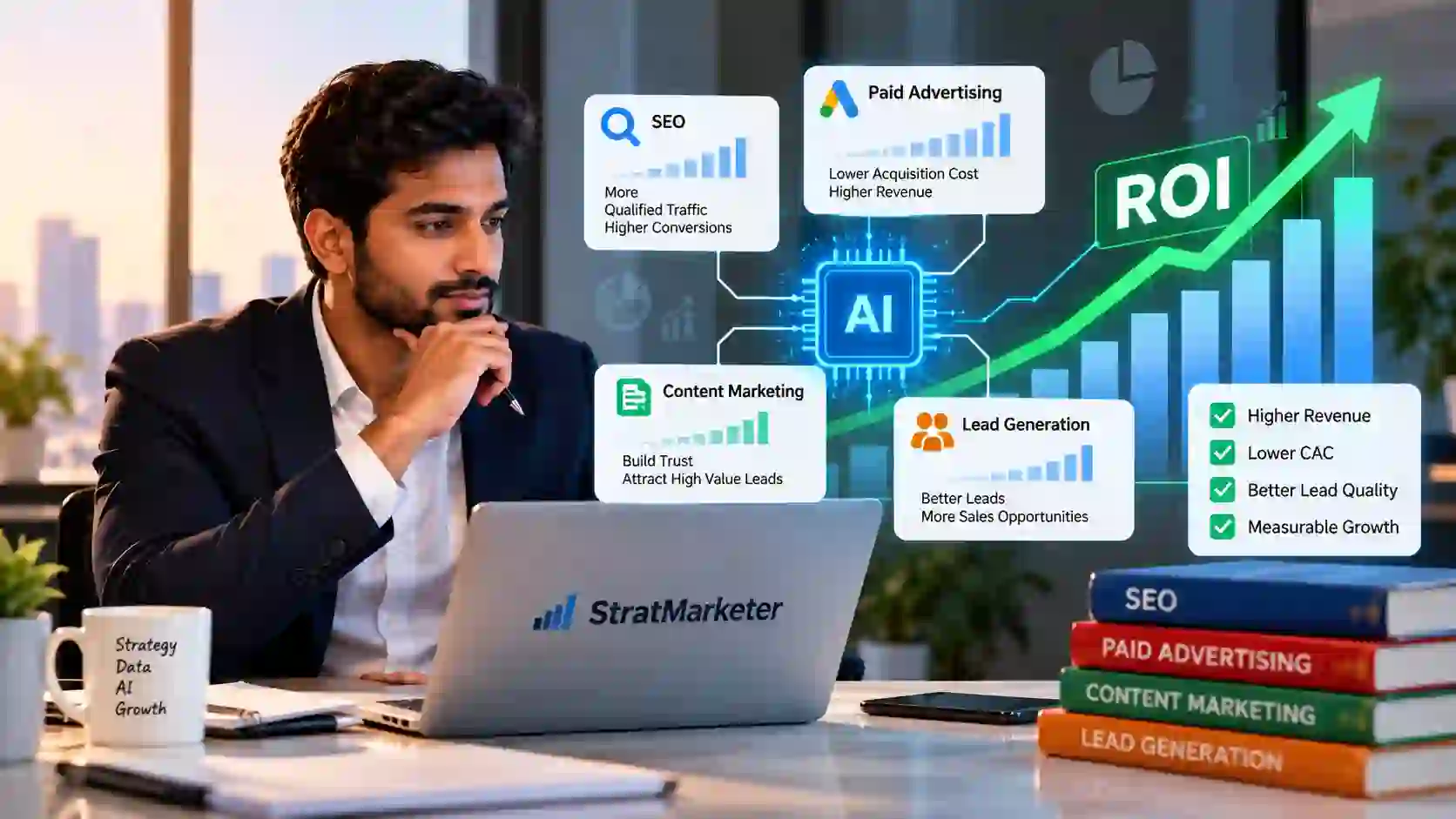
StratMarketer can apply this thinking across SEO, paid advertising, content marketing and lead generation, depending on the company’s needs. The focus should remain on connecting marketing activity with meaningful business outcomes rather than reporting impressive numbers without commercial context.
AI should support the team’s judgement, not replace it. Information from sales staff, customer service teams and business owners often explains results that campaign dashboards cannot fully interpret.
9. Choosing the Right AI ROI Focused Marketing Agency for Your Business Goals
Choosing an agency requires more than comparing service packages or asking which AI tools it uses. A business needs to understand how the agency will measure performance, what information it requires and how its recommendations will influence marketing expenditure.
Start by asking how the agency defines ROI. Will it report traffic, qualified leads, attributed revenue, customer acquisition costs or profit? How will it handle long sales cycles, repeat purchases and conversions that cannot be tracked directly?
An AI ROI focused marketing agency should explain these details before promising specific financial outcomes. Guaranteed returns offered without understanding the business’s pricing, margins and sales process deserve careful scrutiny.
The agency’s approach to data is equally important. Ask how it tracks conversions, identifies duplicate records and connects online enquiries with offline sales. If the business closes deals through phone calls, meetings or quotations, those outcomes should be included in the measurement process wherever practical.
Industry understanding matters too. A manufacturing company may need reporting around qualified enquiries, quotation values and sales pipeline progression. An ecommerce business may need to examine contribution margins, repeat purchases, cancellations and returns. The agency should understand these differences before setting targets.
Businesses should also ask how campaigns will be tested and reviewed. A responsible agency should explain what it plans to measure, how long a test needs to run and what evidence would justify continuing or changing the approach.
StratMarketer may be worth considering for businesses looking to connect AI supported marketing with SEO, paid advertising, content marketing and lead generation. The suitability of the engagement should depend on the business’s objectives, budget, existing systems and agreed reporting methods.
Before signing a contract, clarify agency fees, advertising expenditure, software charges, reporting frequency and account ownership. The company should retain appropriate access to its advertising accounts, analytics and marketing assets.
The most useful agency relationship is one where both sides understand what success means and can discuss disappointing results honestly. Marketing does not become predictable simply because AI is involved.
10. Frequently Asked Questions About AI ROI Focused Marketing Agency
What is an AI ROI focused marketing agency?
An AI ROI focused marketing agency uses artificial intelligence and marketing analytics to connect marketing expenditure with measurable commercial outcomes. These may include qualified enquiries, sales conversions, customer acquisition costs and profitability. The approach depends on the business model and the quality of available data.
How does AI help measure marketing ROI?
AI can analyse campaign performance, identify patterns in customer behaviour, assist with lead scoring and highlight changes in acquisition costs. It can also support reporting across different marketing channels. Reliable results still depend on accurate tracking and human review.
Is an AI ROI focused marketing agency suitable for small businesses in India?
Yes. Small businesses can start with basic conversion tracking, enquiry records and monthly sales reporting. Advanced AI systems are not always necessary. The first priority is understanding which marketing activities generate commercially useful customers.
How long does it take to measure marketing ROI?
Paid advertising can provide early performance indicators within days or weeks. SEO, content marketing and B2B campaigns may require longer evaluation periods. The appropriate timeframe depends on the sales cycle, conversion volume and type of marketing activity.
Can AI guarantee positive marketing ROI?
No. AI can support analysis and decision making, but it cannot guarantee customer demand, sales or profit. Pricing, competition, product quality and sales execution also influence results. Any financial target should be based on realistic assumptions and reviewed against actual performance.
What is the difference between ROAS and marketing ROI?
ROAS compares attributed advertising revenue with advertising expenditure. Marketing ROI compares the relevant financial return with the marketing investment. ROAS helps evaluate advertising efficiency, but it does not establish profitability unless the relevant costs are also considered.
How can StratMarketer help businesses measure marketing performance?
StratMarketer can assess marketing objectives, available tracking data and campaign performance to identify suitable measurements and areas for analysis. Depending on business requirements, the work may involve SEO, paid advertising, content marketing, lead generation and AI supported reporting.
What should a business prepare before hiring an AI marketing agency?
Prepare basic information about revenue, margins, marketing expenditure, customer acquisition and sales stages. Make relevant analytics and CRM records available where appropriate. If these details are not being tracked, establish a consistent recording process first.
Our Services
Contact Us
- Paonta Sahib, Himachal Pradesh, India
- +91-8700998508
- support@stratmarketer.com
Start From Here
These two options make it easy for you to get the information you want.