


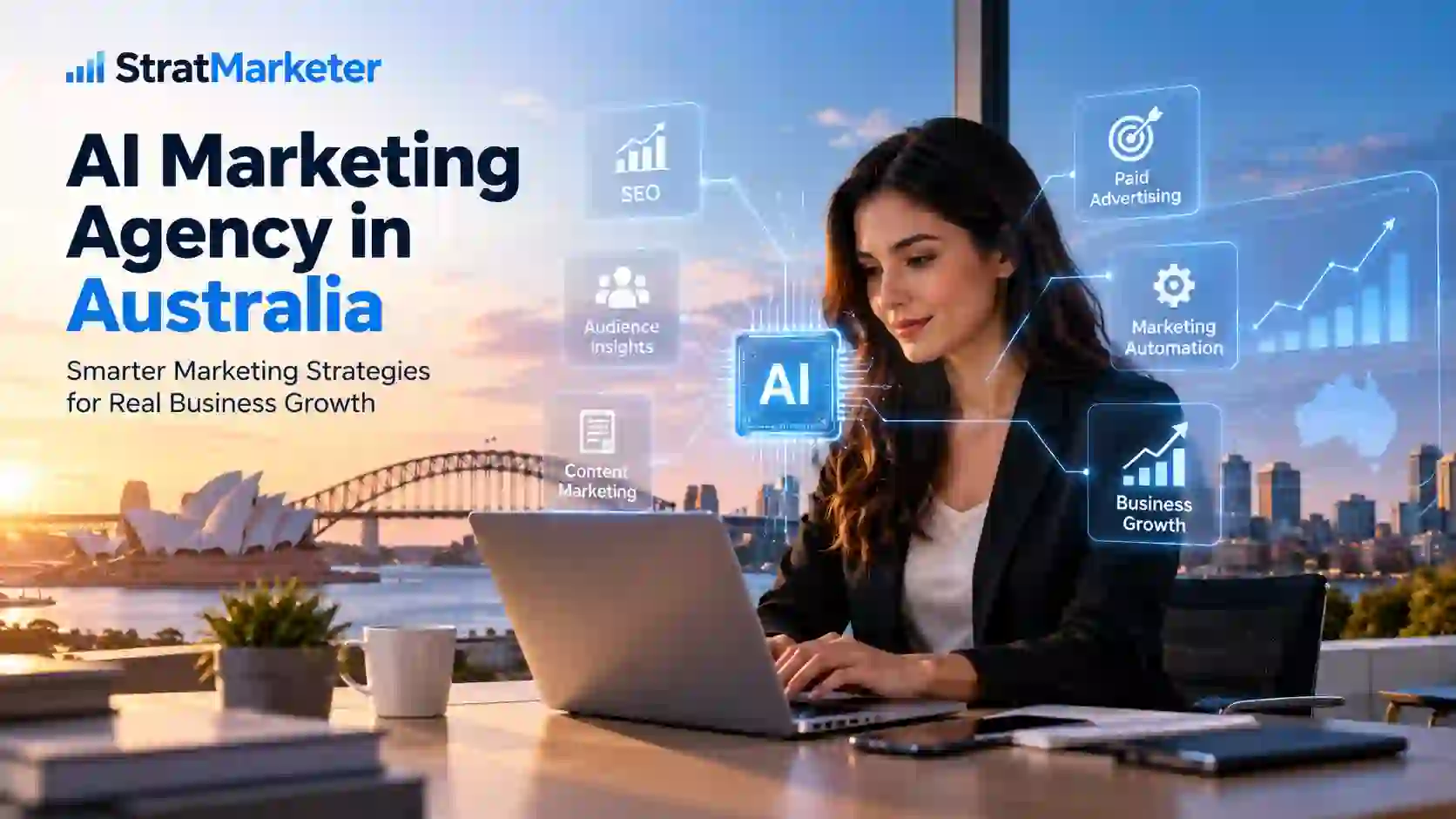
AI Marketing Agency in Australia | StratMarketer
1. Why Australian Businesses Are Rethinking Their Marketing With AI
Australian businesses are under pressure to make their marketing budgets work harder. Advertising costs can rise quickly, customer expectations keep changing, and competition across Google, social media and ecommerce platforms leaves little room for campaigns that produce clicks but fail to generate enquiries or sales. This is one reason more businesses are considering an AI marketing agency in Australia to rethink how they attract and retain customers.
AI is changing the way marketing teams analyse customer behaviour, create content, manage advertising and measure campaign performance. A business no longer has to rely entirely on manual reporting or wait until the end of a campaign to understand what might be going wrong. AI tools can help identify patterns earlier, although the quality of the result still depends on the information available and the decisions made by the marketing team.
Consider a Brisbane based home improvement company running Google Ads. The company may receive plenty of website visits but very few quote requests. Instead of increasing the advertising budget immediately, an AI supported marketing process can examine search terms, landing page behaviour, enquiry patterns and campaign performance to identify possible reasons for the gap. The team can then test changes rather than spending blindly.
That distinction matters. AI is not a replacement for sound marketing judgement. It is a way to examine more information and handle repetitive work without losing sight of the commercial objective.
Australian businesses also operate across different markets, from local service providers in Perth to retailers selling nationally through online stores. Their marketing requirements are rarely identical. An approach that works for a Melbourne fashion retailer may not suit a regional accounting firm with a small customer base and a longer sales cycle.
An experienced AI marketing agency in Australia should understand these differences before recommending automation. The first question should be what the business needs to achieve, not which AI tool it should purchase.
2. What an AI Marketing Agency in Australia Actually Does
The term AI marketing agency can mean several things. Some agencies use AI mainly to produce written content and advertising creatives. Others integrate AI into campaign analysis, customer segmentation, lead management, reporting and marketing automation. Businesses need to understand this distinction before choosing a partner.
An AI marketing agency in Australia should connect technology with everyday marketing decisions. The work may involve identifying high intent search queries, examining customer journeys, developing content for different audience segments, testing advertising variations and reducing the time spent preparing performance reports.
For example, an Australian B2B software company may receive enquiries from businesses of different sizes. A small company looking for an affordable subscription has different requirements from an enterprise buyer evaluating security, integrations and long term support. AI assisted segmentation can help the marketing team identify these differences and prepare more relevant messages for each group.
The agency still needs to check whether those segments make commercial sense. AI can group customers based on patterns in available data, but it cannot automatically determine which group is most valuable to the business without suitable revenue, conversion and customer information.
A capable agency may work across several connected activities.
- SEO and content marketing: Using research tools to identify relevant search topics, understand search intent and plan content that answers genuine customer questions.
- Paid advertising: Analysing campaign performance, identifying waste and testing different messages, audiences and landing pages.
- Marketing automation: Setting up suitable follow ups for enquiries, abandoned purchases or customers who need more information before making a decision.
- Customer analysis: Examining buying patterns, repeat purchases and engagement signals to support better marketing decisions.
- Reporting: Bringing information from advertising, analytics and customer relationship management systems into a clearer view of business performance.
These activities should not operate as separate experiments. If an advertising campaign attracts qualified leads but the sales team takes several days to contact them, generating more leads may not solve the actual problem.
This is where the agency’s understanding of the business becomes important.
At StratMarketer, the relevant approach is to connect AI supported marketing with the company’s objectives, audience and existing processes. Technology should support the work rather than become the entire reason for doing it.
Businesses evaluating an AI marketing agency in Australia should ask what will actually change in their marketing operations, which results will be measured and where human review remains necessary. Clear answers are more useful than a long list of AI platforms.
3. How AI Is Changing Customer Behaviour and Marketing Decisions in Australia
Customer behaviour is not changing simply because AI tools are available. People still compare prices, read reviews, ask friends for recommendations and look for evidence that a business can deliver what it promises. What is changing is how customers gather information and how quickly they expect businesses to respond.
A person searching for an emergency plumber in Adelaide may want a phone number, service availability and an indication of cost within minutes. Someone researching commercial solar installations for a warehouse may spend weeks comparing suppliers, financing options, warranties and expected savings.
Both customers use digital channels, but their decision making processes are very different.
An AI marketing agency in Australia needs to recognise these differences when planning campaigns. A local service business may benefit from accurate business listings, relevant local landing pages, clear service information and fast enquiry handling. A commercial supplier may need detailed case studies, technical articles, comparison pages and follow up communication that answers questions raised during the sales process.
AI can help marketers examine search queries, website interactions, customer support conversations and campaign results to understand where potential customers hesitate. This information can reveal whether people are looking for pricing, technical specifications, social proof or a simpler way to contact the business.
There is a practical limitation, though. A website visit does not always reveal what a person intends to do. Someone may read a product page for research, while another visitor may be ready to purchase. Treating both visitors as equally likely buyers can waste advertising money and create irrelevant follow ups.
Search behaviour is also becoming more varied. Customers may discover businesses through traditional search engines, social platforms, online communities and AI powered search experiences. Businesses therefore need useful information that answers real questions, rather than content created only to repeat keywords.
For an Australian accounting firm, this might mean explaining how its services work for different business structures, outlining common tax preparation requirements and clearly stating when professional advice is needed. For an ecommerce store, it could mean publishing detailed product specifications, delivery information, return conditions and honest answers to common customer concerns.
An AI marketing agency in Australia can use research and analysis tools to identify these information gaps. The important work is deciding which gaps matter most and correcting them with accurate content.
I would be cautious about any agency claiming that AI can predict every customer’s next move. It cannot. Customer intent is influenced by budget, timing, personal circumstances and factors that marketing data may never capture. AI can help identify patterns, but businesses still need to test assumptions against actual enquiries, purchases and feedback.
4. AI Marketing Applications Across Australian Industries
The value of AI marketing depends heavily on the industry, the customer journey and the quality of the available information. A national retailer with thousands of transactions has different opportunities from a small professional services firm that receives twenty enquiries a month.
An AI marketing agency in Australia should adjust its methods accordingly.
Ecommerce and retail
Online retailers can use AI supported analysis to examine product performance, customer segments, repeat purchases and advertising results. A clothing retailer selling across Australia, for instance, may find that different product categories attract different customer groups or that certain campaigns generate sales but produce too many returns.
That information can influence product descriptions, promotional messages and audience selection. However, the retailer should also consider stock availability, delivery costs and profit margins. A campaign that generates more orders is not necessarily a successful campaign if the products sell at very low margins.
Healthcare and allied health
Clinics may use marketing automation to manage appointment enquiries, explain services and provide general information about treatments. AI assisted content research can help identify questions patients commonly ask before booking.
Healthcare marketing requires particular care. Personal medical information should not be casually fed into general AI tools, and advertising claims must not promise outcomes that cannot be supported. Clinics should also consider Australian privacy requirements and applicable advertising rules, including restrictions relevant to regulated health services.
Here, human review is essential.
Real estate and property
Property businesses can use AI to analyse campaign engagement, organise enquiries and tailor property information to different buyer interests. A residential agency in Sydney may need different communication for first home buyers, investors and families looking to move into a larger property.
Yet automated messages should not make assumptions about a person’s finances, family situation or eligibility. Agents still need to verify information and speak with prospective buyers directly.
Education and training
Training providers can use AI to identify which course pages attract interest, organise enquiries and develop content around course requirements, eligibility and career outcomes. A vocational training provider, for example, may need separate information for school leavers, working professionals and employers arranging staff training.
The information must remain accurate, particularly when it concerns qualifications, accreditation, fees or employment prospects.
Manufacturing and B2B services
Industrial suppliers often have longer sales cycles. Prospective buyers may require technical specifications, compliance information, product comparisons and detailed discussions before requesting a quotation.
An AI marketing agency in Australia can help these businesses organise technical content, identify common buyer questions and examine which marketing channels generate qualified enquiries. However, technical claims should be checked by someone who understands the product.
These examples point to a simple distinction. AI can assist with research, communication and analysis in many industries, but the rules surrounding customer information, claims and purchasing decisions differ. The agency must understand the context before applying the technology.
5. Personalisation Without Making Customer Communication Feel Automated
Personalisation sounds straightforward until a customer receives an email that uses their first name but recommends something completely irrelevant. Many businesses have experienced this in one form or another. The message looks customised, yet it feels as though nobody has paid attention.
AI marketing can help businesses make communication more relevant, provided the information behind it is useful and the timing makes sense.
Take an Australian online furniture store. A customer who views office desks may be researching options for a home office. The store could provide a comparison of desk sizes, materials, delivery conditions and assembly requirements. If the customer has already purchased a desk, however, repeatedly sending the same product promotion is likely to irritate them.
The difference is not the technology. It is whether the business understands the customer’s position in the buying process.
An AI marketing agency in Australia can help develop communication based on meaningful signals, such as the type of product viewed, previous purchases, stated preferences or the stage of an enquiry. The agency should also establish rules for when messages should stop, when a person should take over and how customers can manage their communication preferences.
There are several practical ways to approach this.
- Use context rather than just names. A relevant answer to a customer’s question is usually more valuable than inserting their name into a generic email.
- Respect timing. Someone requesting a quotation may appreciate a prompt response, while a person reading an introductory article may not want a sales call immediately.
- Keep messages specific. A customer interested in commercial accounting services needs clear information about scope, fees and business requirements, not a vague promotional message.
- Review automated responses. AI generated communication can contain incorrect details, especially when product prices, availability, policies or service conditions change.
- Allow human intervention. Complaints, complex questions and sensitive situations should not be pushed through an automated sequence simply because the system can handle them.
Australian businesses should also consider privacy and consent when using customer information. The Privacy Act 1988 and the Australian Privacy Principles may apply depending on the organisation and the information being handled. Email and SMS marketing must also be assessed against applicable consent and unsubscribe requirements under Australian law.
Not every business needs advanced personalisation. A small engineering consultancy with a limited number of highly specific clients may get better results from a well written follow up email and a knowledgeable sales representative than from an elaborate automated workflow.
That may sound less exciting, but it is often the more sensible choice.
For StratMarketer, the useful question is not how many customer interactions can be automated. It is where automation makes communication more timely and relevant without removing the judgement that customers expect from a real business.
6. Common Mistakes Businesses Make When Adopting AI Marketing
The biggest mistake businesses make with AI marketing is starting with the technology instead of the problem. A business owner hears that AI can create content, analyse customers and manage advertising, so the first instinct is to purchase a few tools and begin automating tasks. A few weeks later, the team has more content than before, several new subscriptions and very little clarity about whether anything has improved.
An AI marketing agency in Australia should help businesses avoid this situation by identifying where time, money or customer enquiries are being lost before recommending a solution.
One common example is using AI to publish large volumes of website content without checking whether the articles answer useful questions. A business might publish dozens of pages covering similar topics, only to find that the content attracts little relevant traffic. The issue is not necessarily that AI wrote the articles. The issue is that the business prioritised publishing volume over original information, search intent and subject knowledge.
Google’s approach to AI generated content focuses on the quality and usefulness of the material rather than simply how it was produced. Businesses still need to provide accurate information, original insight and a clear reason for the page to exist.
Another mistake is trusting automated advertising recommendations without examining the underlying business numbers. A campaign may generate inexpensive leads, but those leads could be poorly qualified or unlikely to purchase. If the sales team spends hours contacting people who never intended to buy, the apparent saving in advertising costs can become an expensive distraction.
I have a particular concern about businesses judging AI marketing by the amount of work it produces. More emails, more posts and more reports do not automatically mean better marketing. The meaningful question is whether the work attracts suitable customers and helps them make a decision.
Data quality creates another problem. If a company’s customer records contain duplicate entries, outdated contact details or inconsistent sales stages, AI analysis may produce misleading conclusions. The system can process the information quickly, but speed does not correct bad inputs.
Australian businesses should also be careful with customer privacy. Uploading customer records, sales conversations or sensitive business documents into an AI platform without checking its data handling arrangements can create unnecessary risks. Access controls, data retention policies and appropriate consent should be considered before implementation.
There is also the temptation to automate every customer interaction. A property enquiry, a complaint about a delayed delivery and a routine request for opening hours do not require the same response. Businesses that force every conversation through the same automated workflow risk frustrating customers who need a direct answer.
A sensible AI marketing agency in Australia should identify these limitations early. It should explain what the tools can do, where they may fail and which tasks still require human review.
7. Balancing Automation, Creativity and Human Judgement in Marketing
Automation is useful for repetitive work. Creativity helps a business communicate something worth paying attention to. Human judgement determines whether the message is appropriate, accurate and worth sending.
These three functions overlap, but they are not interchangeable.
Consider an Australian travel company promoting regional holidays. AI can help analyse enquiry patterns, draft different versions of an advertisement and identify which destinations attract interest. Yet a marketer still needs to understand why a family might choose a quiet coastal town over a busy tourist destination, how seasonal conditions affect travel plans and what makes the experience genuinely appealing.
A technically polished advertisement can still feel empty if it has no real understanding of the customer.
The same applies to B2B marketing. A software company selling to Australian businesses may need to explain a complicated product in straightforward language. AI can produce several explanations quickly, but someone who understands the product must decide which version answers the buyer’s actual concern without exaggerating what the software can do.
I would generally prefer using AI to generate early ideas, organise research and handle repetitive analysis, while keeping final decisions about positioning, claims and sensitive communication with experienced people. That division is not a universal rule, though. Some routine campaigns can run with limited supervision once they have been tested properly, while other communications need close review every time.
The right balance depends on the potential cost of a mistake.
Where automation makes sense
Tasks with clear rules and predictable inputs are often good candidates for automation. These may include preparing recurring performance reports, grouping enquiries by service interest, identifying missing information in campaign records and scheduling approved communications.
For example, an agency managing several paid advertising campaigns can use automated reporting to flag a sudden fall in conversions or an increase in spending. A marketer can then investigate whether the cause is a tracking issue, a change in search demand, a landing page problem or something else.
The alert is useful. The diagnosis still needs evidence.
Where creativity matters most
Creative work is not limited to writing attractive headlines. It includes understanding the audience, choosing the right argument, deciding which customer problem deserves attention and finding a credible way to communicate the solution.
An AI marketing agency in Australia can use AI generated variations to test different messages, but the original idea should come from a genuine understanding of the market. Otherwise, the campaign may simply produce several versions of the same generic advertisement.
Where human judgement should remain
Human review is especially important when marketing involves legal or financial claims, healthcare information, customer complaints, confidential data or promises about product performance.
Australian businesses should also be cautious about allowing AI tools to make decisions based on incomplete customer profiles. A person’s browsing activity does not reveal their entire situation, and assumptions based on limited data can result in inappropriate messages.
There is a less obvious issue here. Teams can become so comfortable with automated recommendations that they stop questioning them. That worries me more than an occasional imperfect AI generated headline because it changes how people make decisions.
A good working process leaves room for disagreement. If the data suggests one direction but customer feedback points elsewhere, the team should investigate instead of automatically following the recommendation.
Marketing still requires judgement, even when the software appears confident.
8. How StratMarketer Approaches AI Marketing for Australian Businesses
For Australian businesses considering AI marketing, the first conversation should be about the existing marketing process, not a demonstration of software features. A company may already be spending money on SEO, paid advertising, social media and email marketing, yet still struggle to connect those activities with actual sales.
StratMarketer can approach this challenge by examining how the different parts of marketing work together and where AI supported processes may be useful.
The starting point is understanding the business itself. A Melbourne ecommerce retailer, a Brisbane professional services firm and a Perth industrial supplier have different audiences, purchasing cycles and commercial priorities. The marketing approach needs to reflect those differences rather than applying the same automation to every client.
Understanding the existing marketing problem
The initial assessment should look at the website, search performance, advertising activity, content quality, enquiry handling and available conversion data. The aim is to identify a specific problem that can be investigated.
If website traffic is increasing but enquiries remain low, the business may need to examine landing page relevance, pricing information, trust signals or the quality of the traffic. AI analysis may help identify patterns, but the team should not assume that the software has already identified the cause.
If enquiries are arriving but sales are not following, the investigation may need to include lead quality, response times and the sales process.
This distinction prevents businesses from spending money on the wrong solution.
Applying AI where it has a clear purpose
Once the problem is understood, StratMarketer can consider relevant AI supported activities across SEO, content marketing, advertising, customer segmentation and reporting.
For example, a business targeting customers across Sydney, Melbourne and Adelaide may need to understand whether the same service message works in each market. Search research and campaign analysis can help identify differences in demand, while human review ensures that local pages contain meaningful information rather than merely changing the city name.
Similarly, AI supported content research can help identify unanswered customer questions. The final content should use reliable information, relevant business knowledge and examples that readers can actually use.
The aim is not to automate every task. It is to select the tasks where the technology makes the work more useful or less time consuming.
Measuring what happens after implementation
A campaign should be judged against its original objective. For a lead generation business, useful measures may include qualified enquiries, cost per qualified lead, enquiry to sale conversion and revenue generated. For an ecommerce business, order value, repeat purchases, contribution margin and customer acquisition cost may be more relevant.
These measures need to be interpreted in context. A lower cost per lead is not necessarily positive if the leads are less likely to become customers.
StratMarketer should also distinguish between results that have been measured and outcomes that are merely expected. No responsible agency can promise a particular return simply because AI has been introduced.
Keeping the process accountable
AI supported marketing needs clear ownership. Someone should be responsible for checking important claims, reviewing customer communications, monitoring campaign changes and identifying problems when automated processes behave unexpectedly.
For Australian businesses, data handling should also be considered from the beginning. The appropriate safeguards will depend on the information involved, the platforms being used and the organisation’s legal obligations.
The practical objective is to make marketing decisions more informed without losing control over the process. Technology can assist with the work, but the business should still understand why a decision was made and how its results will be assessed.
9. Choosing the Right AI Marketing Agency in Australia for Your Business
Choosing an AI marketing agency in Australia is not simply about comparing service packages or asking which tools the agency uses. The more important question is whether the agency understands your business well enough to recommend the right work.
A local trades business and a national ecommerce company may both need AI supported marketing, but their priorities will be different. One may need more qualified enquiries and faster responses. The other may need better product discovery, stronger repeat purchase rates and more reliable advertising decisions.
Before signing a contract, ask the agency to explain how it would approach your specific situation.
Look for a clear explanation of the work. An agency should be able to describe which activities it recommends, why those activities matter and how progress will be measured. If the discussion revolves around AI tools without connecting them to your business objectives, ask for a more practical explanation.
Ask how results will be measured. Website traffic, impressions and social media engagement can be useful indicators, but they do not tell the whole story. A service business should understand how marketing contributes to qualified enquiries and sales. An online retailer should look beyond order volume and consider profitability.
Understand the role of human review. Ask who checks AI generated content, who approves changes to advertising campaigns and who handles customer complaints or incorrect automated responses. There should be a clear answer rather than an assumption that the software will manage everything.
Check the agency’s approach to privacy. If customer information will be used in AI tools, ask how that information is protected, which platforms process it and who can access it. Australian businesses should expect the agency to take applicable privacy obligations seriously. The Office of the Australian Information Commissioner provides useful advice on selecting and using commercial AI products.
Discuss what happens when the results are disappointing. No agency can guarantee that every campaign will work. What matters is whether the team can investigate weak performance, explain what it has learnt and make sensible changes rather than continuing with an ineffective approach.
I would also be wary of an agency promising immediate rankings, guaranteed sales or a fixed return from AI implementation. Marketing outcomes depend on competition, pricing, the offer itself, the website, customer demand and many other factors.
StratMarketer should be evaluated on the same basis as any other prospective partner. Businesses should understand the proposed scope, reporting arrangements, responsibilities, fees and expected milestones before committing.
A useful first project might be a focused review of one marketing problem rather than a complete overhaul of every channel. This allows the business to assess the quality of the work, the communication process and the value of the recommendations before expanding the engagement.
The right AI marketing agency in Australia is one that can explain not only what it intends to do, but also what it would change if the first approach does not work.
10. Frequently Asked Questions About AI Marketing Agency in Australia
What does an AI marketing agency in Australia do?
An AI marketing agency in Australia helps businesses use artificial intelligence in activities such as SEO, advertising, content research, customer segmentation, marketing automation and performance analysis. The exact services depend on the business’s needs. Some companies need help managing repetitive tasks, while others need better insights into customer behaviour or campaign performance.
Is AI marketing suitable for small Australian businesses?
Yes, although smaller businesses should begin with a specific need. A local electrician, accounting firm or independent retailer might benefit from faster enquiry handling, better reporting or more useful website content. There is little reason to purchase several expensive tools if a simpler process can solve the problem.
How much does an AI marketing agency in Australia charge?
Pricing varies according to the scope of work, the number of marketing channels involved, the technology required and the level of ongoing support. Some agencies charge a monthly retainer, while others quote for individual projects or implementation work. Ask for a clear breakdown of agency fees, software costs and any additional charges before agreeing to a package.
Can AI marketing replace a marketing team?
Not entirely. AI can assist with research, reporting, content preparation and repetitive processes, but people still need to set priorities, check important claims, understand customers and make commercial decisions. Some routine tasks can be automated extensively, but replacing the entire marketing function is rarely a sensible starting point.
How long does it take to see results from AI marketing?
There is no fixed timeline. A reporting automation project may save time soon after implementation, while SEO, customer acquisition and brand development usually require more sustained work. Results also depend on the condition of the website, the quality of existing data, competition and how quickly the business can act on the findings.
Is AI generated content good for SEO in Australia?
AI assisted content can perform well when it is accurate, useful, original and relevant to the reader. Simply publishing large numbers of AI generated pages does not guarantee rankings. Google advises website owners to prioritise helpful, reliable, people first content rather than using automation primarily to manipulate search rankings.
How can businesses protect customer information when using AI marketing tools?
Businesses should review the privacy and security practices of the platforms they use, restrict access to sensitive information, establish clear internal rules and verify how submitted data may be stored or processed. They should also consider their obligations under the Privacy Act 1988 and the Australian Privacy Principles where applicable. The OAIC recommends assessing the risks and suitability of AI products before using personal information with them.
Why consider StratMarketer for AI marketing?
StratMarketer can be considered by businesses looking to connect AI supported marketing with SEO, content, advertising, automation and performance measurement. Before selecting the agency, discuss your current marketing challenges, the proposed scope of work, reporting methods and how success will be measured. Those details will help establish whether the approach suits your business.
What should a business do before hiring an AI marketing agency in Australia?
Start by identifying one business problem that marketing needs to solve. It might be a shortage of qualified leads, high advertising costs, poor enquiry conversion or time consuming reporting. Review the available data, establish a baseline and ask prospective agencies how they would address the issue. A clear starting point makes it easier to judge whether the proposed work is useful.
Our Services
Contact Us
- Paonta Sahib, Himachal Pradesh, India
- +91-8700998508
- support@stratmarketer.com
Start From Here
These two options make it easy for you to get the information you want.