


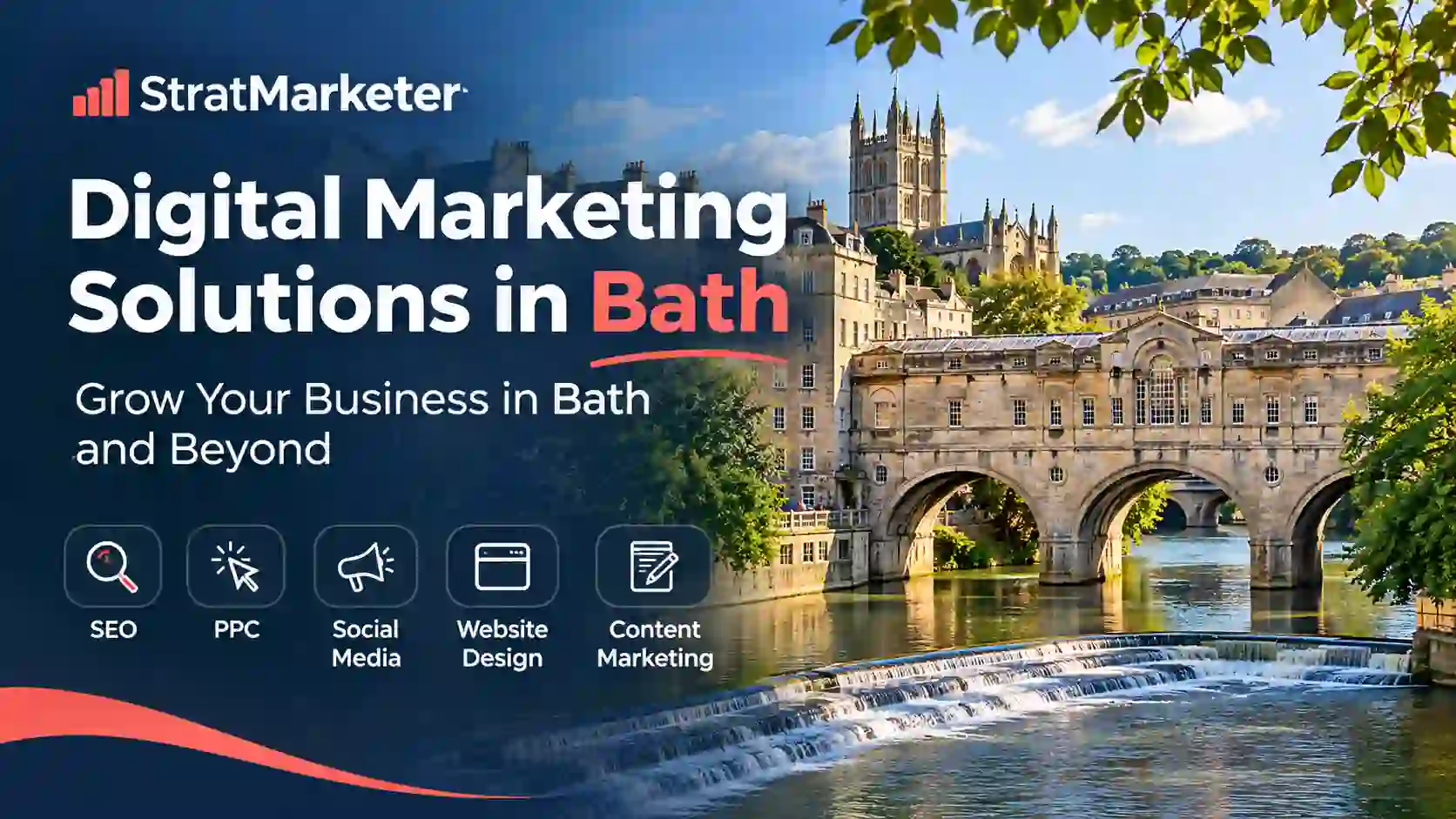
Digital Marketing Solutions in Bath | StratMarketer
1. Why Are Bath Businesses Rethinking Their Digital Marketing Approach?
Running a business in Bath comes with its own set of challenges. A customer might walk past a shop on Milsom Street, search for a nearby alternative on Google, check a few reviews and make a decision without ever visiting the first business’s website. The same thing happens with restaurants, professional services, independent retailers and local trades.
This is one reason businesses are paying closer attention to digital marketing solutions in Bath. Traditional recommendations and repeat customers still matter, but they are no longer the only ways people find local businesses. Online searches, social media, business listings and customer reviews now influence many purchasing decisions.
Bath has a distinctive commercial environment. Independent shops, hospitality businesses, tourism operators, property professionals and established service companies all compete for attention. Their marketing requirements are not identical. A boutique hotel needs to attract people planning a visit, while an accountancy firm may be more interested in generating enquiries from businesses across Somerset and surrounding areas.
Using the same marketing approach for both would be a mistake.
Another issue is that having a website does not automatically bring enquiries. Some businesses have attractive websites but receive very little relevant traffic. Others invest in paid advertising without understanding which campaigns actually generate customers. Money gets spent, reports look busy, but the commercial value remains unclear.
This is where a more considered approach to digital marketing becomes important. Businesses need to understand who they want to reach, which online channels those customers use and what information they need before making contact.
For some Bath businesses, local SEO may be the priority. For others, social media, paid advertising or website improvements may deserve more attention.
I would not recommend investing heavily in every marketing channel at once. It is usually better to identify the biggest gap first. A business that receives website visitors but struggles to convert them has a different problem from one that barely appears in relevant search results.
The starting point should be the business itself, not a list of marketing services.
2. Understanding the Digital Marketing Needs of Businesses in Bath
Before choosing digital marketing services, it is worth understanding what kind of business is operating in Bath and who it wants to attract. A marketing campaign that works for a local restaurant may have very little relevance to a construction company or a professional consultancy.
The local business landscape reflects this variety. According to UK Business Counts data for 2026, Bath and North East Somerset has 8,485 enterprises. Around 88.4% are micro businesses with fewer than ten employees. This means a large proportion of local businesses need marketing that is practical, manageable and commercially sensible rather than unnecessarily complicated.
Official Census and Labour Market Statistics
Consider a few examples.
An independent retail shop around Bath city centre may want more people to visit its premises. Its marketing could focus on local search visibility, Google Business Profile management, customer reviews and social media content showing products, offers and new arrivals.
A hotel or guesthouse has a different requirement. It may need to reach people researching accommodation before visiting Bath, particularly those comparing locations, facilities, room prices and availability. Search engine optimisation, useful website content and paid search campaigns could all play a part.
Professional service providers, including accountants, solicitors, consultants and financial advisers, generally need to build confidence before someone makes an enquiry. Their websites should explain their expertise, services, qualifications where relevant and the types of clients they support.
There are also businesses serving customers beyond Bath. A software company, manufacturer or specialist consultancy may operate from the area but sell across the UK. Restricting its digital marketing to local searches would unnecessarily limit its potential audience.
This distinction matters when selecting digital marketing solutions in Bath.
The right marketing plan should follow the customer’s buying behaviour, not the number of services an agency can offer.
There are a few questions worth answering before committing to a campaign:
- Is the business trying to attract local customers, UK-wide customers or both?
- Are potential customers searching for the service on Google?
- Does the website generate enquiries, bookings or sales?
- Are customers finding the business through referrals rather than online channels?
- Which marketing activities are already generating genuine business?
The answers help establish where the actual problem lies.
For instance, a business may already receive good website traffic but have a poor enquiry rate. Spending more money on SEO would not necessarily solve that issue. Its landing pages, contact process, pricing information or service descriptions may need attention first.
StratMarketer considers these differences important when assessing the digital marketing requirements of a business. The aim should be to connect marketing activity with a clear business requirement rather than simply increasing the number of campaigns being run.
3. How SEO Helps Bath Businesses Reach the Right Local Customers
When someone searches for a service in Bath, appearing in relevant search results can influence which business they consider first.
Think about searches such as a plumber in Bath, an accountant in Bath, a hotel near Bath city centre or a digital marketing agency in Bath. These searches indicate that someone may already have a particular requirement.
This is where search engine optimisation becomes useful.
SEO helps businesses make their websites easier for search engines to understand and helps relevant pages reach people searching for the products or services they provide. However, local SEO involves more than adding the name of Bath to every page.
Local keyword research should reflect what customers actually want to find.
For example, a property maintenance company may need separate pages for plumbing, electrical work and general maintenance if these are genuine services it provides. A single page listing every service may not answer specific customer questions particularly well.
Local SEO and Google Business Profile
A properly maintained Google Business Profile can help eligible local businesses appear in Google Search and Maps.
The information should be accurate and consistent. Business name, address, telephone number, opening hours, website and service details all need attention. Businesses should also select relevant categories and keep photographs updated.
Customer reviews deserve equal attention. A business with genuine, detailed customer feedback gives potential customers more information to consider before contacting it.
For example, someone looking for a local electrician may want to know whether the business handles domestic repairs, commercial installations or emergency call-outs. Clear service information and relevant reviews can help answer those questions.
Businesses should request honest reviews from actual customers rather than offering incentives for positive ratings or publishing fabricated testimonials.
Location-based keyword targeting
A Bath-based business may serve customers in areas such as Oldfield Park, Widcombe, Bathwick and Lansdown. These locations can be relevant to its SEO strategy when the business genuinely serves them.
However, creating dozens of nearly identical location pages is not a sensible approach.
A page targeting a particular area should contain useful information about the service, availability and relevant customer requirements. Simply changing Bath to Widcombe or Bathwick while keeping everything else identical offers very little to readers.
Technical SEO and website content
Search engines also need to crawl and understand website pages. Broken links, poor navigation, duplicate content and indexing problems can affect how effectively a website is discovered.
Content matters as well.
A Bath-based financial consultancy, for example, could publish useful explanations of its services, common financial planning questions and relevant business considerations. A hotel could provide practical information about room facilities, accessibility, parking and travelling to the property.
Google’s guidance places importance on original, helpful content that satisfies visitors rather than pages created primarily to attract search traffic.
Google for Developers+1
Measuring whether SEO is working
Rankings alone do not tell the complete story.
Businesses should monitor organic website traffic, relevant search queries, enquiries, telephone calls and conversions. Google Search Console can help identify search performance, while website analytics can provide further information about visitor behaviour.
A website ranking for hundreds of irrelevant searches may generate less commercial value than one attracting a smaller number of people who genuinely need its services.
That difference should guide the SEO strategy.
4. Website Design and User Experience: Turning Visitors into Enquiries
A business website often becomes the first proper interaction a potential customer has with a company.
Someone might find a Bath-based business through Google, open its website on a mobile phone and spend less than a minute deciding whether to continue. If the page is confusing, slow or missing important information, that visitor may simply return to the search results.
This is why website design needs to be considered alongside digital marketing.
An attractive website is useful, but appearance alone does not generate enquiries. Visitors need to understand what the business offers, whether it can meet their requirements and how to contact it.
What should a business website communicate?
The main service or product should be clear from the first screen. Visitors should not have to search through several pages to understand what the company actually does.
For a Bath-based home improvement company, the homepage could explain its main services, the areas it covers and the type of projects it accepts. A professional consultancy might place its expertise, service categories and enquiry details more prominently.
Contact information should be easy to find.
This sounds basic, but businesses sometimes place telephone numbers only in the footer or hide enquiry forms behind unnecessary navigation steps. These small decisions can create friction.
Mobile-friendly design matters
Many customers browse websites on mobile devices, particularly when searching for local services while travelling or comparing businesses.
A mobile-friendly website should have readable text, properly sized buttons, simple navigation and forms that are easy to complete on a smaller screen.
It should also avoid intrusive pop-ups that prevent visitors from accessing the information they came to see.
Website performance is another consideration. Large images, unnecessary scripts and poorly configured hosting can contribute to slow loading times. Technical improvements should be based on actual performance testing rather than assumptions.
Landing pages should match customer expectations
Suppose a Bath-based business runs an advertising campaign for commercial cleaning services.
If someone clicks the advertisement and lands on a general homepage containing information about every service the company provides, the visitor may struggle to find the relevant details.
A dedicated commercial cleaning page would make more sense. It could explain the services available, types of premises covered, operating arrangements and how to request a quotation.
The same principle applies to SEO landing pages.
Each important service should have a clear purpose and provide enough information for someone to understand what is being offered.
Building trust through website information
Customers often want reassurance before making contact, especially when the service involves a significant financial commitment.
A website can provide this through:
- Clear descriptions of services and deliverables.
- Genuine customer testimonials and reviews.
- Relevant qualifications and professional memberships.
- Real photographs of the business, team or completed work.
- Transparent contact details and business information.
- Privacy information and appropriate cookie controls.
For UK businesses collecting personal information through enquiry forms, privacy responsibilities should not be overlooked. Where non-essential cookies or advertising technologies are used, businesses must consider applicable consent requirements under UK privacy and electronic communications rules. The ICO provides guidance on online advertising and the use of tracking technologies.
ICO+1
StratMarketer approaches website design as part of the wider marketing process. The website should support the SEO, social media and advertising activities being carried out elsewhere. Otherwise, businesses may attract visitors without giving them a convincing reason to enquire.
5. Social Media Marketing for Building Local Brand Recognition in Bath
Social media can help Bath businesses stay connected with customers, show what they offer and give people a reason to remember their name.
But posting regularly is not the same as having a social media strategy.
A business can publish photographs every day and still struggle to attract enquiries. The problem is often the lack of a clear purpose behind its content.
A local restaurant, for example, could use Instagram to show seasonal menus, food preparation, customer experiences and special events. A property company may find LinkedIn more useful for sharing commercial property insights, project updates and professional information.
The platform should match the audience.
Choosing the right social media platforms
Different platforms serve different marketing purposes.
Facebook: Useful for local community communication, business updates, events, offers and customer interaction. It can also support paid campaigns aimed at relevant audiences.
Instagram: Particularly relevant for businesses with strong visual content, including restaurants, hotels, independent retailers, beauty businesses and interior design companies.
LinkedIn: Often more appropriate for B2B organisations, consultants, recruitment companies, financial professionals and businesses looking to establish professional relationships.
YouTube: Useful for demonstrations, educational videos, service explanations, customer stories and longer-form content that people may search for.
Bath businesses do not need to maintain an active presence on every platform. Managing two suitable platforms properly is often more practical than publishing inconsistent content across five.
What should Bath businesses publish?
Content should give people something useful or interesting to engage with.
For a local retailer, this might mean introducing new products, explaining how particular items are used or showing the people behind the business.
A hospitality business could share photographs of its premises, seasonal activities, menu changes and practical information for visitors planning a stay in Bath.
Professional service providers can take a different approach. They might answer common customer questions, explain changes affecting their industry or share short educational videos.
The objective is to make the business easier to understand and remember.
Paid social media advertising
Organic social media has limitations. A post does not automatically reach every follower, and building an audience can take time.
Paid campaigns can help businesses reach selected audiences based on available advertising options. For example, a Bath-based events company might promote an upcoming event to relevant people in the surrounding area.
However, audience selection should be considered carefully. Advertising to everyone within a large geographical radius may produce impressions without generating meaningful enquiries.
Campaigns should have a defined objective, suitable creative material and a clear destination for people who click.
Maintaining consistency and measuring performance
A social media account should reflect the actual business. Outdated contact information, unanswered messages and inconsistent branding can create doubts.
Businesses should monitor more than follower numbers. Useful measures include:
- Relevant engagement and enquiries.
- Website visits from social media.
- Video views and audience retention.
- Messages and booking requests.
- Leads and sales generated by paid campaigns.
StratMarketer treats social media marketing as one part of a broader digital marketing plan. SEO can help people find a business when they are actively searching, while social media can keep the business visible during the consideration stage.
The two channels can support each other, but they need different content and different measures of success.
6. PPC Advertising and Paid Campaigns for Faster Customer Acquisition
Search engine optimisation takes time. A business may publish useful pages, improve its website and work on local SEO for several months before seeing meaningful changes in organic search traffic. Paid advertising offers another route.
For Bath businesses that need enquiries within a shorter timeframe, Pay Per Click advertising can be worth considering.
PPC allows businesses to display advertisements on platforms such as Google Ads and pay when someone clicks an advertisement. The actual cost depends on competition, keyword selection, campaign settings and the industry being targeted.
But paying for clicks is not the same as acquiring customers.
A Bath-based plumbing company, for instance, might advertise for emergency plumbing services. Someone searching for an urgent repair is likely to have a different level of buying intent from someone researching plumbing costs for a future renovation. Treating both searches in exactly the same way can waste advertising money.
Google Ads for Reaching Customers With Buying Intent
Google Search campaigns can help businesses appear when people search for relevant services.
Consider a few examples:
- A solicitor could target searches related to conveyancing services in Bath.
- A restaurant could promote table bookings and special dining experiences.
- A commercial cleaning company could reach organisations looking for regular cleaning contracts.
- A property maintenance business could advertise specific repair and maintenance services.
The important part is keyword selection.
Broad keywords may generate a large number of clicks, but they do not always attract relevant visitors. More specific search terms can sometimes produce better enquiries, even when their overall search volume is lower.
Negative keywords also deserve attention. If a company offers paid professional services, it may want to exclude searches containing terms such as free, jobs or training, depending on its actual offering.
Landing Pages and Conversion Tracking
An advertisement should take visitors to a page that directly relates to what they searched for.
If someone clicks an advert for SEO services in Bath, sending them to a generic homepage with no clear information about SEO services creates unnecessary friction.
The landing page should explain the service, provide useful information and make the next step obvious. This might be a telephone call, enquiry form, consultation request or purchase.
Conversion tracking is equally important. Businesses should know which campaigns generate meaningful actions rather than judging performance purely by clicks and impressions.
For example, 500 website visits may look impressive, but if none produces a relevant enquiry, the campaign needs investigating.
Paid Social Media Campaigns
Google Ads is not the only option.
Facebook and Instagram advertising can help businesses introduce their products or services to selected audiences. This is particularly useful for visually appealing products, hospitality businesses, events and local offers.
A Bath hotel might promote a seasonal accommodation package, while an independent retailer could advertise a new product collection.
The approach is different from search advertising. Someone scrolling through Instagram may not be actively looking for the product at that moment. The advertisement needs to earn their attention before encouraging them to visit the website.
Managing Advertising Budgets Sensibly
Small businesses should avoid committing large advertising budgets before understanding campaign performance.
A sensible starting point is to identify the most commercially valuable service, establish a manageable budget and test relevant search terms or audiences.
Businesses should also account for the management fee, advertising expenditure and landing page development costs separately.
StratMarketer considers PPC advertising as part of a wider acquisition strategy. Paid campaigns can generate immediate visibility, while SEO and content marketing help build organic reach over time.
Neither channel should be judged in isolation. The real question is whether the combined marketing activity is generating enquiries that make commercial sense.
7. Content Marketing That Builds Trust and Supports Buying Decisions
Not every potential customer is ready to make an enquiry the first time they visit a website.
Someone considering a website redesign may spend days comparing agencies, looking at previous work and reading about different services. A business owner looking for an accountant may want to understand fees, qualifications and the type of businesses the firm works with before arranging a meeting.
Content marketing helps businesses answer these questions.
It involves creating and publishing useful information that helps potential customers understand a subject, assess their options and make better purchasing decisions. For businesses using digital marketing solutions in Bath, content can also support SEO, social media and email marketing.
The important thing is to publish content that serves a purpose.
Blog Articles That Answer Actual Customer Questions
A blog should not become a collection of articles written simply because a particular keyword has search volume.
A Bath-based property management company, for example, could publish articles about landlord responsibilities, property maintenance considerations and common questions about letting a property. These subjects are relevant to the services it provides and may attract people who are researching property management.
Similarly, a local financial consultancy could explain business finance options, cash flow considerations and common financial planning questions.
These articles give potential customers a better understanding of the subject before they contact the company.
There is another benefit. A useful article can continue attracting organic visitors long after its publication, provided the information remains relevant and the page is maintained.
Video Content and Visual Communication
Some subjects are easier to explain through video than through lengthy written content.
A Bath hotel could create short videos showing its rooms, facilities and surroundings. A home renovation company could demonstrate different stages of a project, provided it has permission to share the property owner’s images.
Professional service businesses can also use video to explain complicated topics in straightforward language.
Videos can be published on YouTube, embedded into website pages and shared through suitable social media platforms.
I would avoid producing videos simply to follow a trend. If a business has nothing useful to show or explain, publishing more videos will not automatically make its marketing more effective.
Content Marketing and Search Engine Optimisation
Content and SEO should work together.
Keyword research can help identify the questions people are asking, but the article still needs to provide a proper answer. Repeating a phrase such as digital marketing solutions in Bath throughout an article does not make the information more useful.
For example, an article targeting a local service could explain:
- What the service involves.
- Which businesses or customers may need it.
- What the process normally includes.
- What customers should consider before choosing a provider.
- Which questions are worth asking before making a decision.
This gives the page a clear purpose beyond attracting search traffic.
Email Marketing for Staying Connected With Customers
Email marketing is useful when a business has an existing audience and a legitimate reason to communicate with them.
A hotel might send updates about seasonal offers to subscribers. A retailer could share product announcements, while a B2B consultancy might publish occasional industry updates.
However, UK businesses need to pay attention to the rules governing electronic marketing. The Privacy and Electronic Communications Regulations and UK GDPR requirements may apply, depending on the recipient, the type of communication and the relationship with the business.
The ICO provides guidance on direct marketing, including requirements around consent and the use of personal information.
ICO
For StratMarketer, content marketing should not be treated as an isolated blogging activity. Articles, website pages, videos and social media content should support the same broader business objectives while addressing different customer questions.
8. Choosing the Right Digital Marketing Agency in Bath: What Should Businesses Consider?
Choosing a digital marketing agency is not always straightforward.
Many agencies offer similar services. Their websites may mention SEO, social media, PPC, website design and content marketing. The difference becomes clearer when you examine how they approach the actual work.
A business should not select an agency simply because it promises to deliver a large number of activities every month.
The quality and relevance of that work matter considerably more.
Understand the Agency’s Approach to Your Industry
Start by considering whether the agency understands your business model.
A company providing marketing services to independent retailers may need a different approach from a B2B consultancy selling professional services to organisations across the UK.
Ask how the agency would approach your target audience, what marketing channels it considers relevant and how it would assess your existing online presence.
You do not need an agency that claims to understand every industry perfectly. You need one that asks sensible questions and is prepared to research your market before recommending activities.
Examine Previous Work and Evidence
Ask to see examples of previous projects.
Where possible, look for evidence that explains the starting position, work undertaken and measurable outcomes. A ranking screenshot on its own does not establish that a campaign generated valuable business.
Useful evidence could include:
- Improvements in relevant organic search traffic.
- Growth in qualified enquiries.
- Better conversion rates.
- Paid advertising performance.
- Website improvements supported by analytics.
- Examples of content created for genuine customer requirements.
Be careful with impressive percentage claims that have no context. A 300% increase in traffic may sound significant, but it is difficult to assess without knowing the original traffic level and whether the additional visitors were relevant.
Ask How Performance Will Be Reported
A professional agency should be able to explain what it measures and why.
For SEO, reporting may include keyword visibility, organic traffic, indexed pages and conversions. PPC reporting should cover advertising expenditure, clicks, conversion actions and the quality of enquiries.
Google Ads provides conversion measurement for actions such as purchases, sign-ups and telephone calls. This can help businesses understand which campaigns are producing valuable customer activity.
Google Ads Help+1
Ask whether you will have access to your own advertising accounts, analytics properties and website.
This is important.
A business should understand what it owns, what the agency manages and what happens if the working relationship ends.
Be Careful With Guaranteed Rankings
No agency can honestly guarantee a particular organic Google ranking within a fixed timeframe.
Search rankings depend on many factors, including competition, website quality, relevance and changes in search systems.
An agency can establish a strategy, carry out technical and content work, monitor results and make adjustments. It cannot control Google’s ranking decisions.
I would be particularly cautious about agencies promising hundreds of backlinks, guaranteed first-page rankings or immediate organic growth without explaining how they intend to achieve it.
Understand Pricing and Deliverables
Before signing an agreement, ask for a clear explanation of what is included in the monthly fee.
For example, does the service cover technical SEO, content production, website updates, reporting and campaign management? Is advertising expenditure included or billed separately? Who is responsible for providing images, business information and approvals?
The cheapest proposal is not always the most economical option.
An inexpensive package that produces irrelevant content or low-quality links may create more work later. Equally, an expensive agency is not automatically better.
The decision should come down to the relevance of its work, the clarity of its process and whether the proposed investment makes sense for your business.
9. How StratMarketer Approaches Digital Marketing Solutions in Bath
A business looking for digital marketing support usually has a practical objective. It may want more local enquiries, stronger search visibility, better website performance or a more consistent flow of customers.
StratMarketer approaches these requirements by considering how different marketing activities contribute to the wider business objective.
Rather than assuming every company needs the same package, the starting point should be understanding its services, target customers, existing website and current marketing activity.
Understanding the Business Before Recommending Services
The first consideration is the business itself.
A Bath-based retailer, hospitality company and professional consultancy will have different audiences and customer journeys.
The marketing approach should account for these differences.
For example, a local service provider may need greater visibility for relevant location-based searches. A B2B company might benefit more from service-specific landing pages, informative articles and LinkedIn communication.
The decision depends on the business requirements.
Bringing Different Digital Marketing Activities Together
StratMarketer works across different areas of digital marketing, including SEO, social media marketing, PPC, website design, content marketing and online brand management.
These activities can support one another when planned properly.
Consider a business that wants to generate more enquiries through Google.
SEO can help relevant service pages appear in organic search results. PPC can provide paid visibility for selected search terms. Website design and landing page improvements can make it easier for visitors to understand the services and enquire.
Content marketing can answer questions that customers may have before contacting the business.
Social media can keep the company visible and provide another way for potential customers to interact with it.
The important part is making sure these activities have a shared purpose rather than operating as disconnected campaigns.
Focusing on Meaningful Performance Measures
StratMarketer’s digital marketing approach should be evaluated through measures relevant to the client’s objectives.
For a local business, these may include relevant enquiries, telephone calls, website visits from target locations and completed bookings.
For an ecommerce business, purchases, revenue and conversion rates may be more appropriate.
For a B2B company, qualified leads and consultation requests could be more useful than general website traffic.
There is little value in reporting large numbers without explaining what they mean for the business.
Keeping the Strategy Relevant as Requirements Change
Marketing requirements are not permanent.
A company may initially need local SEO but later decide to expand its services into other parts of the United Kingdom. Another business may find that its website generates traffic but does not convert enough visitors into enquiries.
These situations require different decisions.
StratMarketer’s role is to assess the marketing requirements, identify suitable activities and work towards the objectives agreed with the business.
For companies considering digital marketing solutions in Bath, the first conversation should be about their current challenges and commercial priorities, not an assumption that every available service needs to be purchased.
Our Services
Contact Us
- Paonta Sahib, Himachal Pradesh, India
- +91-8700998508
- support@stratmarketer.com
Start From Here
These two options make it easy for you to get the information you want.