


Digital Marketing Solutions in Cambridge | StratMarketer
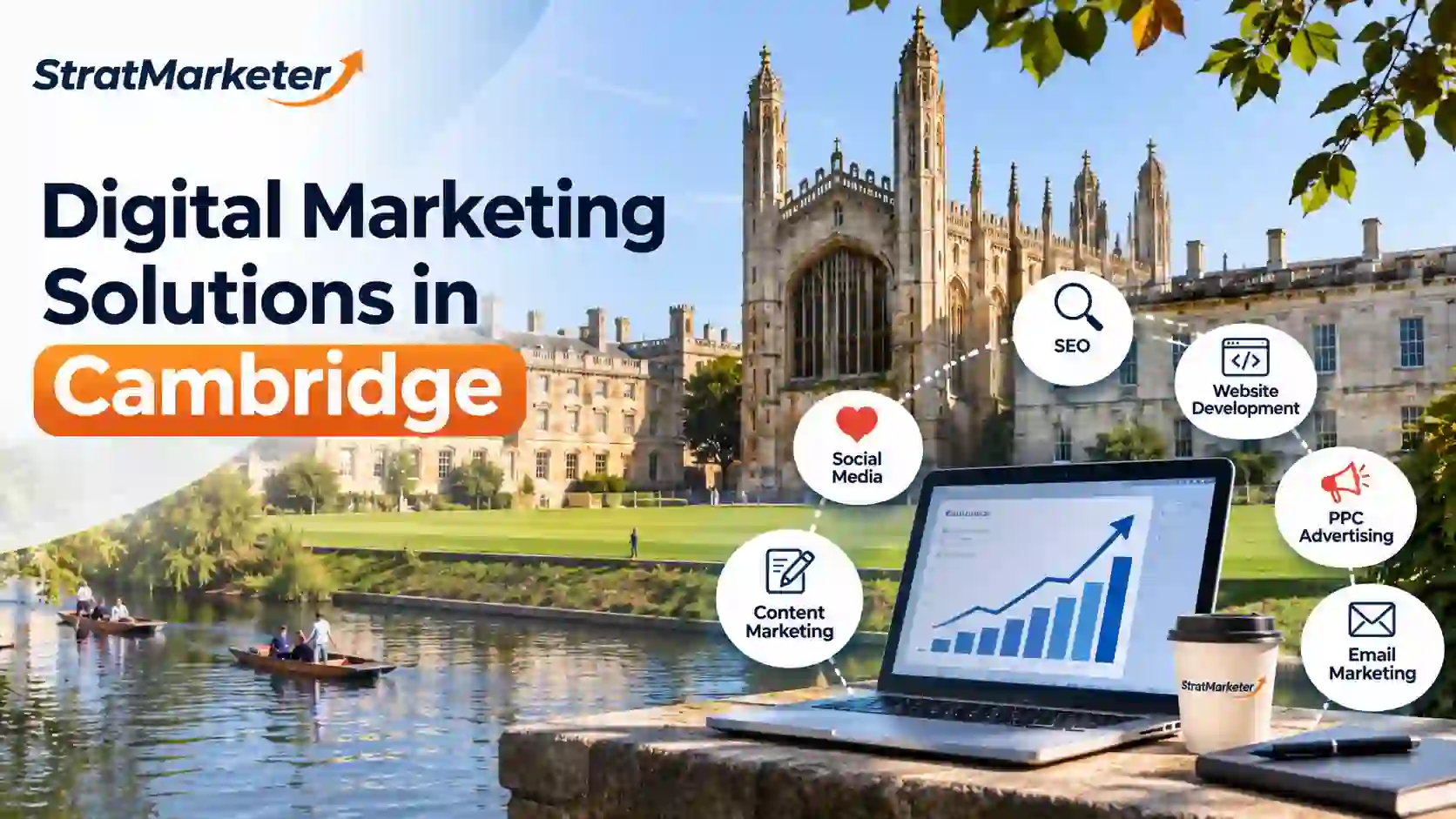
1. Understanding Digital Marketing Solutions in Cambridge and What Local Businesses Need
A business in Cambridge can have a good product, experienced staff and a reliable service, yet still struggle to attract a steady flow of enquiries. Often, the problem is not the quality of the business. Potential customers simply cannot find it when they search online, or they visit its website and leave without taking the next step.
This is where digital marketing solutions in Cambridge become important. Local businesses need more than occasional social media posts or a few paid advertisements. They need a sensible combination of search engine optimisation, website development, content marketing, social media management and paid advertising, depending on how their customers make purchasing decisions.
Cambridge has a varied business environment. Alongside independent shops, restaurants, property businesses and professional service providers, the city has technology companies, education-related organisations, healthcare providers and specialist B2B businesses. Their marketing requirements are not the same.
A restaurant may need to appear when someone searches for places to eat around the city centre. An accountancy firm might want enquiries from business owners looking for tax support. A technology company selling specialist software could spend months building relationships with a relatively small number of suitable prospects.
Treating all these businesses in the same way would be a mistake.
The first step is understanding what a business actually wants from its online presence. Is it looking for telephone enquiries, online bookings, product sales, consultation requests or greater recognition among a particular audience? The answer determines which marketing channels deserve attention.
For example, a Cambridge-based building company may benefit from local SEO, project photographs, customer reviews and dedicated service pages. A software business may need technical articles, LinkedIn marketing, search advertising and landing pages explaining its product.
There is also a difference between getting website visitors and attracting potential customers. A website receiving thousands of irrelevant visits is not necessarily doing a good job. Ten enquiries from people who genuinely need a service can be more valuable than hundreds of casual visitors.
Digital marketing should support the way a business earns money, not become a separate activity that looks busy every month.
Businesses should also consider how their customers move between different online channels. Someone might first see a company on social media, search for its name on Google a few days later, read its reviews and eventually visit its website. Marketing decisions need to account for this behaviour rather than judging every channel independently.
For Cambridge businesses, this means building a recognisable and trustworthy online presence. It also means understanding the local competition, the areas being served and the language customers actually use when searching for products or services.
2. How Local SEO Helps Cambridge Businesses Reach Customers Across the City
When someone searches for a service in Cambridge, they are often looking for a business they can contact without spending hours comparing options. Local SEO helps businesses appear in relevant searches and makes it easier for potential customers to find their location, services and contact details.
For companies serving Cambridge and its surrounding areas, local SEO should be an important part of their digital marketing solutions in Cambridge.
One of the first things to consider is the Google Business Profile. This listing can display a company’s address, telephone number, website, opening hours, photographs, customer reviews and other relevant details. For businesses that interact with customers at a physical location or travel to provide services, maintaining accurate information is particularly important.
An incomplete listing can create unnecessary problems. Imagine someone searching for an electrician in Cambridge, finding a business with an old telephone number and being unable to make contact. That person is likely to choose another provider.
It sounds like a small issue, but these details matter.
Local SEO also involves understanding the geographical areas a business genuinely serves. A company operating in Cambridge might receive enquiries from nearby locations such as Cherry Hinton, Chesterton, Trumpington, Histon and Girton. However, creating separate pages for every nearby place without providing meaningful local information rarely makes a useful website.
A better approach is to develop relevant service pages and explain the actual coverage area. If a business has completed projects in different parts of Cambridge, photographs and genuine project information can help visitors understand its experience.
Google reviews are another important part of local search marketing.
Customers often read reviews before contacting an unfamiliar company. Businesses should encourage genuine customers to share their experiences and respond professionally to feedback, including negative comments. A defensive response can sometimes create a worse impression than the original complaint.
Website optimisation matters too. A page targeting a service should explain what the business offers, who it serves, how the process works and how customers can make an enquiry. Simply inserting the phrase digital marketing solutions in Cambridge repeatedly will not make a page useful.
For example, a local digital marketing agency should explain its SEO services, advertising experience, website development capabilities and reporting process. Visitors need enough information to decide whether contacting the agency makes sense.
There is another detail that businesses sometimes overlook. Local search results can vary according to the searcher’s location, the relevance of the query and the prominence of a business. Ranking first for one search does not mean the company will hold the same position across Cambridge.
That is why local SEO needs regular attention. Business details, customer reviews, website content and local competition can all change over time.
I would also avoid promising a fixed Google ranking within a particular number of days. Search visibility depends on several factors, and no agency can honestly guarantee a particular organic position.
3. Website Design and Development That Supports Business Enquiries and Conversions
A company’s website often becomes the deciding point between a potential customer making contact and choosing another provider. Someone may find the business through Google, visit its website and spend only a short time deciding whether the company looks credible.
This makes website design an important part of digital marketing solutions in Cambridge.
A good website does not need complicated animations or an unusual layout. It needs to communicate clearly. Visitors should understand what the business does, which customers it serves and what they should do next.
Consider a Cambridge-based consultancy offering professional business services. If its homepage contains attractive photographs but does not explain its services, industry experience or consultation process, visitors may struggle to understand its value.
The same problem occurs with local tradespeople, healthcare providers and independent retailers.
The website structure should reflect the way customers search. A business offering several services should normally have separate pages explaining each major service rather than placing everything into one lengthy paragraph on the homepage.
These pages can answer practical questions, such as:
- What does the service include?
- Which types of customers can use it?
- What problem does it solve?
- How can someone request a quotation?
- What makes the business suitable for the work?
This information also gives search engines a clearer understanding of the website.
Mobile usability deserves particular attention. Many customers search for local businesses using their phones. If the telephone number is difficult to find, buttons are too small or the website takes too long to load, visitors may leave before making contact.
Website speed is not just a technical concern. It affects the experience of someone trying to find information quickly.
I generally prefer a straightforward design with clear navigation over a visually complicated website that takes too long to load. Businesses sometimes spend a considerable amount on design features that do very little for enquiries.
Conversion elements should also be placed sensibly. A visible contact button, enquiry form, telephone number and relevant customer testimonials can help visitors take action. However, asking for too much information in an enquiry form can discourage people from completing it.
A simple form requesting a name, email address, telephone number and a short description of the requirement may be sufficient for many service businesses.
For ecommerce websites, the priorities are slightly different. Product descriptions, photographs, delivery information, returns policies, payment options and checkout usability all influence purchasing decisions.
Website security and accessibility should not be treated as optional extras. Businesses collecting personal information need to consider their UK data protection obligations, including the UK GDPR and Data Protection Act 2018. Websites should also be designed with accessibility in mind, particularly when they provide essential information or services.
Another important point is that a website should not be considered finished immediately after launch. Customer behaviour, service offerings and business priorities change. Regular updates, technical maintenance and performance reviews help keep the website relevant.
A website that looks good but does not generate useful enquiries needs attention, regardless of how much was originally spent on it.
4. Social Media Marketing Strategies for Building Local Brand Awareness in Cambridge
Social media can help Cambridge businesses remain visible to customers who may not be actively searching for their services at that particular moment. It provides an opportunity to show what a business does, introduce its people, share useful information and maintain relationships with an existing audience.
However, opening accounts on every social media platform is rarely a sensible starting point.
A professional consultancy may find LinkedIn more useful than Instagram. A restaurant, independent retailer or beauty business may benefit more from Instagram and Facebook because photographs, short videos and customer interactions play a larger role in purchasing decisions.
The platform should follow the audience.
For a business targeting Cambridge customers, social media content should also have some connection with its actual activities. A local café could share seasonal menus, photographs of new dishes, customer updates and information about opening hours. A property business might publish property photographs, local market observations and practical information for buyers and landlords.
This is generally more useful than posting generic motivational quotes every morning.
People want to understand the business behind the account.
That is why employee introductions, project updates, demonstrations and genuine customer feedback can make social media communication more relatable. A Cambridge-based professional service provider could explain a common problem customers face and discuss how its team approaches it.
Video content deserves consideration as well. Short videos can demonstrate products, explain services and answer frequently asked questions. A local construction company, for instance, could share progress photographs and short site videos to show the stages involved in a project.
The content should remain accurate and appropriate. Businesses should obtain permission before publishing identifiable customer photographs, testimonials or other personal information.
Social media advertising offers another option. Facebook and Instagram advertising can help businesses reach selected audiences, while LinkedIn advertising may be relevant for companies targeting professional decision-makers. The choice depends on the service, audience and advertising budget.
For StratMarketer, social media marketing should form part of a wider digital marketing strategy rather than operate separately from SEO and website development. A social media post can introduce a service, while a website page provides the detailed information needed before someone makes an enquiry.
Consistency matters, but consistency does not mean publishing content simply to meet a daily target. A smaller number of useful posts can serve a business better than frequent updates that offer little information.
Businesses should also pay attention to actual responses. Are people asking questions? Are they visiting the website? Are they saving posts, sharing information or making enquiries?
Follower numbers alone do not tell the whole story.
There is a practical issue here too. Social media requires time. A business owner managing customers, employees and daily operations may not have enough time to plan content, create graphics, respond to comments and monitor advertising. Outsourcing this work can make sense, provided the agency understands the business and does not rely on generic content.
5. PPC Advertising and Google Ads for Reaching High-Intent Customers
Organic search marketing takes time. A business that wants to reach potential customers sooner may consider pay-per-click advertising as part of its digital marketing solutions in Cambridge.
Google Ads is one of the main options for businesses looking to reach people who are already searching for particular products or services.
For example, someone searching for an emergency plumbing service in Cambridge may have an immediate requirement. A relevant advertisement can place a plumbing company in front of that person while they are actively looking for help.
This is different from social media advertising, where a business may reach people who match its audience but are not necessarily looking to purchase at that moment.
The first consideration should be keyword selection. Businesses need to understand which searches are commercially relevant and which are likely to generate irrelevant clicks.
A company offering commercial accountancy services, for example, may want to target searches related to business accounting, tax compliance or financial reporting. Advertising against broad terms without considering the searcher’s intention can waste money.
Location targeting also needs careful attention. A Cambridge business serving customers within a defined area should configure its campaigns accordingly. There is little value in paying for clicks from people outside its service coverage unless the business genuinely accepts enquiries from those locations.
Budget management is equally important.
Google Ads operates through an auction system, and the cost of a click can vary depending on the keyword, competition, advertising quality and other factors. Businesses should not assume that a larger advertising budget automatically produces better results.
The landing page is another major consideration. Sending every visitor to the homepage is not always appropriate. Someone searching for SEO services should ideally arrive on a page explaining SEO services, rather than having to navigate through several unrelated sections.
A well-designed landing page should match the advertisement, answer the customer’s immediate questions and provide a clear way to enquire.
Campaign performance should be measured through meaningful actions. These may include telephone calls, completed enquiry forms, purchases or consultation bookings. Clicks and impressions provide useful information, but they do not necessarily indicate business success.
There is also a need to review search terms regularly. Sometimes advertisements appear for searches that have little connection with the service being offered. Adding suitable negative keywords can help reduce this unwanted traffic.
I would be cautious about increasing advertising budgets before understanding the quality of incoming enquiries. A campaign generating 50 enquiries is not automatically better than one generating 15. If most of those 50 enquiries are irrelevant, the business may simply be spending more money to create additional work.
For Cambridge businesses, a sensible PPC campaign starts with a clear commercial objective, carefully selected keywords, relevant location settings and a landing page that supports the customer’s next step.
Paid advertising can generate enquiries relatively quickly, but it does not remove the need for a good website, clear communication and a service that customers actually want.
For businesses working with an agency, reporting should be transparent. They should know how much is being spent, which campaigns are generating enquiries and where the advertising budget is going.
Google explains that local search visibility depends on relevance, distance and prominence, while its advertising auction considers factors such as bids, ad quality, landing page experience and the searcher’s context.
This is why paid advertising needs regular management rather than simply setting a budget and leaving campaigns untouched.
6. Content Marketing and SEO Strategies That Attract Relevant Website Traffic
A website needs useful content if it is going to attract people who are genuinely interested in a business. Publishing articles regularly can help, but the subject of those articles matters far more than the number of posts going live each month.
For businesses investing in digital marketing solutions in Cambridge, content marketing and SEO should work together. SEO helps search engines understand the website, while content gives visitors information that helps them make decisions.
Think about a Cambridge-based financial consultancy. Its potential customers may search for information about business funding, financial forecasting, investment requirements or preparing documents for lenders. If the consultancy only publishes general company updates, it misses an opportunity to answer questions that potential clients are already asking.
A better content strategy starts with the services a business actually provides and the problems its customers want to solve.
This could include service pages, detailed blog articles, frequently asked questions, industry explanations and practical business resources. Each piece should have a clear purpose.
Keyword research is useful here, although it should not become the entire content strategy. A business should understand the difference between someone searching for general information and someone looking for a service provider.
For instance, a person searching for “what is local SEO” may be researching the subject. Someone searching for “local SEO services Cambridge” is more likely to be comparing agencies. Both searches can be relevant, but they require different pages and different messaging.
Search intent is often more important than search volume.
Cambridge businesses should also consider their specialist knowledge. Technology companies can explain technical subjects in accessible language. Professional service firms can discuss common customer problems. Retailers can publish useful product information and comparisons.
This kind of content gives visitors a reason to spend time on the website.
There is no need to publish an article about every possible keyword. I would rather see a business publish a smaller number of genuinely useful articles than fill its blog with pages that repeat the same information in slightly different wording.
Technical SEO needs attention alongside content. Search engines should be able to crawl important pages, understand their structure and access relevant information. Page titles, headings, internal links, image descriptions, mobile usability and website performance all contribute to the overall experience.
Internal linking is particularly useful when handled naturally. A blog article discussing website performance could link to the company’s website development service. A page about search engine optimisation could direct visitors towards a related consultation service.
It helps people move through the website without having to search for everything themselves.
Local relevance also deserves consideration. A Cambridge business can discuss genuine local projects, service coverage and industry activity where these details are relevant. However, adding the city name repeatedly to otherwise generic articles does not create meaningful local authority.
Another issue is content freshness. Older pages sometimes contain outdated service information, broken links or references to discontinued products. Reviewing these pages can be just as useful as publishing new ones.
StratMarketer can approach content marketing as an ongoing activity involving research, content creation, on-page SEO and performance reviews. The purpose should be to attract relevant visitors and help them understand why a business may be the right choice.
7. Email Marketing, Lead Generation and Customer Retention for Cambridge Businesses
Getting someone to visit a website is only one part of the marketing process. Many visitors are not ready to purchase immediately. They may need a quotation, want to compare providers or simply require more time before making a decision.
Email marketing gives businesses a way to maintain communication with people who have agreed to receive their messages.
For companies exploring digital marketing solutions in Cambridge, this can be particularly useful when the buying process involves several conversations.
Consider a Cambridge-based B2B consultancy. A potential customer may initially request information, attend a meeting and then take a few weeks to decide whether to proceed. Sending relevant updates, useful resources or an occasional business email can keep the relationship active.
The same principle applies to retailers, training providers and professional service businesses, although the content and frequency will differ.
The important thing is to give recipients a genuine reason to open an email.
A newsletter containing nothing but promotional offers may quickly lose its appeal. Businesses can instead share company updates, practical advice, new services, relevant articles, event information and useful reminders.
Lead generation should also be connected to the website. A visitor might complete an enquiry form, request a quotation, book a consultation or subscribe to receive a particular resource.
These actions represent different levels of interest.
A person requesting a quotation is not in the same position as someone who has subscribed to a newsletter. Businesses should avoid treating every contact as an immediate sales opportunity.
Segmentation can help. Customers can be grouped according to their interests, previous purchases, enquiry type or stage in the buying process. This allows businesses to send more relevant communication instead of sending identical emails to everyone.
For example, a Cambridge training company could communicate differently with someone interested in corporate training and someone looking for individual professional courses.
Automation can also save time. A business might send an acknowledgement after an enquiry, provide additional information after a consultation request or send a follow-up message after a purchase.
However, automation should not make communication feel impersonal. If someone asks a specific question, a generic automated response is rarely enough.
Email marketing also comes with legal responsibilities in the UK.
Businesses must consider the Privacy and Electronic Communications Regulations, commonly known as PECR, alongside applicable UK data protection requirements. Electronic marketing messages generally require consent or must meet the conditions of the relevant existing customer soft opt-in exception. Marketing emails must also provide a valid way to opt out.
The rules can differ depending on whether the recipient is an individual subscriber or a corporate subscriber. Businesses should check the ICO’s guidance before starting campaigns rather than assuming that having an email address gives permission to send marketing messages.
Customer retention deserves equal attention. Existing customers may already understand the business, its services and the quality of its work. Maintaining a good relationship can lead to repeat purchases, renewals and genuine recommendations.
I would not measure email marketing success through open rates alone. Enquiries, meaningful responses, bookings, purchases and unsubscribes provide a more useful picture of how people are responding.
The best email campaigns are often quite simple. They arrive at an appropriate time, contain information the recipient actually wants and make the next step clear.
8. How StratMarketer Approaches Digital Marketing Solutions in Cambridge
For a business looking for digital marketing support, the important question is not how many services an agency lists on its website. It is how those services fit together and whether they address the actual requirements of the business.
At StratMarketer, the focus is on providing digital marketing solutions in Cambridge through a combination of organic search, paid promotion, website development, content and audience engagement.
The starting point should be understanding the business.
A local service provider looking for more enquiries may need a different strategy from an ecommerce company trying to increase online orders. Similarly, a B2B organisation may require a longer content and lead generation process because its customers take more time to make purchasing decisions.
There should not be one fixed marketing approach for all three.
SEO and local search optimisation
StratMarketer offers SEO and local SEO services to help businesses build their presence in relevant search results. This can involve keyword research, website optimisation, service page development, local business listings and content planning.
For a Cambridge business, the objective is to attract people searching for relevant services and make it easier for them to understand what the company offers.
Google Business Profile management can also form part of the work where local search visibility is important.
Website design and development
A website should explain the business clearly and support enquiries. StratMarketer’s website design and development services can address website structure, page content, navigation, mobile usability and conversion elements.
The intention is to give visitors a clear route from discovering a service to contacting the business.
Content and social media marketing
Content marketing helps businesses answer customer questions and communicate their expertise. StratMarketer can support this through blog content, service pages, content planning and SEO-focused writing.
Social media marketing and management provide another way to communicate with potential customers and maintain regular contact with an existing audience.
The content should reflect the business rather than relying on the same posts and designs across every industry.
PPC and performance marketing
Businesses looking for paid traffic can consider Google Ads and other advertising channels. Campaign planning should take account of commercial objectives, audience requirements, location targeting and available budgets.
Performance marketing also requires proper measurement. Enquiries and conversions should receive more attention than figures that look impressive but do not contribute to business objectives.
Lead generation and wider digital support
Some businesses need more than search optimisation and social media management. StratMarketer’s wider service offering includes email marketing, WhatsApp marketing, online reputation management, graphic design, video marketing, influencer marketing and personal branding.
AI-related services, including AI integration, AI agents, AEO and GEO, can also be considered where they have a clear business purpose.
Not every company needs every service.
A sensible starting point is to identify the main business requirement, select the channels that can address it and review their performance over time. As the business develops, other services may become relevant.
For companies considering digital marketing solutions in Cambridge, StratMarketer aims to bring these activities into a connected marketing approach rather than treating each service as an unrelated monthly task.
The priorities should remain practical. Better enquiries, a clearer online presence and useful communication with potential customers matter more than simply having a long list of marketing activities.
- Frequently Asked Questions About Digital Marketing Solutions in Cambridge
- What do digital marketing solutions in Cambridge include?
Digital marketing solutions in Cambridge can include search engine optimisation, local SEO, website design, social media marketing, Google Ads, content marketing, email marketing and lead generation. The services selected depend on the business, its customers and its marketing objectives.
- How much do digital marketing services cost in Cambridge?
The cost depends on the services required, competition, advertising budgets and the amount of work involved. Basic SEO support will generally require a different budget from a campaign involving SEO, website development, content creation and paid advertising. Businesses should request a quotation based on their actual requirements.
- How long does SEO take to produce results for a Cambridge business?
SEO does not produce guaranteed results within a fixed period. Some improvements, such as correcting technical errors or updating existing pages, may show benefits sooner. Building organic visibility for competitive search terms generally takes longer and requires consistent work.
- Is local SEO important for small businesses in Cambridge?
Yes. Local SEO helps businesses reach people searching for relevant products and services in their service areas. An accurate Google Business Profile, useful website content, genuine customer reviews and consistent business information can all contribute to local search visibility.
- Should Cambridge businesses invest in Google Ads or SEO?
Both can serve different purposes. Google Ads can help businesses reach people actively searching for their services, while SEO focuses on building organic search visibility over time. The right choice depends on the available budget, business objectives and how quickly enquiries are needed.
- Can digital marketing help B2B companies in Cambridge?
Yes. B2B companies can use SEO, LinkedIn marketing, industry-specific content, email marketing and paid advertising to reach relevant decision-makers. Since B2B purchasing decisions often involve several people and longer evaluation periods, building trust through useful information is particularly important.
- How can StratMarketer help businesses in Cambridge?
StratMarketer offers digital marketing services covering SEO, local SEO, website design, PPC, social media marketing, content marketing, email marketing and lead generation. Businesses can consider the services that match their current requirements and marketing priorities.
- Is social media marketing necessary for every business?
Not necessarily. Some businesses receive more value from search marketing, professional networking or direct customer relationships. The choice of social media platform and publishing frequency should depend on where the intended audience spends time and how customers make purchasing decisions.
- Can a business manage digital marketing without hiring an agency?
Yes. Businesses with suitable knowledge, time and resources can manage their own websites, social media accounts, SEO activities and advertising campaigns. An agency may be useful when specialist knowledge or additional support is required.
- How should a business measure digital marketing performance?
Businesses should look at relevant enquiries, qualified leads, telephone calls, online purchases, conversion rates and customer acquisition costs. Website traffic, impressions and social media engagement can provide additional context, but they should not be treated as the only measures of success.
Our Services
Contact Us
- Paonta Sahib, Himachal Pradesh, India
- +91-8700998508
- support@stratmarketer.com
Start From Here
These two options make it easy for you to get the information you want.