


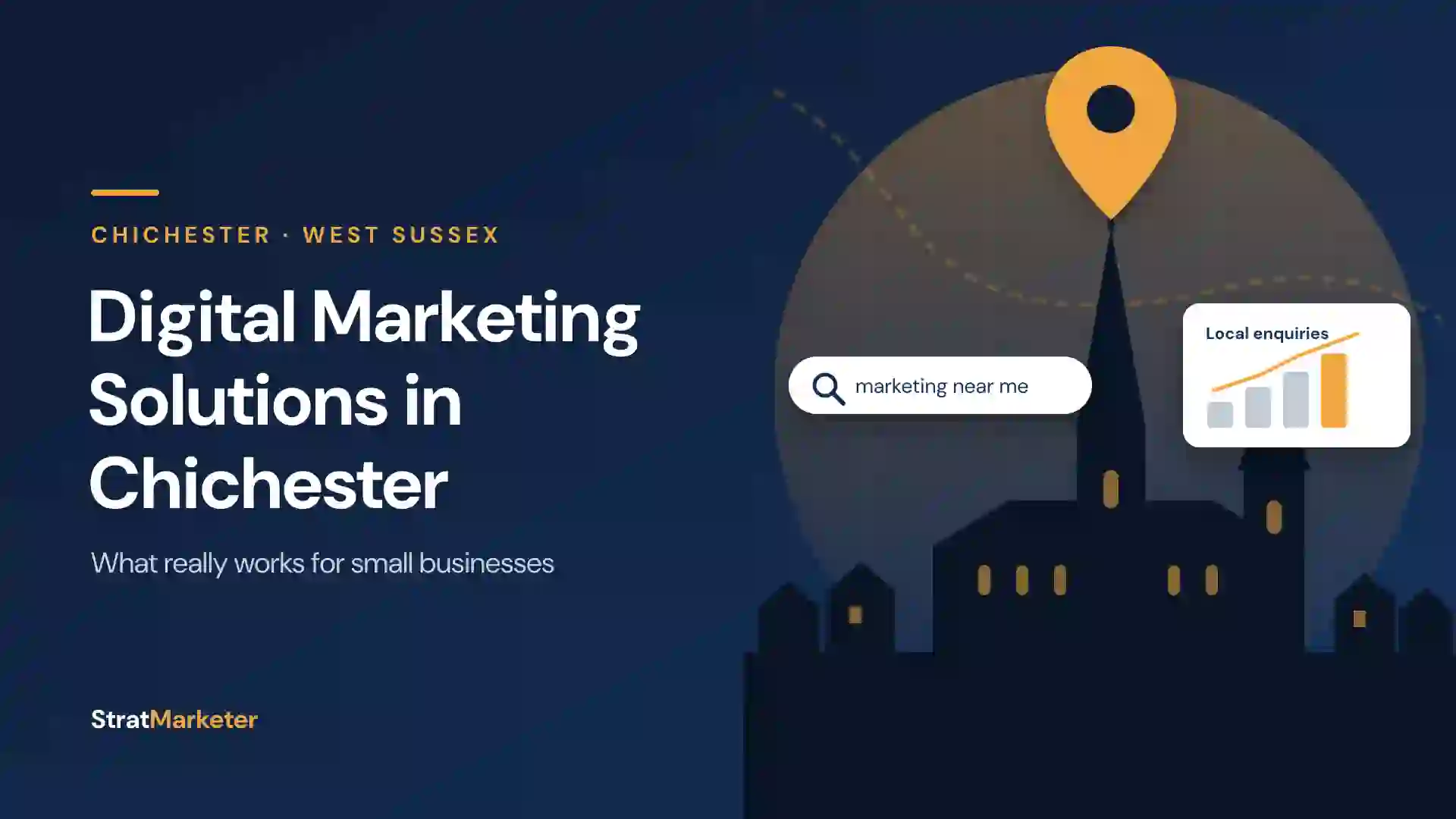
Digital Marketing Solutions in Chichester
Why Digital Marketing Solutions in Chichester Need a Different Approach from London or Brighton
Chichester is small. That sounds obvious, but it changes almost everything about how marketing should work here.
The whole district had around 124,100 people at the 2021 Census, and the ONS figures show the district is the least densely populated of the South East’s 64 local authority areas. That’s the city plus Midhurst, Petworth, the Manhood Peninsula and a lot of villages strung across the South Downs and the coast. Brighton fits more people than that into a much smaller patch.
So the playbook a Brighton agency uses, which is high volume, broad targeting and lots of content aimed at a young, dense, online audience, doesn’t transfer neatly. The district is also older than average. The district’s population in 2024 was estimated at 128,934, with a median age of 48 years. A plumber in Selsey or an independent jeweller near the Cross needs a different mix from a coffee chain in the North Laine.
My view, and plenty of people in the industry would push back on it, is that the best digital marketing solutions in Chichester tend to be smaller and duller than what gets pitched. Fewer channels, done properly. There’s rarely a need for TikTok strategy decks.
A lot of trade here still comes from word of mouth, and the online side mostly confirms what someone was already told at the school gate or in the pub. That’s not a weakness. You just have to market with that in mind.
Who’s Actually Searching? Locals, Visitors and the Goodwood Weekend Spike
There are really two Chichesters, and they search differently.
The first is residents. They search for “boiler service near me”, “dentist accepting NHS patients Chichester” or “best Sunday roast Bosham”. They want proximity, reviews and opening hours, and they make their minds up fast.
The second is visitors. Tourism matters a great deal here. The district’s destination management plan put the visitor economy at £411 million in day and overnight visitor value and 14% of all employment, and that report is a few years old now, so treat the figure as a rough guide rather than gospel. Visitors come for the cathedral, the Festival Theatre, the harbour and West Wittering beach on any half-decent day in August.
Then there’s Goodwood. The Festival of Speed has historically drawn crowds of about 150,000 spectators each year, with the Revival in September and the horse racing in late summer adding to it. Over those weekends, searches for hotels, taxis, restaurants and even “where to buy a flat cap” swing hard towards people who don’t know the area at all.
Here’s a mistake I see a lot. Businesses spend the whole year talking to locals, then those weeks arrive and their Google listing still has old opening hours. Or they have no photos. Or there’s nothing to suggest they’re open late during the Festival. The searchers are there, and the business just isn’t visible to them.
I’ll admit I’m unsure how much a small shop should chase event traffic. For a pub on the A286 it’s huge. For an accountant in Chichester it’s basically noise. That’s why it’s worth working out which Chichester your customers come from before spending anything.
Local SEO and Your Google Business Profile: Where Chichester Businesses Quietly Lose Out
If I could make every small business owner here do one thing, it would be this: open your Google Business Profile and look at it the way a stranger would.
For a local business, that profile often matters more than the website. It’s what appears in the map results when someone searches from their phone on South Street. It shows reviews, photos, hours, a call button and directions. Many people never click through to the website at all.
What usually goes wrong is fairly mundane:
- The category is too vague, for example “shop” instead of “bridal shop”.
- The business name, address and phone number don’t match across Google, Facebook, Yell and the website.
- Reviews go unanswered, especially the bad ones, which sit there for months.
- The service area is set to “Chichester” when half the work comes from Emsworth, Bognor Regis or Midhurst.
- The last photo upload was before the pandemic.
None of this is clever, and that’s partly why it gets ignored. It’s not exciting enough to feel like marketing.
Reviews deserve a mention of their own. In a small place, people read them properly, and they notice a business that replies politely to a one-star rant. Some owners find this genuinely uncomfortable, and I understand why. It’s personal when you run the place yourself. But silence reads worse.
It’s also worth knowing that Google’s local rankings lean heavily on proximity. If you’re out at Fishbourne or Tangmere, you won’t always appear for searches made in the city centre, however good your profile is. That’s frustrating. You can’t fully engineer your way around it, and anyone who promises “number one on Google for Chichester” is guessing. The parking at Northgate is a different frustration altogether, but that’s another article.
The Website Looks Fine, So Why Aren’t the Enquiries Coming In?
I said above that your Google profile can matter more than your website. That’s true, up to a point. It breaks down the moment someone is about to spend real money.
Nobody books a £4,000 kitchen fitter, a wedding venue at Goodwood or a private physio from a map pin alone. They click through, and they judge the website in seconds.
“Looks fine” is the trap. Lots of sites around here look perfectly pleasant on a desktop monitor in the office. On a phone, standing outside Waitrose, the phone number isn’t tappable, the contact form asks for nine fields, and the menu button jumps about as the page loads. That’s usually where the enquiry gets lost, without anyone ever knowing it was there.
A few things are worth checking yourself before paying anyone:
- Open the site on your own phone, on 4G, not the office Wi-Fi.
- Try to contact yourself through it and see how many taps it takes.
- Check whether the site actually says where you are. “Serving Chichester, Bognor and the Witterings” in plain words helps people, and it helps search engines too.
- Check whether you can update the site yourself, or whether you’re stuck emailing a developer who takes a fortnight to reply.
That last point annoys me more than it should. Some businesses are locked into website contracts where they don’t own their domain or can’t get at their content. They only find out when they try to leave.
Speed matters, design matters, but honestly the most common problem is simpler. The site never makes clear what to do next, so people don’t do anything.
Social Media, Google Ads, or Neither? Making Sense of Paid and Organic for a Small City
This is where budgets disappear.
Social media works brilliantly for some Chichester businesses and barely at all for others. A café, a florist, a boutique on East Street or anything with a strong visual side can build a following locally, especially on Instagram and in Facebook community groups, which are still oddly powerful round here. A commercial cleaning firm or a solicitor will probably find that time better spent elsewhere. I know that’s not a popular thing to say.
Google Ads is different, because people are actively searching. Someone typing “emergency electrician Chichester” wants one now. For trades, clinics and services, paid search can be the most direct route to an enquiry, provided the targeting is sensible.
And it often isn’t. One setting catches people out constantly. Google’s location options can show ads to people who are merely “interested in” an area, not just those physically in it. In a tourist city, that can mean paying for clicks from people in Leeds idly browsing a holiday. Restricting ads to people located in or regularly in your area is usually the safer default for a local service, though not always.
Meta ads, meaning Facebook and Instagram, can work well for events, offers and new openings. They’re much weaker for anything that needs immediate intent.
So should you do social, paid, or neither?
I might be wrong here, but for most small businesses in the district I’d sort out the Google profile and the website before spending a penny on ads. Paying to send people to a weak page just makes the problem more expensive. Then again, I’ve seen a brand-new business with no reviews and no history where a small, tightly targeted ad budget was the only way to get noticed at all, so maybe the order isn’t as fixed as I’m making it sound.
It depends who you are, and that probably sounds like a dodge.
What Do Digital Marketing Solutions in Chichester Actually Cost?
Everyone asks this first, and most agencies avoid answering it. I’ll try.
National pricing research puts ongoing local SEO for a service business such as a plumber, dentist or salon at £300 – £800 a month. Comparison sites say small businesses typically spend £500-£1,500/mo on one or two channels. Paid ads cost extra. Management fees for Google Ads are commonly quoted at 10–30% of spend, on top of what you pay Google itself.
Those figures come mostly from agencies and pricing sites, so read them with some suspicion. They’re national averages too. Rates in West Sussex tend to sit below London’s, though I couldn’t find reliable local data to prove that, so treat it as an impression.
What does £500 a month really buy? Usually a handful of hours. That’s enough to keep a Google profile healthy, fix the obvious website problems and write some useful local content. It won’t cover a full social media operation, an ad campaign and SEO all at once. Anyone offering all three for that price is either cutting corners or using automation and calling it strategy.
Then there’s the one-off option, which nobody pushes because it doesn’t pay agencies as well. You pay for an audit and a set-up, then run things yourself. For a lot of small businesses here, that’s honestly the better deal.
UK GDPR, PECR and Cookie Banners: The Rules You Can’t Ignore
This is the dry part. It still matters, partly because the rules changed this year and plenty of websites haven’t caught up.
Three things apply to almost every business doing marketing online.
The ICO fee. If you handle customer data, you probably need to register. It’s £52 or £78 for most organisations, including charities and small and medium-sized businesses. Lots of sole traders don’t realise this applies to them. The ICO has a short online checker to see whether you’re exempt.
Cookies. The Data (Use and Access) Act 2025 changed the cookie rules under PECR. Those changes came into force on 5 February 2026. Some basic analytics can now run without consent, but the exemption is narrower than people assume. It does not extend to engaging third-party analytics providers that link the data they receive with other information they hold, or where they use the data they receive for their own purposes. In practice, the Meta pixel and most advertising tags still need consent. A banner that loads everything before anyone clicks “accept” was a problem before this year and still is.
Email marketing. PECR still covers this. A customer who bought from you and wasn’t given a chance to opt out isn’t automatically fair game for a newsletter. The “soft opt-in” exists, but it has conditions. Buying a list of local business emails and blasting them is the classic mistake, and it’s riskier than people expect.
I’m not a solicitor. If you handle anything sensitive, such as health information at a clinic, get proper advice. The ICO’s guidance for small organisations is surprisingly readable, which isn’t something I say often about regulators.
Choosing a Marketing Partner: Questions Worth Asking Before You Sign Anything
A few questions tell you a lot, quickly.
Who will actually do the work? The person in the sales meeting is often not the person running your account.
How long is the contract, and what happens if you leave? Twelve-month lock-ins for a small business are a red flag to me. Some agencies argue SEO needs time, and that’s partly fair. But time is an argument for results, not for a contract you can’t get out of.
Do you own everything? That means the domain, the website, the Google Ads account and the Google Business Profile. If the agency sets these up in its own name, leaving becomes painful. That happens more than it should, and it genuinely irritates me, because the owner usually only finds out when something has already gone wrong.
What will the monthly report show? If the answer is “impressions” and “reach”, ask how many calls, bookings or enquiries came in. Those are the only numbers you care about. The rest is decoration, mostly.
Do they need to be local? Not necessarily. Knowing that Chichester goes quiet in January and mad during Goodwood helps, but a good remote team can learn that. I used to think being local mattered a lot. Now I’m less sure.
Where StratMarketer Fits In, and Where We Might Not
StratMarketer works with businesses that want marketing tied to enquiries and sales, not vanity numbers. Our starting point is nearly always the unglamorous stuff covered above: the Google profile, the website’s contact journey, and tracking that tells you where enquiries come from. After that we decide whether paid ads or social media are worth adding at all.
We’re probably not the right fit if you want viral content, a big brand campaign or someone to post on TikTok every day. Nor are we right if your budget is very small and your main need is for someone to teach you to do it yourself, although we’ll happily point you in the right direction.
The best digital marketing solutions in Chichester are often the ones that admit what they won’t do. That goes for us too.
Questions People Usually Ask Before Getting Started
How long before SEO works?
Usually months, not weeks. Google profile fixes can show results faster. If someone promises page one in 30 days, walk away.
Can I just do it myself?
Yes, a lot of it. The Google profile, replying to reviews and basic website updates are all manageable. What you’re really paying an agency for is time and experience, not secret knowledge.
Is social media enough on its own?
For some cafés and shops, nearly. For most service businesses, no.
Do I need a big ad budget?
No. A small, well-targeted Google Ads budget can work for trades and clinics. A big, badly targeted one just loses money faster. I’ve seen both, and the second is more common than you’d hope.
Should I wait until the website’s perfect?
Honestly, it never will be. Fix what stops people contacting you, then get on with it.
What if I’ve been burnt before?
That’s fair, and more common than agencies admit. Start with something small and measurable, with a short notice period, and judge on enquiries.
Our Services
Contact Us
- Paonta Sahib, Himachal Pradesh, India
- +91-8700998508
- support@stratmarketer.com
Start From Here
These two options make it easy for you to get the information you want.