



What the New AI Performance Reports Mean for Website Owners
For many website owners, one of the biggest frustrations since the launch of AI Overviews has been the lack of visibility. Pages were appearing inside Google’s AI generated answers, but there was no dedicated way to measure that performance. Search Console continued to show overall impressions and clicks, yet it was almost impossible to understand how much of that visibility actually came from AI powered search experiences.
That changes with Google’s latest update.
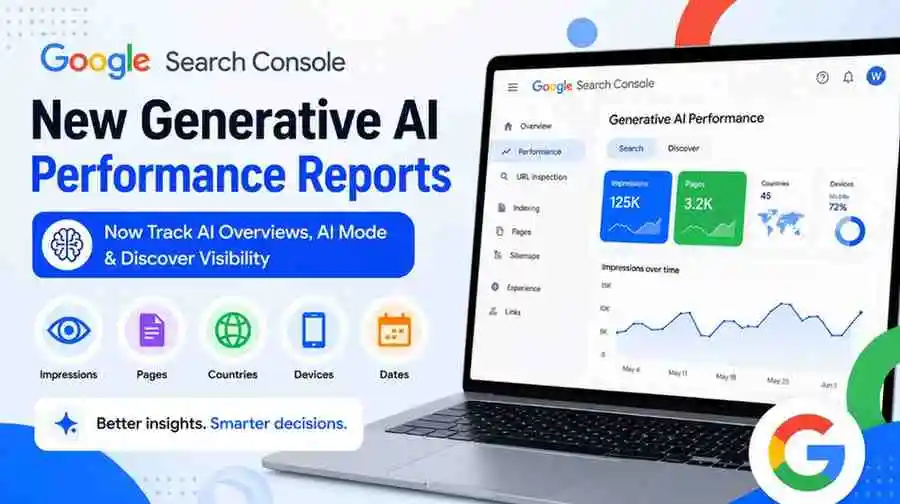
The new Generative AI Performance Reports give website owners a separate view of how their content performs inside AI features. Instead of relying only on traditional Search Console data, publishers can now identify where their pages appear in AI Overviews, AI Mode, and generative AI experiences within Discover. This makes reporting far more meaningful because AI search behaves differently from standard search results.
For businesses that invest heavily in content marketing, this information can influence future content decisions. If certain pages consistently receive impressions within AI generated responses, it suggests Google considers them useful enough to cite while answering user questions. That insight alone can help marketers understand what type of content Google prefers for AI experiences.
The reports also make it easier to measure the impact of newer optimisation approaches such as Generative Engine Optimization, Answer Engine Optimization, and Search Experience Optimization. Instead of assuming these strategies are working, website owners now have another source of data that can support their analysis.
Google has also confirmed that this data will continue to be included within the overall Performance report. The dedicated report simply provides a cleaner way to analyse AI related visibility without mixing it with traditional search metrics.
How AI Overviews and AI Mode Are Now Tracked in Search Console
Google’s new reporting focuses specifically on visibility inside its generative AI search features.
Whenever a page from your website appears as part of an AI Overview or contributes to an answer generated within AI Mode, that visibility can now be reflected in the new Search Console reports. Similar reporting is also available for generative AI features inside Google Discover, giving publishers another way to understand how their content reaches users across Google’s ecosystem.
This does not create a separate ranking system. Instead, it provides additional reporting for content that appears within AI generated experiences. The data helps answer questions that many SEO professionals have been asking for months.
Is my website appearing inside AI Overviews?
Are my pages being surfaced in AI Mode?
Which content is Google selecting when generating AI responses?
Until now, there was no direct way to answer these questions using Search Console. The new reports begin filling that gap.
Google has also clarified that these reports are currently rolling out to only a subset of websites. This gradual release allows the company to gather feedback, validate the data, and improve reporting before making the feature available to all Search Console users.
Understanding Impressions, Pages, Countries, Devices, and Date Filters
The new Generative AI Performance Reports include several familiar metrics, but each one now focuses specifically on Google’s AI powered search experiences.
Impressions show how often URLs from your website appeared within generative AI features across Search and Discover. Even if users do not click your page, impressions provide valuable insight into how frequently Google chooses your content for AI generated answers.
The Pages report identifies the exact URLs that appeared inside AI features. This makes it much easier to recognise which articles, landing pages, or product pages Google considers valuable enough to include in AI generated responses.
The Countries filter allows website owners to understand AI visibility across different regions. Businesses targeting multiple markets can compare where their content performs best and identify opportunities for localisation.
For Search results, the Devices report shows whether users encountered your content on desktop, mobile, or other supported devices. Since user behaviour often varies by device, this information can support both SEO and user experience decisions.
Finally, the Date filter allows performance analysis over hourly, daily, weekly, and monthly periods. This helps publishers monitor changes after publishing new content, updating existing pages, or responding to Google’s algorithm and AI search updates.
Together, these reports provide far more context than simply tracking rankings. They help website owners understand how Google’s generative AI systems surface content, which pages receive AI visibility, and how that visibility changes over time.
Why Google Created Dedicated Reports for Generative AI Search Visibility
Search behaviour has changed quite a bit over the last year. Earlier, users would type a query, scan through the blue links, and choose a website to visit. Today, many searches begin with an AI generated answer that summarises information from multiple sources before a user even scrolls further down the page. As these experiences become more common, website owners naturally want to know whether their content is being included.
That is one of the biggest reasons Google introduced dedicated Generative AI Performance Reports.
The company already included AI related data within the main Performance report, but analysing it separately was difficult. A website might receive thousands of impressions from traditional search results while only a small percentage came from AI Overviews or AI Mode. Without separating those numbers, publishers had no practical way to evaluate their visibility inside Google’s generative search experiences.
Dedicated reporting solves this problem by creating a focused view of AI related performance. Website owners can now analyse AI visibility independently while still comparing it with their overall search performance.
Another reason is transparency. As Google continues integrating AI into Search, publishers have repeatedly asked for more reporting rather than assumptions. These reports show Google’s intention to provide better measurement tools so website owners can understand how AI features contribute to their overall search presence.
It also reflects how SEO is changing. Rankings remain important, but appearing inside AI generated answers is becoming another form of visibility that businesses cannot ignore.
How the New Reports Can Help Improve Your SEO and Content Strategy
Data is only useful when it helps you make better decisions. The new AI Performance Reports are valuable because they allow website owners to identify patterns that were previously hidden inside overall Search Console data.
Suppose you publish ten articles on related topics. If only three of those pages regularly appear in AI Overviews, that is worth investigating. You can compare the structure, depth, topical coverage, supporting evidence, and user intent of those successful pages against the others. Over time, these comparisons can influence how future content is planned and written.
The reports may also help identify topics where Google consistently trusts your website. If your technical guides frequently appear in AI generated responses but your commercial pages do not, that difference provides useful direction for your content strategy.
Content updates become easier to evaluate as well. After improving an existing article, you can monitor whether its AI visibility changes over the following weeks. While many ranking factors remain outside your control, having measurable data makes optimisation less dependent on guesswork.
For agencies and in house SEO teams, these reports also introduce a new performance metric that can be included alongside impressions, clicks, rankings, and conversions. AI visibility is gradually becoming another indicator of content quality and topical authority.
What Website Owners Can Learn from AI Overviews and Discover Performance
The reports are not simply about counting impressions. They reveal how Google’s AI systems interact with your content across different experiences.
For example, the Pages report shows which URLs are selected most often. This helps identify the articles or landing pages that Google’s AI considers useful enough to reference while generating responses.
Country level reporting provides another perspective. A website may perform well inside AI features in one market while receiving very little visibility elsewhere. Businesses serving multiple regions can use this information when planning localisation, multilingual content, or region specific optimisation.
Search and Discover should also be analysed separately. Search visibility usually reflects user queries with clear intent, while Discover often surfaces content based on interests, browsing behaviour, and relevance. If a page performs well in both environments, it may indicate broader content quality rather than simple keyword relevance.
Website owners should avoid making decisions based on a few days of data. AI search is still evolving, and performance may fluctuate as Google’s systems continue improving. Looking at longer trends generally provides a more reliable picture than reacting to short term changes.
Current Limitations and Gradual Rollout of the New Search Console Reports
Although the announcement is significant, it is important to understand what Google has not promised.
The reports are currently available only to a limited number of websites. Google has confirmed that this phased rollout allows the company to test reporting accuracy, collect feedback from publishers, and improve the feature before releasing it more widely.
This means many Search Console users will not see the reports immediately. That does not indicate a problem with their websites or Search Console accounts. It simply means their properties have not yet been included in the rollout.
The reports also focus primarily on visibility rather than explaining why a page appeared inside an AI generated answer. They do not reveal every ranking signal, citation factor, or AI selection process. Google continues to treat many aspects of its AI systems as proprietary.
It is also possible that additional metrics will be introduced later. Google has already mentioned that it is working with website owners to understand which insights would be most useful, suggesting that these reports may expand over time.
For now, they should be viewed as an important first step rather than the final version of AI search reporting.
Best Practices to Increase Visibility in Google’s Generative AI Search Features
Although Google has introduced new reporting, the fundamentals of appearing in AI search remain largely consistent with good SEO practices.
Content should answer genuine user questions clearly and accurately instead of focusing only on keywords. AI systems tend to favour pages that explain topics thoroughly, include reliable information, and satisfy search intent without unnecessary filler.
Building topical authority is becoming increasingly important. Publishing multiple high quality articles around related subjects helps Google understand your expertise more effectively than producing isolated pieces of content.
Keeping information updated also matters. Outdated statistics, broken references, or incomplete explanations reduce the likelihood that AI systems will rely on a page when generating answers.
Technical SEO continues to play its role. Fast loading pages, mobile friendly design, proper indexing, structured headings, and clean site architecture all contribute to better accessibility for both search engines and users.
Finally, focus on trust. Cite credible sources where appropriate, demonstrate real experience, and create content written for people rather than algorithms. The new reports measure visibility, but they do not replace the need for useful, original, and trustworthy content.
Frequently Asked Questions About Google Search Console’s AI Performance Reports
Who can access the new Generative AI Performance Reports?
Google is currently rolling them out to a limited number of websites. Wider availability is expected after testing and feedback.
Do these reports replace the existing Performance report?
No. AI performance data is still included in the overall Performance report. The new reports simply provide a dedicated view for analysing AI related visibility.
Do AI impressions mean users clicked my website?
Not necessarily. An impression only indicates that your URL appeared within a generative AI feature. Clicks are measured separately.
Can these reports improve my rankings?
The reports themselves do not affect rankings. They provide data that helps website owners understand and refine their SEO and content strategies.
Are AI Overviews and AI Mode reported separately?
The reports focus on visibility across Google’s generative AI search experiences. Google may expand reporting capabilities as the feature evolves.
Should businesses change their SEO strategy because of these reports?
The fundamentals remain the same. Creating helpful, trustworthy, and well structured content continues to be the most effective long term strategy. The new reports simply offer better insights into how that content performs within Google’s AI powered search experiences.