


AI Shopify Marketing Agency for Ecommerce Growth
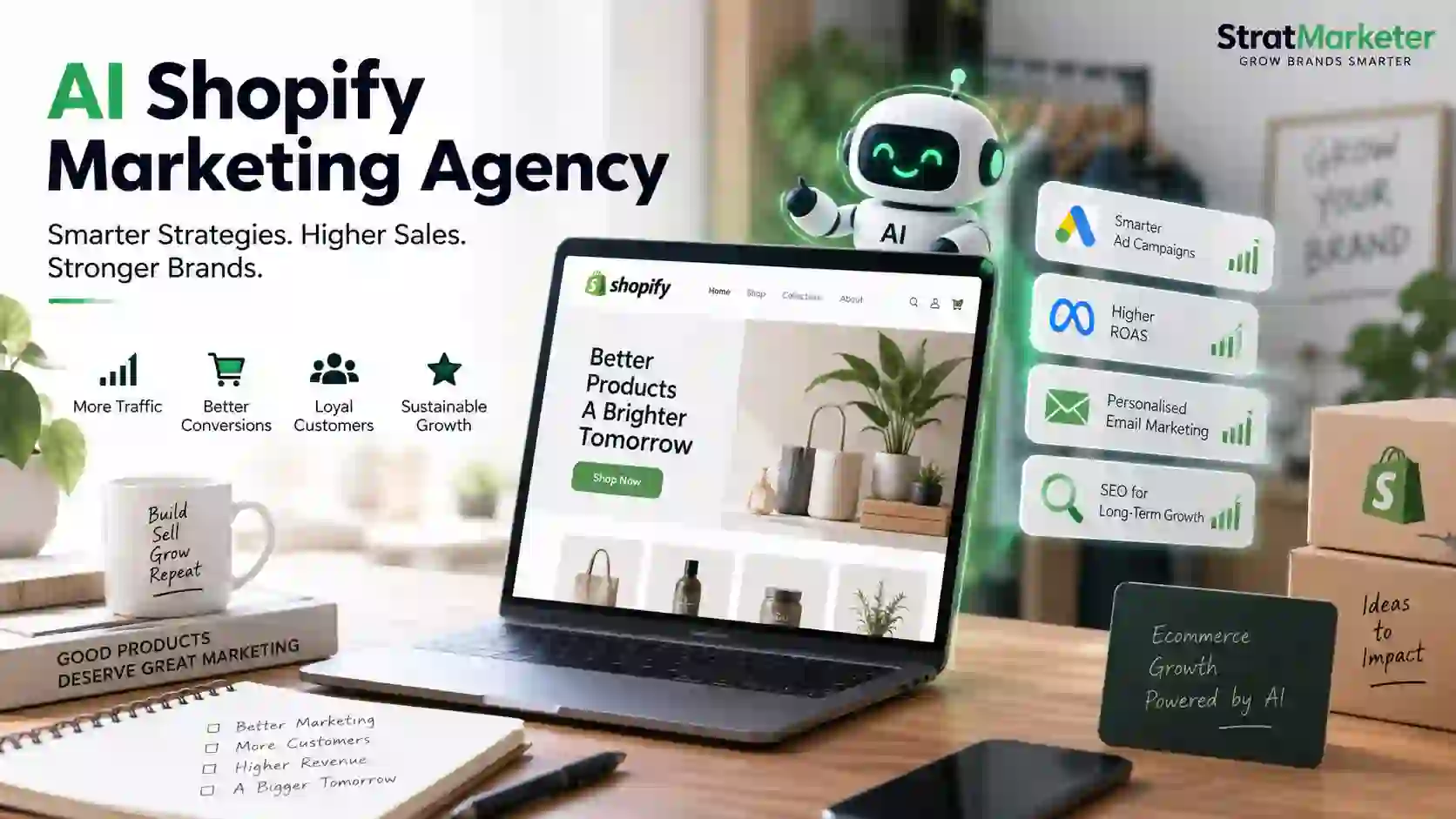
1. Why Shopify Brands Are Considering an AI Shopify Marketing Agency
Running a Shopify store can look simple from the outside. Products are uploaded, the theme is set, payment gateways are connected, and the store is ready to accept orders. The difficult part starts after that.
Getting the right people to visit the store, helping them find the right product, bringing back visitors who did not purchase, and understanding why sales rise or fall takes much more work. This is where an AI Shopify marketing agency can become useful for Indian ecommerce businesses that are trying to make their Shopify stores more efficient without relying entirely on manual marketing decisions.
A growing Shopify brand usually has a lot of information sitting inside its ecosystem. Product views, searches, cart additions, abandoned checkouts, repeat purchases, customer locations, device behaviour, campaign data and email interactions all tell a story. The problem is that store owners often do not have enough time to read that story properly.
AI can help process these signals much faster.
But there is a catch. AI does not automatically understand a business simply because it has access to data. Poor product information can produce poor recommendations. Weak tracking can lead to misleading conclusions. An automatically generated product description may sound polished while saying very little that helps a buyer.
I have seen this problem with ecommerce stores selling everything from skincare products to home accessories. The owner often thinks the issue is traffic. Then the numbers are checked more closely and it turns out thousands of visitors are reaching the product pages but leaving without adding anything to the cart.
That changes the marketing conversation completely.
An AI Shopify marketing agency can use AI to examine these patterns, identify possible friction points and help marketers decide where human attention is actually needed. It might be the product page. It might be pricing. It might be an ad audience. It might simply be that the store is attracting people who were never likely to buy.
This is why AI in Shopify marketing should not be treated as another fashionable software layer. Its real value comes when it helps answer practical questions.
Which products are getting attention but not sales?
Which customers are likely to purchase again?
Which advertising audiences are wasting budget?
Which search terms bring visitors who actually buy?
Which products deserve more content?
Those questions are far more useful than simply asking whether AI is being used.
For Indian Shopify brands, there is another consideration. Customer behaviour can vary considerably across regions, languages, price ranges and payment preferences. A customer in Bengaluru buying a premium skincare product may behave very differently from a customer in Jaipur looking for a lower-priced home product.
AI can help identify such patterns, but someone still has to interpret them properly.
That human judgement matters.
2. Where AI Fits Into Shopify Marketing and Customer Acquisition
AI does not replace Shopify marketing. It sits across several parts of the process and helps marketers work with larger amounts of information.
Think about a store running Google Ads, Meta Ads, email campaigns, SEO and remarketing at the same time. Each channel produces different data. A human marketer can certainly review it, but when the store starts receiving thousands of sessions and orders every month, the amount of information becomes difficult to handle manually.
An AI Shopify marketing agency can use automation and analysis tools to connect some of these signals.
For example, an AI system might identify that customers who view a particular category twice within seven days are more likely to purchase when shown a specific offer. Another analysis may show that mobile users from paid social traffic have a much lower checkout completion rate than desktop users.
That does not immediately tell you what to do.
It tells you where to investigate.
This distinction is important because AI marketing reports can sometimes create false confidence. A dashboard showing a neat recommendation can look authoritative even when the underlying data is incomplete.
For Shopify stores, AI can be useful across several areas.
Customer acquisition is one obvious area. AI can analyse campaign performance and help identify patterns in audiences, creatives, placements and purchase behaviour. It can also help marketers generate and test multiple ad variations much faster than traditional manual workflows.
Content is another area. Product descriptions, collection copy, blog ideas, email subject lines and ad copy can be produced or refined with AI. But the strongest ecommerce content usually still needs a person who understands the actual product.
There is a big difference between writing about a face serum and actually understanding why customers hesitate before buying it.
SEO is also becoming more interesting. Search behaviour is no longer limited to traditional Google queries. Customers increasingly use conversational search, AI search systems and natural language questions when researching products. Shopify brands therefore need content that answers real buying questions rather than stuffing product pages with repeated phrases.
Then there is customer retention.
A store might have 20,000 previous customers, but treating all of them as one audience makes little sense. Some bought once six months ago. Some buy every month. Some purchased a specific product category. Others added products to the cart several times but never completed the purchase.
AI can help segment these groups.
The marketing action can then be different for each one.
A frequent customer may need a replenishment reminder. A dormant customer may respond to a different message. Someone who repeatedly browsed premium products might not need a discount at all. They may simply need stronger product information or reviews.
This is where an AI Shopify marketing agency can bring more value than simply providing AI-generated content.
The real work is connecting the technology with the commercial problem.
3. Using AI to Understand Shopify Customer Behaviour and Purchase Intent
One of the most useful applications of AI for Shopify businesses is analysing customer behaviour.
Store owners often look at basic metrics such as sessions, conversion rate and revenue. Those numbers matter, obviously. But they do not always explain what happened.
Suppose a Shopify store receives 50,000 visitors in a month and generates 1,000 orders. The overall conversion rate might look acceptable. But what if customers from one product category convert at 4.5 percent while another category converts at just 0.6 percent?
The store needs to know why.
AI can examine combinations of behaviour that are difficult to spot manually. Product views, time between visits, search activity, cart additions, previous purchases, traffic sources and browsing sequences can be analysed to identify recurring patterns.
For instance, customers may first read a blog about a problem, visit a product page, leave, return through a branded search and finally purchase after reading reviews.
That journey tells you something.
The first visit created awareness. The second showed consideration. The branded search indicated stronger intent.
An AI Shopify marketing agency can use this kind of information to build better audience segments and marketing journeys.
Purchase intent can also be estimated from behaviour.
A visitor who spends two minutes reading a product page and checking shipping information is behaving differently from someone who lands on the page and leaves within a few seconds. A returning visitor who has already added a product to the cart represents another level of intent.
None of these signals should be treated as absolute proof.
AI predictions are probabilities, not guarantees.
This is particularly important when a store has limited data. If a Shopify store gets only a few hundred visitors each month, an AI model may not have enough reliable information to make strong predictions. I would be cautious about any agency promising sophisticated predictive marketing for a store that barely has enough historical transactions to establish a meaningful pattern.
More data does not automatically mean better marketing either.
Bad tracking creates bad analysis.
If purchase events are not configured properly, attribution is inconsistent, or important customer actions are missing from analytics, AI will simply process an imperfect picture.
This is one reason I prefer starting with measurement before automation. There is little point asking AI to find patterns when the basic numbers themselves cannot be trusted.
Customer behaviour can also reveal product problems.
Imagine an Indian fashion Shopify store where customers repeatedly visit a particular kurta product, scroll through the images, check the size chart and then leave. AI may identify the unusual drop-off pattern. But the actual solution may have nothing to do with AI.
Perhaps the size chart is confusing.
Perhaps the product images do not show the fabric clearly.
Perhaps delivery charges appear too late.
Perhaps customers want more colour options.
The technology can point towards the problem. A human still needs to understand the reason.
That is the part that often gets overlooked.
4. AI for Shopify SEO, Product Pages and Organic Search
SEO for Shopify stores has become more demanding because product pages now compete for attention across traditional search results, shopping results, marketplaces and conversational search experiences.
An AI Shopify marketing agency can use AI to help analyse search intent, identify content gaps and organise large product catalogues more efficiently.
For a store with 500 products, manually reviewing every product page is a slow exercise. AI can help flag pages with thin descriptions, missing information, repetitive copy or weak topical relevance.
That does not mean every page should be rewritten by AI.
Actually, I would advise against that.
Product pages need useful information. Customers want to know what the product is, who it is for, how it works, what is included, what size or quantity they receive, how it should be used and what happens after placing the order.
For Indian ecommerce customers, practical information can be particularly important.
Delivery timelines, COD availability, return conditions, warranty details and product usage instructions can influence purchase decisions significantly. An AI generated paragraph filled with marketing language cannot replace those details.
AI can still make the content process faster.
A marketer can feed product specifications into a content workflow and generate a first draft. The team can then correct claims, add product-specific information and remove unnecessary language.
The same principle works for collection pages.
Suppose a Shopify store sells organic personal care products. Instead of creating a generic collection page around a keyword, the content can answer questions customers actually ask.
Who is this product suitable for?
What ingredients are used?
How is this product different from another category?
How often should it be used?
What should a customer check before ordering?
These questions make the page more useful.
AI can help identify them from search queries, customer support conversations, reviews and website behaviour.
There is also an important technical side.
Shopify SEO involves more than writing content. Site architecture, internal linking, canonical handling, indexation, metadata, structured data, page speed, image optimisation and mobile usability all matter.
AI can assist with audits and prioritisation, but technical changes should be reviewed carefully. A bulk change across hundreds of URLs can create problems very quickly.
I have seen ecommerce teams become overly confident after an AI tool reports that hundreds of pages have been optimised. Then they discover that the pages all contain almost identical copy.
That is not optimisation. It is duplication at scale.
Organic search also requires patience. A new Shopify store cannot publish 300 AI written pages and reasonably expect search visibility overnight.
Search engines are getting better at evaluating usefulness and originality. Product content needs actual value, especially when competing with established retailers that already have reviews, backlinks, customer signals and strong brand recognition.
This is where an AI Shopify marketing agency should ideally combine automation with editorial judgement.
AI finds patterns.
People decide what deserves to be published.
5. Personalisation, Email Marketing and Retargeting for Shopify Stores
Once someone has visited a Shopify store, the marketing job is not necessarily finished.
A large percentage of visitors will leave without buying.
Some are just browsing. Some are comparing prices. Some are waiting for salary day. Some got distracted. Some simply did not find enough information to trust the purchase.
Retargeting has traditionally focused on showing the same product advertisement again and again. That can work, but it can also become irritating.
AI allows Shopify marketers to make these follow-up journeys more specific.
For example, someone who viewed a product several times but never added it to the cart could receive educational content rather than an immediate discount. Someone who abandoned checkout may need a reminder about the unfinished order. A previous customer who purchased a consumable product could receive a replenishment message based on an estimated usage cycle.
That is a much more sensible use of AI.
An AI Shopify marketing agency can analyse previous purchases and engagement patterns to create customer segments that update as behaviour changes.
Email marketing is particularly suited to this.
A Shopify customer database might contain thousands of people, but sending the same email to everyone is rarely ideal.
A customer who bought a product last week should not receive the same message as someone who purchased two years ago.
AI can help determine which customers are more likely to engage with certain types of messages. It can also assist with subject lines, product recommendations, send timing and content variations.
But personalisation can go too far.
Customers do not always want a brand to reveal how much it knows about them.
There is a difference between saying, “You may like these products based on your previous purchase,” and creating a message that feels like the brand has been watching every movement on the website.
That discomfort is real.
I would rather see a Shopify brand use three useful customer segments properly than create fifty microscopic segments that nobody on the marketing team understands.
The same thinking applies to retargeting.
AI can help identify which audiences are worth pursuing and which ones should be excluded. Someone who has already purchased should not necessarily keep seeing an acquisition advertisement for the same product. A high-value repeat customer may deserve a completely different communication journey.
Consider an Indian D2C food brand selling monthly snack boxes. A customer who purchased once may need a reminder after a few weeks. A customer who buys every month may respond better to a new flavour announcement. A customer who repeatedly abandoned checkout might need clearer shipping information rather than another percentage-off coupon.
The AI does not create that strategy by itself.
It helps the team recognise the behavioural difference.
There is also a financial reason to be careful. Discounts can increase short-term conversions while quietly reducing margins. If AI optimisation is focused only on purchases, it may recommend tactics that generate orders but damage profitability.
Revenue is not the same thing as healthy ecommerce performance.
A Shopify brand should eventually look at contribution margin, repeat purchase rate, customer acquisition cost and customer lifetime value alongside conversion rate.
I might be wrong here, but I think this is where many smaller stores still underestimate AI. They think the biggest advantage is faster content creation. Sometimes it is. But the more valuable application may be helping a marketing team see relationships between customer behaviour, acquisition costs and repeat purchases that were previously buried inside different tools.
And sometimes the answer is still very ordinary.
The product page needs better photos.
No algorithm can photograph the product for you.
The customer still has to trust what they see.
6. How AI Can Improve Shopify Advertising Across Google and Meta
Paid advertising for a Shopify store can become expensive very quickly. A campaign may look fine inside the advertising dashboard while the actual store economics tell a different story.
This is where an AI Shopify marketing agency can be useful, particularly when a brand is managing multiple products, audiences and creative variations across Google and Meta.
AI can analyse large volumes of advertising data much faster than a person sitting with spreadsheets. It can identify which products generate purchases, which audiences repeatedly interact without buying, which creative formats attract attention and where spending is producing weak returns.
But I would not hand complete control of advertising to automation.
There is too much context missing from numbers alone.
A product may have a high cost per purchase because it is new. Another may look efficient because it is being bought mostly by existing customers. A campaign can show a strong return while contributing very little to new customer acquisition.
AI needs that context.
For Google Ads, AI can help with search term analysis, audience signals, campaign optimisation, product feed analysis and bidding decisions. For Shopify stores with sizeable catalogues, automated systems can also help identify which products deserve more attention based on conversion and revenue patterns.
Product feed quality matters here more than many store owners realise.
If product titles are vague, descriptions are incomplete or important attributes are missing, advertising systems have less useful information to work with. An AI Shopify marketing agency can combine feed optimisation with campaign data to make product advertising more relevant.
Meta advertising works differently.
Creative matters heavily. A Shopify brand may have a dozen products but only two or three ad creatives that actually resonate with customers. AI can help produce multiple variations of hooks, headlines, scripts, images and video concepts for testing.
That can reduce the time needed to create new variations.
But quantity is not the same as quality.
I have seen brands generate dozens of AI ad variations and then struggle to understand what they were actually testing. Every version changed the headline, image, offer and audience. When the campaign performed differently, nobody knew which factor caused it.
A cleaner testing process is often more useful.
Change one meaningful variable where possible. Keep the product proposition clear. Give the campaign enough data to produce a useful signal. Then decide what deserves another test.
AI can help with this analysis.
For Shopify brands in India, another issue is regional variation. An ecommerce business selling fashion, beauty or home products may see different response rates across cities and customer segments. AI can identify these patterns, but the marketing team should ask why they exist before simply moving budget around.
Maybe delivery time is longer in some locations.
Maybe the product appeals more strongly to a particular demographic.
Maybe COD behaviour is affecting order completion.
The advertising platform cannot always explain the business reason behind the number.
That still requires human judgement.
7. Common Mistakes Shopify Businesses Make When Using AI Marketing
The first mistake is assuming AI will fix weak fundamentals.
It will not.
If the Shopify store has poor product photography, confusing navigation, slow pages, unclear pricing or an unreliable checkout experience, adding AI to the marketing stack will not solve the underlying problem.
It may simply send more people into the same bad experience.
I have seen this happen with ecommerce businesses that immediately wanted AI advertising because their traffic numbers were low. After looking at the store, the bigger issue was that product pages did not answer basic questions about delivery, returns and usage.
More traffic was not the first requirement.
Better information was.
Another common mistake is publishing large amounts of AI-generated content without reviewing it properly.
This is particularly risky for product businesses. AI can sometimes invent product features, make unsupported claims or describe a product in a way that sounds convincing but is factually wrong.
A skincare business, supplement brand or healthcare-related ecommerce company needs to be especially careful here.
One incorrect sentence can create customer complaints and trust problems.
A third mistake is treating every AI recommendation as a fact.
AI may tell you that a particular customer segment has a higher purchase probability. That does not mean every person in that segment will buy. It means the model has identified a pattern based on available information.
There is a difference.
Another issue is excessive automation.
Email sequences, ad campaigns, customer segmentation and product recommendations can all be automated. But when everything runs automatically, nobody may notice that the original business conditions have changed.
A product goes out of stock.
Margins change.
A supplier changes pricing.
A new competitor enters the category.
The automated system may continue optimising around old assumptions.
This is why an AI Shopify marketing agency should have human review built into the process.
Then there is the obsession with tools.
Some Shopify businesses keep adding AI software without deciding what problem each tool is solving. One platform handles content, another handles customer segmentation, another handles advertising analysis and another creates emails.
Soon the team has more dashboards than customers.
That sounds funny, but it happens.
I would rather see a store use fewer tools properly than collect every new AI application that appears.
There is also a subtle mistake around discounts.
If AI is instructed to maximise conversions without considering profitability, it can encourage aggressive offers because discounts often produce an immediate response.
But a store cannot build a healthy business by teaching customers to wait for coupons.
Customer lifetime value, margins, repeat purchases and acquisition costs need to be considered together.
8. What to Look for Before Choosing an AI Shopify Marketing Agency
Choosing an AI Shopify marketing agency should start with the Shopify business itself, not with the agency’s list of AI tools.
Ask what the agency plans to understand first.
If the first conversation is mainly about automation software, AI content generation and campaign dashboards, I would be cautious.
A good agency should want to know what you sell, who buys it, your average order value, your margins, your repeat purchase behaviour, current traffic sources and where you think the business is struggling.
They should also ask about your existing marketing.
An agency promising to rebuild everything immediately may not understand what is already working.
Shopify experience matters too. The team should understand product feeds, collections, product pages, analytics, conversion tracking, customer journeys and ecommerce advertising rather than treating Shopify as just another website platform.
Ask how they measure success.
If the answer is only traffic or impressions, that is not enough.
For an ecommerce business, you eventually care about sales and profitability. Depending on the business model, useful metrics can include conversion rate, customer acquisition cost, average order value, repeat purchase rate, return on ad spend and customer lifetime value.
You should also ask how AI recommendations are reviewed.
This is a surprisingly important question.
Who checks the product content before publishing?
Who reviews campaign changes?
What happens when AI identifies an unusual customer pattern?
How is incorrect information handled?
What happens if automation makes a bad recommendation?
The answers reveal how seriously the agency treats the technology.
I would also look at how the agency talks about results. If every problem is presented as something AI can solve, that is a concern. Ecommerce has too many variables for that kind of certainty.
Sometimes sales decline because demand falls.
Sometimes the product itself needs work.
Sometimes the market changes.
Sometimes the marketing is simply poor.
An AI Shopify marketing agency should be comfortable saying, “We do not know yet. We need to investigate.”
That sentence can be more reassuring than a big promise.
For an Indian Shopify business, I would also ask whether the agency understands local buying behaviour. COD, regional delivery expectations, festival demand, price sensitivity and mobile-first browsing can all influence ecommerce performance.
A strategy that works for a premium US Shopify brand may not work the same way for a D2C business selling primarily across Indian cities.
That difference matters.
9. How StratMarketer Approaches AI Shopify Marketing for Growing Stores
At StratMarketer, the useful question is not simply where AI can be added.
The better question is where AI can make the marketing process more useful without taking away the judgement that the business still needs.
For a growing Shopify store, that usually starts with understanding the current situation.
What is bringing traffic?
Which products attract attention?
Where are customers dropping out?
Which campaigns produce actual purchases?
Are existing customers returning?
Are product pages answering enough questions?
Is the store attracting the right audience in the first place?
These questions can look basic, but they often reveal more than a complicated AI dashboard.
Once the fundamentals are understood, AI can be applied where it has a practical role.
For SEO, it can help analyse search behaviour, content gaps, product page opportunities and large catalogues. Human review remains important because product information must be accurate and genuinely useful.
For paid advertising, AI can assist with audience analysis, creative variations, campaign data interpretation and budget decisions. The aim is not to let automation blindly spend money. It is to make campaign management more informed and responsive.
For customer retention, AI can help identify behavioural groups and build more relevant email and remarketing journeys.
For content, it can speed up research, ideation and first drafts while keeping the final message grounded in the actual product.
There is also room for AI in conversion analysis.
Suppose a Shopify store has healthy traffic but weak checkout completion. Rather than immediately increasing advertising spend, the team can examine the customer journey and look for friction.
Maybe customers are reaching the payment page and leaving.
Maybe shipping charges appear too late.
Maybe a particular device has an unusually high abandonment rate.
Maybe one product category is responsible for most of the problem.
AI can help find these patterns faster.
Then comes the less exciting part.
Someone has to decide what to change.
That is where StratMarketer’s approach focuses on combining AI with practical marketing judgement instead of treating automation as the entire strategy.
I also think there should be room to stop using an AI process when it is not helping. This sounds obvious, but agencies sometimes continue with a system simply because it was part of the original plan.
If a workflow produces weak content, change it.
If an audience model is unreliable, stop relying on it.
If automation creates more work than it saves, question it.
Marketing should remain connected to the business, not to the technology being used.
For Shopify brands trying to grow, that distinction can save a lot of wasted effort.
10. Frequently Asked Questions About AI Shopify Marketing Agency
What does an AI Shopify marketing agency actually do?
An AI Shopify marketing agency uses AI tools and automation alongside traditional marketing methods to help Shopify businesses with areas such as SEO, advertising, customer analysis, content, personalisation and retention.
The exact work depends on the store. AI should support the marketing process rather than become the strategy itself.
Is AI marketing suitable for a small Shopify store?
Yes, but the approach should be proportionate to the amount of data available.
A small store may benefit from AI assisted content, customer segmentation, campaign analysis and email automation. It may not have enough historical data for complicated predictive models.
Starting small is often sensible.
Can AI increase Shopify sales?
It can contribute to higher sales by helping improve targeting, customer journeys, product content, advertising decisions and retention.
But there is no automatic connection between using AI and increasing sales. Product quality, pricing, demand, website experience and fulfilment still matter.
Can AI manage Google Ads and Meta Ads for a Shopify store?
AI can assist with campaign optimisation, audience analysis, bidding, creative development and performance analysis.
Human supervision is still important, especially when budgets are significant or the product category has unusual customer behaviour.
Can an AI Shopify marketing agency help with SEO?
Yes. AI can assist with keyword research, search intent analysis, product content, internal linking opportunities, content planning and technical audits.
The final content and technical changes should still be reviewed carefully.
Is AI-generated product content good for Shopify?
It can provide a useful first draft, but it should not simply be published without checking.
Product specifications, claims, sizes, ingredients, warranties and usage information need to be accurate. A human review is particularly important for products where incorrect information could affect customer safety or trust.
How long does Shopify AI marketing take to show results?
There is no universal timeframe.
Paid advertising can produce signals relatively quickly, while SEO and organic content usually take longer. Customer retention improvements may also depend on the store having enough existing customer data.
Anyone giving the same fixed result timeline to every Shopify business is probably simplifying the situation too much.
Should a Shopify business use AI for everything?
No.
That sounds obvious, yet it is an easy trap to fall into. Some decisions are better handled by people who understand the product, customers and business context.
AI is useful when it removes repetitive work or reveals patterns that are difficult to see manually. It becomes less useful when it adds complexity for the sake of using AI.
Is an AI Shopify marketing agency different from a normal digital marketing agency?
The difference should be in how the agency uses technology and data within the marketing process.
An agency calling itself AI-focused is not automatically better. What matters is whether it can use AI sensibly across Shopify SEO, advertising, customer analysis, content and retention while still understanding ecommerce fundamentals.
What should I ask an AI Shopify marketing agency before hiring one?
Ask what they will analyse first, how they measure success, which AI systems they use, how human review works, how they handle customer data, what Shopify experience they have and how they connect marketing activity with actual business outcomes.
Our Services
Contact Us
- Paonta Sahib, Himachal Pradesh, India
- +91-8700998508
- support@stratmarketer.com
Start From Here
These two options make it easy for you to get the information you want.