



AI Amazon Marketing Agency for Smarter Amazon Growth
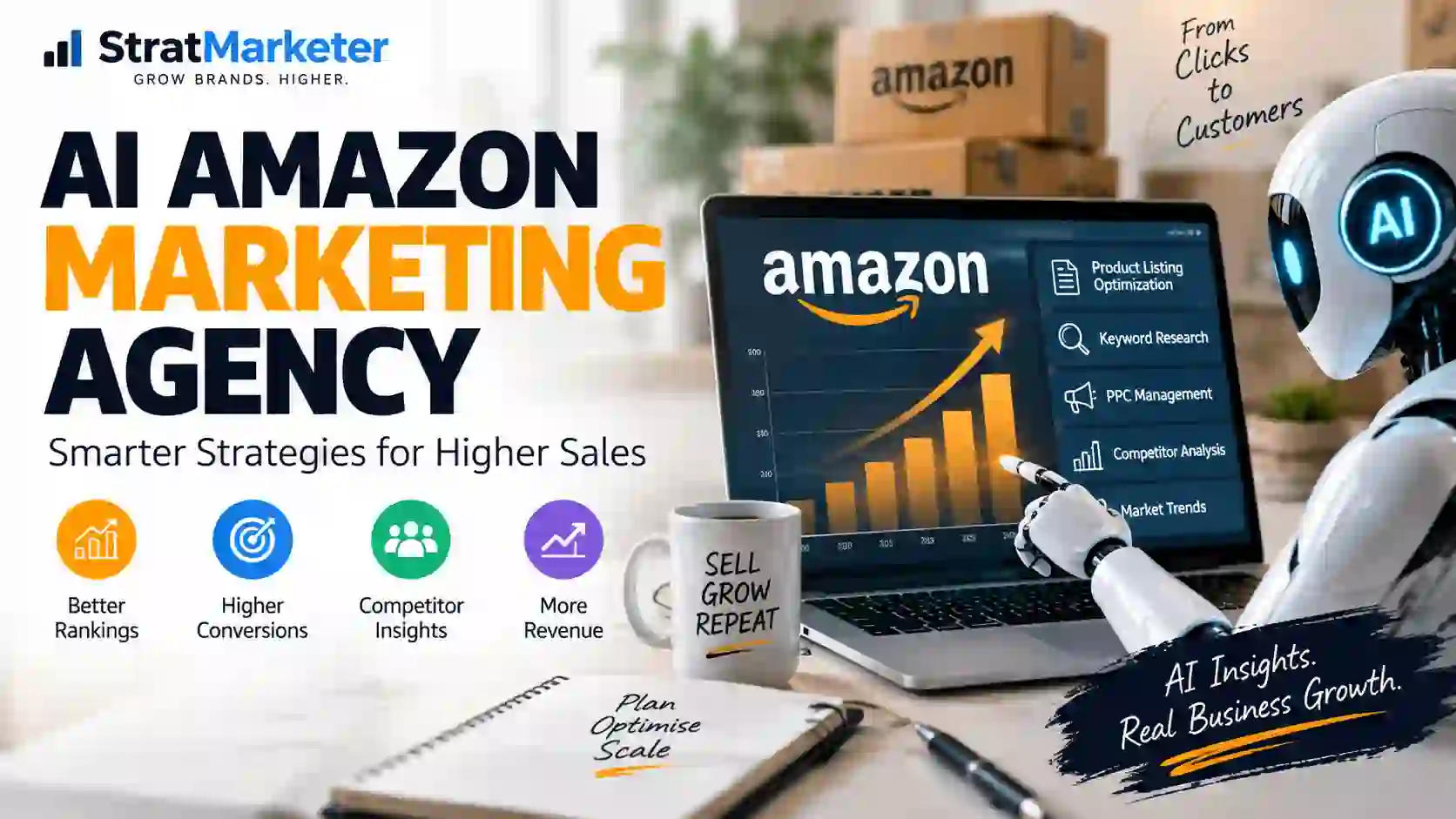
1. Why Amazon Sellers Are Turning to an AI Amazon Marketing Agency
Amazon has become harder to manage manually. Sellers now have to deal with crowded search results, rising advertising costs, changing customer behaviour, stronger competitors, and a huge amount of product and campaign data. An AI Amazon marketing agency can help sellers make sense of this information and act on it faster.
For many Indian sellers, the problem is not simply getting products listed on Amazon. The real difficulty comes after the listing goes live. A product may have good reviews and reasonable pricing but still struggle to generate impressions. Another product may receive plenty of traffic through advertising but fail to convert. These problems require different responses, and blindly increasing the ad budget rarely fixes them.
This is where AI has started becoming useful.
An AI Amazon marketing agency can analyse search terms, advertising performance, customer behaviour, listing content and competitor activity at a scale that would take a human team considerably longer to process. But AI should not be treated as a replacement for Amazon expertise. That distinction matters. A poorly managed AI system can simply make bad decisions faster.
2. What an AI Amazon Marketing Agency Actually Does for Sellers
The phrase AI Amazon marketing agency sounds fairly broad, and frankly, some agencies use it without much substance. In practical terms, the work should cover the areas that influence Amazon sales and advertising performance.
That can include keyword research, product listing optimisation, Amazon PPC management, competitor analysis, campaign structuring, search term analysis, review and customer feedback analysis, content development and performance reporting.
Suppose an Indian seller is selling stainless steel kitchen containers. The seller may already have a listing with a decent title, five bullet points and several product images. Yet the product might be ranking for generic terms while missing more specific searches such as capacity based or use case based queries.
An AI assisted process can identify patterns across search data and campaign reports. The human team then decides which findings actually make commercial sense.
That second part is important.
I would personally be cautious about any AI Amazon marketing agency that claims AI can automatically handle everything from keywords to advertising without human oversight. Amazon is full of exceptions. A keyword with high search volume is not necessarily commercially useful. A competitor’s strategy may work because of their review count, pricing or brand recognition and may not work for a newer seller.
AI can identify patterns. It still needs someone who understands why those patterns matter.
3. How AI Can Improve Amazon Product Listing Performance
A product listing has to perform two jobs at the same time. It needs to help Amazon understand what the product is, and it needs to convince a customer to buy it.
Those are not exactly the same thing.
An AI Amazon marketing agency can analyse listing elements such as the product title, bullet points, description, backend search terms, image messaging and customer reviews to identify areas where the product page may be losing potential buyers.
For example, imagine a seller receives repeated reviews saying that a particular mixer grinder is easy to clean but the lid is difficult to remove. That information is commercially useful. It can influence the way the product is described, the questions addressed in the listing and even future product development.
AI can process large volumes of reviews much faster than a person manually reading hundreds of them. It may identify recurring phrases around durability, packaging, size, usability, delivery expectations or product quality.
But there is a trap here.
AI generated listing copy can sound polished while saying very little. Amazon customers do not need impressive sounding sentences. They want to know whether the product fits their actual requirement.
A seller of cotton bedsheets, for instance, should be clear about fabric, dimensions, weave, wash care and what comes in the package. Adding vague words about premium quality does not solve a buying concern.
I have seen this problem repeatedly in ecommerce content. The copy looks better after AI rewriting, but the listing becomes less useful because specific product information gets buried under attractive language.
The better approach is to use AI for research, comparison and pattern recognition, then make the final content practical.
4. Using AI to Understand Amazon Search Behaviour and Keywords
Keyword research on Amazon is not simply about finding phrases with high search volume.
A seller needs to understand what the shopper is actually trying to buy.
Consider two searches:
“office chair”
“ergonomic office chair with lumbar support”
The first is broad. The second tells us considerably more about the customer’s requirement.
An AI Amazon marketing agency can help analyse large keyword sets and group them according to product relevance, buying intent, attributes and use cases. This becomes particularly useful when a seller has dozens or hundreds of search terms coming from Amazon PPC campaigns.
Search term reports can reveal something interesting. Sometimes the keywords that bring sales are not the keywords the seller originally expected.
For example, a seller may advertise a generic product term and discover that conversions are coming from a more specific phrase related to a product size, material or application. That information can influence both the PPC strategy and the organic listing.
This is one area where AI can save considerable manual effort.
It can sort, cluster and compare data quickly. A human marketer can then look at the commercially important groups instead of spending hours cleaning spreadsheets.
There is another point worth making. Amazon search behaviour is not static. Customer language changes. New products appear. Seasonal demand changes. Competitors introduce new features. Pricing changes the type of search a product receives.
So keyword research should not be treated as something done once and forgotten.
I might be wrong here in saying this applies to every category, because some mature categories can remain fairly stable for long periods. But for competitive categories, regularly reviewing search behaviour is usually more useful than relying on an old keyword list.
5. AI Powered Amazon Advertising and PPC Management
Amazon PPC is probably one of the areas where sellers feel the pressure most quickly.
Money can disappear from an advertising account without producing enough sales. A campaign can receive clicks but very few conversions. Another campaign may perform well for a week and then suddenly become expensive.
An AI Amazon marketing agency can use campaign data to identify these patterns and help marketers decide where attention is needed.
This may involve analysing:
- Search term performance
- Advertising cost of sales
- Click through rates
- Conversion rates
- Cost per click
- Impressions
- Placement performance
- Budget utilisation
- Product level profitability
- Keyword and ASIN targeting
The useful part is not simply producing a report.
The useful part is understanding what the numbers are saying.
Suppose an Amazon seller is getting 1,000 clicks but only 12 orders from a particular campaign. Increasing the budget because the campaign is receiving traffic would probably be a mistake. The issue may be the keyword relevance, listing quality, pricing, reviews or product offer.
On the other hand, a campaign may have strong conversion rates but lose impressions because the daily budget runs out too early. That is a completely different problem.
AI can help surface these situations quickly.
Still, automation has limits. I strongly prefer a setup where campaign changes are reviewed against business margins rather than made purely from advertising metrics. A product with a 20 percent margin cannot be managed in exactly the same way as a product with a 50 percent margin, even if their advertising numbers look similar.
That is where an experienced AI Amazon marketing agency should bring judgement into the process.
Amazon PPC is not just about getting more clicks. It is about getting commercially useful traffic and understanding what happens after the click.
And sometimes the answer is uncomfortable. The advertising campaign may not be the main problem at all. The product, price, reviews or listing may be the real issue.
6. How AI Helps Analyse Competitors, Pricing and Market Trends
Amazon sellers rarely operate in isolation. A competitor can change a price in the morning, launch a coupon in the afternoon and have a new product image live by evening. The seller who notices these changes late can end up reacting instead of planning.
This is one reason an AI Amazon marketing agency can be useful beyond advertising.
AI tools can process competitor listings, product attributes, review patterns, pricing information and advertising signals to identify changes that deserve attention. The purpose is not to copy another seller. That usually creates a race to the bottom.
Imagine an Indian seller selling insulated water bottles. The product has been priced at ₹799 for several months. Suddenly, three competing products start appearing at ₹649 with similar ratings and aggressive coupons. At the same time, one competitor adds a larger capacity option and changes its main image to highlight that feature.
A seller looking only at their own sales report might simply notice that orders have fallen.
A wider market analysis tells a different story.
The problem may be competitive pricing, changed customer expectations or a stronger offer in the category.
AI can help identify such movements much faster, especially when there are many competing ASINs to review. It can also help compare product specifications, review themes and positioning.
Pricing is where sellers need to be particularly careful.
AI can identify pricing patterns, but it should not decide that the cheapest price is always the right price. Amazon customers do compare prices, but they also look at ratings, delivery, brand familiarity, product quality, pack size and perceived value.
A ₹999 product with better reviews and stronger packaging may sell more consistently than a ₹699 alternative.
There is also seasonality. Indian Amazon sellers know this well. A product that performs normally during one period can suddenly receive much higher demand around Diwali, wedding season, monsoon or the school reopening period, depending on the category.
An AI Amazon marketing agency can use historical information and current signals to identify these shifts and help sellers prepare campaigns and inventory decisions earlier.
But forecasting is never a guarantee.
I might be wrong here if I make forecasting sound too predictable. Unexpected competitor promotions, stock problems, policy changes or changes in consumer spending can disrupt even a sensible forecast. AI can give a useful indication. It cannot see tomorrow.
7. Common Mistakes Sellers Make When Using AI for Amazon Marketing
The first mistake is assuming that AI knows the product better than the seller.
It does not.
A seller may have spent five years dealing with customers, distributors, returns and product complaints. An AI tool may have processed thousands of examples, but it does not automatically understand the small details of that particular business.
That knowledge needs to be provided.
Another common mistake is publishing AI generated content without checking product facts. This can create surprisingly awkward situations. A product description might mention a feature that does not exist, use the wrong material specification or make a claim that the seller cannot substantiate.
On Amazon, that is not just a writing problem.
It can become a customer complaint problem.
Some sellers also ask AI to find “the best keywords” and then insert every suggested phrase into their listing. The result can be unnatural copy that tries to satisfy search engines instead of helping the shopper.
I would avoid that approach completely.
Keyword relevance matters, but stuffing a listing with unrelated or repetitive phrases does not make it stronger.
Another issue is over automation in PPC. Sellers sometimes create rules that raise bids whenever a keyword performs well and reduce them whenever performance drops. It sounds sensible until you look at what is happening underneath.
A keyword may have good sales today because of a temporary promotion. Another may have low conversions because the product went out of stock or the Buy Box situation changed. Automatically changing bids without understanding the reason can make the account behave strangely.
There is also a tendency to judge AI marketing by short term numbers.
One week of better advertising performance does not necessarily mean the strategy is working. Likewise, one weak week does not automatically mean it has failed.
Amazon businesses need to look at sales, advertising costs, organic movement, conversion, profitability and category conditions together.
And then there is the most basic mistake.
Giving AI poor information and expecting excellent decisions.
If the underlying product data is incomplete, campaign data is messy and business objectives are unclear, the recommendations will also be limited.
8. What Amazon Businesses Should Check Before Hiring an AI Amazon Marketing Agency
The first thing I would ask an agency is not “Which AI tools do you use?”
I would ask, “What will you actually do with the information?”
There are plenty of software platforms that can analyse Amazon data. Buying access to a tool is not the same as having a capable marketing team.
An AI Amazon marketing agency should be able to explain how it approaches listings, keyword research, PPC, competitor analysis and reporting without hiding behind technical terminology.
Ask how they will understand your product category.
A seller of beauty products has different concerns from a seller of industrial equipment. A private label kitchen brand has different advertising economics from a large established consumer brand.
The agency should also ask about margins.
This sounds obvious, but it gets missed surprisingly often. Revenue can look impressive while the seller is barely making money. If an agency reports sales growth but never discusses contribution margin, advertising spend and other Amazon costs, I would have questions.
Experience with Amazon matters too.
Ask whether the team understands search terms, campaign structures, product targeting, negative keywords, listing restrictions, catalogue issues and the practical realities of selling through Amazon.
You should also understand how much of the work is automated.
There is nothing wrong with automation. In fact, it can save a lot of time. The concern is when nobody reviews what the system is doing.
A good working relationship usually has humans making the important commercial decisions while AI handles repetitive analysis and pattern recognition.
Reporting should be another point of discussion. You should be able to understand what changed, why it changed and what the agency plans to do next.
If every monthly report is filled with graphs but you still do not know why sales went up or down, the report is not doing its job.
Finally, look at how the agency talks about results.
Be cautious with promises of guaranteed rankings or guaranteed sales. Amazon has too many variables for such claims to be taken seriously.
9. How StratMarketer Approaches AI Amazon Marketing for Sellers
At StratMarketer, the useful role of AI should be connected to the actual Amazon business rather than treated as a separate technology exercise.
The starting point is understanding the product and the seller’s commercial position.
A new private label seller may need to establish relevance and collect meaningful customer feedback. An established brand may have a different problem, such as rising PPC costs or competitors taking important search positions. Treating both accounts in exactly the same way would not make much sense.
The AI Amazon marketing agency approach at StratMarketer can bring together listing analysis, keyword research, competitor research, Amazon advertising and performance review.
For listing work, AI can help examine existing content and customer language. The human review then focuses on whether the copy accurately represents the product and answers the questions buyers are likely to have.
For keyword research, the emphasis should be on relevance and intent rather than simply collecting a large number of phrases. Search terms that look attractive in a spreadsheet may not be useful for the actual product.
PPC requires another layer of attention. Campaign performance can be analysed to find wasted spend, useful search terms, weak targets, bid opportunities and areas where the listing may be affecting conversion.
Then comes the part sellers often underestimate.
Learning from the account.
A campaign report should not disappear into a folder after it has been reviewed. Search terms that generate useful sales can influence listing decisions. Customer objections can reveal product positioning problems. Competitor changes can influence advertising priorities. Seasonal patterns can affect planning.
That is where AI becomes more practical.
It helps reduce the amount of manual sorting and comparison, allowing the marketing team to spend more time interpreting what the information means for the seller.
StratMarketer can also look at the wider ecommerce picture rather than treating Amazon advertising as an isolated activity. Organic rankings, product content, paid traffic, customer behaviour and competitive positioning are connected.
Not perfectly connected, of course. Some things remain difficult to explain.
And that is something an honest agency should be comfortable admitting.
10. Frequently Asked Questions About AI Amazon Marketing Agency
What is an AI Amazon marketing agency?
An AI Amazon marketing agency uses artificial intelligence and automation alongside human Amazon marketing expertise to manage and analyse areas such as product listings, keywords, PPC campaigns, competitors and performance data.
Can AI improve Amazon sales?
It can help, but there is no automatic connection between using AI and getting more sales. The product, price, reviews, listing quality, inventory, competition and advertising all matter.
Is AI useful for Amazon PPC?
Yes. AI can analyse large amounts of campaign and search term data, identify patterns and highlight areas where bids, budgets or targeting may need attention. Human review is still important before major changes are made.
Can AI write Amazon product listings?
Yes, but generated copy should always be checked against the actual product. AI can help with research and drafting, but inaccurate specifications or unsupported claims can create problems.
How does AI help with Amazon keyword research?
It can process large keyword sets, identify related search terms, group phrases by intent and analyse search term performance. The final selection should still be based on product relevance and commercial value.
Should every Amazon seller hire an AI Amazon marketing agency?
Not necessarily. Some smaller sellers may be able to manage a simple account themselves. An agency becomes more useful when the catalogue, advertising activity and competition become difficult to manage consistently.
How long does Amazon marketing take to show results?
There is no fixed period. Advertising data can provide signals relatively quickly, while organic ranking and broader account improvements may take considerably longer. Category competition also makes a major difference.
Is AI enough to manage an Amazon account?
I would say no.
AI is very good at processing information and spotting patterns. It is much less reliable when context is missing. A sudden sales decline could be caused by pricing, stock, reviews, competition, a listing issue or something else entirely.
Someone still needs to investigate what actually happened.
What should I ask an AI Amazon marketing agency before hiring it?
Ask about its Amazon experience, PPC process, listing optimisation method, reporting, use of automation, approach to profitability and how often strategy is reviewed. Also ask what information they need from you before starting.
Our Services
Contact Us
- Paonta Sahib, Himachal Pradesh, India
- +91-8700998508
- support@stratmarketer.com
Start From Here
These two options make it easy for you to get the information you want.