


AI D2C marketing agency
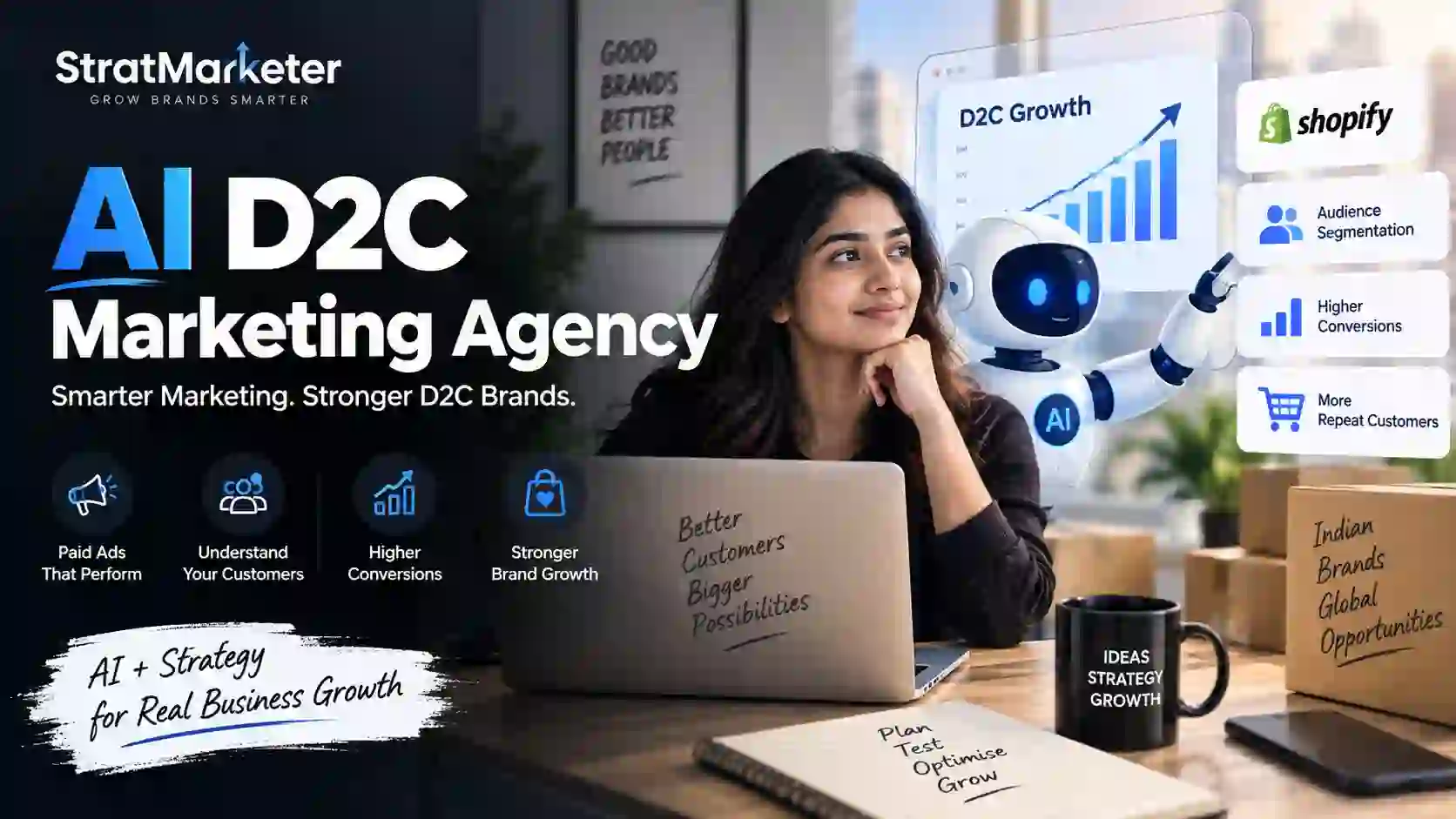
A D2C brand can have a good product, decent packaging and a website that looks perfectly fine, yet sales may still remain unpredictable. One week Meta Ads perform well. The next week acquisition costs rise. A creative that generated orders last month suddenly stops getting clicks. Customers visit the product page, add something to the cart and disappear.
This is where the conversation around an AI D2C marketing agency has become much more practical.
AI is no longer being discussed only as a futuristic technology that might someday change advertising. Indian D2C businesses are already using AI for customer research, campaign analysis, creative production, product recommendations, audience segmentation and automation. The important question is not simply whether AI should be used. It is where it should be used and where human judgement still matters more.
That distinction is often missed.
A skincare brand selling through Shopify, for example, may have thousands of customer records but still not know why repeat purchases are falling. A fashion business may have hundreds of ad creatives but no clear understanding of which creative element is actually responsible for conversions. An AI D2C marketing agency works around these problems by connecting customer information, advertising data, content and automation instead of treating each marketing activity as a separate job.
And frankly, this can get messy.
Why D2C Brands Are Looking at AI Marketing Differently
D2C marketing has always depended heavily on feedback. Clicks, purchases, returns, reviews, abandoned carts and repeat orders tell a brand what customers are doing.
The problem is that there is now far more information than a marketing team can comfortably examine manually.
Think about a growing Indian personal care brand. It may be selling through its own website, Amazon, marketplaces, Instagram and paid advertising platforms at the same time. Every channel produces different signals. Meta shows campaign performance. Shopify shows customer and order behaviour. Google captures search intent. Customer support conversations reveal objections. Reviews show what people actually liked or disliked.
These pieces do not automatically form one useful picture.
AI can help process this information much faster.
An AI D2C marketing agency can use machine learning and AI based tools to identify patterns in campaign data, group customers according to behaviour, analyse large volumes of customer feedback and assist with content variations. This does not mean the software magically knows what customers want. It means the marketing team can work with more information without spending every morning pulling spreadsheets together.
That difference matters.
Indian D2C brands also face a particular problem with customer acquisition. Many businesses start by relying heavily on Meta Ads because the platform can generate sales quickly. But once the brand grows, increasing ad spend does not always produce proportionate revenue.
The business then needs to understand more than advertising.
It needs to know which customers are profitable, which products bring people into the brand, who purchases again, which discounts attract low value buyers and which messages work for different audiences.
This is where AI becomes more useful than simply asking a chatbot to write ten Instagram captions.
I have seen businesses become excited about AI because a tool produced a hundred ad copies in a few minutes. But quantity was never really the bottleneck. The real issue was that most of those copies were saying the same thing in slightly different words.
That is not a marketing strategy.
The stronger use of AI is often less visible. It sits behind research, analysis, testing and decision making.
There is another shift happening too. Customers are becoming less patient with generic communication. Someone buying protein supplements for the first time should not necessarily receive the same communication as an existing customer who purchases every month. A customer who repeatedly browses premium products may respond differently from someone who consistently waits for discounts.
AI makes this type of distinction easier to manage at scale.
Still, I would not say AI should replace the marketing team. Quite the opposite. The more automated the execution becomes, the more important human judgement can become because someone still has to decide what the brand should actually stand for.
What an AI D2C Marketing Agency Actually Does
The phrase AI D2C marketing agency can sound broader than it really is.
It does not mean an agency presses an AI button and campaigns start running by themselves. Good D2C marketing still requires positioning, offer development, channel knowledge, creative judgement and an understanding of customer psychology.
AI simply changes how some of that work gets done.
At StratMarketer, an AI focused D2C marketing approach can involve several connected areas rather than one isolated AI tool. Customer data can be analysed to identify patterns. Advertising accounts can be reviewed for performance changes. Audience groups can be developed based on behaviour. Content ideas can be generated and tested. Campaign reporting can be automated.
The useful part is the connection between these activities.
Suppose a nutrition brand notices that first time buyers between 25 and 34 are converting well from educational videos but existing customers respond better to product bundles. An agency can use these signals to develop different messaging for the two groups.
The first group may need education and trust.
The second group may need convenience, replenishment reminders or a relevant bundle.
The campaign does not have to treat everyone as one audience.
An AI D2C marketing agency may also work with ecommerce data to understand customer journeys. Consider a simple journey:
A person sees a video on Instagram.
They visit the website.
They look at two products.
They leave.
They return through Google a few days later.
They purchase.
Later, they receive an email.
They purchase another product.
Looking only at the final transaction hides most of this behaviour. AI tools can help analyse these journeys across large datasets, although the accuracy depends heavily on the quality of the underlying tracking.
This is important because AI is not a repair mechanism for poor data.
If events are incorrectly configured, customer records are duplicated, attribution is broken or conversion tracking is unreliable, AI can produce a very convincing analysis from incorrect information.
That is one area where I am quite cautious.
People sometimes assume that because an AI system sounds confident, its output must be reliable. Marketing data does not work that way.
An agency may use AI for predictive analysis, campaign recommendations, customer segmentation, automated reporting and creative ideation, but each output still needs to be checked against business reality.
For D2C brands, the practical areas usually include:
Customer research, campaign analysis, content generation, audience segmentation, ad testing, email personalisation, product recommendations, customer support automation and reporting.
Not every brand needs all of these.
A business doing ₹20 lakh a month does not necessarily need an elaborate AI stack that costs more than the problem it is supposed to solve.
That sounds obvious, but it gets ignored surprisingly often.
Using AI to Understand D2C Customers and Buying Behaviour
Customer data can tell you what happened.
AI can help you look for patterns in why certain behaviours keep appearing.
Take an Indian beauty brand with 15,000 customers. Suppose the average order value looks healthy, but repeat purchase rates are uneven. A traditional report might show revenue by month, product and channel.
Useful, but limited.
AI assisted analysis can go deeper by examining product combinations, purchase intervals, acquisition sources and customer behaviour. It might reveal that customers who initially buy a face cleanser are more likely to purchase a moisturiser within 45 to 60 days.
That observation can change the marketing approach.
Instead of sending the same promotional email to every customer, the brand can build a communication sequence around the expected replenishment period.
Another example is customer reviews.
Imagine a brand has collected 8,000 reviews across its website and marketplaces. Reading every review manually is possible, but it becomes difficult as the business grows. AI can categorise recurring themes such as taste, packaging, delivery experience, product effectiveness, texture or value perception.
For a food or supplement brand, the analysis might reveal that customers repeatedly mention the same issue with the product scoop or packaging.
That is not really an advertising problem.
It is a product experience problem.
This is one reason customer analysis should not be treated as a marketing only activity. Sometimes the most useful marketing insight tells you to change something outside marketing.
AI can also help identify customer cohorts.
A cohort is simply a group of customers sharing a meaningful characteristic, often related to when or how they purchased. Looking at cohorts helps a brand understand whether customers acquired in different periods behave differently.
Suppose a D2C brand launched a heavy discount campaign during Diwali. Sales jumped sharply. At first glance, the campaign appears successful.
But six months later, the brand discovers that customers acquired during that period had much lower repeat purchase rates than customers acquired through content led campaigns.
Suddenly the picture is different.
The discount generated transactions, but perhaps not the type of customer the business wanted.
An AI D2C marketing agency can help analyse these patterns across much larger datasets than a small team might comfortably handle manually.
Still, there is a limit.
Buying behaviour is not mathematics alone. People buy because of timing, emotion, convenience, trust, family influence, recommendations and sometimes for reasons that never appear in the data.
A customer buying a ₹1,500 skincare product during a festival sale may not behave the same way next month just because the algorithm predicts a certain pattern.
This may not apply everywhere, but I think brands should be careful about treating predictive marketing as certainty.
It is a probability signal, not a crystal ball.
AI Based Audience Research, Segmentation and Personalisation
Audience segmentation used to be relatively straightforward.
Age. Location. Gender. Interests.
For some campaigns, those categories are still useful. But D2C businesses often have much richer information available.
Purchase history can tell you what someone bought. Browsing behaviour can show what they considered. Engagement can reveal what content they respond to. Customer service conversations may show what stopped them from buying.
AI can combine these signals to create more useful behavioural segments.
For example, an Indian apparel brand might identify groups such as frequent purchasers, high value customers, first time buyers, discount sensitive customers and customers who browse repeatedly without purchasing.
The exact labels are less important than the behaviour behind them.
A first time buyer might receive educational content about sizing, returns and product quality. A repeat customer could receive early access to a new collection. A customer who repeatedly abandons carts may need a different kind of follow up.
Personalisation becomes meaningful when it responds to actual behaviour.
It becomes irritating when every message contains the customer’s first name and pretends to be personal.
We have all seen emails that say, essentially, “Hi Rahul, we picked this just for you”, followed by the same product shown to everyone else.
That is not sophisticated personalisation.
An AI D2C marketing agency can help create dynamic customer journeys where communication changes according to behaviour. AI can assist in deciding which product recommendations to show, which audience should see a particular creative and when a customer might be ready for a follow up.
There is also scope for predictive segmentation.
A model can estimate which customers are more likely to purchase again, which customers may become inactive and which customers are responding strongly to particular product categories.
But these systems need enough historical data to learn from.
A new D2C brand with 300 customers cannot expect the same predictive accuracy as a business with several years of transaction history. Sometimes simple segmentation is better.
That is another area where agencies can make mistakes. They can become fascinated by technical complexity when the brand simply needs three sensible customer groups and better messaging.
I personally prefer starting with behaviour that the business can actually act on.
If a segment cannot change what you do, why create it?
That question saves a lot of unnecessary work.
How AI Can Improve D2C Content and Creative Testing
Creative testing has become one of the more interesting applications of AI in D2C marketing.
A brand might have one product but dozens of possible ways to sell it.
You can talk about price.
You can talk about convenience.
You can demonstrate the product.
You can show customer reactions.
You can explain the problem.
You can compare the product with an old method.
You can build a founder story around it.
Traditionally, testing all these variations required considerable time and production resources. AI can reduce some of the effort involved in generating variations, adapting scripts, creating storyboards, analysing performance and repurposing content for different formats.
But again, producing content is not the same as producing useful content.
For example, an Indian D2C food brand could test short videos around three different ideas. One video focuses on preparation convenience. Another talks about ingredients. A third uses a customer problem as the opening.
If the third version generates better engagement and purchases, the brand can create more variations around that underlying idea.
This is where creative testing becomes interesting.
You are not simply asking, “Which video won?”
You are asking, “What did the customer respond to?”
Was it the opening line?
The product demonstration?
The visual?
The offer?
The creator?
The length?
The problem being discussed?
AI can assist with this analysis by processing large amounts of campaign and creative data. It can identify recurring patterns across ads and help teams produce new variations faster.
For a D2C brand advertising across Meta, Google, YouTube and other channels, that can save considerable manual work.
There is a trap here, though.
If AI generates twenty versions of the same weak idea, you have twenty weak advertisements.
I have seen brands confuse creative volume with creative learning. They produce more videos, more captions and more image variations, then wonder why performance does not change.
The underlying concept was never tested properly.
Creative quality still needs human judgement. The product needs to look believable. The script needs to sound like something an actual customer would understand. Claims need to be checked. For regulated categories such as supplements, cosmetics and health related products, compliance matters too.
AI can make a sentence sound convincing in seconds.
That does not make the claim acceptable.
A sensible AI D2C marketing agency therefore uses AI to shorten the distance between idea, production and learning, rather than simply flooding advertising accounts with automated content.
And there is a human side to all this which gets lost in dashboards. A founder often knows something about the customer that the analytics platform cannot see. Maybe customers from smaller cities ask the same question before ordering. Maybe women buying a certain product frequently call customer support before purchasing because they want reassurance about usage. Maybe a particular product sells well through WhatsApp even though the website data makes it look ordinary.
Those little details matter.
AI should help bring them into the picture, not erase them.
Sometimes the best marketing decision still comes from someone saying, “Customers keep asking us this.”
That sentence can be worth more than a complicated report.
AI for Paid Ads, Retargeting and Customer Acquisition
Paid advertising is one of the areas where D2C brands usually notice the value of AI quite quickly, mainly because there is a lot of campaign information coming in every day.
A typical Indian D2C brand may be running Meta campaigns for prospecting, retargeting campaigns for website visitors, Google Search campaigns for high intent users and sometimes YouTube or other channels for awareness. Add multiple products, creatives, audiences and offers, and the account becomes difficult to understand manually.
An AI D2C marketing agency can use AI assisted analysis to look at these different signals together.
For example, imagine a D2C skincare company spending ₹3 lakh a month on paid advertising. The business sees an acceptable cost per purchase overall, but the number hides a problem. New customer acquisition is becoming more expensive while returning customers are still converting at a decent rate.
A simple report might say that retargeting is performing well.
A deeper analysis asks why.
Perhaps the retargeting audience is small but highly responsive because these people already know the brand. Prospecting campaigns, meanwhile, may be bringing traffic but attracting visitors who are less likely to purchase.
That distinction matters when deciding where the next rupee should go.
AI can help analyse campaign data at scale and identify patterns across creatives, audiences, placements, products and conversion behaviour. It can also assist marketers in finding unusual changes that might otherwise take several days to notice.
Suppose one creative suddenly starts generating significantly more purchases from a particular customer group. An AI assisted system can flag the pattern. The marketer can then investigate whether the result is genuine or simply caused by a temporary change in delivery.
This last part is important.
I would not blindly accept an AI recommendation that says, “Move more budget here.”
Advertising platforms change constantly. Attribution can be imperfect. A campaign can look brilliant for three days and then flatten. Seasonality can distort the numbers. A payday weekend can make an ordinary campaign look unusually strong.
AI sees patterns.
It does not automatically understand the reason behind every pattern.
Retargeting is another interesting area. A customer who viewed a product yesterday is different from someone who abandoned the same product six weeks ago. Showing the same ad to both people may not make much sense.
The first person may simply need reassurance.
The second may have already lost interest.
AI can help classify audiences according to recency and behaviour and support different communication for different groups. A customer who has purchased before could receive a cross sell message rather than another first purchase advertisement.
This can reduce wasted communication.
Customer acquisition also becomes less dependent on one metric. Cost per acquisition is important, but an AI D2C marketing agency should also look at customer value, repeat purchases, refund behaviour, average order value and contribution margins where the data is available.
A ₹500 acquisition cost may look expensive for one product and perfectly reasonable for another if the second customer tends to purchase several times.
That is where many D2C discussions go wrong. People celebrate a cheap acquisition without asking whether the customer is actually valuable to the business.
AI can help bring these numbers together.
But the commercial decision still belongs to the business.
Connecting AI Marketing With Shopify, CRM and Ecommerce Data
There is a less glamorous side of AI marketing that often determines whether the whole thing works.
Data connection.
If the brand’s advertising data sits in one place, Shopify orders in another, customer information in a CRM, email activity somewhere else and WhatsApp conversations outside the reporting system, AI does not automatically solve the fragmentation.
It needs access to meaningful information.
For a Shopify based D2C brand, useful data might include product views, add to cart events, checkout activity, purchases, order value, customer frequency, product combinations and repeat purchase behaviour.
A CRM may contain lead status, customer interactions, sales conversations and support information.
The advertising platforms provide another layer.
An AI D2C marketing agency can connect these sources through available integrations, APIs, analytics systems and automation platforms so that marketing decisions are based on a wider view of the customer journey.
Take a simple example.
A customer visits a D2C website after seeing an Instagram advertisement. They do not purchase immediately. Two days later they return through Google and buy a ₹2,000 product.
If the brand only looks at the last click, Google may receive all the credit.
But the first interaction on Instagram may have played an important role in creating awareness.
This is why ecommerce data needs context.
AI can help analyse customer journeys and attribution signals, but the quality of the conclusion depends on the quality of the tracking setup. Broken events, duplicate customer records and missing conversion signals can make sophisticated analysis look more accurate than it actually is.
That is a dangerous combination.
A polished dashboard can hide a weak foundation.
Shopify data can also help with product level analysis. A brand may discover that one product generates most first purchases while another product produces stronger repeat buying. The marketing strategy can then treat these products differently.
The first product may work as an entry point.
The second may be more useful for retention.
This can influence advertising, email, offers and landing page decisions.
CRM information adds another layer. Suppose customers frequently ask about delivery timelines before purchasing. The brand may initially interpret abandoned carts as a pricing problem.
Customer conversations could show something else.
Perhaps buyers are simply uncertain about when the order will arrive.
That insight can change the website copy, product page information and retargeting message.
AI can help process these conversations at scale by grouping recurring questions and themes. It is especially useful when hundreds or thousands of support interactions exist.
Still, not every brand needs a giant technology stack.
A smaller D2C company may only need reliable Shopify analytics, properly configured advertising tracking, a CRM and a few useful automations.
I sometimes think agencies make this harder than it needs to be. They introduce another platform because it looks advanced, when the business has not even fixed its basic purchase tracking.
Simple systems that work are better than complicated systems nobody trusts.
How StratMarketer Approaches AI D2C Marketing for Indian Brands
StratMarketer’s approach to an AI D2C marketing agency model starts with the marketing problem rather than the technology.
That distinction sounds small, but it changes the work.
If a D2C brand is struggling with expensive acquisition, the first question should not be which AI tool to buy. The questions are more basic.
Which customers are being acquired?
Which products are they purchasing?
What does the repeat purchase behaviour look like?
Which creatives are actually producing sales?
Where are customers dropping from the journey?
Is the problem traffic, conversion, pricing, trust, retention or something else?
AI can then be applied where it has a useful role.
For paid advertising, StratMarketer can use AI assisted analysis to examine campaign patterns, audience behaviour and creative performance. The purpose is not to hand over every advertising decision to software. It is to help the marketing team examine more information and identify areas worth testing.
For content, AI can assist with research, ideas, scripts, variations and repurposing. But the content still needs to sound like the brand.
For ecommerce, customer and product data can be used to understand buying patterns and identify opportunities for personalisation.
For retention, AI can support customer segmentation, email communication and selected automation workflows.
For conversion optimisation, customer behaviour can be studied alongside website data to identify friction points.
The exact combination depends on the business.
An Indian D2C food brand has different problems from a premium furniture company. A fashion label has a different purchase cycle from a supplement business. A beauty brand may have high repeat purchase potential while an electronics brand may depend heavily on replacement cycles.
So the same AI marketing framework should not simply be copied from one company to another.
This is where StratMarketer can combine conventional digital marketing experience with AI assisted processes across SEO, paid advertising, social media, content marketing, email marketing, lead generation, conversion optimisation and automation.
The aim is to make the individual activities work together.
For example, customer research from paid campaigns can influence content. Search behaviour can reveal product questions that should appear on landing pages. Customer feedback can inform ad messaging. Repeat purchase patterns can shape retention campaigns.
That connection is more useful than having an isolated “AI campaign”.
There is also the matter of scale.
A business doing 500 orders a month may need a very different setup from one doing 20,000 orders a month. The amount of data, number of campaigns, customer segments and automation opportunities changes considerably.
An AI D2C marketing agency should recognise that.
Sometimes the best solution is a relatively simple workflow. Sometimes the business genuinely needs deeper integration between ecommerce, CRM, advertising and analytics systems.
I might be wrong here, but I do not think every D2C brand needs to become an AI first company. Some businesses need better product photography. Some need better landing pages. Some need faster customer support. Some simply need to stop spending money on audiences that are not converting.
AI can help with these problems, but it should not become the problem itself.
The uncomfortable bit is that technology cannot compensate for a weak offer forever.
If customers do not understand why they need the product, better segmentation will only help to a point.
Frequently Asked Questions About AI D2C Marketing Agency
What is an AI D2C marketing agency?
An AI D2C marketing agency combines artificial intelligence with digital marketing services for direct to consumer brands. This can include customer analysis, paid advertising, content, segmentation, personalisation, automation, ecommerce analytics and conversion optimisation.
How can AI help a D2C brand acquire customers?
AI can analyse campaign and customer data, identify behavioural patterns, assist with audience segmentation and support creative testing. It can also help marketers compare acquisition costs with repeat purchases and customer value.
Can AI reduce D2C advertising costs?
It can help identify inefficient campaigns, audiences or creative patterns, but lower advertising costs are not guaranteed. Product demand, competition, offer quality, creative quality and platform conditions still affect acquisition costs.
Does StratMarketer use AI for paid advertising?
StratMarketer can use AI assisted processes for campaign analysis, audience research, creative testing and marketing insights while keeping human review involved in important advertising decisions.
Can AI connect Shopify and CRM data?
Yes, depending on the available systems and integrations. Ecommerce, CRM, advertising and analytics data can be connected through suitable integrations and APIs so marketers can analyse customer journeys more effectively.
Is Shopify data enough for AI marketing?
Not always. Shopify can provide valuable ecommerce information, but a complete D2C picture may also require advertising data, customer service information, CRM records, email activity and sales from other channels.
Is AI generated content good for D2C brands?
It can be useful for research, ideation, drafts and variations. It still needs human editing and factual review, particularly for product claims, regulated categories and brand sensitive communication.
What is the biggest AI marketing mistake D2C brands make?
Treating AI as the strategy instead of as a tool. If positioning, product value, tracking or customer understanding is weak, adding more automation will not necessarily fix the underlying issue.
Does every D2C business need an AI D2C marketing agency?
No. The need depends on the company’s size, marketing complexity, available data and internal capabilities. Some businesses may benefit from a few AI assisted processes, while larger D2C operations may have more reasons to integrate AI across multiple marketing functions.
How does AI personalisation work in D2C marketing?
AI can use information such as purchase history, browsing activity, engagement and customer behaviour to help determine which content, products or messages may be relevant to different customer groups.
Can AI predict which customers will purchase again?
AI models can estimate the likelihood of repeat purchase when enough reliable historical data is available. Such predictions are not certain outcomes and should be treated as signals for marketing decisions rather than guarantees.
What should an Indian D2C brand look for in an AI marketing agency?
Look beyond the word AI. Ask how the agency handles customer data, tracking, paid advertising, creative testing, ecommerce analytics and reporting. Also ask how human review is included in the process.
Our Services
Contact Us
- Paonta Sahib, Himachal Pradesh, India
- +91-8700998508
- support@stratmarketer.com
Start From Here
These two options make it easy for you to get the information you want.