


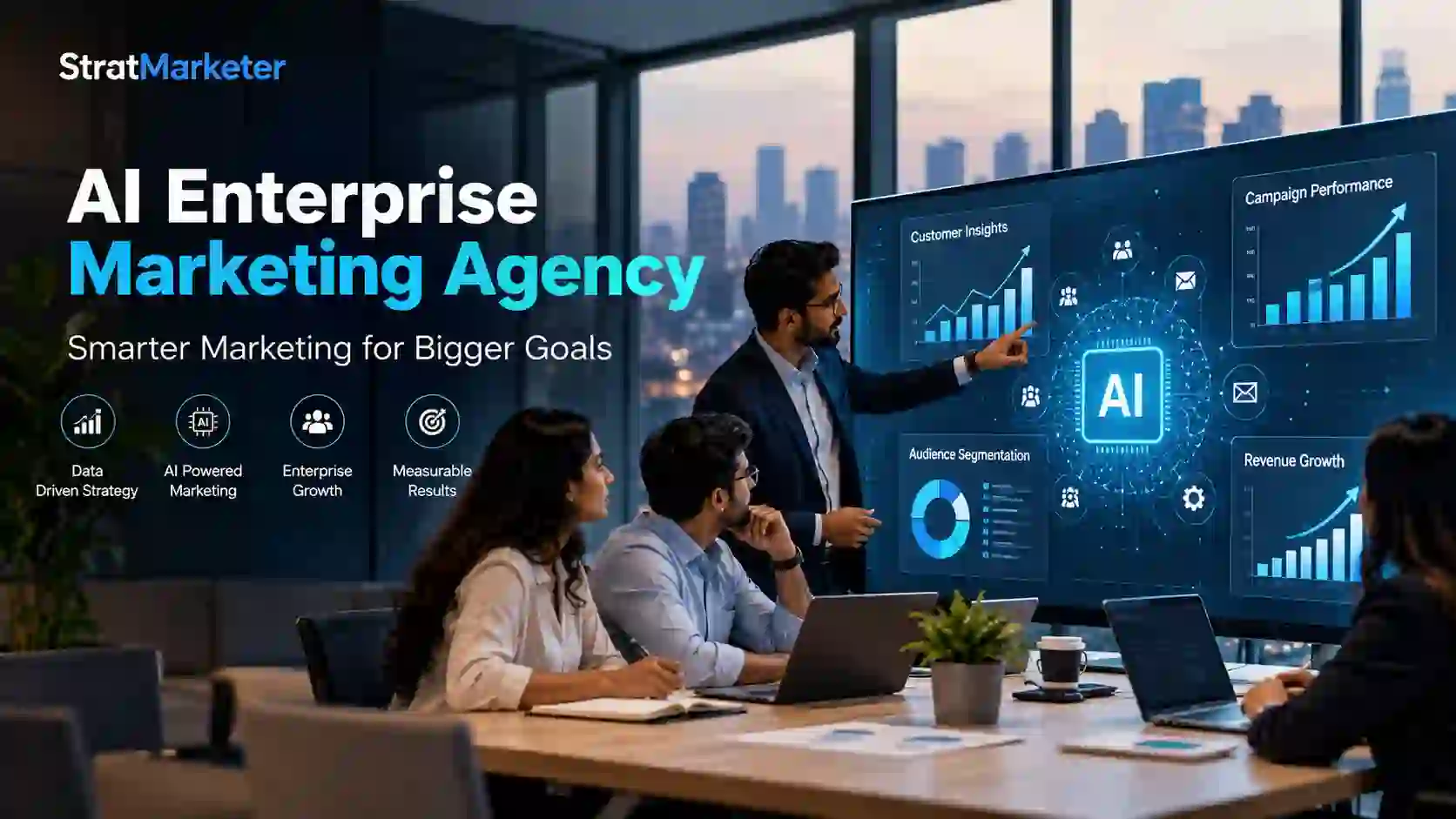
AI Enterprise Marketing Agency for Large Organisations
What Is an AI Enterprise Marketing Agency and What Does It Actually Do?
An AI enterprise marketing agency works on a very different scale from the typical digital marketing agency most companies are familiar with. A small business may need help with Google Ads, social media, SEO, email campaigns or lead generation. An enterprise may need all of these, but the real difficulty comes from making hundreds of moving parts work together.
Think about a large manufacturing company operating across India. It may have separate product teams, regional sales teams, distributors, dealers, CRM records, websites, advertising accounts and several customer segments. Marketing data may sit in different systems. One team may know that a prospect downloaded a product catalogue, while another team has already spoken to that same prospect.
That is where an AI enterprise marketing agency becomes useful.
The job is not simply to add an AI writing tool to the existing marketing process. The agency looks at how customer data, campaigns, sales activity, content, advertising and automation interact, then identifies where AI can actually support the system.
In practical terms, this can include AI assisted customer segmentation, predictive lead analysis, automated content workflows, campaign optimisation, CRM automation, conversational systems, marketing analytics and personalisation.
The important word here is enterprise.
Enterprise marketing usually involves more stakeholders, larger datasets, longer buying cycles and stricter approval processes. A marketing decision that takes five minutes in a small company may take several meetings in a large organisation because sales, IT, finance, legal and regional teams may all be involved.
An experienced AI enterprise marketing agency understands this friction.
I have seen marketing projects become unnecessarily complicated because teams start with the AI tool instead of the business problem. Someone introduces a new platform, creates a few automated campaigns and expects meaningful results. Three months later, nobody is quite sure who owns the system.
That approach rarely works well.
AI should fit into the marketing operation, not become another isolated technology sitting beside it.
For example, an enterprise company could use AI to identify high intent leads from thousands of CRM records. Another organisation may use AI to classify customer enquiries and route them to the right sales team. An ecommerce business might use AI to generate and test large numbers of product creatives while keeping brand and compliance rules in place.
The technology changes according to the requirement.
The business problem comes first.
Why Large Organisations Are Moving Towards AI Based Marketing Systems
There is a practical reason behind the growing interest in AI based marketing systems. Enterprise marketing produces an enormous amount of information.
Website visits. Search behaviour. CRM activity. Email engagement. Advertising interactions. Product enquiries. Sales conversations. Customer service tickets. Purchase history. Offline events.
A human marketing team can analyse some of this information, but there is a limit.
AI systems can process large volumes of information much faster and can identify patterns that might otherwise remain buried inside different platforms.
That does not mean AI automatically makes better decisions. This is where some conversations around enterprise AI become unrealistic.
Bad data processed very efficiently is still bad data.
If an organisation has duplicate customer records, outdated CRM information or disconnected systems, introducing AI will not magically solve those problems. It may actually make the consequences more difficult to notice because automated processes can operate at a much larger scale.
Large organisations are also dealing with increasingly complicated customer journeys. A potential buyer may interact with a search advertisement, visit a website, read several articles, attend a webinar, speak with a sales representative and return weeks later through a branded search.
Traditional reporting can struggle to connect these interactions properly.
An AI enterprise marketing agency can help build systems where these signals are interpreted together.
For instance, an enterprise software company might have thousands of leads entering its CRM every month. Instead of treating every lead equally, an AI system could examine firmographic information, previous engagement, website behaviour and sales activity to identify patterns associated with higher purchase intent.
The sales team can then decide how those leads should be handled.
That last part matters.
AI should support human decisions rather than quietly replacing them in situations where context matters.
Large organisations are also interested in automation because marketing teams often spend too much time on repetitive work. Reporting, data classification, audience grouping, campaign monitoring, content variations and lead routing can consume significant working hours.
When these tasks are automated properly, marketers can spend more time on positioning, customer research and campaign decisions.
But there is another reason enterprises are paying attention to AI.
Scale.
A campaign running across five cities is one thing. A campaign running across several countries, languages, product categories and customer segments is something else entirely. The amount of content and campaign variation required can become difficult to manage manually.
AI can help with that volume.
It does not remove the need for human review.
In my view, that distinction is often missed.
How AI Enterprise Marketing Agencies Handle Complex Customer Journeys
Enterprise customer journeys are rarely clean.
A customer may discover a company through organic search but convert after speaking to a salesperson. Another may respond to an email campaign but purchase through a distributor. A third may visit the website ten times before submitting an enquiry.
Then there are customers who disappear for six months and suddenly return.
An AI enterprise marketing agency has to account for these irregular paths.
One useful application is behavioural segmentation. Instead of creating audiences only from basic information such as location, age or industry, AI can analyse behavioural signals.
Consider a B2B engineering company selling expensive industrial equipment.
A visitor who spends three minutes on a general product page is not necessarily ready to speak to sales. But someone who visits technical specifications, downloads installation documentation, checks warranty information and returns several times may represent a very different level of intent.
An AI system can help identify these patterns.
The marketing team might then serve more relevant information, while the CRM can assign a different lead status or notify the sales team.
The process sounds simple when explained like this. In an actual enterprise environment, it is not.
Customer data may come from multiple sources. CRM fields may not match website identifiers. Regional teams may follow different lead qualification rules. Some information may need permission before it can be used for personalisation.
That is why enterprise AI marketing requires both marketing understanding and technical awareness.
An AI enterprise marketing agency may need to work with CRM systems, analytics platforms, advertising platforms, websites, customer data platforms and automation tools at the same time.
It also needs to understand what should not be automated.
Suppose a customer has submitted a serious complaint. An automated system sending a promotional email because the customer belongs to a high value segment could create a very poor experience.
The data may be technically correct.
The decision is still wrong.
This is one of those areas where human judgement remains important.
AI Marketing Across Multiple Departments, Markets and Business Units
One of the hardest enterprise marketing problems is not generating campaigns. It is maintaining consistency while allowing different teams to operate according to their own requirements.
A company may have a central marketing team in Mumbai, regional teams in Delhi and Bengaluru, separate sales operations, an ecommerce department and product marketing teams working independently.
Everyone wants speed.
Everyone also has their own priorities.
An AI enterprise marketing agency can help create shared systems without forcing every department into exactly the same workflow.
For example, a central team could establish common brand rules, audience definitions and reporting standards. Regional teams could then create campaigns suited to their local markets.
This becomes particularly useful for Indian businesses operating across different languages and customer behaviours.
A campaign that performs well in an English speaking urban audience may not work in the same way in a smaller city. Customer questions, preferred communication styles and purchase considerations can differ significantly.
AI can help marketers process these variations, but the interpretation still needs local understanding.
I would be cautious about any system that claims one AI model can understand every market equally well.
It cannot.
A manufacturing business selling products through distributors presents another challenge. The company may generate leads centrally, while actual sales happen through different dealer networks. Marketing needs to know which leads belong to which territory and whether the distributor has followed up.
AI can assist with routing, scoring and reporting.
The business still needs clear ownership.
Without that, automation simply moves confusion from one spreadsheet into a software system.
There is also the question of approval.
Large organisations often need legal, compliance and senior management approval before certain campaigns can go live. An AI workflow must accommodate these checkpoints rather than bypassing them.
This is where enterprise marketing differs sharply from a small campaign setup.
The system has to respect organisational reality.
Where Enterprise AI Marketing Projects Commonly Go Wrong
The first mistake is usually starting with the technology.
A company hears about generative AI, predictive analytics or AI agents and immediately asks how it can deploy them across marketing.
The better question is much less exciting.
Where is the current marketing process wasting time, losing information or failing to identify useful customer signals?
Start there.
Another common issue is poor CRM hygiene.
I have come across situations where the same company had multiple records for one prospect because different teams entered the information in slightly different ways. An AI system can classify those records very quickly, but unless the underlying data model is fixed, the organisation still has a data problem.
Then there is excessive automation.
Not every email needs to be generated by AI. Not every customer interaction needs a chatbot. Not every campaign decision should be automated.
Sometimes a straightforward rule works better.
This is something I would argue quite strongly. Enterprise teams sometimes make simple marketing operations unnecessarily complicated because an AI component sounds more sophisticated. If a basic CRM rule can route a lead correctly, there is little value in creating a complex AI workflow just to say AI was involved.
Cost and maintenance are another overlooked area.
An AI marketing system is not a one time installation. Models change. Integrations break. customer data changes. Campaign objectives change. Teams change.
Someone has to monitor the system.
Someone has to review unusual outputs.
Someone has to decide what happens when the model gets something wrong.
There is also a human adoption problem.
A marketing director may approve an AI workflow, but if the sales team does not trust the lead scoring system, they may continue using their old process. The technology then exists, but the organisation does not actually use it.
That failure is frustrating because it often appears in reports only much later.
And one more issue deserves attention: overconfidence in AI generated content.
AI can produce readable copy very quickly. That does not mean the copy understands the product deeply. Enterprise brands often have technical, regulatory or industry specific requirements that generic AI content can miss.
A financial services company, pharmaceutical business or industrial manufacturer cannot treat AI generated content in the same way as a casual social media post.
Human review remains necessary.
I might be wrong here, and this may not apply everywhere, but I have become increasingly cautious about enterprise projects that promise complete marketing automation from day one. The more complex the organisation, the more useful a phased approach usually becomes.
Start with one workflow.
Measure what happens.
Fix what breaks.
Then expand.
There is no prize for automating twenty processes when three of them are unreliable.
And sometimes the old spreadsheet, irritating as it is, is telling you something important about how the organisation actually works.
The difficult part of enterprise AI marketing is rarely the AI itself. It is understanding the business well enough to know where the technology belongs, where it does not, and when a human should simply take over.
Data, CRM and Technology Integration in Enterprise Marketing
A large organisation rarely has all its marketing information sitting in one place. The website may run on one platform, customer information may sit inside a CRM, advertising data may come from several accounts, sales teams may maintain their own records, and customer service may have another system altogether.
This is where an AI enterprise marketing agency has to deal with something less glamorous than AI itself: integration.
A marketing director may ask for AI based lead scoring, for example. That sounds straightforward until someone asks where the lead information is coming from.
Is the CRM updated regularly? Are duplicate records removed? Does the website pass complete enquiry information? Are offline sales conversations recorded? Can the advertising platform be connected to the CRM? Are different regional teams using the same lead stages?
If the answer to these questions is unclear, the AI model is not the first problem to solve.
The data is.
An AI enterprise marketing agency may therefore spend considerable time understanding the existing technology environment before introducing new automation. This can include CRM systems, analytics platforms, advertising accounts, customer databases, email platforms, websites and internal reporting tools.
The purpose is not to connect every possible system.
That can actually create another mess.
The useful question is which information needs to move between which systems and why.
Take a company selling industrial machinery across India. Marketing may generate an enquiry from Pune, the lead may enter the CRM, a regional sales manager may qualify it, and the actual order may eventually be processed through a distributor. If these stages are disconnected, the marketing team may report a lead while the sales team sees a completely different customer journey.
AI cannot fix that simply by being added on top.
The underlying data flow has to make sense first.
This is also why CRM structure matters so much. Lead stages, customer categories, product interests, geography and engagement history should have reasonably consistent definitions. If one team calls a prospect “qualified” after a brochure download while another requires a sales conversation, the resulting AI analysis becomes difficult to trust.
There is another concern that often gets ignored.
Access.
Enterprise marketing data can contain commercially sensitive information. An organisation cannot casually connect every internal dataset to every AI tool without considering permissions, security requirements, data handling practices and internal governance.
So an AI enterprise marketing agency is not merely choosing an AI platform. It is helping determine how AI fits into an existing technology environment without creating unnecessary exposure or operational confusion.
And sometimes the right answer is not another platform.
Sometimes cleaning the CRM is more valuable.
How AI Enterprise Marketing Changes Content, Advertising and Lead Generation
Content is probably the most visible area where AI has changed marketing work.
A marketing team can now produce multiple content variations much faster than before. Product descriptions, email variations, landing page copy, advertising concepts, social posts, FAQs and campaign ideas can all be created with AI assistance.
But enterprise content has a problem that smaller businesses sometimes avoid.
Volume is not the same as usefulness.
A large company may have hundreds of products and several customer segments. Producing ten versions of a generic message for every product does not automatically make the communication more relevant.
An AI enterprise marketing agency can use customer information, product data and campaign signals to create more context specific content.
For example, a manufacturer selling electrical equipment may communicate differently with an architect, procurement manager, contractor and distributor. The underlying product remains the same, but their questions are not.
An architect may care about technical specifications.
A procurement team may focus more heavily on pricing, supply and documentation.
A contractor may want installation information.
A distributor may be concerned with margins, stock availability and territory.
AI can help marketers create and manage these variations at a scale that would be difficult manually.
But there should still be a human checking the output, particularly where technical or regulated information is involved.
Advertising is another area where the change is becoming noticeable.
Enterprise advertisers can generate more creative variations, test different messages and analyse campaign signals at a much larger scale. AI can assist with audience analysis, creative variations, keyword grouping, bid related decisions and campaign monitoring, depending on the platform and setup.
The danger is allowing automation to continue without business context.
Suppose an advertisement receives a large number of clicks but generates enquiries from customers who are not commercially useful. An automated system may see strong engagement and continue pushing similar traffic.
The marketing team sees a problem.
The machine sees a successful pattern.
This is why lead quality matters.
An AI enterprise marketing agency can connect advertising activity with CRM information where the technology and data setup allows it. Instead of asking only which campaign generated the most leads, the organisation can start asking which campaign generated leads that progressed through meaningful sales stages.
That is a much more useful conversation.
Lead generation itself can also change.
AI can help classify incoming enquiries, identify potential intent, segment prospects and route leads to appropriate teams. For B2B businesses, this can be particularly useful because the difference between a casual enquiry and a commercially serious prospect can be significant.
Still, lead scoring should not become a mysterious number nobody understands.
Sales teams need to know why a lead has been classified in a particular way. If the system keeps sending low quality leads while ignoring prospects that experienced salespeople consider valuable, trust disappears quickly.
The best enterprise marketing systems leave room for feedback.
Sales teams should be able to say, “This type of lead is usually poor quality” or “These enquiries look weak initially but convert later.”
That information can then become part of the wider process.
Measuring AI Marketing Performance Beyond Leads and Website Traffic
Enterprise marketing reporting has traditionally leaned heavily on familiar numbers.
Traffic.
Clicks.
Leads.
Cost per lead.
Conversion rate.
These numbers are still useful. The problem begins when they become the entire definition of performance.
An AI enterprise marketing agency should look deeper into what happens after a lead enters the system.
A lead may be generated at a low cost but never become a serious opportunity. Another lead may cost considerably more but eventually become a large account.
If the reporting system treats both leads as equal, the organisation is missing part of the commercial picture.
For enterprise businesses, useful measurements can include qualified opportunities, sales pipeline contribution, customer acquisition cost, conversion between sales stages, revenue influenced by campaigns, repeat purchases and customer value.
The exact metrics depend on the business.
A manufacturing company with a six month sales cycle should not necessarily judge its marketing team using the same immediate conversion expectations as an ecommerce brand selling ₹1,500 products.
That sounds obvious, but reporting systems often flatten these differences.
AI can also help identify patterns between marketing activity and later customer behaviour. For example, certain combinations of content consumption, product interest and sales interaction may appear more frequently among customers who eventually purchase.
That information can be valuable.
But attribution needs caution.
Marketing rarely deserves all the credit for a complex enterprise sale. A customer might interact with an advertisement, speak to a salesperson, attend an industry event, receive a distributor recommendation and then purchase months later.
Which activity caused the sale?
There may not be one clean answer.
This is where I would be careful about impressive looking dashboards. A dashboard with fifty metrics can look sophisticated while still failing to answer the basic question of what is actually working.
For an AI enterprise marketing agency, measurement should connect marketing activity with business outcomes without pretending that every outcome can be perfectly attributed.
There is also an operational metric that deserves more attention: time saved.
If an AI system reduces hours spent on repetitive reporting, lead classification or campaign preparation, that has value even if it does not immediately appear as additional revenue.
Likewise, if a system helps a sales team respond to high intent enquiries faster, the benefit may appear later in conversion rates rather than in the original marketing dashboard.
Measurement needs patience.
Enterprise sales rarely move at the speed of a social media campaign.
How StratMarketer Approaches AI Enterprise Marketing for Large Organisations
StratMarketer approaches enterprise AI marketing from the point where marketing activity and business operations meet.
The first consideration should be the organisation’s actual marketing environment. What platforms are already being used? Where does customer data sit? How are leads currently generated and handled? Which parts of the process depend heavily on manual work? Where are teams losing useful information?
These questions matter before selecting an AI solution.
For a large organisation, StratMarketer can look at areas such as AI assisted content workflows, SEO, paid advertising, lead generation, CRM automation, customer segmentation, campaign analysis, conversational marketing and marketing process automation.
The important part is how these pieces connect.
For instance, improving paid advertising without understanding what happens to leads after they enter the CRM may only increase the number of enquiries. Improving content without understanding which customer segments are commercially valuable may produce more traffic without producing better opportunities.
An AI enterprise marketing agency needs to look at those connections.
StratMarketer can also approach enterprise marketing in stages rather than assuming that the entire organisation needs to be automated immediately.
A company may begin with one high volume process, such as lead classification. Once the workflow is tested and the team understands the output, other areas can be considered.
This approach also makes problems easier to identify.
If something fails, there is a reasonable chance of understanding why.
Enterprise organisations also need flexibility across departments and locations. A national company may require different campaigns for different regions while maintaining central brand standards. A B2B organisation may need completely different marketing workflows for enterprise accounts and smaller customers.
AI can support these differences, but the system should not become so complicated that nobody knows how it works.
That is a concern worth taking seriously.
There is also a temptation to make every StratMarketer service sound like an AI service simply because AI is currently important. That would be misleading. Some marketing problems still need good SEO, proper content research, sensible paid advertising, clean tracking or better landing pages.
AI is not a substitute for basic marketing discipline.
In some cases, the most useful enterprise AI project may involve improving the existing process rather than adding a new one.
I might be wrong here, because every organisation has different constraints, but this is one area where restraint can be useful. A large company does not necessarily need more automation. It may need fewer disconnected systems and clearer ownership.
That difference can save a lot of unnecessary work.
Frequently Asked Questions About AI Enterprise Marketing Agency
What does an AI enterprise marketing agency do?
An AI enterprise marketing agency helps large organisations use AI across marketing activities such as customer segmentation, content, advertising, lead management, CRM workflows, campaign analysis and automation. The exact work depends on the organisation’s existing systems and objectives.
Is an AI enterprise marketing agency only useful for large companies?
Not necessarily. Smaller companies can also use AI marketing services, but enterprise projects usually involve more complex data, technology systems, departments and approval processes.
Can AI replace an enterprise marketing team?
Not realistically across the entire marketing function. AI can automate repetitive tasks and support analysis, content production and campaign operations, but strategy, brand decisions, customer understanding and business judgement still require people.
How does AI help with enterprise lead generation?
AI can help analyse customer behaviour, classify enquiries, identify patterns, segment prospects and support lead scoring. Its usefulness depends heavily on the quality of the underlying customer and CRM data.
Does an AI enterprise marketing agency need access to the company’s CRM?
Not always. It depends on the project. Some marketing tasks can be handled without direct CRM access, while lead scoring, lifecycle automation and deeper revenue analysis may require appropriate integration.
Can AI improve enterprise advertising campaigns?
It can assist with campaign analysis, audience segmentation, creative variations and optimisation. However, advertising performance still depends on factors such as offer quality, positioning, targeting, tracking and the actual market.
How long does enterprise AI marketing implementation take?
There is no sensible single timeframe for every organisation. A focused workflow can be implemented relatively quickly, while larger projects involving several systems, departments and data sources can take much longer.
What should an enterprise company check before hiring an AI enterprise marketing agency?
Look at its understanding of enterprise marketing processes, technology integration, CRM, data handling, reporting and actual marketing operations. A company that only demonstrates AI generated content may not have the wider experience required for a complex enterprise environment.
Can StratMarketer work with existing marketing systems?
Yes, the practical approach is usually to understand the systems already being used and then identify where AI and automation can fit. Replacing existing platforms should not automatically be treated as the first step.
Is AI enterprise marketing suitable for Indian companies?
It can be particularly useful for Indian organisations managing multiple regions, languages, sales teams, distributors and customer segments. The setup still needs to account for the company’s industry, technology environment, data practices and internal processes.
Our Services
Contact Us
- Paonta Sahib, Himachal Pradesh, India
- +91-8700998508
- support@stratmarketer.com
Start From Here
These two options make it easy for you to get the information you want.