


AI Cloud Marketing Agency for Smarter Digital Marketing
What Is an AI Cloud Marketing Agency and Why Does It Matter?
There is a point in many growing companies where marketing starts feeling unnecessarily complicated. Leads are coming from Google, Meta, LinkedIn, WhatsApp, email, the website and sometimes marketplaces. The CRM has another version of the customer story. The sales team has its own notes. Then someone asks for a report, and suddenly three people are downloading spreadsheets and trying to figure out which number is actually correct.
This is where an AI cloud marketing agency becomes relevant.
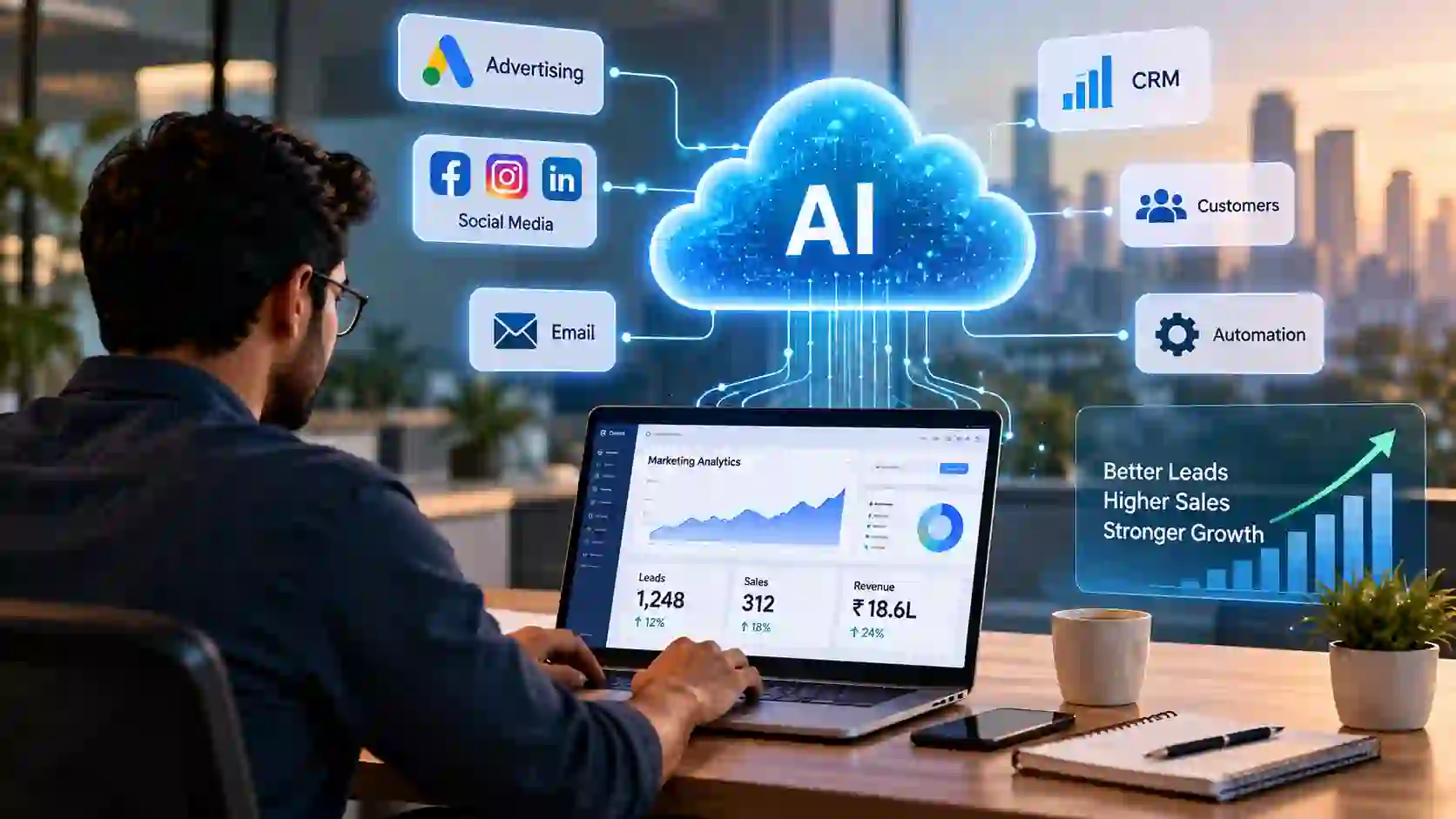
An AI cloud marketing agency brings artificial intelligence, cloud based marketing infrastructure, customer data, automation and campaign management into a connected working environment. Instead of treating SEO, advertising, CRM, analytics and customer communication as completely separate activities, the idea is to let these systems exchange information and respond to customer behaviour.
That sounds technical, but the business problem is quite ordinary.
A manufacturing company in Ahmedabad may receive an enquiry through Google, another through WhatsApp and another from an old customer. If these interactions sit in separate systems, the marketing team sees three activities. The business owner sees three leads. In reality, it might be one company researching the same product through different channels.
An AI cloud marketing agency tries to make that picture clearer.
The cloud part matters because modern marketing rarely operates from one computer or one database. Data needs to move between platforms. AI matters because there is simply too much information for a person to examine manually every day.
And marketing matters because all of this technology is useless if it does not help a real customer make a decision.
Why Marketing Teams Are Moving Towards Cloud Based AI Systems
Traditional marketing software was often purchased to solve one particular problem.
One platform handled email. Another handled CRM. Another handled advertising. Analytics sat somewhere else. A chatbot was added later. Then a separate reporting tool appeared because nobody liked the reports from the first tools.
This arrangement can work for a while.
Then the company grows.
A sales manager wants to know which campaigns are generating qualified enquiries. The marketing manager wants to know which audience segments are responding. The founder wants to know why advertising costs increased. The CRM contains thousands of contacts, but many records are duplicated or incomplete.
At this point, simply adding another tool does not necessarily solve the problem.
An AI cloud marketing agency usually looks at the connections between these systems.
For example, website behaviour can be connected with CRM information. Advertising data can be brought into a central reporting environment. AI models can then identify patterns in customer activity, classify leads, recommend audience groups or help automate follow ups.
There is an important distinction here.
AI does not magically make poor marketing data useful.
If the CRM has duplicate customers, incorrect phone numbers, missing source information and inconsistent sales stages, feeding that information into an AI system does not suddenly create truth. It can actually create more confident looking mistakes.
I have seen this problem repeatedly in marketing projects. A company becomes excited about automation before checking whether its basic data structure is reliable. Six months later, everyone is blaming the AI when the original issue was bad data entry.
That is one reason cloud marketing architecture needs to be treated as part of marketing operations, not as a fancy technology project.
Cloud systems also change how teams work
A cloud based setup allows authorised teams to access marketing information from different locations and devices. More importantly, different applications can exchange information through APIs, connectors and automation workflows.
A lead might enter through a landing page.
The CRM records it.
An automation system assigns a lead category.
The sales team receives the enquiry.
The advertising platform can later receive conversion information.
An analytics system can connect campaign activity with downstream business outcomes.
AI can then examine patterns across these interactions.
The individual components are not particularly mysterious. The value comes from making them work together.
How AI Cloud Marketing Agency Services Connect Data, CRM and Advertising
This is probably the part that sounds more complicated than it really is.
Think about a B2B company selling industrial equipment. It may have website traffic, Google Ads, LinkedIn campaigns, enquiry forms, email campaigns, a CRM and a sales team.
Without integration, marketing may report 2,000 website visitors and 150 enquiries.
Sales may report 38 serious opportunities.
Finance may report 11 actual orders.
Everyone is technically talking about the same business, but each department is looking through a different window.
An AI cloud marketing agency can help connect these layers.
The website can pass enquiry data into the CRM. Campaign source information can be retained. CRM stages can be mapped to actual sales outcomes. Advertising platforms can receive qualified conversion signals instead of only counting form submissions.
That last point is particularly important.
A marketing platform can easily optimise for form submissions. But ten cheap forms are not necessarily better than two serious buyers.
Suppose a solar equipment company receives 100 enquiries. Perhaps 60 are looking only for residential pricing, 20 are outside the service area, 15 are genuine commercial prospects and 5 are existing customers asking for support.
If the advertising system treats all 100 enquiries as equal conversions, its optimisation process is working with the wrong signal.
A better integrated setup can distinguish between those outcomes.
The AI layer can assist with classification, scoring and pattern identification. The cloud layer provides the infrastructure for data exchange and storage. The CRM remains important because it contains the commercial journey.
The agency’s job is not simply to connect everything because it can.
It needs to decide what should actually be connected.
That difference matters.
CRM integration is where many projects become messy
CRM data often reflects years of business habits.
One salesperson writes “hot lead”. Another writes “urgent”. Someone else selects “qualified”. A fourth person leaves the stage unchanged for three months.
An AI cloud marketing agency may use rules and models to standardise or interpret this information, but the business still needs sensible definitions.
What is a qualified lead?
What counts as an opportunity?
When does a lead become inactive?
What should happen when someone downloads a brochure three times but never contacts sales?
These questions sound basic. They are not.
A useful cloud marketing system is built around business definitions first and technology second.
Using AI to Personalise Customer Journeys Across Multiple Channels
Personalisation used to mean putting a customer’s first name into an email.
That is not particularly impressive anymore.
Modern personalisation can involve timing, product interest, previous interactions, location, customer status, content consumption and purchase behaviour.
Consider an Indian education company.
A student visits a course page, downloads a syllabus and returns two days later. Later, the same person opens an email about course fees but does not book a counselling call.
A connected marketing system can recognise these actions.
The next communication does not have to repeat the same generic advertisement. It could address fees, financing, course duration or the next step in the application process.
The same principle works in ecommerce.
Someone who repeatedly views running shoes should not necessarily receive the same message as someone who purchased running shoes last week.
AI can help identify behavioural patterns and decide which content, audience or action may be relevant.
But there is a line that marketers should be careful about.
Too much personalisation becomes uncomfortable.
I personally prefer systems that use customer behaviour to make communication more useful rather than systems that try to prove how much they know about the customer. There is a subtle difference. A customer does not need to be reminded that a company has tracked every page they visited.
Good personalisation often feels ordinary.
The right message appears at the right moment.
That is enough.
Personalisation also depends on context
Location can matter in India because buying behaviour varies significantly across markets.
A B2B software company targeting Bengaluru startups may communicate differently from one targeting manufacturers in Rajkot. A healthcare brand may have different communication requirements in Mumbai compared with a smaller city. Even language preferences can influence engagement.
An AI cloud marketing agency can combine these signals with customer data to create more relevant journeys.
For example:
A new visitor may receive educational content.
A returning visitor may receive product comparison information.
A lead who has spoken to sales may receive case studies.
An existing customer may receive onboarding or cross sell communication.
The important part is not the number of automated messages.
It is whether the journey makes sense.
I might be wrong here, but I think marketers sometimes underestimate how much simplicity matters. A technically sophisticated customer journey with twelve automated branches can still perform badly if the customer simply wants a clear answer.
AI Cloud Marketing for Lead Generation, Sales and Customer Retention
Lead generation is usually where businesses first notice the practical value of an AI cloud marketing agency.
Marketing teams already collect enormous amounts of information from campaigns.
Search terms.
Ad interactions.
Landing page activity.
Form submissions.
Email engagement.
CRM activity.
Sales conversations.
Website behaviour.
The difficult part is turning these signals into useful action.
AI can assist with lead scoring by identifying patterns associated with previous conversions. It can classify incoming enquiries, identify potential duplicates, summarise customer interactions and help sales teams prioritise follow ups.
For example, imagine a machinery manufacturer receives 500 enquiries over several months.
A simple system may classify them according to form fields.
A more advanced setup can consider company size, product interest, previous website activity, enquiry language, requested quantity and sales history.
That does not mean the AI knows who will buy.
It means the sales team has more information available when deciding where to spend its time.
That distinction is important.
AI should support sales judgement, not pretend to replace it.
Lead generation becomes more useful when sales data comes back into marketing
This is where many businesses leave money on the table.
Marketing generates leads and sends them to sales.
Then the marketing team starts another campaign without learning what happened to the previous leads.
An integrated AI cloud marketing agency setup can create a feedback loop.
Suppose Google Ads produces 200 leads.
Sales later identifies 30 as qualified opportunities and 8 become customers.
That information is much more valuable than simply knowing that Google Ads produced 200 leads.
The campaign can then be analysed against actual business outcomes.
Perhaps one keyword generated many enquiries but almost no serious opportunities. Another generated fewer leads but a much higher proportion of buyers.
This is where AI assisted marketing becomes more commercially useful.
Not because AI wrote an advertisement.
Because the system has a better understanding of what happened after the click.
Retention is another area where cloud systems quietly matter
Customer retention is often treated as a separate function, but marketing data can help identify when existing customers need attention.
For a SaaS company, declining product usage might indicate that an account needs support.
For an ecommerce business, a customer who used to purchase every month and suddenly stops may be worth a reactivation campaign.
For a manufacturing supplier, a customer whose normal order cycle has passed could be contacted by the sales team.
These are not futuristic scenarios.
Businesses have been doing parts of this manually for years.
The difference is scale.
An AI cloud marketing agency can help automate the monitoring and response process so that the sales or marketing team does not have to remember every customer individually.
Still, automation needs restraint.
If every unusual behaviour triggers an email, WhatsApp message and sales call, the customer will notice. And not in a good way.
There should be judgement built into the system.
What this looks like for an Indian business
Take a mid sized D2C brand selling personal care products.
The brand runs Meta Ads, Google Ads, email marketing and WhatsApp campaigns. Orders are stored in an ecommerce platform while customer conversations sit somewhere else.
At first, the business may judge campaigns by revenue and return on ad spend.
An AI cloud marketing agency can help connect additional signals.
Which customers purchased once?
Which customers purchased three times?
Which products are commonly bought together?
Which customers stopped buying?
Which campaign attracted high value customers?
Which audience generated orders but also unusually high refund rates?
Now the marketing team has a richer picture.
There is still no guarantee that AI will find some magical hidden pattern. Sometimes the pattern is obvious once the data is connected. Sometimes there is no useful pattern at all.
That is normal.
Marketing teams should be comfortable with both outcomes.
And there is another practical issue. Indian businesses often have fragmented customer data because different teams adopt different tools at different stages of growth. One department may use Excel, another a CRM, another WhatsApp, another a marketplace dashboard. Getting these systems to communicate properly can take more effort than the AI implementation itself.
This is where StratMarketer can approach AI cloud marketing as an operating problem rather than simply an advertising problem.
The focus should be on how information moves through the business, where decisions are being made, and which parts genuinely benefit from automation.
Not every task needs AI.
Not every customer journey needs ten steps.
Not every campaign needs a prediction model.
Sometimes the most useful change is simply getting the CRM, website and advertising data to agree with each other.
And yes, there is a slightly uncomfortable part of all this.
Businesses can spend a lot of money building sophisticated marketing infrastructure and still have weak offers, unclear messaging or poor sales follow up. No cloud architecture fixes that. A perfectly connected system can faithfully show you that customers do not want what you are selling.
That is useful information, but it can be painful to look at.
I might be wrong here, and this does not apply everywhere, but the companies I have seen get the most practical value from AI cloud marketing are usually not the ones asking for the most AI features. They are the ones willing to clean their data, define their customer stages properly and let marketing learn from what happens after the lead arrives.
There is something almost boring about that.
Boring can be good.
Because once the technology settles down, the real question is still the same one a business owner has always had: who is the customer, what do they need, and what should happen next?
The Role of Cloud Infrastructure in Marketing Automation and Analytics
Most people think of cloud infrastructure as something belonging to the IT department. Servers, storage, APIs, databases, permissions and security settings sound far removed from marketing.
But marketing increasingly depends on all of them.
When a customer fills out a form on a website, that information has to travel somewhere. When a lead changes from “new” to “qualified”, another system may need to know. When an ecommerce customer purchases for the second time, an email or WhatsApp workflow may need to respond differently. When an advertising platform receives conversion information, the quality of that signal can affect future campaign optimisation.
The cloud provides the environment in which these activities can happen reliably.
An AI cloud marketing agency may work with cloud databases, CRM systems, marketing automation platforms, analytics tools, customer data platforms and API connections. The exact technology varies from one business to another. There is no universal stack that every company should copy.
That is actually a good thing.
A manufacturing company with a long B2B sales cycle has very different requirements from a D2C brand processing thousands of orders every month.
For a B2B company, the important information may be company size, enquiry value, sales stage, product category and expected order date. For ecommerce, purchase history, product affinity, repeat orders and customer lifetime value may matter more.
The infrastructure needs to reflect that reality.
Why automation sometimes fails quietly
One problem with marketing automation is that failures are not always obvious.
An advertisement may still be running. The website may still be online. The CRM may still open normally. But if a data connection has stopped passing information, nobody notices until the monthly report looks strange.
This happened to a business I was reviewing where leads were reaching the sales team, but the campaign source information was not being carried through properly. The company initially thought its reporting problem was an analytics issue. It turned out to be a broken field mapping between two systems.
Small technical detail.
Large reporting problem.
An AI cloud marketing agency needs to think about these connections because AI models are only as useful as the information reaching them. If the underlying events are incomplete, automated decisions can become unreliable.
Cloud infrastructure also makes centralised reporting easier. Marketing teams can bring information from different platforms into a common environment and examine customer activity across a longer period rather than looking at individual platform dashboards.
There is still work involved.
Data needs cleaning. Access needs to be controlled. Events need consistent naming. Tracking needs to be checked. Old records may need to be dealt with.
Cloud does not mean effortless.
That is one point I would insist on when evaluating an AI cloud marketing agency. If someone spends most of the conversation talking about AI features but barely asks where your customer data lives, how your CRM is structured or how conversions are currently recorded, I would be cautious.
Common Problems Businesses Face When Adopting AI Cloud Marketing
The first problem is usually not AI.
It is confusion.
A business may have ten different marketing tools, three agencies, several spreadsheets and a CRM that nobody fully trusts. Then someone decides that AI should connect everything.
That is backwards.
Before automation, there needs to be some understanding of what the business is trying to automate.
Data quality is another recurring issue. Duplicate contacts are common. Old leads remain active. Customer records have missing information. Sales teams use different definitions for the same stage.
An AI cloud marketing agency can help organise these problems, but it cannot simply wish them away.
If 5,000 customer records contain inconsistent information, the first useful task may be cleaning and standardising them.
Not building a chatbot.
Integration costs can be underestimated
Connecting two systems may sound simple.
Sometimes it is.
Sometimes it is not.
An older CRM may have limited API support. A business may be using a custom website. An advertising account may have incomplete conversion tracking. A marketplace may provide only certain customer fields. A finance system may have different customer identifiers from the CRM.
Then there are permissions and security requirements.
A serious AI cloud marketing agency has to account for these practical details. Otherwise, the project can look excellent in a presentation and become painful during implementation.
There is another issue that I think gets ignored too often: employees.
If the sales team does not understand why a new CRM field matters, they may leave it blank. If marketers do not trust an AI generated lead score, they may ignore it. If the reporting dashboard uses unfamiliar definitions, people may continue making their own spreadsheets.
Technology cannot force operational discipline very easily.
Training and adoption matter.
Too much automation can create its own problem
Earlier, I argued that automation can reduce repetitive work.
I still believe that.
But automation is not automatically good.
A poorly designed workflow can send irrelevant emails, create duplicate CRM records, notify salespeople about low quality leads or keep contacting customers after they have already purchased.
That creates friction.
I have personally seen marketing teams become so focused on making a workflow technically possible that nobody stopped to ask whether the customer would actually appreciate receiving the message.
That is where an AI cloud marketing agency needs restraint.
The best automation is often invisible to the customer.
They simply get the right information when they need it.
There are also concerns around privacy, permissions and data governance. Businesses handling customer information should understand what data is collected, where it is stored, who can access it and how third party systems use it. The exact obligations depend on the business, sector, geography and technology stack, so these questions should not be treated as an afterthought.
And then comes the human resistance.
Someone will say, “We have always done it this way.”
Sometimes they are wrong.
Sometimes they have a very good reason.
Both possibilities need to be investigated before changing the process.
How StratMarketer Approaches AI Cloud Marketing for Indian Businesses
At StratMarketer, the useful starting point for AI cloud marketing should not be the question, “Which AI tool should we use?”
It should be, “Where is marketing information getting lost?”
That question changes the conversation.
For one business, the answer might be between Google Ads and the CRM. For another, it could be the gap between website enquiries and sales follow up. An ecommerce company might have customer data scattered across its store, advertising platforms, email software and WhatsApp.
A local business may have an entirely different issue. The owner may be handling leads personally, using WhatsApp conversations as the CRM and checking advertising results once a week.
There is no point giving that company a giant enterprise architecture on day one.
Start where the friction is.
A practical AI cloud marketing approach can involve mapping the customer journey first, identifying the important data points, checking the existing tools and then deciding which connections are actually worth building.
For example, an Indian B2B manufacturer may need a setup where:
Website enquiries enter the CRM.
Lead source is preserved.
Enquiries are classified according to product interest.
Sales receives the relevant information.
Lead stages are updated.
Qualified opportunities are connected back to campaign reporting.
AI assists with lead classification and customer interaction analysis.
Management can see the relationship between marketing activity and actual opportunities.
The important word is “actual”.
A dashboard showing 20,000 visitors may look impressive but tells very little about commercial performance by itself.
StratMarketer can also look at automation opportunities beyond lead generation. Customer segmentation, remarketing, email workflows, WhatsApp communication, content personalisation, campaign analysis and reporting can all form part of an AI cloud marketing setup when they have a clear business purpose.
I would not automate everything.
Some customer conversations need people. Some sales decisions need people. Some unusual cases are better handled manually because the cost of getting them wrong is high.
AI should have room to assist without being given authority over every decision.
That balance becomes especially relevant for Indian businesses because many companies are operating through a mixture of modern software and very traditional processes. A sales executive might update a CRM in the morning and then keep the actual customer conversation in WhatsApp. An owner might still maintain a private Excel sheet because they trust it more than the official dashboard.
It can feel messy.
But that mess contains useful information about how the business actually operates.
An AI cloud marketing agency should understand the real workflow before trying to redesign it.
Sometimes the best system is not the most sophisticated one.
It is the one people actually use.
Measuring AI Cloud Marketing Beyond Leads, Clicks and Traffic
Marketing reports have become very good at counting activity.
Clicks.
Impressions.
Sessions.
Leads.
Engagement.
Conversions.
These numbers have their place, but they do not necessarily tell the full commercial story.
Suppose an AI cloud marketing agency helps a company generate 1,000 leads.
That sounds substantial.
Now imagine only 20 become genuine sales opportunities and two become customers.
The lead count is not enough.
A better measurement framework follows the customer further into the business.
For a B2B company, that might mean looking at:
Qualified lead rate.
Opportunity creation.
Pipeline value.
Sales conversion.
Average deal value.
Customer acquisition cost.
Time from enquiry to sale.
Revenue by acquisition source.
For ecommerce, the useful measures could include:
Repeat purchase rate.
Customer lifetime value.
Average order value.
Contribution after advertising and fulfilment costs.
Refund rate.
Retention by acquisition source.
The exact metrics should depend on the business.
This is where AI can help with analysis. Instead of asking someone to manually compare thousands of customer records, models can identify patterns, group customers, flag unusual changes and assist with forecasting.
But there is a difference between identifying a pattern and explaining it.
If an AI system tells you that one customer segment is becoming less active, someone still needs to investigate why.
Perhaps the pricing changed.
Perhaps a competitor launched a better offer.
Perhaps the customers are seasonal.
Perhaps the tracking is broken.
Perhaps nothing important happened.
AI can point towards a question. It should not always be treated as the final answer.
That distinction matters when measuring an AI cloud marketing agency’s work.
I would rather see a business reduce wasted advertising spend, improve qualified lead handling and understand its customers more clearly than celebrate a large increase in dashboard activity.
There is also a time factor.
Some marketing channels convert quickly. Others take months. A manufacturing company selling equipment worth several lakh rupees cannot always be evaluated using the same timeframe as a consumer brand selling a ₹799 product.
This is where simple reporting can become misleading.
The numbers need context.
And sometimes the most useful metric is not a marketing metric at all. It may be sales cycle length, repeat orders, gross margin or the percentage of enquiries that sales can actually contact.
That is not as glamorous as an AI dashboard.
It is probably more useful.
Frequently Asked Questions About AI Cloud Marketing Agency
What does an AI cloud marketing agency actually do?
An AI cloud marketing agency combines marketing strategy with cloud based data systems, automation, analytics, CRM integration and AI tools. The exact work depends on the company’s existing technology and marketing process.
It can involve campaign management, customer segmentation, lead scoring, reporting, automation, personalisation and data integration.
Is an AI cloud marketing agency useful for small businesses?
It can be, but the approach should be proportionate.
A small business may not need a complex cloud architecture. It may benefit more from connecting its website, CRM, advertising and customer communication properly.
The technology should match the business rather than the other way around.
Does AI replace a marketing team?
No.
AI can automate repetitive tasks and help analyse large amounts of information, but marketing still requires judgement, positioning, creative thinking, customer understanding and commercial decisions.
A human team also needs to check important outputs rather than assuming that every AI recommendation is correct.
What data does an AI cloud marketing agency need?
It depends on the objective.
Common sources include website activity, CRM records, advertising data, ecommerce transactions, email engagement, customer interactions and sales outcomes.
The quality and relevance of the data matter more than simply having a large quantity of it.
Can AI cloud marketing improve lead quality?
It can help identify patterns associated with qualified leads and distinguish different types of enquiries.
But it cannot guarantee that every high scoring lead will become a customer. Sales feedback remains important because the CRM needs to learn from what actually happens after an enquiry.
Is cloud marketing only for large companies?
No.
The architecture can be scaled according to the size and needs of a business. A smaller company may use a relatively simple set of connected tools, while a larger organisation may need more complex data infrastructure and governance.
The mistake is assuming that more technology automatically means better marketing.
How long does it take to implement AI cloud marketing?
There is no sensible single timeline.
A simple CRM and advertising integration may take considerably less time than connecting multiple legacy systems, cleaning large customer databases and creating advanced automation.
The existing technology stack usually determines much of the effort.
Does StratMarketer provide AI cloud marketing services?
StratMarketer can approach AI cloud marketing as part of a broader digital marketing and automation setup, including data integration, AI assisted marketing, CRM workflows, campaign management and analytics.
The actual scope should be determined after understanding the business, its customer journey and the systems already being used.
Our Services
Contact Us
- Paonta Sahib, Himachal Pradesh, India
- +91-8700998508
- support@stratmarketer.com
Start From Here
These two options make it easy for you to get the information you want.