


AI IT Marketing Agency for Smarter IT Growth
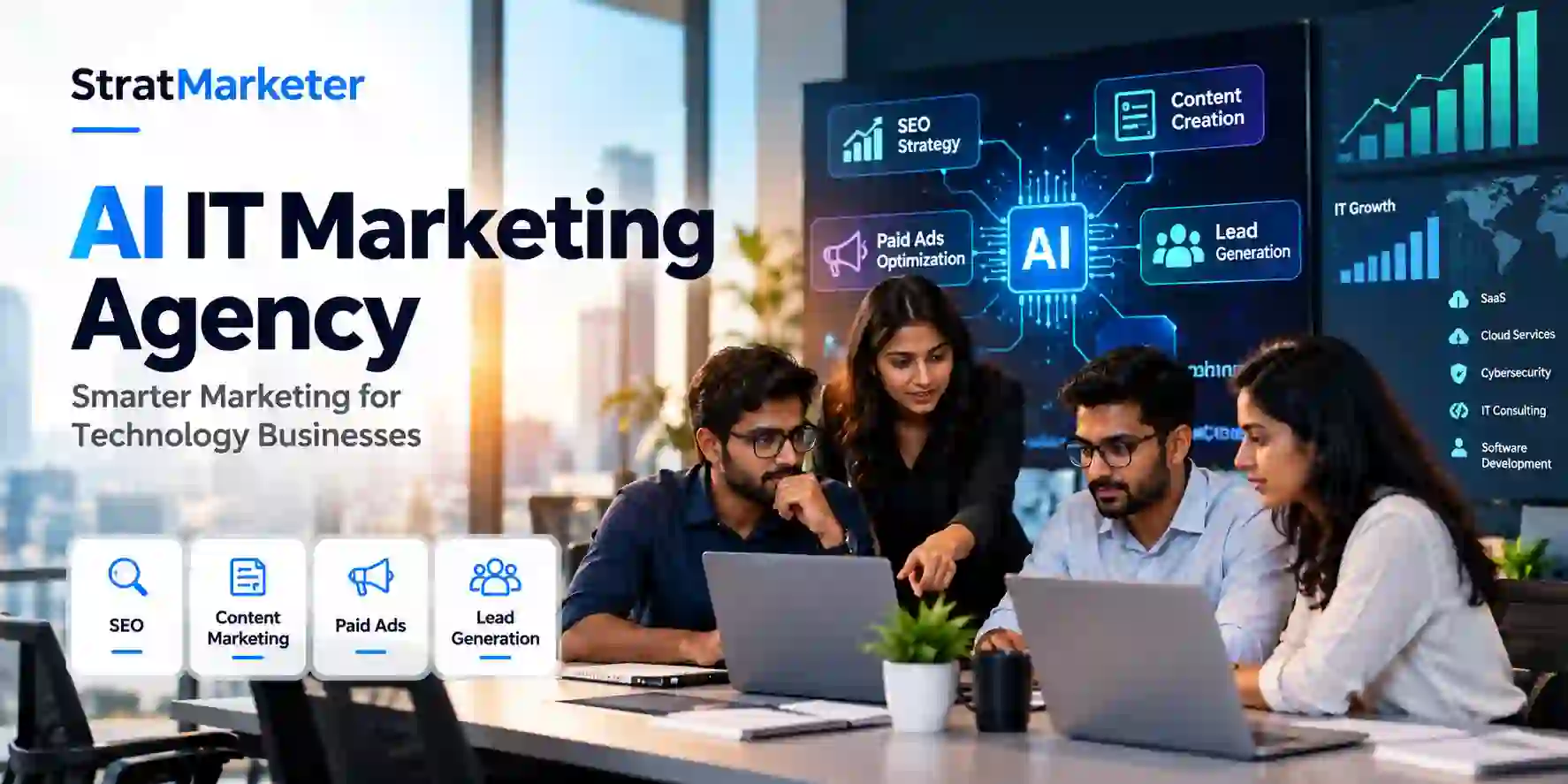
What Is an AI IT Marketing Agency and What Does It Actually Handle?
An AI IT marketing agency sits somewhere between traditional digital marketing and the technology systems that modern IT companies already use. That distinction matters because selling software, cloud services, cybersecurity, SaaS products, managed IT services or enterprise technology is not the same as selling a simple consumer product.
The buying cycle can be long. Several people may influence the decision. A technical manager may care about integrations, while a CFO looks at cost and the founder worries about implementation. Marketing has to speak to all of them without producing five completely different versions of the same business story.
This is where an AI IT marketing agency can become useful.
It does not simply mean using ChatGPT to write blogs or generating ad copies automatically. That is probably the smallest part of the work. A capable AI IT marketing agency uses artificial intelligence to examine customer behaviour, organise marketing data, identify patterns, personalise communication and reduce repetitive work across the marketing process.
For an IT company, that could involve analysing search behaviour before deciding what content to publish, identifying which leads are becoming sales opportunities, studying paid advertising data, finding gaps in website journeys and helping sales teams understand which prospects need attention.
There is also a practical difference between automation and intelligence.
If a CRM automatically sends an email three days after someone downloads a report, that is automation. If a system recognises that the person belongs to a particular industry, visited pricing pages twice, interacted with a technical case study and has a high likelihood of becoming a qualified prospect, the marketing decision becomes more interesting.
That is closer to what an AI IT marketing agency should actually be doing.
For example, consider an Indian SaaS company selling workflow software to manufacturing businesses. Its website may receive hundreds of visitors every month, but most will not become leads. A conventional marketing approach might focus heavily on traffic and form submissions.
An AI supported approach can look deeper.
Which pages are attracting operations managers? Which industries are returning to the website repeatedly? Which content topics appear before a demo request? Which leads are spending time on integration pages rather than general product pages? Which campaigns are generating enquiries that sales actually considers useful?
These questions are far more valuable than simply asking how many clicks a campaign generated.
I also think there is a common misunderstanding here. An AI IT marketing agency is not supposed to replace marketers, salespeople or subject matter experts. Good IT marketing still needs people who understand the product and the buyer. AI can process large amounts of information quickly, but it does not automatically understand why an Indian manufacturing company might hesitate before adopting a cloud platform, or why a CTO may reject an otherwise strong proposal because implementation looks painful.
That human context still matters.
Why IT Companies Are Moving Towards AI Led Marketing
IT marketing has become difficult partly because the buyer has become more informed.
A prospect can compare software providers, read reviews, watch product demonstrations, examine competitor pricing and ask an AI tool to explain technical differences before ever speaking with a salesperson. The old approach of publishing a few generic service pages and waiting for enquiries is becoming less reliable.
IT companies also produce enormous amounts of information.
There are product specifications, documentation, blogs, case studies, white papers, technical presentations, customer conversations, sales notes, campaign data and CRM records. Much of this information exists somewhere inside the company but is rarely connected properly.
An AI IT marketing agency can help make sense of that scattered information.
Suppose a cloud services company has spent years answering the same questions from prospects. Sales teams know the objections. Technical teams know the implementation concerns. Customer support knows where users struggle. Marketing knows what pages attract visitors.
Usually, these teams do not operate from one shared pool of insight.
AI can help identify repeated themes across these sources and turn them into useful marketing opportunities. A recurring sales objection can become an article. A support issue can become an educational video. A successful customer implementation can become a case study. A high converting search query can influence landing page content.
That sounds simple when written down. In actual companies, it is not.
I have seen marketing teams spend weeks discussing what content to create while sales already had dozens of unanswered customer questions sitting in email threads. The information was there. Nobody had joined the dots.
This is one reason an AI IT marketing agency can be valuable for IT businesses with complex offerings.
There is another reason.
Personalisation.
Not the annoying kind where a website simply inserts someone’s first name into an email. Real personalisation means recognising differences in intent.
Someone searching for “managed cloud services pricing” is behaving differently from someone searching for “AWS migration checklist for manufacturing companies”. Both may eventually become customers, but their immediate concerns are different.
An AI system can help marketers identify these patterns at a scale that becomes difficult to manage manually.
Still, I would not say AI automatically makes marketing better. That would be too convenient. Poor data, weak positioning and unclear offers remain poor data, weak positioning and unclear offers even after AI is added.
Sometimes AI simply helps a bad marketing system produce bad work faster.
That is worth remembering.
Where AI Changes IT Marketing Beyond Basic Automation
The most useful applications of AI in IT marketing often happen quietly.
They are not always the things that look impressive in a presentation.
One important area is intent analysis. IT websites often receive visitors at completely different stages of research. Some are learning. Some are comparing vendors. Some already know what they want and are checking whether a provider can deliver it.
AI can analyse behaviour across pages, search terms and interactions to help classify these patterns.
A visitor reading an introductory article about cybersecurity is not necessarily ready for a sales conversation. A visitor who spends several minutes reading a security architecture page, then checks pricing and visits the contact page is a different case.
A good AI IT marketing agency can help create systems where these behavioural signals actually influence marketing activity.
Content production is another area, but this is where I have some concern.
AI can produce hundreds of articles. That does not mean a company should publish hundreds of articles.
For IT brands, technical credibility matters. If an article about cloud migration contains incorrect terminology or confidently explains something that engineers immediately recognise as wrong, the company loses trust. The problem becomes bigger when the same content gets reused across LinkedIn, email and sales material.
AI should assist research, topic development, content analysis and editing. The final technical judgement should still come from someone who understands the subject.
There is also predictive analysis.
Marketing teams can use historical data to identify which lead characteristics tend to correlate with better sales outcomes. Industry, company size, page behaviour, source, campaign interaction and previous engagement can all contribute to a lead scoring model.
The model is not perfect.
No model is.
But even an imperfect signal can help sales teams prioritise their time.
Another area is conversational marketing. AI powered chat systems can answer common questions, qualify prospects and direct visitors towards relevant resources. For an IT services company receiving enquiries outside office hours, this can be particularly useful.
But again, the quality of the knowledge base matters.
If the chatbot does not understand the company’s actual services, implementation limitations or commercial policies, it can create more confusion than value.
The best use of AI is often not visible to the customer at all.
It might be helping a marketing manager understand why one campaign attracts enterprise leads while another produces mostly low value enquiries. It might be identifying a content gap. It might be cleaning CRM data. It might be finding repeated customer objections hidden inside thousands of records.
That is less glamorous.
It is also where much of the real value can sit.
Using AI Across SEO, Content, Paid Ads and Lead Generation
SEO for IT companies has become more complicated because search behaviour itself is changing.
People do not always search using the exact service name anymore. A business owner may search for a problem. A technical decision maker may search for a solution. An enterprise buyer may search around a specific implementation requirement.
An AI IT marketing agency can use search and behavioural data to identify these different patterns and build content around actual user needs rather than producing pages simply because a keyword has search volume.
Take an IT consulting company offering ERP implementation.
A basic SEO strategy might focus on phrases such as ERP implementation services, ERP consultants and ERP software implementation.
Those terms matter, but they are only part of the picture.
Potential customers may also search for ERP implementation cost in India, ERP migration problems, ERP integration with existing systems, ERP implementation timeline, ERP implementation for manufacturing or even why ERP projects fail.
These searches reveal concerns.
Those concerns are marketing opportunities.
AI can help cluster thousands of related queries into broader themes, identify missing topics and understand how different pages should connect. A marketer can then decide which topics deserve detailed articles, which should become service pages and which belong in FAQs or case studies.
Paid advertising is another area where AI can assist.
An IT company may run Google Ads for several services. One campaign might produce many leads but very few qualified opportunities. Another may generate fewer leads but much better sales conversations.
If the marketing team judges everything by cost per lead, the second campaign can easily be switched off.
That would be a mistake.
An AI IT marketing agency can connect campaign information with CRM outcomes and help assess quality further down the funnel. The question becomes less about “How many leads did this keyword generate?” and more about “What happened to the leads that came from this keyword?”
That distinction is important for high ticket IT services.
Content is where AI creates both opportunity and risk.
A company can use AI to analyse existing content, identify duplication, suggest topic gaps, create content briefs, review readability and repurpose long form material into other formats. But publishing generic AI generated content at scale is not the same thing as building authority.
For example, a cybersecurity company could ask AI to produce ten articles about phishing attacks.
Or it could take actual questions its security consultants receive from Indian SMEs, explain what businesses commonly get wrong, discuss practical controls and add observations from real projects.
The second approach has a much better chance of being useful.
Lead generation follows the same principle.
AI can help identify high intent visitors, score leads, personalise follow ups and recommend content based on the prospect’s stage. But the offer still has to make sense.
No amount of AI can rescue a vague service proposition.
The Role of CRM Data in AI Based IT Marketing
This is probably the area that gets overlooked most often.
Companies want AI marketing, but their CRM data may be incomplete, duplicated or badly organised.
One sales executive enters “IT services”. Another writes “managed services”. Someone else enters “MSP”. A third person leaves the industry field blank. The same company may appear under different names.
Then someone expects AI to find meaningful patterns in the data.
It cannot perform miracles.
For an AI IT marketing agency, CRM hygiene becomes part of the marketing conversation because the CRM contains information about what happens after the lead submits a form.
Website analytics can tell you what people did.
CRM data can tell you what happened next.
That difference is huge.
Imagine an Indian software company generates 500 leads from SEO and paid advertising in six months. On the surface, the marketing programme looks successful.
But after connecting the CRM, the company finds that only 35 became sales qualified opportunities and just 8 entered serious commercial discussions.
Now the real analysis can begin.
Were the wrong companies being attracted? Were certain keywords producing low quality traffic? Was the landing page promising something the sales team did not actually offer? Were prospects from particular industries more likely to move forward? Did response time affect conversion?
AI can help analyse these patterns, especially when the dataset becomes too large for manual review.
It can also support lead scoring.
A lead from a 500 employee technology company that visits pricing, implementation and case study pages several times may deserve a different follow up from someone who downloaded a general checklist and never returned.
But scoring should not become a black box.
Salespeople should understand why a lead has been marked as high priority. If the system says a prospect is valuable but the salesperson knows the company has no budget or is outside the service area, human judgement should win.
This is where I would disagree with some aggressive AI marketing claims. The goal should not be to remove people from the decision. The goal should be to help them make better decisions with less manual sorting.
CRM data can also influence content.
Suppose an IT company discovers that many qualified opportunities come from businesses asking about integration with an older ERP system. That is not merely a sales observation. It is a content signal.
The company may need an integration page, a technical explainer, a case study and perhaps a comparison article.
Now marketing is learning from actual commercial conversations instead of guessing what customers might want.
There is a small but important detail here. CRM integration should not be treated as a one time technical setup. Data changes. Sales teams change their habits. New fields get added. Old workflows stop making sense.
Someone needs to keep checking whether the information remains useful.
I might be wrong here, but I think this is one of the main reasons some AI marketing projects disappoint. The technology gets attention at the beginning, while the boring work of maintaining clean customer data slowly gets ignored.
And once that happens, the system starts learning from unreliable information.
That is when things get uncomfortable.
Common Marketing Problems AI Cannot Solve on Its Own
There is a temptation to think that an AI IT marketing agency can fix almost every marketing problem once the right tools are connected. I do not agree with that.
AI can process information quickly. It can find patterns, classify leads, assist with content, analyse campaigns and automate repetitive actions. But it cannot decide whether an IT company’s actual offer makes sense to its market.
That problem appears more often than people admit.
I have seen IT businesses spend heavily on marketing while their service positioning remains unclear. The website says everything from cloud computing and cybersecurity to software development, consulting, managed services and digital transformation. Nothing is technically wrong, but a visitor still cannot understand what the company is particularly good at.
AI cannot solve that simply by generating another page.
The same applies to pricing.
Many Indian IT companies hesitate to show even an approximate pricing structure because they fear competitors will see it. That is understandable in some sectors, but it can create another problem. A prospect may spend twenty minutes researching a service and still have no idea whether the company works with businesses of their size.
An AI IT marketing agency can analyse behaviour around pricing pages and enquiry forms. It cannot decide the commercial policy for the company.
That decision belongs to the business.
There is also the issue of sales follow up. Marketing may generate a strong enquiry, but if nobody responds properly for two days, the opportunity can disappear. AI can send reminders. It can assign leads. It can even suggest follow up messages.
It cannot force a salesperson to have a useful conversation.
I have seen this with service companies where the marketing dashboard looked healthy but the sales pipeline was weak. The problem was not traffic. It was what happened after the enquiry arrived.
Another limitation is technical accuracy.
An AI system can explain an API, cloud platform, security concept or software architecture in fluent language. That does not guarantee the explanation is correct for the particular product being sold.
This is especially risky for B2B IT marketing.
A cybersecurity company cannot publish technically questionable advice simply because it sounds professional. A cloud services provider cannot make broad claims about security or compliance without checking the details. An AI IT marketing agency still needs access to technical experts and internal documentation.
There is another uncomfortable problem. AI can learn from historical data, but historical data can contain bias.
If a company has traditionally generated better customers from large enterprises, an AI model may favour similar leads. That sounds reasonable until the company decides to enter the mid market.
The model can then quietly work against the new strategy.
So yes, AI can help marketing decisions. But it does not replace judgement.
That distinction becomes important when a business starts believing its dashboard more than its sales team.
How StratMarketer Approaches AI IT Marketing for Indian Businesses
At StratMarketer, the practical starting point for an AI IT marketing agency approach should not be the AI tool itself.
It should be the business.
That sounds obvious, but the difference shows up quickly when working with Indian IT companies. A technology business in Bengaluru selling enterprise software has different marketing problems from a software development company in Pune serving overseas startups. A cybersecurity provider in Delhi may have a completely different sales cycle from a managed IT services company working with SMEs in Ahmedabad.
The marketing system has to reflect that reality.
StratMarketer’s approach can begin by understanding the service portfolio, customer profile, sales cycle, existing acquisition channels and the actual questions prospects ask before becoming customers.
That last part is particularly useful.
A service page may say that a company provides “end to end IT solutions”, but customers rarely walk into a sales conversation using that phrase. They usually have a specific problem.
Their website may be slow.
Their cloud bill may be too high.
Their old software may not integrate with a newer system.
Their sales team may not be getting enough qualified enquiries.
Their management may be worried about cybersecurity.
Those real problems should influence the content and advertising strategy.
For an Indian IT company, the research stage also needs some local context. Search behaviour can vary by market. Decision making can involve founders, technical heads, finance teams and procurement departments. In smaller businesses, one person may handle three of these roles.
That changes how a marketing funnel behaves.
StratMarketer can use AI to organise search data, website behaviour, CRM information and campaign performance, but the interpretation should remain grounded in the business.
For example, suppose an IT services company receives enquiries for “software development services” but most enquiries are from very small businesses looking for inexpensive development work. The company actually wants larger projects.
Simply generating more traffic for the same keyword may make the situation worse.
The better question is why the wrong audience is being attracted.
Perhaps the website needs stronger qualification language. Perhaps the service page is too broad. Perhaps case studies need to show project size, industry and technical complexity. Perhaps paid campaigns need different landing pages.
This is where an AI IT marketing agency should be useful.
Not just producing more content, but helping the business understand what is happening underneath the numbers.
Content can then be built around actual commercial intent. SEO can be connected with service pages rather than treated as a separate activity. Paid campaigns can be judged using CRM outcomes. Email and WhatsApp communication can be used carefully where appropriate. Sales feedback can return to the marketing team instead of remaining trapped inside the sales department.
I would also avoid automating every customer interaction.
Indian B2B buyers often want to speak to a person when the service is expensive or technically complicated. A chatbot can answer basic questions, but there are situations where a human conversation is simply better.
That is not a failure of AI.
It is good judgement.
Measuring AI Marketing Performance Beyond Leads and Website Traffic
Leads and traffic are easy to report.
They are also easy to misunderstand.
An IT company can receive 1,000 website visitors and 50 enquiries and still have a weak marketing system if none of those enquiries fit the business.
For an AI IT marketing agency, measurement needs to move further down the funnel.
Consider a simple example.
An IT consulting company gets 100 leads in a month. Thirty are contacted. Fifteen have a proper sales conversation. Six become qualified opportunities. Two become paying customers.
The important numbers are not only the 100 leads and the website traffic that generated them.
The company should understand where those two customers came from.
Which search term?
Which landing page?
Which campaign?
Which industry?
Which type of content did they consume?
How long did the sales process take?
What was the average deal value?
Did those customers remain active?
This kind of analysis changes the conversation between marketing and management.
A good AI IT marketing agency can help connect these stages so that marketing activity is judged against commercial outcomes rather than isolated platform metrics.
That does not mean traffic is useless.
Traffic still matters when it comes from the right audience. Engagement still matters. Rankings still matter. Form submissions still matter.
They simply should not be treated as the final answer.
For SEO, useful measurements may include qualified organic enquiries, assisted conversions, commercial keyword growth and the number of relevant pages bringing potential buyers into the website.
For paid advertising, the business may want to track qualified opportunity rate, customer acquisition cost, sales conversion and revenue from specific campaigns.
For content, the measurement can be more subtle.
A technical article may generate only a few enquiries but influence several sales conversations because prospects read it before contacting the company. If the company judges that article only by direct form submissions, it may wrongly conclude that the content failed.
This is where attribution becomes messy.
I do not think any marketing attribution model should be treated as absolute truth. Customer journeys are rarely clean. A person may discover a company through Google, return through LinkedIn, read a case study three weeks later and finally contact sales after receiving a recommendation from someone else.
Which channel gets credit?
There is no perfect answer.
The sensible approach is to use several signals and look for patterns instead of pretending the dashboard knows everything.
AI can make this analysis easier, particularly when there are large amounts of campaign and CRM data. But the marketing team still has to ask uncomfortable questions.
Why are leads falling?
Why are opportunities not converting?
Why does one service generate enquiries but not revenue?
Why are high value customers coming from one small content cluster?
Sometimes the answer is not what the marketing team wants to hear.
Mistakes IT Companies Make When Choosing an AI IT Marketing Agency
The first mistake is choosing an agency because it talks the most about AI.
That is not a reliable measure.
An agency can have access to dozens of AI tools and still produce weak marketing.
I would look much more closely at whether the agency understands the IT buying cycle. Can they discuss lead quality? Do they understand enterprise search behaviour? Can they connect marketing activity with CRM outcomes? Do they ask what happens after a lead comes in?
Those questions tell you more.
The second mistake is expecting immediate results from AI.
AI can speed up research, analysis and production. It does not mean SEO rankings, brand trust and qualified sales opportunities appear overnight.
IT marketing often takes time because the products themselves take time to understand.
The third mistake is allowing the agency to publish technical content without proper review.
This can become embarrassing quickly.
A software company may publish an article containing a small technical error. A developer notices it. A CTO notices it. A potential customer notices it. The company may never know exactly why the prospect lost confidence, but the damage has already happened.
An AI IT marketing agency should have a review process for technical claims.
Another mistake is focusing too heavily on dashboards.
If an agency spends every monthly meeting showing impressions, clicks and keyword positions but cannot explain why qualified enquiries are increasing or falling, I would ask difficult questions.
Reports should help management make decisions.
They should not simply prove that activity happened.
There is also a tendency to ask for “AI automation” before fixing the basic marketing infrastructure.
If the website has unclear services, broken conversion paths and outdated case studies, adding more automation may just send more people into a weak funnel.
Fix the obvious things first.
Then automate where automation genuinely helps.
Finally, do not choose an AI IT marketing agency only because it promises to generate a large amount of content. More content is not automatically better content. For technical B2B businesses, ten genuinely useful pages can sometimes be worth more than a hundred generic articles.
I know that sounds less exciting.
It is still true in many cases.
Frequently Asked Questions About AI IT Marketing Agency
What does an AI IT marketing agency do?
An AI IT marketing agency uses artificial intelligence alongside conventional marketing methods to help IT companies with areas such as SEO, content, advertising, lead qualification, customer data analysis, personalisation and marketing automation. The useful part is how these activities connect with actual business outcomes.
Is an AI IT marketing agency suitable for small IT companies?
It can be, but the approach should be smaller and practical. A small software company does not need a complicated AI system simply because one is available. It may benefit more from better lead qualification, content research, SEO analysis and automated follow ups.
Can AI replace an IT marketing team?
I would not recommend treating it that way. AI can handle repetitive analysis and production tasks, but positioning, technical judgement, customer understanding and commercial decisions still need people.
Can AI IT marketing improve lead quality?
It can help. Lead scoring, behavioural analysis, audience segmentation and CRM analysis can identify patterns associated with better opportunities. But if the underlying offer attracts the wrong audience, AI cannot completely fix that problem.
Does AI generated content work for IT companies?
It can assist content production, but publishing unreviewed AI content is risky for technical businesses. IT buyers expect accuracy. Content should reflect real product knowledge, customer questions, practical experience and technical review.
How does AI help with IT company SEO?
AI can help analyse search queries, identify related topics, organise content clusters, examine competitors, detect content gaps and understand user behaviour. It should support SEO judgement rather than replace it.
Can an AI IT marketing agency work with an existing CRM?
Yes, provided the CRM and its data can be accessed appropriately. CRM integration can help connect marketing activity with lead qualification, sales opportunities and customer outcomes.
How long does it take to see results?
There is no useful universal number. Paid campaigns can produce data quickly, while SEO and content usually need more time. The quality of the website, existing authority, market competition, offer and sales process all affect the timeline.
Is AI marketing expensive for an IT company?
The cost depends on what is actually being built and managed. A company using AI for content research and campaign analysis has a very different requirement from one integrating CRM data, automated workflows and predictive lead scoring.
What should an IT company ask before hiring an AI IT marketing agency?
Ask how the agency measures qualified opportunities, how it handles technical content review, how CRM data will be used, what parts of the process will actually use AI and how marketing performance will be connected to sales outcomes. If the answers remain vague, I would be cautious.
Our Services
Contact Us
- Paonta Sahib, Himachal Pradesh, India
- +91-8700998508
- support@stratmarketer.com
Start From Here
These two options make it easy for you to get the information you want.