


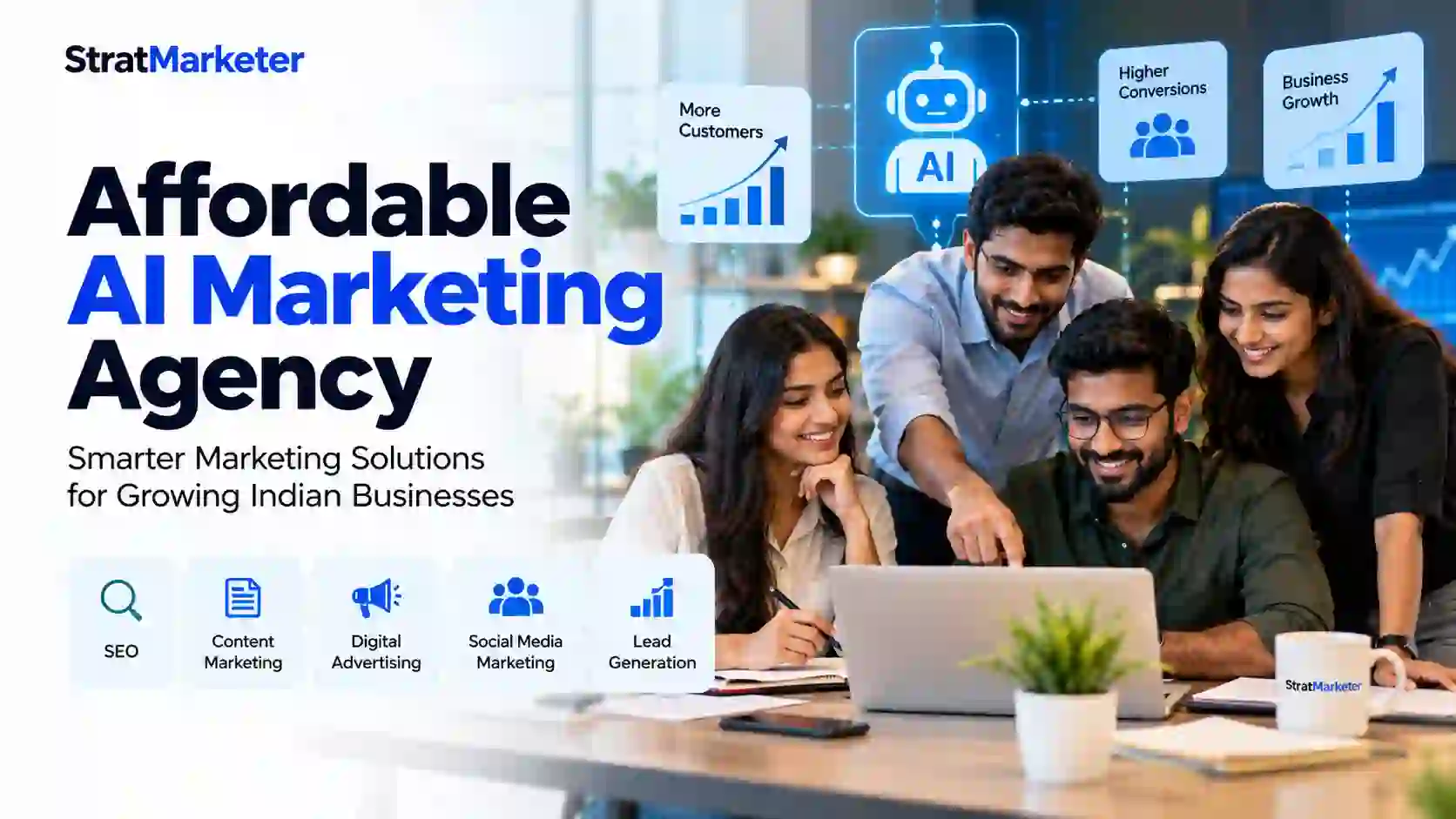
Affordable AI Marketing Agency for Indian Businesses
1. Why Businesses Are Looking for an Affordable AI Marketing Agency
For many Indian businesses, digital marketing has become difficult to manage within a reasonable budget. A local manufacturer may need regular website content, Google Ads, social media posts, and lead generation, while a startup might be trying to attract its first hundred customers without spending heavily on advertising. Hiring separate specialists for every task can quickly become expensive. This is one reason businesses are considering an affordable AI marketing agency that combines AI tools with practical marketing experience.
AI has changed how marketing work gets done. Tasks such as keyword research, audience analysis, content planning, ad copy variations, and campaign reporting can now be completed more efficiently. Work that once required several hours of manual effort may take considerably less time when the right tools are used properly.
But saving time does not automatically mean saving money for the client. The agency must have a sensible process, understand the business, and know where human judgement is necessary.
Consider a small industrial supplier in Gujarat that wants to generate enquiries from businesses across India. The company may not need an expensive, large-scale marketing campaign immediately. It might benefit more from a well-organised website, search engine optimisation, useful technical content, and a focused Google Ads campaign. AI can help with research and execution, while a marketer ensures the content reflects the company’s actual products, capabilities, and customer requirements.
That distinction matters.
An affordable AI marketing agency should help businesses spend their marketing budgets more carefully, rather than simply offering a long list of services at a low price. If the agency produces hundreds of generic posts but fails to attract relevant customers, the apparent savings have little value.
Indian businesses are also dealing with changing customer behaviour. Buyers increasingly research products online before speaking to a salesperson. They compare suppliers, check reviews, read service pages, and sometimes use AI-powered search tools to shortlist companies. Businesses that lack useful online information can lose potential enquiries before a conversation even begins.
For small businesses, the challenge is deciding which marketing activities deserve investment first. A local service provider may need stronger local search visibility, while a B2B company might need detailed service pages and a steady flow of qualified enquiries.
StratMarketer can approach these requirements by combining AI-assisted research and content workflows with SEO, paid advertising, social media marketing, and lead generation, depending on the business’s actual needs. The objective should be to select activities that support a clear business goal, not to use AI in every possible task just because the technology is available.
2. What Makes an AI Marketing Agency Affordable Without Compromising Quality?
An agency’s monthly fee tells only part of the story. The more useful question is what the business receives for that amount, how the work is performed, and whether the output serves a commercial purpose.
An affordable AI marketing agency usually controls costs through better workflows, sensible automation, and a clear understanding of priorities. It does not necessarily charge less because its employees have less experience or because it uses cheaper tools.
AI can reduce repetitive work in several areas. For example, an agency can use AI-assisted research to organise keyword ideas, identify common customer questions, analyse campaign reports, and prepare initial content outlines. A human marketer can then check the information, refine the messaging, and decide what deserves attention.
This arrangement can reduce wasted effort.
However, there are limits. AI-generated information can be inaccurate, search intent can be misunderstood, and content may sound convincing without answering the customer’s real question. In industries such as manufacturing, healthcare, finance, and legal services, those mistakes can damage trust.
I would be cautious about choosing an agency that promises a large number of articles, backlinks, social media posts, and advertisements for an unusually low monthly fee. Volume is easy to advertise. Explaining how the work will attract relevant customers is much harder.
Here are some practical factors worth examining before signing a contract.
Clear deliverables and scope: The proposal should state which services are included, how frequently work will be delivered, and what falls outside the agreed scope. If SEO, paid advertising, content creation, and social media are all included, the agency should explain how resources will be allocated.
Human review: AI may assist with drafting and analysis, but important claims, product details, service information, and campaign decisions need appropriate review. A technical article for an industrial company should not contain specifications invented by a content tool.
Relevant expertise: An agency should understand the business’s customers, sales cycle, and market. Marketing a local coaching institute is different from marketing a nutraceutical manufacturer that sells through distributors.
Transparent reporting: Businesses should receive reports that explain what happened and what needs attention. Website traffic, impressions, clicks, leads, and conversions are useful measurements, but they do not all have the same commercial value.
Flexible priorities: A small business might initially need website improvements and local SEO more than daily social media posts. An agency that insists on selling the same package to every client may not be the right choice.
Pricing also depends on the amount of work involved. A company with an established website and a small number of target markets may need less initial work than a business launching a new brand across multiple cities.
For StratMarketer, the practical consideration is how AI-assisted workflows can fit into the company’s broader digital marketing services while retaining attention to strategy, content quality, and campaign performance. The appropriate scope will depend on the client’s objectives and available budget.
Affordable marketing should not mean accepting poor work. It should mean avoiding unnecessary work in the first place.
3. AI Marketing Services That Deliver Practical Value for Indian Businesses
Not every AI marketing service deserves equal priority. The right choice depends on how customers discover a business, what they need before making a purchase, and how the company generates revenue.
For an Indian small business, the following services can be useful when applied to a specific commercial problem.
Search engine optimisation and keyword research
SEO is often a sensible starting point for businesses whose customers actively search for their products or services online.
AI-assisted research can help organise search queries, identify related topics, group keywords by intent, and reveal questions that customers may ask before contacting a supplier. Marketers can use these findings to plan service pages, product descriptions, and supporting articles.
Suppose a third-party nutraceutical manufacturer wants to attract enquiries from supplement brands. A page focused on manufacturing capabilities, product categories, quality processes, packaging options, and enquiry requirements may be more useful than publishing numerous general articles about nutrition.
The content must reflect the manufacturer’s actual capabilities. AI can assist with research and drafting, but it cannot independently verify factory certifications, production capacity, or regulatory compliance.
Content marketing
Businesses often struggle to publish useful content consistently because research, writing, editing, and approvals take time.
AI can help create initial outlines, organise interview notes, suggest content angles, and adapt approved information into different formats. Human editors must still check facts, remove repetition, and ensure that the content reflects the company’s knowledge.
A manufacturing company, for instance, might turn a product specialist’s explanation of material grades into a technical blog, a frequently asked questions section, and a LinkedIn post. The value comes from making genuine business knowledge easier to use, not from publishing the same generic text across several channels.
Paid advertising and campaign analysis
AI-assisted advertising workflows can help generate variations of ad copy, organise audience research, analyse campaign performance, and identify areas that deserve further testing.
Google Ads and social advertising platforms also provide their own automated bidding, targeting, and creative features. An agency should understand these native capabilities before recommending additional tools.
For a coaching institute in Jaipur, the priority might be enquiries for a particular course rather than website visits in general. The campaign needs relevant keywords, a suitable landing page, a clear enquiry process, and a way to measure lead quality.
AI can support campaign management, but it cannot compensate for an unsuitable offer or an ineffective landing page.
Social media marketing
Small businesses frequently spend time preparing posts without knowing whether the content serves any purpose. AI can help convert approved product information, customer questions, and company updates into content ideas for different platforms.
A local furniture manufacturer, for example, could use workshop photographs, material explanations, delivery updates, and customer-approved project images to prepare a useful content calendar.
The content still needs to look and sound like the business. Publishing large volumes of repetitive AI-written posts can make a company’s social media presence feel impersonal.
Lead generation and customer communication
AI-assisted tools can help organise enquiries, classify common questions, draft responses, and identify patterns in customer interactions. When connected to an appropriate CRM or communication platform, they may also reduce manual follow-up work.
There should be sensible limits. Customers need an easy way to reach a person when an automated response cannot resolve their concern. Personal information should be handled carefully, and marketing messages should comply with applicable privacy and communication requirements.
For businesses working with limited budgets, these services need not all begin at once. A company with poor organic search visibility may prioritise SEO, while one receiving traffic but few enquiries may need landing page improvements and better lead tracking.
StratMarketer’s role can be to identify which activities are most relevant before deciding how AI fits into the work.
4. How AI Is Changing SEO, Content Creation, and Digital Advertising
AI has affected marketing at different levels. Some changes are visible to customers, while others happen inside the tools marketers use every day.
Search is a good example. Businesses can no longer assume that every customer journey begins with a conventional list of website links. Google’s AI features and other AI-powered search experiences can provide direct answers, summaries, and recommendations. Customers may also use conversational tools to compare suppliers or understand a product before visiting a company’s website.
This does not mean conventional SEO has become irrelevant. Businesses still need useful pages, accessible website structures, accurate information, and content that answers genuine customer questions. The challenge is to create material that is valuable to readers, whether they arrive through a traditional search result or another discovery channel.
SEO now requires stronger information and clearer intent
AI tools can help marketers identify related search queries, organise topics, and examine the questions people ask. They can also assist with content audits and identifying gaps across existing pages.
But keyword inclusion alone will not make a page useful.
A business searching for an affordable AI marketing agency may want to understand pricing, available services, quality controls, and expected results. A page that repeats the target phrase throughout the text without answering those concerns is unlikely to satisfy the reader.
For StratMarketer, the more useful approach is to connect search intent with the information a potential customer needs to make a decision. That could include the agency’s service scope, the role of AI in its workflows, reporting methods, and the limitations of automation.
Content creation is faster, but editing matters more
AI can generate outlines, initial drafts, summaries, and alternative headlines quickly. This can help marketers manage research and production workloads.
The problem starts when the draft is treated as the finished article.
An AI-generated article about industrial marketing may overlook distributor relationships, long sales cycles, technical specifications, or the way procurement teams evaluate suppliers. Those details often determine whether the content is useful to the intended reader.
A better workflow begins with business information, verified sources, and actual customer questions. AI can help organise the material, while an experienced editor checks accuracy, adds relevant context, and removes unsupported claims.
I would rather publish one detailed article that answers a real customer question than ten pages that say essentially the same thing. That preference will not apply to every content programme, but it is particularly relevant when trust and technical knowledge influence purchasing decisions.
Advertising can use faster testing and analysis
AI tools can assist with ad copy variations, creative concepts, audience analysis, and performance reporting. Advertising platforms can also automate parts of bidding and delivery based on campaign settings and available conversion data.
This creates opportunities for smaller businesses that cannot afford a large in-house marketing team.
Still, automation needs useful inputs. If a business tracks every form submission as a successful lead without checking whether those enquiries are relevant, the campaign may optimise towards the wrong outcome. The advertising platform could report better conversion numbers while the sales team receives more unsuitable enquiries.
That is an uncomfortable situation because the dashboard may look healthy.
Businesses should distinguish between a click, an enquiry, a qualified lead, and an actual sale. Where possible, CRM information and offline sales outcomes should inform campaign decisions, subject to suitable tracking, consent, and data handling practices.
AI does not remove the need for original business knowledge
A company’s actual experience remains valuable. Product details, customer objections, project examples, service limitations, and practical lessons provide information that generic tools cannot reliably invent.
For example, an agency preparing content for an Indian B2B company should understand whether customers normally enquire through phone calls, WhatsApp, distributor references, or website forms. These behaviours can differ considerably across industries and regions.
AI can help process information about those patterns. It should not be allowed to fabricate them.
I might be wrong here, but the agencies that benefit most from AI may not be those producing the greatest volume of content. They may be the ones that know which information matters, verify it properly, and use automation to spend more time on decisions that require experience.
5. Affordable AI Marketing Agency vs Traditional Digital Marketing Agency
The difference between an AI marketing agency and a traditional digital marketing agency is not always as clear as the labels suggest. Many established agencies already use automation, analytics platforms, AI writing tools, and advertising systems.
The more meaningful distinction is how the agency combines technology with human judgement, and whether that approach suits the client’s needs.
An affordable AI marketing agency may use AI-assisted workflows to reduce repetitive work and manage certain tasks more efficiently. A traditional agency may rely more heavily on manual processes, established specialist teams, or conventional campaign methods. Neither model automatically produces better results.
Area | AI-assisted marketing agency | Traditional marketing agency |
Research and planning | AI can help organise search data, audience insights, and topic ideas | Research may rely more on manual analysis and established tools |
Content production | AI can assist with outlines, drafts, and content variations | Writers may create more material manually, often with specialist input |
Advertising | AI can support analysis and creative testing alongside platform automation | Campaign decisions may rely more on manual optimisation and established workflows |
Reporting | Routine data summaries can be automated | Reports may involve more manual preparation |
Human expertise | Still needed for strategy, review, positioning, and complex decisions | Typically central to planning, creative work, and campaign management |
Pricing | May reduce some production costs, depending on the workflow | Depends on team size, service scope, expertise, and delivery model |
These differences are general tendencies, not fixed rules. A traditional agency may have excellent automation, while an AI-focused agency may still perform most tasks manually.
Which model is more suitable for a small business?
Consider a small business in Pune that wants to improve its website, publish useful content, and generate enquiries through Google Ads.
If its budget is limited, an AI-assisted agency may be able to organise keyword research, prepare initial content drafts, test ad variations, and automate parts of reporting without requiring a large production team.
That can make the arrangement practical.
However, if the business operates in a technically complex industry, it may need a specialist who understands the products, regulations, and buying process. An agency that produces content quickly but misunderstands the company’s services could create more work for the client.
There is another issue with pricing. A lower monthly fee does not necessarily mean a lower overall cost. Businesses should consider onboarding, advertising spend, software charges, website changes, content revisions, and any additional work that falls outside the contract.
For instance, a marketing package may include campaign management but exclude the actual advertising budget. Another may include content writing but not technical review or website development. Comparing the headline prices without examining these details can lead to the wrong decision.
StratMarketer can position AI as part of its digital marketing workflow while continuing to focus on the business’s actual requirements. For some clients, that may mean SEO and content marketing first. Others may need paid campaigns, social media support, or lead generation systems.
The choice should come down to the quality of the work, the clarity of the scope, and whether the agency understands what the business is trying to achieve. AI is useful when it helps the team make better use of its time. It is not a substitute for knowing the client’s business.
6. Common Pricing Mistakes Businesses Make When Hiring an AI Marketing Agency
Choosing an affordable AI marketing agency often starts with comparing monthly packages. One agency offers SEO and content, another includes social media and paid advertising, and a third promises to manage almost everything for a surprisingly low fee. On paper, the third option may look attractive. The difficulty begins when the business tries to understand what the package actually covers.
The cheapest marketing package is not always the most economical choice. What matters is the work being delivered, its relevance to the business, and the cost of correcting mistakes later.
One common mistake is paying for output instead of value. An agency might promise 30 blog posts every month, hundreds of social media creatives, or a fixed number of keyword targets. These figures are easy to measure, but they do not establish whether the work is useful. Thirty repetitive articles may bring less value than a smaller number of well-researched pages addressing the questions prospective customers actually ask.
This becomes particularly important for Indian B2B companies. A machinery supplier in Ahmedabad, for example, may receive only a few relevant enquiries each month, but each enquiry could represent a substantial order. The company needs content that helps procurement teams understand specifications, delivery capabilities, and product suitability. Publishing large quantities of generic content is unlikely to solve that problem.
Another mistake is overlooking the difference between agency fees and advertising expenditure. If a business hires an agency to manage Google Ads, the monthly management fee and the money paid to Google are usually separate costs. The same distinction applies to many social media advertising campaigns. Businesses should ask for these expenses to be shown clearly rather than assuming that a quoted package includes everything.
There is also the issue of AI software charges. Some agencies include their tools within the service fee, while others may charge separately for particular platforms, integrations, or subscriptions. Neither arrangement is automatically wrong, but the client should know what is included.
Paying for services the business does not need yet
I have a practical preference here. I would rather see a small business start with two well-chosen marketing activities than spend its entire budget on a package covering every available channel.
A local accounting firm may benefit more from strong service pages, local SEO, useful client information, and a clear enquiry process than from daily video production across multiple platforms. An ecommerce company with an established product catalogue may have different priorities, including product feed quality, advertising creative testing, and conversion tracking.
The right mix depends on how customers buy.
Businesses should also be careful with guaranteed ranking and lead promises. SEO results depend on competition, website quality, content relevance, technical factors, and changes in search behaviour. Paid advertising results depend on factors such as the offer, landing page, bidding strategy, and customer demand. An agency can establish targets and explain its approach, but it should not present uncertain outcomes as guaranteed results.
Before signing an agreement with an affordable AI marketing agency, clarify a few points in writing.
- What work will be delivered each month, and who will review it?
- Are advertising spend, software costs, website changes, and taxes included?
- How will the agency measure qualified enquiries rather than just clicks?
- What happens if the business needs revisions or additional work?
- Will the business retain access to its website, advertising accounts, analytics, and campaign data?
These questions are not about negotiating every rupee. They help prevent disagreements after the work begins.
An agency that explains its costs clearly gives the client a better basis for deciding whether the service is suitable. If the proposal is vague about deliverables but very confident about results, I would ask more questions before proceeding.
7. How Small Businesses and Startups Can Use AI Marketing on a Limited Budget
Small businesses do not need to adopt every AI marketing tool at once. In fact, buying several subscriptions before deciding what problem needs solving can become another unnecessary expense.
A better starting point is to identify where marketing currently loses time or money.
For a startup, the immediate challenge might be explaining a new product to potential customers. For a local service provider, it may be attracting enquiries from the right area. An established manufacturer may already have a good reputation offline but lack the website content needed to attract customers from other states.
These businesses need different approaches.
Start with the marketing activity closest to a business goal
Suppose a small industrial business in Gujarat wants to attract enquiries from buyers in Maharashtra, Karnataka, and Tamil Nadu. It has a website, but the service pages provide very little information about its products and capabilities.
Before investing heavily in social media campaigns, the business could review its website, identify the search terms used by prospective buyers, improve its key service pages, and create useful technical content.
AI can assist with keyword grouping, competitor content analysis, content outlines, and the preparation of initial drafts. A subject matter expert can verify specifications and explain the company’s actual capabilities.
This approach gives the business a useful foundation without requiring a large marketing team.
For a new ecommerce brand, the priorities may be different. It may need stronger product descriptions, better product images, advertising creative variations, and a landing page that makes purchasing straightforward. AI-assisted tools can help generate copy variations and organise creative tests, but the business still needs to assess whether the products, pricing, and offer appeal to its customers.
Use existing information before paying to create more
Many companies already have useful marketing material that is not being used properly. Sales presentations, product brochures, customer questions, training documents, and frequently asked questions can provide the starting point for website content and social media communication.
A manufacturer might have a technical sales executive who answers the same questions about minimum order quantities, delivery timelines, or material specifications every week. Those answers can help shape a useful website FAQ section and reduce repetitive communication with prospective customers.
AI can help organise and adapt this information. The business should check every detail before publishing it, particularly when the content includes technical claims, prices, certifications, or contractual terms.
There is no need to start every article from a blank page.
Automate repetitive work, not important decisions
A small business can use AI to prepare initial email drafts, classify common customer questions, organise content calendars, summarise campaign reports, and generate alternative advertising messages. These tasks can save time when the process is clearly defined.
However, customer complaints, sensitive enquiries, technical recommendations, and important sales discussions may need direct human attention. Automated replies that misunderstand a customer’s requirements can do more harm than a delayed but accurate response.
The same applies to lead generation. A business can automate parts of its enquiry workflow, but it should still check whether leads are relevant and whether sales staff are following up appropriately.
A modest budget still needs measurement
Businesses should decide in advance what progress would look like. For SEO, that might mean more relevant search traffic and enquiries from target service pages. For advertising, it could mean a lower cost per qualified lead rather than simply a lower cost per click. For social media, it may be meaningful conversations or visits from the intended audience.
The first month may reveal problems rather than deliver impressive results. Tracking may be broken, the website may load slowly, or customers may be abandoning the enquiry form. Those findings are useful if the business acts on them.
I might be wrong here, but smaller companies often benefit more from fixing one weak point in their marketing process than from adding another channel. A startup with a limited budget does not have much room for activities that look busy but do not contribute to its sales process.
An affordable AI marketing agency should help the business make these choices, explain what can reasonably be achieved within its budget, and avoid recommending services simply because they are available.
8. How StratMarketer Approaches Affordable AI Marketing for Growing Businesses
For a growing business, AI marketing should not begin with a software list. It should begin with a conversation about the business itself.
What does the company sell? Who makes the purchasing decision? Where do customers currently come from? Which marketing activities are already working, and where is the company losing potential enquiries?
These questions help determine whether AI will be useful and where it can fit into the existing marketing process.
At StratMarketer, affordable AI marketing can be approached through a combination of research, content planning, digital marketing execution, and performance review. The actual scope should depend on the client’s needs rather than a fixed assumption that every business requires the same services.
Understanding the business before selecting services
A local service provider and a national B2B company may both want more leads, but the path to those leads can differ considerably.
A local clinic, for example, may need accurate business information, local SEO, a useful website, and a clear appointment enquiry process. A manufacturer may need detailed product pages, technical content, search engine optimisation, and campaigns aimed at specific industries or procurement roles.
The initial assessment should identify the audience, commercial objectives, website condition, available marketing budget, and existing performance data. If the business has no reliable conversion tracking, that issue may need attention before campaign results can be assessed properly.
Using AI where it saves meaningful effort
AI-assisted tools can support keyword research, content outlines, competitor analysis, campaign reporting, creative variations, and the organisation of marketing information. Their purpose is to reduce repetitive work and help the team focus on decisions that require experience.
For example, an SEO campaign may involve organising a large set of search terms into relevant topics. AI can help group those terms, but a marketer still needs to decide which pages deserve attention, whether the search intent matches the company’s services, and whether the website can realistically compete for the chosen queries.
Similarly, AI can help prepare a first draft of a service page. The final version should accurately explain the service, address customer concerns, and reflect the company’s actual capabilities.
StratMarketer’s broader digital marketing services can support these activities through SEO, content marketing, social media marketing, paid advertising, website development, and lead generation, where appropriate to the agreed scope.
Keeping the budget connected to priorities
An affordable AI marketing agency should be willing to explain what it recommends postponing as well as what it recommends doing.
A business with a limited budget may not need SEO, paid advertising, influencer marketing, email marketing, and video production simultaneously. It may be more sensible to establish a strong website foundation, identify relevant search opportunities, and build a reliable enquiry process before expanding into other activities.
That decision should not be permanent. If search campaigns are generating qualified leads but the business needs faster growth, paid advertising or additional creative testing may become worthwhile. If website visitors are not converting, the priority may instead be the landing page or offer.
Marketing plans need to respond to evidence rather than follow a fixed monthly routine regardless of performance.
Reporting honestly about progress
StratMarketer should assess marketing work against the objectives agreed with each client. Useful reporting may include organic search performance, relevant website visits, advertising costs, qualified enquiries, conversion rates, and the actions planned for the next reporting period.
The reporting should also explain limitations. A rise in website traffic does not necessarily mean revenue will increase. A campaign may generate enquiries that the sales team cannot serve, or the business may take several months to convert a lead into a customer.
For B2B companies, this distinction is especially important because purchasing decisions may involve technical reviews, quotations, internal approvals, and negotiations.
No single metric tells the whole story.
The aim is to give businesses a clear understanding of the work being performed, why it matters, and what needs attention next. That also makes it easier to discuss whether the current budget remains suitable as the company grows.
9. Measuring the Value of AI Marketing Beyond Traffic and Lead Generation
Traffic and leads are useful marketing measurements, but they are not the final business outcome. A company can attract thousands of website visitors and still struggle to generate profitable sales. It can also receive a smaller number of enquiries that are far more relevant to its services.
This is why an affordable AI marketing agency should help clients distinguish between activity and commercial value.
Look at the quality of enquiries
Imagine a business receives 100 enquiries in a month. If most are unrelated to its services, outside its delivery area, or unable to meet its minimum order requirements, the sales team may spend considerable time filtering them.
Now consider a campaign that produces 30 enquiries, of which 15 are genuinely relevant. The second campaign may offer more commercial value even though it generates fewer enquiries overall.
The business should agree on what qualifies as a good lead. For one company, it may be a prospect requesting a quotation. For another, it could be a customer who meets specific budget, location, or technical requirements.
This definition should be shared with the marketing team before results are evaluated.
Measure the cost of acquiring a customer
Cost per lead is calculated by dividing the relevant marketing expenditure by the number of leads generated.
Customer acquisition cost goes further by considering how much the business spends to acquire an actual customer. Depending on the purpose of the calculation, this may include advertising, agency fees, sales costs, and other relevant expenses.
For example, if a business spends ₹60,000 on marketing and acquires 10 customers during the measurement period, the simple marketing cost per acquired customer is ₹6,000. The calculation assumes those 10 customers can reasonably be attributed to the campaign and that the ₹60,000 includes the costs being assessed.
If the business counts only advertising spend and ignores the agency fee, the figure will be lower but incomplete. It should label the calculation clearly rather than compare it directly with a more comprehensive acquisition cost.
Track what happens after a lead arrives
Marketing performance often becomes difficult to judge when the website generates enquiries but no one records what happens next.
A basic CRM or even a consistently maintained sales tracker can record the enquiry source, qualification status, quotation stage, and final outcome. This information helps identify which campaigns are attracting potential customers who actually progress through the sales process.
For a manufacturer, a lead may take weeks or months to convert because the buyer needs samples, technical documentation, commercial negotiations, and internal approval. Evaluating that campaign after only a few days could lead to an unfair conclusion.
The sales cycle should influence the reporting period.
Assess content quality and usefulness
AI-assisted content should be assessed on more than the number of pages published. Relevant indicators include whether the content answers customer questions, attracts the intended audience, supports enquiries, and provides accurate information.
Businesses should also check for duplicated material, factual errors, and pages that compete with one another for similar search terms. Publishing more content can create extra maintenance work if the material is poorly planned.
Search performance is worth monitoring, but rankings alone do not establish commercial value. A page may rank well for a broad query while attracting visitors who have no intention of purchasing the service.
Account for the time saved
AI can also reduce the time required for certain marketing tasks. A team may spend less time preparing initial drafts, formatting reports, sorting keyword lists, or generating creative variations.
That time has value, but it should be measured carefully. Time saved on drafting is not necessarily an equivalent cash saving if the business still pays the same fixed salaries or agency fees. The benefit may instead come from allowing the team to complete additional useful work or spend more time on review and strategy.
I would not judge an AI marketing programme solely by how many hours it claims to save. I would want to know what the team did with those hours and whether the change helped the business.
For StratMarketer, a sensible reporting approach would connect the work completed to the client’s actual objectives, with clear definitions for traffic, qualified leads, conversions, and costs. The numbers may not always look impressive in the early stages, but an honest explanation is more useful than a report that presents every increase as a success.
10. Frequently Asked Questions About Choosing an Affordable AI Marketing Agency
What is an affordable AI marketing agency?
An affordable AI marketing agency uses AI-assisted tools and established marketing practices to manage work such as SEO, content creation, advertising, social media, and reporting within an agreed budget. Affordability depends on the service scope, quality, expertise, and business requirements, not just the monthly fee.
How much does an AI marketing agency charge in India?
There is no single standard price. Fees vary according to the services included, campaign complexity, website condition, content requirements, and level of specialist involvement. Paid advertising budgets and software subscriptions may be charged separately. Request a proposal that clearly separates the agency fee from additional expenses.
Can small businesses benefit from AI marketing?
Yes. Small businesses can use AI to support keyword research, content planning, advertising copy, customer enquiry management, and reporting. The best starting point is usually the activity most closely connected to the business’s current problem, rather than purchasing several tools or services at once.
Does AI-generated content help with SEO?
AI-assisted content can support SEO when it is accurate, useful, relevant to search intent, and properly reviewed. Using AI to publish large amounts of repetitive or unreliable material is not a sound strategy. Google’s published guidance focuses on the quality and usefulness of content rather than whether AI was used to produce it.
Is an AI marketing agency better than a traditional agency?
Not automatically. An AI-assisted agency may manage certain repetitive tasks more efficiently, while a traditional agency may offer suitable expertise and established workflows. Many agencies use both approaches. Compare the actual team, processes, deliverables, reporting, and relevant experience before choosing.
How long does AI marketing take to show results?
The timeframe depends on the activity. Paid advertising can produce initial campaign data relatively quickly, but profitable results may take longer to establish. SEO usually requires sustained work, and progress depends on competition, website quality, content, and other factors. An agency should explain its expected milestones without guaranteeing a specific outcome.
What should I check before hiring StratMarketer?
Start by discussing your business goals, target audience, available budget, and current marketing performance. Ask StratMarketer to explain the proposed services, monthly deliverables, review process, reporting methods, and any additional charges. Make sure you understand how the work will be assessed and what access you will retain to your marketing accounts and data.
Can AI replace a digital marketing team?
AI can automate or assist with certain tasks, but it does not remove the need for strategic decisions, fact checking, creative judgement, customer understanding, and campaign management. Most businesses will benefit from using AI as part of a well-managed marketing process rather than treating it as a complete replacement for human expertise.
How can I tell whether my AI marketing investment is worth it?
Track relevant enquiries, qualified leads, customer acquisition costs, sales outcomes, and the performance of individual marketing activities. Compare these results with the agreed objectives and the total costs involved. Give activities an appropriate evaluation period, particularly when the business has a long sales cycle.
Our Services
Contact Us
- Paonta Sahib, Himachal Pradesh, India
- +91-8700998508
- support@stratmarketer.com
Start From Here
These two options make it easy for you to get the information you want.