


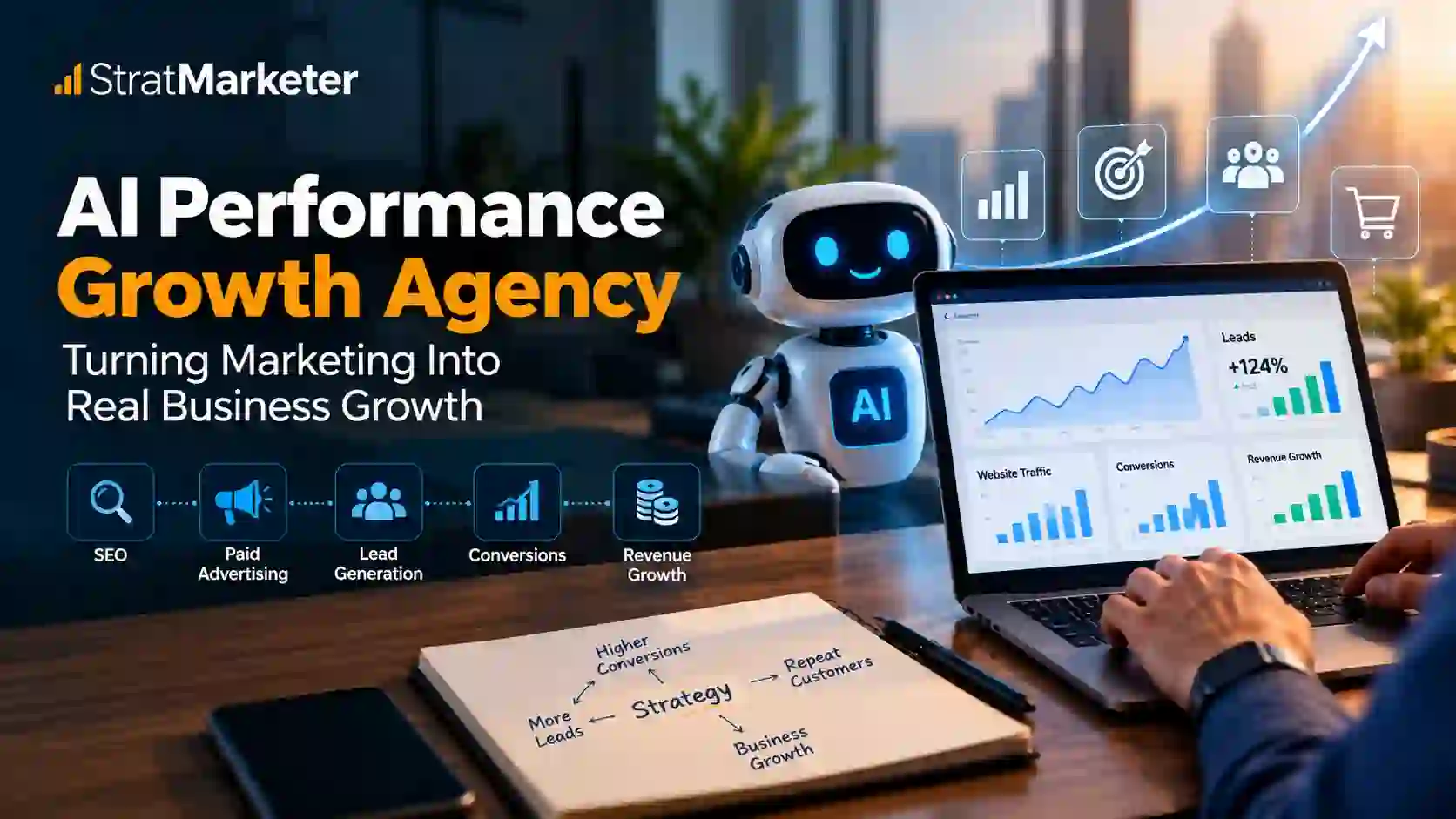
AI Performance Growth Agency for Business Growth
Why Businesses Are Looking for an AI Performance Growth Agency
Many Indian businesses are spending money on digital marketing but still struggling to understand what is actually contributing to revenue. Website traffic may be increasing, social media enquiries may look promising, and advertising campaigns may generate hundreds of clicks, yet sales remain inconsistent. For a business owner, this creates an uncomfortable question. If marketing activity is increasing, why is the business not growing at the same pace?
This is where an AI performance growth agency can make a practical difference. Instead of treating SEO, paid advertising, content marketing and lead generation as separate activities, the agency uses artificial intelligence alongside marketing expertise to understand how these channels contribute to business performance.
Consider a manufacturer in Gujarat that receives enquiries through its website, IndiaMART, Google Ads and WhatsApp. The sales team may spend hours responding to enquiries without knowing which source brings serious buyers. AI supported analysis can help identify patterns in lead quality, customer behaviour and conversion rates, allowing the business to allocate its marketing budget more carefully.
The important point is that AI does not automatically make marketing profitable. Poor targeting, weak landing pages, slow sales follow ups and unclear pricing can still prevent conversions. Technology helps identify problems, but somebody must understand the business well enough to address them.
An experienced AI performance growth agency looks beyond impressions and clicks. It examines whether marketing is attracting the right people, generating meaningful enquiries and contributing to sales. For Indian businesses working with limited budgets, this distinction matters because every additional marketing expense needs a clear business reason.
What an AI Performance Growth Agency Actually Does
The term can sound technical, but the underlying work is closely connected to everyday business decisions. An AI performance growth agency combines marketing strategy, campaign management, customer data analysis and automation to help businesses understand what is working and where money is being wasted.
The work usually starts with an examination of the existing marketing setup. This includes website performance, search visibility, advertising expenditure, lead sources, conversion rates and the way enquiries move through the sales process. Without this information, introducing AI tools can simply add another layer of complexity.
For instance, a real estate company might receive 200 enquiries in a month but close only three deals. Increasing the advertising budget may generate more enquiries, but it will not necessarily improve sales. The underlying issue could be irrelevant enquiries, delayed callbacks, unsuitable property options or a mismatch between advertised prices and customer budgets.
An AI performance growth agency can analyse available data to identify recurring patterns. It may help segment enquiries by source, classify customer intent, identify underperforming campaigns and automate parts of the follow up process. The business team can then investigate why qualified prospects are dropping out.
The practical responsibilities often include:
- Marketing performance analysis: Understanding campaign costs, conversion rates, qualified leads and revenue contribution.
- AI supported campaign optimisation: Using available performance signals to guide bidding, audience selection, creative testing and budget allocation.
- Search and content strategy: Identifying customer questions, relevant search terms and content gaps that affect organic traffic and enquiries.
- Lead management: Organising incoming enquiries, assigning leads, prioritising follow ups and identifying potential sales opportunities.
- Reporting and measurement: Connecting marketing activity with meaningful business outcomes rather than relying on surface level metrics.
Not every business needs all these services at once. A small B2B company with a long sales cycle may benefit more from better lead tracking and follow up automation than from adding another advertising platform.
My preference is to establish reliable measurement before introducing multiple AI tools. It may seem less exciting than launching a new automation system, but it gives the business a clearer way to judge whether the investment is worth continuing.
How AI Connects Marketing Performance With Business Growth
Marketing performance and business growth are related, but they are not the same thing. A campaign can achieve a low cost per click and still attract visitors who never purchase. A website can generate a large number of leads while the sales team struggles to convert them. AI becomes useful when it helps connect these separate stages.
An AI performance growth agency examines the path from the first customer interaction to the final business outcome. Depending on the business, this may involve organic search, a paid advertisement, a product page, a phone call, a sales conversation and a completed purchase.
Each stage can reveal a different problem.
Suppose an online store receives 10,000 monthly visitors and generates 200 orders. The business owner wants more sales, so the immediate temptation may be to increase traffic. However, analysis might show that product pages attract visitors but shipping charges cause many customers to abandon their carts. In that situation, attracting more visitors may not be the best first move.
AI supported analytics can help identify unusual drop off patterns, compare customer segments and highlight pages that deserve closer examination. The marketing team can then test changes to product information, delivery messaging or checkout steps.
The same principle applies to service businesses. A consultancy may receive enquiries from several cities, but its most profitable projects may come from only two regions. Understanding the relationship between location, enquiry quality, sales conversion and project value can help the business prioritise its efforts.
A useful performance review should consider more than lead volume.
Metric | What it helps a business understand |
Customer acquisition cost | How much it costs to acquire a customer through marketing and sales |
Lead to customer conversion rate | How effectively enquiries turn into paying customers |
Return on advertising spend | How much attributed revenue is generated for each unit of advertising spend |
Customer lifetime value | The expected value of a customer relationship over time |
Marketing qualified lead rate | Whether campaigns are attracting prospects who match the business’s requirements |
These metrics need context. Return on advertising spend, for example, measures attributed revenue rather than profit. A campaign showing a return of four rupees for every rupee spent may still be unprofitable after product costs, fulfilment, salaries and other expenses.
This is one area where businesses should be careful with impressive dashboards. A report can look excellent while the accounts tell a different story.
An AI performance growth agency should help management understand the connection between marketing activity, sales outcomes and commercial costs. It should not claim that AI alone caused growth when pricing changes, seasonal demand or the sales team’s efforts may also have contributed.
Using Customer Data to Make Better Marketing Decisions
Customer data is valuable because it helps businesses move away from assumptions. However, collecting more information does not automatically produce better decisions. The information must be accurate, relevant and connected to a clear business question.
An AI performance growth agency may work with website analytics, customer relationship management systems, advertising reports, search performance data and sales records. AI tools can help identify patterns across these sources, provided the business has suitable data access and the information can be matched reliably.
Take an Indian education company offering professional certification courses. Its marketing team may run campaigns across Google Search, Instagram and YouTube. Instagram could generate many enquiries at a relatively low cost, while Google Search produces fewer enquiries but a higher proportion of paid admissions.
If the company evaluates performance only by cost per lead, it may shift too much budget towards Instagram. When admission records are connected with lead sources, the business can assess which campaigns bring students who actually enrol.
This does not mean that the lowest cost channel is always the wrong choice. Instagram may be useful for awareness, remarketing or reaching future students who are not ready to enrol immediately. The point is to judge each channel according to its role and eventual contribution.
AI can also help with customer segmentation. A business may identify groups based on product interest, purchase history, enquiry behaviour or engagement with previous campaigns. These groups can receive more relevant communication instead of identical messages.
For example, a nutraceutical manufacturer serving distributors and private label brands should not treat every enquiry as equally valuable. A prospective buyer asking about minimum order quantities, formulation options and manufacturing documentation has different requirements from someone looking for a small retail purchase. Organising enquiries around these differences can help the sales team respond appropriately.
There are limits, though. If customer records are incomplete, duplicate entries are common or sales teams fail to update outcomes, an AI system may identify misleading patterns. A prediction based on unreliable information remains unreliable, even when the output looks convincing.
Businesses must also handle customer information responsibly. Data collection and automated communication should follow applicable privacy requirements, and sensitive information should not be shared with AI tools without appropriate safeguards.
An AI performance growth agency should therefore focus on the usefulness of the data, not simply its volume. Sometimes the most valuable step is fixing inconsistent lead records or ensuring that every sales enquiry receives a recorded outcome.
AI Powered SEO, Paid Advertising and Lead Generation
SEO, paid advertising and lead generation serve different purposes, but they often influence the same customer journey. Someone may discover a business through Google Search, return through a paid advertisement and finally enquire after reading a case study. Measuring each interaction separately can create an incomplete picture of how the customer made a decision.
An AI performance growth agency can use AI supported research and analysis to make these channels work together more effectively. The exact application depends on the business model, its competition and the quality of the information available.
SEO and organic search
AI can assist with analysing search queries, grouping related topics, identifying content gaps and examining how visitors interact with website pages. These insights can help a business decide which pages need clearer explanations, stronger internal links or more useful information.
For an Indian industrial supplier, this could mean creating separate pages for product specifications, bulk supply requirements, delivery coverage and technical questions instead of publishing numerous articles that repeat the same information.
However, AI generated content does not automatically rank well. Search performance still depends on relevance, usefulness, technical accessibility, credibility and the quality of the overall website. Publishing large quantities of similar pages simply to target keywords can waste resources and create a poor experience for visitors.
Paid advertising
Advertising platforms already use machine learning for tasks such as bidding, delivery and conversion optimisation. An AI performance growth agency should understand these built in capabilities rather than presenting every automated platform feature as a separate innovation.
Its role includes checking conversion tracking, reviewing audience quality, testing creative variations and evaluating campaign economics. If a campaign generates many low quality enquiries, the answer may involve revising the offer, improving the landing page or sending better conversion signals to the advertising platform.
There is a catch. Automated bidding depends heavily on the objectives and signals provided. If the system is optimising for form submissions but the business needs profitable customers, it may produce more submissions without producing better sales.
Lead generation and follow up
Lead generation is not finished when somebody fills out a form. Enquiries must be qualified, assigned and followed up in a reasonable time.
AI can assist with categorising enquiries, identifying likely intent, drafting responses and routing leads to the appropriate sales representative. CRM automation can also remind staff about pending follow ups and record interactions.
For a company selling industrial equipment, an enquiry about a bulk purchase scheduled for the next month should not necessarily receive the same response as a request for a single replacement part. Context matters.
StratMarketer can approach these activities as connected parts of the marketing process, with the emphasis on measurable business performance rather than adopting AI for its own sake. The agency’s actual contribution should be assessed through clear objectives, documented work and agreed reporting.
Ultimately, an AI performance growth agency needs to understand both the marketing platform and the business behind it. More traffic, cheaper leads and faster automation are useful only when they help the company reach the right customers and convert genuine demand into revenue.
Turning Marketing Leads Into Revenue and Repeat Customers
A business can generate enquiries every day and still struggle to make money. The problem often starts after a potential customer shares their contact details. Nobody calls for several hours, the sales team forgets to follow up, or the prospect receives a generic message that does not address what they actually asked for. Marketing gets blamed, even though the enquiry itself may have been perfectly good.
An AI performance growth agency looks at what happens after a lead enters the business. Generating an enquiry is only one part of the process. The next challenge is to help the sales team identify serious prospects, respond at the right time and move suitable customers towards a purchase.
Consider an Indian B2B company selling industrial machinery. A buyer may enquire about a machine worth several lakhs, but the purchase could depend on technical specifications, installation, financing and management approval. Treating that enquiry like a simple online retail order would be a mistake. The sales team needs context, not just an automated reminder.
AI can help organise incoming leads according to their requirements, source, engagement and previous interactions. It can also assist with drafting responses, prioritising follow ups and identifying enquiries that have remained unattended. The sales representative still needs to verify the details and have a meaningful conversation with the buyer.
The handover between marketing and sales deserves particular attention. If the marketing team measures success by the number of forms submitted while the sales team measures success by closed deals, both departments may report good performance while the business struggles.
An AI performance growth agency should help connect these two sides. This involves tracking lead sources, recording sales outcomes and reviewing which campaigns bring customers who are more likely to purchase.
Why repeat customers matter
The first purchase is not always where a business earns most of its money. A customer may return for another order, purchase a related product or recommend the company to someone else. These outcomes are particularly relevant for manufacturers, wholesalers, subscription businesses and ecommerce brands.
AI supported customer analysis can help identify buyers who may need replenishment reminders, customers who have not purchased recently or segments that respond well to particular offers. A business selling skincare products, for example, might send a relevant reorder reminder based on the usual purchase cycle rather than sending promotional messages every few days.
But customer communication should remain useful. Too many messages can irritate buyers and damage trust. I would rather see a business send fewer, relevant messages than automate every possible interaction.
Repeat purchase analysis also helps businesses understand whether their marketing expenditure is producing lasting customer relationships. A campaign that attracts customers who purchase repeatedly may be more valuable than one that generates many first time buyers who never return.
There is one practical limitation. AI cannot create customer loyalty when the product is poor, deliveries are unreliable or complaints remain unresolved. It can help a company recognise these problems, but the business must correct them.
For StratMarketer, the sensible approach is to connect lead generation, conversion tracking and customer retention with the commercial goals of the business. The objective should not be to automate every customer interaction. It should be to make sure valuable opportunities are not lost because of avoidable gaps in the sales process.
Common Reasons AI Performance Marketing Fails to Deliver Growth
AI marketing can save time and help teams analyse information, but it does not guarantee better business performance. Some companies invest in multiple tools, automate their campaigns and produce more reports without seeing meaningful growth. Often, the technology is not the main problem.
The business has not clearly defined what success looks like.
An AI performance growth agency should be able to identify the difference between activity and progress. A business receiving more website visits is not necessarily growing. A company generating more leads may simply be attracting people who are unlikely to buy.
Several problems tend to appear repeatedly.
Optimising for the wrong metric
Suppose a service company wants qualified project enquiries but its advertising campaigns are optimised for inexpensive form submissions. The platform may learn to attract people who submit forms easily, even when they have little purchasing intent.
The campaign report may show a lower cost per lead. The sales team, meanwhile, may be dealing with irrelevant enquiries all day.
The solution is to review lead quality and, where the systems allow it, feed meaningful conversion information back into the advertising platform. Qualified opportunities and completed sales are generally more useful signals than form submissions alone, although the right optimisation event depends on sales volume and the length of the buying cycle.
Poor quality data
AI tools rely on the information they receive. Duplicate contacts, missing sales outcomes, incorrectly configured analytics and inconsistent CRM records can lead to misleading recommendations.
Imagine a business that records every phone call as a successful conversion, even when the caller is asking for a job or supplier partnership. Advertising systems may then optimise towards the wrong audience.
This is not an AI failure in isolation. It is a measurement problem that the business should have corrected earlier.
Automating a weak sales process
Automation can make an existing process faster, but faster does not always mean better. If the sales team takes three days to respond to enquiries, sending an automated acknowledgement within seconds does not solve the delay.
The business still needs clear responsibility for lead follow up, sensible response timelines and a way to identify enquiries that require personal attention.
Expecting immediate results from every channel
Paid advertising can produce traffic relatively quickly, but that does not mean profitable sales will appear immediately. SEO, customer trust and longer B2B sales cycles often require more time.
An AI performance growth agency should set expectations according to the channel, competition, budget and starting position. Promising the same timeline for every business is not credible.
Using AI generated content without sufficient review
AI can assist with research, outlines and content production. However, publishing generic pages with little original value can leave a website full of material that gives customers no strong reason to choose the business.
For an Indian engineering company, a detailed explanation of product tolerances, installation conditions or maintenance requirements may be more useful than dozens of broad articles about industry trends.
Ignoring the economics of growth
Revenue is not profit. Advertising expenditure, discounts, returns, sales commissions, delivery costs and service expenses can all affect the actual result.
I find this one of the most frustrating mistakes because the business may genuinely believe its marketing is working well. The dashboard shows rising revenue, but nobody has checked whether the additional sales are financially worthwhile.
An AI performance growth agency should help management examine these numbers before recommending further spending.
There are situations where more automation is appropriate, and others where it introduces unnecessary complexity. I might be wrong here, but many smaller companies would benefit more from fixing tracking, landing pages and sales follow up before purchasing another AI platform.
How StratMarketer Approaches AI Driven Performance Growth
For StratMarketer, AI driven performance growth should begin with a straightforward question. What does the business actually need to achieve, and what is preventing it from getting there?
The answer will differ between companies. An ecommerce brand may need better purchase conversion and repeat orders. A manufacturing business may need fewer irrelevant enquiries and more qualified distributors. A professional services firm may need to convert website visitors into consultations.
The starting point should reflect those differences rather than forcing every client into the same marketing framework.
Understanding the current position
Before changing campaigns, the existing setup needs to be examined. This may include website analytics, search performance, paid advertising data, landing pages, CRM records and sales reports.
The aim is to identify where potential customers are being lost. If website visitors are not enquiring, the problem could involve page relevance, unclear pricing or a weak call to action. If enquiries arrive but rarely convert, the sales process or lead quality may need closer attention.
Without this initial assessment, marketing changes become guesswork.
Connecting marketing activities
SEO, paid advertising, content marketing and lead generation should support a shared business objective.
For example, search content can answer questions that prospective customers ask before making a purchase. Paid campaigns can reach people actively looking for a product or service. Lead management systems can help the sales team respond to incoming enquiries. Performance reporting can then reveal which activities contribute to qualified opportunities.
AI can assist with analysing search queries, identifying audience patterns, testing campaign variations and organising customer information. Human review remains important, especially when decisions involve significant budgets or claims about products and services.
Measuring what matters
StratMarketer should establish reporting around agreed performance indicators rather than relying only on impressions, clicks or lead volume.
Depending on the engagement, these indicators may include qualified leads, cost per qualified lead, conversion rate, customer acquisition cost, attributed revenue and repeat purchase rate.
Not every metric will be available from day one. Some businesses have incomplete sales records or no reliable connection between advertising platforms and their CRM. These gaps should be acknowledged and addressed instead of hiding them behind a polished report.
Where revenue attribution is uncertain, reports should make that limitation clear.
Testing, learning and adjusting
Performance marketing requires regular evaluation. A campaign that works during one season may perform differently when customer demand changes. An audience that generates inexpensive leads may stop producing profitable sales as competition increases.
AI supported analysis can help identify patterns and suggest areas for testing. StratMarketer’s marketing team should then decide which changes are commercially sensible, implement them and assess the results.
Not every test will succeed. A revised landing page may fail to increase conversions, or a new advertising creative may attract attention without generating sales. These outcomes still provide useful information when the test has a clear objective and reliable measurement.
Keeping the business involved
The agency cannot make informed decisions if the client does not share essential information about sales, pricing, product margins or customer objections.
A regular review should therefore include more than campaign statistics. It should discuss which leads converted, why certain opportunities were lost and whether the quality of enquiries has changed.
StratMarketer can use these findings to inform the next round of marketing decisions. The exact process should depend on the scope of work agreed with the client, and any claims about results should be supported by actual campaign records.
The purpose of an AI performance growth agency is not to make a business dependent on technology. It is to help the business make better decisions about where to spend, whom to reach and what to fix next.
What Indian Businesses Should Evaluate Before Hiring an AI Performance Growth Agency
Choosing an agency is not simply a matter of comparing monthly fees. Businesses need to understand what work will be carried out, how performance will be measured and who will be responsible when results fall short of expectations.
An agency may be strong in paid advertising but less experienced in SEO. Another may have good technical knowledge but limited understanding of B2B sales cycles. The right fit depends on what the business is trying to achieve.
Before hiring an AI performance growth agency, consider the following areas.
- Clarity about business objectives
The agency should ask about your products, customers, sales process, margins and growth targets. If the first conversation focuses entirely on impressions, rankings and automation tools, ask how these activities are expected to contribute to revenue.
A good discussion should establish what success means for your particular business.
- A clear explanation of its AI capabilities
Ask which activities use AI and why. Does the agency use it for research, campaign analysis, lead classification, reporting or automation? Which decisions are still made by people?
You do not need a complicated technical explanation. You do need a clear understanding of what the tools actually do and what information they require.
- Reliable measurement and reporting
Find out how the agency tracks conversions and evaluates lead quality. Ask whether you will receive access to relevant advertising accounts, analytics platforms and reports.
For businesses with longer sales cycles, ask how enquiries are connected with qualified opportunities and closed deals. If complete attribution is not possible, the agency should explain what can and cannot be measured.
- Relevant industry understanding
An ecommerce company and a heavy equipment manufacturer do not have the same sales process. One may rely on product page conversion and repeat purchases. The other may depend on technical evaluations, distributor relationships and lengthy negotiations.
Ask the agency how it would approach your particular business model. Specific reasoning is more useful than broad claims about AI expertise.
- Transparent pricing and scope
Understand what the monthly fee includes, which advertising costs are separate and whether software subscriptions or additional services will cost extra.
If an agency proposes SEO, paid advertising, content production and AI automation together, ask which activities will receive priority. A large list of deliverables does not automatically mean that the work will produce business value.
- Ownership and access
Your company should understand who owns the advertising accounts, website content, customer data and reporting setup. Access arrangements should be clear before work begins.
Also ask how customer information is handled, which third party tools receive it and what safeguards apply. This is particularly important when AI systems process customer records or business documents.
- Honest expectations
No agency can reliably guarantee a specific number of sales without considering the business, competition, budget and starting conditions.
Ask how performance will be reviewed, what happens if the original assumptions prove incorrect and how the agency will respond when a campaign underperforms. A realistic answer is more reassuring than a confident promise with no explanation.
For businesses considering StratMarketer, these discussions can help establish a suitable scope of work, agreed performance indicators and a practical reporting process before the engagement begins.
The cheapest agency is not always the least expensive choice in the long run. Equally, a high fee does not prove that an agency understands your business. What matters is whether its work can be evaluated against clear objectives and whether it responds sensibly when the evidence changes.
Frequently Asked Questions About AI Performance Growth Agency
What is an AI performance growth agency?
An AI performance growth agency combines digital marketing expertise with AI supported analysis and automation to help businesses attract customers, improve conversions and measure marketing performance. The exact services vary by agency and business requirements.
How is an AI performance growth agency different from a traditional digital marketing agency?
The main difference should be how the agency uses data and technology to inform decisions. A traditional agency may already use automated bidding, analytics and customer segmentation. An AI focused agency should explain what additional value its methods provide rather than treating every automated feature as something entirely new.
Can an AI performance growth agency help small businesses in India?
Yes. Small businesses can use AI supported tools for lead management, content research, campaign analysis and customer communication. However, the services should fit the available budget and operational capacity. A company receiving only a few enquiries each week may not need a complex automation system.
How long does it take to see results?
There is no universal timeline. Paid advertising can produce early signals, while SEO and longer B2B sales cycles may take considerably longer to show commercial results. The agency should agree on suitable early indicators and longer term business outcomes before work begins.
Does AI guarantee better marketing ROI?
No. AI can help analyse information and automate selected tasks, but return on investment still depends on customer demand, product quality, pricing, campaign execution and sales performance. Results must be measured against the full cost of acquiring and serving customers.
What should a business ask StratMarketer before hiring?
Ask how StratMarketer would assess your current marketing performance, which services it recommends first, how it will measure qualified leads and revenue, what tools it plans to use, and how reporting will work. Also clarify pricing, account ownership, data handling and the responsibilities of both teams.
Is AI driven performance growth suitable for B2B companies?
Yes, particularly when businesses need to manage enquiries from multiple channels or understand a long sales cycle. AI can help organise leads and identify patterns, but technical discussions, relationship building and purchase negotiations still require human involvement.
What is the biggest mistake businesses make when investing in AI marketing?
Focusing on technology before defining the business problem. If a company cannot explain which customers it wants, what a profitable conversion looks like or how sales outcomes are recorded, adding AI may simply make the existing confusion harder to identify.
Our Services
Contact Us
- Paonta Sahib, Himachal Pradesh, India
- +91-8700998508
- support@stratmarketer.com
Start From Here
These two options make it easy for you to get the information you want.