


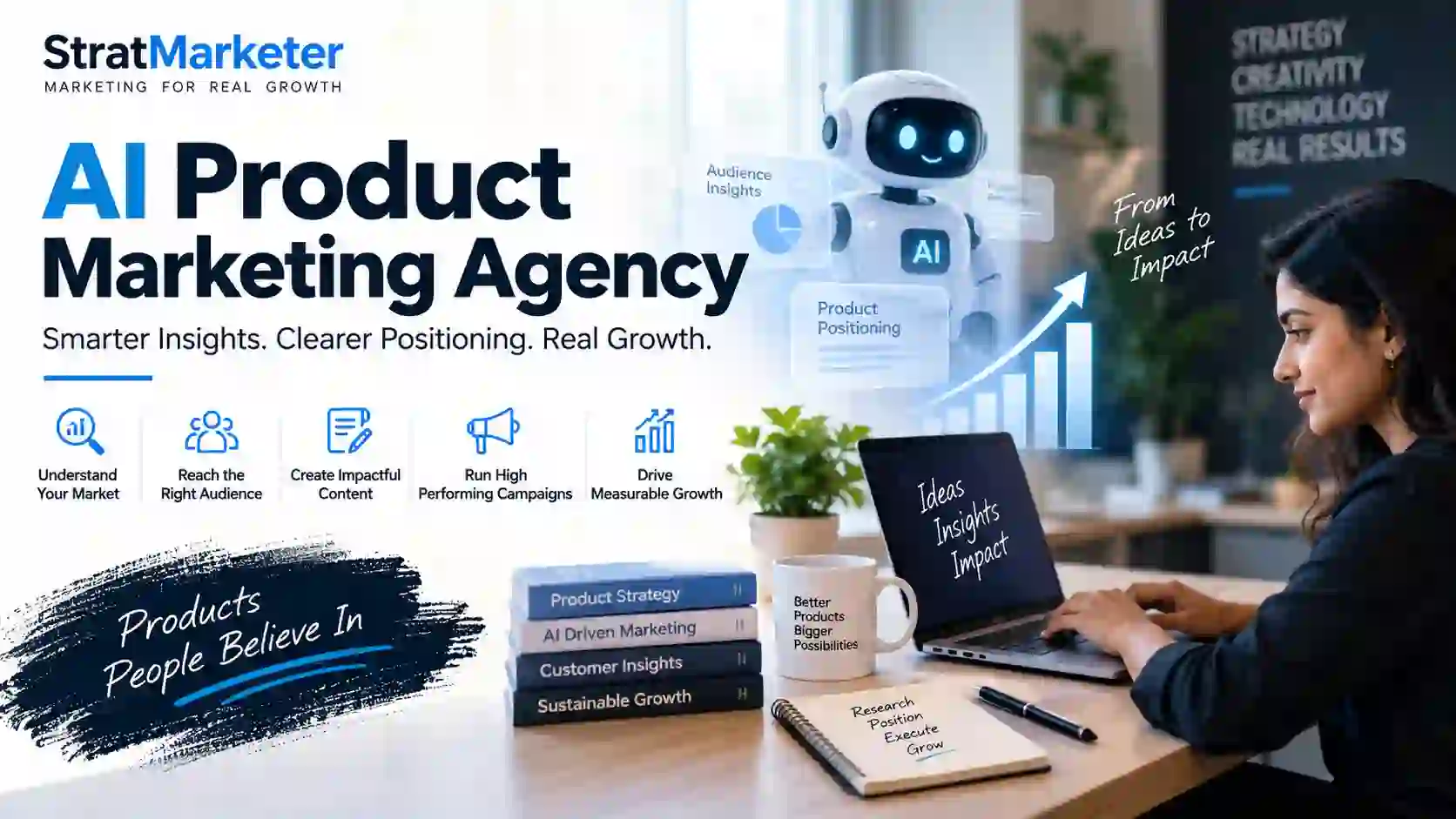
AI Product Marketing Agency for Smarter Product Growth
1. Why Product Marketing Is Changing With AI
Product marketing used to be heavily dependent on a few familiar activities. A team would study the market, speak with customers, prepare positioning, create sales material, publish campaigns and then wait for enough data to understand what worked. That process still exists, but the pace has changed.
AI has made it possible to work with customer and market information much faster. A marketing team can analyse large volumes of search queries, customer conversations, product reviews, campaign data and competitor messaging in a much shorter time. The difficult part is no longer simply collecting information. It is deciding what deserves attention.
This is where an AI product marketing agency can become useful.
I have seen product teams make a fairly common mistake. They collect every possible piece of information and then try to put all of it into their marketing. A SaaS company, for example, may have 25 product features but the buyer may care deeply about only three of them. More information does not automatically make the product easier to sell.
AI can help identify these patterns.
Suppose an Indian SaaS company sells an inventory management platform to small manufacturers. Its internal team may describe the product through technical features such as stock forecasting, purchase workflows, warehouse alerts and reporting dashboards. A customer searching online may be thinking very differently.
They may be worried about excess inventory sitting in a warehouse.
That difference matters.
An AI product marketing agency can analyse search behaviour, customer language, reviews and existing campaign data to find the gap between how a company describes its product and how potential buyers actually describe their problem.
That does not mean handing the entire marketing process to an AI system. I would actually be cautious about doing that.
AI is very good at finding patterns and producing variations. It is much less reliable when the business needs judgement about why one message feels credible and another sounds like marketing noise.
That distinction has become increasingly important as AI-generated content has become easier to produce. Anyone can now create hundreds of product descriptions, ad variations or social posts. The problem is that customers still have to believe the message.
And customers are not particularly patient with vague claims.
A product marketing strategy therefore has to move beyond producing more content. It has to understand the product, the buyer, the buying situation and the reason someone should care.
AI simply gives marketers more ways to investigate those things.
For Indian companies, there is another layer. Customer behaviour can vary considerably between metro markets, Tier 2 cities and more specialised B2B segments. A product sold to a startup founder in Bengaluru may need completely different messaging from one sold to a traditional manufacturing business in Gujarat or Maharashtra.
Language matters too.
Not necessarily because every campaign needs to be translated, but because people often use different words to describe the same problem. A customer may search for “billing software for distributors”, while the company calls the same product a “B2B commerce management platform”.
Both can refer to the same thing.
Only one may match the customer’s actual search behaviour.
This is one reason product marketing is becoming more closely connected with search data, customer research, paid advertising and conversion analysis.
The role is becoming less about creating one perfect positioning statement and more about continuously understanding how the market responds to the product.
2. What an AI Product Marketing Agency Actually Does
The phrase AI product marketing agency can sound broader than it really is.
It does not simply mean an agency that uses ChatGPT to write product content.
That is probably the weakest interpretation of the term.
A serious AI-led product marketing process can involve customer research, competitive analysis, positioning, audience segmentation, content development, search optimisation, advertising, landing page testing and performance analysis. AI can sit across several of these activities, but human judgement remains necessary.
Consider a company launching a new B2B software product.
The first question should not be, “What content should we publish?”
The better question is, “Who has a real reason to buy this product, and what is stopping them?”
That changes the work completely.
An AI product marketing agency may begin by analysing existing customer data, website behaviour, sales conversations, reviews, search queries and competitor positioning. If sales teams have recorded common objections, those can also provide useful information.
For instance, imagine a cybersecurity company selling a compliance platform to Indian SMEs.
Its website might repeatedly talk about automation, monitoring and reporting. But after analysing sales conversations, the company may discover that prospects are primarily worried about three things:
They do not know which compliance requirements apply to them.
They are concerned about the cost of implementation.
They fear that adopting a new platform will disrupt existing operations.
Those concerns should influence product marketing.
The agency can then build messaging around actual buying friction rather than simply repeating product features.
AI is particularly useful when there is a large amount of unstructured information.
Hundreds of customer reviews can be grouped by recurring complaints. Search queries can be classified by intent. Competitor pages can be compared for repeated claims. Campaign results can be segmented by audience, message and offer.
But the output still needs interpretation.
I have a concern here because agencies sometimes present AI analysis as if it is automatically objective. It is not. The quality of the source data matters enormously. If the CRM contains poor sales notes, the analysis will also be poor. If customer research is limited to a narrow audience, AI can make that narrow view look much more convincing than it actually is.
That can be dangerous.
A good AI product marketing agency therefore uses AI as part of a working process rather than treating it as the strategy itself.
The distinction is subtle, but it changes the quality of the final marketing.
AI can tell you that customers repeatedly mention pricing.
A product marketer has to investigate whether price is genuinely the problem or simply the easiest objection for a prospect to state.
Those are not the same thing.
3. Turning Product Features Into Messages People Understand
This sounds simple until you actually work on a complicated product.
A technology company may spend months developing a feature and naturally become attached to the technical explanation. The marketing team then inherits that language.
Customers usually do not care about the feature in isolation.
They care about what changes for them.
Take an AI-powered customer support platform. The company might promote “automated intent classification with multilingual response generation”.
Technically, that may be accurate.
But a support manager might be more interested in reducing repetitive tickets and giving customers faster answers without hiring another large support team.
The second statement is not necessarily more sophisticated. It is simply closer to the business problem.
This is one of the areas where an AI product marketing agency can help product teams find different ways of expressing the same product value.
AI can generate multiple messaging angles quickly, but the process should start with understanding the actual use case.
For an Indian ecommerce brand, an AI-powered demand forecasting tool could be presented in several ways.
One version might focus on forecasting accuracy.
Another could focus on reducing stockouts.
Another could talk about planning inventory before major seasonal demand.
A fourth could speak directly to marketplace sellers who struggle with excess inventory after promotional periods.
The product has not changed.
The context has.
This is why I generally prefer product messaging that starts with the customer’s situation rather than the technology. A feature can be copied, upgraded or replaced. The underlying customer problem often remains.
There is another practical issue that comes up frequently.
Companies sometimes try to explain everything on the first screen of a landing page.
That rarely helps.
If a visitor needs to understand the entire product architecture before knowing why it matters to them, the page has already made the job harder.
AI can help create different landing page structures for different audiences. A finance manager may see cost control and reporting language. An operations manager may see workflow efficiency. A founder may see business visibility and reduced manual work.
That does not mean creating completely different products for every visitor.
It means acknowledging that the same product can solve different problems for different people.
An AI product marketing agency can use customer and behavioural data to identify these differences and build messaging around them.
Still, there is a line.
Personalisation becomes irritating when it feels obvious that a company is manipulating every word according to a profile. I would rather see a useful message written plainly than an aggressively personalised message that sounds artificial.
That is especially true for B2B products, where the buyer may spend weeks discussing a purchase internally.
The website creates the first impression, but credibility closes the gap.
4. Using AI to Understand Customers, Markets and Competitors
Product marketing becomes much easier when the company understands what customers are actually saying.
The difficulty is that customer information is scattered.
Sales calls sit in CRM notes. Reviews appear on marketplaces. Questions come through WhatsApp. Search queries sit inside analytics platforms. Customer complaints arrive through email. Social media comments contain another set of opinions.
Nobody wants to manually read thousands of individual comments.
AI can help here.
An AI product marketing agency can use AI-assisted analysis to identify recurring themes across different sources. For example, a company selling accounting software may discover that customers frequently mention three different frustrations.
The first is difficulty migrating existing data.
The second is confusion around reports.
The third is a lack of confidence when filing statutory information.
Those themes can influence everything from website copy to product onboarding and paid advertising.
Competitor analysis works in a similar way.
A basic competitor analysis often becomes a spreadsheet containing competitor names, pricing and feature lists. Useful, perhaps, but incomplete.
The more interesting question is how competitors position themselves.
What promise do they repeat?
Which customer segment are they clearly speaking to?
What objections do their pages attempt to answer?
What terms do they use?
What do their customers praise?
What do customers complain about?
AI can process large amounts of this material and surface recurring patterns. The marketing team can then investigate the patterns that actually matter.
For example, five competitors might all talk about “easy implementation”. That phrase may have become meaningless because everyone uses it.
If customers repeatedly complain that implementation takes too long across the category, there may be an opportunity to communicate something more specific.
Perhaps the product integrates with an existing ERP system.
Perhaps onboarding is handled by a local implementation team.
Perhaps migration support is included.
Now the marketing claim has evidence behind it.
This is much more useful than simply writing another sentence saying, “Our platform is easy to implement.”
Search behaviour can reveal similar gaps.
An AI product marketing agency can examine queries at different stages of the buying process. Some people may search for the general problem. Others may compare products. Some may search for pricing. Others may search for alternatives after using a competitor.
These groups should not necessarily receive the same message.
An early-stage searcher may need education.
A comparison-stage visitor may need proof.
A buyer close to conversion may want pricing, implementation details, integrations or support information.
This is where AI can help connect research with execution.
But there is a limitation that should not be ignored.
AI can identify what people are saying. It cannot always explain why they said it.
I might be wrong here, but I think this is one of the most underestimated weaknesses of AI-assisted customer research. A recurring phrase in 500 reviews looks impressive in a report. Sometimes the phrase is repeated simply because the product category uses that language, not because it represents a deep customer motivation.
Someone still has to read the context.
Sometimes one conversation with a real customer tells you more than 10,000 classified comments.
That conversation can be uncomfortable too. Customers may say something the product team does not want to hear.
That is often where the useful information is.
5. AI Product Marketing Across SEO, Content and Paid Campaigns
Once positioning becomes clearer, the same customer understanding can influence search, content and advertising.
This is where an AI product marketing agency can connect activities that are often handled separately by different marketing teams.
SEO teams may focus on rankings.
Paid media teams may focus on cost per lead.
Content teams may focus on publishing frequency.
Product marketing should be looking at the bigger question: are we communicating the product in a way that attracts people who have a genuine reason to buy it?
For SEO, AI can help identify topic clusters, search patterns, content gaps and variations in customer language. It can also help analyse existing pages and find areas where the website does not properly answer buying questions.
But simply publishing AI-generated articles is not product marketing.
A page about “What is inventory management software?” may bring traffic. A page explaining how a particular inventory problem affects Indian distributors, what implementation actually involves and which operational questions buyers should ask can be far more commercially useful.
The difference is experience.
Search engines have also become better at evaluating content based on usefulness, originality and overall quality. That makes generic AI-written pages a weak long-term strategy.
Paid campaigns create another opportunity.
Suppose an Indian SaaS company is advertising to three groups: startups, mid-sized manufacturers and professional service firms.
A single advertisement might mention the product’s broad capabilities.
An AI-assisted product marketing process can help test different messages for each audience.
The startup campaign could focus on reducing manual work.
The manufacturer campaign could focus on operational visibility.
The professional services campaign could focus on billing and workflow management.
Then the performance data can be fed back into the product marketing process.
That feedback loop is important.
If one audience consistently responds to a particular problem statement, that information should not remain inside the advertising dashboard. It can influence landing pages, sales presentations, case studies and even product communication.
This is where AI can make product marketing more responsive.
Still, there is a common trap.
Teams sometimes test hundreds of headlines and call that experimentation.
It is not necessarily useful experimentation.
If the underlying offer is unclear, changing a headline from “Manage your business better” to “Manage your business faster” does not teach much. The team needs to test meaningful differences in audience, problem, promise, proof or offer.
I have seen businesses spend money testing tiny creative variations when the real issue was much deeper. The landing page was targeting the wrong buyer.
No amount of AI-generated ad variations fixes that.
SEO has the same problem. Publishing 50 articles around a weak product proposition does not create strong product marketing.
The strongest work usually happens when the channels start informing each other.
Search tells you what people want.
Sales tells you what stops them.
Customer conversations tell you what they actually experience.
Paid campaigns show which messages attract attention.
Website behaviour shows where interest disappears.
AI can help connect these signals, but someone still has to sit with the uncomfortable bits and decide what they mean.
That part cannot be automated neatly.
And perhaps it should not be.
Personalisation Without Making Marketing Feel Robotic
Personalisation sounds attractive when it is discussed inside a marketing meeting. Use customer data, understand intent, create relevant messages, show the right offer at the right stage. All of that makes sense.
Then the campaign goes live and suddenly every sentence feels like it was assembled by a machine.
That is where personalisation becomes a problem.
An AI product marketing agency can use customer signals to make product communication more relevant, but relevance does not mean inserting someone’s company name into an email or showing different headlines based on a few demographic fields.
Real personalisation is usually quieter.
A B2B software buyer who has already visited the pricing page probably does not need another introductory explanation of what the product does. They may want information about implementation, integrations, contract terms or support. A first-time visitor searching for a basic solution has a different need.
The product is the same.
The conversation should not be.
AI makes it easier to recognise these differences. Search intent, website behaviour, previous interactions, CRM information and campaign engagement can be combined to understand where someone might be in the buying process.
But I prefer using this information carefully.
For example, suppose a healthcare software company is marketing its platform to clinics across India. A clinic owner in a smaller city may care about ease of onboarding and support. A multi-location healthcare group may be more concerned about permissions, reporting, integrations and operational control.
Showing both audiences exactly the same message wastes an opportunity.
At the same time, creating ten different versions of every page is unnecessary.
There is a practical middle ground.
An AI product marketing agency can identify the few differences that actually affect buying behaviour and build messaging around them. That might mean different landing pages for different industries, separate ad groups for distinct use cases, or different email sequences depending on product interest.
The personalisation should help the customer understand the product faster.
If the customer has to wonder why the company knows so much about them, something has gone wrong.
This is especially important in India, where people can be quite sensitive about unsolicited communication. A personalised WhatsApp message from a business can feel useful when it answers a genuine question. The same message can feel intrusive when it appears out of nowhere and starts pushing an offer.
There is a thin line.
I also do not believe every marketing decision needs AI. Sometimes a well-written page for one clearly defined customer group will outperform an elaborate personalisation system simply because the message is clearer.
That happens more often than people admit.
The objective should not be maximum personalisation. It should be useful communication.
Where AI Product Marketing Can Go Wrong
AI can make a weak marketing process faster.
That is not always good news.
If a company has poor positioning, unclear customer research and weak product messaging, AI can produce hundreds of variations of the same underlying mistake. The output looks busy. The problem remains.
One of the first issues is overproduction.
A company launches a new software product and decides it needs blogs, social posts, videos, landing pages, email campaigns and advertisements immediately. AI makes producing all of this relatively easy.
But who decided what should be said?
If that question has no clear answer, content volume becomes a distraction.
An AI product marketing agency should be careful not to confuse production capability with marketing effectiveness.
Another issue is inaccurate information.
AI systems can misunderstand product documentation, interpret incomplete data incorrectly or confidently produce claims that the company cannot support. This is particularly risky in industries such as healthcare, finance, legal technology and cybersecurity.
A product marketer needs to check claims against actual product capabilities.
I have seen a surprisingly simple mistake cause trouble here. A feature described internally as “automated reporting” was presented in marketing as “fully automated compliance reporting”. Those phrases sound similar. They are not the same promise.
One creates an expectation the product may not fulfil.
Another problem is loss of brand personality.
When every competitor starts using similar AI tools, generic language spreads quickly. “Seamless”, “powerful”, “innovative”, “intelligent” and “next-generation” appear everywhere.
Eventually none of those words tells the buyer much.
Customers remember specifics.
A product that says, “Connect your existing Shopify store and see inventory changes across locations from one dashboard” gives the reader something concrete to understand. A sentence about an “intelligent commerce ecosystem” does not.
There is also the issue of bad data.
If customer information is incomplete or biased towards existing customers, AI may reinforce the company’s current assumptions. The business may conclude that a particular audience is ideal simply because that is where it already has data.
New markets become harder to identify.
And then there is the temptation to automate decisions that require judgement.
I would be particularly cautious about this.
AI can help decide which messages deserve testing. It should not blindly decide what a brand promises its customers.
Marketing involves interpretation, timing and sometimes restraint.
Not every available insight needs to become a campaign.
How StratMarketer Approaches AI Product Marketing
At StratMarketer, the useful starting point is not the AI tool.
It is the product.
That sounds obvious, but many marketing problems begin because the team starts with channels before understanding what is actually being sold.
A product may have excellent technology but weak market communication. Another product may have a relatively simple feature set but a very clear reason for customers to buy it.
Those two businesses need very different marketing decisions.
The work around AI product marketing agency services therefore needs to connect product understanding with customer intent.
For StratMarketer, that can involve looking at the product positioning, existing website, search demand, customer questions, competitor communication, paid campaign data and conversion behaviour. The exact mix depends on the product.
For an Indian SaaS business, the first useful insight might come from search behaviour.
For a D2C product, customer reviews and purchase behaviour may reveal more.
For a B2B technology company, sales objections can be extremely valuable.
There is no fixed formula.
One thing I would insist on is separating facts from assumptions. If customers say that implementation takes too long, that is a customer signal. If the marketing team believes customers are leaving because of price, that is a hypothesis until the evidence supports it.
AI can help organise both.
It should not turn the hypothesis into a fact simply because the language sounds confident.
Once the positioning becomes clearer, the work can extend into SEO, content, paid advertising, landing pages, email communication, remarketing and conversion optimisation.
The advantage comes from connecting these activities.
Suppose paid advertising shows strong response to a particular product use case. That insight can influence an organic landing page. If sales conversations reveal a repeated objection, that objection can be addressed in content. If search data shows that buyers use different terminology from the company, website language can be reconsidered.
This is where StratMarketer’s AI product marketing agency approach can be practical rather than purely technical.
The agency can use AI for research, content ideation, audience analysis, campaign variation and pattern recognition while keeping strategic decisions connected to actual business context.
And yes, there will be times when the answer is to do less.
A company does not need another 30-page content calendar if its main product page is still unclear.
That kind of uncomfortable prioritisation is part of product marketing too.
Measuring Product Marketing Beyond Leads and Clicks
Leads are useful.
Clicks are useful.
Neither tells the whole story.
A campaign can generate thousands of clicks and very few serious enquiries. Another can generate a modest number of leads but bring in companies that have a genuine need for the product.
The second situation may look weaker inside a basic marketing dashboard.
It may not be.
For an AI product marketing agency, measurement should connect marketing activity with what happens further down the customer journey.
That can include qualified enquiries, demo engagement, trial activation, product usage, sales acceptance, opportunity creation and eventual revenue.
The exact metrics depend on the product.
A SaaS company might care about trial-to-paid conversion.
An ecommerce brand may care about repeat purchase behaviour.
A B2B manufacturer may have a much longer enquiry-to-order cycle.
This is why I dislike universal marketing dashboards.
They make businesses look comparable when their buying processes are completely different.
There is also a useful qualitative layer.
What questions are prospects asking?
Which objections keep appearing?
Are customers understanding the product more quickly?
Are salespeople spending less time explaining basic functionality?
Are prospects arriving with a clearer understanding of the use case?
These signals can reveal whether product marketing is actually doing its job.
AI can help connect quantitative and qualitative information.
For example, campaign data may show that a particular audience has a high click-through rate but poor conversion. Customer conversations might reveal that these visitors are interested in the topic but are not the actual buyers.
That is a valuable finding.
The answer is not necessarily to increase the budget.
It may be to change the audience or message.
Another useful measure is message performance across channels.
If a particular customer problem repeatedly produces stronger engagement in paid ads, organic search pages and sales conversations, that is more meaningful than one isolated campaign metric.
Over time, the company starts building a clearer picture of what the market responds to.
Still, attribution is messy.
Someone may discover a product through Google, watch a YouTube video two weeks later, click a remarketing advertisement and finally speak with sales after seeing a LinkedIn post.
Which channel gets credit?
The software will give you an answer.
That does not mean the answer is the whole truth.
I might be wrong here, but I think product marketing teams sometimes spend too much time trying to make attribution perfectly clean when the more useful question is whether the overall buying journey is becoming clearer and more efficient.
Perfect measurement is difficult.
Useful measurement is achievable.
Frequently Asked Questions About AI Product Marketing Agency
What does an AI product marketing agency do?
An AI product marketing agency helps businesses understand their target customers, position products, develop messaging and use AI-assisted research and marketing processes across channels such as SEO, content, paid advertising and conversion optimisation.
The exact work depends on the product and market.
Is an AI product marketing agency only useful for software companies?
No. AI product marketing can be relevant to ecommerce brands, consumer products, professional services, SaaS businesses, technology companies and other categories where customer research and product communication matter.
The approach changes according to the buying process.
Can AI completely replace a product marketing team?
I would not recommend treating it that way.
AI can handle research assistance, pattern identification, content variations and large-scale analysis. Product positioning, customer interpretation, brand judgement and final decisions still require people who understand the business.
How can AI help with product positioning?
AI can analyse customer feedback, search queries, competitor communication, reviews and campaign data to identify recurring themes. Those findings can help marketers understand which problems, use cases and messages deserve deeper attention.
The underlying evidence still needs human review.
Does AI-generated content help product marketing?
It can, provided the content is based on genuine product knowledge and customer needs.
Producing large quantities of generic content is unlikely to solve a positioning problem. Strong product content needs specific information, credible examples and a clear reason for existing.
Can StratMarketer use AI for paid product marketing campaigns?
Yes. AI can support audience research, campaign variations, messaging analysis, creative testing and performance interpretation. The important part is connecting those activities with the actual product positioning rather than treating paid advertising as a separate exercise.
How long does AI product marketing take to show results?
There is no reliable universal timeline.
SEO can take longer to build, while paid campaigns can produce behavioural data much sooner. Product marketing also depends on the product category, competition, existing brand demand, website quality and sales cycle.
Sometimes the first useful result is not more leads. It is learning that the current message is attracting the wrong audience.
Is AI product marketing suitable for Indian businesses?
Yes, but the strategy should reflect the Indian market rather than simply copying an overseas playbook.
Customer language, price sensitivity, regional markets, purchasing authority and sales processes can vary substantially between industries and locations. These factors should be considered before deciding how AI is used.
What should a business provide to an AI product marketing agency?
Useful inputs can include product documentation, customer research, sales information, existing campaign data, website analytics, customer reviews, competitor information and details about the current sales process.
Our Services
Contact Us
- Paonta Sahib, Himachal Pradesh, India
- +91-8700998508
- support@stratmarketer.com
Start From Here
These two options make it easy for you to get the information you want.