


AI Growth Partner for SaaS | StratMarketer
Why SaaS Companies Are Looking for an AI Growth Partner
SaaS growth rarely breaks because a company has no marketing ideas. More often, the problem is that there are too many moving parts and nobody has enough time to look at them together. A SaaS company may have decent traffic, a useful product, a sales team, paid campaigns, product analytics and plenty of content, yet monthly growth still feels strangely inconsistent.
This is where an AI growth partner for SaaS can become useful.
The phrase sounds technical, but the underlying problem is quite ordinary. A founder wants more qualified trials. The marketing team wants better conversion from existing traffic. Product wants users to reach activation faster. Sales wants leads that actually understand the product before booking a call. Customer success wants fewer early cancellations. Everyone is working, but the work does not always connect.
I have seen this happen particularly with SaaS businesses that grow quickly after finding product-market fit. The company adds another landing page, then another campaign, then more content, then a new CRM workflow. Six months later, the marketing stack has become complicated while the original growth problem is still sitting there.
AI changes part of this equation because it can process large amounts of information quickly. But simply adding AI tools does not create growth.
That distinction matters.
A genuine AI growth partner for SaaS should be looking at the whole commercial journey, not just producing AI-written blog posts or automating emails. Acquisition, activation, conversion, retention and expansion are connected. If one part is weak, pushing harder on another can actually waste money.
For example, suppose a SaaS company spends heavily on Google Ads and gets 1,000 additional visitors each month. That sounds positive. But if most visitors are landing on a generic homepage, do not understand the product within a few seconds and leave without starting a trial, the additional traffic has not solved much.
The problem is not necessarily advertising.
It may be positioning.
Or the onboarding experience.
Or poor search intent.
Or simply that the landing page speaks to features while buyers are thinking about a business problem.
This is why SaaS companies increasingly look for an AI growth partner for SaaS rather than treating SEO, paid media, content, CRM and conversion work as separate activities.
There is also a practical issue with internal teams. A small SaaS marketing team may have two or three people handling everything from LinkedIn posts to Google Ads, analytics and product launches. Asking that team to manually analyse thousands of search queries, customer conversations, campaign variations and behavioural patterns is unrealistic.
AI can reduce some of that workload.
The judgement still has to come from people.
That is probably the part that gets missed most often.
A machine can tell you that users from one acquisition channel have a lower activation rate. It cannot automatically tell you whether the problem is the message, audience quality, pricing expectation or product experience. Someone has to investigate the reason.
For SaaS companies in India, there is another layer. Many products are selling globally from India, which means the marketing cannot always follow an Indian B2B sales pattern. A founder may be sitting in Bengaluru or Hyderabad while trying to acquire customers in the US, UK or Australia. Search behaviour, buying expectations and messaging can vary considerably.
An AI growth partner for SaaS has to understand that difference instead of treating every visitor as the same person.
And honestly, this is where I prefer a more restrained use of AI. I would rather see a team use AI to analyse 20,000 customer interactions and then make five thoughtful changes than generate 500 pieces of content that nobody needs.
The volume is not the achievement.
The better decision is.
What an AI Growth Partner for SaaS Actually Does
There is a lot of confusion around the term because almost any agency using AI can describe itself as an AI growth partner for SaaS.
That does not necessarily mean much.
A useful partner should be involved in decisions that affect revenue, customer acquisition and product adoption. The work may start with marketing, but it should not stop there.
Consider a SaaS product with a free trial. The company has 10,000 monthly visitors, 600 trial signups and only 90 users who become genuinely active.
The obvious reaction might be to increase traffic.
I would not do that first.
I would ask what happens between signup and meaningful product usage.
If most users create an account but never complete the first important action, acquiring another 5,000 visitors simply creates more inactive accounts. An AI growth partner for SaaS can examine behavioural data, onboarding messages, user feedback, support tickets and acquisition sources to identify where the drop is happening.
That investigation might reveal something surprisingly basic.
Perhaps the onboarding asks for too much information.
Perhaps users expected a five minute setup but encounter a 30 minute configuration process.
Perhaps the ad promises automation while the product initially requires manual setup.
These are not purely marketing problems.
They sit between marketing and product.
This is why the role is broader than campaign management.
An AI growth partner for SaaS may work across areas such as market research, positioning, content, SEO, paid acquisition, landing pages, conversion optimisation, lifecycle communication and customer analytics. The exact mix depends on the business.
For one SaaS company, SEO might be the major opportunity. For another, the bigger issue could be trial activation. A third might have strong acquisition but poor retention.
There should not be a fixed package for all three.
I have a concern with the common agency habit of reporting activities instead of business movement. Ten new landing pages, 30 blogs and hundreds of ad variations can look impressive in a monthly report. But if qualified pipeline has not changed, the company needs to ask harder questions.
An AI growth partner for SaaS should be able to connect the work to actual commercial behaviour.
That means looking beyond impressions and clicks.
A simple SaaS growth model might look like this:
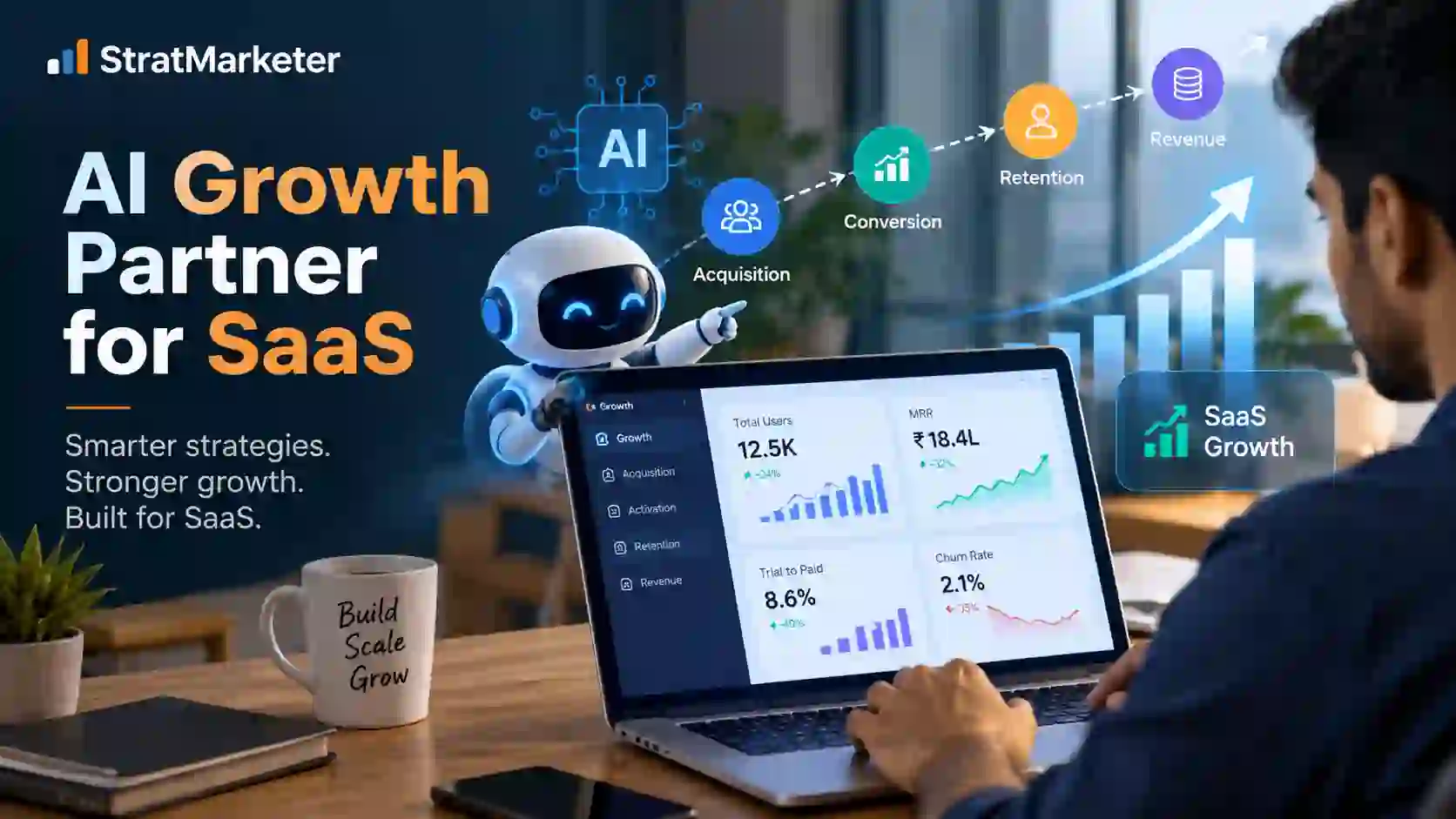
Traffic → Signup → Activation → Paid conversion → Retention → Expansion
The numbers at each stage matter because growth compounds through the entire chain.
If 10,000 relevant visitors produce 500 signups, and 20 percent of those users activate, the company has 100 activated users. If the activation rate rises from 20 percent to 30 percent without increasing traffic, the company now has 150 activated users from the same acquisition base.
That is a very different growth conversation.
AI is particularly useful when the amount of information becomes too large for manual analysis. It can cluster customer feedback, identify patterns in search queries, compare campaign messages, summarise sales calls and flag behavioural differences between customer segments.
But the output still needs interpretation.
I might be wrong here if someone has found a SaaS environment where complete automation works beautifully across the whole funnel. In most businesses I have seen, it does not. The messy customer behaviour in between the neat stages is where human judgement still matters.
Finding Growth Gaps Across Acquisition, Activation and Retention
SaaS teams often talk about growth as if it were one number.
Monthly recurring revenue.
New customers.
Trial signups.
That can hide a lot.
A company might be acquiring customers at a healthy rate while losing older accounts almost as quickly. Another may have excellent retention but struggle to attract enough new users. A third may have plenty of signups but weak activation.
An AI growth partner for SaaS needs to find the gap instead of automatically pushing the loudest metric.
Take acquisition first.
The question is not simply, “How many visitors did we get?”
It is, “Which visitors have a realistic reason to buy this product?”
This is where search intent becomes valuable. A person searching for “best project management software for remote teams” is behaving differently from someone searching for “what is project management”. Both are relevant to the broad topic, but they are not equally close to a purchase.
AI can help analyse thousands of queries and group them according to intent, use case and customer problem. A human marketer can then decide which groups deserve dedicated pages, comparison content, product messaging or paid campaigns.
The same principle applies to lead generation.
A SaaS company may have plenty of demo requests but poor sales acceptance. Looking only at the number of demos can make the marketing team feel successful while the sales team becomes increasingly frustrated.
I have seen a version of this with B2B businesses where a campaign was generating hundreds of leads, but salespeople were quietly marking many of them as irrelevant. Nobody noticed the disconnect until acquisition costs started rising.
The lesson is uncomfortable.
A lead is not necessarily progress.
Activation is another area where growth teams often underestimate the problem. A signup tells you that someone was interested enough to create an account. It does not tell you that the product has become valuable to them.
For a CRM SaaS, activation might involve importing contacts and creating the first workflow. For an accounting platform, it could mean connecting financial data and completing the first reconciliation. For a collaboration tool, it might be inviting a team and completing the first shared project.
The definition has to come from the product.
An AI growth partner for SaaS can help identify behavioural patterns around that event. Which acquisition sources produce activated users? Which pages did they visit? Which onboarding messages did they receive? How long did activation take? Where did users stop?
That information can change marketing decisions.
Suppose LinkedIn produces fewer trials than Google, but LinkedIn users activate at twice the rate and have stronger retention. The channel may look weaker if you only compare signup volume.
This is why I dislike making channel decisions based only on top-of-funnel numbers.
The picture changes again with retention.
SaaS has a peculiar advantage and problem. Revenue can recur, but customers can also leave quietly. A customer who cancels after six months may have looked like a successful acquisition when they first converted.
AI can help identify churn patterns across customer size, product usage, onboarding completion, support conversations and subscription history. It can flag groups that behave differently before cancellation.
That does not mean AI can predict every churn event accurately.
It cannot.
There will always be customers who leave because their company was acquired, a budget was frozen or a project ended. Not every cancellation is a marketing failure.
This is where growth work becomes less tidy than the dashboards suggest.
Using AI Without Losing the Human Side of SaaS Marketing
There is a strange contradiction in AI marketing.
Companies want personalised communication, but they also want to automate more of it.
Customers notice when those two goals collide.
A SaaS email saying, “We noticed you haven’t completed your workflow setup” can be useful. An email that repeats the same generic message three times because an automation was badly configured feels irritating very quickly.
An AI growth partner for SaaS should use customer information to make communication more relevant, not simply more frequent.
Personalisation can happen at several levels.
A visitor researching enterprise security needs different information from a startup founder comparing monthly pricing. A finance manager may care about approval controls and audit trails. A technical buyer may want API documentation, integration details and security architecture.
The product has not changed.
The buying concern has.
AI can help identify those patterns from conversations, search behaviour, CRM records and website interactions. The marketing team can then adapt the message.
There is also a creative side to this.
I have seen teams use AI to generate dozens of ad variations and then assume they have solved creative testing. They have not. Fifty variations of the same weak proposition are still built around a weak proposition.
The important question comes earlier.
What exactly are we trying to make the customer understand?
That could be a cost saving, a faster workflow, fewer manual tasks, lower compliance risk or better collaboration. Once the core idea is clear, AI becomes useful for testing different ways of expressing it.
The human side matters even more for SaaS products that require explanation.
A financial software company cannot rely entirely on clever copy. Customers may want to know how data is handled, what integrations are supported, what happens during implementation and what the product does when something goes wrong.
Trust is built through specificity.
Not adjectives.
This is particularly important in India, where SaaS businesses increasingly sell to international customers. A polished website can get attention, but buyers often move quickly towards documentation, customer stories, security pages, pricing details and product demonstrations before they commit.
An AI growth partner for SaaS should understand those moments.
I would also be careful about putting confidential customer data into poorly governed AI systems. SaaS companies routinely handle sales notes, support conversations, product usage information and sometimes sensitive business data. AI workflows need appropriate access controls, data handling practices and human review.
Speed is useful.
Carelessness is expensive.
And there is another human issue that does not show up in analytics.
Customers can tell when a company has stopped listening.
If every support response, onboarding email and product announcement sounds machine generated, the business slowly becomes distant. That may not create an immediate drop in conversion, but it can change how customers feel about the product.
Good SaaS marketing still needs people who understand why customers hesitate.
AI should help those people see more clearly.
Building Better Content, SEO and Search Strategies for SaaS
SaaS SEO has become harder because simply publishing articles around software keywords is no longer enough.
The search environment has changed. Buyers may encounter a SaaS brand through traditional Google results, AI generated answers, comparison pages, Reddit discussions, YouTube, product review sites, community conversations and direct recommendations.
That means an AI growth partner for SaaS has to think beyond a blog calendar.
A SaaS website needs useful commercial pages first.
Product pages.
Use case pages.
Integration pages.
Comparison pages where they make sense.
Industry pages when the product genuinely serves different industries.
Then comes educational content.
This order matters because I have seen SaaS companies publish 100 plus informational articles while their core product pages barely explain what the software actually does. The site receives some organic traffic, but very little of it has a natural path towards becoming a customer.
Content should answer the questions buyers actually ask.
For example, a payroll SaaS might publish an article about payroll processing. That is fine, but a stronger content opportunity could be something like “payroll software for multi location businesses” if that reflects an actual customer segment.
The difference is intent.
AI can make this research much faster. It can process search terms, customer questions, sales call transcripts, support tickets and competitor pages to identify recurring themes. It can also help marketers organise large keyword sets around topics instead of producing disconnected articles.
But the final content still needs original knowledge.
If ten SaaS websites have already explained what CRM software is, publishing the eleventh generic explanation adds very little.
A better article might explain a specific implementation problem. Perhaps users are struggling to migrate from spreadsheets. Perhaps a certain integration causes data duplication. Perhaps sales teams are using CRM fields incorrectly and creating unreliable reports.
These details are much harder to fake.
They also create stronger trust.
For SaaS businesses, product-led SEO can be especially interesting. A company might create free calculators, templates, checklists, small tools, integration documentation or public resources that genuinely help people before they become customers.
Not every company needs these.
But when the product naturally supports them, they can become useful entry points.
Search optimisation is also becoming more connected with product language. If a SaaS company calls a feature “Smart Workflow Intelligence” but customers search for “automated approval workflow software”, there is a communication problem.
The product team may love the feature name.
The customer may not know what it means.
An AI growth partner for SaaS can compare internal terminology with the language customers actually use. That can influence page titles, headings, FAQs, sales material and even how features are explained inside the product.
This is one area where I strongly prefer plain language.
A SaaS website does not need to sound clever.
It needs to make the right buyer think, “Yes, this is the problem I am trying to solve.”
There is also the growing importance of AI search experiences. I would not claim that traditional SEO has suddenly become irrelevant. It has not. But SaaS companies should now think about whether their expertise can be understood and referenced across multiple search environments.
That means clear explanations, factual product information, useful documentation, original research where available, expert commentary and pages that answer real questions directly.
AI can help identify gaps.
It should not manufacture expertise.
A company selling cybersecurity software, for example, cannot establish authority by publishing dozens of generic AI written security articles. A technical reader will eventually notice that the content contains no experience, no specific implementation detail and no meaningful point of view.
That is where many content strategies become uncomfortable.
The company knows its product deeply, but marketing rarely captures that knowledge. Engineers know the edge cases. Customer success knows the onboarding problems. Sales knows the objections. Support knows what breaks at 11 PM when a customer is trying to finish an important task.
That information is valuable.
An AI growth partner for SaaS can help turn those internal experiences into useful content without flattening everything into generic marketing copy.
And sometimes the best SEO decision is not to publish another article at all. It might be fixing a confusing product page, improving internal linking, rewriting a comparison page, adding technical documentation or removing outdated information.
That is less exciting than producing another batch of content.
It can also be more useful.
One small SaaS company I worked around had a surprisingly simple issue. Its product was capable of solving a particular operational problem, but the website used internal product terminology throughout the main pages. Prospects understood the problem, searched for it, landed on competing pages and never realised this company had the same solution. The product had not failed. The language had.
That kind of gap is exactly where an AI growth partner for SaaS can earn its place.
Not by producing more noise.
By noticing what everyone inside the company has stopped noticing.
Paid Acquisition, Funnels and Conversion Decisions
Paid acquisition becomes expensive when a SaaS company treats traffic as the main objective. It is tempting to look at a campaign dashboard and feel positive because clicks are increasing, but clicks do not pay the subscription bill.
For an AI growth partner for SaaS, the more useful question is what happens after the click.
A SaaS buyer rarely moves from an advertisement directly to a subscription decision. There may be a landing page, product explanation, pricing review, demo, free trial, onboarding step and several internal discussions before money changes hands. The exact path varies, especially between self serve SaaS and enterprise software.
This is why funnel analysis should begin with the customer journey rather than the advertising platform.
Google Ads may bring high intent visitors. LinkedIn may bring fewer clicks but better enterprise prospects. Meta can sometimes work for specific SaaS categories and audiences, although I would be cautious about assuming it will work simply because another company is getting results there.
The numbers have to be judged against the business model.
Suppose a SaaS company pays ₹1,000 to acquire a trial signup. That figure alone tells us very little. If the trial user never activates, ₹1,000 is expensive. If the user becomes a paying customer worth ₹60,000 over the relationship, the same acquisition cost looks completely different.
This is where conversion decisions become more interesting.
An AI growth partner for SaaS can bring campaign data, website behaviour and CRM information together to understand which traffic sources are producing meaningful customers. AI can help identify patterns across thousands of interactions much faster than a person manually checking spreadsheets.
But there is a catch.
Attribution can lie.
A customer might click a Google ad, read three articles, watch a product video, speak to sales and then return directly to the website two weeks later. Which channel gets credit? The answer depends on the attribution model, and none of the common models perfectly explains human buying behaviour.
So I would not make major budget decisions from one attribution report.
Look at several signals.
Are qualified leads increasing? Are trial users activating? Are sales accepted opportunities rising? Are customers from the channel staying? Does the acquisition cost make sense against the revenue profile?
The funnel also needs the right message at the right stage.
A person discovering the category does not need the same landing page as someone comparing two vendors. Sending both to the same generic homepage is one of those mistakes that looks harmless until you examine the numbers.
A focused landing page can answer the obvious questions quickly. Who is this for? What problem does it solve? How does it work? What makes the product different? What should I do next?
Sometimes the answer is a demo.
Sometimes it is a free trial.
Sometimes it is simply reading more.
I prefer testing these decisions rather than assuming them.
There is also a temptation to keep changing everything at once. New headline, new offer, new audience, new creative, new landing page, new pricing message. Then conversion rises or falls and nobody knows why.
Good experimentation is slower than that.
You need enough consistency to understand what actually changed.
That sounds obvious. In busy SaaS teams, it often gets ignored.
An AI growth partner for SaaS can help generate variations, identify patterns and analyse test results, but somebody still needs to decide what deserves a proper experiment. AI should reduce analysis time, not remove thinking from the process.
Turning Product and Customer Data Into Growth Insights
Most SaaS businesses have more customer information than they realise.
The problem is that it sits in different places.
Website analytics show one story. CRM records show another. Product analytics show behaviour. Support tickets reveal friction. Sales calls reveal objections. Cancellation notes explain why customers leave, although those notes are often painfully vague.
Then there is the data nobody has formally collected because a sales manager simply remembers that “customers in this segment keep asking about integration.”
That memory matters too.
An AI growth partner for SaaS can help bring these signals together and find patterns that are difficult to spot manually.
Consider a simple example.
A company notices that trial conversions are falling. The marketing team assumes lead quality has declined. But when product usage is examined, a different pattern appears. Trial users from the same traffic sources are still signing up, but fewer of them complete the first important product action.
The problem has moved downstream.
More advertising will not fix it.
Maybe the onboarding has become confusing after a product update. Maybe an integration that used to be optional is now effectively required. Maybe the first screen is showing too many features instead of directing users towards the one action that creates value.
These are growth insights, even though they do not come from a marketing dashboard.
AI is useful here because it can process large volumes of unstructured information. Imagine having several thousand support conversations and wanting to know the five recurring reasons users struggle during onboarding. Reading them manually could take days.
AI can cluster the conversations and surface recurring themes.
A person can then validate them.
That second step is important.
AI might group two issues together because the language looks similar when the underlying problems are completely different. A human who understands the product needs to check whether the pattern actually makes sense.
The same approach works with sales calls.
If prospects repeatedly ask about implementation time, that is a signal. If many ask whether the product integrates with a particular platform, that is another. If enterprise buyers keep asking about security documentation before discussing price, the website may need to address that concern much earlier.
The data is not merely telling you what happened.
It is giving you clues about why it happened.
Retention analysis can be even more revealing.
Imagine two groups of customers. Both have similar acquisition costs and initial subscription values. One group uses the product heavily in its first month and remains for two years. The other signs up, uses a few features and cancels within six months.
The acquisition channel might be identical.
The customer behaviour is not.
An AI growth partner for SaaS can look at usage frequency, feature adoption, account size, support history and other available signals to identify behaviours associated with stronger retention.
This does not mean the system should label a customer as “likely to churn” and automatically send five emails.
That can become annoying very quickly.
The useful question is what intervention makes sense.
Maybe the customer needs onboarding assistance. Maybe a missing integration is blocking adoption. Maybe the account has never used a feature that is central to its use case.
Growth becomes more practical when the data leads to an action.
I also think SaaS companies should be careful with vanity dashboards. A beautiful dashboard with 40 metrics can create the illusion of control. If nobody can explain which three numbers actually influence the next decision, the dashboard is decoration.
Sometimes a simple weekly view is more useful.
New qualified opportunities.
Activation rate.
Paid conversion.
Retention.
Expansion.
Customer acquisition cost.
Then investigate the unusual movement.
That is enough to start.
Where SaaS Growth Partnerships Commonly Go Wrong
The biggest problem is often not technology.
It is expectation.
A SaaS founder may expect an AI growth partner for SaaS to come in and produce rapid growth across every channel. The partner may then respond by launching content, paid campaigns, automation and landing pages simultaneously.
Everyone is busy.
Nobody has proved what is working.
I have a particular dislike for this model because it creates activity very quickly but understanding very slowly.
Another common problem is starting with tools instead of the customer.
A company buys an AI writing platform, connects analytics, installs automation software and starts generating campaigns before clearly defining its best customer segment. The technology works perfectly. The strategy remains unclear.
AI cannot compensate for a confused market position.
There is another issue with over automation.
Not every SaaS customer wants a chatbot.
Not every lead needs a five email sequence.
Not every support question should be answered by AI.
Some customers have complicated requirements and want to speak to someone who understands their situation. Enterprise buyers in particular may need technical, security or implementation conversations that cannot be reduced to automated prompts.
The better approach is selective automation.
Automate repetitive work where the customer does not lose anything by doing so. Keep human involvement where judgement, trust or complexity matters.
Measurement can also go wrong.
A partner might report higher traffic, lower cost per click or more leads while the actual revenue picture remains unchanged. The company then continues funding activities because the monthly report looks healthy.
This is why commercial metrics need to sit above channel metrics.
Another failure comes from poor communication between marketing and product.
Marketing discovers a recurring customer problem but does not tell product. Product changes onboarding but marketing continues promoting the old experience. Sales hears objections that never reach either team.
The result is fragmented learning.
A good growth partnership should create a feedback loop.
Customer behaviour informs marketing. Marketing insights inform product. Product changes alter customer behaviour. Sales feedback feeds back into positioning.
It is not always neat.
It should not be.
There is also the question of data quality. AI can analyse bad data very efficiently, which is almost worse than having no analysis at all. Duplicate CRM records, missing campaign tracking, inconsistent lifecycle stages and poorly defined activation events can make sophisticated analysis misleading.
Before adding another AI layer, sometimes the boring work needs to be done.
Clean the data.
Define the events.
Agree on what counts as an activated customer.
Decide which revenue numbers matter.
Then start analysing.
I might be wrong here, because some very young SaaS companies genuinely need speed more than process. But once a company reaches the stage where multiple acquisition channels and customer segments are involved, messy measurement starts becoming expensive.
The partnership also fails when expectations are vague.
“Help us grow” is not enough.
Grow what?
Trials?
Qualified pipeline?
Paid conversions?
Annual recurring revenue?
Retention?
Expansion?
A useful relationship needs a clear commercial question.
How StratMarketer Works as an AI Growth Partner for SaaS
At StratMarketer, the role of an AI growth partner for SaaS should not begin with a list of tools.
It should begin with the business problem.
A SaaS company might approach us because organic traffic is flat. Another may have traffic but poor trial conversion. Someone else may be spending on paid acquisition but cannot work out why customer acquisition costs keep increasing.
Those are three different situations.
They should not receive the same plan.
The first step is understanding the product, customer, market and existing acquisition system. That includes looking at the website, search presence, messaging, landing pages, content, paid campaigns and available customer data.
Then comes the less glamorous part.
Finding the friction.
Perhaps the product positioning is unclear. Perhaps the website is attracting informational traffic instead of commercial prospects. Perhaps a campaign is bringing leads that sales does not want. Perhaps users are signing up but never reaching the point where the product becomes useful.
AI can help analyse large volumes of information during this process. Search data can be grouped by intent. Customer feedback can be clustered. Campaign performance can be compared across segments. Content opportunities can be mapped against the questions buyers actually ask.
But StratMarketer’s role should not be reduced to what AI can automate.
The human interpretation is where the work becomes useful.
For content and SEO, the focus is on building pages around actual customer problems, product use cases and commercially relevant search behaviour. The aim is not to keep publishing simply because the editorial calendar says Tuesday is “blog day”.
For paid acquisition, campaigns need to be connected to the quality of the resulting leads and customers. A cheap click that never produces a meaningful action is not particularly useful.
For conversion work, the focus can move towards landing page clarity, calls to action, onboarding paths and the points where potential customers hesitate.
For lifecycle marketing, AI can help identify customer segments and behavioural patterns, while the messaging still needs to sound like it came from a company that understands its users.
And the process should remain flexible.
A SaaS company may start with SEO and later discover that activation is a bigger constraint. The focus should be allowed to move.
That is important because growth rarely follows the original spreadsheet.
One month, the problem may be acquisition. The next, it may be onboarding. Then pricing. Then retention.
A good partner keeps asking what is limiting growth now.
Not what service was promised six months ago.
StratMarketer can also work across the different parts of digital acquisition rather than treating SEO, paid advertising, content and conversion as isolated services. For a SaaS business, that connection matters because the customer does not experience marketing in separate departments.
They experience one company.
If the advertisement says one thing and the landing page says another, the problem is obvious to the customer even if every internal team has completed its task.
That is the kind of disconnect we would want to catch.
The same applies to AI itself.
AI should be used where it creates useful leverage, such as research, analysis, content assistance, customer insight processing, campaign iteration and repetitive workflows. It should not be used just because saying “AI powered” sounds impressive.
I would rather tell a SaaS founder that a particular automation is unnecessary than add another system that nobody inside the company understands six months later.
Growth work has enough complexity already.
Frequently Asked Questions About AI Growth Partner for SaaS
What is an AI growth partner for SaaS?
An AI growth partner for SaaS helps software companies use AI, marketing expertise, customer data and growth processes to improve acquisition, conversion, activation and retention. The work can cover SEO, content, paid acquisition, funnels, analytics and lifecycle marketing depending on the company’s actual needs.
Is an AI growth partner for SaaS the same as a digital marketing agency?
Not necessarily. A traditional digital marketing agency may focus mainly on marketing channels. An AI growth partner for SaaS should look more closely at the complete customer journey and use AI where it can help with research, analysis, personalisation, testing and automation.
The boundaries can overlap, though.
Can AI replace a SaaS marketing team?
I would not build a SaaS growth strategy around that assumption. AI can handle a lot of repetitive analysis and production work, but positioning, customer understanding, creative judgement and commercial decisions still need people.
When should a SaaS company consider working with an AI growth partner?
Usually when the company has enough activity to create a real growth problem but not enough internal capacity to analyse everything properly. That could mean rising acquisition costs, weak trial activation, poor conversion, stagnant organic growth or inconsistent customer retention.
Can an AI growth partner help with SaaS SEO?
Yes. AI can assist with search intent research, topic analysis, content planning, competitive research and identifying gaps across a large website. But the content still needs genuine product knowledge and useful information. Publishing AI generated articles at scale is not a substitute for expertise.
Does AI growth work for early stage SaaS companies?
It can, but the approach needs to be different. An early stage company may not have enough data for sophisticated modelling. Customer interviews, product feedback and direct sales conversations can be more valuable than complex AI analysis at that stage.
How does StratMarketer use AI for SaaS growth?
StratMarketer can use AI for research, customer and campaign analysis, content support, search intent analysis, automation and identifying patterns across growth data. The important part is combining that analysis with human marketing judgement rather than leaving decisions entirely to automated systems.
Can an AI growth partner guarantee SaaS growth?
No responsible partner should guarantee a specific growth outcome. Too many variables sit outside the marketing team’s control, including product quality, pricing, market demand, competition, customer retention and sales execution.
What can be managed is the quality of the research, testing, measurement and decisions made from the available evidence.
What should a SaaS company ask before hiring an AI growth partner?
Ask how they define growth, which metrics they will actually work against, how they handle customer data, how they evaluate AI generated work, what they need from the internal team and how they connect marketing activity with revenue.
Our Services
Contact Us
- Paonta Sahib, Himachal Pradesh, India
- +91-8700998508
- support@stratmarketer.com
Start From Here
These two options make it easy for you to get the information you want.