


AI CRO Agency for Ecommerce | StratMarketer
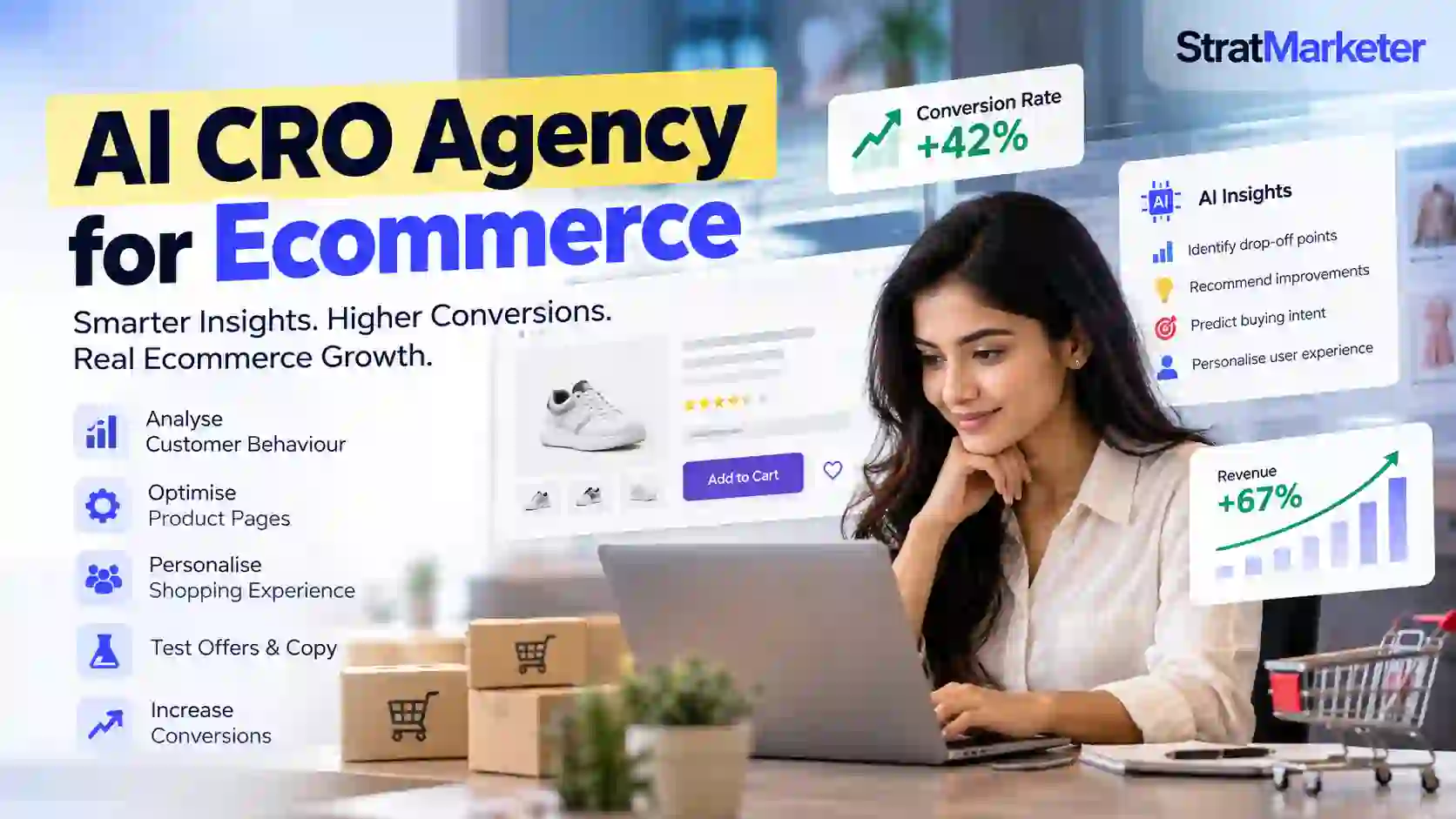
Why Ecommerce Conversion Rate Optimisation Is Changing With AI
For many ecommerce brands, the problem is not getting people to the website. The harder part is getting those visitors to actually buy.
A brand can have decent traffic from Google, Meta Ads, marketplaces, influencers or WhatsApp campaigns and still watch a large share of visitors leave without placing an order. This is where conversion rate optimisation becomes important. But the way ecommerce teams approach CRO is changing, partly because AI can process customer behaviour, product data and website interactions much faster than a person sitting with a spreadsheet.
An AI CRO agency for ecommerce works around this problem differently. Instead of looking only at whether conversion rates went up or down, AI can help examine what visitors are doing before that conversion happens.
A shopper may land on a product page, spend 40 seconds reading the description, open the size chart, return to the product image, scroll to reviews and then leave. Another shopper may add the product to cart but abandon the checkout after seeing delivery charges. A third may visit five times before purchasing.
These are not the same problem.
Yet traditional CRO discussions sometimes put all of them under one number, such as conversion rate.
That number matters, obviously. But by itself it tells you very little.
I have seen ecommerce teams spend weeks changing buttons and headlines when the actual issue was much more basic. The product information was unclear. Delivery expectations were buried. Mobile users could not easily find the variant selector. On Indian ecommerce websites, payment preferences and COD information can also influence the decision in ways that a simple desktop conversion report will never explain.
AI gives CRO teams another layer of visibility.
It can help identify patterns across thousands of sessions, product pages, customer interactions and transaction records. It can group similar behaviour, flag unusual changes and help teams decide where an experiment deserves attention.
That does not mean AI automatically knows why customers are leaving.
This distinction is important.
AI can find patterns. Humans still need to understand the business reason behind those patterns.
For example, suppose an ecommerce fashion brand notices that product page engagement is high but purchases are weak. An AI system might identify that visitors frequently move between product images and the size guide before leaving.
That is useful.
But the CRO team still has to ask why.
Is the sizing information confusing? Are customers unsure whether the fabric stretches? Are there too few model references? Is the price too high compared with competitors? Is the return policy unclear?
The answer does not come from a dashboard alone.
What an AI CRO Agency for Ecommerce Actually Does
The phrase AI CRO agency for ecommerce can sound more complicated than the actual work.
At its core, the job is still about helping more of the right visitors complete valuable actions. The difference is that AI can support the research, analysis and testing process.
An AI CRO agency for ecommerce may examine website analytics, heatmaps, session recordings, customer feedback, product information, search behaviour and conversion data together instead of treating each source separately.
That matters because ecommerce behaviour is rarely explained by one report.
Imagine a skincare brand selling a ₹1,200 serum. Analytics show that the product receives thousands of visits but has a weak purchase rate. The marketing team might initially assume the traffic quality is poor.
Then another set of data shows something interesting.
Visitors are spending a reasonable amount of time on the page. They are reading reviews. They are opening the ingredient section. But a significant number are leaving after checking shipping information.
That changes the investigation.
Maybe customers want to know whether the product can be delivered to their pincode. Maybe the estimated delivery date appears too late. Maybe COD is unavailable. Maybe shipping charges become visible only after the customer has invested time in the buying process.
An AI CRO agency for ecommerce can help connect these pieces faster.
The agency may use AI to segment visitors, identify repeated behaviour, analyse large volumes of feedback and generate hypotheses for testing. The actual CRO work can then involve changing page content, simplifying navigation, improving product information, adjusting the checkout experience or testing different offers.
The important word here is testing.
I would be cautious about any CRO service that treats AI recommendations as automatically correct. Ecommerce websites are full of unusual situations. A product may convert badly because stock is inconsistent. A campaign may suddenly attract a different audience. A discount may lift conversion while damaging margins.
AI does not remove these complications.
It can make them easier to investigate.
A good AI CRO agency for ecommerce also has to understand commercial context. Increasing conversion rate from 2 percent to 3 percent sounds positive, but if the change comes from a heavy discount, the business may not actually be better off.
That is where experienced CRO work becomes different from simply adding AI tools to an analytics stack.
Where AI Finds Conversion Problems That Teams Often Miss
One reason ecommerce teams turn to an AI CRO agency for ecommerce is volume.
A growing online store can have thousands of visitors every day. Nobody can manually review every session, product interaction or customer comment.
AI can process that volume and surface patterns that deserve attention.
One useful example is behavioural clustering.
Instead of treating all visitors as one audience, AI can identify groups based on actions. One group may browse several products without adding anything to cart. Another may repeatedly return to the same product. Another may add products to cart but leave during payment.
Those behaviours suggest different problems.
The first group might need better product discovery.
The second might need stronger trust signals.
The third might have a checkout problem.
This sounds simple when explained afterwards. In a live ecommerce account, it can get messy quickly.
There is also an issue with micro friction.
A customer does not always leave because something is dramatically wrong. Sometimes the website simply makes the purchase slightly harder than it needs to be.
A product page might have five product images but no close-up photograph.
The return policy might exist, but only in the footer.
The reviews might be excellent, but buried below three long sections.
The CTA might be visible on desktop but require scrolling on a smaller mobile screen.
The product description might explain features without answering the question the customer actually has.
Individually, these look minor.
Together, they can affect conversion.
An AI CRO agency for ecommerce can use behavioural data to spot recurring friction. For example, repeated clicks on an element that is not clickable may indicate confusion. Frequent back-and-forth movement between sections may suggest that customers are searching for missing information. Sudden exits after a particular interaction can point to a possible friction point.
AI can also analyse customer language.
This is particularly useful for ecommerce businesses with large volumes of reviews, support conversations and product questions.
Suppose customers repeatedly ask:
“Is this suitable for oily skin?”
“Will this fit a 42-inch chest?”
“Can I return this after opening?”
“Does it work with this model?”
These questions are not merely customer support issues.
They are conversion research.
If hundreds of potential customers are asking the same thing, the product page may not be answering it properly.
That is one area where I strongly prefer practical CRO over cosmetic CRO. Changing button colours can be tested, but if customers cannot find the information they need to trust the purchase, the button is not the main problem.
Product Pages, Landing Pages and Checkout Experience
AI CRO does not stop at the homepage.
In ecommerce, the product page often carries a huge part of the buying decision. This is especially true when customers arrive directly from search results, shopping ads, social media or marketplace campaigns.
An AI CRO agency for ecommerce may examine how different product pages perform and then compare the behaviour of visitors across them.
Perhaps one product page converts at 3.4 percent while another similar product converts at 1.5 percent.
The obvious reaction is to copy the better page.
I would not do that immediately.
First, I would ask whether the traffic is comparable.
Maybe the higher converting product receives branded search traffic while the weaker page gets cold social traffic. Perhaps the product price is different. Maybe one product has 900 reviews and the other has 30.
AI can help identify these differences, but the interpretation still requires judgement.
Landing pages create another set of problems.
A paid campaign may promise one thing and send users to a generic collection page. The visitor then has to search for the product they saw in the advertisement.
That creates friction before the customer has even started evaluating the product.
For ecommerce campaigns, message continuity matters. If an advertisement talks about a specific product benefit, the landing experience should make that benefit easy to find.
AI can help analyse campaign language, landing page content and user behaviour together. It can also help identify which landing page elements correlate with better engagement or purchase behaviour.
Checkout is where things become particularly sensitive.
A customer who has already selected a product has shown strong intent. Losing them at this stage can be expensive.
Common friction points include unexpected shipping costs, complicated forms, limited payment options, account creation requirements, unclear delivery dates and technical issues.
Indian ecommerce also has some specific considerations.
Customers may compare prepaid discounts with COD options. They may check delivery estimates before completing the purchase. UPI has become a familiar payment method, but that does not mean every checkout experience using UPI is automatically frictionless.
An AI CRO agency for ecommerce can examine abandonment patterns and identify where users are dropping off.
But again, the solution should not be assumed.
If checkout abandonment rises after a shipping fee is introduced, the answer might not be removing the fee. The business may need to communicate the shipping threshold earlier, test free shipping above a certain order value, or reconsider the offer economics.
CRO has to respect margins.
Otherwise it becomes a game of making the conversion percentage look nicer.
Using AI to Understand Ecommerce Customer Behaviour
Customer behaviour is messy.
People do not always behave according to the neat funnel diagrams used in marketing presentations.
Someone might discover a product on Instagram, search for the brand on Google, read reviews three days later, visit the website from a direct link and finally purchase through a mobile device.
Another customer may visit once and buy immediately.
An AI CRO agency for ecommerce can help make sense of these different journeys by combining behavioural signals rather than looking at a single interaction.
This is where segmentation becomes useful.
A brand might separate visitors into first-time shoppers, returning visitors, high-value customers, cart abandoners and people who viewed several products without purchasing.
The next step is not simply to personalise everything.
Too much personalisation can become annoying.
A customer who looked at running shoes once does not necessarily want every page to scream running shoes for the next month.
The better use of AI is often quieter. Identify meaningful behavioural differences and use them to inform decisions.
For example, returning customers may need less introductory product information and more information about new arrivals or replenishment. First-time visitors may need stronger trust signals. High-intent visitors may benefit from clearer delivery information or product comparisons.
AI can help identify these patterns from large datasets.
Customer reviews are another rich source.
A traditional review analysis might tell you that customers generally like the product. AI can go deeper by grouping comments around themes such as fit, packaging, delivery, quality, durability, usage difficulty or value for money.
That can directly influence CRO.
If customers repeatedly praise quality but complain that product sizing is confusing, the website should not simply display more praise. It should solve the sizing concern.
This is where ecommerce CRO becomes interesting.
The best conversion improvement is sometimes not a marketing change at all. It can be better information.
I might be wrong here, but I think many brands still underestimate how much uncertainty affects online buying. People hesitate when they cannot confidently answer a basic question before paying.
That uncertainty can come from price, fit, quality, delivery, returns, compatibility or simply not knowing what happens after clicking Buy Now.
AI can help identify those uncertainty points.
It can also help teams prioritise them.
Not every issue deserves a test. A tiny interaction on a low traffic page may not matter much. A recurring problem on a best-selling product page could have a much larger commercial effect.
That prioritisation is one of the more useful roles for an AI CRO agency for ecommerce.
Still, there is a limit.
AI can tell you that a pattern exists. It cannot always tell you what the customer was feeling when they left the page. Sometimes the reason is painfully ordinary. They got distracted. Their child called them. Their internet connection dropped. They changed their mind.
Not every exit is a CRO problem.
That sounds obvious, but it is surprisingly easy to forget when staring at a dashboard full of numbers.
And that is probably why ecommerce CRO needs both technology and human judgement. AI can process the mess. Someone still has to decide which part of the mess actually matters.
Personalisation Without Making the Shopping Journey Complicated
Personalisation sounds simple until an ecommerce website starts doing too much of it.
A visitor looks at running shoes once and suddenly every banner, recommendation, popup and email starts talking about running. Another customer buys a face wash and keeps seeing the same product recommended for weeks. A returning customer already knows the brand, yet the website continues showing them the same introductory message meant for a first-time visitor.
That is not really personalisation. It is repetition with customer data attached to it.
An AI CRO agency for ecommerce has to be careful here because personalisation should remove uncertainty, not create another layer of noise.
The useful version is often quite subtle.
A first-time visitor may need reassurance about returns, delivery and payment options. A returning customer may care more about new products or replenishment. Someone who has already added an item to cart may not need another generic discount popup. They may simply need a clear reminder about delivery or stock availability.
AI can help identify these behavioural differences at scale.
For an Indian ecommerce store, this can become particularly interesting around geography, payment behaviour and product preferences. A customer in Mumbai and a customer in a smaller town may have different delivery expectations. Someone buying a ₹500 product may behave differently from someone considering a ₹15,000 purchase.
But personalisation should not become surveillance in disguise.
Customers should feel that the website understands what they need, not that it has been watching every click.
I prefer using behavioural signals that have a clear purpose. If a customer has repeatedly looked at a particular product category, showing relevant products can make sense. If someone has already purchased an item, recommending compatible or replenishment products can also be useful.
The moment personalisation starts changing too many things at once, testing becomes difficult too.
You no longer know what caused the improvement or decline.
This is one reason an AI CRO agency for ecommerce should treat personalisation as a conversion hypothesis rather than a feature that needs to be added everywhere.
Sometimes the most effective personalised experience is simply showing the right information at the right point.
A customer who wants to know delivery time should not have to dig through a long FAQ page.
A customer comparing two products should not have to open five browser tabs.
Small things like that matter.
And sometimes there is no need to personalise at all.
That part gets forgotten.
Testing Offers, Layouts, Copy and Calls to Action With AI
CRO becomes much more useful when assumptions are tested instead of defended.
Every ecommerce team has opinions about what should work.
The founder likes one headline. The designer prefers another layout. The performance marketer thinks the CTA should be changed. Someone from sales believes customers need a discount. Then everybody looks at the conversion data and tries to prove their point.
I have seen this happen more than once.
AI can make the testing process more systematic, but it does not remove the need for proper experimentation.
An AI CRO agency for ecommerce may use historical website data to identify pages with meaningful traffic and weak conversion performance. Those pages can then become candidates for testing.
The test could involve product copy.
It could involve layout.
It could involve the placement of reviews.
It could involve a different CTA.
Or it could involve the offer itself.
These are very different experiments.
Suppose an ecommerce brand sells premium furniture. The product page has strong traffic but relatively few purchases. The team might test a headline focused on craftsmanship against one focused on durability.
Another test could make delivery information more prominent.
Another might show EMI availability near the price.
The point is not to change everything simultaneously.
If the headline, product images, price presentation, reviews and CTA all change together, the result may show that conversion changed, but it will be difficult to understand why.
AI can help generate variations and identify patterns across previous tests. It can also help analyse which segments responded differently to an experiment.
But there is a practical warning here.
More tests do not automatically mean better CRO.
If a website receives very little traffic, constantly running tiny experiments can create noisy results. The team may end up reacting to random fluctuations.
This is where experience matters more than enthusiasm for AI.
An AI CRO agency for ecommerce should know when there is enough evidence to test something and when the better option is qualitative research, customer interviews or simply fixing an obvious usability problem.
Offers need even more care.
A 10 percent discount can increase orders. That does not necessarily mean it created better business performance.
If the average order value falls and the margin becomes too thin, the test may have increased conversion while hurting profitability.
I would rather see ecommerce teams test different forms of value. Free shipping above a threshold, bundles, quantity offers, extended returns, payment options and product guarantees can all affect purchase confidence.
The right answer depends heavily on the category.
A fashion brand may benefit from clearer return communication. A consumer electronics brand may need compatibility information. A beauty brand may need stronger product education. A furniture company may need delivery and installation clarity.
AI can help find the pattern.
The commercial team still has to understand the product.
Common Mistakes Ecommerce Brands Make With AI CRO
The first mistake is assuming that AI knows the customer better than the business does.
It does not.
AI works from available information. If the tracking is incomplete, the product catalogue is messy or customer events are incorrectly configured, the recommendations can be misleading.
Garbage data is still garbage, even when analysed very quickly.
Another problem is changing too many things at once.
A brand may introduce AI generated product descriptions, dynamic recommendations, personalised banners, automated offers and new checkout messaging in the same month.
Then sales move.
Nobody knows why.
Was it the traffic mix? The offer? Seasonality? The new product? A technical issue? The personalisation?
The team ends up guessing.
An AI CRO agency for ecommerce should bring some discipline to this process. Not every idea needs to go live immediately.
Another mistake is chasing conversion rate without looking at customer value.
Consider two scenarios.
In the first, conversion rises because the brand introduces a heavy discount.
In the second, conversion rises because customers understand the product better and trust the purchase more.
The numbers may look similar initially.
The business implications are not.
There is also a tendency to copy CRO experiments from large ecommerce websites.
This can be risky.
A large marketplace has millions of visits and enormous amounts of behavioural data. A smaller Indian ecommerce business may have a few thousand monthly sessions. The same testing method may not produce reliable results.
The website context matters.
Mobile experience is another area where brands sometimes rely too heavily on desktop assumptions. In many Indian ecommerce categories, mobile visitors represent a substantial part of traffic. A page that feels acceptable on a laptop can become frustrating on a smaller screen.
Buttons may be difficult to tap.
Product images may take too long to load.
Sticky elements may cover important information.
The checkout form may feel endless.
AI can flag behavioural patterns, but someone needs to actually experience the website on a phone.
That human check still matters.
Then there is the temptation to automate copy everywhere.
AI can produce dozens of headlines in seconds. That does not mean all of them deserve to appear on a real website.
Sometimes the original product copy written by someone who actually understands the customer is better.
I have a particular concern about generic AI personalisation. When every visitor sees a slightly different version of a website, consistency can disappear. Customers may receive conflicting messages about pricing, offers or product benefits.
That creates another problem altogether.
So yes, AI can help CRO.
But more AI is not the objective.
Better decisions are.
How StratMarketer Approaches AI CRO for Ecommerce
At StratMarketer, the practical starting point for an AI CRO agency for ecommerce should not be a tool.
It should be the business problem.
Before recommending a test, it makes sense to understand where the website is currently losing potential customers. That means looking at traffic sources, product pages, landing pages, user journeys, cart behaviour and checkout performance together.
A paid traffic problem should not be treated as a CRO problem just because the website has a low conversion rate.
If the wrong audience is arriving, changing the CTA will not solve the underlying issue.
Likewise, if a product has weak demand, improving its product page may only take the business so far.
The first layer is usually behavioural analysis.
Which pages receive attention?
Where do visitors leave?
Which products attract interest but fail to convert?
Where do returning visitors behave differently?
Are there noticeable differences between mobile and desktop users?
Are particular traffic sources showing unusual behaviour?
Then comes qualitative evidence.
Customer reviews.
Support questions.
Search queries.
Returns.
Feedback from sales teams.
Sometimes one customer support message explains a conversion problem better than an entire analytics report.
Suppose customers repeatedly ask whether a product is suitable for a particular use case. That question should probably appear on the product page rather than being answered manually every time.
This is the sort of small operational detail that can have a surprisingly large effect.
The next step is prioritisation.
Not every issue gets a test.
High traffic pages with meaningful commercial value generally deserve more attention than pages nobody visits. The same applies to products with strong demand signals but weak purchase completion.
AI can help rank patterns and identify relationships, but StratMarketer still needs to consider business context before deciding what to test.
Then comes experimentation.
The team may test page structure, copy, product information, reviews, offers, CTA placement, recommendation modules or checkout messaging.
The exact experiment depends on what the evidence suggests.
That matters because there is no universal CRO template that works for every ecommerce website.
A fashion store selling ₹1,500 products and a D2C brand selling ₹25,000 appliances are dealing with completely different buying friction.
Even within the same category, the audience can behave differently.
I would also keep an eye on what happens after conversion.
A successful CRO experiment should not be judged only by the immediate purchase rate. Average order value, returns, repeat purchases, discount dependency and customer quality can tell a different story.
This is where an AI CRO agency for ecommerce has to look beyond the first transaction.
And sometimes the answer will be that a proposed change should not be made.
That is fine.
CRO is not about changing a website for the sake of showing activity. Some pages are already doing their job. Some problems belong to pricing or product-market fit. Some belong to fulfilment.
Knowing where CRO stops is part of the work too.
Frequently Asked Questions About AI CRO Agency for Ecommerce
What does an AI CRO agency for ecommerce do?
An AI CRO agency for ecommerce uses AI alongside analytics, customer behaviour data and experimentation to identify conversion problems and test possible improvements. The work can cover product pages, landing pages, checkout, offers, copy, personalisation and customer journeys.
Is AI CRO only useful for large ecommerce companies?
No. But the approach needs to match the amount of available data.
A large store can support more detailed segmentation and experimentation. A smaller store may need to rely more on qualitative research and obvious usability improvements before running frequent tests.
Can AI increase ecommerce conversion rates automatically?
Not reliably.
AI can identify patterns and suggest opportunities, but conversion improvements still depend on the quality of the data, the product, traffic quality, website experience and the changes being tested.
What can an AI CRO agency test?
It can test many things, including product page layouts, headlines, descriptions, calls to action, reviews, offers, recommendations, navigation, forms and checkout messaging.
The right test depends on the problem identified first.
Does AI CRO mean using personalised websites for every customer?
No.
Personalisation is only one part of CRO. Sometimes showing everyone clearer delivery information or a better product comparison can have more value than creating different experiences for every visitor.
How does AI analyse ecommerce customer behaviour?
It can process events such as product views, searches, clicks, cart additions, checkout activity and purchases. When combined with reviews and customer feedback, these signals can reveal behavioural patterns that may not be obvious from basic conversion reports.
Can AI CRO reduce cart abandonment?
It can help identify reasons associated with cart and checkout abandonment. For example, teams may find patterns around shipping costs, payment steps, delivery information or form complexity.
The actual fix still needs to be tested.
Should an ecommerce business focus only on conversion rate?
I would not.
Conversion rate matters, but average order value, margin, returns, repeat purchases and customer quality can matter just as much. A change that increases orders but reduces profitability is not necessarily a useful CRO outcome.
How long does CRO take to show results?
There is no fixed timeline.
A clear usability problem on a high traffic page may show a measurable change relatively quickly. More complex experiments need enough traffic and time to produce useful evidence.
Is AI CRO the same as SEO or paid advertising?
No.
SEO focuses on organic search visibility. Paid advertising focuses on acquiring traffic through advertising platforms. CRO focuses on what happens after visitors arrive and how the website helps them take the intended action.
The three can influence each other, though.
Why should an ecommerce brand work with an AI CRO agency instead of only using AI tools?
Tools can show data and generate suggestions. An agency also brings analysis, experimentation, commercial context and implementation experience.
Our Services
Contact Us
- Paonta Sahib, Himachal Pradesh, India
- +91-8700998508
- support@stratmarketer.com
Start From Here
These two options make it easy for you to get the information you want.