


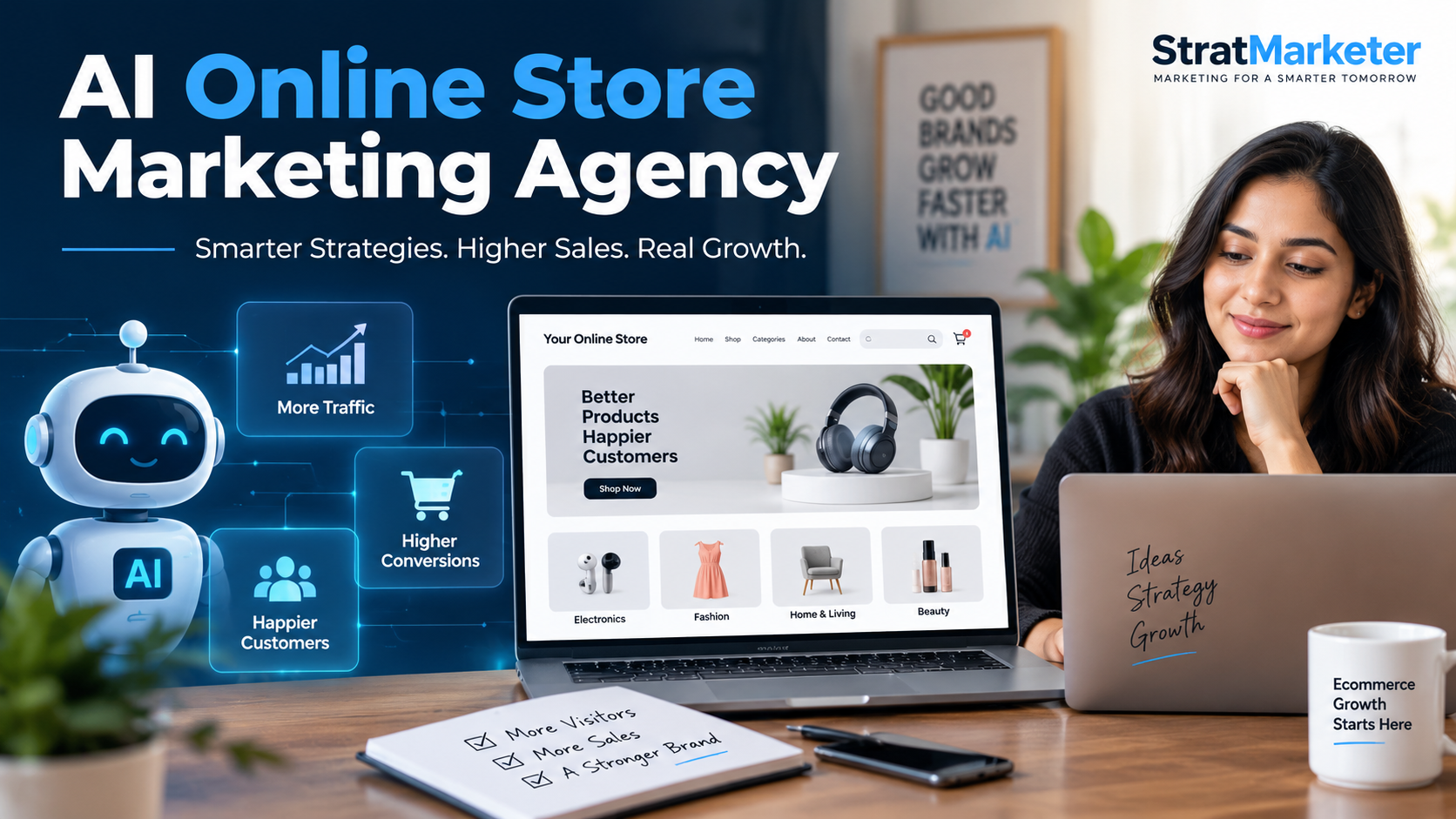
AI Online Store Marketing Agency for Ecommerce
Why Online Store Marketing Is Changing With AI
Online store marketing used to involve a fairly familiar routine. A store owner would study search terms, write product pages, run Google or Meta campaigns, send promotional emails, check sales, and then repeat the process. It worked, but it also meant a lot of decisions were made from limited information.
AI has changed that part.
An online store can now process customer behaviour, product data, search patterns, advertising signals and content performance much faster than a small marketing team could manually. The useful part is not simply generating more content. It is finding patterns that were previously easy to miss.
For example, an Indian fashion ecommerce store may notice that customers coming from Instagram behave differently from customers arriving through Google Search. One group may respond to short video demonstrations, while the other may spend more time comparing sizes, materials and delivery information. Treating both groups exactly the same wastes money.
This is where an AI online store marketing agency can become relevant.
The better use of AI is not to replace marketing judgement. It is to help marketers make decisions with more context. Product demand can be studied across different customer segments. Ad creatives can be tested in greater variety. Product descriptions can be adapted for different search intents. Customer questions can be grouped to identify recurring objections.
But there is a catch.
I have seen businesses get excited about AI because it can produce hundreds of product descriptions quickly. Then they discover that the descriptions all sound almost identical. The store has more content, but customers still cannot understand why one product is actually different from another.
That is not a marketing win.
AI is useful when it helps answer a real business question.
Why are customers abandoning the product page? Which products are attracting clicks but not purchases? Which search queries indicate strong buying intent? Which advertising messages are bringing traffic but poor quality orders?
These questions matter more than simply asking an AI tool to “create content.”
Indian ecommerce businesses also have another layer to consider. Customers may compare prices across marketplaces, check COD availability, look for WhatsApp support, read reviews and then leave the website before purchasing. A customer in Delhi may behave very differently from a customer in a smaller city where delivery expectations, payment preferences and trust signals are different.
AI can help identify those behavioural differences, provided the business has enough useful data.
And that last part is often forgotten.
Good AI marketing still depends on good inputs.
What an AI Online Store Marketing Agency Actually Does
The phrase AI online store marketing agency can sound vague because AI can now be used in almost every part of digital marketing.
In practical terms, the agency should be helping an ecommerce business use AI alongside established marketing channels such as SEO, paid advertising, email, social media, conversion optimisation and customer retention.
The important word is “alongside.”
AI does not suddenly make Google Ads profitable. It does not automatically create a high converting product page. It does not understand a brand’s customers perfectly after reading a few paragraphs about the business.
It needs direction.
A capable agency may use AI to analyse large volumes of search queries and identify patterns in what customers are actually looking for. It may examine advertising data to find weak creative combinations. It can help group customers according to behaviour rather than relying only on basic demographic categories.
For an ecommerce brand selling skincare products, for example, customer intent may fall into several different groups.
Someone may be searching for a solution to a specific skin concern. Another person may already know the product and search directly for the brand. Someone else may be comparing two ingredients. A fourth customer may have seen the product on Instagram and simply want to know whether it is suitable for their skin type.
The marketing should not treat all four people as one audience.
This is one of the areas where an AI online store marketing agency can contribute meaningful work.
AI can assist with:
- Customer and audience analysis
- Search intent research
- Product content development
- Product feed analysis
- Paid advertising analysis
- Creative testing
- Email personalisation
- Customer segmentation
- Conversion rate analysis
- Retargeting audiences
- Review and feedback analysis
- Competitor and market research
- Ecommerce reporting
But implementation still requires people.
Someone has to decide whether the findings make business sense. Someone has to understand margins. Someone has to know whether a discount is financially sensible. Someone has to recognise when an AI generated recommendation conflicts with what customers are actually saying.
I personally prefer this human plus AI model over the idea of fully automated ecommerce marketing. There are too many commercial details that numbers alone cannot explain.
Suppose a product gets thousands of visits but very few orders. AI might identify a pattern around traffic quality. Fine. But perhaps the real problem is that the product has a two week delivery period while competitors offer next day shipping.
No algorithm needs to invent that answer.
The business already knows it.
The agency’s job is to connect the data with the business reality.
Where AI Fits Into Ecommerce Marketing Without Making It Robotic
There is a strange problem happening with ecommerce content right now.
AI has made it easier to personalise marketing, yet careless use of AI can make every store sound less personal.
You have probably seen product descriptions that say almost the same thing everywhere. “Premium quality.” “Designed for modern lifestyles.” “Perfect for everyday use.” “Experience superior performance.”
None of these statements necessarily tells the buyer anything useful.
The problem is not AI itself. The problem is using AI without enough brand context.
An AI online store marketing agency should first understand how the business speaks to customers. Is the brand practical and direct? Is it premium? Does it appeal to young consumers? Does it sell technical products where specifications matter more than emotional language?
Then AI can be used to support that voice.
Take a small Indian home decor brand as an example. If the brand sells handmade wooden organisers, customers may care about dimensions, wood type, finish, cleaning requirements and whether the item fits a particular shelf.
A generic AI generated description may focus heavily on aesthetics.
A useful marketing system would notice that product page visitors are repeatedly asking about measurements and material durability. The content can then answer those questions clearly.
That feels personal because it responds to actual customer behaviour.
Not because the page contains the customer’s first name.
Personalisation has also moved beyond inserting names into emails. An online store can potentially tailor recommendations based on browsing behaviour, previous purchases, product categories viewed and purchase frequency.
But even here, restraint matters.
If someone purchases running shoes, showing them another pair of running shoes every week is not necessarily useful. They may need socks, insoles, maintenance products or nothing at all.
More personalisation is not always better personalisation.
There is also a trust issue.
Customers are increasingly aware that websites use automated systems. If recommendations become strangely specific or repetitive, people may feel watched rather than helped.
This is why I would be careful about giving AI complete control over customer communication. Let it identify patterns and prepare options. Keep human review around important messages, especially for premium products, complaints, sensitive categories and high value customers.
I might be wrong here, because the right level of automation varies enormously by store size and category. A large catalogue retailer and a boutique D2C brand should not necessarily operate the same way.
Using AI to Understand Online Store Customers Better
Customer data is one of the strongest areas for AI in ecommerce marketing, mainly because online stores generate enormous amounts of behavioural information.
A typical store may have data from Google Analytics, Search Console, Meta Ads, Google Ads, Shopify or another ecommerce platform, email platforms, customer reviews, CRM systems and customer support conversations.
Individually, these sources tell only part of the story.
The difficult part is connecting them.
Imagine a furniture ecommerce store notices that one particular dining table receives plenty of organic traffic. The product page also has a healthy amount of engagement, but sales remain disappointing.
A basic report might simply show low conversion.
AI assisted analysis can look deeper.
Are visitors coming from informational searches rather than transactional searches? Are people leaving after checking delivery information? Are mobile users behaving differently? Are customers repeatedly searching for the same table dimensions? Do reviews mention assembly problems? Are competitors offering similar products at a substantially lower price?
Those questions can change the marketing decision.
I have found customer reviews particularly useful in this context. Businesses often treat reviews as something to display for trust. They can also act as a source of marketing intelligence.
If customers repeatedly mention that a product is easy to clean, that phrase may deserve a place on the product page. If people repeatedly complain that the colour looks different from the photographs, the problem may not be advertising at all. The photography needs attention.
AI can process large numbers of reviews and categorise recurring themes much faster than a person manually reading every review.
That does not mean every AI interpretation should be trusted blindly.
A sarcastic review can be misclassified. A complaint may be an isolated incident. A phrase can mean different things depending on the product category.
Human checking still matters.
Customer segmentation is another area where AI can be useful.
Instead of looking only at age or location, an ecommerce business can segment customers by behaviour. For instance:
A customer who purchases once every six months.
A customer who buys every month.
A customer who frequently adds products to the cart but rarely checks out.
A customer who responds strongly to bundles.
A customer who purchases only during sales.
These groups should not necessarily receive the same message.
The frequent buyer may respond to early access or product recommendations. The cart abandoner may need better product information rather than another discount. The discount dependent buyer might need a different commercial approach altogether.
This is where an AI online store marketing agency can move beyond campaign execution and start looking at the actual customer journey.
And sometimes the result is uncomfortable.
You may discover that your “best selling” product attracts customers who almost never return.
That changes the conversation.
AI for Product Discovery, Content and Search Visibility
Search has become more complicated for online stores.
Customers do not always search for products using the exact words used in a product catalogue. They may describe a problem, compare features, ask questions, use conversational searches or discover products through AI generated answers and social platforms before reaching the store.
This means product discovery cannot depend only on placing a keyword in a product title.
For example, someone looking for a laptop backpack might search for “waterproof office backpack for 16 inch laptop”, “professional laptop bag for daily metro travel” or “best backpack for laptop and office documents”.
The products may be similar, but the intent behind those searches is different.
AI can help ecommerce marketers identify these variations and map them to relevant product pages, category pages, buying guides and supporting content.
There is another practical use.
Product catalogues can contain hundreds or thousands of SKUs. Checking every title, description, attribute and metadata field manually can take an enormous amount of time.
AI can help identify obvious gaps.
Perhaps some products have incomplete specifications. Maybe certain descriptions are too similar. Maybe important attributes are missing. Perhaps category pages have thin supporting content. Maybe product names do not match the language customers actually use in search.
An AI online store marketing agency can use this analysis to prioritise what needs human attention.
I would not recommend automatically rewriting an entire catalogue just because an AI audit finds duplicate wording.
That is where ecommerce teams sometimes go too far.
A catalogue of 5,000 products does not necessarily need 5,000 completely unique paragraphs. What matters is whether the content helps customers understand the product and whether the page satisfies the relevant search intent.
For ecommerce SEO, useful product information usually includes things such as specifications, compatibility, dimensions, materials, use cases, availability, delivery information, return conditions and genuine customer feedback where applicable.
AI can help organise and analyse this information.
It cannot manufacture missing facts.
That distinction is important.
If a manufacturer has not provided the actual battery capacity, an AI tool should not fill the gap with a plausible number. If a supplement manufacturer has not confirmed an ingredient quantity, generated content must not guess it. If a product is not waterproof, no amount of clever wording should make it sound waterproof.
This sounds obvious.
Yet these are exactly the small mistakes that can create bigger problems for ecommerce businesses.
Search visibility is also moving beyond traditional blue links. Customers increasingly encounter product information through shopping results, marketplace listings, social platforms and AI powered discovery experiences. That makes consistent and accurate product information more important than simply producing large volumes of SEO content.
A store selling thousands of products needs clean product data.
That may sound boring, but it matters.
Titles, descriptions, structured attributes, images, pricing, stock information and category relationships all contribute to how products are understood by search systems and customers.
The role of an AI online store marketing agency here is not to flood the website with machine written pages. It is to use AI where scale creates a genuine advantage, while keeping factual accuracy and human judgement in the loop.
That distinction is likely to become even more important as ecommerce discovery continues shifting.
Personalisation That Still Feels Human
Personalisation sounds simple until you actually have to do it for a busy online store.
Showing a customer’s name in an email is easy. Showing the right product, at the right stage of the buying journey, without making the customer feel like the website is following them around is much harder.
This is one reason an AI online store marketing agency needs to be careful with automation.
Consider an online fashion store. A visitor looks at three cotton shirts, checks the size chart twice and leaves. A basic retargeting system may immediately start showing the same shirt everywhere.
But perhaps the customer did not buy because the available size was unclear.
The better response may be a message explaining the fit, not another discount.
AI can help identify these behavioural signals. It can examine browsing patterns, purchase history, product preferences and engagement with previous campaigns. From there, marketing teams can create more relevant experiences.
For an ecommerce business, this might mean showing related products after a purchase, changing email recommendations based on previous orders, creating different remarketing audiences or adjusting messages for first time and returning visitors.
There is a fine line, though.
I have seen ecommerce brands become so obsessed with personalisation that every customer gets a different message, recommendation or offer. It sounds sophisticated on paper, but the experience becomes messy. Sometimes a straightforward message works better.
Human behaviour is not perfectly predictable.
Someone may browse expensive products for weeks and then buy a cheaper alternative because their budget changed. Another customer may usually buy one category but suddenly need something completely different for a family event.
AI works with patterns. Customers occasionally break them.
That is why I prefer using AI to support personalisation rather than allowing it to dictate every customer interaction. The system can identify what is likely to be relevant, while the marketing team decides whether the recommendation actually makes sense.
This matters even more for Indian ecommerce.
Customers may want COD, ask questions on WhatsApp, compare the same product on Amazon and the brand’s website, check delivery availability by pincode and then wait before purchasing. The journey can be surprisingly non linear.
A personalisation system that assumes every customer follows a neat funnel will miss some of this behaviour.
Sometimes the most useful personalisation is simply answering the question the customer is already asking.
AI Advertising for Ecommerce Stores Across Google and Meta
Paid advertising is probably one of the areas where ecommerce businesses notice AI most quickly.
Google and Meta already use machine learning extensively to decide which users see particular advertisements, how campaigns are distributed and which combinations of creative, audience and placement are likely to generate results.
That changes the job of the marketer.
The old habit of creating one campaign, one audience and one advertisement and then leaving it untouched does not work particularly well for many ecommerce categories now. There are too many variables.
An AI online store marketing agency can use AI to analyse those variables at scale.
For Google Ads, this may involve examining search terms, product performance, conversion behaviour, feed information and campaign patterns. For Meta, it can include analysing creative themes, audience behaviour, placements, product categories and customer acquisition patterns.
But there is a misconception worth clearing up.
AI does not mean you can upload a product catalogue and expect profitable advertising automatically.
Advertising still depends on the offer.
If a product costs ₹2,999 and a comparable product is available for ₹1,999, better automation cannot completely hide the difference. If the landing page loads slowly on mobile, the campaign cannot fix that. If the product photographs are poor, generating more ad variations will not solve the underlying problem.
The uncomfortable part is that advertising data often exposes weaknesses elsewhere in the business.
A campaign may generate plenty of clicks but very few purchases. The first reaction is often to blame the advertising.
Sometimes that is fair.
Sometimes the product page is the problem.
AI can help investigate the difference. It can compare traffic quality, customer behaviour, device patterns, creative themes and conversion rates. This gives marketers more information before making changes.
Creative testing is another area where AI can save considerable manual effort.
An ecommerce brand might have several product benefits. Instead of creating one advertisement around the product itself, the team can test different angles such as price, convenience, durability, appearance, use case or customer problem.
For example, a kitchen product could be marketed around saving preparation time, reducing cleaning effort or making small kitchens easier to manage.
The product has not changed.
The reason for buying it has.
This is where AI assisted creative analysis becomes useful. It can help identify which messaging patterns are attracting attention and which ones are producing meaningful actions rather than cheap clicks.
Still, I would resist the temptation to judge an advertisement too quickly.
A creative can have a lower click through rate and still bring better customers. Another can generate a lot of engagement but attract people who never purchase.
Revenue, margin, repeat purchases and customer quality eventually matter more than vanity numbers.
Where AI Online Store Marketing Can Go Wrong
AI can make ecommerce marketing faster.
It can also make bad decisions happen faster.
That is the part businesses sometimes underestimate.
An AI online store marketing agency may have access to excellent tools, but tools do not remove the need for judgement. If the underlying strategy is wrong, automation can simply multiply the mistake.
One common problem is low quality content at scale.
A store has 1,500 products. Someone decides that every description should be rewritten with AI. Within a few days, thousands of pages have been changed.
The descriptions are grammatically correct.
They are also bland.
Product information that was once specific gets replaced with generic language. Important differences between products disappear. Customers see paragraphs that sound like they were written for five different brands at once.
That is not useful optimisation.
Another issue is inaccurate information.
AI systems can generate plausible statements that were never supplied by the business. In ecommerce, that can be dangerous. Product specifications, warranties, ingredients, compatibility details, dimensions and performance claims need factual verification.
A marketing team should never accept an AI generated fact simply because it sounds convincing.
There is also the problem of excessive automation in advertising.
If an algorithm notices that discounts generate more purchases, it may appear logical to promote discounts more aggressively. But constant discounting can train customers to wait for sales.
The short term campaign numbers may look good while the brand’s pricing behaviour becomes weaker.
Customer data creates another concern.
An online store can collect an enormous amount of information. Browsing behaviour, purchase history, email engagement and other signals can all be useful, but businesses still need to handle customer information responsibly and follow applicable privacy requirements.
Not every piece of available data needs to be used.
I also worry about overconfidence in dashboards.
A dashboard may show that one audience is converting at a higher rate. Fine. But why? Perhaps it is genuinely a better audience. Perhaps that audience happened to receive a temporary offer. Perhaps the sample size is too small.
This is where human review becomes important.
I might be wrong here, but I think ecommerce teams will become less impressed by the word AI over time. Once every agency and advertising platform uses it, the technology itself stops being a differentiator. What matters will be whether the business is using it sensibly.
And sometimes the right answer will still be, “Do not automate this.”
How StratMarketer Approaches AI Online Store Marketing
At StratMarketer, the practical value of an AI online store marketing agency should come from connecting AI with the existing ecommerce marketing process rather than treating AI as a separate activity.
An online store still needs strong fundamentals.
The website needs to work properly. Product information needs to be accurate. Search intent needs to be understood. Advertising needs proper tracking. Landing pages need to make sense. Customers need clear reasons to trust the business.
AI can then be used where scale, pattern recognition and repetitive analysis make a genuine difference.
For example, a store with a large product catalogue may have thousands of customer queries, search terms and product interactions. Manually reviewing all of that information can take a lot of time. AI can help organise the information so the marketing team can see recurring themes.
The same principle can apply to content.
Instead of producing hundreds of generic articles, the focus can be on understanding what customers actually need to know before purchasing. Product comparisons, category content, buying questions and support information can then be developed around genuine customer intent.
Advertising is handled with the same thinking.
Rather than assuming that every campaign problem requires a new audience, the team can examine the full journey. Where are people entering? Which products attract them? Where are they leaving? Which creative themes produce useful traffic? Are purchases coming from customers who are likely to return?
Those questions are more valuable than simply asking whether AI was used.
For ecommerce businesses, StratMarketer can bring AI into areas such as SEO, paid advertising, content marketing, customer analysis, conversion optimisation, remarketing and campaign reporting.
But there is an important boundary.
AI should assist judgement, not replace commercial judgement.
A store owner knows things that may not appear in analytics. They know which product has frequent returns. They know which supplier causes delays. They know that customers from one region regularly ask the same question before ordering.
That knowledge should not be ignored simply because an AI dashboard says something else.
The best marketing conversations often happen when both sources of information are considered together.
And sometimes the AI recommendation should lose.
That is not a failure of the technology.
It is probably a sign that someone is actually paying attention.
Frequently Asked Questions About AI Online Store Marketing Agency
What does an AI online store marketing agency do?
An AI online store marketing agency uses AI alongside ecommerce marketing methods such as SEO, paid advertising, content, customer analysis, personalisation and conversion optimisation. The purpose is usually to analyse larger amounts of information, automate repetitive work and identify useful patterns without removing human decision making.
Is AI marketing suitable for small ecommerce businesses?
Yes, but the approach needs to match the size of the business.
A small store does not need an elaborate AI system for everything. It may get more value from customer segmentation, product content analysis, advertising insights, email personalisation and basic automation.
The mistake is trying to copy the marketing setup of a large ecommerce company before there is enough data to support it.
Can AI write product descriptions for an online store?
It can, but the output should be checked carefully.
AI can help create initial drafts, organise product information and adapt content for different customer questions. It should not invent specifications, claims, ingredients, warranties or technical details.
For important products, human review remains necessary.
Can AI help reduce ecommerce advertising costs?
It can help identify inefficient campaigns, weak creative combinations, poor performing products and audience patterns. But lower advertising costs are not guaranteed.
Sometimes spending more on a profitable campaign makes sense. Sometimes the real issue is the product page, offer or customer experience rather than the advertising itself.
Does an AI online store marketing agency replace an internal marketing team?
Not necessarily.
An agency can provide specialised skills, analysis and execution while an internal team continues handling brand decisions, product knowledge and commercial priorities. For some businesses, the agency becomes an extension of the existing team. For others, it handles most marketing activity.
The right arrangement depends on what the business already has internally.
Can AI improve ecommerce SEO?
AI can assist with search intent research, content analysis, product data organisation, internal linking opportunities and large scale content audits.
But search visibility still depends on useful content, technical quality, trustworthy information, good product pages and a website that actually satisfies the visitor.
Generating more pages is not the same thing as earning more search traffic.
Is AI personalisation always better for ecommerce?
No.
This is one area where more automation can make an experience worse. Customers want relevant recommendations, but they do not necessarily want every action tracked and reflected back at them.
Good personalisation should feel useful.
If it feels intrusive, repetitive or strangely accurate in an uncomfortable way, the business has probably gone too far.
How does StratMarketer use AI for online store marketing?
StratMarketer can use AI across areas such as ecommerce SEO, content, advertising analysis, customer segmentation, personalisation, campaign optimisation and conversion related work.
The important part is how those tools are connected to the actual store, products, customers and commercial goals. AI by itself is not a marketing strategy.
How quickly can an ecommerce store see results from AI marketing?
There is no reliable universal timeline.
Paid advertising changes can sometimes show signals relatively quickly, while SEO, content and organic product discovery generally require more time. The quality of tracking, website experience, product demand, competition and existing authority all affect the timeline.
A store with weak fundamentals may need those issues addressed before AI based marketing can make much difference.
Is an AI online store marketing agency useful if the store already runs Google and Meta Ads?
It can be. The question is not whether Google Ads or Meta Ads are already being used. The question is whether the campaigns are being analysed deeply enough and connected to the rest of the customer journey.
Our Services
Contact Us
- Paonta Sahib, Himachal Pradesh, India
- +91-8700998508
- support@stratmarketer.com
Start From Here
These two options make it easy for you to get the information you want.