


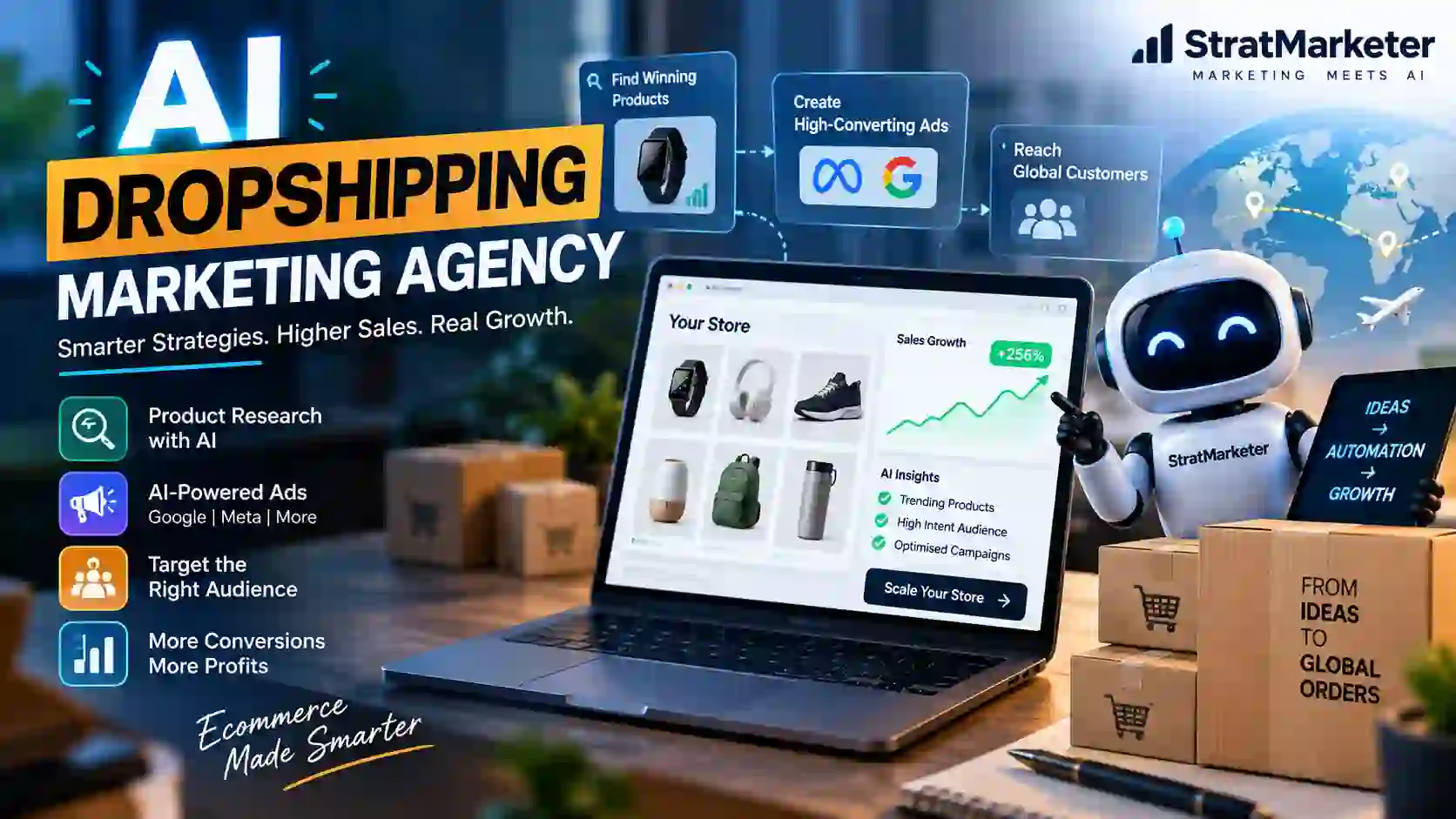
AI Dropshipping Marketing Agency for Smarter Ecommerce
1. Why Dropshipping Marketing Is Changing With AI
Dropshipping has always had one uncomfortable problem. It is relatively easy to open a store, add products and start running advertisements, but it is much harder to figure out which products deserve attention, which audience is actually interested, what message will make them stop scrolling, and where the money is leaking.
That is where artificial intelligence is changing the working style of ecommerce marketing.
An AI dropshipping marketing agency can process large amounts of information much faster than a traditional marketing workflow. Search behaviour, product trends, customer reviews, advertising data, landing page performance and audience responses can all be examined together. The useful part is not simply generating a few ad headlines with AI. The real value comes when these signals influence actual marketing decisions.
I have seen dropshipping businesses spend weeks arguing over whether a product is worth advertising, only to discover that the problem was not the product itself. The product page was weak, the creative showed the wrong use case, and the campaign was attracting people who liked the video but had little buying intent.
AI does not magically solve that.
It can, however, shorten the distance between finding the problem and identifying what might be causing it.
For an Indian ecommerce entrepreneur selling into the US, UK, Australia or other markets, this becomes even more relevant. The customer may be sitting thousands of kilometres away. You cannot rely on assumptions about what people want because a product looks popular on Instagram or because a supplier claims it is trending.
The marketing system has to learn from actual behaviour.
This is one reason an AI dropshipping marketing agency approaches campaigns differently from a basic social media advertising setup. Instead of treating every campaign as a fresh experiment, AI can help analyse patterns from previous campaigns and feed those observations into the next round.
Suppose a store sells compact kitchen organisers. Ten creatives are tested. Two receive strong click-through rates, but only one generates meaningful purchases. A basic report may simply say that one advertisement performed better.
A more useful analysis asks why.
Was the winning creative showing the product being used rather than sitting on a white background? Did the opening three seconds demonstrate the storage problem? Was the audience responding to convenience rather than price? Did customers coming from one placement spend more time on the product page?
Those questions matter more than the number of clicks.
And this is where I personally think many discussions around AI marketing become too enthusiastic. AI can process information quickly, but it does not automatically understand why a customer in Mumbai, Bengaluru or New York behaves differently. Human judgement still matters, particularly when the data is limited or misleading.
Still, the change is real.
Dropshipping marketers now have access to tools that can analyse customer language, generate creative variations, identify patterns in campaign performance and help automate repetitive decisions. The agency’s role is increasingly about connecting these capabilities with commercial judgement.
There is another change that often gets overlooked.
Customers have become harder to impress.
A generic product photograph followed by “Limited Time Offer” is unlikely to feel convincing when hundreds of stores are selling similar products. AI makes it easier to create variations, but that also means the internet gets filled with more variations of the same mediocre advertising.
So better technology does not automatically mean better marketing.
The brands that benefit tend to use AI to understand the customer more deeply, test ideas faster and remove repetitive work while keeping the final message grounded in the actual product.
That distinction becomes important when choosing an AI dropshipping marketing agency.
2. What an AI Dropshipping Marketing Agency Actually Does
The phrase sounds straightforward, but agencies can use AI in very different ways.
One agency may use AI mainly for content generation. Another may use it for campaign analysis. A more integrated AI dropshipping marketing agency may connect product research, customer segmentation, creative development, paid advertising, analytics and conversion optimisation into one workflow.
There is a big difference between these approaches.
If AI is only being used to write five Facebook captions, there is nothing particularly sophisticated about the process. Most ecommerce teams can already do that with readily available tools.
The interesting work happens behind the scenes.
An agency may begin by examining the store itself. Product margins, shipping times, pricing, return conditions, product reviews and conversion data all matter. A product that sells for ₹1,499 may look attractive until advertising costs, payment charges, returns and fulfilment expenses are considered.
AI can help organise these numbers and identify patterns, but someone still has to understand the economics.
Then comes audience research.
Customer reviews are especially useful here. People often describe the problem they wanted to solve in language that marketers would never naturally write. One customer might say, “I bought this because my kitchen counter was always cluttered.” That sentence tells a marketer much more than a generic demographic profile saying women aged 25 to 44.
Those real expressions can influence ad hooks, product page copy and video scripts.
A good AI dropshipping marketing agency may also use AI to break audiences into behavioural groups. Visitors who viewed a product once are not necessarily equivalent to people who added it to their cart three times. Someone who purchased a related item may need a completely different message from someone seeing the brand for the first time.
That sounds obvious when written down.
In actual campaigns, it is surprisingly easy to overlook.
There is also a technical side. AI can support analysis of advertising platforms, website analytics, CRM information and ecommerce data. When these systems are connected properly, marketers can see relationships that are difficult to notice when every report sits separately.
For example, an advertisement might produce cheap traffic but poor purchases. Another might have a higher cost per click but bring customers with higher average order values. If the team only looks at CPC, the first advertisement appears better.
If the team looks at contribution to actual revenue, the picture can change.
This is why I prefer to think of an AI dropshipping marketing agency as a decision support partner rather than an agency that simply “uses AI”.
The technology should help answer practical questions.
Which product deserves more testing?
Which audience is showing buying intent?
Which creative deserves another variation?
Where are visitors dropping out?
Which campaign is consuming money without enough commercial return?
What customer objections keep appearing?
What should be tested next?
The answers will not always come from AI. Sometimes the answer is sitting in a customer review or in a checkout report that nobody bothered to read properly.
There is a less glamorous part of the work too. Tracking needs to be clean. Product feeds need attention. Events need to fire correctly. Conversion data needs checking. If the underlying information is poor, an AI system can produce a beautifully written explanation of completely unreliable data.
That has happened before, and it is frustrating because the dashboard can look impressive while the business is making decisions on bad inputs.
For StratMarketer, the useful role of AI in dropshipping marketing is therefore not replacing marketers. It is helping the team handle more information, test more variations and identify patterns that deserve human attention.
3. Finding Products and Audiences With Better Market Signals
Product selection is where many dropshipping businesses start, and also where they can make expensive mistakes.
A product may have millions of views on social media and still be a poor product for a particular store.
Maybe the supplier has inconsistent quality. Maybe shipping takes too long. Maybe competitors are selling it for less. Maybe customers like watching demonstrations but do not feel enough urgency to purchase.
An AI dropshipping marketing agency can bring several signals together before serious advertising money is spent.
Search trends can indicate whether interest is growing or falling. Customer reviews can reveal recurring frustrations. Competitor advertisements can show what claims are being repeated. Social content can reveal which product benefits receive attention. Ecommerce data can provide evidence once the store has enough traffic.
None of these signals should be treated as a crystal ball.
That is important.
I might be wrong here, but I think marketers sometimes give product research tools too much authority. A tool may identify a product as “high potential”, but there is no universal high potential product. The economics depend on the market, offer, creative, fulfilment and customer expectations.
Consider a simple example.
A portable pet hair remover might perform reasonably well in India because customers understand the problem and the product is relatively inexpensive. Selling the same product to a US audience may require a different positioning. The customer may care more about furniture protection, convenience or saving time than the physical product itself.
Same product.
Different reason to buy.
AI can help identify these language differences by analysing large collections of reviews, comments and customer queries.
Audience research also becomes less dependent on broad demographics.
Instead of simply targeting “pet owners”, marketers can examine different behavioural signals. Some people are dealing with shedding dogs. Others have cats. Some are buying cleaning products after moving into a new home. Some may be searching for solutions because they are tired of cleaning sofas and car seats.
The advertising message can then reflect the actual problem.
This is particularly useful for dropshipping because the product is often not a unique invention. Several stores may sell almost identical items. The differentiation may therefore come from the offer, positioning, creative demonstration, trust and customer experience.
An AI dropshipping marketing agency can use audience data to test these different angles without creating every variation manually from scratch.
One campaign might focus on convenience.
Another might focus on a common frustration.
Another might show the product in a real home.
Another could use customer language taken from reviews.
After enough data comes in, the team can examine which messages generate useful behaviour.
There is a practical issue here, though. Early-stage stores often do not have enough data to make strong conclusions.
If fifty people visit a product page and three purchase, it is risky to build a huge theory around those three customers.
This is where experience matters.
AI can identify patterns. A marketer has to decide whether the pattern is meaningful.
Sometimes the answer is simply, “We need more data.”
That answer is not exciting, but it can save money.
4. Using AI for Product Research and Competitor Analysis
Competitor research used to involve opening dozens of websites, checking product descriptions, taking screenshots of advertisements and maintaining spreadsheets.
Some of that work is still useful.
But much of the repetitive part can now be assisted by AI.
An AI dropshipping marketing agency can analyse competitor product pages, customer reviews, frequently repeated claims, pricing structures and content themes to build a clearer picture of the market.
The purpose should not be copying competitors.
That usually creates another store that looks exactly like the others.
The more useful question is, “What are customers repeatedly being told, and what are they still complaining about?”
Suppose five competing stores describe a posture corrector using almost identical language. Customers, meanwhile, keep complaining in reviews that the product is uncomfortable after several hours.
That is an interesting signal.
A marketer could decide to test a different positioning around comfort, fit or realistic usage expectations, provided the product genuinely supports those claims.
This is where AI-supported competitor analysis can become useful rather than merely convenient.
Product descriptions can also be compared for gaps.
Perhaps competitors explain what the product does but do not answer common questions about cleaning, battery life, sizing or compatibility. Those missing details can become useful additions to a product page.
I remember seeing ecommerce teams spend a surprising amount of time analysing competitor logos and colour schemes while ignoring customer complaints. That always feels like the wrong priority to me.
Customers tell you where the market is uncomfortable.
Read that part.
AI can help process hundreds or thousands of reviews much faster. It can group comments around recurring subjects such as shipping, quality, packaging, usability, sizing, durability or customer support.
For a dropshipping store, this can be particularly valuable because fulfilment and product quality are often outside the marketer’s direct control.
If reviews repeatedly mention broken packaging, increasing advertising spend is not the first problem to solve.
No amount of clever ad copy fixes a damaged product arriving at someone’s home.
An AI dropshipping marketing agency can also use competitor research to identify creative patterns. If every competitor is using polished studio images, a brand might test more natural product demonstrations. If everyone talks about price, another angle could focus on a specific use case.
That does not mean the alternative will work.
It means there is something worth testing.
There is a fine line between market awareness and imitation. Good research should make your decisions more informed, not make your store look like a clone.
5. AI-Powered Ads Across Google, Meta and Other Channels
Paid advertising remains one of the biggest expenses for many dropshipping businesses, so this is where AI gets serious attention.
Meta, Google and other advertising platforms already use machine learning heavily in their campaign systems. Advertisers are not manually controlling every impression anymore. Platforms analyse signals about users, placements, creative and conversion behaviour to decide where advertisements should appear.
That changes the marketer’s job.
An AI dropshipping marketing agency is not simply choosing interests and leaving a campaign running. The work increasingly involves giving advertising platforms strong inputs and then analysing the quality of what comes back.
Creative variety matters.
If one product has only one video and one static image, the campaign has very little room to learn which presentation resonates. AI can help create multiple hooks, scripts, headlines and variations around the same core idea.
But there is a trap.
More creative does not automatically mean better creative.
If ten AI generated advertisements all say essentially the same thing with different wording, the business has produced quantity without learning much.
The better approach is to vary the underlying idea.
For example, a dropshipping brand selling a rechargeable mini vacuum could test a car cleaning demonstration, a desk cleaning use case, a pet hair problem, a travel angle and a quick before and after demonstration.
These are different hypotheses.
AI can help create and organise the variations. Performance data then tells the team which ideas deserve deeper testing.
On Google, the role can look different because search intent is often stronger. Someone searching for a specific product or problem may already be closer to purchase than someone casually watching a social video.
An AI dropshipping marketing agency can analyse search terms, product categories, ad copy and landing page behaviour to understand where paid search is producing commercially useful traffic.
Again, clicks are not enough.
A keyword that generates cheap traffic but no purchases can become an expensive distraction at scale.
Meta advertising brings another challenge. Creative fatigue can appear quickly, particularly when a product is being promoted aggressively. AI can help generate new versions, but the marketing team still needs to recognise when the underlying offer itself has become stale.
Sometimes the answer is not another headline.
It is a different product angle.
Or a better landing page.
Or a clearer offer.
Or simply stopping an advertisement that has already had enough testing.
This is one area where I would disagree with the idea that AI should run everything automatically. Automation is useful for repetitive work, but a human should still be watching the commercial context. A campaign can look efficient for a few days while refunds, poor-quality leads or fulfilment problems are quietly increasing.
The numbers need to be read together.
That is also where StratMarketer can approach AI dropshipping marketing agency work as a connected process rather than treating Google Ads, Meta Ads, product research and website conversion as separate jobs. The point is not to make every decision with AI. The point is to use AI where it can process information quickly, while keeping business judgement involved where the consequences are expensive.
And sometimes the most useful decision is to pause.
Not scale.
Not generate another fifty creatives.
Just pause and look at what is actually happening.
6. Personalisation Without Making a Dropshipping Store Feel Robotic
Personalisation sounds simple until you actually try to do it well.
A customer does not necessarily want a website to announce that it knows what they searched for five minutes ago. Sometimes that feels useful. Sometimes it feels intrusive. And sometimes it is just awkward.
For an AI dropshipping marketing agency, personalisation should usually be about relevance rather than showing off technology.
A visitor looking at a fitness accessory could see content related to their use case. Someone who abandoned a cart could receive a reminder that addresses a genuine concern, such as delivery information or product availability. A returning customer could see complementary products rather than being shown the exact same introductory advertisement again.
That is useful personalisation.
There is a big difference between that and replacing every sentence with the customer’s name.
AI can help identify behavioural patterns across browsing, purchasing and engagement data. It can then support different messages for different groups. A first time visitor might need trust and product education. A repeat visitor may already understand the product and need a reason to complete the purchase.
The copy should change because the customer’s situation changed.
Not because the software wants to prove something.
I have seen stores become so obsessed with personalisation that the customer journey starts feeling strangely artificial. Every email has dynamic text. Every banner changes. Every recommendation is algorithmically selected. Yet the basic product information remains unclear.
That is backwards.
For Indian dropshipping brands selling internationally, language and cultural context also matter. A customer in India may respond differently to pricing, COD, delivery expectations and payment methods than someone shopping from the United States. The same product page cannot always be treated as universally appropriate.
AI can help identify these differences, but the final experience still needs human judgement.
There is another practical advantage. Personalisation can help a store avoid wasting advertising money on people who have already moved through the funnel. Showing a first time product introduction to someone who has already added the item to their cart is not necessarily useful.
The message should move forward.
That sounds basic. Many stores still do not do it properly.
7. Where AI Dropshipping Marketing Can Go Wrong
AI makes some marketing tasks easier.
It also makes bad decisions easier to repeat.
That is the uncomfortable part.
If an advertiser feeds poor data into an AI system and then trusts every recommendation, the technology can make the mistake look more convincing. A neat dashboard can hide a weak assumption.
For an AI dropshipping marketing agency, this is one of the biggest risks.
Consider product research. An AI system may identify a product as popular because it is receiving a lot of social attention. But attention is not the same thing as commercial demand. People may enjoy watching demonstrations without wanting to purchase the item.
The same issue appears with advertising.
A creative may generate thousands of views and plenty of cheap clicks but very few purchases. If the team celebrates the engagement numbers without checking revenue quality, the campaign can continue consuming budget.
There is also the problem of AI generated content.
Product descriptions can become repetitive. Advertisements can start sounding identical. Images may show unrealistic product details. Video demonstrations can accidentally make a product look different from what customers actually receive.
That last issue is serious.
A customer who receives something noticeably different from what the advertisement showed is not going to care that the creative was produced efficiently.
They will probably ask for a refund.
AI can also misread small datasets. Imagine a new store has only twenty purchases. A system detects that customers from one audience segment are converting at a higher rate. That may be a useful signal, but it is not necessarily a stable conclusion.
I might be wrong here, but I think small ecommerce businesses are particularly vulnerable to this because they are eager to find patterns quickly. Sometimes there simply is not enough information yet.
Wait.
Test again.
Then decide.
Privacy and data handling also deserve attention. Customer information should not be casually copied into tools without understanding how that information is processed and stored. Consent, platform rules and applicable privacy requirements still matter.
AI does not remove those responsibilities.
And there is a more basic failure that I find more irritating than the technical ones.
Using AI to avoid thinking.
If every problem receives the same response, “Let’s generate more content,” the business is probably not using AI properly. Sometimes the problem is the product. Sometimes the price is wrong. Sometimes shipping takes too long. Sometimes the offer makes no sense.
More advertisements will not repair those issues.
8. How StratMarketer Approaches AI Dropshipping Marketing
StratMarketer approaches AI dropshipping marketing agency work from the practical side first.
The starting point should be the business, not the tool.
Before deciding where AI fits, there needs to be some understanding of the product, customer, margins, fulfilment process, website experience and advertising history. A product with a ₹500 margin cannot be marketed in the same way as one with a ₹3,000 margin. The allowable acquisition cost changes everything.
That is why product economics should sit behind the marketing decisions.
From there, AI can support different parts of the workflow.
Product and competitor research can be examined for recurring customer problems. Search behaviour can help identify demand patterns. Reviews can reveal objections and language that customers naturally use. Existing advertising data can show which concepts have already received some response.
The creative process can then become more experimental.
Instead of producing one advertisement and hoping it works, different product angles can be tested. A product may be presented through a problem, demonstration, comparison, use case or customer situation.
The important thing is that each variation should have a reason for existing.
StratMarketer can also use AI to support audience segmentation and campaign analysis. Someone who has never interacted with the store should not necessarily receive the same message as someone who has viewed several products.
Website behaviour matters too.
If advertisements generate traffic but visitors leave immediately, the advertising campaign may not be the main problem. The product page might have unclear pricing, weak trust signals, poor images or insufficient information.
This is where an AI dropshipping marketing agency needs to think beyond advertisements.
The store is one connected customer journey.
A person sees an advertisement, visits the product page, checks reviews, looks at shipping information, compares the price, perhaps leaves, returns later and finally purchases. If the marketing team only studies the first click, a lot of the story disappears.
StratMarketer’s role can involve bringing these parts together and using AI where it saves meaningful time or reveals useful patterns.
Not every task needs automation.
I actually prefer some manual checks, particularly around product claims, customer objections and unusual campaign behaviour. Automation is excellent until something strange happens. Then someone needs to notice that the numbers do not make sense.
That human check is not a weakness.
It is part of the process.
9. Measuring Store Performance Beyond Clicks and Sales
Clicks are easy to celebrate.
Sales are easy to report.
Neither tells the whole story.
An AI dropshipping marketing agency should look at the quality of the economics behind those numbers.
Suppose a campaign produces ₹2 lakh in sales from ₹80,000 in advertising. At first glance, that sounds positive. But what happens if product costs are ₹70,000, shipping is ₹25,000 and refunds take another ₹15,000?
The business may not have performed as well as the headline revenue suggests.
This is why metrics need context.
Important measurements can include customer acquisition cost, average order value, conversion rate, refund rate, contribution margin, repeat purchase behaviour and the relationship between advertising spend and actual profit.
The exact numbers that matter depend on the business model.
A store selling a ₹700 product has very different economics from one selling a ₹7,000 product. A subscription product behaves differently again.
AI can help bring these figures together and identify changes over time. It can flag unusual movements, compare audience segments and help marketers examine which campaigns are producing valuable customers rather than simply traffic.
Customer behaviour after the purchase is especially useful.
If one advertisement generates fewer orders but those customers have lower refund rates and higher repeat purchases, it may deserve a different interpretation from a campaign that generates a large number of one time orders.
This is where many dashboards become misleading.
Everything looks healthy until someone checks what happened after checkout.
I have a simple preference here. I would rather see a smaller number of meaningful metrics than twenty five colourful numbers that nobody uses. A store owner should be able to explain where money is being spent, what customers are doing and what has changed.
If that explanation requires opening six dashboards, something is already getting unnecessarily complicated.
And even with AI, measurement has limits.
Attribution is not perfect. Customers move between devices and platforms. Privacy changes can affect tracking. Advertising platforms naturally present their own data from their own perspective.
So the numbers should be treated as evidence, not absolute truth.
10. Frequently Asked Questions About AI Dropshipping Marketing Agency
What does an AI dropshipping marketing agency do?
An AI dropshipping marketing agency uses artificial intelligence alongside marketing expertise to support areas such as product research, customer analysis, advertising, creative testing, personalisation, conversion optimisation and campaign reporting.
The exact work varies by agency.
Using an AI writing tool for advertisements alone does not necessarily make an agency an AI dropshipping marketing agency. The more important question is how AI is connected to actual marketing decisions.
Can AI find profitable dropshipping products?
It can help identify promising signals, but it cannot guarantee profitability.
An AI dropshipping marketing agency may analyse search interest, customer reviews, competitor activity and other market information to shortlist products worth testing.
Profitability still depends on factors such as product cost, advertising cost, shipping, returns, competition and customer demand.
Can AI create dropshipping advertisements?
Yes. AI can assist with advertising copy, creative concepts, scripts, image variations and video ideas.
But advertisements should still represent the real product accurately. Generating hundreds of variations is not useful if none communicates a convincing reason to buy.
Is AI useful for Meta Ads for dropshipping?
Yes, particularly for creative testing, audience analysis and campaign performance analysis.
Meta already uses substantial automation within its advertising systems, so the role of an AI dropshipping marketing agency is often less about manually controlling every setting and more about providing strong creative inputs, analysing performance and deciding what should be tested next.
Can AI replace a dropshipping marketer?
Not reliably.
AI can handle repetitive analysis and content production, but decisions involving product quality, positioning, customer expectations, margins and unusual campaign behaviour still require judgement.
A human marketer also needs to recognise when the data is misleading.
How much does an AI dropshipping marketing agency cost?
There is no single standard price.
Fees can depend on the number of channels, advertising budget, creative requirements, store size, research requirements and level of campaign management.
It is worth asking exactly what the agency will manage rather than choosing based only on the monthly fee.
Does AI guarantee better dropshipping sales?
No.
There is no technology that guarantees sales.
AI can help a marketing team analyse information faster, test more ideas and identify patterns, but the product, offer, customer experience and fulfilment still matter.
When should a dropshipping store consider an AI marketing agency?
Usually when the business has enough activity to generate useful marketing data and the owner is spending too much time handling research, advertising analysis, creative testing or customer segmentation manually.
For a brand that has barely launched and has almost no traffic, fixing the basics may be more useful first.
Can StratMarketer help with AI dropshipping marketing?
Yes. StratMarketer can support areas such as AI assisted product research, paid advertising, creative testing, audience analysis, conversion optimisation and campaign reporting as part of an AI dropshipping marketing agency approach.
Our Services
Contact Us
- Paonta Sahib, Himachal Pradesh, India
- +91-8700998508
- support@stratmarketer.com
Start From Here
These two options make it easy for you to get the information you want.