


AI Marketing Agency for Small Business | StratMarketer
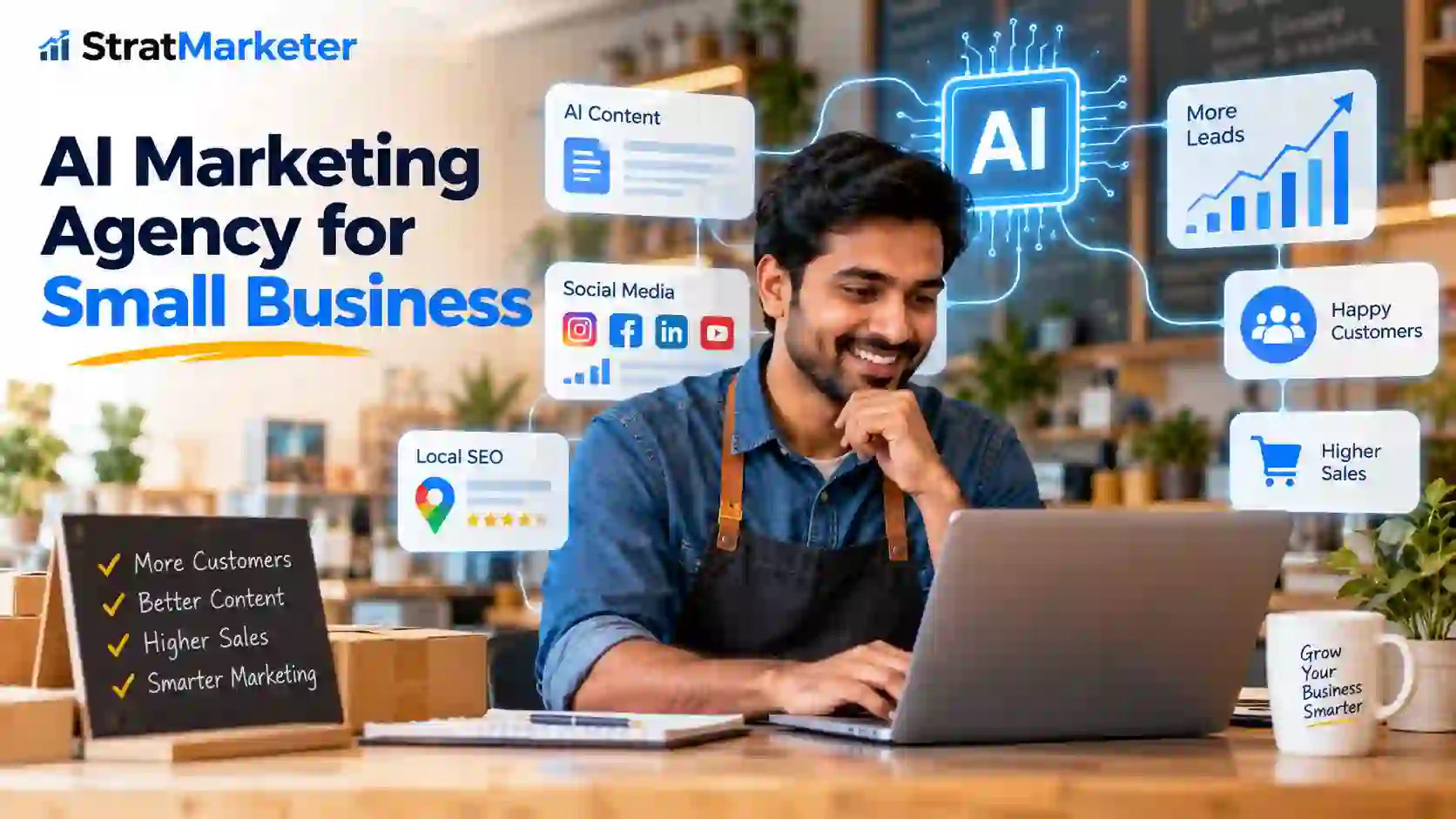
1. Why Small Businesses Are Rethinking Their Marketing Approach With AI
For a small business owner in India, marketing often becomes another responsibility added to an already busy working day. Managing customers, handling orders, checking payments, coordinating with suppliers and looking after employees leave very little time to plan marketing properly. Yet, without regular marketing, attracting new customers becomes difficult. This is one reason many businesses are beginning to consider an AI marketing agency for small business rather than depending entirely on traditional marketing methods.
The way customers discover and evaluate businesses has changed. Someone looking for a local interior designer may first check Google reviews, compare websites, browse Instagram and then send a WhatsApp enquiry. A coaching institute may receive enquiries through Google Search, YouTube and social media. Customers rarely depend on a single source before making a decision.
Small businesses have to remain visible across these platforms, but managing everything manually requires time, people and money. This is where artificial intelligence is changing the working process.
AI is no longer limited to large companies with dedicated technology teams. Even a local service provider, retail shop, real estate consultant or small manufacturing business can use AI tools for content planning, customer communication, keyword research and campaign analysis.
However, adopting AI does not automatically solve marketing problems.
A business can publish 30 social media posts in a month using AI and still receive no genuine enquiries. The problem may be poor positioning, irrelevant content, weak local targeting or an offer that customers simply do not understand. Technology cannot correct every business decision.
This is why working with an AI marketing agency for small business is becoming a practical consideration. The purpose should not be to use AI everywhere. It should be to identify where automation saves time, where human thinking is necessary and which marketing activities deserve the available budget.
Traditional Marketing Is Becoming Difficult to Manage for Small Teams
Traditional digital marketing often involves separate activities handled through different tools and people.
For example, a small business might hire someone for SEO, another freelancer for social media and an external agency for paid advertising. Each person may follow a different content calendar, communication style and reporting method.
The owner ends up coordinating everything.
Consider a small furniture manufacturer in Ahmedabad. The business wants enquiries from architects, interior designers and residential customers. Its marketing requirements may include product photography, website content, Google Business Profile management, SEO and social media advertising.
Managing these activities independently can become expensive. There is also a risk that the website communicates one message while social media promotes something entirely different.
AI-assisted marketing can help connect these activities through shared research, content planning and customer information. An experienced AI marketing agency for small business can also identify which activities can be handled through automation and which require direct human involvement.
I personally prefer this approach over purchasing several disconnected marketing tools without understanding how they will work together.
Customer Expectations Have Changed
Customers now expect businesses to respond quickly.
A person enquiring about a website design service may contact three agencies within ten minutes. If one business replies after two days, the customer might have already selected another provider.
Small businesses often miss enquiries simply because nobody is available to respond immediately.
AI-powered communication tools can help acknowledge enquiries, answer basic questions, collect contact details and direct customers towards the next step. For example, an AI chatbot on a website can ask visitors about their service requirements and preferred contact time.
But there is a limit.
Customers do not always want automated conversations. Someone discussing a manufacturing requirement, a property purchase or a high-value professional service may prefer speaking directly with an experienced person.
A sensible AI marketing agency for small business should understand this difference instead of replacing every customer interaction with a chatbot.
Marketing Decisions Are Becoming More Dependent on Better Information
Small business owners frequently make marketing decisions based on assumptions.
A restaurant may believe Instagram is its biggest customer acquisition channel because it receives regular comments. A local training institute may spend money on Facebook advertisements because competitors are doing the same.
But engagement does not necessarily mean enquiries, and enquiries do not necessarily become paying customers.
AI tools can help organise information from website analytics, advertising reports, customer enquiries and search performance. This makes it easier to identify patterns.
For example, a business may find that most valuable enquiries come from Google searches rather than social media. Another may discover that a particular service page receives traffic but generates very few calls.
These observations can influence where the marketing budget should go.
An AI marketing agency for small business should connect such findings with actual business requirements. Simply sharing monthly impressions and reach figures does not tell an owner whether marketing is contributing to sales.
AI Is Making Professional Marketing Resources More Accessible
Earlier, creating regular marketing content required a designer, writer, video editor and marketing coordinator. Small businesses could not always afford all these resources.
AI has changed some of that cost structure.
Businesses can now use AI-assisted research, writing, image generation, video editing and reporting tools to complete certain tasks more efficiently.
A local healthcare equipment distributor, for instance, can use AI-assisted research to prepare product education topics, develop initial website content and organise frequently asked customer questions. A marketing professional can then review the technical information before publication.
This is an important distinction. AI can prepare a starting point, but factual verification and professional judgement still matter.
The value of an AI marketing agency for small business comes from combining these tools with an understanding of the market, customer behaviour and business objectives.
2. What Does an AI Marketing Agency for Small Business Actually Do?
The term AI marketing agency can mean different things depending on the company providing the service.
Some agencies use AI mainly for writing content. Others offer marketing automation, SEO research, advertising support, customer segmentation and performance analysis.
For a small business owner, the important question is not how many AI tools an agency uses. It is what marketing work the agency can actually handle.
An experienced AI marketing agency for small business should understand the business model before recommending any technology.
A local coaching institute does not have the same requirements as an ecommerce company. A manufacturing business looking for distributors needs a different marketing approach from a salon trying to attract customers within a five-kilometre area.
The work should reflect these differences.
Understanding the Business Before Selecting AI Tools
The first activity should involve understanding the business, its services, customers and existing marketing position.
An agency may review the website, existing search rankings, social media accounts, customer reviews and advertising history.
Suppose a small accounting firm in Pune wants more enquiries from startups and local businesses. Before introducing AI automation, the agency needs to understand which accounting services the firm offers, which customers it wants to attract and what makes its services relevant.
Without this information, AI-generated marketing content can become generic.
The same applies to keyword research. Ranking for broad terms that attract irrelevant visitors does not necessarily help the business.
SEO and Search Content Development
SEO remains important for small businesses because customers frequently use Google to find products and professional services.
AI can assist with keyword clustering, competitor research, content gap identification, search intent analysis and content preparation.
An AI marketing agency for small business may use these capabilities to identify relevant topics and organise them into a practical publishing plan.
For example, a local pest control company might need pages targeting residential pest control, commercial pest management, termite treatment and seasonal mosquito control.
Instead of producing random blog posts, the agency can organise content around the actual services customers are searching for.
Human review is still necessary, especially when content includes technical claims, pricing, safety instructions or regulatory information.
Social Media Content and Creative Production
Maintaining social media accounts takes consistent effort.
Small businesses often struggle to publish because the owner or staff members are already occupied with daily operations.
AI-assisted content workflows can help prepare post ideas, captions, video scripts, creative variations and publishing schedules.
An agency can also study which topics generate meaningful engagement rather than simply publishing content because a calendar says something is due.
For example, a home decor business could publish product demonstrations, room styling ideas, customer questions and short videos explaining material differences.
The content should still look and sound like the business. Copying generic AI captions can make a local company appear less personal.
Paid Advertising and Campaign Management
Google Ads and Meta Ads can bring enquiries, but advertising without proper tracking can consume a small business budget quickly.
AI tools can assist with audience analysis, creative variations, keyword suggestions and campaign reporting.
An AI marketing agency for small business may use these capabilities to examine which advertisements generate relevant leads and which campaigns attract people who never become customers.
However, automated bidding and platform recommendations should not be accepted blindly.
If a business receives 100 enquiries but only two are relevant, increasing the advertising budget may make the problem worse.
The agency must examine lead quality, landing page relevance and the sales process before recommending further spending.
Customer Communication and Marketing Automation
Many businesses receive enquiries through websites, email, WhatsApp and social media.
Keeping track of every conversation becomes difficult when the team is small.
AI-assisted automation can help with:
- Sending initial enquiry acknowledgements.
- Organising customer information.
- Categorising enquiries by service requirement.
- Scheduling follow-up messages.
- Answering frequently asked questions.
- Reminding staff about pending enquiries.
For Indian businesses, WhatsApp is particularly relevant because customers are comfortable using it for quotations, product questions and service discussions.
Still, automated messages should respect customer consent and applicable privacy requirements. Sending repeated promotional messages without permission can damage trust.
Reporting and Marketing Performance Analysis
An agency should explain what happened during the month and why it happened.
AI-assisted reporting can help identify changes in website traffic, keyword rankings, advertising costs, enquiry volume and customer behaviour.
But the final report should answer practical questions.
Did the website attract the intended audience? Which service received more enquiries? Did advertising generate qualified prospects? Where did potential customers leave the conversion process?
This is the kind of work that makes an AI marketing agency for small business useful to an owner who cannot spend hours interpreting marketing dashboards.
3. Where AI Makes the Biggest Difference in Everyday Small Business Marketing
AI is often discussed through large business applications, but its practical value for a small company is usually found in ordinary daily tasks.
A business owner does not necessarily need a complicated AI system. Sometimes the biggest relief comes from reducing repetitive work that consumes two or three hours every day.
There are areas where AI can genuinely help, provided it is used with some care.
Preparing Marketing Content Without Starting From Zero
Content creation is one of the most time-consuming marketing activities for small teams.
A business may know what it wants to communicate but struggle to turn that knowledge into website pages, social media posts or email content.
AI can help organise rough ideas into usable drafts.
For instance, a real estate consultant in Jaipur may want to explain the difference between ready-to-move and under-construction properties. The consultant can provide actual project information, customer questions and relevant details. AI can help prepare an initial article or social media script.
The consultant must still verify the property details and remove unsupported claims.
I would rather publish eight useful posts based on real customer questions than 30 generic posts created only to maintain frequency.
That preference matters because customers can recognise when a business is simply filling its social media feed.
Responding to Enquiries Faster
A small business may receive enquiries outside regular working hours.
AI-assisted chat systems can help collect basic information before a staff member responds.
Consider a website development company receiving an enquiry at 10:30 pm. An automated assistant can ask about the type of website, expected pages, business category and preferred contact time.
The team can review the information the following morning instead of beginning the conversation from scratch.
An AI marketing agency for small business can help set up this process, but the questions should remain simple. Asking visitors to complete a long questionnaire before speaking to anyone can discourage potential customers.
Finding Better Content Ideas Through Customer Questions
Many businesses struggle to decide what to publish.
They often repeat the same promotional messages because they do not have a clear content source.
Customer enquiries can solve this problem.
A small electronics retailer may regularly receive questions about warranty periods, installation, product compatibility and after-sales support. These questions can become website articles, short videos and social media posts.
AI tools can group similar questions and identify recurring themes.
This creates content that addresses actual customer concerns rather than relying entirely on competitor research.
Producing Different Creative Versions
One advertisement does not appeal to every customer.
A coaching centre may want to communicate affordability to students while explaining placement assistance to parents. Both audiences may be interested in the same course, but their concerns are different.
AI can assist with creating different advertisement headlines, scripts and creative concepts.
The agency can then test these variations to understand which message generates better enquiries.
The important point is that AI should help generate options. The agency still needs to understand the audience and select appropriate messages.
Organising Customer Data and Follow-ups
Small businesses sometimes lose enquiries because information remains scattered across notebooks, spreadsheets and personal WhatsApp accounts.
AI-supported CRM systems can help categorise customer information and identify pending follow-ups.
For example, a commercial printing company may receive enquiries from schools, event organisers and retail businesses. Organising these enquiries by customer type and order requirement makes follow-up easier.
However, automation cannot replace a proper sales process. If staff members do not update enquiry status or record customer discussions, the system will also become unreliable.
Understanding What Is Not Working
This is perhaps one of the more useful applications.
AI can assist in reviewing marketing information and identifying possible reasons behind poor performance.
Suppose an Indian furniture website receives reasonable organic traffic but very few quotation requests. A review may reveal that product pages do not display dimensions, material specifications, delivery information or clear enquiry options.
The problem may not be traffic at all.
An AI marketing agency for small business should be willing to question the existing marketing approach rather than recommending more content or advertising every time performance falls.
Sometimes the right decision is to stop doing something.
4. Can Small Businesses Afford AI Marketing Without Increasing Their Budgets?
Cost is a genuine concern for small business owners.
A company with limited monthly revenue cannot allocate a large amount to marketing technology, agency fees and advertising simultaneously. Even if AI tools appear affordable individually, several subscriptions can create unnecessary expenses.
The question is whether AI marketing can work within the existing budget.
In many cases, yes. But it depends on how the business allocates its resources.
AI Does Not Require Purchasing Every Available Tool
There are AI tools for writing, graphic design, video editing, SEO research, automation and customer support.
Buying subscriptions for all of them is rarely necessary.
A small business should begin with the tasks that consume the most time or create the biggest operational difficulty.
For example, a local service company may need help with SEO content and enquiry management. It may not need an advanced AI video production platform immediately.
An AI marketing agency for small business should recommend tools according to actual requirements, not the number of software products it can include in a proposal.
Where Marketing Costs Can Be Reduced
AI-assisted workflows may reduce the time required for repetitive tasks.
Marketing activity | Possible AI contribution |
Content research | Topic grouping and initial research |
Social media | Caption drafts and content ideas |
Graphic design | Initial creative concepts |
Video production | Script preparation and editing assistance |
SEO | Keyword clustering and content analysis |
Customer communication | Basic enquiry handling |
Reporting | Data organisation and performance summaries |
These are possible efficiencies, not guaranteed savings.
A business may still require professional photography, technical writing, original video footage or specialist SEO work. Removing those activities simply because AI is available can reduce content quality.
A Practical Budget Example
Consider a small service business with a monthly marketing budget of Rs 25,000.
It could allocate the available amount towards website SEO, content preparation, social media management and enquiry tracking. The exact distribution would depend on the business, competition and existing marketing position.
If AI helps reduce repetitive research and content preparation time, the agency may be able to complete more useful work within the same budget.
But there is something owners should understand.
Lower production costs do not automatically mean lower agency fees or better business performance. Strategy, experience, review and campaign management still require professional effort.
Why Cheap AI Marketing Packages Can Become Expensive
Some service providers advertise extremely high content volumes at very low prices.
A small business owner may find an offer of 50 articles, 100 social media posts and hundreds of backlinks attractive.
But what happens if those articles contain inaccurate information? What if the backlinks come from irrelevant websites? What if social media posts have no connection with customer requirements?
The business has paid for activity without necessarily receiving useful marketing work.
I am not convinced that publishing more content is always the right solution. For a small business with limited resources, five properly researched service pages may be more useful than dozens of shallow articles.
When evaluating an AI marketing agency for small business, ask how the agency checks content quality, measures enquiries and decides what should be published.
Start With the Activities That Can Be Measured
A small business does not need to automate everything in the first month.
It can begin with one or two activities and examine the results.
For example, a local consultancy might start by improving its website enquiry process and creating useful service content. Once these activities become consistent, it can consider additional automation.
This reduces the risk of spending money on systems that employees do not use.
5. Using AI for Local SEO, Google Business Profile and Customer Discovery
For many Indian small businesses, local search is directly connected to revenue.
A customer looking for a dentist, electrician, interior designer, coaching institute or restaurant may search for businesses within a particular city or locality.
The business needs to appear when that customer is actively looking for the service.
Local SEO helps make this possible. AI can assist with research, content preparation and customer insight, but local relevance still depends on accurate business information and genuine customer experience.
Finding the Search Terms Local Customers Actually Use
Small businesses often select keywords based on how they describe their own services.
Customers may use different language.
A manufacturer may describe its offering as industrial packaging solutions, while customers search for corrugated box manufacturers, customised packaging suppliers or bulk packaging companies.
AI-assisted keyword research can help identify these variations and group them according to search intent.
An AI marketing agency for small business can use this information to plan service pages, location pages and supporting articles.
For example, a dental clinic in Jaipur may need content around dental implants, root canal treatment, teeth cleaning and emergency dental appointments. Each page should answer the questions relevant to that particular service.
Simply repeating the city name throughout every page will not create useful local content.
Google Business Profile Still Matters
Google Business Profile remains an important platform for businesses serving customers at a physical location or within a defined service area.
Its information helps customers understand where a business operates, how to contact it and what services it provides.
AI can assist with preparing business descriptions, responding to common review themes and creating post ideas. However, the actual business information must remain accurate.
A local salon in Chandigarh, for example, should maintain correct opening hours, contact details, service categories, photographs and appointment information.
An agency can also review customer questions and feedback to identify areas where the business needs to communicate more clearly.
There is one mistake I see businesses making repeatedly. They treat Google Business Profile as a one-time registration activity. They create the listing, add a few photographs and then leave it unattended.
That approach misses the purpose of maintaining an accurate business presence.
Handling Customer Reviews With More Care
Customer reviews influence how people evaluate local businesses.
AI can help categorise reviews according to recurring topics such as service quality, staff behaviour, delivery delays, pricing concerns and customer support.
This can help an owner identify repeated complaints.
Suppose a home appliance repair company receives several reviews mentioning delayed technician visits. The owner can examine the operational issue instead of simply preparing polite automated replies.
Replies should also be genuine. A customer who has complained about a damaged product deserves a meaningful response, not a generic message generated by AI.
An AI marketing agency for small business should help maintain communication quality while ensuring that customer concerns reach the right person.
Creating Location-Based Website Content
Businesses operating in multiple areas often need separate location information on their websites.
For example, a pest control company serving Ahmedabad, Gandhinagar and Vadodara may require location-specific pages explaining its service coverage.
AI can assist with organising the content, but every page should contain useful local details.
These may include:
- Actual service availability in the location.
- Relevant residential or commercial requirements.
- Services offered in that area.
- Local contact and enquiry information.
- Genuine customer experiences where available.
Creating 20 pages by changing only the city name is not a sound SEO practice. Such pages offer little additional value to visitors.
Google’s spam policies also address large-scale content production intended primarily to manipulate search rankings. AI-generated content is not automatically a problem, but publishing unoriginal pages at scale can become one.
6. How AI Helps Small Businesses Create Better Content and Social Media Campaigns
Creating content regularly is not easy for a small business. The owner may understand the products, customers and market better than anyone else, but finding time to write captions, prepare videos, plan posts and manage different social media accounts is another matter.
This is where an AI marketing agency for small business can make a practical difference.
AI can help businesses turn everyday business knowledge into useful marketing content. A customer question can become a social media post. A product demonstration can become a short video. A frequently asked question can become a website article.
The content does not always need to begin with a complicated campaign idea. Sometimes the best material comes from conversations that happen inside the business every day.
Creating Content That Customers Actually Want to Read
One common problem with small business social media accounts is repetitive promotional content. Every post talks about the company’s services, offers or achievements.
Customers eventually lose interest.
A better approach is to discuss the problems customers are trying to solve.
For example, a small interior design company in Pune could create content around questions such as:
- How much does a modular kitchen cost?
- Which materials are suitable for Indian kitchens?
- What should homeowners check before hiring an interior designer?
- Is a customised wardrobe worth the additional cost?
AI can organise these questions into content topics, prepare initial drafts and suggest different ways to communicate the information.
An AI marketing agency for small business should also ensure that the final content reflects the company’s actual experience. If the interior designer has worked with a particular material or faced installation problems at a project site, those details make the content more useful.
Generic AI writing cannot replace that knowledge.
Using AI for Instagram, Facebook and LinkedIn
Different social platforms attract different audiences.
A local fashion retailer may receive customer attention through Instagram, while a B2B industrial supplier may find LinkedIn more relevant. A coaching institute might use Facebook and Instagram to communicate with students and parents.
Publishing identical content everywhere is rarely the right decision.
AI can help adapt a single business idea into different formats.
For example, a small accounting consultancy can turn an article about GST filing mistakes into:
- An Instagram carousel explaining common mistakes.
- A short video discussing one important issue.
- A LinkedIn post for business owners.
- A Facebook post answering a frequently asked question.
The central information remains the same, but the presentation changes according to the platform.
Making Short Videos Without Large Production Budgets
Video content has become an important part of digital marketing. However, small businesses may not have the budget to arrange professional video shoots every week.
AI-assisted video tools can help prepare scripts, subtitles, voiceovers, editing drafts and visual variations.
A local restaurant, for example, can record its chef preparing a popular dish using a smartphone. AI-assisted editing can help create short clips for Instagram Reels and YouTube Shorts.
The original footage still matters. Customers often respond better to genuine food preparation, actual products and real people than to completely artificial promotional videos.
I would be careful about using AI-generated visuals for businesses where customers need to inspect the actual product before purchasing. A furniture seller showing an AI-created sofa that differs from the delivered product can create unnecessary complaints.
Building a Consistent Content Calendar
Small businesses often publish regularly for a few weeks and then stop.
AI can help prepare a realistic content calendar based on available resources, seasonal demand and business priorities.
For instance, an Indian clothing retailer may plan content around wedding shopping, festive collections, summer wear and everyday clothing requirements.
A calendar should not become a rigid publishing obligation. If a business has an important product launch or a genuine customer issue to address, the schedule should allow changes.
An experienced AI marketing agency for small business should focus on useful publishing frequency rather than impressive-looking content numbers.
Understanding Which Content Generates Enquiries
Likes and comments are easy to observe, but they do not always indicate business value.
A post receiving 500 likes may generate no sales, while a simple product explanation with 20 interactions may bring five serious enquiries.
AI-assisted analytics can help compare content performance across platforms.
Businesses can examine website visits, WhatsApp clicks, calls, enquiry forms and other available conversion information.
The important thing is to connect content performance with actual customer actions. Otherwise, social media reporting becomes a collection of attractive numbers that do not tell the owner much.
7. Common AI Marketing Mistakes That Can Cost Small Businesses Time and Money
AI makes marketing tasks easier to start. That does not mean every task becomes easier to complete properly.
I have a concern about how some small businesses approach AI. They see a tool producing content within seconds and assume the difficult part of marketing is now solved.
It isn’t.
The quality of the original information, the business objective and the decisions made after content creation still determine whether the activity is useful.
Here are some mistakes worth avoiding.
Publishing AI Content Without Human Review
This is one of the most common problems.
AI tools can generate convincing paragraphs containing incorrect product information, outdated details or unsupported claims.
Consider a nutraceutical business publishing an article about a dietary supplement. If the content includes inaccurate ingredient information or exaggerated health claims, the consequences can go beyond poor SEO performance.
The same issue applies to financial services, healthcare, legal services and technical products.
An AI marketing agency for small business must have a proper review process before publishing content. Technical claims should be checked by someone who understands the subject.
Chasing Content Quantity Instead of Customer Intent
Publishing more articles does not automatically lead to better search performance.
A small business website with 100 unrelated blog posts may attract visitors who have no interest in its services.
For example, a website development company does not necessarily need articles about every trending technology. It should focus on topics connected to website development requirements, pricing, maintenance, ecommerce websites and business website planning.
Content should answer questions that potential customers are likely to ask before contacting the company.
Depending Entirely on Automated Social Media Replies
Automated replies are useful for acknowledging enquiries and answering basic questions.
But customers can become frustrated when every question receives the same scripted response.
Imagine someone enquiring about a customised industrial machine. They may need to discuss production capacity, dimensions, installation and technical specifications. A basic chatbot cannot reasonably handle every part of that discussion.
An AI marketing agency for small business should establish clear points where automated communication ends and human assistance begins.
Buying Too Many AI Subscriptions
There is no shortage of AI tools claiming to solve different marketing problems.
Small businesses sometimes subscribe to several platforms without identifying what each one contributes.
The result is duplicated expenses and underused software.
A company may have three tools for content writing but still lack a proper process for collecting customer enquiries.
Before purchasing a tool, ask one question. Which specific business task will this subscription help complete?
If the answer is unclear, there is probably no reason to purchase it immediately.
Ignoring Customer Privacy
Marketing automation involves customer information, and businesses need to handle it responsibly.
Customer phone numbers, email addresses, purchase histories and enquiry details should not be uploaded to AI platforms without considering privacy, access controls and applicable data protection requirements.
Businesses operating in India should pay attention to the Digital Personal Data Protection Act, 2023, and the applicable rules and commencement notifications.
An agency should also explain how customer information is stored, processed and accessed.
Expecting Immediate SEO Rankings
AI can help prepare website content faster, but search rankings depend on several factors, including relevance, competition, website quality, reputation and the usefulness of the information.
A business should not expect its website to rank on the first page simply because it publishes AI-assisted articles.
Google evaluates content quality and usefulness rather than rewarding a particular writing method.
An AI marketing agency for small business should communicate realistic expectations and explain what can be measured during the first few months.
Allowing AI to Make Every Marketing Decision
Automation can provide recommendations, but business decisions need context.
An advertising platform may suggest increasing the daily budget because a campaign is receiving clicks. However, if those clicks are not generating relevant enquiries, increasing expenditure may be a poor decision.
This is where human judgement becomes important.
AI should support marketing decisions, not make the business owner dependent on automated recommendations.
8. How StratMarketer Approaches AI Marketing for Small Businesses
At StratMarketer, the idea behind AI marketing should be practical. A small business does not need complicated technology simply because it is available. It needs marketing activities that make sense for its customers, services and available budget.
An AI marketing agency for small business should first understand what the business is trying to achieve.
For one company, the immediate requirement may be better local search performance. Another may need a professional website, consistent social media communication or a more organised lead generation process.
These requirements should not receive identical solutions.
Starting With the Business and Its Customers
StratMarketer’s approach to AI marketing begins with understanding the business category, target audience, services and existing online presence.
A local manufacturer looking for distributor enquiries requires a different approach from a salon looking for appointment bookings.
The initial assessment can include website performance, search visibility, competitor positioning, social media activity and existing enquiry sources.
This helps identify where marketing attention is required first.
Combining AI With SEO and Content Marketing
SEO remains a useful source of long-term customer discovery for many small businesses.
StratMarketer can use AI-assisted research to identify relevant keywords, understand search intent, organise content topics and prepare initial drafts.
The content is then reviewed according to the business’s actual services and customer requirements.
This can include service pages, location-based content, blog articles, frequently asked questions and supporting website information.
The objective is to publish material that answers genuine customer questions rather than producing content simply to increase the website’s page count.
Supporting Social Media and Creative Requirements
Small businesses need a consistent presence, but every business has different content requirements.
StratMarketer can use AI-assisted workflows for content ideas, caption preparation, creative planning, video scripts and campaign variations.
For an Indian retail business, the content plan may include seasonal purchasing behaviour, product demonstrations, customer questions and festival-related communication.
For a B2B company, the emphasis may be on industry information, service explanations, product applications and professional communication.
Connecting Marketing Activities With Lead Generation
Traffic alone is not the final objective for most small businesses.
StratMarketer can connect marketing activities with lead generation through relevant landing pages, enquiry forms, website calls to action, WhatsApp communication and advertising campaigns.
AI can assist with organising incoming enquiries and identifying common customer requirements.
The business should also have a process for following up with potential customers. Even a well-designed marketing campaign cannot compensate for enquiries that remain unanswered.
Reviewing Performance Instead of Following a Fixed Formula
Marketing requirements change as a business receives new enquiries and understands customer behaviour.
StratMarketer can review available performance information and identify which activities need attention.
For example, if a website receives traffic but produces very few enquiries, the agency may need to examine its service pages, messaging and contact options.
If social media generates engagement but little business interest, the content strategy may need a different direction.
An AI marketing agency for small business should be comfortable making these adjustments instead of following the same monthly activity list regardless of performance.
I might be wrong here, but I believe small businesses often need fewer marketing activities performed properly, not more activities managed through additional software.
Our Services
Contact Us
- Paonta Sahib, Himachal Pradesh, India
- +91-8700998508
- support@stratmarketer.com
Start From Here
These two options make it easy for you to get the information you want.