



AI Profit Driven Marketing Agency | StratMarketer
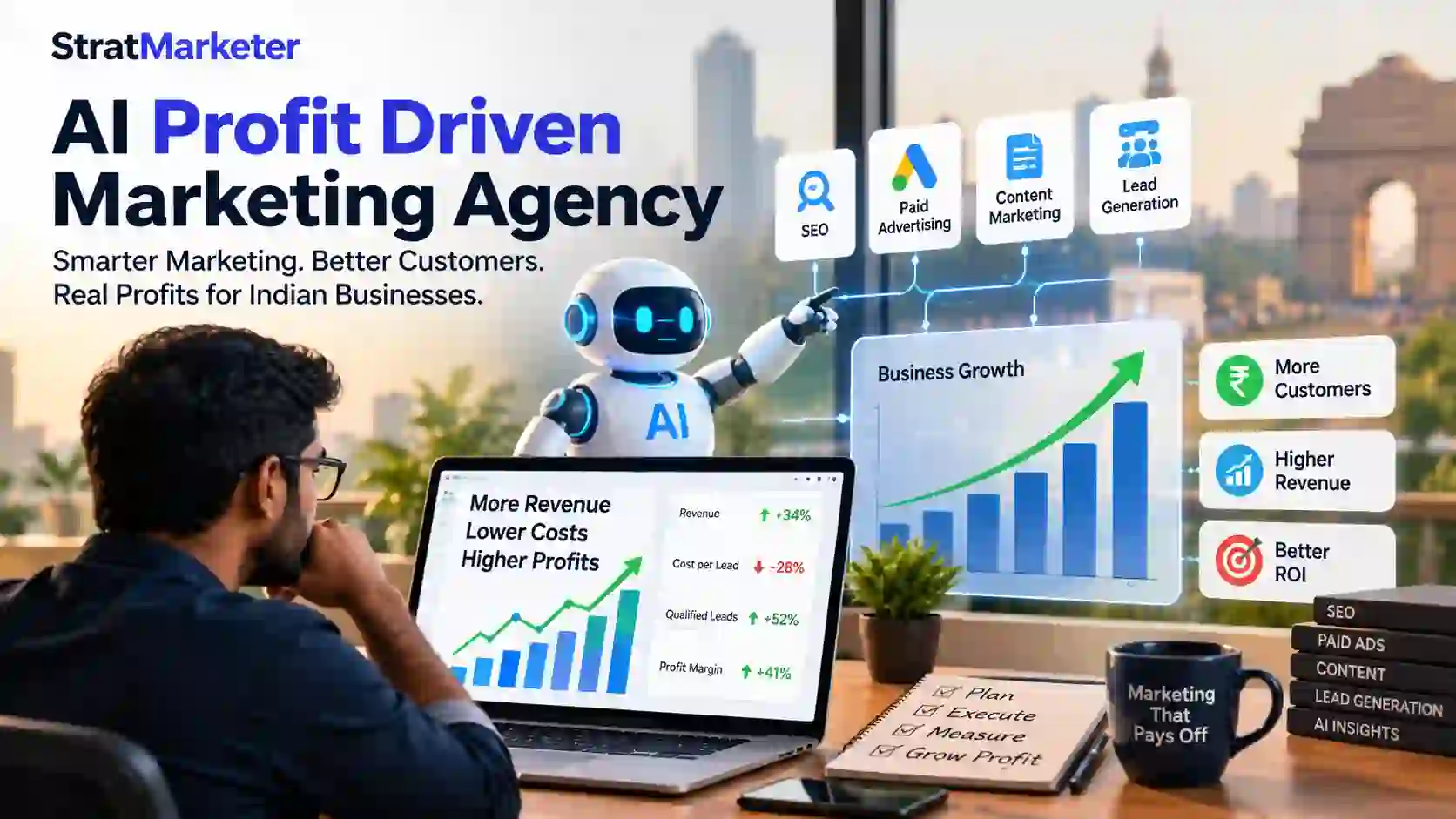
1. Why Indian Businesses Are Looking for an AI Profit Driven Marketing Agency
Many Indian businesses are spending money on digital marketing but still struggling to understand what they are getting in return. Website traffic may be increasing, social media accounts may be receiving more enquiries, and advertising campaigns may be generating leads. Yet, when the owner checks the actual revenue, the results often look less encouraging.
This is where an AI profit driven marketing agency becomes relevant. Instead of treating traffic, impressions and enquiries as the final measure of success, the focus shifts towards how marketing contributes to sales, customer retention and business profitability.
For a manufacturing company in Ahmedabad, for example, generating 500 enquiries is not particularly useful if most enquiries come from people looking for products the company does not manufacture. A software company in Bengaluru may face a different problem. Its advertisements might generate hundreds of trial registrations, but very few users may convert into paying customers. Both businesses need better marketing decisions, not simply more leads.
An AI profit driven marketing agency uses artificial intelligence, customer data and marketing analytics to identify where money is being spent, which activities attract commercially valuable customers, and where resources are being wasted.
The distinction matters because Indian businesses operate across very different price points, customer expectations and sales cycles. A local service provider selling services worth ₹5,000 cannot evaluate marketing in the same way as an industrial supplier handling orders worth several lakhs. AI can help both businesses, but the measurements and decisions must reflect their commercial realities.
There is also a growing problem with affordable digital advertising. Getting clicks is relatively straightforward in many industries. Converting those clicks into profitable customers is much harder. Rising competition, inconsistent lead quality, delayed follow-ups and discount-driven sales can all reduce the actual return from a campaign.
I believe businesses should question any marketing report that celebrates lead volume without showing what happened after those leads entered the sales pipeline. A campaign can look successful in a monthly presentation while quietly consuming the company’s margin.
An AI profit driven marketing agency helps bring these disconnected activities into a single commercial picture. It can analyse campaign performance, identify patterns in customer behaviour, support lead prioritisation and help marketers allocate budgets according to business outcomes.
However, AI does not automatically make marketing profitable. The quality of the underlying data, the reliability of the sales process and the business’s pricing decisions still matter. If a company loses money on every order because its costs are too high, no advertising algorithm can permanently solve that problem.
For Indian businesses considering this approach, the starting point should be simple. Before asking how AI can generate more customers, ask which customers are worth acquiring, how much the business can afford to spend on them, and what needs to happen between the first enquiry and the final payment.
2. What Makes an AI Profit Driven Marketing Agency Different from a Traditional Agency
A traditional digital marketing agency may focus on delivering SEO rankings, website traffic, paid advertising campaigns, social media engagement and monthly leads. These activities are important. The problem begins when they are managed independently of sales and profitability.
An AI profit driven marketing agency looks beyond the marketing platform itself. It tries to understand the relationship between advertising costs, customer acquisition, order value, conversion rates, repeat purchases and the cost of serving customers.
Consider an ecommerce business selling kitchen appliances. Its advertising dashboard may show that a campaign generated ₹3 lakh in sales after spending ₹60,000 on advertisements. At first glance, that looks promising. But the business still needs to account for product costs, shipping, payment gateway charges, returns, discounts and other operating expenses.
If those costs consume most of the revenue, the campaign may be generating very little profit despite a seemingly attractive return on ad spend.
The difference is not simply the use of artificial intelligence. Many traditional agencies already use AI powered advertising tools, automated reporting and content generation platforms. The more important distinction is the commercial objective behind those tools.
Area | Conventional marketing focus | Profit driven AI marketing focus |
Paid advertising | Clicks, conversions and campaign revenue | Contribution margin and profitable customer acquisition |
SEO | Rankings, traffic and keyword growth | Commercial search demand, qualified enquiries and sales |
Lead generation | Number of enquiries received | Lead quality, sales conversion and acquisition cost |
Content marketing | Publishing frequency and engagement | Content contribution to qualified demand and revenue |
Reporting | Platform performance metrics | Marketing performance connected to business economics |
These differences are not absolute. A capable traditional agency can also measure profit, while an agency using AI can still make poor decisions. What matters is whether the agency has a clear process for connecting its work to the client’s financial outcomes.
For instance, an industrial equipment supplier may receive enquiries from small workshops, large factories, distributors and government contractors. All these enquiries may look similar inside a basic lead generation report. Their potential order values, buying timelines and service requirements can be very different.
AI assisted lead scoring can help organise these enquiries using available information such as company size, product requirements, previous interactions and historical sales outcomes. The sales team can then prioritise opportunities that are more likely to become commercially worthwhile customers.
But there is a limitation. If the company has never recorded which leads eventually became customers, the AI system has little reliable information to learn from. It may rank leads according to superficial characteristics instead of genuine buying potential.
This is why I would place more importance on an agency’s measurement process than on the number of AI tools it claims to use.
StratMarketer can position its AI profit driven marketing approach around this principle. AI should help businesses make better budget decisions, understand customer behaviour and connect marketing activity with sales performance. It should not become another layer of software that produces attractive reports without changing the decisions being made.
3. How AI Connects Marketing Activities With Actual Business Profit
Marketing profit becomes easier to understand when a business stops looking at every channel separately and starts following the complete customer journey.
A customer might first find a company through Google search, read an article, return through a remarketing advertisement and finally contact the sales team after receiving an email. If the company measures only the last advertisement, it may give that channel too much credit and undervalue the earlier interactions that helped the customer make a decision.
AI can help analyse these journeys, provided the business has enough reliable data and an appropriate tracking setup.
The first step is connecting marketing information with commercial records. Website analytics may show where a visitor came from. Advertising platforms record campaign costs. A customer relationship management system, or CRM, can record enquiries, sales conversations and opportunity stages. Billing records show what customers actually paid.
When these sources can be connected, the business gets a more useful picture of performance.
Suppose a Pune based B2B company spends ₹1 lakh per month on digital marketing and receives 100 enquiries. On further examination, 25 enquiries meet its sales criteria, 10 become serious opportunities and four eventually turn into customers.
The business can now examine the cost of acquiring a qualified opportunity and the cost of acquiring a paying customer. It can also compare the revenue and contribution margin generated by those customers.
These numbers reveal much more than the original enquiry count.
AI can support this analysis by identifying recurring patterns. Perhaps enquiries from a particular search campaign have a higher sales conversion rate. Perhaps leads who request a technical consultation are more likely to purchase than those who download a brochure. Perhaps one customer segment takes longer to close but produces substantially larger orders.
Such findings can help the marketing team decide where to spend its next rupee.
There is an important distinction between revenue and profit, though. A campaign generating ₹10 lakh in revenue is not necessarily more valuable than one generating ₹6 lakh. The first may involve expensive products, large discounts, high return rates or substantial service costs. The second might generate a better contribution margin.
For a basic assessment, businesses can begin with contribution profit.
Contribution profit = Revenue minus variable costs attributable to those sales
Variable costs may include product costs, packaging, shipping, payment processing fees, sales commissions and other costs that change with each order. Marketing expenditure can then be considered when evaluating the profitability of the campaign or customer acquisition activity.
For example, an ecommerce seller generating ₹5 lakh in attributable revenue might have ₹2 lakh in product costs, ₹50,000 in fulfilment and payment expenses, and ₹1 lakh in advertising costs. The remaining ₹1.5 lakh is a simplified contribution after these specified costs, not the company’s final net profit. Salaries, rent, technology and other overheads may still need to be accounted for.
This type of calculation prevents marketing teams from celebrating revenue while ignoring the costs required to produce it.
AI can also help with forecasting. Based on historical campaign performance, lead conversion rates and average order values, a business may estimate what different budget levels could produce. Such forecasts are useful for planning, but they are not guarantees. Market conditions, competitor activity and changes in customer demand can make actual results different.
Attribution presents another challenge. A customer may interact with several marketing channels before buying. Assigning the entire sale to one touchpoint can distort budget decisions. AI assisted attribution can offer useful estimates, but the business should compare these estimates with CRM records, controlled experiments and actual sales outcomes whenever possible.
The practical objective is not to produce the most complicated model. It is to understand which marketing activities contribute to commercially valuable customers and which ones need attention.
4. Using AI to Reduce Customer Acquisition Costs and Wasted Ad Spend
Customer acquisition cost, commonly called CAC, measures how much a business spends to acquire a customer. It is one of the most useful numbers for an AI profit driven marketing agency because it connects marketing expenditure with an actual commercial outcome.
A simple version of the calculation is:
Customer acquisition cost = Total acquisition expenditure divided by the number of new customers acquired.
For a more accurate calculation, businesses should decide which expenses belong in the measurement. Advertising spend alone may be appropriate for evaluating a specific campaign, but fully loaded acquisition cost can also include agency fees, sales development costs, relevant software and other acquisition expenses.
The same definition must be used when comparing campaigns or reporting performance over time.
AI can help reduce unnecessary spending in several ways.
One is identifying weak campaign segments. A paid advertising campaign may generate many clicks from certain search terms but very few qualified enquiries. Analysing search queries, conversion data and CRM outcomes can reveal where spending is unlikely to produce valuable customers.
For example, a company selling industrial water treatment equipment might discover that advertisements are attracting students searching for project information, homeowners looking for small domestic filters and buyers seeking industrial installations. These visitors have different commercial intent.
AI assisted search term analysis can help identify irrelevant patterns and suggest negative keywords. The marketing team still needs to review those suggestions, since excluding a broad term without context can accidentally remove valuable prospects.
Another opportunity is lead prioritisation. A sales team that receives 200 enquiries each month may not have enough time to contact every prospect with equal urgency. AI can organise leads according to relevant signals, such as the requested service, company profile, urgency, engagement history and previous conversion patterns.
This is particularly useful when sales teams are small and enquiries arrive from several channels.
However, I would not recommend allowing an AI score to become the final authority on whether a lead deserves attention. New customers, smaller businesses and unusual buying journeys may not resemble historical customers. A scoring model trained on incomplete records can repeatedly overlook good opportunities.
Budget allocation is another area where AI can help. If two advertising campaigns generate similar numbers of enquiries but one consistently produces more paying customers at a lower acquisition cost, the company has a reason to investigate shifting more budget towards that campaign.
Still, lower CAC should not be the only objective. A campaign acquiring customers for ₹2,000 may appear better than one acquiring customers for ₹4,000. But if the first group produces ₹3,000 in contribution over the relevant period and the second produces ₹15,000, the cheaper acquisition may be less attractive.
The correct decision depends on the value and profitability of the customers acquired.
AI can also support creative testing by analysing differences in advertisement messages, landing pages, audience segments and conversion behaviour. Rather than judging a creative only by its click through rate, the business can evaluate whether it attracts visitors who purchase and remain profitable after acquisition costs.
This takes time. A campaign with a small budget may not generate enough conversions to support confident conclusions, especially in B2B industries where sales cycles are long. Changing advertisements every few days because of minor fluctuations can make performance harder to interpret.
I find this one of the more frustrating mistakes in paid marketing. Businesses sometimes replace campaigns before gathering enough evidence, then blame the platform when the results remain inconsistent.
An AI profit driven marketing agency should help establish reasonable testing periods, minimum evidence requirements and clear financial thresholds before making major budget changes.
It should also account for the limits of platform reporting. Advertising systems often optimise towards the conversions they can observe. If a company reports every form submission as equally valuable, the platform may find more people who submit forms without buying anything.
Sending accurate conversion information back to advertising platforms, including qualified leads or completed sales where technically and legally appropriate, can help align optimisation with the business’s real objectives.
5. Applying AI Across SEO, Paid Advertising, Content Marketing and Lead Generation
An AI profit driven marketing agency should not treat SEO, paid advertising, content marketing and lead generation as four unrelated activities. Customers often move between these channels before they purchase, and each channel can contribute differently depending on the product, industry and buying cycle.
The objective is to understand what each activity contributes, then allocate resources according to its role in the customer journey.
SEO and organic search
SEO can bring customers to a website without charging for every click. That does not make organic traffic free. Businesses still invest in content, technical improvements, research, website maintenance and professional expertise.
AI can help identify search intent, group related queries, examine content gaps and analyse which pages attract qualified visitors. It can also help businesses identify pages that receive substantial traffic but generate few meaningful enquiries.
Consider a manufacturer of food processing machinery. An article explaining the difference between two types of packaging machines may attract early stage researchers. A page explaining machine capacity, installation requirements, operating costs and customisation options may attract buyers who are closer to making a purchase.
Both pages can be useful, but their commercial roles are different.
A profit focused SEO programme should evaluate more than keyword rankings. Relevant measurements include qualified organic enquiries, assisted conversions, sales opportunities, customer acquisition costs and revenue where attribution is reasonably reliable.
AI generated content should be checked carefully for technical accuracy and originality. Publishing large numbers of similar articles simply because the production process has become cheaper can waste resources and create low value pages that do little for customers.
Paid advertising
Paid search and social advertising can generate demand quickly, but the financial outcome depends on the quality of the audience, the offer, the landing page and the sales process.
AI can assist with bidding, audience analysis, advertisement testing, budget forecasting and campaign optimisation. These features can be useful when conversion tracking is reliable.
For an Indian education company, for example, a campaign generating 300 course enquiries may appear successful. But if most enquiries are outside the eligible age group, cannot afford the fees or are interested in a different course, the sales team may spend considerable time following up without securing admissions.
The better measurement is not simply how many leads were generated. It is how much was spent to acquire an eligible student who completed the admission process and paid the required fees.
Content marketing
Content marketing supports customers who need information before they make a purchase. This is particularly relevant for financial services, industrial products, healthcare related services and B2B software, where customers may compare several suppliers before making a decision.
AI can help analyse recurring customer questions, identify missing explanations, organise research and adapt content to different stages of the buying process. Human review remains necessary, especially where technical, financial or regulatory claims are involved.
A practical example would be a project finance consultancy publishing content about loan eligibility, documentation, financial projections and lender expectations. These pages may attract business owners who are preparing to approach banks. Their commercial value depends on whether they bring relevant enquiries, not simply how many people read them.
The agency should assess which topics lead to useful conversations and which pages answer questions without attracting potential customers. Both types of content can have a role, but they should not be judged by the same metric.
Lead generation
Lead generation connects marketing activity with the sales process. This is where poor data management often becomes visible.
A company may collect enquiries through website forms, WhatsApp, telephone calls, landing pages and social media. If these records remain scattered, it becomes difficult to determine which campaigns generate paying customers.
AI can help categorise enquiries, summarise conversations, identify missing information and support follow up prioritisation. With suitable integrations, it can also help connect campaign sources with CRM stages and closed sales.
For StratMarketer, this creates an opportunity to bring marketing services into a more connected measurement process. SEO can attract relevant search demand, paid advertising can test acquisition opportunities, content can address buyer concerns, and lead generation systems can help businesses track what happens after an enquiry arrives.
The important part is maintaining a clear connection between each activity and the commercial outcome it is meant to support. A channel does not need to produce an immediate sale to be valuable, but its contribution should be assessed realistically.
I might be wrong here, but many businesses do not need a more advanced AI platform as their first step. They need a reliable record of which leads were contacted, which opportunities progressed, what customers purchased and how much those sales contributed after variable costs.
Without that foundation, even sophisticated marketing technology can produce very convincing numbers that do not explain why the business is making money, or why it is not.
6. Why More Leads Do Not Always Mean Higher Profits
A business can generate more leads every month and still struggle to make money. It sounds contradictory, especially when marketing reports show rising enquiry numbers, but the problem becomes clear when those enquiries reach the sales team.
Not every person who fills out a form is ready to buy. Some are comparing prices, some are looking for information, and others may not even be the right customer for the service being offered. If a company measures marketing success only by the number of enquiries received, it can end up spending more money to create work that never converts into revenue.
An AI profit driven marketing agency looks at what happens after the enquiry arrives.
Consider a solar installation company serving residential and commercial customers in India. It runs an advertising campaign and receives 250 enquiries in a month. The sales team contacts 180 people, conducts 35 site assessments and closes eight installations. The company may have generated an impressive number of leads, but the real commercial result depends on the value and profitability of those eight projects.
Now consider another campaign that generates only 90 enquiries but closes 12 installations with healthier margins. Which campaign performed better? The answer depends on acquisition costs, project profitability and the resources required to convert those leads, not on the original enquiry count.
This is where AI assisted lead qualification can help. A business can use information such as project size, location, budget, purchase timeline and previous interactions to organise leads into meaningful categories. Sales representatives can prioritise prospects who appear more likely to buy, while other enquiries receive appropriate follow up.
There is a catch. Lead scoring is only as reliable as the information behind it. If the sales team rarely updates the CRM, the system may not know which leads became customers. It may simply learn from incomplete patterns and assign high scores to the wrong people.
I would also be careful about judging sales teams entirely on conversion percentages. Some representatives handle difficult enquiries, while others receive customers who are already close to purchasing. A fair assessment needs to consider lead quality and the sales process together.
The same issue appears in ecommerce. A campaign might attract thousands of visitors who use discount codes, purchase low margin products and rarely return. Another campaign may attract fewer buyers who purchase higher value products and come back several times. The second group could be more profitable even when the first campaign produces more immediate sales.
For StratMarketer, the useful question is not simply how to generate more leads through AI. It is how to attract the right prospects, help the sales team handle them effectively and understand which customers create genuine commercial value.
Sometimes, reducing the number of enquiries is a sensible decision if it means the business receives fewer irrelevant enquiries and more serious buyers.
7. Common Mistakes That Make AI Marketing Investments Unprofitable
Artificial intelligence can make certain marketing tasks faster, but speed does not guarantee better decisions. Businesses can spend money on automation, software and agency services without seeing meaningful financial benefits if the underlying process is poorly designed.
One common mistake is investing in AI before defining the business objective. A company may purchase a marketing automation platform because competitors are using similar tools. It may then automate email sequences, generate content and produce reports without deciding which business problem these activities are supposed to solve.
Before adopting a tool, the company should identify the specific task, the existing cost of performing it, the expected benefit and the method for measuring the result. If the software saves two hours each week but introduces substantial subscription and maintenance costs, the financial case may be weak.
Another mistake is relying on inaccurate conversion data. Imagine a business that counts every website form submission as a successful conversion. Its advertising platform receives these signals and learns to attract people who frequently complete forms. Over time, the number of reported conversions may rise while the number of paying customers remains unchanged.
The business then increases its advertising budget because the dashboard appears positive.
This problem cannot be solved simply by changing the AI model. The company must improve conversion tracking and, where possible, feed reliable information about qualified leads and completed sales back into its marketing systems.
Treating revenue as profit
Revenue is an important measure, but it does not reveal how much money remains after costs.
A business selling products with thin margins may generate substantial sales through discounts and paid advertisements while earning very little from each order. If an agency optimises campaigns for revenue alone, it may encourage spending patterns that look successful but leave the company financially worse off.
An AI profit driven marketing agency should understand the client’s basic unit economics before recommending significant budget changes. This includes product margins, fulfilment costs, customer acquisition costs and the expected value of repeat purchases.
Automating content without checking its usefulness
AI can produce articles, advertisements, product descriptions and email drafts quickly. The temptation is to publish more simply because production has become cheaper.
That approach can fail when the content repeats information already available elsewhere, makes unsupported claims or does not answer the customer’s actual question. In technical industries, an incorrect specification or misleading explanation can damage trust and create problems for the sales team.
I would rather see a business publish fewer useful articles than fill its website with pages that exist mainly to attract search traffic. The same principle applies to social media posts and automated email campaigns.
Ignoring the sales process
Marketing does not end when a prospect submits an enquiry. Delayed calls, unclear pricing, poor product explanations and inconsistent follow up can prevent good leads from becoming customers.
Suppose an industrial supplier receives an enquiry on Monday but contacts the prospect four days later. The buyer may already have spoken to another supplier and moved forward with a quotation. The marketing campaign may be blamed for poor conversion, even though the lead was commercially relevant.
AI can help organise follow up reminders, summarise conversations and flag unanswered enquiries. It cannot compensate entirely for a sales process that nobody takes responsibility for.
Expecting AI to make every decision correctly
Automated recommendations should be reviewed, particularly when the decision affects large budgets or customer relationships. Historical data can contain biases, seasonal patterns and unusual events that do not repeat.
A campaign that performed exceptionally well during a festive sale may not produce the same outcome during an ordinary month. A lead scoring system built around large companies may overlook smaller buyers who could become valuable customers.
Businesses need clear limits on automated decisions and a way to investigate unexpected results.
Finally, there is the issue of measurement itself. If the agency, sales team and business owner use different definitions of a qualified lead, successful conversion or profitable customer, the monthly report can become a source of disagreement rather than a basis for action.
Before increasing AI investment, everyone involved should agree on what success means, how it will be calculated and who is responsible for recording the relevant information.
8. How StratMarketer Approaches Profit Driven AI Marketing
StratMarketer can approach profit driven AI marketing by starting with the client’s commercial problem rather than selecting a technology first. A manufacturer, ecommerce seller, professional services firm and software company may all need AI assisted marketing, but their revenue models and acquisition challenges are not the same.
The first task is understanding how the business makes money.
For an ecommerce company, that may mean examining product margins, average order value, repeat purchases, returns and advertising costs. For a B2B company, it may involve reviewing enquiry quality, sales cycle length, average contract value and the percentage of opportunities that eventually close. A local service provider may need to understand how many enquiries become booked appointments and completed jobs.
This initial assessment helps establish which numbers deserve attention.
StratMarketer’s services across SEO, paid advertising, content marketing, lead generation, website design and AI integration can then be connected to the business’s priorities. The purpose is not to use every service for every client. It is to identify the activities that have a reasonable chance of addressing the problem.
For example, a company may already receive enough website traffic but struggle to convert visitors into enquiries. In that situation, increasing content production might not be the first priority. Reviewing the landing page, simplifying the enquiry process and clarifying the offer could be more appropriate.
Another company may receive regular enquiries but struggle to close sales because most prospects are poorly matched to its services. Search intent analysis, advertisement changes and better qualification questions may be more useful than increasing the budget.
AI can support these decisions by helping the team analyse search queries, organise customer feedback, identify content gaps, review campaign performance and detect patterns in available sales data. Human review is still needed to decide whether the findings make commercial sense.
A practical approach also needs a baseline. Before making major changes, StratMarketer should establish the current acquisition cost, lead quality, conversion rate and relevant revenue or contribution measures wherever reliable data is available. Without a baseline, it becomes difficult to determine whether the work has produced a meaningful change.
The next stage is testing. Instead of changing several parts of a campaign simultaneously, the team can test specific improvements, such as a different landing page, a revised audience, a clearer service offer or a new lead qualification process. This makes it easier to understand what may have contributed to the outcome.
Not every test will work. A revised advertisement may generate fewer clicks but more qualified enquiries. A new landing page may improve form submissions without increasing sales. These results should be examined honestly rather than presented as automatic successes.
Reporting should connect the activity with the outcome. A client may still need rankings, impressions and click data to understand how a campaign is progressing, but those numbers should sit alongside commercially relevant measures.
I would also avoid promising that AI marketing will produce a fixed percentage increase in profit within a particular period without examining the business first. Profit depends on factors beyond marketing, including pricing, competition, fulfilment, customer service and the ability to close sales. An agency can influence several of these factors, but it cannot control all of them.
For StratMarketer, the practical objective is to help clients make better decisions about where marketing money goes, which customer segments deserve attention and what should change when results fall short of expectations.
That work may involve more automation in one business and better tracking in another. The technology should follow the problem, not the other way around.
9. Measuring Marketing Profitability Beyond Traffic, Clicks and Conversions
A useful marketing report should help a business owner decide what to do next. It should not merely describe what happened inside an advertising platform.
Traffic, clicks and conversions remain useful measurements, but they explain only part of the customer journey. To understand profitability, businesses need to connect these indicators with acquisition costs, sales outcomes and the financial contribution generated by customers.
The right measurements depend on the business model.
Metric | What it tells the business |
Customer acquisition cost | How much it spends to acquire a new customer |
Lead to customer conversion rate | What proportion of recorded leads become paying customers |
Cost per qualified lead | How much is spent to acquire an enquiry that meets agreed criteria |
Contribution margin | How much revenue remains after relevant variable costs |
Customer lifetime value | The expected economic value of a customer over a defined relationship period |
Return on advertising spend | The revenue attributed to advertising divided by advertising expenditure |
Marketing sourced revenue | Revenue associated with opportunities originating from marketing |
Payback period | How long it takes to recover acquisition expenditure from customer contribution |
These metrics should not be used in isolation. A low cost per qualified lead is encouraging, but it does not prove profitability if those leads rarely purchase. A high customer lifetime value estimate can also be misleading if it is based on optimistic assumptions about repeat purchases.
Customer acquisition cost deserves particular attention. If a company spends ₹1.2 lakh on acquisition activities and gains 30 new customers, its calculated acquisition cost is ₹4,000 per customer, assuming the spending and customer count cover the same period and scope.
The next question is whether those customers generate enough contribution to justify the expense.
If the average customer produces ₹3,000 in contribution during the period being assessed, the company has not recovered the acquisition cost within that period. If the same customer produces ₹12,000 in contribution over a longer relationship, the economics may look different. The business must account for the time required to earn that contribution and the uncertainty of future purchases.
This is why lifetime value should not be treated as guaranteed future revenue. It is an estimate based on observed behaviour and assumptions that need to be reviewed.
Return on advertising spend also needs careful interpretation. If an advertisement costs ₹20,000 and is associated with ₹1 lakh in revenue, the reported ROAS is 5 times. That does not mean the company has earned ₹80,000 in profit. Product costs, shipping, returns, taxes where relevant, agency fees and other expenses may substantially change the final result.
For businesses with longer sales cycles, marketing sourced revenue and pipeline progression can be more informative than immediate purchases. A financial consultancy or industrial equipment supplier may take several months to convert an enquiry into a signed contract. Measuring the campaign after only a few days could produce an unfair assessment.
Attribution should be treated with similar care. If a customer discovers a company through organic search and later purchases after clicking a paid advertisement, the sale may appear in both channels’ reporting systems. The business needs a consistent method for recording the customer journey and should avoid adding overlapping figures together as though they represent separate revenue.
AI can help identify patterns across these records and support forecasting, but it cannot remove every measurement limitation. Where possible, businesses can compare results through controlled tests, geographic comparisons or campaign experiments that help estimate the incremental effect of marketing.
Incremental impact matters because some customers would have purchased even without a particular advertisement. If the company credits every such purchase to the campaign, it may overestimate the value of its advertising spend.
A sensible reporting process therefore combines financial metrics with operational indicators. The owner should be able to see acquisition cost, lead quality, sales conversion, contribution and the time needed to recover spending. The marketing team can then use supporting measures such as rankings, clicks and landing page conversion rates to investigate why performance is changing.
The purpose of an AI profit driven marketing agency is not to remove every familiar marketing metric. It is to put those metrics in their proper place, so the business can distinguish activity from commercial value.
10. Frequently Asked Questions About AI Profit Driven Marketing Agency
What is an AI profit driven marketing agency?
An AI profit driven marketing agency uses artificial intelligence, marketing analytics and business performance data to help companies connect marketing activities with revenue, customer acquisition costs and profitability. It looks beyond traffic and lead volume to assess whether marketing expenditure contributes to worthwhile commercial outcomes.
How is an AI profit driven marketing agency different from a regular digital marketing agency?
The main difference is the focus of measurement. A regular agency may report rankings, clicks, impressions and enquiries, while an AI profit driven marketing agency also examines qualified leads, sales conversion, acquisition costs and contribution margin. Many traditional agencies can measure these figures too, so businesses should evaluate the actual working process rather than the label.
Can AI marketing reduce customer acquisition costs?
It can help. AI may identify weak campaign segments, support lead prioritisation, improve audience analysis and assist with budget allocation. The actual result depends on the quality of the data, the sales process and the competitiveness of the market. Lower acquisition costs should also be assessed alongside customer value and contribution.
Does AI profit driven marketing work for small Indian businesses?
Yes, provided the approach matches the business’s size and resources. A small service provider may benefit from tracking enquiry sources, improving follow up and identifying which services generate profitable customers. It may not need an expensive AI platform. Accurate records and a clear understanding of costs are often more useful starting points.
Which metrics should a business track first?
Start with customer acquisition cost, lead to customer conversion rate, average order value or contract value, and contribution after relevant variable costs. The exact set depends on the business model. A B2B company with a long sales cycle will need different reporting from an ecommerce seller receiving daily orders.
How does StratMarketer use AI in profit driven marketing?
StratMarketer can connect AI assisted analysis with services such as SEO, paid advertising, content marketing, lead generation and AI integration. The appropriate combination depends on the client’s commercial objectives, available data and existing marketing performance. Specific financial results should be assessed using actual client records rather than assumed in advance.
How long does it take to see results?
There is no fixed timeline. Paid advertising tests may produce early signals within weeks, while SEO, repeat purchase behaviour and longer B2B sales cycles can require substantially more time. Businesses should distinguish early indicators from confirmed financial outcomes and allow enough time for meaningful sales data to emerge.
Can AI guarantee higher marketing profits?
No. AI can support better analysis and decisions, but it cannot guarantee profitable customers or eliminate commercial risk. Pricing, product quality, competition, operating costs and sales execution all influence profitability.
Is revenue the same as marketing profit?
No. Revenue is the money generated from sales. Marketing profitability requires considering the costs associated with those sales and the expenditure required to acquire customers. Depending on the calculation, the business may also need to account for agency fees, fulfilment expenses and other relevant costs.
Our Services
Contact Us
- Paonta Sahib, Himachal Pradesh, India
- +91-8700998508
- support@stratmarketer.com
Start From Here
These two options make it easy for you to get the information you want.