


AI Marketing Agency in UK | StratMarketer
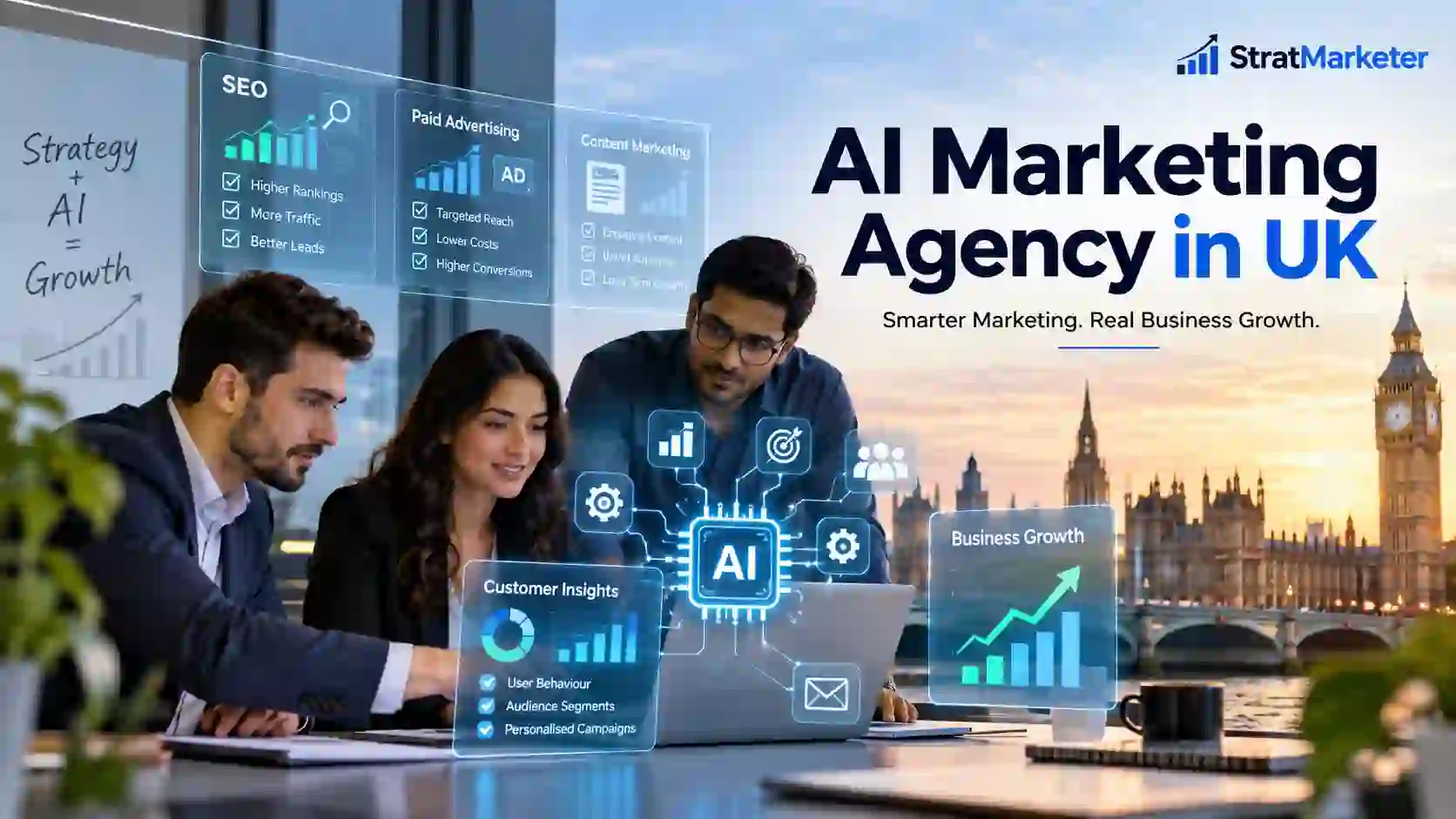
What Businesses Should Expect From an AI Marketing Agency in UK
Choosing an AI marketing agency in UK is not just about finding a company that uses artificial intelligence to create content or automate advertising. For most businesses, the real concern is simpler. They want enquiries from the right customers, marketing costs they can justify, and a clearer understanding of what is working.
A business owner in Manchester may be trying to generate more qualified leads for a professional service. An ecommerce company in London might be spending heavily on paid advertising but struggling to turn website visits into purchases. A small business in Birmingham may have a limited marketing budget and cannot afford to test every idea manually. These businesses have different needs, even if they are all looking for an AI marketing agency in UK.
AI can help with research, campaign analysis, customer segmentation, content production and repetitive marketing tasks. But the software alone does not decide what a business should communicate, which audience deserves more attention, or when an advertising campaign needs to change direction. Those decisions still require judgement.
At StratMarketer, the approach to AI marketing should begin with the business problem rather than the technology being used. A company with poor website conversion rates may not need more content. It may need clearer product information, better landing pages or a simpler enquiry process.
That distinction matters. Businesses should expect an AI marketing agency in UK to explain how its work connects with commercial objectives, what information it needs, how performance will be measured and where human review remains necessary.
How AI Is Changing Digital Marketing for UK Businesses
Digital marketing has always involved a certain amount of uncertainty. Businesses test advertisements, publish content, review traffic and make changes based on the information available. AI changes how quickly some of this work can happen, particularly when marketing teams are dealing with large amounts of data.
Consider a UK retailer running campaigns across Google, Meta and email. Each platform produces different information about clicks, purchases, audience behaviour and advertising costs. AI assisted analysis can help identify patterns across these sources, provided the data is accessible and sufficiently reliable. A marketing team can then investigate why one product category attracts visits but generates fewer sales than another.
This does not mean AI automatically identifies the correct answer. A drop in sales might be connected to advertising quality, but it could also result from delivery charges, stock shortages, seasonal demand or a competitor changing its prices. An agency that immediately increases the advertising budget without investigating these factors could waste money.
The same principle applies to content marketing. AI can help research search queries, group related topics, identify gaps in existing pages and prepare initial drafts. Human editors still need to check the information, remove unsupported claims and make sure the content answers the question a customer actually has.
Search is also changing. Search engines increasingly use AI in some search experiences, while consumers use conversational tools to research products, services and suppliers. UK businesses therefore need content that is useful, well organised and supported by credible information, not simply large volumes of pages containing similar keywords.
An experienced AI marketing agency in UK should understand both the opportunities and the limitations. Automation can reduce repetitive work, but poor automation can reproduce mistakes across hundreds of campaigns or pages before anybody notices.
I would rather see a business automate one well understood process than introduce five AI tools at once without knowing which one is helping.
There is a practical reason for that preference. When too many tools are introduced together, it becomes difficult to identify whether a change in performance came from better targeting, new creative material, revised landing pages or a change in the platform itself.
AI Marketing Agency in UK for Small Businesses, Startups and Established Brands
Not every business needs the same level of AI marketing support. Company size is one factor, but the stage of the business and the quality of its existing marketing systems are often more important.
Small businesses working with limited budgets
A local accountancy firm, independent retailer or home improvement company may have only a small team managing its marketing. The owner could be handling customer enquiries during the day and reviewing advertising reports in the evening.
For these businesses, an AI marketing agency in UK can help organise routine work, identify promising search topics, prepare campaign variations and analyse enquiry patterns. Automated email responses can also acknowledge enquiries outside office hours, provided customers can reach a real person when they need one.
The first priority should be choosing a few tasks that genuinely consume time or prevent the business from responding quickly.
For example, a plumbing company receiving enquiries through its website, telephone and social media might benefit more from a centralised lead management process than from generating dozens of social media posts every week. If enquiries are not being recorded properly, publishing more content may simply create more missed opportunities.
Startups trying to find their market
Startups face a different problem. They may not yet know which customer segment responds best to their offer, what language customers use to describe their problems or which sales channel is worth investing in.
AI can help analyse interview notes, organise customer feedback, compare messaging variations and identify recurring objections. This information can support better decisions about landing pages and advertising.
However, there is a risk in treating early data as proof. A startup with only a small number of customers should not assume that a pattern will continue at a larger scale. A few enthusiastic buyers may represent an unusual group rather than the wider market.
A capable AI marketing agency in UK should help startups test assumptions without pretending that every early result is statistically meaningful.
Established companies managing several channels
Larger businesses often have the opposite challenge. They already have substantial customer data, multiple marketing platforms and established campaigns. Their problem is connecting information and maintaining consistency across teams.
AI can assist with audience segmentation, campaign reporting, content workflows and the analysis of customer journeys. It may also help teams identify differences in performance between product categories, regions or acquisition channels.
Data governance becomes more important here. Customer information may be spread across a CRM, ecommerce platform, advertising accounts and email software. Before connecting these systems to AI tools, the company needs to understand access permissions, data handling arrangements and applicable privacy obligations.
For established organisations, the value of an AI marketing agency in UK often depends less on the number of tools it uses and more on whether it can work within existing processes without creating additional operational problems.
Using AI for SEO, Paid Advertising and Content Marketing
AI has a role in several marketing disciplines, but its usefulness depends on the task. A tool that works well for grouping search terms may be unsuitable for making decisions about advertising budgets without further analysis.
SEO is a good example. AI can help an agency review a large website, group related search queries, identify missing topics and examine how individual pages relate to one another. It can also support technical investigations by helping teams interpret crawl reports or identify recurring page issues.
The difficult part is deciding what deserves attention first.
A UK business might have hundreds of pages indexed by search engines, but only a small number may contribute meaningfully to leads or revenue. Updating every page simply because an AI tool identifies an opportunity is rarely the best use of time. Commercial relevance, search intent, existing performance and the quality of the information should guide the work.
Paid advertising requires a different approach. AI assisted tools can help generate variations of advertising copy, analyse performance patterns and support audience research. Advertising platforms also use machine learning to automate bidding and delivery.
Still, a campaign can produce impressive click numbers while attracting people who are unlikely to buy. The agency must examine the quality of enquiries, conversion rates, customer acquisition costs and, where reliable data is available, the revenue generated by those customers.
Content marketing presents another opportunity. AI can help turn a complicated research process into a more manageable workflow, but the final content must reflect the company’s actual services and knowledge.
Suppose a UK manufacturer wants to publish an article about choosing industrial packaging. A generic AI draft may explain common packaging materials, but it may miss the practical concerns that influence purchasing decisions, such as storage conditions, transport damage, minimum order quantities or compatibility with existing machinery. Someone who understands the product needs to add that detail and verify the technical claims.
That is where I think agencies sometimes get the balance wrong. Producing content faster is not necessarily a useful achievement if the content gives customers no reason to trust the company.
A sensible AI marketing agency in UK should use technology to support research and production while keeping editorial responsibility with people who can assess accuracy, relevance and business context.
The same principle applies across all three disciplines. AI can help a marketing team work through information more efficiently, but the commercial decision still needs to be grounded in what the business is trying to achieve.
How AI Marketing Helps UK Businesses Understand Customer Behaviour
Customer behaviour is rarely as straightforward as a dashboard makes it appear. A person might visit a website several times before contacting a company, compare prices on a mobile phone and complete a purchase days later on a laptop. Another customer might click an advertisement accidentally and never return.
AI can help businesses interpret patterns across these interactions, but the quality of the analysis depends on the information being collected and the limits of the available data.
One useful application is customer segmentation. Instead of treating every visitor as part of the same audience, a business can examine meaningful differences in behaviour. Some customers may respond to detailed product comparisons. Others may be more interested in delivery information, pricing or evidence of previous customer satisfaction.
A business selling specialist equipment, for instance, may find that visitors who read technical specifications and download product documents behave differently from those who visit only the homepage. This can inform the content shown to each audience and the messages used in follow up communications.
It is important not to confuse a behavioural pattern with a confirmed explanation. If visitors who read a technical document are more likely to enquire, that does not prove the document caused the enquiry. Those visitors may already have been more interested in purchasing.
A careful agency tests its assumptions rather than turning every correlation into a marketing rule.
Using customer feedback to understand objections
AI tools can help categorise customer reviews, sales call notes, support tickets and survey responses. Businesses may discover recurring concerns about pricing, product suitability, delivery times or the difficulty of understanding a service.
For a professional services company, the analysis might reveal that potential clients frequently ask what happens after an initial consultation. The company could respond by explaining its process more clearly on the website, rather than spending more money attracting additional visitors to an unclear page.
The information should be handled responsibly. Personal data must not be copied into AI systems without considering the provider’s data handling terms, access controls and applicable legal requirements.
Making personalisation useful rather than intrusive
Personalisation can mean something as simple as showing relevant product recommendations or sending an email based on a customer’s previous purchase. It does not require a business to make assumptions about someone’s private life or collect every available piece of information.
For UK businesses, the relevant privacy framework includes the UK GDPR and the Data Protection Act 2018, alongside applicable electronic marketing rules. Depending on the activity, businesses may need to consider consent, lawful basis, transparency and the rules governing cookies or direct marketing.
An AI marketing agency in UK should understand these responsibilities before introducing behavioural tracking or automated customer profiling.
There is also a human side to the issue. Customers appreciate communication that saves time, answers their questions and reflects their interests. They are less likely to appreciate messages that make them feel watched.
I might be wrong here, but I suspect many businesses would get more value from understanding a handful of genuine customer objections than from building increasingly complicated behavioural profiles. The simpler finding is sometimes the one that changes the marketing decision.
And sometimes the data does not tell you enough.
A customer may leave a website because the product is too expensive, because they are busy, or because they are only researching options for a purchase next quarter. Those situations can look almost identical in an analytics report, which is why AI analysis should support customer understanding rather than replace it.
Frequently Asked Questions About AI Marketing Agency in UK
What does an AI marketing agency in UK do?
An AI marketing agency in UK uses artificial intelligence alongside established marketing methods to support activities such as SEO, paid advertising, content production, customer analysis and marketing automation. The exact services depend on the agency and the client’s requirements.
Is AI marketing suitable for small businesses in the UK?
Yes. Small businesses can use AI to support content research, customer communication, reporting and repetitive tasks. They do not necessarily need expensive systems. The sensible starting point is to identify one or two activities that consume time or create avoidable problems.
How much does an AI marketing agency in UK charge?
Pricing varies according to the services provided, campaign complexity, business size and level of support. Some agencies charge a monthly retainer, while others price individual projects or specific deliverables. Request a written proposal that explains the work, fees and any additional software costs.
Can AI marketing replace a human marketing team?
Not entirely. AI can automate selected tasks and assist with analysis, but businesses still need people to make strategic decisions, verify information, understand customer concerns and take responsibility for published communications. The appropriate balance depends on the work involved.
How long does AI marketing take to produce results?
There is no single timeline. Advertising tests may provide early signals within days or weeks, while SEO and content marketing often require several months to show meaningful progress. The timeline also depends on the starting position, competition, budget and quality of implementation.
How can I choose the right AI marketing agency in UK?
Look for an agency that understands your business objectives, explains its methods clearly, measures commercially relevant outcomes and takes data privacy seriously. Ask for relevant examples, a defined scope of work and a clear explanation of how results will be assessed.
Does StratMarketer provide AI marketing services for UK businesses?
StratMarketer can be positioned around AI supported digital marketing for UK businesses, including SEO, content marketing, paid advertising and marketing automation. Businesses should confirm the exact services, delivery arrangements, pricing and reporting commitments directly with StratMarketer before entering an engagement.
Is AI generated content safe to publish on a business website?
AI assisted content can be published when it is useful, accurate, original in its contribution and properly reviewed. Businesses should check facts, remove unsupported claims and ensure the content reflects genuine expertise. Publishing large quantities of unreviewed material simply to target more search terms is a poor approach.
Our Services
Contact Us
- Paonta Sahib, Himachal Pradesh, India
- +91-8700998508
- support@stratmarketer.com
Start From Here
These two options make it easy for you to get the information you want.