


AI Marketing Agency for Startups | AI-Powered Growth
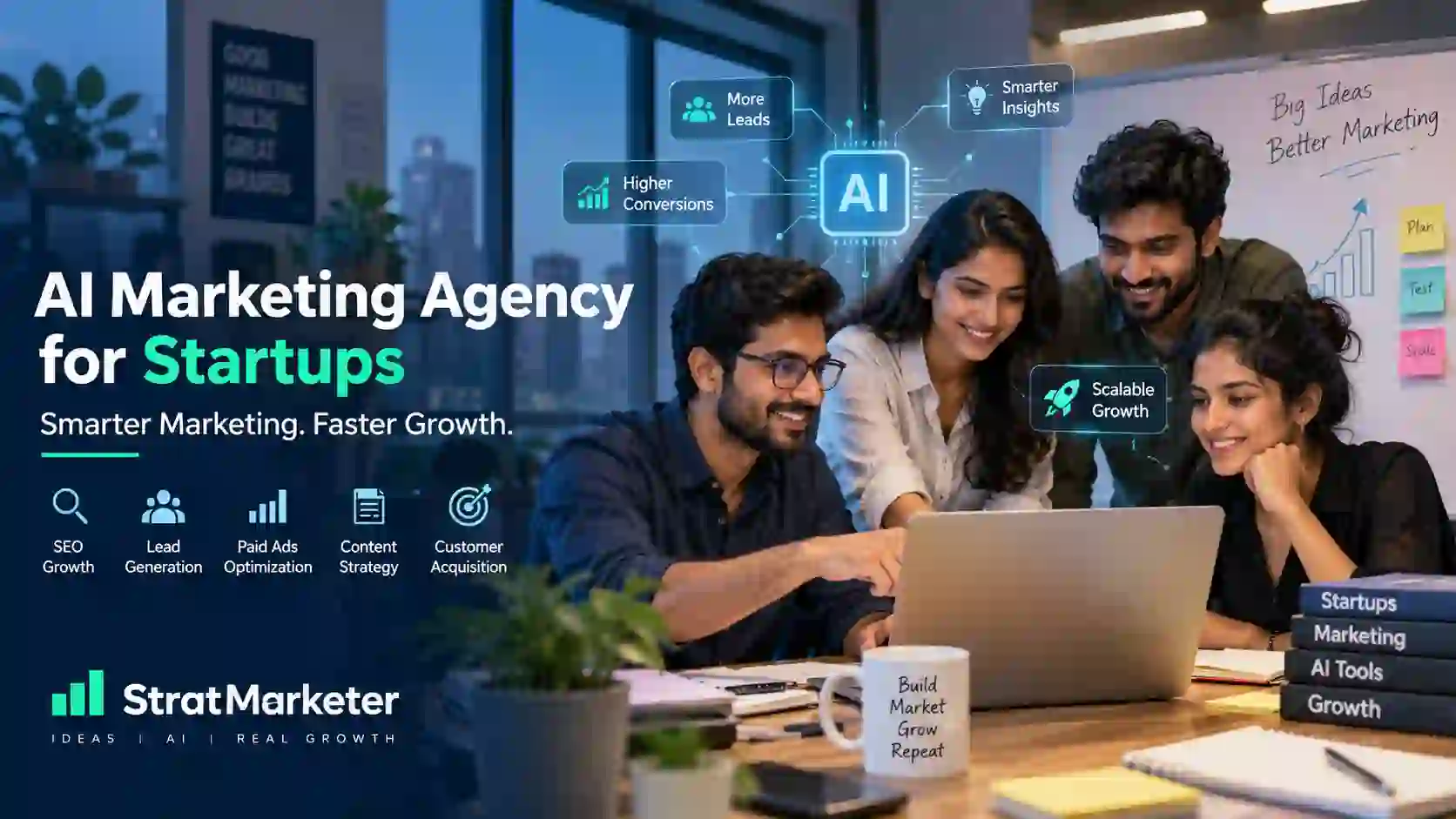
1. Why Startups Are Turning to an AI Marketing Agency for Faster Market Growth
Most startups do not struggle because they have no marketing ideas. They struggle because there is never enough time, money, or people to test everything.
A founder may be handling product decisions in the morning, talking to investors in the afternoon, and checking ad performance late at night. In that situation, marketing often becomes reactive. A campaign is launched because a competitor is running something similar. Blogs are published without knowing what customers are actually searching for. Leads are collected but not followed up properly.
This is one reason more businesses are looking for an AI marketing agency for startups.
The role of AI in startup marketing is not simply about generating content or setting up automated emails. When used properly, AI can help a startup process marketing data faster, identify patterns in customer behaviour, reduce repetitive work, and test different ideas without requiring a large internal marketing department.
For an early-stage company, speed matters. But speed without direction can be expensive.
An AI marketing agency for startups can help connect different parts of marketing that are often handled separately, including SEO, paid advertising, lead generation, content, customer communication, analytics, and campaign optimisation. Instead of waiting weeks to understand whether something is working, teams can analyse performance patterns and make changes more quickly.
I have seen small businesses spend a significant part of their initial marketing budget on ads before understanding who was actually converting. This happens quite often. The dashboard may show website traffic, impressions, clicks, and engagement, but the business owner is still asking a very basic question: “Why are people visiting but not buying?”
That is where better analysis becomes useful.
AI tools can help identify patterns across large volumes of campaign and customer data. They may reveal that a particular audience responds better to one offer, that certain search queries bring low-quality leads, or that customers repeatedly leave a website at the same stage of the conversion process.
But AI is not a shortcut to startup success. I would be cautious about any agency that presents it that way.
A poor product-market fit cannot be fixed by automation. Weak messaging does not suddenly become persuasive because an AI tool has written it. The technology is useful, but someone still needs to understand the market, question the data, and decide what should actually be changed.
For startups with limited resources, however, an experienced AI marketing agency for startups can make experimentation more practical. The focus can move from doing more marketing activities to understanding which activities deserve more investment.
And sometimes the answer is that the campaign should simply be stopped.
2. What an AI Marketing Agency for Startups Actually Does Beyond Basic Automation
There is a common misunderstanding that an AI marketing agency for startups is mainly responsible for using AI tools to create social media posts, blog articles, advertisements, and email campaigns.
That is only one small part of the work.
The more useful application of AI is in helping marketing teams make better decisions across different channels. A startup may be receiving data from its website, Google Ads, social media campaigns, CRM, email platform, and search performance tools. Individually, these platforms provide information. The difficulty is connecting the information in a meaningful way.
An AI marketing agency for startups can use AI-supported processes to analyse customer interactions, campaign performance, search behaviour, lead quality, and content opportunities more efficiently.
For example, suppose a SaaS startup receives 500 leads in a month. At first glance, the marketing campaign looks successful. But after examining the CRM data, the business discovers that only 40 of those leads are relevant, and just a few reach the sales stage.
The real problem is not lead volume.
It is lead quality.
AI-supported analysis can help identify common characteristics among better leads. Perhaps they come from a specific industry, interact with particular content before submitting an enquiry, or arrive through certain keywords. This information can then influence future advertising, SEO, landing pages, and email communication.
Automation is still useful, of course. Startups can automate repetitive activities such as lead qualification, email sequences, reporting, content workflows, and customer follow-ups.
But automation without thinking can create its own problems.
I have seen automated marketing systems continue sending promotional emails to leads who had already spoken to the sales team. It looks unprofessional and slightly irritating from the customer’s side. The business assumes that automation saves time, while nobody notices that the customer experience is becoming worse.
This is why an AI marketing agency for startups needs to look beyond automation. The work should involve strategy, human review, data interpretation, and continuous adjustments.
AI can process information quickly. It cannot always understand why a potential customer is uncomfortable with an offer, why a founder’s personal reputation is influencing a sale, or why a local market behaves differently from what the data initially suggests.
That still requires judgement.
3. How AI Helps Startups Understand Customers Before Spending More on Advertising
Advertising budgets can disappear surprisingly fast.
A startup launches Google Ads, Meta Ads, LinkedIn campaigns, or other paid promotions and receives some clicks. Then the natural reaction is to increase the budget because the campaign appears to be generating activity.
But activity is not always interest.
Before spending more on advertising, startups need to understand who their potential customers are, what problem they are trying to solve, and how they make buying decisions. This sounds obvious, yet many companies begin advertising before they have properly examined their own customer data.
An AI marketing agency for startups can help organise and analyse information from customer enquiries, reviews, sales conversations, website behaviour, search queries, CRM records, and marketing campaigns.
For example, AI-assisted analysis can help identify recurring questions asked by potential customers. If a large number of prospects repeatedly ask about pricing, implementation time, product compatibility, or service reliability, these concerns should influence marketing communication.
Instead of producing another generic advertisement, the startup may need to answer the questions people are already asking.
For Indian startups, this can be particularly important because customer behaviour can vary significantly across industries and regions. A B2B software buyer in Bengaluru may have a different decision-making process from a manufacturing business owner in Pune or a retail entrepreneur in Ahmedabad.
The same advertising message may not work equally well everywhere.
AI can help identify patterns, but I might be wrong here in assuming that more customer data always creates better marketing decisions. In some cases, startups collect too much information and become confused by minor patterns that do not actually matter.
Not every number deserves attention.
An experienced AI marketing agency for startups should therefore focus on meaningful questions. Which customer segment is converting? What content attracts qualified prospects? Where are potential customers leaving the sales process? Which campaigns are generating enquiries that the sales team actually wants?
These questions can prevent unnecessary advertising expenditure.
4. Using AI for Startup SEO, Content, Search Visibility and Organic Growth
SEO has become more complicated for startups because publishing content alone is no longer enough.
Search engines are better at evaluating usefulness, topical relevance, content quality, and the credibility behind information. At the same time, users are increasingly finding information through AI-powered search experiences, answer engines, voice search, and traditional search results.
This creates a wider search environment for startups.
An AI marketing agency for startups can use AI-supported research and analysis to understand search intent, identify content gaps, analyse competitors, organise keyword opportunities, and find questions that potential customers are actually asking.
However, I do not agree with the idea that AI should be allowed to produce large volumes of website content without strong human involvement.
That approach often creates pages that sound acceptable but say very little.
A startup needs content that reflects actual product knowledge, customer concerns, industry understanding, and experience. AI can assist with research, content organisation, topic analysis, and optimisation, but the final material should still have a clear human perspective.
For instance, a startup offering financial software should not simply publish generic articles explaining accounting concepts. Its content should address the real problems its potential customers face, perhaps invoice reconciliation delays, GST-related reporting confusion, cash flow visibility, or manual spreadsheet work.
Specificity matters.
An AI marketing agency for startups can also help identify which existing pages require improvement. Sometimes a website already has useful content, but the information is poorly organised, outdated, or not answering the user’s actual question.
Organic growth can take time. This is one area where startups sometimes become impatient.
Paid advertising may generate visibility immediately, while SEO usually requires sustained work. Yet depending entirely on advertising can create long-term dependence on increasing budgets. A balanced strategy can help a startup build assets that continue attracting relevant traffic over time.
Still, this does not apply everywhere. A startup operating in a highly specialised niche with very low search demand may need to prioritise partnerships, outbound sales, community building, or paid acquisition before investing heavily in content.
SEO is useful when there is genuine search behaviour to capture.
That distinction matters.
5. AI Powered Paid Advertising and Campaign Optimisation for Startups
Paid advertising platforms already use AI and machine learning extensively. The challenge for startups is not simply turning on automated campaign settings. The real challenge is understanding whether the system is optimising towards the right business outcome.
An AI marketing agency for startups can help connect campaign optimisation with meaningful goals such as qualified leads, sales opportunities, subscriptions, purchases, or customer acquisition value.
A campaign that generates cheap leads is not necessarily successful.
This is something many startups learn after wasting money.
Suppose an online education company receives leads at a very low cost. The marketing dashboard looks impressive. But when the sales team contacts those leads, most are not interested, cannot afford the programme, or submitted the form accidentally while looking for free information.
The cost per lead looks good. The business result does not.
AI-supported campaign analysis can help identify such gaps by examining conversion patterns and connecting advertising data with later stages of the customer journey. Startups can then test different audiences, messages, offers, landing pages, and campaign structures.
An AI marketing agency for startups may also use AI to analyse creative performance. One advertisement might attract attention but fail to generate conversions. Another may have fewer clicks but bring better customers.
This is where human judgement becomes important again.
AI may identify that one creative is performing better statistically, but it may not recognise that the message is attracting customers who will later become difficult to retain. Marketing performance should not always be judged by the first conversion alone.
I have a concern with the current obsession around fully automated advertising. Giving an algorithm complete control can sometimes reduce the visibility a startup has over its own marketing decisions. Automation can be useful, certainly, but blindly trusting it is different.
The better approach is usually a combination of AI-based optimisation and regular human review.
Startups should know where their money is going. They should know which campaigns are producing meaningful business activity. And when something does not work, they should be willing to stop it instead of waiting for the algorithm to somehow fix everything.
Sometimes it doesn’t.
The real value of working with an AI marketing agency for startups is not that AI makes marketing automatic. It is that the right use of technology can help a small team understand more, test faster, and spend with a little more confidence.
A little more confidence is still useful when the budget is tight.
6. How Startups Can Use AI for Lead Generation, Funnels and Customer Acquisition
Lead generation is often where startup marketing becomes messy. A business may run ads, publish content, attend industry events, send emails, and receive enquiries from several channels, but nobody has a clear picture of which activities are actually bringing customers.
An AI marketing agency for startups can help bring more order to this process by using AI to analyse lead behaviour, identify patterns, support qualification, and improve different stages of the conversion funnel.
The starting point should not be, “How can we get more leads?”
That question sounds reasonable, but it can send a startup in the wrong direction.
A better question is, “What kind of leads eventually become customers, and what happens before they convert?”
AI can analyse information from CRM platforms, website forms, email interactions, chat conversations, landing pages, and advertising campaigns to identify behavioural patterns. A startup may find that its best customers usually visit two or three product pages before submitting an enquiry. Another business may discover that leads who download a particular resource are more likely to book a sales call.
These small patterns can influence how a funnel is built.
For example, an Indian B2B startup selling HR software may receive website traffic from HR managers, business owners, recruiters, and students researching the industry. All of them may interact with the website, but they do not have the same commercial value.
An AI marketing agency for startups can help separate these patterns and create more relevant communication for different audiences. Someone researching HR technology may need educational content. A company actively looking for HR software may need a product comparison, pricing information, or a demo.
Sending both people the same email sequence does not always make sense.
AI can also support lead scoring. Instead of treating every enquiry equally, startups can use behavioural and business information to understand which leads may deserve quicker follow-up. This can be useful for small sales teams that do not have the capacity to personally investigate hundreds of enquiries every month.
Still, automated lead scoring can be unreliable if the underlying data is poor.
A startup with inaccurate CRM records or inconsistent sales updates can easily train its internal processes around the wrong assumptions. This is one of those areas where the technology may look advanced while the basic information underneath is a complete mess.
I have seen that happen more than once.
Customer acquisition also depends on what happens after the first interaction. A potential customer may not purchase immediately. They may compare options, speak with colleagues, check reviews, return to the website, and then disappear for a few weeks.
AI-supported marketing can help create more responsive follow-up systems, but I personally think startups should be careful not to over-automate this part. Nobody enjoys receiving five generic messages simply because they visited a pricing page once.
The funnel should still feel like a conversation.
Sometimes a prospect needs more information. Sometimes they are simply not ready. And sometimes they are not a good customer for the business in the first place.
7. Common Marketing Problems Startups Face When Adopting AI Too Early or Incorrectly
AI can make startup marketing more efficient, but adopting it too early or without a clear purpose can create new problems.
One common mistake is purchasing multiple AI tools before the startup has established a basic marketing process. Teams subscribe to content tools, automation platforms, AI analytics systems, chatbots, and advertising software, then struggle to connect them.
The result is often more technology and less clarity.
An AI marketing agency for startups should first understand what the startup is trying to solve. Is the problem lead quality? Slow content production? Weak advertising performance? Poor follow-up? Lack of customer insights?
AI should support a real requirement.
Another issue is poor-quality data. AI systems depend heavily on the information available to them. If the CRM contains duplicate leads, incorrect sales statuses, missing customer information, and outdated records, the analysis can become misleading.
This sounds technical, but it is really a practical problem.
A startup may believe that AI is identifying its ideal customer while the system is actually analysing incomplete or incorrectly categorised data.
Then there is the content problem.
Many startups now use AI to create large amounts of website content quickly. In theory, this saves time. In reality, it can create dozens of pages that sound similar, repeat the same information, and do not reflect any genuine expertise.
More content is not always better.
Earlier, I mentioned that AI can help startups move faster. That is true. But this is where that idea breaks down. Moving faster in the wrong direction only means reaching the problem earlier.
This may not apply everywhere, but early-stage startups often need fewer marketing activities with better thinking behind them.
Another problem is depending completely on automation for customer communication. Chatbots and automated email systems can be helpful, especially when a startup receives a high number of enquiries. However, important conversations should not always be handed over to an automated system.
A frustrated customer may need a person.
A high-value prospect may have an unusual requirement.
A founder may need to understand what customers are actually saying instead of reading a summary generated by a tool.
There is also a tendency to trust AI outputs because they appear confident. That can be dangerous. AI-generated analysis can contain incorrect assumptions, incomplete information, or recommendations that do not fit the business model.
Someone still needs to ask, “Does this actually make sense?”
That question gets ignored surprisingly often.
8. What Founders Should Check Before Hiring an AI Marketing Agency for Startups
Choosing an AI marketing agency for startups should not be based only on how many AI tools the agency claims to use.
Tools change quickly.
The more important question is whether the agency understands startup marketing, customer acquisition, business models, and the uncertainty that comes with an early-stage company.
Founders should first ask how the agency plans to understand the business. Before launching campaigns, the agency should know who the target customer is, what problem the startup solves, how the product is positioned, what the sales cycle looks like, and what a successful customer actually means for the business.
For a SaaS startup, a successful customer may be a monthly subscriber.
For a B2B company, the sales process may take several months.
For an ecommerce startup, repeat purchases may matter more than the first sale.
These differences affect marketing decisions.
A good AI marketing agency for startups should also be transparent about what AI is actually being used for. There is a difference between using AI for research, analysis, automation, campaign testing, and customer insights, and simply using it to generate content.
Founders should understand the difference.
It is also worth asking how marketing performance will be measured. Vanity metrics such as impressions, likes, and traffic can provide useful context, but they should not become the main measure of success.
The agency should discuss business-relevant outcomes.
Qualified enquiries. Sales opportunities. Conversion rates. Customer acquisition cost. Retention. Revenue quality.
Not every startup will need to track all of these immediately, but the marketing activity should connect to a real business objective.
Another important question is ownership.
Who owns the advertising accounts, analytics access, content assets, CRM data, and campaign history?
This can become uncomfortable later if a startup changes its agency and discovers that important accounts are controlled by someone else.
Founders should also look at how the agency handles experimentation. Startup marketing involves testing. Nobody knows every answer in advance.
An agency that promises guaranteed results within an unrealistic timeframe should make a founder cautious. I would rather work with a team that explains what it plans to test and why than one that promises impossible numbers during the first conversation.
There is no perfect checklist for choosing an AI marketing agency for startups, though. Chemistry and communication also matter.
A founder should be able to challenge the agency’s thinking.
And the agency should be comfortable challenging the founder when a marketing idea does not appear realistic.
That relationship can feel slightly uncomfortable at times. It is probably a good sign.
9. How StratMarketer Supports Startups With AI Based Marketing and Growth Activities
StratMarketer works with businesses that need marketing activities connected more closely with changing customer behaviour, search trends, advertising performance, and business goals.
For startups, the marketing requirement can change quickly. A company that is initially focused on product awareness may later need qualified leads. Another startup may have enough traffic but poor conversion rates. Some businesses need help building their search presence before increasing advertising expenditure.
This is why an AI marketing approach should not begin with the same set of activities for every company.
As an AI marketing agency for startups, StratMarketer can support different areas of digital marketing by combining AI-supported analysis with practical human decision-making. Depending on the startup’s requirements, this may involve SEO, content marketing, paid advertising, lead generation, conversion optimisation, local SEO, social media marketing, email marketing, AI integration, marketing automation, and search visibility across emerging search environments.
The agency can also help startups look at how different marketing activities connect.
For example, paid campaigns can provide useful information about customer interests and search behaviour. Those insights may help improve website content and SEO. Content performance can reveal recurring customer questions that may later influence landing pages or advertising messages.
Marketing channels should not always operate independently.
StratMarketer’s approach can be particularly useful for startups that want to experiment without randomly adding more tools and activities. The aim should be to understand what is producing useful movement for the business and what is simply creating reports.
There is a difference.
An AI marketing agency for startups should also recognise that AI tools cannot replace industry knowledge. StratMarketer can use technology to support research, automation, content processes, campaign analysis, and optimisation, while keeping human review involved in important decisions.
That matters because startup marketing is rarely predictable.
A strategy that works for one SaaS company may fail for another. A campaign that performs well during the early growth stage may stop working after the business enters a more competitive market.
I might be wrong here, but I think the agencies that will remain useful are not necessarily the ones using the most AI tools. They will be the ones that know when the tools are helping and when they are creating unnecessary complexity.
That distinction is becoming important.
10. Frequently Asked Questions About AI Marketing Agency for Startups
What is an AI marketing agency for startups?
An AI marketing agency for startups uses AI-supported tools and processes alongside human marketing expertise to support activities such as SEO, advertising, lead generation, content, automation, customer analysis, and campaign optimisation.
Can an AI marketing agency help an early-stage startup?
Yes, but the startup should first have a reasonably clear product, audience, and business objective. AI can support marketing decisions, but it cannot solve every underlying business problem.
Is AI marketing expensive for startups?
It depends on the services, tools, advertising budget, and level of marketing support required. Some AI-supported processes can reduce repetitive manual work, although using too many unnecessary tools can also increase costs.
Can AI replace a startup marketing team?
No. AI can reduce manual work and support analysis, but marketing still requires strategic judgement, creativity, customer understanding, and human communication.
How can AI improve startup lead generation?
AI can help analyse customer behaviour, identify patterns, support lead qualification, personalise follow-up communication, and identify which marketing sources are producing better-quality prospects.
Should startups use AI-generated content for SEO?
AI can assist with research and content production, but publishing large volumes of generic AI-generated content without expert review is not a strong long-term approach. Content should still provide genuine value and reflect real subject knowledge.
What should founders ask before hiring an AI marketing agency for startups?
Founders should ask about the agency’s experience, use of AI, reporting process, performance measurement, account ownership, data handling, and how it plans to understand the startup’s specific market and customer journey.
Does every startup need an AI marketing agency for startups?
No. Some startups may be better served by building an internal marketing capability or focusing on a specific marketing channel first. This depends on the stage of the business, budget, team capability, and growth requirements.
Our Services
Contact Us
- Paonta Sahib, Himachal Pradesh, India
- +91-8700998508
- support@stratmarketer.com
Start From Here
These two options make it easy for you to get the information you want.