


What Makes an AI Marketing Agency for SaaS Different From a Traditional Marketing Agency?
Marketing a SaaS product is rarely as straightforward as generating website traffic and waiting for users to sign up. Someone may discover the product through a Google search, read three comparison articles, visit the pricing page twice, disappear for two weeks, and then return after receiving an email about a feature they were already considering. For B2B SaaS, the situation can become even more complicated because the person using the software may not be the person approving the purchase.
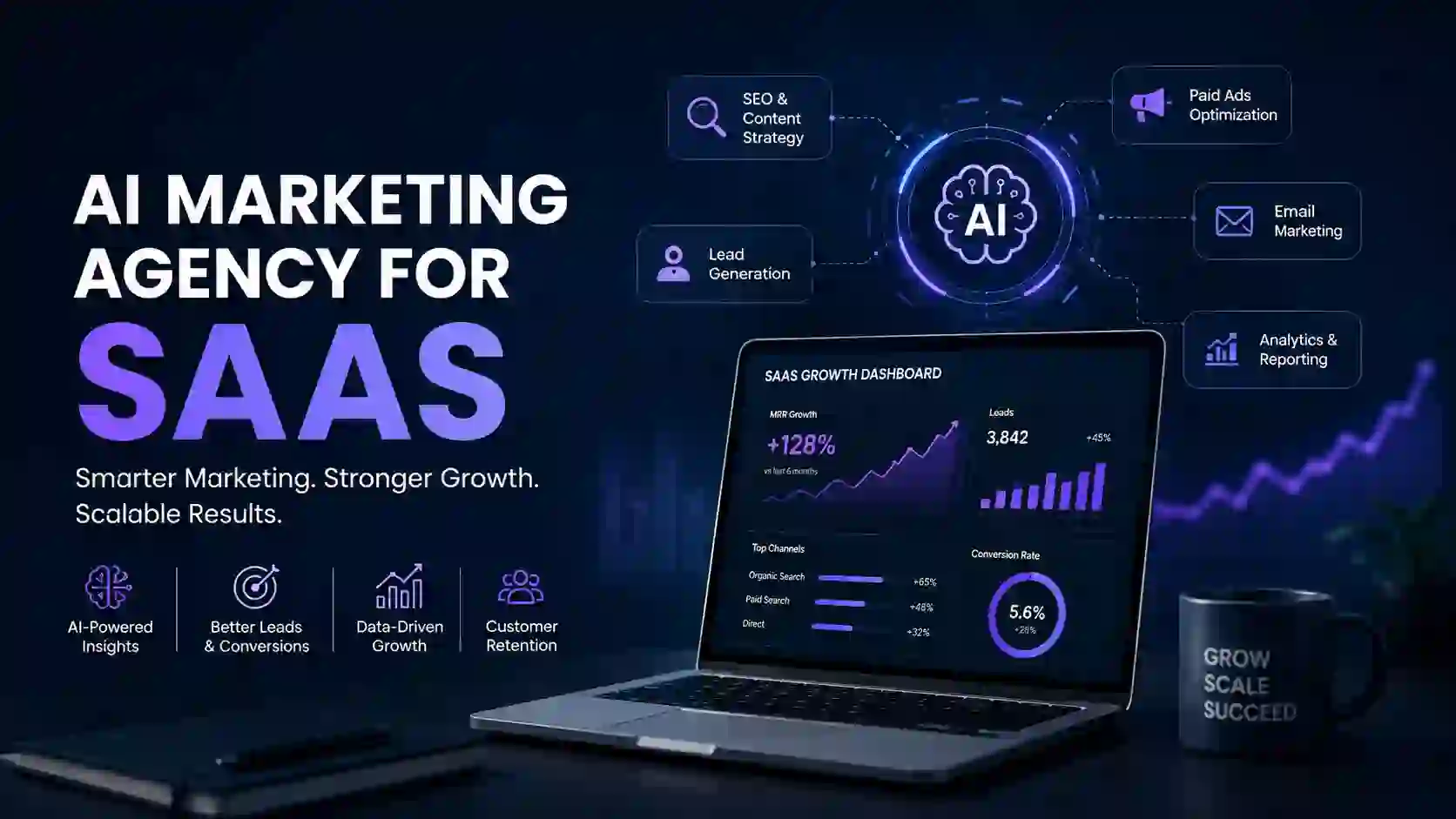
This is where an AI marketing agency for SaaS can approach marketing differently from a traditional agency.
A traditional marketing agency may focus heavily on individual channels. One team handles SEO, another manages paid advertising, and someone else sends emails. The problem is that SaaS marketing data does not naturally stay inside one channel. Search behaviour, website interactions, trial sign-ups, demo requests, CRM activity and customer usage can all reveal something about how a potential buyer is moving towards a decision.
An AI marketing agency for SaaS attempts to connect these signals more effectively.
For example, a visitor searching for “best project management software for construction teams” is probably in a different stage from someone searching for the name of a specific software product. Treating both visitors with the same landing page and advertisement is not always sensible. AI can help analyse patterns across larger volumes of search queries, campaign data and customer interactions, allowing marketers to identify differences that might otherwise remain buried inside reports.
But there is an important point here. AI does not automatically understand a SaaS business.
I have seen marketing teams become overly confident after adding an AI tool to their workflow. The tool produces customer personas, competitor analysis and dozens of campaign ideas in minutes. Everything looks impressive. Yet the content may have little understanding of why customers actually choose the product. For SaaS companies, especially those selling technical or specialised software, this gap can be expensive.
An AI marketing agency for SaaS still needs people who understand the product, the market and the buying process. AI can process information quickly, but it cannot simply be allowed to decide what matters.
The strongest use of AI is usually in helping marketers notice patterns sooner.
A SaaS company selling HR software in India, for instance, may receive leads from startup founders, HR managers and finance teams. Their reasons for visiting the website can be completely different. Founders may care about pricing and implementation speed. HR teams may focus on features and employee management. Finance teams might ask about compliance, contracts and cost.
One generic marketing message will struggle to address all of them.
AI can help identify these differences across search terms, website behaviour and campaign performance. The marketing team can then create more relevant content, advertising and lead nurturing journeys.
That distinction matters. AI should support judgement, not replace it.
Traditional agencies are also capable of using data, of course. The difference is increasingly about the scale and speed at which information can be processed. An AI marketing agency for SaaS can potentially analyse larger datasets, automate repetitive marketing activities and test more variations without requiring every small task to be handled manually.
Still, this does not mean traditional marketing has suddenly become useless. In fact, many old marketing principles remain stubbornly important. Understanding customer problems, communicating clearly and building trust are not problems that disappear because AI is involved.
I would actually be concerned if an agency spoke only about AI and barely discussed customers.
The technology is useful. The buyer is still the reason for the marketing.
Where SaaS Companies Are Actually Using AI in Their Marketing Today
The conversation around AI can sometimes make it sound as if SaaS companies are handing over their entire marketing department to software. That is not what is happening in most serious businesses.
The practical use of AI is usually more fragmented.
An AI marketing agency for SaaS may use AI to research search behaviour, analyse campaign performance, create content variations, identify potential audience segments, improve email workflows or understand which leads appear more likely to convert. These are different tasks, and each one requires a different level of human involvement.
One area where AI has become particularly useful is content research.
SaaS companies often need to produce a significant amount of content. There may be feature pages, use case pages, industry pages, comparison content, blog articles, help documentation and email campaigns. Researching every possible question manually can take considerable time.
AI can help group search queries, identify recurring themes and find patterns in the language used by potential customers.
For example, a cybersecurity SaaS company may initially believe that its customers are mainly searching for broad terms related to security software. After deeper analysis, however, the search behaviour may reveal repeated concerns around compliance reporting, employee access management or specific industry regulations.
That changes the content strategy.
Instead of publishing another broad article about cybersecurity, the company may need pages that answer very specific commercial questions.
An AI marketing agency for SaaS can use AI-assisted research to identify such opportunities, although the findings still need to be checked against real search data and customer conversations. AI-generated assumptions can be surprisingly convincing even when they are wrong.
This is one area where I might be wrong here if I generalise too much. Some SaaS markets have very limited search volume, and AI cannot manufacture demand where none exists.
AI is also being used in advertising.
Paid campaigns generate large amounts of information. Keyword performance, audience behaviour, creative response, landing page interactions and conversion patterns can all change over time. Analysing these signals manually becomes difficult when a SaaS company is running campaigns across Google, LinkedIn, Meta and other platforms.
AI can assist with identifying trends and suggesting areas that need attention.
Suppose a SaaS business is running ads for a free trial. One campaign generates fewer trial sign-ups but produces customers with a higher average subscription value. Another campaign generates many cheap sign-ups that rarely convert into paying users.
Looking only at the cost per lead could produce the wrong decision.
An AI marketing agency for SaaS can help connect advertising performance with later funnel activity. The objective is not simply to generate the maximum number of leads. It is to understand which marketing activity contributes to meaningful revenue.
Email marketing is another common use case.
SaaS businesses often collect leads at different stages. Some users download a resource. Others request a demo. Some start a trial and never complete onboarding. AI can help analyse behaviour and support more relevant communication based on where the person appears to be in the journey.
The important word is support.
Poorly configured automation can become irritating very quickly. Most people have experienced this. You download one report and suddenly receive six emails explaining a product you have no intention of buying.
That is not intelligent marketing.
It is just automation with better branding.
Using AI to Understand SaaS Buyers, Search Intent and Long Sales Cycles
SaaS buying journeys can be messy.
A potential customer may first search for information about a problem without knowing what type of software they need. Months later, they may compare different platforms. By the time they request a demo, several stakeholders may already be involved.
This creates a problem for marketing teams because the final conversion does not always reveal the full journey.
An AI marketing agency for SaaS can help analyse multiple signals to develop a better understanding of how buyers move through the process. This may include search queries, website pages visited, time spent exploring features, content downloads, email engagement and CRM activity.
Search intent is particularly important.
Consider someone searching for “how to reduce customer churn in SaaS.” This person may be researching a problem. Another person searching for “customer retention software pricing” is likely much closer to evaluating solutions.
Both searches may be related to the same broader business issue, but the marketing response should be different.
AI can help classify and group large numbers of search queries based on patterns. A marketing team can then identify informational, commercial and comparison opportunities more efficiently.
However, search intent classification is not perfect.
A keyword can have multiple meanings depending on the user. Someone searching for a product comparison may simply be doing early research, while another person may be ready to purchase within hours. No AI system can always know this from a keyword alone.
This is where broader behaviour becomes useful.
If a visitor reads a comparison article, then visits pricing, checks integrations and returns to the website three days later, the situation looks different from someone who reads one blog article and leaves.
An AI marketing agency for SaaS can use these behavioural patterns to create better audience segments and marketing journeys.
For longer sales cycles, this becomes even more important.
B2B SaaS companies may spend months nurturing a potential customer. During that period, different people may interact with the brand. A technical user may read documentation while a decision-maker reviews pricing and case studies.
I have always preferred marketing teams that accept this complexity rather than trying to force every customer journey into a neat funnel.
Real buyers do not behave that neatly.
A company may need different content for users, managers, founders and procurement teams. AI can assist with analysing these differences, but the marketing strategy still needs human thinking.
There is also a risk of over-personalisation. Just because a system can track behaviour does not mean every action should trigger a highly specific message. Sometimes customers simply need time.
Marketing should not feel like someone standing behind the user, watching every click.
How an AI Marketing Agency for SaaS Can Support SEO and Organic Growth
SEO for SaaS has become more demanding than simply finding a few keywords and publishing articles around them.
A SaaS website often needs to compete across several types of searches. There are problem-related searches, product category searches, feature searches, integration searches, competitor comparisons and industry-specific searches.
An AI marketing agency for SaaS can help organise and analyse these opportunities at a larger scale.
For example, a CRM software company may find search opportunities around sales pipeline management, lead tracking, automation, reporting and integrations. Within each area, there may be dozens or hundreds of related questions.
AI-assisted analysis can help group these topics and identify relationships between them.
This can be useful when planning content, but content should not be created simply because a keyword exists.
That mistake happens often.
A company sees a high-volume keyword and publishes an article that has little connection with its product or audience. The page may generate traffic but produce almost no meaningful business value.
Organic growth needs relevance.
StratMarketer can approach SaaS SEO by looking beyond isolated keyword rankings and examining how content supports the broader buying journey. An article may introduce a problem. A comparison page may help someone evaluate options. A feature page may answer technical questions. These pieces can work together, though not every visitor will follow the expected path.
AI can also support content audits.
Large SaaS websites sometimes accumulate outdated articles, duplicate topics and pages that no longer match the current product positioning. Analysing hundreds of URLs manually is time-consuming. AI can help identify patterns in content overlap, topic gaps and outdated language.
But I would not trust an automated audit without manual review.
A page with low traffic may still be important for a specific customer segment. A technical integration page may not receive thousands of visits, yet the visitors who land there could have strong purchase intent.
This is where numbers can mislead.
An AI marketing agency for SaaS should also pay attention to the quality and credibility of content. SaaS buyers, particularly in B2B markets, often need evidence before making a decision. Generic AI-generated articles with no real product understanding may attract impressions, but they rarely create strong trust.
Expert input matters.
Real customer examples matter.
Clear explanations matter.
Organic growth is also becoming connected with how information is surfaced through AI-powered search experiences and answer-based platforms. This means SaaS brands need content that answers specific questions clearly while still providing enough depth and context.
The aim should not be to write for machines.
That usually becomes obvious.
The aim is to make information genuinely useful and structured clearly enough that both people and search systems can understand it.
Sometimes the best SEO work looks almost boring from the outside. Updating an old integration page, correcting product information, improving internal links or answering one recurring customer question properly can matter more than publishing ten average articles.
AI Powered Paid Advertising for SaaS Customer Acquisition
Paid advertising can help SaaS companies generate demand quickly, but it can also waste money with impressive efficiency.
An AI marketing agency for SaaS can use AI to analyse campaign data, test messaging variations and identify patterns that may not be immediately obvious. This is particularly useful when campaigns involve multiple audience segments, keywords and creatives.
However, more automation does not always mean better advertising.
I have seen campaigns where automated systems aggressively increased spending because conversion numbers looked strong, while the quality of those conversions was quietly declining. If the marketing team only tracks demo requests or trial sign-ups, they may miss the larger problem.
For SaaS businesses, customer acquisition should be evaluated beyond the first conversion.
A trial user who cancels after seven days is different from a customer who remains subscribed for two years.
AI can help connect these stages when the right data is available. Advertising platforms, analytics systems and CRM data can provide a broader picture of which campaigns are producing valuable customers.
Message testing is another area where AI can be useful.
A SaaS product may have several potential value propositions. One audience may respond to cost savings. Another may care about reducing manual work. Technical users may focus on integrations and functionality.
Instead of manually creating every possible variation from scratch, AI can assist marketing teams in developing and testing different messaging directions.
But the final message still needs judgement.
AI-generated ad copy often sounds polished until you notice that it could be used by almost any software company.
That is the problem.
StratMarketer can use AI-supported advertising analysis while keeping the SaaS product, customer objections and commercial objectives at the centre of campaign decisions. The purpose is not to automate everything. It is to reduce unnecessary manual work and create more room for better decisions.
And sometimes a campaign will fail for reasons that AI cannot solve.
The offer may be weak.
The pricing may not fit the market.
The product may simply not stand out enough.
No amount of campaign optimisation can completely hide that for long.
That uncomfortable part is worth remembering.
Improving SaaS Lead Generation and Conversion Funnels With AI
Generating leads is often not the biggest problem for a SaaS company. The frustrating part usually comes later.
The website gets traffic. Demo forms are being submitted. Free trials are increasing. The sales team is busy. Yet a large percentage of these leads never become customers.
This is where an AI marketing agency for SaaS can help look beyond basic lead numbers and examine what is happening between the first interaction and the actual purchase.
A typical SaaS conversion funnel may involve search traffic, paid advertising, content, landing pages, demo requests, free trials, product onboarding and sales conversations. If these stages are reviewed separately, it becomes difficult to understand where genuine buying intent is being lost.
AI can help analyse behaviour across these touchpoints.
For example, a visitor may download a product comparison document, return to the website several times and visit the pricing page. Another visitor may submit a demo form immediately after clicking an advertisement and never interact again. Both are technically leads, but their potential value may be very different.
An AI marketing agency for SaaS can use behavioural and campaign data to identify patterns that suggest stronger purchase intent. This can help marketing and sales teams prioritise leads instead of treating every enquiry in exactly the same way.
Lead scoring is one obvious example.
Traditional lead scoring often works through fixed rules. A person gets points for opening an email, visiting a pricing page or requesting a demo. AI-assisted systems can potentially examine a wider combination of signals and identify patterns associated with past conversions.
Still, I would be careful about blindly trusting lead scores.
A SaaS company selling enterprise software may receive its best leads from people who barely engage with marketing emails but arrive with a very specific problem and request a serious conversation. Another company selling a low-cost subscription product may see the opposite pattern.
This may not apply everywhere.
The value of AI in lead generation depends heavily on the quality of data already available. If CRM information is incomplete or conversion tracking is poorly configured, the system is working with weak material.
A messy funnel does not become intelligent simply because AI has been added to it.
Landing page optimisation is another area where AI can support SaaS marketing. Different users may respond to different messaging, feature explanations or calls to action. AI-assisted testing can help analyse which combinations perform better across larger datasets.
But there is a mild contradiction here. Earlier, I said AI can help marketers process more variations, and I stand by that. Yet testing too many variations without a clear commercial hypothesis can create confusion. More tests do not automatically mean more learning.
A SaaS business still needs to ask simple questions.
Why are visitors not converting?
Are they confused about the product?
Is the pricing unclear?
Are they not the right audience in the first place?
Sometimes the answer is painfully simple.
An AI marketing agency for SaaS can also support funnel analysis by identifying drop-off points. A large number of users may start a free trial but fail during onboarding. Others may reach the demo booking page and abandon it.
These patterns deserve attention because customer acquisition costs are rarely limited to advertising expenditure. Every qualified visitor who leaves because of unnecessary friction represents wasted effort somewhere else in the marketing process.
For Indian SaaS companies targeting international markets, this can become particularly important. A company based in Bengaluru or Pune may attract visitors from the United States, the United Kingdom and Australia, but the website messaging, pricing communication or demo process may not feel equally relevant to every audience.
AI can help analyse behavioural differences between markets. The actual decision about how to respond should remain human.
That distinction keeps coming back because it matters.
Using AI for Email Marketing, Lead Nurturing and Customer Engagement
Email marketing is still relevant for SaaS, although many companies damage their own campaigns by treating every contact like an unfinished sale.
A person who has downloaded a blog resource does not necessarily need a sales pitch the following morning.
AI can help SaaS companies create more relevant lead nurturing journeys by analysing customer behaviour and grouping contacts based on interests, actions and stages of engagement.
An AI marketing agency for SaaS may use AI to identify which content topics a prospect has interacted with, which product pages they have visited and whether they are showing signs of moving closer to a purchase decision.
This information can support more useful communication.
For example, a prospect exploring integration pages may benefit from technical information, case studies or implementation details. Someone who has repeatedly visited pricing pages may have different concerns.
But even here, over-personalisation can feel uncomfortable.
There is a point where useful communication starts feeling like surveillance.
I personally prefer SaaS email campaigns that use behaviour as context without making the customer feel as if every movement has been watched. A simple relevant email often works better than an overly clever message that says, in effect, “We noticed you visited this page three times.”
Nobody asked for that level of intimacy.
AI can also help with email content variations.
Different segments may require different messaging. A founder evaluating a small SaaS product may want a quick explanation of pricing and business value. An enterprise buyer may need more detailed information about security, integrations and implementation.
Creating these variations manually can take time.
AI can assist with drafting, analysing engagement and identifying patterns in subject lines or content performance. However, final communication should still sound like the company behind the product.
One issue I have noticed with AI-generated email content is sameness. The emails may be grammatically correct and professionally written, yet they feel strangely empty. They do not sound as if anyone inside the company has actually spoken to a customer.
That becomes more obvious over time.
Customer engagement can also include onboarding communication. SaaS businesses often lose potential customers during the period between registration and the first meaningful product experience.
An AI marketing agency for SaaS can support segmentation and communication during this stage. If users consistently stop at a particular step, the company may need to send more relevant guidance or reconsider the product experience itself.
This is important because not every engagement problem is a marketing problem.
Sometimes the software is confusing.
The onboarding flow may be too long.
The first useful action may take too much effort.
AI can help identify the pattern, but it cannot always fix the underlying issue.
That is where marketing teams, product teams and customer success teams need to work together. SaaS growth becomes fragmented when each department sees only its own metrics.
Common Mistakes SaaS Companies Make When Adopting AI for Marketing
One of the biggest mistakes is adopting AI because competitors are talking about AI.
This usually leads to tool collection.
A company subscribes to an AI writing platform, an AI analytics platform, an AI chatbot and several automation tools. After a few months, nobody is entirely sure which system is producing useful results.
The software costs increase. The workflow becomes more complicated.
And there is a small amount of irritation because everyone knows something is being wasted, but nobody wants to be the person who says it.
An AI marketing agency for SaaS should ideally begin with marketing problems rather than AI tools.
If lead quality is poor, understand why.
If organic traffic is not converting, investigate the audience and content.
If sales cycles are long, identify where prospects are slowing down.
AI should be selected because it helps solve a specific issue.
Another common mistake is publishing large volumes of AI-generated content without sufficient review. SaaS companies often have technical products, specialised customers and detailed commercial requirements. Generic content can easily misrepresent features or make promises the product cannot support.
This can create trust problems.
A cybersecurity SaaS company cannot afford vague or inaccurate content about security. A financial software business needs to be careful with claims. Even smaller mistakes can create unnecessary questions during the buying process.
Human expertise remains necessary.
Another issue is poor data preparation.
AI systems depend on the information they receive. If a SaaS company has duplicate contacts, incomplete CRM records and inconsistent conversion tracking, AI analysis may simply produce more complicated versions of the same confusion.
I might be wrong here, but I often think companies spend too little time fixing basic data because it is not as exciting as experimenting with new AI tools.
The unglamorous work matters.
SaaS companies also make the mistake of measuring AI activity instead of business outcomes. Creating more content, testing more advertisements or sending more automated emails does not necessarily mean marketing is improving.
The more relevant questions are often uncomfortable.
Are qualified leads increasing?
Are trial users becoming customers?
Is customer acquisition becoming more efficient?
Are marketing efforts contributing to revenue?
If the answer is unclear, the AI activity may need to be questioned.
There is also the issue of removing human judgement too quickly. An AI recommendation can look authoritative because it is presented with confidence. That does not make it correct.
A good AI marketing agency for SaaS should be willing to challenge automated recommendations when they conflict with customer knowledge or commercial reality.
What SaaS Businesses Should Check Before Hiring an AI Marketing Agency for SaaS
Hiring an agency because it uses AI is not enough.
Most marketing agencies now have access to AI tools in some form. The more useful question is how they actually use them.
Before working with an AI marketing agency for SaaS, a SaaS business should understand whether the agency has experience with SaaS buying journeys. SaaS marketing is different from selling a one-time consumer product.
Recurring revenue changes the economics.
Retention matters.
Onboarding matters.
Customer quality matters.
An agency should be able to discuss more than traffic and lead volume.
It is also worth asking how the agency connects marketing activity with CRM and revenue information. If advertising campaigns are generating leads but nobody knows which leads become customers, optimisation becomes limited.
The agency should also be clear about where AI is being used.
Is it being used for research?
Content analysis?
Campaign optimisation?
Automation?
Reporting?
The answer should not be “everywhere.”
That response would concern me.
SaaS businesses should also check the level of human involvement. Who reviews AI-generated content? Who validates campaign decisions? Who understands the product?
These questions become more important when the SaaS product operates in a specialised industry.
For example, a healthcare software platform and a simple team collaboration tool require very different levels of subject knowledge. An agency should understand where it has expertise and where it needs input from the client.
Transparency is another factor.
AI can make reporting look complicated. Agencies can present dashboards containing hundreds of metrics while avoiding the most important questions about commercial performance.
A good reporting process should make it easier to understand what is working.
Not harder.
Businesses should also avoid expecting immediate miracles. AI can reduce manual work and support faster analysis, but it does not remove the need for testing, customer research and consistent marketing effort.
Sometimes the right answer is to fix something very ordinary.
A confusing landing page.
A weak product explanation.
An unanswered customer objection.
Not everything needs artificial intelligence.
How StratMarketer Helps SaaS Companies Use AI Across Their Marketing Efforts
StratMarketer works with the understanding that AI should be connected to actual marketing work rather than treated as a separate service with impressive terminology.
For SaaS companies, this can involve using AI-supported analysis across areas such as SEO, paid advertising, content marketing, lead generation, campaign automation and customer engagement.
The starting point is understanding what the SaaS business is trying to achieve.
A company preparing to enter a new market may have different needs from an established SaaS business struggling with lead quality. Another company may already receive strong traffic but need help improving conversion from free trials or demo requests.
These situations should not receive the same marketing plan.
StratMarketer can use AI to support research and analysis while keeping human review involved in strategic decisions. Search trends can be examined alongside customer intent. Advertising performance can be considered alongside lead quality. Content opportunities can be reviewed in relation to the product and the actual questions buyers ask.
For an AI marketing agency for SaaS, this combination is more useful than simply automating individual tasks.
StratMarketer can also support SaaS companies across connected areas of digital marketing, including SEO, paid advertising, content marketing, conversion optimisation, lead generation, AI integration and marketing automation. The intention is to reduce the disconnect that often develops when every marketing channel is handled without considering what happens before or after it.
One campaign can affect another.
A search visitor may later respond to an advertisement.
A paid lead may read organic content before booking a demo.
An email may bring a prospect back to a pricing page.
The path is rarely clean.
That is why AI becomes more useful when it helps the marketing team see connections rather than simply produce more activity.
At the same time, StratMarketer does not treat AI as a substitute for business understanding. SaaS companies still need clear positioning, useful communication and a realistic understanding of their customers.
There are things software can analyse that humans may overlook. There are also things customers say in one sales call that can completely change how a marketing message should be written.
Both matter.
And perhaps that is where the current discussion around AI marketing becomes slightly misleading. The question is not really whether SaaS companies should use AI. Most will use it in some form.
The more difficult question is whether they are using it to understand customers better or simply to produce more marketing.
Those two directions can look similar at first. They are not.