


What an AI Marketing Agency for Ecommerce Actually Does
An ecommerce business can look quite simple from the outside. You list products, run advertisements, bring people to the website and wait for orders. Anyone who has actually managed an online store knows that it rarely works that neatly.
A customer may click a Meta advertisement three times before purchasing. Another person may visit a product page, add the item to the cart and disappear. Someone else may purchase once and never return. Meanwhile, the ecommerce team is looking at advertising reports, website analytics, product performance, customer messages, email campaigns and sales data, trying to understand what is actually working.
This is where an AI marketing agency for ecommerce can become useful.
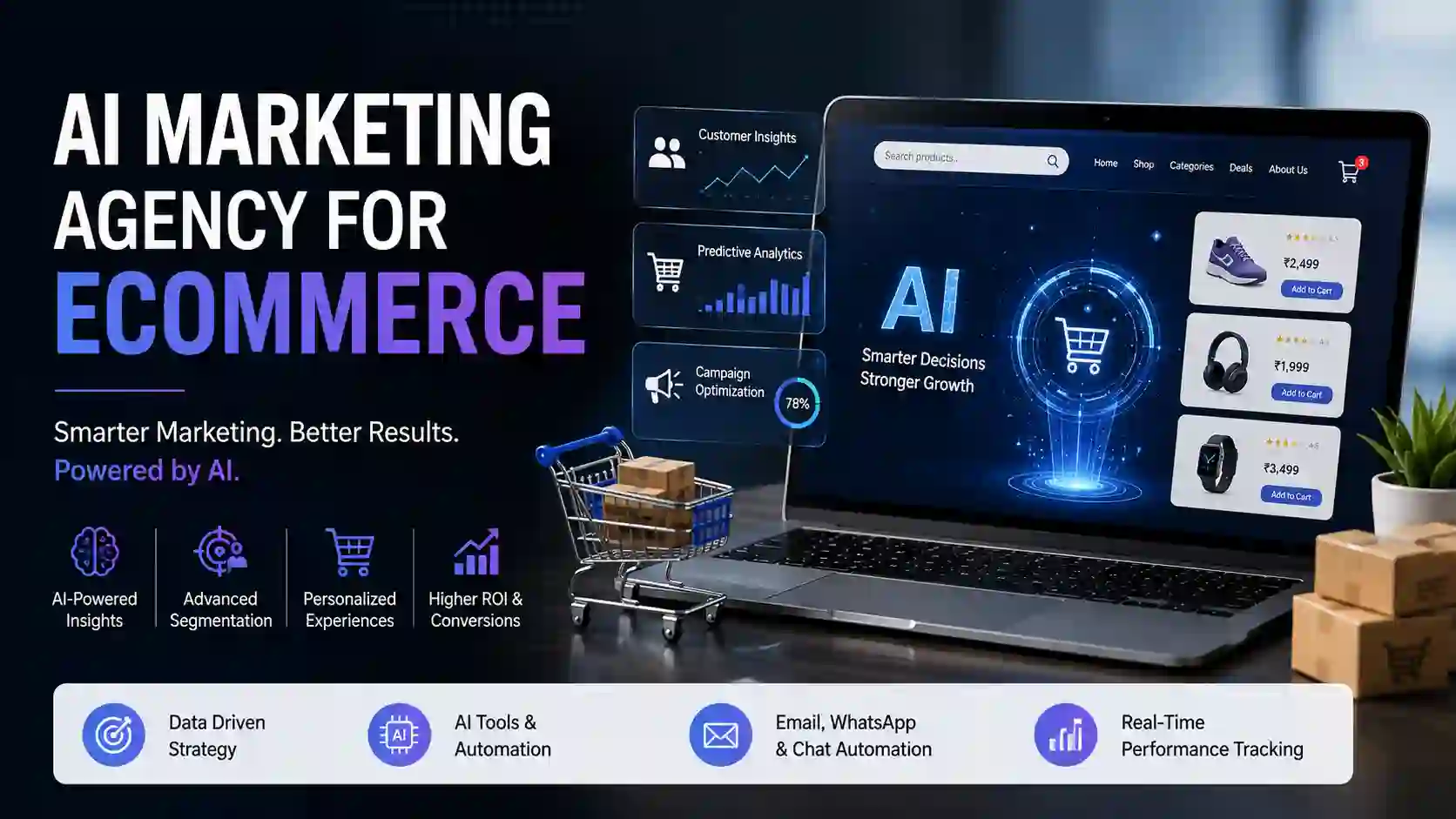
An AI marketing agency for ecommerce uses artificial intelligence, automation and customer data to help online businesses make marketing activities more responsive and manageable. The work can include advertising optimisation, customer segmentation, personalised communication, content production, SEO analysis, product recommendations and marketing automation.
But there is an important point here. AI is not simply a tool that writes product descriptions or generates images.
That understanding is too limited.
The real value of an AI marketing agency for ecommerce comes from connecting different parts of the marketing process. Customer behaviour creates data. That data can reveal patterns. AI tools can process some of those patterns faster than manual analysis. The marketing team can then use the information to adjust campaigns, content, offers or customer communication.
For example, an Indian skincare ecommerce brand may notice that a particular product performs well among first time visitors but repeat customers rarely purchase it again. The problem may not be the product itself. It could be that the business has no follow up campaign for customers who purchased the product. An AI based system can help identify such customer groups and trigger different communication based on their behaviour.
This is where an AI marketing agency for ecommerce moves beyond ordinary campaign management.
The agency may help create systems where marketing reacts to what customers actually do.
Some customers need a discount reminder. Some need product education. Some may respond better to a bundle offer. Others may already be ready to purchase and do not need another advertisement following them across the internet for ten days.
I have seen ecommerce businesses spend a surprising amount of money repeatedly advertising to customers who had already purchased. It is a small operational issue, but these things add up.
An AI marketing agency for ecommerce can help reduce such gaps by using customer data, automation and machine learning based tools more intelligently.
That does not mean every business needs complex AI infrastructure. A small Shopify store selling handmade products and a large ecommerce brand with thousands of daily orders have completely different requirements. The tools, automation and level of analysis should be different as well.
Sometimes a basic automated abandoned cart sequence is more useful than an expensive AI platform nobody in the team understands.
I strongly prefer practical implementation over adding AI tools simply because AI is currently popular.
An AI marketing agency for ecommerce should ideally understand both sides of the work. The technology side matters, but ecommerce behaviour matters just as much. A system can analyse customer data, but someone still has to understand why customers may be behaving in a particular way.
Data does not always explain frustration.
Why Traditional Ecommerce Marketing Is Becoming Harder to Scale
Traditional ecommerce marketing is not suddenly useless. SEO still works. Paid advertising still works. Email marketing still works. Good product pages still matter.
The problem is that managing all of these activities manually becomes difficult as an ecommerce business grows.
A brand selling twenty products may be able to manage campaigns manually. When the business starts selling hundreds of products across different categories, locations and customer groups, things begin to get messy. Different products have different margins. Some products are seasonal. Some attract new customers while others generate repeat purchases.
A standard marketing approach can start becoming inefficient.
An AI marketing agency for ecommerce can help businesses deal with this growing complexity by using automation and AI assisted analysis across different marketing activities.
Take paid advertising as an example.
An ecommerce marketing manager may have to monitor multiple campaigns across Google Ads, Meta Ads and other platforms. They need to compare creative performance, audiences, products, landing pages and conversion data. Doing this manually is possible, but it can become slow.
And sometimes the team is simply looking at too much information.
AI tools can help identify patterns and changes that may otherwise take longer to notice. For example, a particular product advertisement may be receiving plenty of clicks but generating fewer purchases. Another creative may have a higher cost per click but significantly better conversion rates.
The numbers need interpretation.
This is one reason an AI marketing agency for ecommerce cannot simply rely on automation. Automated systems can highlight changes, but the marketing decision still requires context.
Maybe the product is temporarily out of stock.
Maybe the landing page is slow.
Maybe the advertisement is attracting the wrong audience.
Maybe the offer expired and someone forgot to remove it from the creative. This happens more often than people think.
Scaling becomes harder because ecommerce customers are also less predictable than before. They move between devices, compare products across marketplaces, search on Google, watch product videos and check reviews before purchasing.
One customer journey can involve several platforms.
A person might see a product on Instagram in the morning, search for it on Google during lunch, visit the website later and finally purchase after receiving a WhatsApp message or email.
Traditional reporting often struggles to connect these interactions properly.
This is where an AI marketing agency for ecommerce may help bring different signals together and create a clearer understanding of the customer journey.
Still, I would not claim that AI can accurately explain every purchase decision. It cannot.
Human buying behaviour is not always logical. Someone may purchase a product simply because they liked the packaging. Another person may abandon a purchase because the delivery date looked inconvenient. Data may show the action but not always the emotion behind it.
This may not apply everywhere, and I might be wrong here, but many ecommerce businesses seem to overestimate how much a dashboard alone can explain their customers.
The difficulty of scaling marketing also comes from content requirements. Ecommerce brands need product images, advertisements, videos, social media content, email campaigns and landing page content on a continuous basis.
Creative fatigue is real.
An advertisement that performs well for three weeks may suddenly stop producing results. The team then needs new variations, new hooks, different product angles and fresh formats.
Producing this volume manually can become expensive and slow.
AI does not remove the need for creative thinking, but it can reduce repetitive work. An AI marketing agency for ecommerce can use AI tools to create and test multiple content variations while maintaining human review over messaging and brand communication.
That balance matters.
Because faster content is not automatically better content.
How AI Helps Ecommerce Brands Understand Customers and Buying Behaviour
Most ecommerce businesses collect more customer information than they actively use.
Website visits, product views, purchases, abandoned carts, email interactions, search behaviour and advertising engagement can all create useful signals. The challenge is understanding what those signals mean.
An AI marketing agency for ecommerce can help analyse customer behaviour at a larger scale and identify groups or patterns that may be difficult to spot manually.
For example, an online fashion brand may discover that customers purchasing formal shirts often return within two months to purchase accessories. Another group may purchase only during discount periods.
These customers should probably not receive identical marketing communication.
AI assisted segmentation can help businesses group customers based on their behaviour rather than relying only on basic categories such as age or location.
This can change how an ecommerce business approaches marketing.
Instead of sending one promotional email to the entire database, a business can create different communication for customers based on product interest, purchase history or recent website activity.
An AI marketing agency for ecommerce may help set up these customer segments and automate communication based on specific triggers.
Suppose someone repeatedly views protein supplements but does not purchase. Sending them a generic company newsletter may not be particularly useful. A product comparison, ingredient explanation or customer review may be more relevant.
The timing matters too.
Send the message three months later and the customer may have forgotten about the brand.
AI can also help identify customers who are likely to become inactive. A business may notice that regular customers have not returned within their usual purchase cycle. The system can flag such customers and trigger a relevant follow up campaign.
This is especially useful for products with predictable consumption cycles.
An Indian nutrition brand selling monthly supplement packs, for instance, may know that many customers need a refill after a certain period. Instead of waiting for the customer to remember, the brand can use automated communication to remind them.
Simple idea. Often poorly implemented.
Customer behaviour analysis can also help businesses understand product relationships.
People who purchase one product may frequently purchase another. AI systems can analyse these combinations and support product recommendation strategies.
This can improve average order value, although I should add that recommendations can become irritating when they are poorly matched.
We have all seen websites recommending something completely unrelated to what we were looking at.
A good AI marketing agency for ecommerce should not simply turn on recommendation tools and assume the work is complete. The recommendations need monitoring. Customer behaviour changes. Product inventories change. Seasonal demand changes.
There is also the issue of intent.
Someone viewing a product repeatedly may be interested in buying it. Or they may be comparing it with another brand. Or perhaps they are checking the product for someone else.
The data can suggest intent. It cannot always prove it.
That uncertainty is worth remembering.
Using AI for Product Discovery, Personalisation and Customer Journeys
Product discovery is one of the biggest challenges for ecommerce businesses with large catalogues.
Customers do not always know what they are looking for.
Someone visiting a skincare website may search for help with dry skin rather than the name of a specific product. A customer shopping for fitness supplements may be unsure whether they need protein, creatine or another product altogether.
Traditional website navigation can make this process difficult.
An AI marketing agency for ecommerce can help improve product discovery by using AI based search, recommendation systems and personalised website experiences.
For example, an ecommerce website can analyse browsing behaviour and show products related to previous interactions. A customer who frequently visits pages related to organic food may see relevant products earlier than someone browsing household items.
Personalisation can also continue beyond the website.
Email content, advertisements and product recommendations can be adjusted based on customer behaviour. A first time visitor should not necessarily receive the same communication as a customer who has purchased five times.
This sounds obvious, but many ecommerce brands still send identical campaigns to everyone.
An AI marketing agency for ecommerce can help build more responsive customer journeys where the communication changes based on behaviour.
A possible journey may look something like this. A customer visits a product page but leaves. Later, they receive educational content related to the product category. If they return and add the product to the cart, the communication changes. After purchase, they may receive usage information instead of another sales message.
The journey does not need to be complicated.
Actually, overcomplicating customer journeys is one of the mistakes I dislike most.
I have seen businesses create so many automation branches that nobody in the team knows which message a customer is receiving. Then two promotional messages go out on the same day, followed by a feedback request. The customer experience becomes confused.
AI should make personalisation easier to manage, not create a larger mess.
An AI marketing agency for ecommerce can also use conversational AI tools such as chatbots to support product discovery. A chatbot can help answer basic questions about products, delivery, ingredients or product suitability.
But chatbots have limitations.
Customers can become frustrated when the system keeps repeating the same answer or cannot understand a basic question. Human support still has a role, particularly when customers have specific concerns.
Personalisation works best when it feels useful rather than invasive.
There is a difference between showing a customer products related to their browsing history and making them feel constantly watched. Ecommerce brands need to be careful with this line.
A customer should feel understood, not followed around.
AI Powered Content and Creative Production for Ecommerce Marketing
Content production is often one of the most time consuming parts of ecommerce marketing.
A single product may need a product description, social media posts, advertisement copy, images, videos, email content, landing page content and different versions for different audiences.
Multiply this across a large catalogue and the workload becomes obvious.
An AI marketing agency for ecommerce can help reduce the time required for content production by using AI tools for research, copy development, creative variations and video production.
The important word is variations.
Ecommerce marketing teams often need multiple versions of the same idea. One advertisement may focus on price. Another may focus on product quality. A third may address a common customer concern.
AI tools can help generate initial versions quickly, allowing the marketing team to review, modify and test them.
However, I would be cautious about publishing AI generated content without human editing.
Generic content is still generic, regardless of how quickly it was produced.
For an ecommerce business, product content needs accuracy. A skincare product should not make unsupported claims. A nutritional supplement should not contain misleading information. Product specifications should be checked carefully.
This is where an AI marketing agency for ecommerce needs proper quality control.
AI can speed up the first draft, but somebody must verify the final version.
Creative production is also becoming more experimental. Ecommerce brands can now create multiple product video concepts, background variations and advertising formats without arranging a full production process every time.
This can be useful for testing.
For example, a D2C fashion brand can test different opening hooks for the same product video. One version may start with the product problem. Another may begin with a customer situation. A third may focus entirely on the visual appearance of the product.
The business can then study which creative direction attracts stronger engagement and conversions.
This does not mean every advertisement should be created by AI.
Some of the strongest ecommerce creatives still come from understanding a customer frustration properly. A founder explaining why a product was created can sometimes perform better than an extremely polished AI generated advertisement.
That is the mild contradiction here. AI can help brands produce more creative content, but more content can also create more noise.
The goal should not be to produce content endlessly.
It should be to learn what customers respond to.
An AI marketing agency for ecommerce can help connect creative production with performance analysis. Instead of treating content creation and advertising as separate activities, the agency can examine which messages, visuals and product angles are producing meaningful results.
That is where the process becomes more useful.
Sometimes a slightly imperfect product video converts better because it feels believable. Sometimes polished content performs better for premium products. There is no single rule that works across every ecommerce category.
And there is always one creative idea that makes sense in the meeting but looks completely strange once the campaign goes live.
It happens.
For StratMarketer, the role of an AI marketing agency for ecommerce is not simply about placing AI into every part of an ecommerce business. The more practical approach is to identify where AI can reduce repetitive work, support faster decisions, help understand customer behaviour and create better marketing experiences.
Some businesses need advanced automation.
Others simply need their existing marketing systems to stop working in isolation.
The difference matters.
How AI Supports Ecommerce SEO, Paid Advertising and Campaign Optimisation
For most ecommerce businesses, marketing does not fail because they have no tools. It fails because the tools are producing information faster than the team can understand it.
SEO platforms show keyword opportunities, ranking movements and technical issues. Advertising platforms show clicks, impressions, conversions and audience data. Analytics platforms show user behaviour. Email platforms show engagement. By the end of the month, there may be several reports, but the important question still remains: what should we actually change?
An AI marketing agency for ecommerce can help make this process more manageable.
In ecommerce SEO, AI can assist with analysing large product catalogues, identifying content gaps, clustering search intent and finding patterns across product categories. This can be particularly useful for websites with hundreds or thousands of product pages.
For example, an online home decor store may have separate pages for wall mirrors, decorative mirrors, bedroom mirrors and living room mirrors. If these pages are poorly differentiated, the business can end up with similar content competing against itself. AI assisted analysis can help identify overlapping themes and areas where category pages need clearer intent.
But there is a concern here.
AI can generate a large amount of SEO content very quickly. That does not mean publishing all of it is a sensible idea.
I have seen ecommerce websites where product descriptions appear to have been rewritten repeatedly using automated tools, and after reading three of them, you realise that almost nothing specific is being said about the actual product.
Search engines may understand more than before, but customers are not foolish either.
An AI marketing agency for ecommerce should use AI to support research and production while keeping product accuracy, customer questions and real business knowledge at the centre. For ecommerce SEO, useful content often comes from details that a generic tool cannot guess, such as product material, common usage issues, delivery concerns or comparisons customers repeatedly ask for.
AI can also help with internal linking opportunities and content prioritisation. A growing ecommerce website may have dozens of category pages and hundreds of products, but not every page deserves the same effort. Analysing traffic potential, conversion behaviour and existing page performance can help teams decide where to focus.
Paid advertising is another area where an AI marketing agency for ecommerce can support campaign decisions.
Advertising platforms themselves increasingly use machine learning for bidding, audience delivery and campaign optimisation. The agency’s role is changing because of this. It is no longer only about manually changing bids every few hours.
The more useful work often involves improving the inputs.
Creative quality matters. Product feeds matter. Conversion tracking matters. Landing pages matter. Audience signals matter. If the underlying information is poor, automation can make poor decisions faster.
That last part is important.
A fashion ecommerce brand, for example, may give an advertising platform hundreds of products without properly categorising them or understanding which products have healthy margins. The system may push sales towards products with low profitability simply because they convert easily.
Revenue increases. Profit does not necessarily follow.
An AI marketing agency for ecommerce should look beyond surface level conversion numbers and consider the actual commercial objective. Sometimes the best selling product is not the product a business should spend most of its advertising budget promoting.
Campaign optimisation can also benefit from AI assisted creative analysis. A business can study patterns across multiple advertisements and identify recurring characteristics in better performing creatives. Perhaps short videos work better for one audience. Perhaps product demonstrations perform better than founder led videos.
Even here, I would avoid treating patterns as permanent rules.
A creative that performs well today can lose effectiveness when customers see it too often. Campaign performance changes with competition, seasonality, offers and customer behaviour. Optimisation is not something that gets completed.
It keeps moving.
Email, WhatsApp, Chatbots and Automation for Better Customer Engagement
Most ecommerce brands understand the value of getting new customers. The difficult part is what happens after the first interaction.
A visitor may leave without purchasing. A customer may abandon a cart. Someone may buy once and never hear from the brand again. Another customer may be receiving promotional messages every week despite clearly showing no interest in those products.
This is where an AI marketing agency for ecommerce can help create more relevant communication through automation.
Email remains useful because it allows brands to communicate with customers without depending entirely on paid advertising platforms. AI can support customer segmentation, content variations, send time analysis and automated flows based on customer behaviour.
A customer who purchases a product may need product usage information. A person who abandons a cart may need a reminder. Someone who has not purchased for several months may need a different reason to return.
These are not identical situations.
WhatsApp has also become an important communication channel for Indian ecommerce businesses, particularly where customers are comfortable asking questions before purchasing. Automated WhatsApp communication can help with order updates, abandoned cart reminders, product information and repeat purchase campaigns.
However, frequency needs attention.
I have personally seen ecommerce brands turn WhatsApp into another advertising channel where customers receive message after message with discounts, offers and reminders. After a point, people simply mute the business.
An AI marketing agency for ecommerce should focus on relevance rather than message volume.
AI can help determine customer segments and trigger communication based on behaviour, but the business still needs to decide what is appropriate. A person who has just completed a purchase probably does not need a discount advertisement for the exact same product fifteen minutes later.
Chatbots can support customer engagement as well. They can answer common questions about products, delivery timelines, returns and basic order information.
For ecommerce websites with a high volume of similar customer questions, this can reduce pressure on support teams.
But there should always be an option for human support when required.
A customer with a complicated delivery issue or a complaint does not want to argue with a chatbot that keeps offering three unrelated options.
That experience can damage trust faster than a slow response.
An AI marketing agency for ecommerce can help businesses map common customer interactions and decide where automation is useful and where human involvement should remain.
The best automation often feels ordinary.
The customer gets the information they need at the right time and does not think about the technology behind it.
Common Problems Ecommerce Brands Face When Using AI in Marketing
The biggest problem is often not the AI tool itself.
It is the expectation.
Some ecommerce businesses purchase multiple AI platforms expecting immediate improvements in sales, efficiency and customer retention. Then the tools are connected to incomplete data, poorly organised product information and unclear marketing processes.
The results are disappointing.
An AI marketing agency for ecommerce should first understand the existing situation before introducing more technology. If conversion tracking is incorrect, customer data is fragmented or product information is inconsistent, AI cannot magically repair the entire marketing operation.
Poor inputs create poor outputs.
One common issue is using AI generated content without proper review. Product descriptions may contain incorrect specifications. Advertisement copy may make claims the business cannot support. Customer messages may sound completely unrelated to the brand.
This can create problems in categories such as healthcare, nutrition, skincare and financial products where communication needs greater care.
Another issue is excessive automation.
A customer may receive an email after browsing a product, a WhatsApp reminder after adding it to the cart, a retargeting advertisement later and another promotional message the next day. Technically, every automation may be functioning correctly.
The overall customer experience is still irritating.
I might be wrong here, but I think many teams judge automation based on whether it was successfully triggered instead of whether the customer actually needed it.
There is a difference.
Data quality is another major problem. Ecommerce businesses may have duplicate customer records, incomplete product information or disconnected systems. AI analysis based on poor information can produce misleading recommendations.
There are also privacy and consent considerations. Businesses need to be careful about how customer information is collected, stored and used. Personalisation should not cross into behaviour that makes customers uncomfortable.
An AI marketing agency for ecommerce should discuss these concerns instead of presenting AI as a solution for everything.
Some agencies also create unnecessary complexity. A simple ecommerce operation suddenly has multiple automation platforms, AI writing tools, analytics dashboards and integrations. Nobody is completely sure which tool is responsible for what.
Then one system stops working.
Everyone notices after two weeks.
The better approach is often simpler. Start with a real marketing problem. Identify where automation or AI can genuinely help. Test the process. Review the results. Expand only when the system is useful.
AI implementation does not need to become a technology project just because the business uses ecommerce.
Sometimes the problem is just a badly written product page.
What to Check Before Hiring an AI Marketing Agency for Ecommerce
Choosing an AI marketing agency for ecommerce should involve more than checking whether the agency mentions artificial intelligence on its website.
The first question should be practical: what exactly will they do differently?
An agency should be able to explain how AI will fit into your current marketing activities. If the answer is vague and focuses mainly on automated content generation, I would be cautious.
Ecommerce marketing involves several connected areas. Website conversion, product information, customer behaviour, advertising performance, SEO and retention all influence one another. An agency working in this space should understand those relationships.
It is worth asking about the agency’s approach to customer data as well. What information will be analysed? How will customer segments be created? Which marketing platforms will be connected?
You do not necessarily need a complicated technical explanation, but you should understand what is happening.
Another useful question is how the agency measures success.
An AI marketing agency for ecommerce may talk about traffic, clicks and engagement. These can be useful metrics, but an ecommerce business ultimately needs to understand how marketing affects revenue, profitability, customer acquisition and repeat purchases.
The exact priorities will differ between businesses.
A new D2C brand may initially focus on acquiring customers. An established ecommerce business may be more concerned about improving repeat purchases. A business with low margins may care more about advertising efficiency.
This is why I do not believe every ecommerce business needs the same AI marketing setup.
Ask how much human involvement remains in the process. This is particularly important for advertising, customer communication and content. AI generated output should not automatically reach customers without appropriate review.
You should also ask how easily you can understand the work.
An agency does not need to reveal every internal process, but reporting should make sense. If a client receives pages of technical terminology without any clear explanation of what changed and why, something is not right.
A good working relationship also depends on whether the agency understands the product category.
Selling furniture is different from selling supplements. Fashion has different buying behaviour from B2B ecommerce. A business selling premium products may require a completely different customer journey from a business competing primarily on price.
Experience matters here, although no agency can honestly claim to know every category perfectly.
One more thing deserves attention. Do not hire an AI marketing agency for ecommerce only because the business wants to use AI.
That is backwards.
First understand the marketing problems. Then decide whether AI is useful in solving them.
How StratMarketer Helps Ecommerce Businesses Use AI in Their Marketing
For ecommerce businesses, AI should fit into the marketing process in a way that makes practical sense. That is the approach StratMarketer can take when working with online brands.
As an AI marketing agency for ecommerce, StratMarketer can look at how different marketing activities are currently connected and identify areas where AI, automation and better data analysis may be useful.
This can involve ecommerce SEO, AI assisted content planning, paid advertising, creative testing, customer segmentation, marketing automation and customer communication.
The process should begin with understanding the business rather than selecting tools immediately.
What products are generating revenue? Where are customers dropping off? Which campaigns are producing sales but not profitable customers? Are repeat customers returning? Is the brand sending the right communication at the right stage?
These questions are often more useful than starting with, which AI tool should we use?
StratMarketer can support ecommerce businesses in creating marketing systems where different activities inform one another. SEO insights can support content decisions. Customer behaviour can influence email and WhatsApp communication. Advertising performance can help identify better creative directions.
An AI marketing agency for ecommerce can also help reduce repetitive manual work where automation is genuinely useful. But automation should not remove accountability.
Someone still needs to review the campaign.
Someone still needs to understand the customer.
And sometimes the numbers are wrong.
For StratMarketer, AI marketing for ecommerce should remain connected to the actual commercial reality of the business. A marketing activity may generate more traffic without generating better customers. An automated campaign may technically work but create a poor customer experience. A piece of AI generated content may save time but fail to communicate anything meaningful.
These things need to be checked.
The practical use of AI is not about replacing every existing process. It is about knowing where technology can help and where it simply adds another layer of work.
That distinction is probably going to become more important as ecommerce businesses adopt more AI tools. The brands that use technology thoughtfully may find it easier to manage growing marketing complexity.
The ones that collect tools without fixing the underlying problems may just end up with a more expensive dashboard.