


What an AI Content Marketing Agency Actually Does
When a business hears the term AI content marketing agency, the first thought is often simple: does this mean an agency is just using AI to write blogs faster?
Not really.
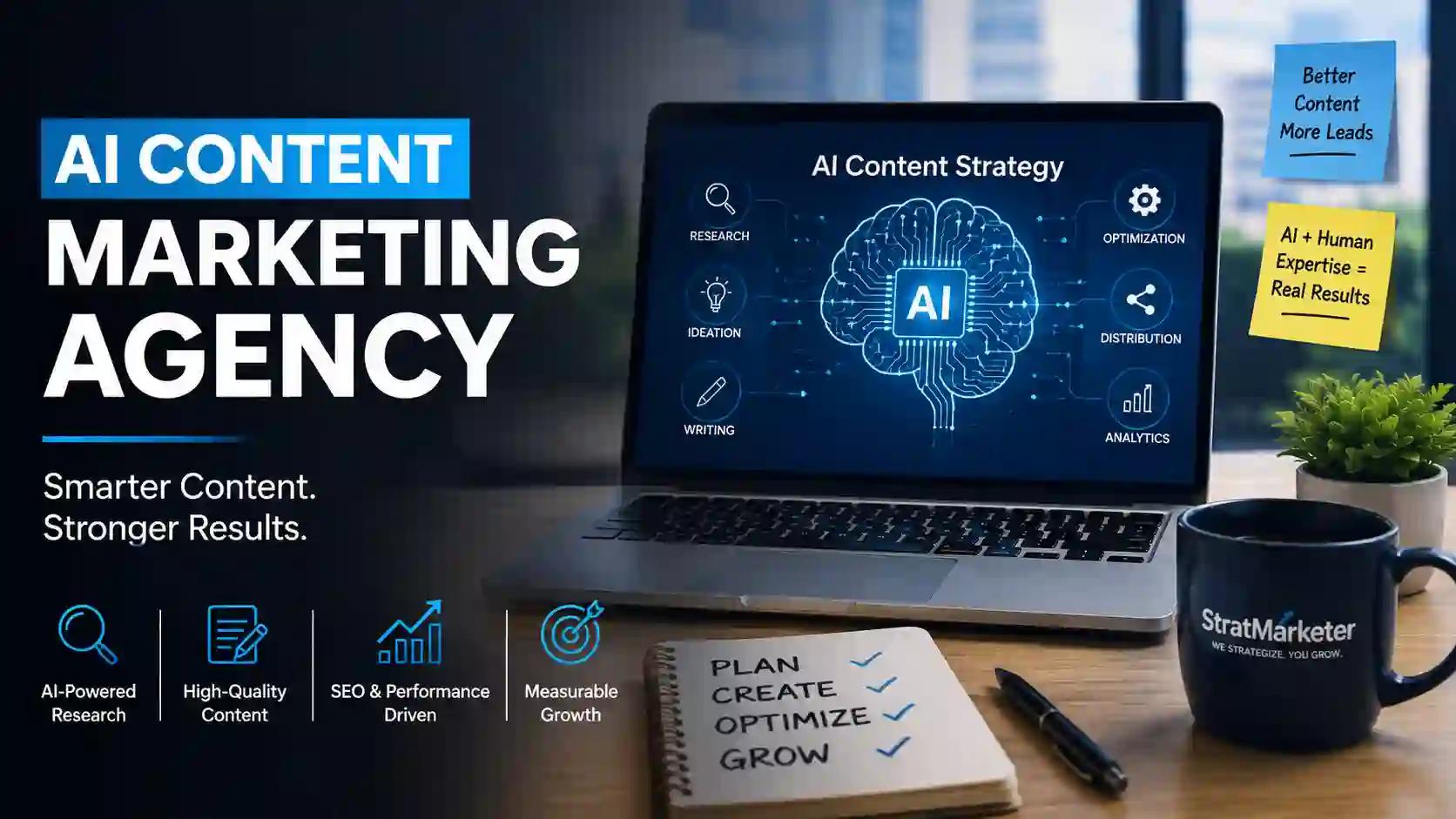
An AI content marketing agency works across research, content planning, search intent, writing, optimisation, distribution and performance analysis. AI can help with parts of this work, but the quality of the final content still depends heavily on the people deciding what should be written, who it is for, what information matters and what should be left out.
This distinction is important because many businesses have already experienced the other side of AI content. They publish dozens of articles, the grammar looks fine, keywords are present, and yet nothing meaningful happens. Traffic stays weak. Leads do not improve. Sometimes the content does not even answer the question properly.
That is where an experienced AI content marketing agency becomes useful.
For a company like StratMarketer, the role is not simply to produce more words. It is to use AI where it saves time and human judgement where the content needs actual understanding.
A good agency may use AI to analyse large amounts of search data, identify related topics, organise research, create initial content structures or examine existing pages. But someone still needs to question the output.
That questioning part is where much of the real work happens.
Suppose an Indian manufacturer wants content around industrial automation. An AI tool can quickly generate an article about automation systems. But it may not understand the difference between the information a plant manager wants and the information a student looking for a basic definition needs. It may also miss Indian purchasing concerns such as installation support, after sales service, supplier credibility and compatibility with existing machinery.
An AI content marketing agency has to account for those details.
I have seen businesses make the mistake of treating AI as a replacement for content expertise. They usually end up with content that sounds acceptable but says very little. That is frustrating because the problem is not always obvious when you first read it.
The better approach is to treat AI as part of the working process rather than the entire process.
Why Businesses Are Moving Towards AI Assisted Content Marketing
Content marketing has become harder to manage manually at scale.
A business may need service pages, blog articles, landing pages, comparison content, social posts, email material and supporting content for different stages of the buying process. If everything is researched and produced from scratch every time, the process becomes slow and expensive.
This is one reason businesses are working with an AI content marketing agency.
AI assisted workflows can reduce the time spent on repetitive research and production tasks. A content team can analyse thousands of search queries more quickly, group similar topics, identify missing subtopics and create initial research notes without spending hours doing everything manually.
But speed alone is not a strong reason to publish content.
There is a difference between producing content and producing useful content.
For example, a SaaS company targeting Indian businesses may want to rank for terms related to payroll software. AI can help identify related questions such as payroll compliance, employee attendance, salary processing and statutory deductions. The human team then needs to decide which subjects deserve individual pages, which belong together and which questions indicate genuine buying intent.
That decision cannot simply be handed over to a tool.
Another reason companies are adopting AI assisted content marketing is consistency. A growing business may have several products, multiple locations and different customer groups. Maintaining the same basic quality across hundreds of pieces of content can become difficult.
AI can help with repetitive checks and production support.
It can flag missing information, suggest related terms, summarise research material and help teams work through large content inventories. Human editors can then focus on accuracy, tone, originality and whether the content actually makes sense.
There is also a cost consideration.
Businesses are under pressure to justify marketing expenditure. They want content that contributes to organic traffic, enquiries and sales rather than simply increasing the number of published articles. An AI content marketing agency can potentially manage larger content programmes without increasing every production cost at the same rate.
Still, I would not say AI automatically makes content marketing cheaper. Poor AI content creates another cost because someone eventually has to rewrite it. We have seen this happen with websites that published large volumes of generic articles and later needed entire sections rewritten.
So the saving depends on how the technology is used.
How AI Content Marketing Agencies Plan Content Around Search Intent
Keyword research used to be treated almost like a list of words that needed to appear on a page.
That approach has become much less useful.
A person searching for “best accounting software for small business” is behaving differently from someone searching “what is accounting software”. The words may be related, but the expectation behind them is not the same.
An experienced AI content marketing agency looks beyond the keyword itself.
AI tools can help identify patterns in search queries, related questions, competitor topics and content gaps. But the final interpretation requires judgement.
Search intent can broadly indicate whether someone is trying to learn something, compare options, find a specific service or make a purchase. Real searches are messier than those categories suggest, though.
Take the keyword “third party nutraceutical manufacturer”. A person searching it may be looking for manufacturing capabilities, certifications, minimum order quantities, formulation support, product categories or a manufacturing partner. A generic definition of third party manufacturing will probably not satisfy that person.
This is where content planning becomes more practical.
A strong AI content marketing agency studies what the user is likely trying to accomplish after the search. What information would help them make the next decision? What questions are they likely to ask a supplier? What information would make them trust the company enough to make contact?
For an Indian audience, location can matter as well.
Someone searching for a “solar project finance consultant in Pune” is not necessarily looking for a general explanation of project finance. They may want to understand financing structures, documentation, lender expectations, project viability and whether the consultant has experience with similar projects.
Content should reflect that reality.
AI can make the research stage much quicker. It can compare search results, identify repeated themes and organise large keyword sets. It can also help identify questions that competitors have overlooked.
But there is a trap here.
If every agency uses the same AI tools and asks similar prompts, the research starts producing similar content ideas. That is why relying entirely on automated recommendations can make a website look like every other website in the industry.
Human experience adds the missing layer.
A person who understands the business can say, “Customers do not actually ask this question before buying. They ask this other thing.”
That small correction can completely change the article.
AI Content Creation Without Losing Human Expertise
This is probably the area where businesses have the most concern.
Can AI write content that feels human?
Sometimes.
Can AI consistently understand a complicated business, its customers, its market and its practical problems without human involvement?
I would be careful with that claim.
An AI content marketing agency should have a clear editorial process instead of treating generated text as finished content.
The first requirement is source quality. If the underlying information is weak, the final article will also be weak. This becomes particularly serious for industries such as finance, healthcare, pharmaceuticals, manufacturing and legal services where small factual errors can change the meaning.
Then comes interpretation.
AI may produce a technically correct paragraph that still feels wrong for the intended reader. It may explain a subject using terminology that professionals rarely use. It may over explain simple points while rushing through the part that actually influences a purchase decision.
Human editing catches these problems.
For instance, consider a content piece about business loans for manufacturing units. A generic AI article might discuss interest rates, collateral and repayment periods. A professional writer familiar with Indian businesses may also understand that promoters often worry about project cost assumptions, working capital requirements, debt service capacity and whether the financial projections will satisfy a lender.
That difference matters.
The best content often contains small practical observations rather than dramatic claims. A line about how a quotation from machinery suppliers can affect project cost calculations may be more useful than three paragraphs explaining what a business loan is.
This is also where first hand business information becomes valuable.
Client interviews, sales conversations, existing FAQs, product documents and feedback from customer facing teams can give the content something generic AI output cannot easily invent responsibly.
StratMarketer can use AI to process and organise this information, but the actual editorial judgement still matters.
I prefer that model.
I do not think every sentence needs to be rewritten manually just to prove that a human touched it. That would defeat the purpose of using AI. But important claims, examples, industry terminology and commercial messaging should receive human attention.
There is also the issue of tone.
Indian business audiences do not always respond well to content that sounds excessively polished. A manufacturing decision maker may prefer direct information about specifications, certifications, timelines and costs rather than a page filled with impressive sounding marketing language.
That is one reason AI content needs editing for context, not just grammar.
Sometimes a slightly plain sentence is better.
SEO, Content Distribution and Performance Tracking
Publishing an article is only one part of content marketing.
A useful AI content marketing agency also needs to understand what happens after publication.
SEO begins before an article is written because the topic, search intent, internal linking and page purpose all influence how useful the final page can become. After publication, performance needs to be monitored and interpreted.
AI can help here too.
Large content inventories are difficult to examine manually. AI assisted analysis can help identify pages with declining traffic, overlapping topics, missing internal links, weak content sections or keywords where the website has visibility but poor engagement.
But numbers need context.
A page receiving 10,000 visits is not automatically better than one receiving 1,000 visits. If the first page attracts broad informational traffic while the second brings qualified enquiries from people looking for a service, the second page may be far more valuable.
This is where businesses sometimes get stuck.
They celebrate traffic because it is easy to report. Then they wonder why enquiries have not increased.
An AI content marketing agency should look at the relationship between content and business intent. Rankings, organic traffic, engagement, enquiries, assisted conversions and lead quality can all provide useful signals, depending on the business model.
For a B2B company, the journey may be long. Someone might read a technical article today, return two weeks later through a service page and contact the company after speaking to their internal team. Giving all the credit to one page can be misleading.
Content distribution matters as well.
A strong article may support email campaigns, LinkedIn content, sales material, internal links, landing pages and other website resources. The same idea does not need to be copied everywhere. It can be adapted according to where the audience sees it.
AI can assist with repurposing, but again, context matters.
A technical article turned into a LinkedIn post should not simply be shortened. The useful point may need to be reframed around a practical business problem. An email might focus on one finding. A sales team might use another section during a client conversation.
That is where content starts behaving like part of marketing rather than a collection of blog posts.
There is still uncertainty in measurement, too. Search behaviour keeps changing, search results are increasingly dynamic, and AI generated answers are affecting how users discover information. A page can lose clicks even when its underlying visibility remains valuable because users may get part of the answer directly in the search experience.
I might be wrong here, because this does not apply everywhere and different industries are seeing different patterns. But businesses that judge content only through old style traffic reports may miss some of what is happening around their visibility.
The practical question is simpler.
Is the content helping the right people understand the problem, trust the business and take a useful next step?
If yes, the technology behind it becomes secondary.
And sometimes the best piece of content is still the one that took longer than expected because somebody stopped and said, “This sounds good, but our customers do not actually talk like this.”
That correction is worth a lot.
Common Problems Businesses Face with AI Generated Content
AI generated content has made content production much easier, but easier production does not always mean better content. This is where many businesses get disappointed.
A company may publish 30 or 40 articles in a few months and still see very little movement in organic enquiries. The pages may be grammatically correct, properly formatted and filled with relevant terms, yet they feel empty when someone who actually works in that industry reads them.
One common problem is repetition. AI systems learn from patterns, so if a subject has already been discussed thousands of times online, the first draft can easily sound like a combination of existing explanations. The wording may be different, but the thinking is often the same.
For a business website, that is not enough.
Another problem is factual confidence. AI can sometimes present an uncertain statement as if it were established fact. This becomes uncomfortable in areas such as finance, pharmaceuticals, healthcare, manufacturing and legal services. A writer may accept the sentence because it sounds professional, while a subject expert immediately notices that something is off.
There is also the issue of local context.
An article written for Indian businesses needs to understand Indian buying behaviour, business terminology and practical conditions. A generic explanation of project finance may completely miss the concerns of an Indian promoter dealing with lenders, project reports, working capital requirements and documentation.
I have seen another irritating issue quite often. Businesses ask for AI content because they want to reduce production time, then spend almost the same amount of time correcting the content afterwards. The problem was never AI itself. The workflow was poorly designed.
Over optimisation can cause trouble too. When a business becomes obsessed with inserting a keyword into every possible paragraph, the article starts sounding unnatural. Search engines are not the only audience. A real person has to read the page and decide whether the company knows what it is talking about.
AI generated content also tends to miss experience unless that experience is supplied to it.
A manufacturing company might know that customers frequently ask about minimum order quantities, packaging changes or sample approvals. A generic article may never mention these things because they are not obvious from broad online research.
That is why human input remains necessary.
How StratMarketer Uses AI Alongside Human Content Expertise
At StratMarketer, AI works best as part of the content process rather than as a replacement for writers, editors or subject understanding.
The technology can handle a lot of repetitive work. Research can be organised faster. Large keyword sets can be grouped. Existing pages can be reviewed for missing topics. Content briefs can be developed more efficiently. Drafting can also move faster when the underlying direction is already clear.
But there is a point where someone needs to stop looking at the tool and start looking at the reader.
That is where human expertise comes in.
Suppose a company wants content around industrial machinery. AI can identify hundreds of related searches and produce a reasonable structure. But a human writer familiar with B2B purchasing may know that buyers care about installation time, machine compatibility, maintenance support, spare parts and supplier reliability.
Those details can completely change the article.
StratMarketer can use AI to support research and production while keeping editorial decisions with people. Information supplied by the client can also be incorporated into the content so the final piece reflects the actual business instead of a generic version of the industry.
This matters particularly for businesses with complicated products.
A technical product cannot always be explained properly through publicly available information. Internal documents, sales questions, customer objections and product knowledge often contain the strongest content ideas.
AI helps organise that information. Human judgement decides what deserves attention.
I personally prefer this combination over fully automated publishing. It is not because AI cannot produce readable paragraphs. It can. The concern is that readable is a very low standard for business content.
A page should have a reason to exist.
It should answer something properly, remove confusion, explain a decision, or help a potential customer understand why one option may suit them better than another.
Sometimes the best improvement is surprisingly small. Replacing a vague paragraph with a specific example from the company’s actual customer experience can make the whole page feel more credible.
That is the kind of editing that cannot be reduced to grammar checking.
When Hiring an AI Content Marketing Agency Makes Sense
Not every business needs an AI content marketing agency.
If a company publishes two carefully researched articles every month and has an experienced internal writer who understands the industry, outsourcing may not make much sense. There is no point adding an agency simply because AI is involved.
The situation changes when content requirements start becoming difficult to manage internally.
A growing B2B company may need dozens of service pages, location pages, supporting blogs and comparison articles. At the same time, the internal marketing team may already be handling paid advertising, social media, sales support and website updates.
Content becomes the thing that keeps getting postponed.
This is one situation where an AI content marketing agency can help.
The other is when a business has content but lacks a clear search strategy. There may be hundreds of old blogs on the website, several pages competing for the same keywords and important services that have almost no supporting content.
Publishing more articles will not necessarily solve that problem.
The existing content needs to be examined first.
Businesses also benefit when they operate in specialised sectors. Finance, renewable energy, nutraceuticals, manufacturing, technology and professional services often require content that goes beyond basic definitions.
In these cases, the agency needs to understand the commercial context as well as SEO.
Another sign is inconsistency. If one article sounds professional, the next sounds machine generated and the third has outdated information, the website starts losing credibility.
That matters more than many businesses realise.
A potential customer may not consciously think, “This website has poor editorial consistency.” They may simply feel that the company does not seem particularly reliable.
There is one point where I disagree with the common idea that every company should immediately produce content at scale because AI makes it possible.
I would not do that.
If the topic selection is weak, scaling weak content only creates a larger maintenance problem. First figure out what deserves to be published. Then use AI to make the production process more manageable.
That order matters.
How to Choose the Right AI Content Marketing Agency in India
Choosing an AI content marketing agency in India should involve more than asking how many articles they can produce each month.
Ask what happens before writing starts.
A serious agency should be able to explain how it researches the business, understands the audience, identifies search intent and decides what content is worth producing. If the entire explanation is about AI tools and faster writing, I would be cautious.
The next thing to examine is editing.
Who checks the content after AI has been used? Is there a human editor? Does someone verify important claims? How are client supplied facts handled? What happens when the AI draft conflicts with information from the business?
These questions reveal a lot.
You should also look at actual samples rather than accepting claims about quality. Read several pieces from the same agency. Check whether they feel like they were written for real businesses or whether every article has the same rhythm and vocabulary.
Ask how they handle industry specific subjects.
For example, an agency working with a pharmaceutical manufacturer should understand that content requirements can be very different from those of a local restaurant or an ecommerce clothing store. The same content process cannot simply be copied across industries.
SEO reporting deserves attention as well.
An agency should not make ranking promises it cannot reasonably control. Search results change, competitors publish new material, algorithms change and user behaviour changes. Anyone guaranteeing a particular ranking position should make you uncomfortable.
I would also ask about content updates.
What happens to an article six months after publication? Does the agency check whether the information is still accurate? Are pages consolidated when they overlap? Are underperforming articles reviewed instead of simply forgotten?
This is where the difference between content production and content management becomes clear.
Cost matters, obviously, especially for Indian businesses comparing agencies. But the cheapest article is rarely the cheapest option if every piece needs to be rewritten internally.
Look at the amount of usable work you receive.
And do not be afraid to ask a simple question: who will actually be working on my account?
Sometimes the person selling the service and the person writing the content are completely different. That is normal to an extent, but you should know how communication and subject knowledge will be handled.
A good AI content marketing agency should make that process reasonably clear.
Frequently Asked Questions About AI Content Marketing Agencies
What is an AI content marketing agency?
An AI content marketing agency uses artificial intelligence tools as part of research, planning, writing, optimisation and content analysis. The better agencies still rely on human writers and editors for judgement, accuracy and industry context.
Is AI generated content good for SEO?
It can be, but AI use itself does not make content good for SEO. Search performance depends on usefulness, relevance, technical quality, originality, search intent and many other factors. Automatically publishing large quantities of generic content is not a reliable SEO strategy.
Does StratMarketer use AI to write every article?
AI can support different stages of the process, but it should not replace human judgement. Research, content development, editing and factual review still need appropriate human involvement, particularly for specialised subjects.
Can an AI content marketing agency write content for technical industries?
Yes, provided the agency understands the subject and receives reliable business information. Technical content often needs input from product teams, engineers, consultants or other subject experts. AI alone should not be expected to understand every technical detail correctly.
How does AI help with keyword research?
AI can process large keyword lists, identify related topics, group similar searches and help reveal content gaps. Human analysis is still needed to decide which keywords have genuine business value and what type of page should target them.
Will AI content sound robotic?
It can.
Poorly edited AI content often has predictable phrasing, repetitive explanations and an unnatural level of polish. Good editorial work removes that feeling by adding context, specific examples, varied language and genuine business information.
How long does it take to see results from content marketing?
There is no fixed period. Search competition, website authority, content quality, industry and publishing consistency all affect performance. Some pages can gain visibility relatively quickly, while others may take considerably longer.
Should a small Indian business hire an AI content marketing agency?
Not automatically. If the business has a clear content need, limited internal resources and enough commercial value in organic search, an agency may make sense. If there is little search demand or the business does not yet have its basic website and positioning sorted out, content may not be the first priority.
Can an agency guarantee Google rankings?
No credible agency can guarantee specific organic rankings. An agency can work towards better search performance, but rankings depend on many factors outside its direct control.
What should businesses provide to an AI content marketing agency?
Useful information includes product details, service information, customer questions, sales objections, technical documents, existing website material and details about the target audience. Even a one hour conversation with someone who knows the business well can provide information that broad online research will never capture.
And sometimes that one conversation changes the entire article. The writer realises the customer’s real problem was not what the keyword suggested, and the original content plan quietly gets thrown out. That is usually a good thing.
Content work can get messy like that, especially when the business itself is complicated. It is not always possible to know the best angle before talking to the people who deal with customers every day.