


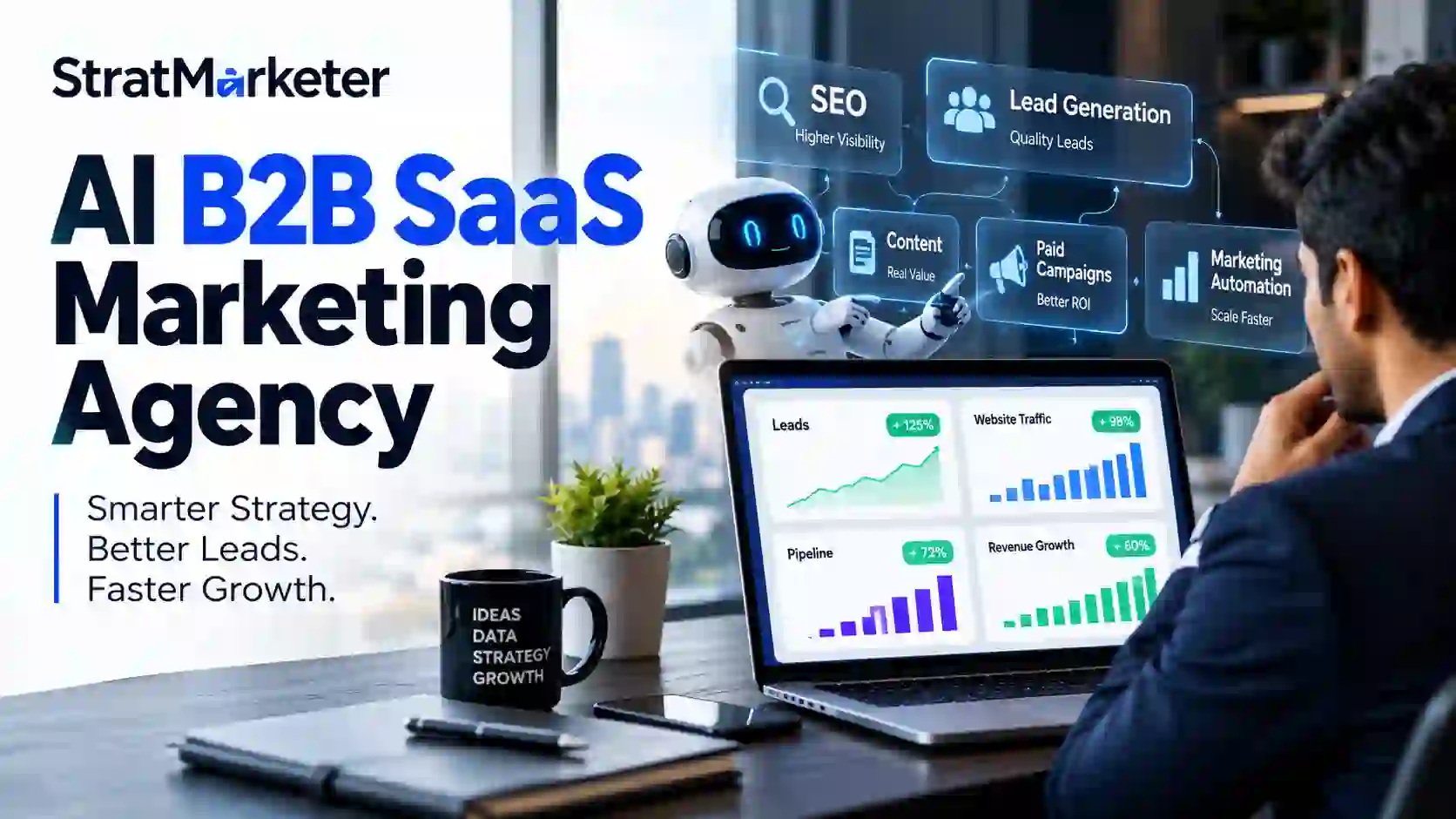
AI B2B SaaS Marketing Agency for Smarter Growth
1. Why B2B SaaS Marketing Is Changing With AI
B2B SaaS marketing has become harder in a way that is not always obvious from the outside. A software company can have a good product, a capable sales team, useful content and a reasonable advertising budget, yet still struggle to create a predictable flow of qualified opportunities. The problem is often not a lack of activity. There is simply too much of it.
A typical SaaS buyer may read several articles, compare competing products, watch product videos, check pricing, speak to colleagues, search on Google, ask an AI assistant for alternatives and only then contact a sales team. By that stage, the buyer may already have formed a fairly strong opinion about the product.
This is one reason businesses are looking at an AI B2B SaaS marketing agency differently today. AI is not simply being used to write blog posts faster. It is being used across research, audience analysis, content production, campaign management, customer segmentation, sales intelligence and marketing operations.
But there is an important distinction here.
Adding AI tools to an existing marketing process does not automatically make the process intelligent.
I have seen SaaS teams generate hundreds of pages with AI and still receive very little meaningful traffic. The pages were technically readable. They simply did not answer the questions that serious buyers were asking. That mistake can become expensive because the team starts believing that more content is the answer.
Usually, it is not.
The more useful role of AI is helping marketing teams understand patterns that are difficult to process manually. For example, a B2B SaaS company may have thousands of website visits, trial registrations, demo requests and customer interactions. Hidden inside that information could be a clear pattern showing that companies from one industry convert at a much higher rate, or that certain product features consistently appear before a sales conversation.
That information can influence messaging, landing pages, advertising and even sales follow-up.
There is another change taking place as well. Search itself is becoming less linear.
People still use Google, but they also use AI based search and conversational tools to investigate software categories, compare vendors and understand technical problems. This means SaaS companies cannot depend entirely on ranking for a handful of commercial keywords.
Their information needs to be useful enough to appear across different discovery environments.
That does not mean traditional SEO has become irrelevant. Far from it. Strong technical SEO, useful pages, internal linking, authoritative references and clear product information still matter. The difference is that the content needs to answer a broader set of real questions.
For a SaaS product selling workflow automation software, for instance, the buyer may not search only for “workflow automation software”. They might search for how to automate approval processes, how to reduce manual reporting, alternatives to a particular platform, integration problems, implementation costs or ways to measure automation ROI.
Those searches reveal intent.
AI can help identify and organise these patterns, but someone still needs to understand the business behind them.
That is where I think the human part of SaaS marketing remains important. A machine can identify that a particular phrase appears frequently in customer conversations. It cannot always understand why a CFO becomes uncomfortable when that phrase appears on a pricing page, or why a technical buyer keeps asking about deployment architecture before agreeing to a demo.
Those details come from actual conversations.
And B2B SaaS buying decisions are full of such details.
2. What an AI B2B SaaS Marketing Agency Actually Does
The phrase “AI B2B SaaS marketing agency” can sound broader than it really is.
At a practical level, the work is about connecting AI capabilities with the marketing problems faced by software companies.
That can include market research, competitor analysis, SEO, paid advertising, lead generation, email workflows, conversion optimisation, content development, CRM automation and performance analysis.
The tools are only one part.
Suppose a SaaS company wants more enterprise leads. A weak approach would be to simply increase advertising spend and use AI generated ad variations. A more useful approach would start by examining which companies already become customers, which roles influence the purchase, what objections appear during sales calls and where qualified prospects are dropping out.
Only then does AI become useful.
It can process large quantities of campaign data, identify recurring themes, group audiences, analyse content performance and help generate variations for testing.
The agency still needs to decide what should actually be tested.
This distinction matters because B2B SaaS is not like selling a low cost consumer product. The sales cycle can involve founders, marketing heads, IT teams, finance teams, procurement and senior management. One person may discover the product while another person approves the budget.
The messaging cannot be identical for everyone.
An AI B2B SaaS marketing agency may therefore build different content and campaign paths around different buying roles.
A CTO may want technical reliability, integrations, security and implementation details. A marketing head may care about productivity, attribution and campaign outcomes. A finance leader may focus on cost, utilisation and commercial justification.
One product.
Several reasons to buy.
AI can help organise this complexity, especially when there is enough customer and campaign data to work with. But the strategy should remain connected to actual business conversations.
I prefer this approach because it prevents what I call the “AI everywhere” problem.
Sometimes an agency uses AI because it can, rather than because the business needs it. A simple report that takes ten minutes to prepare does not need an elaborate AI workflow. On the other hand, analysing thousands of search queries, CRM records or campaign interactions manually can waste a huge amount of time.
The technology should fit the problem.
3. Where AI Fits Into the B2B SaaS Customer Journey
The B2B SaaS customer journey is rarely a straight line.
Someone may first encounter a product through a LinkedIn post, search for the company later, read two articles, visit the pricing page, leave, return through a branded search, download a report and finally request a demo several weeks later.
If marketing only measures the final conversion, much of the journey disappears.
AI can help connect these signals.
At the awareness stage, it can help identify topics and questions that potential customers are researching. This can inform SEO content, videos, reports and social content.
During consideration, AI can help analyse which pages prospects visit, what content they consume and what questions repeatedly appear in sales conversations.
Closer to purchase, automation can help with lead qualification, personalised email sequences, account research and sales alerts.
After the sale, the same information can support onboarding and retention marketing.
This is particularly relevant for SaaS companies because customer value does not end at the first transaction. Renewals, upgrades, additional users and expanded usage can have a significant effect on revenue.
One practical example is a SaaS company offering project management software to mid sized Indian businesses. The company may notice that customers who invite more than five team members during the first month are far more likely to continue using the platform.
That insight can change marketing and onboarding.
Instead of simply trying to acquire more signups, the company could create campaigns that explain team adoption, provide onboarding resources and encourage administrators to invite relevant users.
AI can help find the pattern.
The business still has to decide what to do with it.
That second part is often ignored.
4. Using AI for SaaS Lead Generation and Demand Creation
Lead generation is probably where SaaS companies feel the pressure most quickly.
The problem is that getting more leads is not necessarily the same as getting more business.
A company can generate thousands of form submissions through broad advertising and still have a sales team complaining that most enquiries are irrelevant.
This is where an AI B2B SaaS marketing agency can use automation and analysis to make lead generation more selective.
AI can analyse historical lead information and identify characteristics associated with stronger opportunities. These might include company size, industry, location, technology stack, job role, pages visited or previous engagement.
The exact signals differ from one SaaS company to another.
For example, a CRM software company selling to Indian manufacturers may find that a visitor from a manufacturing company with 100 or more employees, who visits integration pages and pricing information, is more commercially relevant than someone who reads ten general marketing articles.
That does not mean the first visitor will definitely become a customer.
It simply gives the marketing and sales teams a better signal.
AI can also help with account based marketing. Instead of treating every visitor as an isolated lead, businesses can identify target accounts and build content or outreach around specific industries and business problems.
Demand creation is slightly different.
Not every potential buyer is ready to book a demo today. Some are still trying to understand the problem.
A SaaS company selling cybersecurity software, for instance, may need to educate an operations manager about a risk before that person starts comparing vendors.
If marketing only targets “buy cybersecurity software” searches, it misses much of the earlier demand.
AI can help identify related questions and themes from search data, customer conversations, support tickets and market research.
This creates a larger content opportunity.
Still, I would be careful with automated personalisation. A message that says, “We noticed your company is expanding rapidly and thought our platform could help,” can feel impressive in a presentation and strangely invasive when received by a real person.
Personalisation should have a reason behind it.
Otherwise, it is just decoration.
5. AI Powered Content and Search for B2B SaaS Brands
Content remains one of the most important acquisition channels for SaaS companies, but the old approach of publishing a large number of keyword focused articles is becoming increasingly difficult to justify.
The issue is not that AI content cannot rank.
Some AI assisted content can perform perfectly well when it is based on strong research, genuine expertise and useful information. The bigger issue is that generic content has become extremely easy to produce.
If ten SaaS companies publish essentially the same article about “benefits of CRM software”, none of them has created much of a reason for the reader to trust one company over another.
An AI B2B SaaS marketing agency should therefore use AI to accelerate research and production without removing the company’s actual knowledge from the content.
That means pulling insights from product teams, sales calls, customer questions, implementation problems and support conversations.
Those details make content harder to copy.
Consider a SaaS company that provides inventory management software to Indian distributors. A generic article might explain inventory forecasting in broad terms.
A stronger article could discuss what happens when distributors maintain stock records in Excel while sales teams update inventory through WhatsApp, and how mismatched stock numbers affect purchasing decisions.
That is closer to the buyer’s reality.
It also gives search engines and AI systems more useful information to work with.
The same principle applies to product pages.
A product page should not simply contain a list of features. It should explain what the feature does, who needs it, what problem it addresses and where its limitations are.
This last part is surprisingly useful.
If a SaaS product does not support a particular integration, saying so clearly may prevent an unsuitable demo request. That sounds like losing a lead, but it can save sales time and create more trust with the people who remain.
AI can support this work by analysing search queries, grouping topics, finding content gaps and helping marketers produce variations.
But the final editorial judgement matters.
I have a particular concern with AI generated SaaS content that sounds technically perfect but has no evidence of having been written by anyone who has actually dealt with the problem. The sentences are polished. The examples are vague. Every paragraph seems correct, yet nothing sticks.
That type of content is easy to recognise once you have read enough of it.
Search is also expanding beyond traditional blue links. AI based search experiences increasingly provide direct answers, comparisons and summaries. SaaS companies therefore need information that can be understood clearly when extracted from a page.
Clear definitions help.
Specific product information helps.
Original research helps.
Real examples help.
Strong internal linking helps readers and machines understand the relationship between different topics.
But I might be wrong here if I make it sound like every SaaS company needs a huge content operation. This does not apply everywhere. A niche B2B product with a small addressable market may get more value from a handful of technically strong pages and focused outbound activity than from publishing fifty articles a month.
The economics matter.
A company selling specialised industrial software to a few hundred potential buyers in India should not copy the content model of a global productivity SaaS platform.
That distinction is often missed when AI makes content production cheap.
And cheap production can create its own problem. Teams start producing because production is easy.
Then the website fills up.
The traffic reports look busy.
The sales pipeline does not.
That gap is where thoughtful SaaS marketing work begins.
6. Turning Product Data Into Better Marketing Decisions
Most SaaS businesses already have more marketing information than they realise. The difficulty is that the useful information is usually scattered across different places.
Website analytics may show where visitors came from. The CRM may show which companies became opportunities. Product analytics may show which features customers use. Sales notes may contain objections that never appear in formal reports. Support tickets may reveal recurring problems. Email platforms hold another layer of information.
Individually, these datasets can look ordinary.
Put together, they can explain why some prospects move forward while others disappear.
An AI B2B SaaS marketing agency can help bring these signals together and identify patterns that would be difficult to spot manually. For example, a SaaS company might discover that visitors who read implementation content and then view integration documentation are more likely to request a demo than visitors who only read feature pages.
That changes the marketing conversation.
Instead of saying, “Our integration page gets traffic,” the team can ask, “Why do visitors who engage with integration content behave differently?”
That is a much more useful question.
Product data can also help marketing understand customer quality. A free trial is not necessarily a successful acquisition. If 1,000 people sign up but only 30 reach the activation point associated with long term retention, the headline signup number is hiding the real issue.
I have seen teams celebrate lower cost per lead while the sales team quietly complains about lead quality. Both reports can technically be correct. The problem is that they are measuring different things.
AI can help connect these datasets and surface relationships between acquisition sources, product behaviour and commercial outcomes.
For a B2B SaaS company, useful signals might include:
- Trial activation
- Number of active users
- Feature adoption
- Account size
- Demo attendance
- Sales qualified opportunities
- Expansion activity
- Renewal behaviour
- Customer support patterns
The interesting part comes when these signals are compared.
Suppose paid search produces fewer leads than another channel, but those leads have higher product activation and stronger conversion into paid accounts. Cutting paid search simply because the lead volume is lower could be a mistake.
This is where I prefer looking at the entire journey rather than one dashboard.
There is another practical benefit. Product data can influence content decisions.
If users repeatedly struggle with one feature, marketing and product teams can create clearer educational material around it. If prospects repeatedly ask about implementation time, the website should probably answer that question before the sales call.
Sometimes the best marketing content is hiding inside a sales team’s inbox.
That sounds obvious, but it gets missed surprisingly often.
An AI B2B SaaS marketing agency can use language analysis to identify recurring questions and objections from large volumes of conversations. The important part is not simply generating an article from those conversations. The useful work is recognising what those questions say about buyer expectations.
A repeated question about pricing may indicate a pricing problem.
Or it may simply mean the website does not explain the pricing model clearly.
Those are very different situations.
7. Common Mistakes Businesses Make With AI SaaS Marketing
The first mistake is assuming that AI itself is a marketing strategy.
It is not.
AI is a capability. The strategy still has to come from the market, the product, the customer and the commercial objective.
I have seen businesses purchase several AI tools and then spend more time managing the tools than understanding their customers. There is something slightly frustrating about that because the original reason for adopting AI was supposed to be saving time.
The second mistake is producing too much content.
AI makes content production easy. That is precisely why companies need more editorial discipline, not less.
A SaaS website with 500 weak articles is not automatically more authoritative than one with 60 genuinely useful pages. If the pages overlap, repeat the same information or target slightly different versions of the same search query, they may simply create clutter.
Another common problem is using AI without proper product knowledge.
A generic AI system can explain what a CRM does. It cannot automatically explain why a particular CRM works better for a sales team operating across Indian cities, dealing with distributors and maintaining several offline processes.
That knowledge has to come from the business.
There is also the issue of hallucinated information. AI systems can confidently produce incorrect product capabilities, technical specifications, integrations or market claims.
For SaaS companies, that can become a serious credibility problem.
Imagine publishing that your platform supports an integration that it does not actually support. A prospect discovers the mismatch during a sales call. The marketing team may consider it a small content error. The prospect may simply consider it a reason not to trust the company.
So factual review matters.
Another mistake is excessive personalisation.
Not every visitor needs a completely different message. Sometimes a clear page that answers the right question is better than a complicated personalisation system.
I would also be cautious about using AI to score leads without understanding the underlying data. If historical sales data contains bias, the AI model may reproduce it. A company might then prioritise leads based on patterns that happened to work in the past but do not represent future opportunities.
This is particularly relevant when markets change.
A new industry segment may look “low quality” simply because the company has not sold to it before.
There is one more issue that deserves attention.
Marketing teams sometimes optimise for what AI can measure easily rather than what the business actually needs.
Traffic is easy to count.
Leads are easy to count.
Content output is easy to count.
Revenue quality, sales cycle influence and customer retention require more work.
That imbalance can quietly distort the entire marketing programme.
8. How StratMarketer Approaches AI B2B SaaS Marketing
At StratMarketer, the practical starting point should be the SaaS business itself rather than the AI tools available in the market.
A software company selling accounting technology to Indian SMEs has different marketing requirements from a SaaS platform selling enterprise cybersecurity services to global companies. Treating both businesses with the same content calendar or campaign structure would make little sense.
The first thing worth understanding is the buying environment.
Who actually uses the product?
Who approves it?
What causes a prospect to start looking for a solution?
What alternatives are they considering?
What normally stops the purchase?
Where does the sales team spend time explaining the same thing repeatedly?
Those questions provide a better starting point than immediately asking which AI platform should be used.
From there, an AI B2B SaaS marketing agency can look at the different marketing layers.
Search may require technical SEO, product-led content, comparison pages, use case pages and topic clusters that reflect genuine buyer questions.
Paid advertising may require better audience segmentation, landing page testing and continuous analysis of search and conversion data.
Lead generation may require CRM automation, qualification rules and better account identification.
Email marketing may require behaviour based sequences rather than generic newsletters.
Content production can use AI for research support, first drafts, topic expansion and content analysis, while subject matter expertise remains with people who understand the product.
This balance matters.
StratMarketer can also use AI to analyse campaign patterns and identify where the funnel is weakening. For example, if a landing page generates a reasonable number of leads but very few sales qualified opportunities, the problem may not be advertising.
The problem could be the audience.
Or the offer.
Or the qualification process.
Or simply that the page attracts people who were never a good fit.
The answer should come from the evidence rather than from assumptions.
Another important area is content distribution. A useful SaaS article should not necessarily live only on the website. Parts of the insight can be adapted for LinkedIn, email, sales enablement material, short form video and other relevant channels.
But repurposing should not mean copying the same paragraph everywhere.
A technical explanation that works on a website may need a completely different treatment for a sales email.
This is where human judgement still matters.
I also think SaaS marketing agencies should be willing to tell clients when something is not worth doing. If a particular channel produces activity but no meaningful commercial value, continuing simply because it is part of the monthly plan is difficult to justify.
That is not always an easy conversation.
But it is usually a necessary one.
9. Measuring SaaS Marketing Beyond Leads and Traffic
A SaaS marketing dashboard can look excellent and still tell an incomplete story.
Traffic has increased.
Leads have increased.
Cost per lead has decreased.
The marketing report looks healthy.
Then the sales team asks a simple question: “How many of these companies are actually worth speaking to?”
That is where measurement needs to become more commercial.
For an AI B2B SaaS marketing agency, useful measurement can extend from the first interaction through revenue and retention.
At the acquisition level, businesses can monitor organic traffic, paid traffic, branded searches, conversion rates and content engagement.
But those numbers should eventually connect to pipeline.
A more useful sequence might look like this:
Visitor to lead.
Lead to qualified lead.
Qualified lead to opportunity.
Opportunity to customer.
Customer to retained account.
Retained account to expansion.
The exact stages depend on the SaaS model.
For a self serve SaaS product, activation and product usage may be more important than sales opportunities. For enterprise SaaS, sales qualified pipeline, average contract value, sales cycle and retention can carry more weight.
Marketing attribution also becomes complicated here.
A prospect may discover a company through organic search, read an article, see a LinkedIn post, attend a webinar and finally click a branded Google ad before requesting a demo.
Which channel gets credit?
There is no single answer that works for every business.
This is why I am cautious about declaring one channel the “best” based on last click data. Last click can be useful, but it often gives too much credit to the final interaction.
AI can help analyse multi touch journeys, but the output still depends on the quality of the underlying tracking.
If the CRM is poorly maintained, campaign naming is inconsistent and conversion events are missing, no sophisticated model can magically produce reliable attribution.
Garbage data remains garbage data.
For SaaS businesses, customer economics should also enter the discussion.
Customer acquisition cost is important, but it should be considered alongside customer lifetime value, gross retention, net revenue retention, payback period and expansion behaviour where those measures are relevant.
Marketing should not simply find cheaper leads.
It should help find commercially useful customers.
That distinction changes decisions.
A campaign that produces fewer enquiries but attracts larger accounts with stronger retention may deserve very different treatment from a campaign producing a high number of low value trials.
There is still room for simple numbers.
Sometimes a founder just wants to know whether the marketing is creating enough qualified opportunities this month. That is a fair question. Not every decision requires a complicated attribution model.
The trick is knowing when simple measurement is enough and when it starts hiding something important.
10. Frequently Asked Questions About AI B2B SaaS Marketing Agency
What does an AI B2B SaaS marketing agency do?
An AI B2B SaaS marketing agency combines SaaS marketing expertise with AI based tools and automation. Its work can include SEO, content, paid advertising, lead generation, CRM workflows, customer segmentation, campaign analysis and conversion optimisation.
The actual mix depends on the SaaS product and its sales model.
Is AI useful for B2B SaaS SEO?
Yes, when used properly. AI can help with keyword research, topic analysis, content gaps, search intent analysis and content development. But it should not replace product expertise or editorial review.
Generic AI content is unlikely to give a SaaS brand much distinction.
Can AI generate B2B SaaS leads automatically?
AI can support lead generation through audience analysis, lead scoring, personalisation, automation and campaign optimisation. It cannot guarantee qualified leads simply because AI is involved.
The quality of the offer, market, positioning and targeting still matters.
How does AI help with SaaS content marketing?
It can analyse large amounts of search and customer data, identify recurring questions, assist with research and help marketers create different content formats more efficiently.
The strongest content still needs genuine product knowledge and useful examples.
Should a SaaS company use AI for every marketing activity?
No.
Some tasks are better handled with simple processes. AI makes the most sense where there is a large amount of information, repetitive work or a clear opportunity to identify patterns that humans may miss.
Can AI replace SaaS marketing professionals?
I would not look at it that way. AI can automate parts of research, production and analysis, but positioning, judgement, customer understanding and commercial decision making still require human involvement.
The role of the marketing professional may change considerably, though.
How long does AI B2B SaaS marketing take to show results?
There is no universal timeline. SEO may take months to develop meaningful visibility, while paid campaigns can generate data much faster. Enterprise SaaS sales cycles can also be long, so marketing influence may take time to appear in revenue numbers.
Anyone promising a fixed result within a fixed number of days without understanding the product, market and baseline data is making the conversation too simple.
Is AI B2B SaaS marketing suitable for Indian SaaS companies?
Yes, but the approach needs to reflect the market being served. An Indian SaaS company targeting domestic SMEs may need different messaging, pricing communication and acquisition channels from an Indian SaaS company selling enterprise software to North American customers.
The geography of the buyer matters more than the location of the marketing agency.
What should a SaaS company check before hiring an AI B2B SaaS marketing agency?
Look at how the agency understands your product, market, sales process and existing data. Ask what it plans to measure and how marketing activity will connect to qualified pipeline. I would also ask what happens when the data contradicts the original strategy.
Our Services
Contact Us
- Paonta Sahib, Himachal Pradesh, India
- +91-8700998508
- support@stratmarketer.com
Start From Here
These two options make it easy for you to get the information you want.