


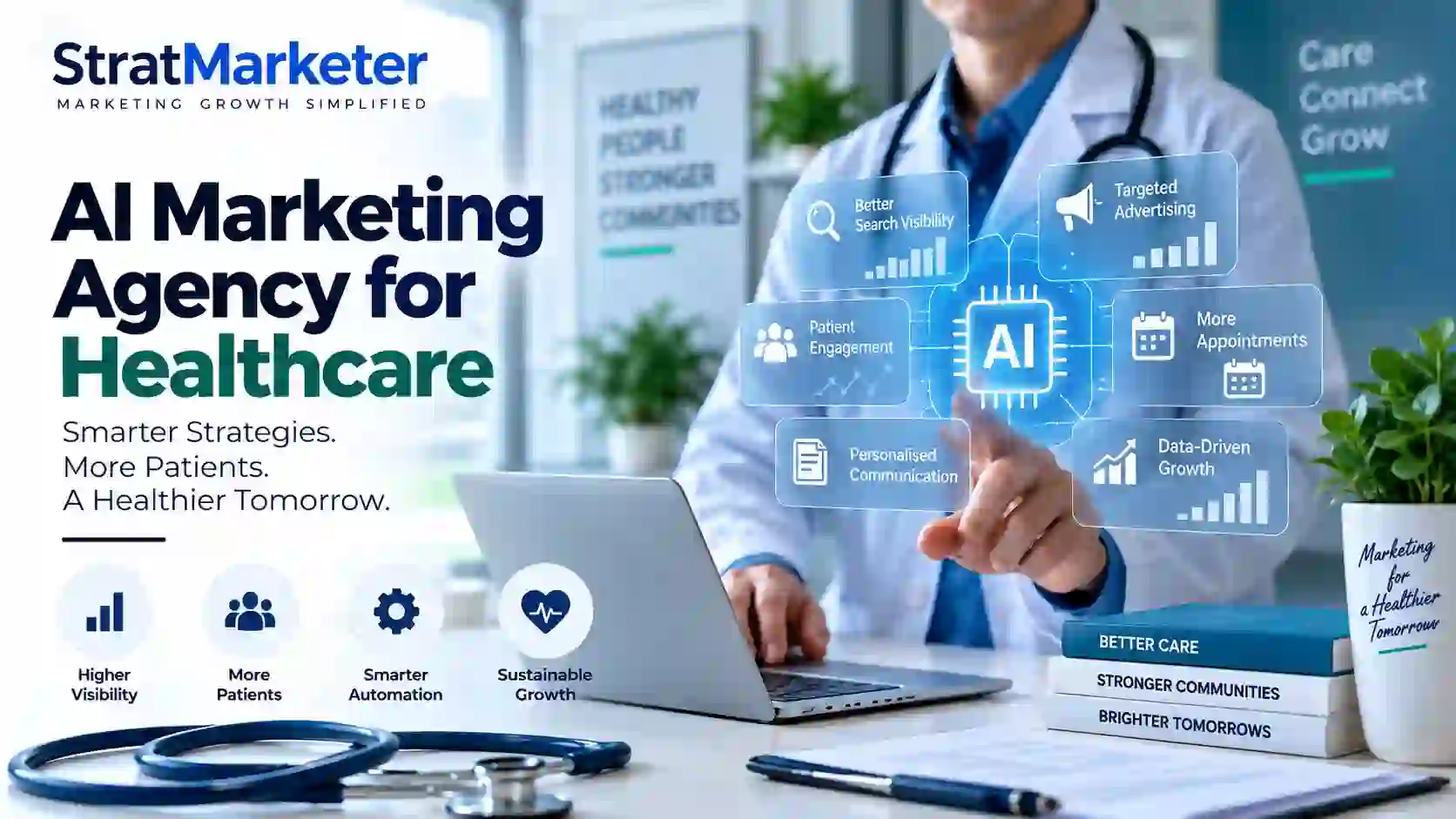
AI Marketing Agency for Healthcare: Smarter Patient Growth with StratMarketer
What Does an AI Marketing Agency for Healthcare Actually Do?
Healthcare marketing has become more complicated than simply creating a website, posting on social media, and running a few Google Ads campaigns. Patients now search symptoms, treatments, doctors, hospitals, reviews, costs, and nearby options across Google, YouTube, social platforms, AI search tools, and healthcare directories before making a decision. For many healthcare businesses, understanding what is actually bringing patients and enquiries has become difficult.
This is where an AI marketing agency for healthcare can play a practical role.
An AI marketing agency for healthcare uses artificial intelligence along with conventional digital marketing activities to analyse patient behaviour, identify marketing opportunities, automate repetitive processes, improve campaign decisions, and create more relevant communication. The purpose is not to replace doctors, healthcare staff, or human marketing teams. AI is simply being used to process information and patterns that would otherwise take considerable time to analyse manually.
For example, a multi-speciality clinic may receive enquiries from Google Ads, organic search, WhatsApp, website forms, and social media. The problem is not always generating more enquiries. Sometimes the clinic does not know which campaigns are bringing serious patients and which ones are generating low-quality leads.
An experienced AI marketing agency for healthcare can help analyse this journey.
AI can support campaign optimisation, keyword research, content planning, lead qualification workflows, patient communication, advertising analysis, and conversion tracking. But healthcare requires more care than ordinary industries. A marketing campaign for a restaurant can experiment freely with creative language. Healthcare communication cannot always work that way.
Claims need attention. Patient information needs protection. Medical content requires review.
That difference matters.
In my view, one of the biggest misunderstandings around AI marketing is that businesses assume AI automatically makes marketing intelligent. It does not. A badly configured campaign can still make bad decisions faster.
A healthcare marketing agency using AI should first understand the organisation. Is it a hospital trying to increase appointments for a specific department? Is it a dental clinic competing locally? Is it a diagnostic centre trying to increase test bookings? Is it a healthcare technology company selling to hospitals?
The marketing approach changes significantly.
For instance, a dermatologist in Delhi may benefit from local SEO, paid search campaigns, reputation management, and appointment-focused landing pages. A healthcare SaaS company, on the other hand, may need B2B content, LinkedIn marketing, lead nurturing, and longer sales funnels.
Both are healthcare businesses. Their marketing problems are not remotely the same.
An AI marketing agency for healthcare should therefore use AI as part of the decision-making process rather than treating it as a product that can be added to every activity. AI can identify patterns, but people still need to understand the context behind those patterns.
Sometimes the context is everything.
Why Healthcare Businesses Are Looking Beyond Traditional Digital Marketing
Traditional digital marketing still works. SEO works. Google Ads works. Content marketing works. Social media can work.
The issue is that healthcare businesses are dealing with more data, more competition, and more fragmented patient journeys than before.
A patient searching for a knee replacement specialist may not book an appointment immediately. They may first search for symptoms, watch videos, compare hospitals, check reviews, ask family members, search the doctor’s name, and return to the website several days later.
Traditional reporting may show only the final conversion.
It does not always explain what happened before it.
This is one reason healthcare organisations are becoming interested in working with an AI marketing agency for healthcare. AI tools can help marketing teams analyse larger volumes of information and identify patterns across campaigns and user behaviour.
For example, an organisation may notice that one blog receives thousands of visitors but produces very few appointments. Another article with much lower traffic may bring visitors who frequently submit consultation forms.
A human marketer can identify this eventually. AI-assisted analysis may help identify such patterns faster, particularly when the business is managing hundreds of pages and multiple marketing channels.
Healthcare businesses are also facing rising advertising costs. Simply increasing the budget does not always produce better results.
I have seen this problem in businesses where the management believes the marketing team needs to generate more leads, while the real issue is that enquiries are not being followed up properly. Leads sit for several hours. Calls are missed. Website forms receive delayed responses.
Then the business spends more money on advertising.
That can be frustrating because the problem was not actually marketing.
AI-powered automation can sometimes help by routing enquiries, sending appropriate follow-up communication, categorising leads, and alerting teams when action is required. But again, healthcare communication needs careful planning. An automated message should not create unrealistic expectations or provide medical advice where a qualified professional is required.
This is where an AI marketing agency for healthcare needs industry understanding rather than just technical knowledge.
Healthcare is also changing because patients increasingly expect quicker responses. They want information about appointment availability, services, locations, doctors, and basic processes without waiting for a phone call during working hours.
Automation can help here.
But there is a line.
A chatbot can explain how to book an appointment. It should not casually diagnose someone based on a few messages.
The difference sounds obvious, but it can become blurry when businesses rush into AI adoption.
Healthcare marketing is not just about generating traffic anymore. Businesses want to understand why some visitors become patients, why some campaigns fail, and where money is being wasted.
AI can help answer parts of those questions.
Not all of them.
How AI Is Changing Patient Acquisition and Healthcare Marketing Decisions
Patient acquisition has traditionally been discussed in fairly simple terms. Run advertisements, improve search rankings, generate enquiries, convert those enquiries into appointments.
The actual journey is rarely that clean.
People make healthcare decisions differently depending on urgency, location, trust, income, age, family influence, and the seriousness of the medical concern. Someone searching for emergency care behaves differently from someone researching cosmetic dental treatment for three months.
This is where AI-assisted marketing analysis can be useful.
An AI marketing agency for healthcare may use AI tools to analyse campaign performance across larger datasets and identify which combinations of channels, keywords, content, and user behaviour are more likely to contribute to meaningful enquiries.
Consider a hospital running campaigns for several departments. Orthopaedics, cardiology, fertility treatment, paediatrics, and general health check-ups may all have completely different patient journeys.
Treating every department with the same marketing strategy usually creates problems.
AI can assist with segmentation and pattern analysis. Marketing teams can examine which content attracts particular audiences, which advertisements generate qualified enquiries, and where potential patients are leaving the journey.
For example, a healthcare website may receive strong traffic from mobile users but experience poor form completion rates. The first assumption may be that advertising is weak.
But after looking deeper, the issue might be a long appointment form that is difficult to complete on a mobile phone.
It happens more often than people think.
AI can help surface such behavioural patterns, although the final solution still requires human judgement. This is one reason I am slightly cautious about businesses that describe AI as an automatic decision-maker. Data can suggest a problem. It does not always understand why the problem exists.
AI can also support predictive analysis in some marketing situations. For example, historical campaign data may help identify patterns associated with higher-quality enquiries.
However, I might be wrong here for smaller healthcare businesses because prediction models become less useful when there is limited or inconsistent data. A small clinic with irregular enquiry volume may not have enough reliable historical information to justify complicated AI systems.
Sometimes a good spreadsheet and an attentive marketing manager are enough.
The value of an AI marketing agency for healthcare depends partly on knowing when not to overcomplicate things.
AI can also make testing more efficient. Advertising campaigns often involve multiple headlines, landing pages, audience segments, and creative formats. Testing everything manually can become time-consuming.
AI tools can help marketers identify underperforming combinations and suggest areas that deserve further testing. But medical advertising should not be treated like ordinary ecommerce advertising. A campaign selling shoes can aggressively test urgency and promotional language. Healthcare requires greater responsibility.
That should not be forgotten because the technology looks impressive.
AI Marketing for Hospitals, Clinics, Doctors and Healthcare Brands
Healthcare is a broad category, and marketing requirements differ considerably between organisations. A single approach from an AI marketing agency for healthcare cannot realistically work for every type of healthcare business.
Hospitals usually deal with multiple departments, larger websites, complex patient journeys, and reputation management challenges. Their marketing may involve service pages, doctor profiles, local search visibility, health awareness content, paid campaigns, and ongoing brand communication.
AI can help analyse large volumes of website and campaign information.
For example, a hospital with hundreds of service pages may use AI-assisted processes to identify duplicate content issues, search trends, content gaps, and declining organic performance. Human SEO specialists still need to review the recommendations because healthcare content cannot simply be generated and published without checking accuracy.
That is something I strongly prefer.
Medical content should have professional oversight.
Clinics often have a different problem. They may compete within a limited geographical area and need to attract patients from specific cities or localities. A dental clinic in Chandigarh, for instance, may care more about appearing for relevant local searches than receiving visitors from across India.
An AI marketing agency for healthcare can support local keyword analysis, review monitoring, campaign optimisation, and patient enquiry workflows.
Doctors also need a different approach.
Personal branding can help doctors build visibility, but healthcare marketing should avoid becoming overly promotional. Educational content, expert commentary, treatment information, and patient-focused explanations can create greater trust than exaggerated claims.
A doctor does not necessarily need millions of followers.
They need the right audience to trust them.
Healthcare brands, including diagnostic companies, wellness platforms, healthcare technology businesses, and medical service providers, may use AI differently. They may need broader content strategies, B2B lead generation, email automation, paid campaigns, and audience segmentation.
The common factor is that an AI marketing agency for healthcare should understand the actual business model before recommending tools.
This sounds basic, but businesses often start from the opposite direction. They first decide they want AI and then look for somewhere to use it.
I do not think that approach works particularly well.
A better question is simple: what is currently difficult, repetitive, slow, or unclear in the marketing process?
If AI can genuinely help, use it.
If not, there is no reason to force it.
A hospital may need AI-assisted reporting. A clinic may need automated lead follow-up. A healthcare technology company may need AI-supported content research.
The technology should follow the problem.
Where AI Can Help With Healthcare SEO, Content and Search Visibility
Search behaviour is becoming more complex. Healthcare users do not only search short keywords such as “best cardiologist” or “dental clinic.” They ask detailed questions, compare options, and increasingly use conversational search queries.
This creates both an opportunity and a problem.
Healthcare businesses need more useful content, but publishing a large number of AI-generated articles without professional review can damage trust. Medical information is particularly sensitive because inaccurate content can influence real decisions.
An experienced AI marketing agency for healthcare can use AI to support research and production processes without handing complete editorial control to a machine.
For SEO, AI can assist with analysing search intent, identifying related questions, finding content gaps, reviewing website structure, and monitoring performance changes. It can also help marketing teams process large datasets faster.
But the final content still needs context.
Suppose people are searching for information about diabetes management. A generic AI-generated article may technically answer common questions, but it may miss the concerns that Indian patients actually have, such as affordability, diet habits, family eating patterns, and difficulty maintaining treatment routines.
Local context changes content.
The same applies to hospitals and clinics trying to improve local search visibility. AI can identify keyword patterns and analyse competitors, but a healthcare business still needs accurate location information, service pages, reviews, and a properly maintained online presence.
There is no shortcut around the basics.
An AI marketing agency for healthcare can also help create content systems rather than relying entirely on individual blog posts. For example, a healthcare organisation may identify recurring questions received by reception staff and convert appropriate non-diagnostic questions into educational website content.
That can be useful because the topics come from real patient behaviour.
A clinic might repeatedly receive questions about how to prepare for a diagnostic test, what documents are needed, how long reports usually take, or how appointments work. These are not glamorous marketing topics, but they can reduce confusion and make the website more useful.
Sometimes boring content performs surprisingly well.
AI can help organise and analyse these questions at scale.
Healthcare content should also consider the growing importance of answer-focused search experiences. Users increasingly expect direct, clear information rather than long pages filled with repeated keywords.
Still, I would not assume that AI search will completely replace traditional search anytime soon. That may happen differently across audiences, regions, and age groups.
This may not apply everywhere.
Many patients still search in familiar ways, particularly when looking for a local doctor or hospital. They may use Google Maps, recommendations from relatives, and direct searches rather than AI tools.
So an AI marketing agency for healthcare should not abandon conventional SEO in pursuit of new technology. The more sensible approach is to build useful content and technically sound websites that can remain understandable across different search environments.
At the end of it, healthcare marketing is still about trust. AI can process patterns and automate certain tasks, but it cannot replace the discomfort a patient feels when they are uncertain about where to go, whom to trust, or whether the information they are reading is reliable.
And honestly, that part should probably remain human.
Using AI for Paid Advertising and Patient Lead Generation
Paid advertising in healthcare can become expensive very quickly. A hospital may run campaigns for multiple specialities, a clinic may compete with several established providers in the same city, and some healthcare keywords naturally attract high advertising competition. Spending more money does not automatically solve the problem.
This is where an AI marketing agency for healthcare can help make campaign management more practical.
AI can analyse advertising performance across keywords, audiences, devices, locations, landing pages, and other campaign variables. Instead of manually reviewing large amounts of campaign data, marketers can use AI-assisted tools to identify patterns that may require attention.
For example, a healthcare business may discover that one campaign generates a high number of form submissions but very few actual appointments. Another campaign may produce fewer enquiries but a much higher appointment conversion rate.
Looking only at the number of leads can be misleading.
An AI marketing agency for healthcare should therefore focus on lead quality, not simply lead volume. This becomes particularly important for hospitals and clinics where the marketing team and front-desk team often measure success differently.
The marketing team may celebrate 500 enquiries.
The clinic may say only 80 people actually visited.
Both observations can be correct.
AI can support better campaign analysis by connecting advertising activity with later stages of the patient journey where appropriate data and tracking systems are available. It can help identify repeated patterns, such as particular search terms producing irrelevant enquiries or certain campaign combinations producing stronger appointment intent.
But there is an important limitation. AI only works with the information it receives.
If appointment outcomes are not properly recorded, lead sources are inconsistent, or campaign tracking is incomplete, even advanced AI analysis can produce unreliable conclusions. I have seen businesses blame advertising when their internal data was simply messy.
That irritation is understandable. Companies spend money on tools and then discover that nobody has consistently updated the basic lead information.
For patient lead generation, AI can also support faster enquiry handling. Automated systems may categorise incoming leads, route them to the appropriate team, and trigger basic follow-up communication.
A fertility clinic, for example, may receive enquiries about consultations, treatment information, appointment availability, and general questions. These enquiries may need different responses and different levels of human involvement.
Automation can organise the first step.
It should not replace the actual conversation when the situation requires empathy or professional medical guidance.
Paid advertising also benefits from ongoing testing. AI can help marketing teams review different ad variations and identify patterns in performance. However, healthcare advertisements require additional caution because language that performs well commercially may not always be appropriate for medical communication.
I am not particularly comfortable with healthcare campaigns that create unnecessary fear just to increase clicks.
A strong AI marketing agency for healthcare should understand this distinction.
Personalisation, Automation and the Patient Journey in Healthcare Marketing
Personalisation is often discussed as though every patient wants a completely customised digital experience.
That is not necessarily true.
Sometimes people simply want relevant information and a quick response.
An AI marketing agency for healthcare can help healthcare organisations use data and automation to make communication more relevant without making interactions feel intrusive. This may include sending appropriate appointment reminders, providing relevant service information, responding to common administrative queries, or routing patients to the right department.
The patient journey can begin long before an appointment.
Someone may first visit a healthcare website through an educational article. Another person may click a Google Ad because they are actively looking for treatment. A third person may receive a referral and search the hospital name to check reviews and doctors.
These journeys cannot always be treated in the same way.
AI can help analyse behaviour patterns and group audiences based on relevant marketing signals. This can allow businesses to create different communication paths instead of sending the same message to everyone.
For example, someone who has already requested an appointment may need a simple confirmation and reminder. Someone reading general healthcare content may only need access to more relevant educational information.
The difference sounds small, but it affects how communication feels.
Automation can also reduce delays inside healthcare businesses. If a website enquiry arrives outside working hours, an automated acknowledgement can confirm that the request has been received. The patient does not have to wonder whether the form disappeared somewhere.
Small things matter.
However, personalisation can become uncomfortable when businesses collect or use information without proper care. Healthcare organisations must be particularly conscious about patient privacy and applicable data protection requirements.
An AI marketing agency for healthcare should not treat sensitive healthcare information like ordinary ecommerce behaviour data.
That is a major concern.
Automation should make the patient experience easier, not make people feel watched.
There is also a mild contradiction here. Earlier, AI-driven personalisation can be extremely useful for making communication relevant. But excessive personalisation can easily cross the line into something patients find invasive or inappropriate.
This is where human judgement becomes necessary again.
The technology may be capable of doing something. That does not automatically mean the business should do it.
Common Risks and Mistakes When Using AI in Healthcare Marketing
The biggest mistake is often adopting AI because competitors are talking about it.
Healthcare businesses sometimes purchase multiple AI tools without clearly understanding what each one is supposed to solve. The result is more software, more dashboards, and occasionally more confusion.
An AI marketing agency for healthcare should begin with the actual marketing and operational problem.
Another common mistake is publishing unverified AI-generated healthcare content. AI can assist with drafting, research organisation, and content analysis, but medical content requires careful review. Incorrect statements, exaggerated claims, or outdated information can create serious trust problems.
Healthcare businesses should also avoid using AI-generated testimonials, fake patient experiences, or fabricated doctor content.
It may look convincing for a short period.
It is still a bad idea.
Poor data quality is another major issue. AI systems depend on available information. If lead records are incomplete or inconsistent, campaign analysis can become unreliable.
For example, one staff member may mark an enquiry as “appointment booked”, while another uses “confirmed”, and a third leaves the field empty. Over time, analysing performance becomes unnecessarily difficult.
Sometimes the problem is boring administration.
It still affects marketing.
Over-automation can also damage patient communication. A healthcare business may create automated messages for every stage of the journey and eventually make the entire experience feel mechanical.
Patients are not just conversion events.
This may sound obvious, but marketing dashboards can make people forget it.
Another mistake is assuming that AI eliminates the need for experienced marketers. AI can process information and identify patterns, but it may not understand local competition, organisational limitations, patient concerns, or the reason a particular campaign performed unusually well during one period.
Context matters.
I might be wrong here for some highly automated healthcare businesses, but for most Indian healthcare organisations, human oversight will remain important for quite some time.
What Healthcare Businesses Should Check Before Hiring an AI Marketing Agency for Healthcare
Before choosing an AI marketing agency for healthcare, a business should first understand its own requirements.
This is important because different agencies may use the same phrase, “AI marketing”, to describe completely different services.
One agency may focus mainly on AI content production. Another may specialise in advertising automation. A third may offer CRM automation, analytics, SEO, and lead workflows.
Healthcare businesses should ask what the agency actually does.
Experience with healthcare or other regulated industries can also be useful. The agency does not necessarily need experience in every medical speciality, but it should understand that healthcare communication requires more caution than ordinary commercial marketing.
Ask how the agency handles content accuracy.
Ask what information is reviewed by humans.
Ask how campaign decisions are made.
And ask what happens to patient or business data within the tools being used.
A good AI marketing agency for healthcare should also be able to explain its process without hiding behind technical language. If the agency cannot clearly explain what AI is doing and why it is being used, that is worth questioning.
Healthcare businesses should also avoid choosing an agency based entirely on promises about leads or rankings.
No responsible agency can control every factor that affects patient acquisition.
Location, reputation, pricing, doctor availability, competition, service quality, response time, and internal operations can all influence results.
The agency can improve marketing systems.
It cannot fix every problem inside the organisation.
Reporting is another area to examine. The business should understand what metrics will be tracked and how marketing performance connects with actual outcomes. Website traffic alone may not be enough. At the same time, obsessing over every small metric can become exhausting.
The important question is whether the marketing activity is helping the business move in the right direction.
Sometimes that answer takes longer than expected.
How StratMarketer Supports Healthcare Businesses With AI Based Marketing
StratMarketer approaches AI-based marketing by combining technology with practical digital marketing activities rather than treating AI as a replacement for every existing process.
For healthcare businesses, the starting point should be understanding the organisation’s actual situation. A clinic looking for more local appointments does not have the same requirements as a hospital managing several departments or a healthcare company trying to generate B2B enquiries.
As an AI marketing agency for healthcare, StratMarketer can support businesses across areas such as AI-assisted SEO, content planning, paid advertising analysis, lead generation, marketing automation, local search visibility, conversion optimisation, and AI-supported customer communication workflows.
The objective is to identify where technology can save time, organise information, and support better marketing decisions.
Not every process needs AI.
That is probably worth saying again because the pressure to automate everything is becoming quite strong.
StratMarketer can help healthcare businesses examine their existing marketing activities and identify gaps in website visibility, content, advertising performance, lead handling, and digital communication. AI tools can then be introduced where they have a practical role.
For example, AI-assisted analysis may help identify content opportunities from search behaviour and recurring audience questions. Marketing automation may help manage enquiry routing and follow-up workflows. Paid advertising tools can help analyse campaign patterns and identify areas requiring further testing.
But technology still requires supervision.
A healthcare business should retain control over important decisions, particularly where brand reputation, patient communication, or medical information is involved.
The more sensible approach is not to ask how much AI can replace.
It is to ask where it can genuinely help.
That is where an AI marketing agency for healthcare can make a difference. The technology is changing quickly, and some healthcare businesses will benefit from adopting AI earlier than others. Some may find that improving basic SEO, lead response times, and website usability produces better results before introducing advanced automation.
So where should a healthcare business start?
Probably with the problems that already exist, rather than the technology everyone is currently talking about.
Our Services
Contact Us
- Paonta Sahib, Himachal Pradesh, India
- +91-8700998508
- support@stratmarketer.com
Start From Here
These two options make it easy for you to get the information you want.