


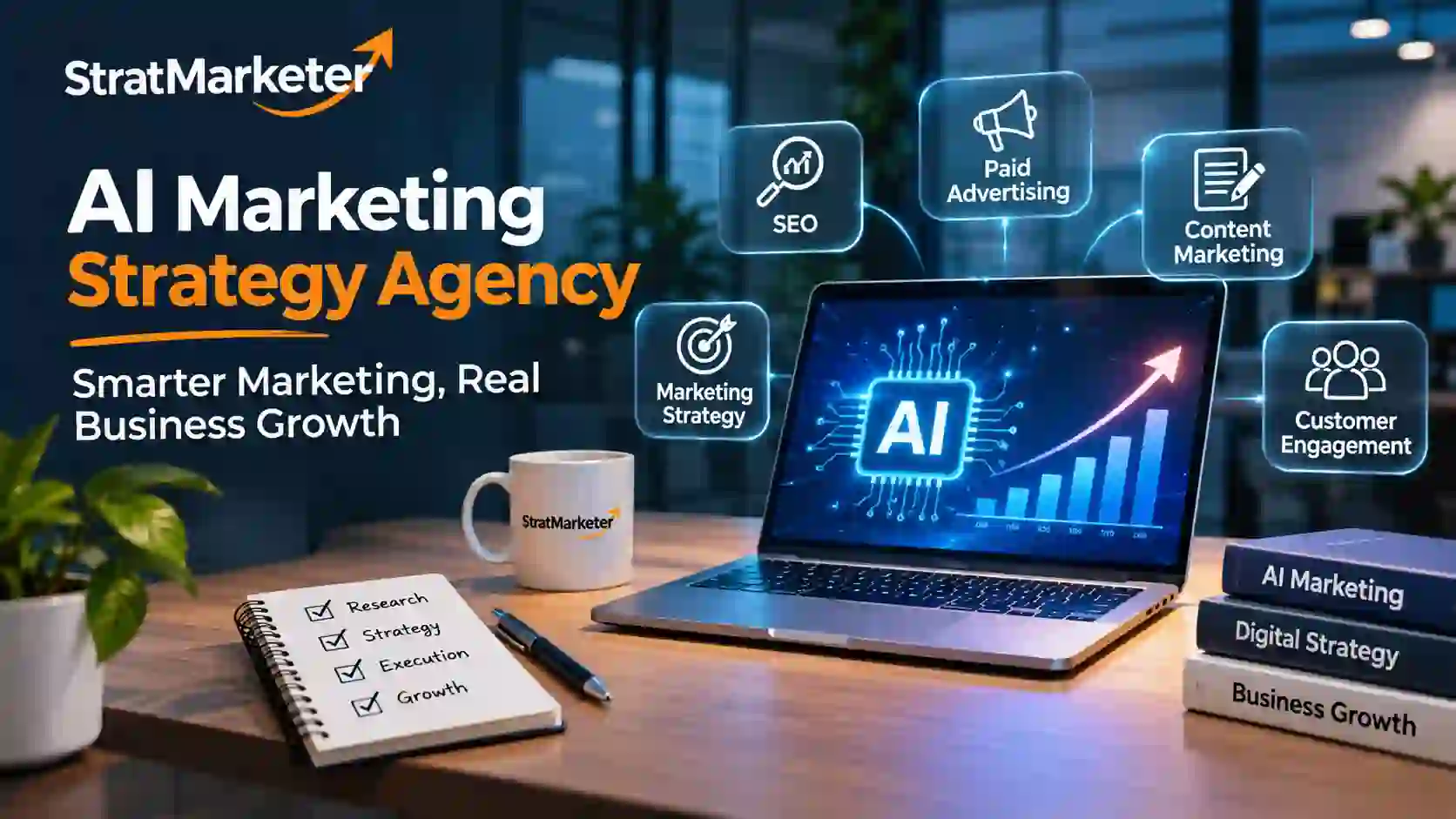
AI Marketing Strategy Agency for Smarter Business Growth
1. Why Businesses Are Rethinking Their Marketing Strategies With AI
Marketing decisions were easier to make when businesses had fewer channels to manage. A company could invest in SEO, run a few Google Ads, publish social media posts, and review enquiries at the end of each month. That approach still works in some situations, but customer behaviour has changed. People now compare brands across search engines, social platforms, marketplaces, review websites, and AI-powered search tools before making a purchase.
This has created a problem for businesses. Marketing teams collect large amounts of information, yet understanding what to do with it is not always straightforward. A business may receive website traffic but struggle to convert visitors into enquiries. Another may spend heavily on advertising without knowing which audience is actually interested in its products.
This is where an AI marketing strategy agency becomes relevant. Instead of treating every marketing channel as a separate activity, businesses are beginning to use AI to understand how different activities connect and where their marketing budget should go.
AI can analyse customer interactions, identify patterns in campaign performance, study search behaviour, and help businesses make decisions faster. However, using AI does not automatically make a marketing strategy successful. The quality of the information, the business objective, and the decisions made by experienced marketers still matter.
Consider an Indian manufacturer selling industrial packaging materials. Its customers may come from different industries, including pharmaceuticals, food processing, and manufacturing. Each customer group has different requirements, buying timelines, and search behaviour. A common advertising campaign may generate traffic, but it might not attract the right buyers.
An AI-supported marketing approach can help identify which industries generate more qualified enquiries, what type of content attracts decision-makers, and which advertising campaigns deserve more investment.
There is another reason businesses are reconsidering their approach. Traditional marketing reports often explain what happened after a campaign has finished. AI tools can help marketers examine ongoing performance and identify possible changes earlier.
For example, if a particular landing page receives visitors but produces very few enquiries, marketers can examine search intent, page content, visitor behaviour, and conversion patterns instead of simply increasing advertising expenditure.
I personally believe businesses should stop treating AI as a replacement for marketing knowledge. A tool can identify a pattern, but understanding why customers behave in a particular way requires commercial understanding. That distinction is important.
2. What Does an AI Marketing Strategy Agency Actually Do?
An AI marketing strategy agency does much more than introduce automation tools into an existing marketing process. Its actual responsibility is to understand a business, identify its marketing problems, and decide where AI can make the work more useful.
A company might already have an SEO agency, an advertising team, and someone managing social media. Yet these activities may not support the same business objective. SEO could be bringing informational traffic, paid advertising could be attracting price-sensitive visitors, and social media might be reaching people who are unlikely to purchase.
An AI marketing strategy agency examines these activities together.
The work generally begins with understanding the business model. A B2B company selling machinery needs a different marketing approach from a D2C skincare brand. The former may need technical content, industry-specific landing pages, and lead qualification. The latter may depend more heavily on product discovery, customer reviews, repeat purchases, and advertising creatives.
Once the business requirements are understood, the agency can examine available data and identify opportunities.
Some of the work may involve:
- Reviewing website traffic, search performance, and customer acquisition sources.
- Analysing customer queries and identifying common buying concerns.
- Finding gaps in existing content and marketing campaigns.
- Studying advertising performance across different audience segments.
- Identifying suitable opportunities for marketing automation.
- Developing a channel strategy based on business priorities.
- Establishing measurable performance indicators.
The important part is deciding what should happen after the analysis.
For instance, an ecommerce business may discover that customers frequently visit product pages but leave without purchasing. The problem may not be insufficient traffic. It could be unclear product information, delivery concerns, missing reviews, or an unconvincing offer.
An AI marketing strategy agency can use customer behaviour data to identify possible reasons and recommend what to test. The final decision should still involve someone who understands the product and its customers.
There is also a difference between an agency that uses AI occasionally and one that builds its marketing process around it. Using an AI writing tool to produce twenty blog posts is not the same as developing a content strategy based on search demand, customer questions, topical relevance, and business value.
At StratMarketer, the broader approach to digital marketing needs to consider how SEO, paid campaigns, content, social media, and customer engagement work together. AI can support these activities, but the business objective should determine which tools and methods are used.
A company does not need ten different AI subscriptions to begin with. Sometimes, better use of its existing analytics and customer information is enough.
3. How AI Helps Businesses Understand Customer Behaviour and Market Demand
Many businesses believe they understand their customers because they regularly receive enquiries. But enquiries alone do not reveal the entire buying process.
A customer might visit a website five times before submitting a form. Another may read three blog articles, compare product specifications, and then contact the sales team after two weeks. Someone else might enquire immediately but never have a genuine purchasing requirement.
These differences matter when developing a marketing strategy.
An AI marketing strategy agency can help businesses examine customer behaviour across multiple touchpoints rather than looking at each interaction separately.
Understanding what customers are searching for
Search behaviour provides useful information about customer requirements. Someone searching for a general product category may still be researching. Someone searching for pricing, manufacturers, installation, or product comparisons may be closer to making a decision.
AI-assisted keyword analysis can help identify these differences.
For example, a nutraceutical brand looking for third-party manufacturing services may receive searches from people interested in product formulations, private labelling, packaging, manufacturing costs, and regulatory requirements.
These searches represent different stages of the buying process.
Creating one generic service page for every visitor may not address their actual concerns. A better strategy could include technical articles, manufacturing service pages, product category information, and enquiry-focused content.
Identifying patterns in customer enquiries
Customer enquiry data can reveal what people repeatedly ask before purchasing.
A software company might notice that prospects frequently ask about integration, pricing, training, and customer support. A manufacturing company may receive repeated questions about minimum order quantities, delivery schedules, certifications, and product specifications.
AI can help categorise these conversations and identify recurring topics.
This information can then influence website content, sales material, advertising messages, and follow-up communication.
However, customer data must be handled responsibly. Businesses should not upload confidential customer records into public AI tools without checking privacy, security, and data handling arrangements.
Understanding market demand
Market demand is not always reflected in website traffic.
A business might receive fewer searches for a specialised industrial product but still operate in a commercially valuable market. Another business may receive thousands of informational visits without generating meaningful enquiries.
This is why an AI marketing strategy agency should look beyond search volume.
It should examine factors such as:
- Search intent and customer requirements.
- Competitor positioning and content coverage.
- Seasonal changes in demand.
- Customer feedback and common objections.
- Product interest across different audience segments.
- Conversion behaviour across marketing channels.
For an Indian business, regional behaviour also matters. A customer searching for commercial solar installation in Gujarat may have different requirements from a customer researching the same service in Himachal Pradesh. Electricity consumption, installation conditions, commercial requirements, and local competition can influence the buying decision.
AI can help organise these differences, but local market understanding remains necessary.
One thing I would be careful about is treating AI-generated customer insights as confirmed facts. A pattern in a small dataset can easily lead to the wrong conclusion. It should be checked against actual enquiries, sales conversations, and customer feedback.
4. Building Marketing Strategies Around Real Business Goals, Not Just Automation
A marketing strategy should begin with a business question.
Does the company need more qualified enquiries? Is it trying to enter a new market? Does it want to sell more products through its website? Is the sales team receiving enquiries from people who cannot afford the product?
These questions should come before selecting AI tools.
Unfortunately, some businesses start in the opposite direction. They purchase automation software, introduce AI content generation, and begin experimenting with several platforms without defining what success should look like.
The result can be more marketing activity without meaningful business progress.
An AI marketing strategy agency should connect technology with commercial priorities.
Take a real-world type of example. An Ahmedabad-based engineering company wants to generate enquiries from manufacturing plants across India. Its existing website receives visitors, but most enquiries come from people looking for employment or low-cost individual services.
Simply increasing website traffic would not solve this problem.
The marketing strategy needs to attract procurement managers, plant owners, engineering heads, and other relevant decision-makers.
AI can support this process by examining search queries, identifying relevant industry topics, grouping customer requirements, and helping marketers understand which pages attract more valuable visitors.
The agency may then recommend:
- Separate landing pages for important industrial applications.
- Technical content addressing product selection and installation.
- SEO targeting commercial and industry-specific search terms.
- LinkedIn campaigns aimed at relevant business audiences.
- Lead forms that collect useful project information.
- CRM workflows for managing and qualifying enquiries.
Notice that automation is only one part of the work.
Marketing goals should determine the technology
Different business objectives require different approaches.
Business objective | Suitable AI-supported marketing activity |
Generate qualified leads | Lead analysis, audience segmentation, and conversion tracking |
Increase organic traffic | Search intent analysis and content opportunity research |
Improve ecommerce sales | Product recommendations and customer behaviour analysis |
Reduce advertising waste | Campaign performance analysis and audience insights |
Improve customer engagement | Automated responses and customer segmentation |
Enter a new market | Competitor research and regional demand analysis |
These activities should not be implemented simply because the technology is available. Their usefulness depends on the company’s existing marketing process.
For example, automated lead scoring is not particularly useful if the sales team does not update enquiry status or record which leads become customers. The system may produce impressive-looking reports, but the underlying information remains unreliable.
I prefer starting with two or three clearly defined business objectives rather than automating everything at once. It gives the team enough time to understand what is working.
But this approach has limits too. A large ecommerce business with thousands of daily transactions may need several connected automation systems from the beginning. The right decision depends on the scale and complexity of the operation.
5. Using AI for SEO, Paid Advertising, Content Marketing, and Customer Engagement
AI is becoming part of almost every major digital marketing activity. Still, the practical value differs from one channel to another. An AI marketing strategy agency should understand these differences instead of applying the same automation process everywhere.
AI in SEO and organic search
SEO involves more than identifying keywords and publishing articles. Search engines evaluate relevance, content usefulness, website experience, technical accessibility, and other quality signals.
AI can assist marketers with keyword clustering, search intent analysis, competitor content research, content gap identification, and technical SEO investigations.
For example, a business selling commercial water purification systems might find that customers search for industrial RO plants, water treatment solutions, maintenance requirements, and commercial purification equipment.
These topics can be organised into relevant website sections and supporting articles.
AI can also help examine whether existing content answers the questions customers are actually asking.
However, publishing large numbers of AI-generated articles without proper research is risky. Repeating information already available across dozens of websites does not give readers a strong reason to trust a business.
Google’s guidance focuses on helpful, reliable, people-first content rather than whether content was created using AI. Businesses should therefore concentrate on accuracy, originality, and genuine expertise.
AI in paid advertising
Paid advertising can consume a considerable portion of a company’s marketing budget. This is particularly important for businesses operating in competitive Indian markets.
AI can help analyse campaign performance, audience responses, conversion patterns, and creative variations.
Consider a company advertising industrial equipment through Google Ads. It may receive clicks from people searching for spare parts, employment opportunities, second-hand machinery, and new equipment purchases.
These visitors do not have the same commercial value.
Campaign analysis can help identify irrelevant search terms, compare conversion performance, and guide decisions about budget allocation.
AI-assisted creative testing can also help ecommerce brands examine different product images, headlines, video formats, and advertising messages.
But there is one area where I would not blindly trust automation. Advertising platforms may optimise towards the conversion event they receive, not necessarily the business outcome the company wants. If a campaign is optimised for low-quality form submissions, it may generate more of them.
Qualified leads and actual sales should be considered wherever the tracking setup allows it.
AI in content marketing
Content marketing works best when it answers a genuine customer question.
AI can help marketers research topics, organise information, examine frequently asked questions, and identify gaps in existing content.
A real estate company, for example, may need content about property documentation, home loan requirements, location comparisons, construction quality, and possession timelines.
An AI marketing strategy agency can use search and customer enquiry information to identify which subjects deserve attention.
The content itself still needs human review. Property laws, financial information, product specifications, and compliance-related claims should never be published without verification.
For StratMarketer, this means content should support the wider digital marketing strategy rather than becoming an isolated activity. A blog article, service page, social media post, and lead generation campaign should address connected customer requirements.
AI in customer engagement
Customer engagement is another area where AI has practical applications.
Businesses receive enquiries through websites, WhatsApp, email, social media, and telephone calls. Responding to every basic question manually can become difficult as enquiry volume increases.
AI-powered chat systems can help answer routine questions, direct visitors towards relevant services, and collect preliminary information.
For example, a digital marketing company might receive enquiries about SEO pricing, PPC management, website development, and social media marketing. A properly configured chatbot can identify the service requirement and direct the visitor towards the right enquiry process.
However, customers should be able to reach a human representative when their questions become specific or complicated.
An automated response that repeatedly fails to understand a customer can damage trust faster than a delayed human response.
The same applies to WhatsApp marketing. Automated messages should be relevant, permission-based, and useful. Sending repeated promotional messages without considering customer interest is not a marketing strategy.
AI should make customer communication more useful, not make customers feel they are talking to a wall.
6. Why Human Expertise Still Matters in AI-Driven Marketing Decisions
AI can process information faster than a person, but marketing decisions are rarely based on numbers alone. A business may have good website traffic, a reasonable conversion rate, and a growing social media audience, yet still struggle to generate revenue. Understanding why this happens requires more than analysing a dashboard.
This is where human expertise becomes important.
An experienced marketer looks at the business behind the numbers. They consider the product, pricing, competition, customer expectations, sales process, and market conditions before recommending changes. AI can help examine these factors, but it does not automatically understand their commercial importance.
Consider an Indian manufacturing company selling specialised machinery. Its website may receive only 500 visitors every month, which might appear low compared with a consumer ecommerce website. However, if those visitors include procurement managers and factory owners, the traffic could be commercially valuable.
Would increasing traffic to 5,000 visitors necessarily make the marketing more successful? Not if most new visitors are students, job seekers, or people looking for unrelated information.
An AI marketing strategy agency needs to recognise this difference.
Understanding local customer behaviour
Indian customers do not always follow the same purchasing pattern. In many industries, buyers speak to sales representatives, request quotations, compare multiple suppliers, and take time before making a final decision.
For high-value products and services, the buying process can involve several people.
A customer looking for a commercial solar installation may first research available systems, then ask about installation costs, government policies, warranties, and maintenance. The final decision might happen after discussions with family members, financial teams, or company management.
AI can help identify these customer questions. But deciding which information should be communicated first requires an understanding of the buying process.
Knowing when automation is inappropriate
Not every customer interaction should be automated.
A chatbot may handle basic questions about service availability, but a customer discussing a complicated manufacturing requirement may need a knowledgeable person. Similarly, automated advertising recommendations may suggest increasing campaign expenditure, while a marketer may recognise that the business cannot currently handle additional orders.
These situations require judgement.
Creative thinking cannot be reduced to data analysis
Marketing also involves understanding emotions, language, and cultural context.
An advertisement targeting customers in Mumbai may need a different communication style from one targeting customers in a smaller industrial town. A campaign written entirely in formal English may not connect equally well with every audience.
AI can generate variations, translate messages, and analyse engagement. Human marketers need to decide whether those messages sound natural and represent the business properly.
I would rather have a smaller campaign with a clear message than publish hundreds of AI-generated advertisements that all sound almost identical.
That is not an argument against AI. It is a reminder that marketing is still a human activity, even when technology handles a large part of the research and execution.
7. Common AI Marketing Strategy Mistakes That Businesses Should Avoid
Businesses are often attracted to AI because it promises faster research, automated content production, and better control over marketing activities. But adopting these tools without understanding their limitations can create problems that are not immediately visible.
Some mistakes are technical. Others come from expecting AI to solve business problems that were never properly understood.
Using AI without defining the marketing objective
This is probably the most common mistake.
A company starts using AI for content writing, advertising, customer communication, and reporting without deciding what it wants to achieve. After a few months, the team has produced more content and automated several activities, but enquiries and sales have not changed much.
An AI marketing strategy agency should first identify the actual business requirement.
If the company needs qualified B2B leads, producing more general social media posts may not be the right priority.
Publishing large volumes of unverified content
AI writing tools can produce articles quickly. That does not mean every article is accurate, original, or useful.
This becomes particularly concerning in industries such as healthcare, finance, manufacturing, and pharmaceuticals, where incorrect information can affect customer decisions.
For example, a nutraceutical manufacturer discussing supplement ingredients must verify product specifications, permitted claims, labelling requirements, and relevant regulatory information. An AI-generated explanation should never be treated as a substitute for technical or regulatory review.
The same applies to SEO. Publishing similar articles across multiple pages simply to cover more keywords can result in a weak website experience.
Depending entirely on automated advertising decisions
Advertising platforms use machine learning to optimise campaign delivery. Their recommendations can be useful, but businesses should understand what the platform is actually optimising.
A campaign generating 200 form submissions may look successful. But if only five enquiries are relevant, the company may be spending money on the wrong audience.
Marketing teams should examine lead quality, sales outcomes, and acquisition costs wherever reliable tracking is available.
Ignoring customer privacy
Customer information is valuable, but it should be handled carefully.
Businesses must consider applicable privacy requirements, consent, data retention, and the security practices of the AI platforms they use. Uploading customer databases or confidential business information into an unapproved public tool is not a sensible shortcut.
Choosing tools before understanding the workflow
A business may purchase several subscriptions because competitors are using them. Later, employees struggle to connect the platforms, maintain consistent information, or understand which tool is responsible for what.
More software does not automatically mean better marketing.
Ignoring the human review process
Even a well-performing AI system can produce incorrect recommendations when the input information is incomplete. A sudden change in website traffic, for example, could be related to seasonality, tracking problems, website changes, or search engine updates.
Assuming every change requires a new marketing campaign can waste time and money.
I have a particular concern about agencies promising completely automated marketing. Businesses still need people who can question reports, challenge assumptions, understand customers, and take responsibility for decisions.
Automation should reduce unnecessary work. It should not remove accountability.
8. How StratMarketer Approaches AI Marketing Strategy for Indian Businesses
Indian businesses operate in very different markets. A local service provider, an ecommerce company, a pharmaceutical manufacturer, and a B2B technology business cannot follow the same marketing strategy simply because they use similar digital platforms.
StratMarketer approaches digital marketing with the understanding that business requirements should determine the marketing activities, not the other way around.
For an AI marketing strategy agency, the first responsibility is to understand where the business currently stands and what it expects from digital marketing.
A company looking for enquiries from a specific city needs a different approach from a brand trying to reach customers across India.
Starting with the business and its customers
The first area to examine is the business itself.
What does it sell? Who makes the purchasing decision? What problems does the product or service solve? Which competitors are already attracting the target audience?
These questions help establish the direction of the marketing strategy.
For example, a company offering professional services in Ahmedabad may need local SEO, Google Business Profile management, service-specific landing pages, and enquiry generation. A national ecommerce brand may require product SEO, performance advertising, conversion analysis, and customer retention activities.
The strategy should reflect these differences.
Using AI to support research and planning
AI-assisted research can help organise search information, identify content opportunities, analyse customer queries, and examine competitor positioning.
StratMarketer can use these insights to determine which marketing activities deserve attention.
For example, if customers repeatedly search for pricing, implementation, and service comparisons before contacting a company, these subjects may deserve dedicated website content.
The objective is not to produce content for every possible search term. It is to answer the questions that influence customer decisions.
Connecting different digital marketing channels
A business should not have completely disconnected marketing activities.
StratMarketer’s digital marketing services cover areas such as:
- SEO and local SEO.
- Social media marketing and social media optimisation.
- Google Ads and PPC management.
- Content marketing and website content development.
- Website design and conversion-focused landing pages.
- Email marketing and WhatsApp marketing.
- Lead generation and performance marketing.
- Online reputation management.
- YouTube SEO and video marketing.
- AI integration and marketing automation.
The selection of services depends on the company’s objectives and available resources.
For instance, an Indian B2B service company may need SEO and LinkedIn marketing to reach decision-makers, while a consumer brand may benefit more from product-focused content, Meta Ads, and remarketing.
Keeping content relevant to Indian audiences
Language and regional understanding are important.
A business targeting customers in Gujarat may need regional landing pages, locally relevant content, and an understanding of how customers search for its services. The same approach may not work in Maharashtra, Delhi, or southern India.
AI can help identify regional search patterns and organise content requirements. Human review is necessary to ensure that the information reflects actual local needs rather than simply changing city names in existing content.
Measuring business outcomes
Marketing performance should be evaluated through meaningful indicators.
Website traffic and social media engagement can provide useful information, but they should not become the only measures of success.
Depending on the business, StratMarketer can examine organic enquiries, qualified leads, conversion rates, advertising expenditure, cost per acquisition, landing page performance, and customer engagement.
A company should also understand how marketing enquiries move through its sales process. Without that information, it becomes difficult to know whether a campaign is attracting genuine buyers.
The purpose of an AI marketing strategy agency is not to make every marketing activity dependent on AI. It is to identify where technology can support better decisions and where experienced people need to remain involved.
9. What Should You Check Before Hiring an AI Marketing Strategy Agency?
Choosing an agency requires more attention than comparing service packages or checking how many AI tools it uses.
A business is trusting an external team with its marketing direction, customer communication, and often a significant advertising budget. The agency should be able to explain its decisions in language that business owners can understand.
Before hiring an AI marketing strategy agency, I would look at a few practical areas.
- Does the agency understand your industry?
Industry understanding makes a difference, particularly in B2B and specialised sectors.
An agency working with an industrial equipment manufacturer should understand long sales cycles, technical buyers, quotation requests, and product specifications. An agency working with an ecommerce brand should understand product discovery, customer reviews, repeat purchases, and conversion behaviour.
Ask how the agency plans to understand your customers before recommending a strategy.
- Can it explain how AI will be used?
The agency should be able to explain which activities will involve AI and why.
Will AI be used for customer research, SEO analysis, advertising insights, content planning, lead qualification, or automation?
Be cautious if the entire explanation is based on producing more content or reducing manpower.
- Does it understand SEO and paid advertising beyond automation?
AI tools cannot replace an understanding of search engine optimisation, advertising policies, campaign structure, keyword intent, and conversion tracking.
Ask how the agency will connect AI-supported research with actual marketing execution.
- How will performance be measured?
Before signing an agreement, understand what the agency will report.
For one business, qualified enquiries may be the main indicator. For another, ecommerce revenue or customer acquisition cost may matter more.
You should also know how often reporting will happen and who will explain the results.
- Who reviews AI-generated work?
This question is often overlooked.
Ask whether experienced marketers review campaign recommendations, content, advertising messages, and customer communication before publication.
There should be a clear process for checking factual claims, brand language, and technical information.
- Does the agency understand data security?
If customer information, CRM records, or internal business documents are involved, ask how they will be handled.
The agency should be able to explain its data access practices and the safeguards used when working with external AI platforms.
- Is the proposed strategy realistic for your budget?
An agency recommending SEO, PPC, video marketing, social media, automation, and content production simultaneously may not be considering your actual resources.
A good strategy identifies priorities.
I would also suggest asking for a clear explanation of what happens during the first 90 days. Not every marketing channel produces measurable business outcomes immediately, and an agency should be honest about that.
The right agency will not promise a fixed number of sales simply because it uses AI. It should explain the work, the expected indicators, the limitations, and how decisions will be reviewed as the campaign progresses.
10. Frequently Asked Questions About AI Marketing Strategy Agency
- What is an AI marketing strategy agency?
An AI marketing strategy agency helps businesses plan and manage marketing activities using artificial intelligence alongside human marketing expertise. Its work may include customer research, SEO planning, advertising analysis, content strategy, audience segmentation, and marketing automation. The objective is to connect these activities with actual business requirements.
- How is an AI marketing strategy agency different from a traditional digital marketing agency?
The main difference is how AI is incorporated into research, planning, analysis, and execution. A traditional agency may rely more heavily on manual research and reporting, while an AI-supported agency can use machine learning and automation to process information and identify patterns. Both still require experienced marketers to make sound decisions.
- Can AI marketing strategies help small businesses in India?
Yes. Small businesses can use AI for keyword research, content planning, customer query analysis, advertising performance reviews, and basic communication automation. They do not need expensive software to begin. The important thing is choosing activities that address an actual business problem.
- Does AI replace digital marketing professionals?
No. AI can handle several repetitive tasks and support analysis, but it cannot take complete responsibility for business strategy, customer relationships, creative judgement, and marketing accountability. Human expertise remains necessary.
- How much does an AI marketing strategy agency charge in India?
There is no fixed industry-wide price. Charges depend on the scope of work, number of marketing channels, research requirements, technology involved, and level of ongoing support. A basic strategy engagement will generally involve different costs from an ongoing arrangement covering SEO, PPC, content, and automation.
- Can AI help improve SEO performance?
AI can assist with keyword research, search intent analysis, content gap identification, technical investigations, and performance analysis. However, rankings still depend on multiple factors, including content usefulness, website quality, competition, and search engine evaluation. AI-generated content alone does not guarantee better rankings.
- Is AI marketing suitable for B2B companies?
Yes. B2B companies can use AI to understand industry-specific search demand, segment potential buyers, analyse enquiries, and plan technical content. It can be particularly useful for companies with long purchasing cycles and multiple decision-makers.
- How long does it take to see results from an AI marketing strategy?
It depends on the channels being used. Advertising campaigns may provide early performance information, while SEO and organic content usually require a longer period to show meaningful results. Businesses should evaluate progress through relevant indicators rather than expecting every marketing activity to produce immediate sales.
- Why should businesses consider StratMarketer for AI marketing strategy?
StratMarketer combines digital marketing knowledge with AI-supported research, planning, and marketing activities. Businesses can explore services such as SEO, PPC, content marketing, social media, lead generation, website development, and marketing automation based on their requirements. The appropriate combination depends on the company’s market, customers, and commercial objectives.
- Is AI marketing strategy useful without marketing automation?
Absolutely. AI can support research, customer analysis, keyword planning, and campaign evaluation without automating the entire marketing process. In fact, some businesses benefit more from better research and decision-making than from introducing additional automated systems.
Our Services
Contact Us
- Paonta Sahib, Himachal Pradesh, India
- +91-8700998508
- support@stratmarketer.com
Start From Here
These two options make it easy for you to get the information you want.