


AI Marketing Consulting Company for Indian Businesses
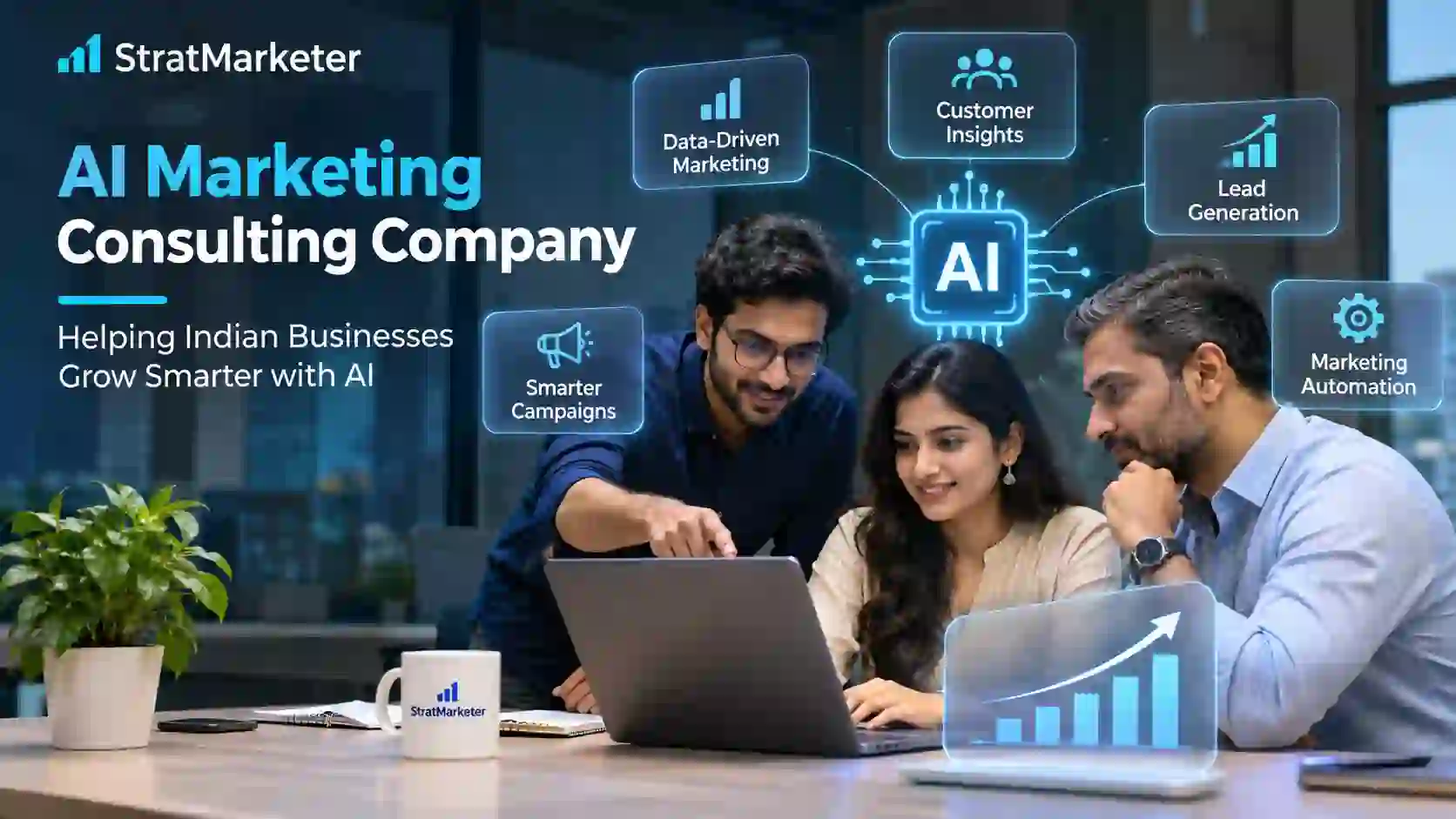
1. Why Businesses Are Turning to an AI Marketing Consulting Company
Marketing has become harder to manage for many Indian businesses. A company may be spending money on Google Ads, posting regularly on Instagram, publishing blogs, and collecting enquiries through its website, yet still struggle to understand which activities are bringing actual customers. The problem is not always a lack of marketing effort. Sometimes, businesses are working with too much disconnected information and making decisions without understanding what is happening behind the numbers.
This is one reason businesses are considering an AI marketing consulting company rather than simply hiring another agency to manage campaigns. They want someone who can examine their existing marketing activities, identify where technology can help, and recommend a practical way forward.
AI has changed the way marketing teams approach research, customer communication, content planning, advertising and performance analysis. Tasks that once required several hours of manual work can now be completed much faster. But using AI tools without a clear business objective can create another problem. Businesses may end up paying for multiple subscriptions without knowing whether those tools are contributing to revenue.
Consider a manufacturing company in Ahmedabad that receives enquiries from its website, IndiaMART, trade exhibitions and sales representatives. Its marketing team might have hundreds of customer records but no clear understanding of which industries are showing the strongest buying interest. An AI-supported marketing system can help organise this information, identify common enquiry patterns and give the sales team a better starting point.
The technology itself is not the achievement. What matters is how the information is used.
An experienced AI marketing consulting company looks beyond the tools. It considers the company’s existing marketing setup, customer acquisition costs, sales process, website performance and available data before recommending changes.
There is also a financial reason behind this shift. Many businesses cannot afford to experiment endlessly with marketing budgets. They need to understand whether their campaigns are reaching the right people and whether the enquiries are worth following up.
In my opinion, this is where consulting becomes more valuable than simply introducing AI software. A business owner does not necessarily need ten different AI applications. Sometimes, one properly connected system and a better marketing decision-making process can solve a much bigger problem.
2. What Does an AI Marketing Consulting Company Actually Do?
The term AI marketing consulting can mean different things depending on the company offering the service. Some providers mainly help businesses select AI tools. Others work on marketing automation, customer segmentation, advertising analysis, content operations and integration with existing business systems.
A genuine AI marketing consulting company should first understand how the business currently attracts and converts customers.
For example, a real estate developer may receive enquiries through Google Ads, property portals, WhatsApp and direct calls. If these enquiries are handled separately, the sales team might contact the same person multiple times while missing another interested buyer.
A consultant would examine this process before recommending automation.
The work generally involves several connected activities.
Understanding the existing marketing system
The first task is to examine how the company currently operates. This includes its website, advertising accounts, social media channels, customer databases, CRM software and lead management process.
A consultant may find that the company is generating enough leads but losing potential customers because enquiries are not assigned to the right salesperson.
That is not an advertising problem. It is a process problem.
Identifying suitable AI applications
Not every business needs the same AI tools. An ecommerce company may benefit from product recommendation systems and automated customer support, while a professional consultancy might need better lead qualification and content research.
The recommendations should depend on the actual requirement.
Planning marketing automation
AI can assist with repetitive marketing activities such as customer categorisation, email personalisation, enquiry classification and campaign reporting.
However, automation should not remove necessary human communication. A customer asking about a ₹20 lakh industrial machine may need a technical discussion, not an automated message containing five generic product links.
Connecting marketing information
A business may use Google Analytics, Google Ads, Meta Ads Manager, a CRM and email marketing software. When these systems operate separately, understanding the complete customer journey becomes difficult.
An AI marketing consulting company can help plan how information should move between these systems and how it can be used for reporting and decision-making.
Evaluating performance
After implementation, the consultant needs to examine whether the changes are producing useful results. This could involve lead quality, customer acquisition cost, conversion rates, campaign performance and time saved by the marketing team.
One thing I would personally question is the practice of presenting the number of AI tools implemented as proof of success. A company can have an impressive collection of software and still have a poor marketing process.
The business outcome should matter more than the software list.
3. How AI Is Changing Marketing Planning and Business Decisions
Traditional marketing planning often depends on historical campaign reports, competitor research, customer feedback and the experience of marketing professionals. These methods remain relevant, but AI has introduced another way to examine information.
Businesses can now process larger volumes of marketing data, identify recurring patterns and test different possibilities before committing substantial budgets.
Take an Indian clothing ecommerce brand preparing for the festive season. The company may have sales information from Diwali, Navratri, Eid and previous wedding seasons. Instead of planning every campaign using the previous year’s calendar, the marketing team can examine product demand, customer segments, regional buying patterns and previous advertising performance.
AI tools can help identify products that receive more interest from certain customer groups. The marketing team can then use those findings to plan product promotions, advertising creatives and email campaigns.
But there is a limitation.
Historical data does not always predict future behaviour accurately. A sudden change in consumer preferences, competitor pricing or product availability can make an otherwise sensible forecast unreliable.
This is why AI marketing consulting should combine analytical capabilities with business judgement.
Another important change is the way companies approach marketing budgets. Instead of allocating money based only on past spending, businesses can examine campaign-level performance and identify where additional investment may be justified.
For instance, a company spending ₹2 lakh every month on digital advertising might discover that its Google Search campaigns generate fewer enquiries than social media campaigns but bring customers with a higher purchase value.
If the business looks only at the number of leads, it may make the wrong decision.
AI-assisted analysis can help examine several performance indicators together, provided the underlying tracking is accurate.
Marketing planning is also becoming more flexible. Teams can test different audience groups, content formats, landing page messages and campaign ideas without waiting for a lengthy reporting cycle.
I believe this is one of the more useful changes. Marketing teams no longer need to treat every campaign plan as something fixed for three months. They can review what is happening, understand the reasons and make adjustments.
Still, the final decision should not be handed over entirely to an algorithm. A marketing professional understands the context behind a customer’s decision, something that may not appear clearly in a spreadsheet.
4. Using Customer Data to Understand Buying Behaviour
Many businesses collect customer information but do not use it properly.
A website may receive thousands of visitors, a sales team may maintain hundreds of enquiry records, and an ecommerce store may have years of purchase history. Yet the company may not know why some customers purchase immediately while others take several weeks to make a decision.
This is where an AI marketing consulting company can help businesses make better use of available customer information.
AI systems can examine patterns across different types of customer data, including:
- Website visits and page interactions.
- Previous purchases and product preferences.
- Enquiry history and customer responses.
- Email engagement and campaign interactions.
- Search behaviour and advertising responses.
- Customer service questions and feedback.
Suppose a nutraceutical brand in India sells protein supplements, multivitamins and herbal wellness products. Its customer database may include gym owners, individual consumers, distributors and retailers.
Sending the same promotional message to everyone is unlikely to work equally well.
An AI-supported customer segmentation system can help categorise customers according to their previous purchases, interests and engagement patterns. The marketing team can then prepare different communication for each group.
A distributor may be interested in bulk pricing and product availability. An individual customer may want ingredient information, product usage details and packaging options.
The difference is important.
Customer segmentation also helps businesses understand when a customer may need another interaction. For example, someone who repeatedly visits a product page but does not complete a purchase may need clearer product information or assistance with the checkout process.
However, businesses should be careful about the quality of their data.
If customer records contain duplicate entries, incorrect phone numbers or outdated information, AI systems may produce misleading insights. Poor information does not become reliable simply because it is processed using advanced software.
Privacy also deserves attention. Indian businesses handling personal information should consider applicable requirements under the Digital Personal Data Protection Act, 2023, and relevant rules and notifications. Customer data should be collected and used with appropriate consent, safeguards and transparency.
I would rather see a company working with a smaller, properly maintained customer database than collecting thousands of records without understanding where the information came from.
There is a practical side to this as well. Customers do not always behave according to neat categories. Someone who purchased a premium product last month may choose a budget option next month. Marketing teams should treat AI-generated segments as useful indicators, not permanent labels.
5. AI Marketing Consulting for Lead Generation and Customer Acquisition
Generating leads is not particularly difficult for a business with an advertising budget. Getting enquiries from people who are genuinely interested in purchasing is a different matter.
This distinction becomes important for businesses selling expensive products, professional services, industrial equipment, property or B2B solutions. They may receive hundreds of enquiries but convert only a small percentage into customers.
An AI marketing consulting company can help examine the complete journey from the first interaction to the final purchase.
For a business offering industrial automation solutions in Pune, the buying process may involve a factory manager, procurement department, technical consultant and company director. Each person may have different questions before approving a purchase.
A generic lead generation campaign may attract enquiries, but many of those enquiries may not have the budget, authority or immediate requirement.
AI can assist with identifying useful signals.
Finding the right potential customers
AI-supported research can help marketing teams examine industry categories, company characteristics, search interests and previous customer patterns. This information can be used to plan more relevant audience segments.
For B2B companies, this may include identifying businesses operating in particular industries or regions.
Understanding lead quality
Not every enquiry deserves the same priority. A company requesting a detailed quotation may have a stronger purchase intention than someone who has only downloaded a brochure.
AI-assisted lead scoring can assign priority based on available information, such as enquiry source, engagement, company details and previous interactions.
The sales team can use these signals to decide which prospects need immediate attention.
Improving landing page communication
A landing page should answer the questions that matter to potential customers. AI can help analyse customer queries, identify common objections and suggest improvements to page content.
For example, an Indian project finance consultancy may receive enquiries from entrepreneurs who are unsure about eligibility, project reports, collateral requirements and repayment terms.
A landing page addressing these concerns can attract more relevant enquiries than one containing only general service descriptions.
Supporting faster follow-ups
Lead response time can influence whether a prospect continues the conversation. AI-enabled systems can classify enquiries, send acknowledgement messages and assign leads to relevant team members.
But there is a difference between responding quickly and responding properly.
A business should not send automated messages repeatedly just because a prospect has not replied. That can create irritation rather than interest.
Examining customer acquisition costs
An important part of AI marketing consulting is understanding how much the business spends to acquire an actual customer.
Consider a simple example. A company spends ₹50,000 on advertising and receives 100 enquiries. At first glance, the campaign appears to generate leads at ₹500 each.
But suppose only five enquiries become paying customers. The actual advertising cost per customer is ₹10,000, excluding sales and operational expenses.
This is a very different picture.
An AI marketing consulting company can help connect advertising information with CRM and sales data so that businesses can examine more meaningful performance indicators.
I might be wrong here, but I feel many businesses in India still focus too heavily on lead volume because it is easier to report. The more difficult question is how many of those leads actually became paying customers, and why the remaining enquiries did not convert.
That is where the real marketing discussion begins.
6. Where AI Marketing Tools Help and Where Human Expertise Matters
There is a common assumption that using more AI tools automatically makes marketing better. I do not completely agree with this. AI can handle a surprising amount of marketing work, but there are situations where human judgement remains more important than automation.
An AI marketing consulting company should understand this difference before recommending any technology to a business.
Consider content marketing. AI tools can help research topics, analyse search intent, prepare content outlines, identify keyword opportunities and assist with drafting. This saves time, particularly for businesses that publish content regularly.
However, understanding what an Indian customer actually wants from a product or service requires more than keyword research.
A manufacturer selling third party nutraceutical products, for example, needs content that explains formulation options, manufacturing capacity, packaging, quality testing and regulatory requirements. A generic AI-generated article may mention all these subjects but fail to answer the actual concerns of a business owner planning to launch a supplement brand.
That is where human expertise matters.
The same difference appears in advertising.
AI-powered advertising platforms can automate bidding, identify audience signals and help test creative variations. Marketing professionals still need to decide whether the campaign is reaching the correct audience, whether the offer makes commercial sense and whether the landing page communicates the product properly.
Some areas where AI tools are useful include:
- Marketing research: Analysing search queries, competitor information and customer feedback.
- Content operations: Supporting topic research, content briefs, editing and content distribution.
- Advertising analysis: Examining campaign performance and identifying unusual changes.
- Customer communication: Supporting email personalisation, enquiry classification and automated responses.
- Marketing reporting: Combining information from different platforms and preparing performance summaries.
- Customer segmentation: Finding patterns in purchase history, interests and engagement.
But there are areas where human involvement should remain central.
Brand positioning is one of them. A company needs to understand what it wants customers to remember about its products. AI can suggest positioning statements, but it cannot independently decide what the business should stand for.
Customer relationships are another example. An automated chatbot can answer basic questions about pricing or delivery. It may struggle when a customer has a complicated complaint or needs a customised commercial discussion.
I also have concerns about allowing AI to publish content without proper review. A business can end up publishing technically incorrect information, particularly in industries such as healthcare, finance and manufacturing.
The sensible approach is to let AI handle repetitive analysis and execution support while experienced professionals remain responsible for important decisions.
An AI marketing consulting company should be able to explain exactly where automation makes sense and where it should not be used. If every problem receives the same answer, which is to purchase another AI tool, the business should question the recommendation.
7. Common Mistakes Businesses Make When Adopting AI Marketing
Adopting AI marketing is not difficult from a technical perspective. Most businesses can access AI writing platforms, advertising tools, automation software and customer management applications without much difficulty.
The challenge starts when these tools need to work together as part of an actual marketing operation.
I have noticed that businesses often become interested in AI after seeing a competitor use automation or after attending a marketing seminar. They start purchasing software before deciding what problem they want to solve.
This creates unnecessary expenses.
Here are some mistakes worth paying attention to.
Buying AI tools without a clear requirement
A business might subscribe to multiple content writing tools, chatbot platforms, image generators and automation applications. After a few months, employees may use only one or two of them.
Before purchasing software, identify the activity that needs attention. Is it lead management, reporting, customer segmentation or content production?
The answer should determine the technology.
Publishing AI-generated content without checking facts
This is particularly concerning for Indian businesses operating in technical industries.
Suppose a pharmaceutical or nutraceutical company publishes content containing incorrect ingredient information or misleading product claims. Even if the article is well written, the consequences can extend beyond poor search performance.
Every factual statement needs proper review.
Ignoring customer data quality
AI analysis depends on the information provided to it. If the CRM contains duplicate records, incomplete enquiry details or incorrect customer classifications, the resulting reports may be unreliable.
Businesses should clean their existing records before investing heavily in automated analysis.
Expecting immediate sales growth
AI implementation does not automatically produce more customers.
A company may automate its enquiry process and reduce response time, but if the product pricing is uncompetitive or the sales team lacks product knowledge, conversions may remain low.
Marketing technology cannot solve every business problem.
Removing human involvement completely
Some companies attempt to automate customer communication, content approval and campaign management simultaneously.
This can make marketing operations feel impersonal. Customers may receive technically correct responses that do not address their actual concerns.
Human review is especially important when communication involves pricing negotiations, technical requirements or customer complaints.
Measuring activity instead of business performance
The number of automated emails, AI-generated articles or chatbot conversations does not necessarily indicate marketing success.
Businesses should examine enquiries, qualified leads, sales conversions, customer acquisition costs and revenue contribution.
Ignoring privacy and security
Companies should understand where customer information is stored, how third-party platforms process it and who can access it.
Sensitive business information should not be copied into public AI platforms without reviewing the platform’s data handling practices and internal security requirements.
There is another mistake that receives less attention. Businesses sometimes expect their marketing teams to adopt AI without providing training or changing existing processes. Employees are then blamed when the tools are not used properly.
That is unfair.
Technology adoption requires time, practical training and clear responsibility. An AI marketing consulting company should account for these things during implementation rather than treating them as minor operational details.
8. How StratMarketer Approaches AI Marketing Consulting for Indian Businesses
Indian businesses operate in different markets, and their marketing requirements are rarely identical.
A local service provider in Chandigarh may depend heavily on Google Business Profile, local search visibility and WhatsApp enquiries. An ecommerce brand in Mumbai may be more concerned with product discovery, paid advertising, repeat purchases and customer retention. A manufacturing company in Gujarat may need a completely different approach focused on B2B enquiries and sales follow-ups.
This is why StratMarketer approaches AI marketing consulting from the perspective of the business requirement rather than starting with a list of AI software.
The objective is to understand how technology can support the company’s marketing activities without creating unnecessary complexity.
Understanding the business before recommending AI
The first consideration is the company’s existing marketing setup.
This includes its website, SEO performance, advertising campaigns, social media activities, content strategy, lead generation process and customer communication channels.
For example, if a company already receives sufficient website traffic but struggles to convert visitors into enquiries, increasing content production may not be the right recommendation.
The actual issue could be poor landing page communication, weak enquiry forms or a lack of trust signals.
Connecting AI with existing digital marketing activities
AI should not operate as a completely separate marketing function.
StratMarketer considers how AI can support different digital marketing activities, including SEO, social media marketing, PPC, content marketing, email marketing and lead generation.
For instance, AI-assisted keyword research can help identify relevant content opportunities. Customer query analysis can support better website content. Campaign analysis can help marketing teams examine advertising performance.
These activities should work towards the same business objective.
Making customer acquisition more organised
For companies receiving enquiries from multiple sources, lead management can become difficult.
An AI-supported process can help classify incoming enquiries, organise customer information and support timely follow-ups.
However, the process should still allow sales representatives to handle conversations that require personal attention.
Using marketing information for better decisions
Businesses often receive reports from several platforms but struggle to understand the overall picture.
StratMarketer focuses on connecting marketing activities with meaningful business indicators. These may include qualified enquiries, conversion rates, customer acquisition costs and campaign-level performance.
The purpose is to help decision-makers understand what deserves attention rather than simply presenting more numbers.
Keeping human judgement involved
AI can assist with research, analysis, automation and content operations. Strategy, brand communication and important customer decisions still require professional involvement.
I personally prefer this combination over completely automated marketing. Indian customers often ask detailed questions before making a purchase, particularly when dealing with expensive services or B2B products. A system that cannot recognise when a conversation needs human attention can easily damage the customer experience.
StratMarketer’s wider digital marketing capabilities also allow businesses to consider AI alongside SEO, PPC, SMO, website design, content marketing, local SEO, email marketing and lead generation.
The requirement is not to introduce AI into every activity. It is to identify where it can make marketing operations more useful and manageable.
9. What Should Businesses Evaluate Before Hiring an AI Marketing Consulting Company?
Hiring an AI marketing consulting company is a business decision, not simply a technology purchase.
The right consultant should understand marketing fundamentals, business operations and the practical limitations of AI. A company that knows how to operate several AI applications may not necessarily understand how to use them to solve commercial problems.
Before making a decision, business owners should examine a few important areas.
- Understanding of marketing fundamentals
AI knowledge alone is not enough.
Ask how the consultant approaches SEO, paid advertising, customer acquisition, conversion optimisation and marketing strategy. AI should support these activities rather than replace the basic principles behind them.
- Ability to understand your industry
An ecommerce business, manufacturing company and professional consultancy have different customer journeys.
The consultant should understand your business model, buying cycle and customer expectations before recommending automation.
- Practical AI implementation experience
Ask for examples of how AI has been used in actual marketing workflows. The discussion should cover the original problem, implementation process, limitations and measurable outcomes.
Be careful with presentations that contain impressive AI terminology but no clear explanation of the work.
- Data privacy and security practices
Understand how customer information will be accessed, stored and processed.
Ask whether third-party tools will receive your business information and what security measures are followed.
- Integration with existing systems
Your business may already use a CRM, email marketing software, analytics platforms and advertising accounts.
A consultant should explain how recommended AI applications will work with these systems. Avoid unnecessary changes when existing tools can meet the requirement.
- Reporting and accountability
Ask what will be measured after implementation.
For some companies, reducing manual reporting time may be an important outcome. For others, the priority could be improving lead quality or understanding advertising profitability.
The expected outcome should be agreed upon before starting.
- Human support and training
Your employees should know how to operate the systems after implementation.
Ask whether the consulting company provides training, documentation, workflow support and assistance when something goes wrong.
- Realistic expectations
Be cautious of companies promising guaranteed sales, instant search rankings or completely automated marketing.
AI can help businesses make better use of information, but results also depend on product quality, pricing, market demand, competition and sales execution.
One question I would definitely ask during the selection process is this: If we stop using your recommended AI software, will we still retain the strategy, customer information and marketing knowledge developed during the engagement?
The answer can tell you a lot about how the consulting relationship is structured.
A good AI marketing consulting company should leave the business with a clearer understanding of its marketing operations, not make it dependent on a collection of tools that nobody internally knows how to manage.
10. Frequently Asked Questions About AI Marketing Consulting Company
- What is an AI marketing consulting company?
An AI marketing consulting company helps businesses understand and implement artificial intelligence in their marketing activities. Its work may include marketing automation, customer segmentation, campaign analysis, content operations and lead management.
- How can an AI marketing consulting company help a small business?
Small businesses can use AI to manage repetitive activities, organise customer enquiries, analyse marketing performance and prepare content. The consultant helps identify which applications are worth the investment based on the company’s budget and requirements.
- Is AI marketing suitable for traditional Indian businesses?
Yes. Manufacturing companies, educational institutions, healthcare providers, real estate businesses and local service providers can all use AI-supported marketing processes. The technology should match the business requirement rather than being adopted simply because it is popular.
- Does AI marketing replace digital marketing professionals?
No. AI can support research, reporting, automation and content production, but marketing professionals are still needed for strategy, creative decisions, customer relationships and quality control.
- How much does AI marketing consulting cost in India?
There is no single standard price. The cost depends on the scope of consulting, number of tools involved, integration requirements, business size and ongoing support. Businesses should request a clear scope of work and pricing before starting.
- Which AI tools are commonly used in marketing?
Businesses may use ChatGPT for research and content assistance, Google Analytics for website analysis, CRM automation platforms for lead management and AI-supported advertising tools for campaign optimisation. The right selection depends on the intended application.
- How long does AI marketing implementation take?
A basic workflow may take a few weeks, while larger projects involving CRM integration, customer data management and multiple marketing systems can take considerably longer. Data quality and internal approval processes also affect the timeline.
- Why should a business hire StratMarketer for AI marketing consulting?
StratMarketer approaches AI marketing as part of the wider digital marketing process. Its services cover areas such as SEO, PPC, social media marketing, content marketing, website development and lead generation. This allows businesses to consider AI applications in relation to their existing marketing requirements rather than treating them as isolated activities.
- Can AI marketing help reduce customer acquisition costs?
It can help identify inefficient campaigns, organise lead management and provide better information about customer behaviour. However, lower acquisition costs are not guaranteed. Product pricing, competition, conversion rates and sales processes also influence the final result.
- What should a business do before adopting AI marketing?
Start by identifying one or two marketing problems that require attention. Review existing customer data, marketing processes and available software. Once the business understands what needs to change, it becomes easier to select appropriate AI applications.
Our Services
Contact Us
- Paonta Sahib, Himachal Pradesh, India
- +91-8700998508
- support@stratmarketer.com
Start From Here
These two options make it easy for you to get the information you want.