


Why More Businesses Are Choosing an AI Marketing Agency Instead of Traditional Digital Marketing
A few years ago, digital marketing was largely about following fixed processes. Businesses would create a website, publish a few blogs, run some advertisements, post regularly on social media, and hope that consistent effort would eventually bring enquiries. That approach still has value, but customer behaviour has changed much faster than many businesses expected.
Today, people search across Google, AI search platforms, YouTube, social media, voice assistants, and even chat based tools before making a buying decision. A customer may visit your website several times, compare competitors, watch product videos, read reviews, and then contact you weeks later. Traditional marketing methods often struggle to understand this changing journey.
This is one of the biggest reasons businesses are moving towards an AI marketing agency instead of relying only on conventional digital marketing practices.
An AI marketing agency does not replace marketers with software. It uses artificial intelligence to analyse customer behaviour, identify opportunities, predict trends, automate repetitive work, and support faster decision making while experienced marketers continue to build strategy, creativity, and brand positioning.
Many Indian businesses have also realised that marketing budgets need to work harder. Spending money on campaigns without understanding customer intent is becoming expensive. AI helps identify which audiences are more likely to convert, which keywords deserve attention, what type of content performs better, and where advertising budgets are being wasted.
I remember working with a local manufacturing business that had been running paid advertisements for months. Their reports showed plenty of website visitors, but enquiries remained disappointingly low. After analysing user behaviour using AI powered tools, we noticed that visitors were leaving after reaching a confusing service page. The problem was not advertising at all. It was the user experience. Once that page was redesigned and supported with better content, enquiries increased without increasing the advertising budget.
Experiences like this explain why businesses are no longer looking only for agencies that manage campaigns. They want partners that can understand customer behaviour, connect data with business goals, and make faster improvements. That is exactly where an AI marketing agency creates value.
At the same time, AI is not magic. It cannot understand every business situation on its own. It still needs experienced professionals who know the market, understand customers, and can recognise when data tells only part of the story. I might be wrong here, but many businesses that fail with AI usually expect software to replace thinking. It simply does not work that way.
The companies seeing the best results are those combining artificial intelligence with experienced marketing strategy rather than choosing one over the other.
What an AI Marketing Agency Actually Does Beyond Basic Marketing Services
Many people hear the phrase AI marketing agency and immediately think about chatbots or AI generated content. The reality is much broader.
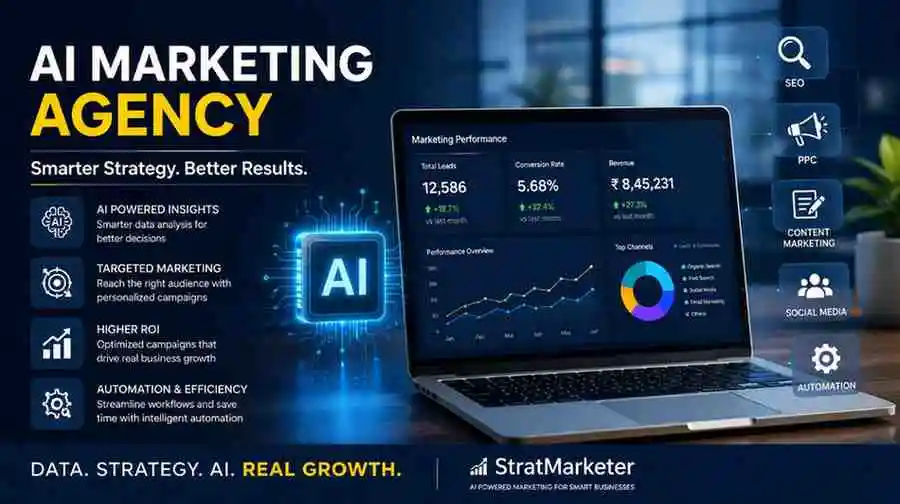
An experienced AI marketing agency works across every stage of the customer journey. Artificial intelligence becomes part of research, planning, content creation, SEO, paid advertising, lead generation, customer engagement, reporting, and ongoing optimisation.
Instead of relying only on manual analysis, AI can quickly process thousands of data points that would otherwise take days to review. This allows marketers to identify patterns that often remain hidden during traditional campaign management.
For example, an AI powered marketing team may discover that visitors arriving through informational blog content spend more time on product pages than users coming from certain paid advertisements. That insight helps reshape the entire marketing strategy instead of simply adjusting advertisement budgets.
An AI marketing agency also helps businesses produce personalised customer experiences at scale. Website content, email campaigns, advertising creatives, landing pages, and follow up communication can be adapted based on customer interests instead of sending identical messages to everyone.
Search engine optimisation has also changed considerably. Ranking on Google now depends on content quality, topical authority, search intent, user satisfaction, technical performance, and overall search experience. AI assists by analysing search trends, identifying content gaps, clustering keywords, monitoring competitor strategies, and suggesting opportunities that human researchers may overlook.
Still, I disagree with agencies that claim AI can completely automate digital marketing. Some decisions require experience that no software currently possesses. Understanding why a family owned jewellery business speaks differently from a technology startup is something algorithms often miss.
A strong AI marketing agency understands that technology should support human expertise rather than replace it.
Businesses also benefit from faster reporting. Instead of waiting until the end of every month to understand campaign performance, AI powered dashboards can monitor important metrics continuously. Marketing teams can react earlier when campaigns begin losing effectiveness.
This becomes especially valuable during seasonal campaigns, product launches, or highly competitive markets where even small delays can affect overall results.
How AI, Human Strategy and Data Work Together to Deliver Better Marketing Results
Successful marketing has never depended on technology alone.
Even the most advanced AI systems cannot build customer trust without meaningful messaging, thoughtful branding, and genuine understanding of business goals. The strongest results usually come when artificial intelligence, experienced marketers, and reliable business data work together rather than separately.
An AI marketing agency combines these three elements throughout every marketing activity.
Artificial intelligence handles large volumes of information quickly. It identifies search trends, predicts customer behaviour, monitors campaign performance, segments audiences, analyses competitors, and detects patterns that humans might overlook.
Human marketers then interpret those insights.
They decide which opportunities actually matter for the business. They understand local buying behaviour, customer emotions, pricing concerns, industry competition, and brand positioning. Data may suggest one direction, but experience sometimes points somewhere else.
I have seen both happen.
A software company once wanted to target only high search volume keywords because every report suggested that approach. On paper it looked perfect. In reality, those keywords attracted people looking only for free information. After shifting focus towards commercial search intent with lower search volumes, enquiry quality improved noticeably. Earlier I said data leads to better decisions, and I still believe that. Yet data without business context can easily become misleading. That contradiction appears more often than people realise.
An AI marketing agency also improves campaign speed. Instead of spending days preparing reports, marketers spend more time solving actual business problems. AI automates repetitive analysis while professionals focus on strategy, creative thinking, customer communication, and continuous improvement.
Another important advantage is prediction.
AI models can estimate which campaigns are likely to perform well, which customer segments deserve additional investment, and which marketing channels may require immediate attention. These predictions are never perfect, but they often help businesses avoid expensive mistakes.
Sometimes they do not.
That is why experienced marketers still review recommendations before making important decisions.
There is also an emotional side that people rarely discuss. I still feel uncomfortable when businesses blindly trust every AI recommendation without questioning it. Marketing is about people first. Numbers explain behaviour, but they do not explain every reason behind it.
And sometimes they never will.
Services You Can Expect from StratMarketer AI Marketing Agency
Every business has different goals. A manufacturing company may want dealer enquiries. A hospital may need appointment bookings. An ecommerce brand focuses on sales, while a local service provider wants qualified phone calls. Because of this, a good AI marketing agency should never offer exactly the same marketing plan to everyone.
At StratMarketer, the focus is on understanding the business first and selecting the marketing channels that actually contribute to growth instead of chasing every new trend.
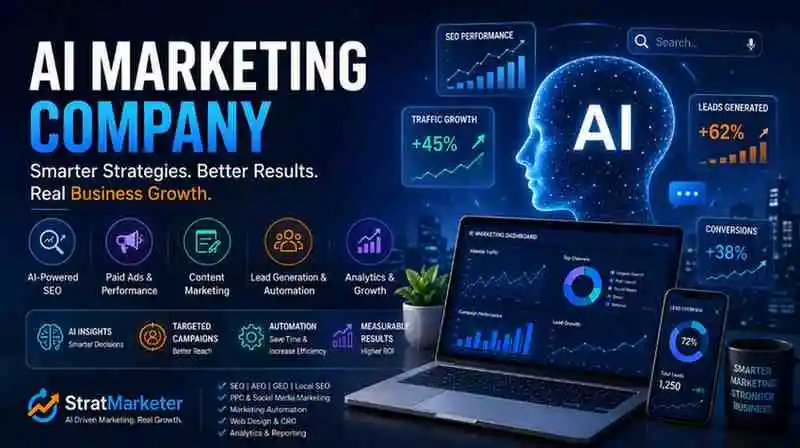
The services offered by StratMarketer cover the complete digital marketing journey.
Search Engine Optimization helps businesses improve their organic visibility across Google and modern AI powered search experiences. Website design focuses on creating fast, responsive, and user friendly websites that encourage visitors to stay longer and take action. Content marketing includes blogs, landing pages, service pages, industry resources, and authority building content that answers real customer questions.
Businesses also receive support for PPC advertising, Google Ads, Meta Ads, LinkedIn campaigns, YouTube advertising, remarketing, and conversion focused landing pages.
Social media marketing goes beyond posting regular updates. It involves audience research, content planning, creative production, paid promotions, engagement strategies, and performance analysis that align with business objectives.
Automation has become another important service. Instead of manually following up with every enquiry, businesses can automate email sequences, WhatsApp communication, lead nurturing, appointment reminders, CRM workflows, and customer segmentation without losing the personal touch.
An experienced AI marketing agency also provides services such as Local SEO, Google Business Profile optimisation, online reputation management, AI driven lead generation, Search Experience Optimization, Voice Search Optimization, Generative Engine Optimization, Answer Engine Optimization, analytics reporting, competitor analysis, and marketing automation.
I have seen businesses invest in every available platform simply because competitors were doing the same. Most of those campaigns never produced meaningful results. Sometimes fewer channels managed properly generate far better outcomes than trying to be visible everywhere.
That decision is often difficult because every platform promises quick success.
SEO, Content Marketing and Search Experience That Build Long Term Organic Growth
Organic growth rarely happens by accident.
Businesses that consistently appear in search results usually invest in quality content, technical improvements, customer experience, and continuous optimisation over several months rather than expecting immediate rankings.
A professional AI marketing agency understands that search engines evaluate much more than keywords today. Google wants content that genuinely answers user questions, demonstrates expertise, loads quickly, provides a good browsing experience, and satisfies visitors after they click.
This is where AI becomes useful.
Instead of manually researching hundreds of search terms, AI helps identify emerging topics, customer questions, semantic relationships, search intent, and content opportunities that deserve attention. Experienced SEO professionals then refine those insights into meaningful content strategies instead of publishing articles simply because a tool suggested them.
At StratMarketer, SEO begins with understanding the audience rather than chasing rankings alone.
Keyword research, competitor analysis, technical SEO audits, internal linking, schema implementation, content optimisation, topical authority building, website architecture improvements, and regular performance monitoring all work together to strengthen long term visibility.
Content marketing follows the same philosophy.
A single blog rarely changes business performance. Consistent publishing of helpful content across related topics gradually builds authority within an industry. Customers begin recognising the business as a trusted source instead of another company trying to sell something.
Search Experience Optimization has also become increasingly important.
Ranking first means very little if visitors leave immediately because the website is confusing, slow, or difficult to navigate. An AI marketing agency evaluates user behaviour, click patterns, engagement metrics, and navigation flow to improve the complete search experience after visitors arrive.
Earlier I mentioned that SEO delivers long term value. I still believe that strongly. Yet there are situations where businesses launching a new product simply cannot wait several months for organic traffic. In those cases, combining SEO with paid advertising often makes much more sense than relying on either strategy alone.
PPC, Social Media, Automation and AI Powered Campaign Management for Better ROI
Paid advertising has become more competitive than ever.
Many businesses increase advertising budgets hoping for better results, only to discover that higher spending does not automatically generate more enquiries or sales. Campaign quality matters far more than campaign size.
An experienced AI marketing agency approaches paid marketing differently.
AI helps analyse audience behaviour, identify high performing creatives, predict campaign performance, monitor bidding patterns, detect wasted spending, and recommend budget adjustments before costs become difficult to control.
Google Ads, Meta Ads, LinkedIn campaigns, YouTube advertising, display advertising, remarketing, and shopping campaigns all benefit from continuous optimisation rather than occasional updates.
Creative testing has also changed.
Instead of running one advertisement for several months, businesses can quickly test multiple headlines, visuals, audience segments, landing pages, and offers to understand what resonates with potential customers. AI speeds up this testing process while marketers interpret the results within the context of business objectives.
Social media marketing follows a similar pattern.
Posting regularly is no longer enough. Successful campaigns combine educational content, videos, customer stories, community engagement, influencer collaborations, paid promotions, and detailed audience analysis to create meaningful interactions rather than vanity metrics.
Automation quietly supports everything happening behind the scenes.
Lead enquiries can automatically enter CRM systems. Prospective customers receive personalised follow up messages. Sales teams receive notifications when leads show buying intent. Reports update automatically, allowing marketers to spend less time preparing spreadsheets and more time improving campaigns.
Sometimes automation works so smoothly that businesses hardly notice it.
And perhaps that is exactly how it should be.
How AI Marketing Helps Businesses Generate Better Quality Leads and Higher Conversions
Traffic alone does not grow a business.
Most business owners eventually realise that attracting thousands of visitors means very little if very few become genuine customers. The real objective is generating qualified leads that have a genuine interest in the product or service being offered.
A skilled AI marketing agency focuses on this difference from the beginning.
AI analyses visitor behaviour across websites, advertisements, emails, landing pages, and search activity to understand which audiences are more likely to convert. This allows marketing efforts to become more focused instead of reaching everyone with the same message.
Landing pages can also be improved using behavioural insights.
If visitors repeatedly abandon enquiry forms at a particular step, AI tools highlight those friction points. Small improvements such as simplifying forms, improving page speed, changing headlines, or adding stronger trust signals often produce noticeable increases in enquiries.
I remember reviewing a service website where almost every visitor clicked the pricing page but very few submitted an enquiry. We initially assumed pricing was the issue. After watching user recordings, it became obvious that people could not easily find the enquiry button on mobile devices. Fixing that simple design problem increased lead generation more than rewriting the entire website.
This may not apply everywhere, but many businesses underestimate how much user experience influences conversions.
An AI marketing agency also improves lead quality by identifying customer intent earlier in the buying journey. Prospects researching solutions receive educational content, while customers showing stronger purchase intent receive more direct offers, consultations, demonstrations, or product information.
The result is not simply more leads.
It is better conversations with people who are genuinely interested.
Why Businesses Across Different Industries Trust StratMarketer as Their AI Marketing Agency
Trust is difficult to earn in digital marketing.
Many businesses have already worked with agencies that promised first page rankings within weeks or guaranteed thousands of leads without understanding the business itself. After experiences like those, owners naturally become cautious before investing again.
StratMarketer approaches marketing differently by combining experienced strategy with modern AI capabilities rather than treating artificial intelligence as a replacement for professional judgement.
As an AI marketing agency, StratMarketer works with businesses across manufacturing, healthcare, education, real estate, ecommerce, professional services, local businesses, technology companies, hospitality, finance, and many other industries because the core marketing principles remain similar even though customer behaviour changes between sectors.
Every campaign begins with research.
Business objectives, customer expectations, competitor activity, search demand, website performance, and existing marketing data are reviewed before recommendations are made. That reduces guesswork and helps businesses prioritise activities that are more likely to produce measurable outcomes.
Transparency also matters.
Clients receive regular performance reports, practical recommendations, and clear explanations instead of complicated marketing terminology. When campaigns perform well, the reasons are discussed. When improvements are needed, those conversations happen honestly too.
I sometimes wonder if agencies spend too much time trying to impress clients with complicated reports instead of explaining simple business outcomes.
Perhaps.
Businesses also appreciate having multiple marketing services managed under one strategy instead of coordinating several separate vendors for SEO, advertising, content, social media, automation, and website management.
That consistency helps every marketing channel support the others.
Over time, this integrated approach allows businesses to build stronger online visibility, generate better quality enquiries, improve customer engagement, and make more informed marketing decisions with the support of an experienced AI marketing agency like StratMarketer.
Common Questions to Ask Before Hiring an AI Marketing Agency
Choosing an AI marketing agency is not only about comparing prices or checking how many services are listed on a website. The right partner should understand your business, your customers, and the challenges within your industry. AI is a valuable tool, but without a clear strategy it becomes another piece of software that produces reports without creating business growth.
Before making a decision, spend time asking questions that reveal how the agency actually works.
Ask how they build a marketing strategy instead of simply asking which AI tools they use. Good agencies will talk about understanding your business goals, customer journey, competitors, and search behaviour before recommending any campaigns.
Find out who will manage your account. Artificial intelligence can automate research, reporting, and campaign optimisation, but experienced marketers should still review every important decision. If an agency claims everything is fully automated, I would personally be cautious. Marketing still needs human judgement.
Request examples of measurable business outcomes rather than only screenshots showing impressions or website traffic. Increased visibility is useful, but qualified enquiries, sales, and revenue usually matter much more.
It is also worth asking how they measure success over time. A reliable AI marketing agency should explain the key performance indicators they monitor and how they adjust campaigns when results are below expectations.
Another important question involves transparency. Will you receive regular reports? Will recommendations be explained in simple language? Can you understand where your marketing budget is being invested?
I have seen businesses sign long contracts without asking these basic questions, only to realise months later that they never truly understood what work was being done.
One final thought.
Do not choose an agency simply because it talks about AI more than everyone else. Choose one that explains how AI will actually help your business grow.
Frequently Asked Questions About Choosing an AI Marketing Agency
What is an AI marketing agency?
An AI marketing agency combines artificial intelligence with experienced marketing professionals to improve SEO, paid advertising, content marketing, social media, automation, lead generation, and overall marketing performance. AI supports faster analysis and better decision making, while human experts develop strategy and creative direction.
How is an AI marketing agency different from a traditional digital marketing agency?
A traditional agency often depends heavily on manual research and reporting. An AI marketing agency uses artificial intelligence to analyse data, predict trends, automate repetitive tasks, personalise campaigns, and identify opportunities much faster while still relying on experienced marketers for strategic decisions.
Is AI marketing suitable for small businesses?
Yes. Small businesses can benefit from AI powered marketing because it helps use limited budgets more efficiently. Better audience targeting, smarter content planning, campaign optimisation, and marketing automation can improve results without unnecessarily increasing advertising costs.
Can AI replace human marketers?
No. AI can analyse information quickly and automate repetitive work, but it cannot replace business experience, creativity, customer understanding, or strategic thinking. The best results usually come from combining technology with experienced professionals.
How long does it take to see results from an AI marketing agency?
It depends on the marketing channels being used. Paid advertising may generate enquiries within days, while SEO and content marketing often require several months to build consistent organic visibility. Every business grows at a different pace.
Does AI improve SEO rankings?
AI itself does not improve rankings automatically. It helps identify keyword opportunities, content gaps, search intent, technical issues, and optimisation opportunities. Rankings improve when those insights are implemented through a well planned SEO strategy.
What industries can benefit from an AI marketing agency?
Almost every industry can benefit, including manufacturing, healthcare, education, real estate, ecommerce, finance, hospitality, professional services, technology companies, and local businesses. The marketing strategy should always be adapted to the specific industry and customer behaviour.
Why should businesses choose StratMarketer as their AI marketing agency?
StratMarketer combines AI powered insights with practical marketing experience to create strategies focused on business growth rather than vanity metrics. From SEO and content marketing to PPC, social media, website development, automation, lead generation, and analytics, StratMarketer builds integrated marketing systems designed to generate qualified leads, strengthen online visibility, and support long term business success.