


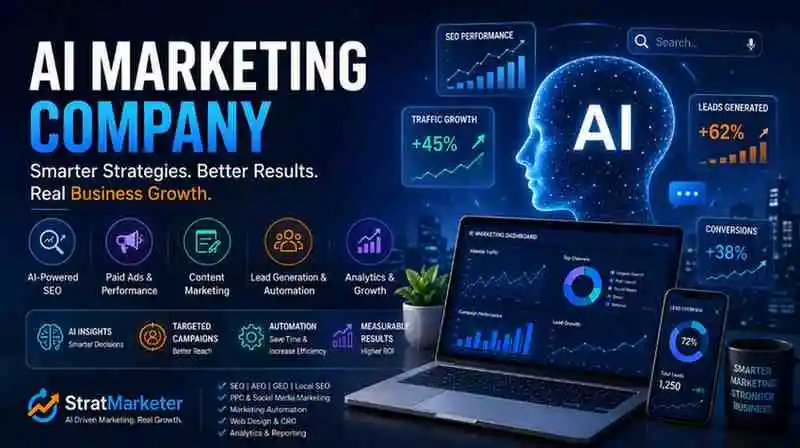
Why Businesses Are Turning to an AI Marketing Company Instead of Traditional Agencies
A few years ago, most businesses looked for a digital marketing agency that could manage SEO, run Google Ads, post regularly on social media, and send monthly reports. That approach still works to some extent, but the way customers search, compare, and make buying decisions has changed dramatically. People now ask AI assistants for recommendations, expect personalised experiences, and interact with brands across multiple platforms before making a purchase.
This shift has made many businesses rethink their marketing strategy. Instead of hiring separate specialists for content, advertising, SEO, automation, and analytics, they are increasingly choosing an AI marketing company that can connect these activities into one intelligent system.
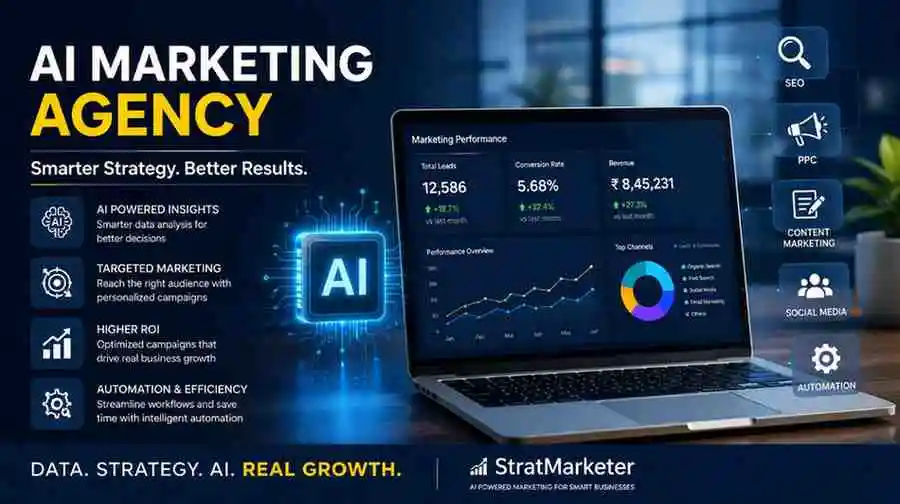
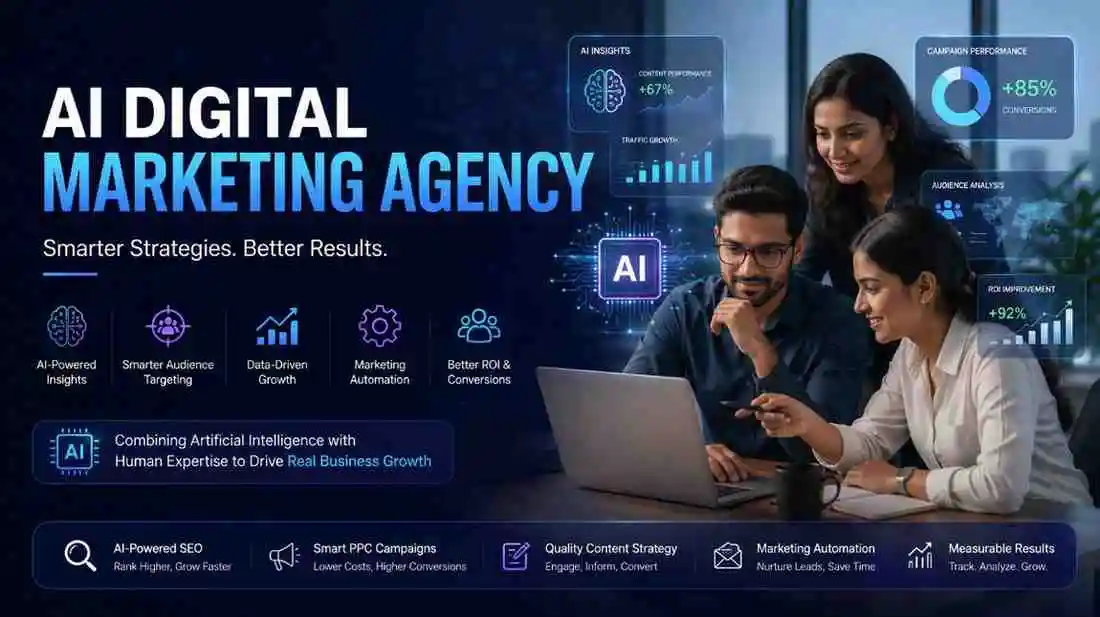
An AI marketing company does not replace human marketers. It combines artificial intelligence with experienced professionals who know how customers behave, what motivates buying decisions, and how different marketing channels influence each other. AI processes large amounts of information quickly, while marketers use that information to make practical decisions that fit real business goals.
I’ve seen businesses spend months creating content without understanding what their audience was actually searching for. A furniture retailer once focused almost entirely on promotional posts because they believed frequent offers would increase sales. The website traffic remained flat. After analysing search behaviour and customer questions, the content strategy shifted toward buying guides, comparison articles, and product education. The results improved gradually because the marketing finally matched customer intent rather than assumptions.
Traditional agencies often work in separate departments. The SEO team focuses on rankings. The paid advertising team looks after campaigns. Social media follows another plan. While each department may perform well individually, the overall customer experience can become disconnected.
An AI marketing company connects these activities. Customer insights from advertising campaigns can improve SEO content. Search behaviour can shape social media topics. Website analytics can identify where users lose interest, allowing businesses to improve conversions instead of simply increasing traffic.
That connected approach is becoming more valuable than simply doing more marketing.
What an AI Marketing Company Actually Does Beyond Basic Digital Marketing
Many people assume an AI marketing company simply uses ChatGPT or another AI tool to write content faster. That idea misses most of what AI can actually contribute.
Modern AI marketing involves analysing customer behaviour, predicting trends, identifying opportunities, automating repetitive work, improving campaign performance, and helping businesses make decisions using real data instead of guesswork.
For example, instead of manually reviewing thousands of keywords, AI can identify search patterns, seasonal demand, and emerging topics within minutes. Experienced marketers then decide which opportunities are commercially valuable rather than chasing every keyword with search volume.
Content creation follows a similar pattern. AI can help organise research, identify related questions, and speed up production, but experienced writers still shape the content with industry knowledge, local understanding, and practical experience. Without human judgement, content often becomes repetitive and lacks the credibility that readers expect.
An AI marketing company also improves paid advertising by continuously analysing campaign performance. Rather than waiting for monthly reports, marketers can identify which audience segments respond best, which creatives lose effectiveness, and where advertising budgets should be adjusted.
Marketing automation is another area where businesses notice immediate benefits. Instead of manually following up every enquiry, AI can organise leads, personalise communication, and support sales teams without making interactions feel robotic. Of course, this works only when automation is designed carefully. Poor automation often frustrates customers more than it helps them.
Search itself is evolving too. Businesses no longer compete only for traditional Google rankings. Customers now discover brands through AI search experiences, voice assistants, answer engines, YouTube, social platforms, and conversational search tools. An experienced AI marketing company understands that visibility now extends far beyond one search engine.
That broader perspective is becoming increasingly important for businesses planning long term growth.
How AI and Human Expertise Work Together to Build Better Marketing Campaigns
One concern I hear quite often is that AI will eventually replace marketers. From what I’ve experienced, that hasn’t happened. If anything, businesses need experienced marketers even more because AI produces enormous amounts of information, and someone still has to decide what actually matters.
AI can identify patterns that humans may overlook. It can compare campaign performance across thousands of keywords, analyse customer behaviour, recommend bidding adjustments, and highlight unusual changes in website traffic. These capabilities save time and improve decision making.
But strategy still comes from people.
An AI marketing company understands where automation should stop and human judgement should begin. Customer emotions, brand positioning, pricing decisions, competitive messaging, and long term business planning still require experience that algorithms cannot fully replicate.
I remember discussing lead generation with a local education institute that wanted to automate almost every enquiry. On paper, the workflow looked efficient. In reality, prospective students had questions that required reassurance, not automated replies. The business eventually reduced automation during the final consultation stage because human conversations produced significantly better enrolment rates.
That experience changed how I look at AI. Technology works best when it supports relationships rather than replacing them.
I might be wrong here because every industry behaves differently, but businesses that rely entirely on automation often struggle to build trust over time. Customers still notice authenticity.
This doesn’t mean traditional methods are always outdated. Some industries with highly specialised services still depend heavily on personal relationships, referrals, and face to face discussions. AI supports those efforts rather than replacing them completely.
The strongest marketing campaigns usually combine fast analysis from AI with thoughtful decisions made by experienced professionals. That balance helps businesses respond more quickly to changing customer behaviour without losing the human understanding that marketing has always depended on.
SEO, AEO, GEO, and Search Experience Optimisation in the Age of AI
Search has changed more in the last few years than many businesses expected. Ranking on Google is still important, but it is no longer the only goal. People now search through AI assistants, voice search, YouTube, social platforms, and answer engines. Sometimes they don’t even click a website because the answer appears directly in front of them.
That is exactly why an AI marketing company looks beyond traditional SEO.
Search engine optimisation still focuses on helping websites rank for relevant keywords, but businesses also need to think about Answer Engine Optimisation, Generative Engine Optimisation, and Search Experience Optimisation. Each one plays a different role in how people discover brands online.
AEO helps your content become clear enough for search engines and AI assistants to provide direct answers. GEO focuses on making content understandable for generative AI platforms that summarise information instead of simply listing websites. Search Experience Optimisation looks at what happens after someone lands on your website. If visitors leave within a few seconds because the page loads slowly or feels confusing, rankings alone rarely produce meaningful business growth.
I’ve noticed many companies celebrating higher traffic while enquiries remain exactly the same. Usually the problem isn’t visibility. It’s the experience after the click.
A manufacturing business once invested heavily in SEO and managed to rank for several competitive terms. Traffic increased steadily, yet enquiries barely changed. After reviewing the website, the issue became obvious. Important product details were difficult to find, enquiry forms asked for too much information, and mobile navigation felt frustrating. Once those problems were fixed, conversions improved without adding more traffic.
That experience convinced me that rankings and business growth are not always connected in the way people assume.
An experienced AI marketing company studies user behaviour, search intent, content quality, technical performance, and customer journeys together instead of treating SEO as a separate activity. That integrated approach often produces stronger long term results.
Smarter Content, Paid Advertising, and Lead Generation Powered by AI
Creating more content doesn’t automatically generate more business. Publishing daily articles or social media posts without understanding audience intent usually creates noise instead of value.
An experienced AI marketing company starts by understanding why customers search, what information they need, and what questions prevent them from making a decision.
Artificial intelligence helps analyse search trends, customer behaviour, competitor strategies, and content gaps much faster than manual research. This allows marketers to focus their time on developing useful content instead of spending days collecting information.
Content also performs better when combined with advertising.
For example, if paid campaigns reveal that customers respond strongly to one service, those insights can shape future blog articles, landing pages, email campaigns, and video content. Similarly, SEO data can identify high intent keywords that deserve larger advertising budgets.
I’ve worked with businesses where the SEO and PPC teams barely communicated with each other. Both teams were working hard, but valuable insights stayed inside separate reports. Once the campaigns started sharing data, customer acquisition became far more efficient because every channel supported the others.
Lead generation has also become much smarter.
Instead of treating every visitor the same way, AI can identify high intent users based on their behaviour, returning visits, page interactions, and previous enquiries. Marketing teams can then personalise follow ups based on where prospects are in their buying journey.
Still, I sometimes worry that businesses rely too heavily on automation. People buying expensive products or professional services often need reassurance from another person before making a decision. AI speeds up communication, but trust usually develops through genuine conversations.
That’s something technology hasn’t completely solved.
Website Design, Marketing Automation, and Customer Journey Optimisation
Many businesses think marketing begins after a website goes live. In reality, the website itself is one of the biggest marketing assets a company owns.
A professionally designed website should do much more than look attractive. It should guide visitors naturally from curiosity to enquiry without creating unnecessary confusion.
An experienced AI marketing company studies how visitors move through a website. Which pages keep their attention? Where do they leave? Which forms get completed? Which pages quietly lose potential customers?
Those answers often matter more than increasing traffic.
A local healthcare clinic once redesigned its website with impressive graphics and animations. Everything looked modern. Unfortunately, appointment bookings declined because important contact information became harder to find. The redesign focused on appearance instead of usability.
Simple changes eventually solved the problem.
Marketing automation supports this journey by reducing repetitive work while improving customer communication. New enquiries can receive immediate acknowledgements. Existing customers can receive personalised updates. Sales teams can prioritise leads based on genuine buying signals instead of contacting everyone in exactly the same way.
Customer journey optimisation connects every stage together.
Someone may first discover your business through Google Search, later watch your YouTube videos, read customer reviews, visit your website several times, and finally contact your sales team after receiving an email reminder. An AI marketing company looks at that entire journey rather than measuring each marketing channel independently.
Sometimes one small improvement creates surprisingly large results.
Sometimes it doesn’t.
How StratMarketer Helps Businesses Grow with AI Driven Marketing Strategies
Businesses rarely struggle because they lack marketing activities. Most struggle because those activities operate independently.
This is where StratMarketer follows a different approach.
Rather than offering isolated services, StratMarketer builds connected marketing systems where SEO, paid advertising, content marketing, website development, automation, social media, local SEO, AI integration, and analytics work together toward measurable business goals.
As an experienced AI marketing company, StratMarketer begins by understanding the business itself before recommending marketing solutions. Every industry has different buying behaviour. A manufacturing company, a healthcare provider, and an ecommerce business cannot follow the same strategy simply because they all want more leads.
The team analyses customer intent, website performance, search visibility, competitor positioning, and existing marketing efforts before creating an execution plan. Artificial intelligence supports research, forecasting, campaign optimisation, and performance monitoring, while experienced specialists make strategic decisions based on business priorities.
This combination allows businesses to respond faster to changing customer behaviour without losing the practical judgement that experienced marketers bring.
StratMarketer also focuses on newer search opportunities through SEO, AEO, GEO, voice search optimisation, local SEO, Google Business Profile optimisation, content marketing, AI powered automation, and Search Experience Optimisation.
I appreciate this broader approach because marketing channels rarely succeed in isolation anymore. One successful campaign often influences another in ways that monthly reports don’t fully capture.
Of course, no strategy works overnight. Sustainable growth still requires consistency, testing, and regular improvements. AI makes those improvements faster, but it doesn’t remove the need for patience.
Common Mistakes Businesses Make When Choosing an AI Marketing Company
The biggest mistake is believing every company using AI delivers the same level of expertise.
Many agencies now describe themselves as an AI marketing company simply because they use AI writing tools or automated reporting software. Those tools certainly improve productivity, but they don’t automatically create better marketing strategies.
Businesses should pay attention to how the agency thinks rather than which software it uses.
Another common mistake is choosing purely on price.
Low cost packages often promise large numbers of blogs, backlinks, advertisements, or social media posts every month without explaining how those activities contribute to actual business growth. Marketing should solve problems, not simply complete monthly tasks.
I’ve seen companies switch agencies every few months expecting dramatic improvements each time. Eventually they spend more time changing partners than building consistent marketing momentum. That cycle becomes exhausting.
One issue I don’t completely agree with is the promise of guaranteed rankings. Search algorithms change constantly, competitors improve their websites, and customer behaviour evolves. Any AI marketing company claiming guaranteed first page rankings deserves careful questioning.
I might be wrong because some businesses operate in less competitive markets, but guarantees usually make me uncomfortable.
Another mistake is ignoring reporting quality.
Businesses often receive reports filled with impressions, clicks, and keyword movements while never discussing revenue, qualified leads, customer acquisition costs, or return on investment. Those numbers matter far more than vanity metrics.
And finally, don’t assume AI replaces experience.
The strongest AI marketing company combines intelligent technology with marketers who understand customers, industries, and business strategy. AI provides speed and insight. People provide judgement. That balance is usually where meaningful growth begins.
How to Evaluate the Right AI Marketing Company for Long Term Business Growth
Choosing an AI marketing company is not the same as hiring someone to manage social media or run a few advertising campaigns. You’re trusting a partner with your brand’s visibility, customer acquisition, and long term growth. That decision deserves more than comparing monthly pricing.
The first thing I usually recommend is looking beyond the agency’s website. Every company can claim expertise in AI, SEO, PPC, or automation. The better question is whether they can explain why a particular strategy suits your business instead of offering the same package to everyone.
Ask how they research your market.
Ask how they measure success.
Ask what happens if the first strategy doesn’t work.
The answers often reveal more than a polished sales presentation.
An experienced AI marketing company should also be comfortable discussing search behaviour, customer journeys, AI powered automation, conversion optimisation, content strategy, and business goals together. If every conversation revolves around rankings or impressions alone, something is probably missing.
Transparency matters just as much.
You should know what work is being done each month, why it is being done, and how it contributes to enquiries or revenue. Marketing reports should explain business outcomes, not simply display colourful graphs.
I also believe communication is underestimated. During one project, the technical work was actually quite good, but getting simple updates took weeks. That delay created unnecessary frustration because business owners were left guessing what was happening. Eventually, the relationship became harder than the marketing itself.
Perhaps that experience made me slightly biased.
Case studies can be useful too, but don’t judge them only by impressive traffic numbers. Look for examples where businesses generated qualified leads, improved conversion rates, increased revenue, or entered new markets successfully.
Another factor worth considering is adaptability.
Artificial intelligence, search engines, and customer behaviour continue to evolve. A reliable AI marketing company should regularly test new approaches instead of relying on strategies that worked several years ago. At the same time, not every new trend deserves immediate attention. Good marketers know the difference between genuine opportunities and temporary excitement.
This may not apply everywhere, but I generally trust agencies that admit when something is uncertain instead of pretending they have every answer.
Long term growth rarely comes from shortcuts.
It usually comes from consistent execution, honest reporting, continuous testing, and a marketing partner willing to improve the strategy as your business grows.
Frequently Asked Questions About Hiring an AI Marketing Company
What is an AI marketing company?
An AI marketing company combines artificial intelligence with experienced marketing professionals to improve SEO, paid advertising, content marketing, website optimisation, automation, lead generation, and customer acquisition. AI supports faster analysis and better decision making, while people create the strategy.
Is an AI marketing company better than a traditional digital marketing agency?
For many businesses, yes. An AI marketing company can analyse larger volumes of customer data, optimise campaigns more quickly, and automate repetitive marketing tasks. However, results still depend on the experience of the people managing those tools.
Can AI replace human marketers?
Not completely.
AI can process information much faster than people, but it cannot fully understand customer emotions, business relationships, brand positioning, or industry experience. The strongest marketing strategies usually combine technology with human judgement.
How long does it take to see results from an AI marketing company?
It depends on the service.
Paid advertising may generate leads within days or weeks. SEO and organic growth usually require several months of consistent effort. Sustainable business growth is rarely immediate, even with AI.
What services should I expect from an AI marketing company?
A professional AI marketing company generally offers SEO, AEO, GEO, PPC management, content marketing, website design, marketing automation, local SEO, Google Business Profile optimisation, social media marketing, analytics, conversion rate optimisation, and AI powered campaign management.
Is AI generated content enough for SEO?
No.
AI can assist with research, outlining, and drafting, but content still needs human editing, industry knowledge, fact checking, and practical experience. Search engines increasingly reward content that demonstrates expertise and genuine value rather than simply producing large volumes of text.
How do I know if an AI marketing company is the right fit for my business?
Look at their process rather than their promises. A dependable AI marketing company should understand your business goals, explain its recommendations clearly, provide transparent reporting, and focus on measurable outcomes such as qualified leads, conversions, and revenue instead of vanity metrics alone.
I still think that’s the biggest difference. Businesses don’t really need more marketing activities. They need marketing that works together, adapts when customer behaviour changes, and continues delivering value long after the first campaign goes live. Sometimes the simplest idea ends up being the hardest one to implement.