


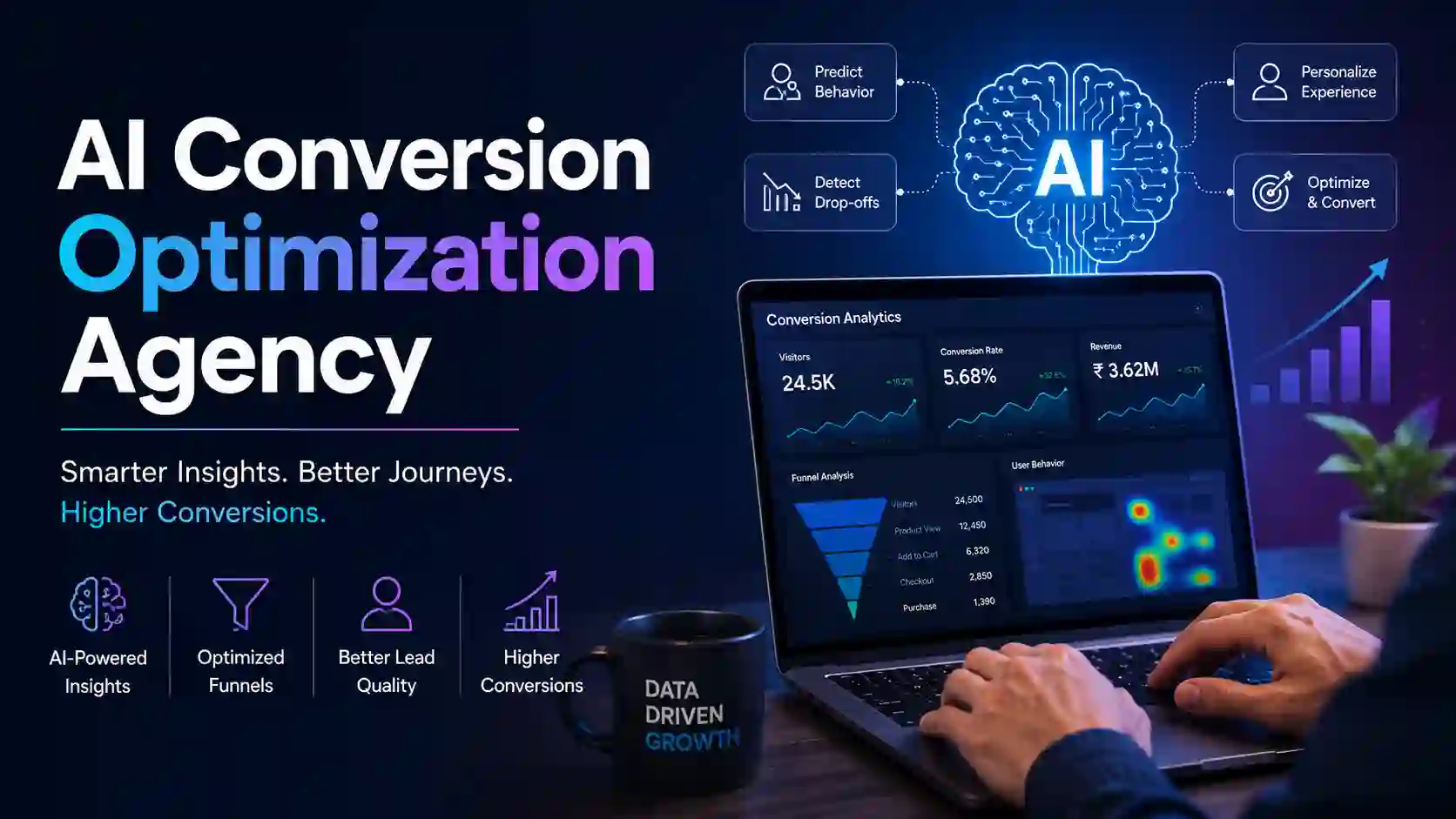
What Is an AI Conversion Optimization Agency and What Does It Actually Do?
A website can bring plenty of visitors and still fail to generate enough enquiries, purchases or sign ups. This is where an AI conversion optimization agency comes into the picture. The basic job is not simply to bring more people to a website. It is to understand why existing visitors are not taking the action a business wants them to take.
An AI conversion optimization agency studies what people do after they land on a website. Where do they stop? Which pages get attention? Which forms are abandoned? Are visitors reading the pricing section or leaving before reaching it? Does the call to action make sense on mobile? These questions sound simple, but finding reliable answers from thousands of visitor sessions is not always easy manually.
AI makes this analysis much faster.
For example, suppose a software company in Bengaluru receives 8,000 monthly visitors through Google and paid advertising but gets only 70 serious enquiries. The owner may assume the problem is traffic quality. Sometimes it is. But an AI conversion optimization agency may find that visitors are actually reaching the pricing page, spending time there and then leaving because the enquiry form asks for too many details.
That is a very different problem.
The work usually involves analysing website behaviour, conversion paths, landing pages, forms, customer journeys, traffic sources and historical performance. AI can process large amounts of this information and identify patterns that are difficult to notice by looking at a basic analytics dashboard.
But there is an important point here. AI does not automatically know why a customer behaves in a certain way. It identifies patterns. Human judgement is still needed to understand the business context and decide what should change.
I have seen businesses make the mistake of changing their entire website after noticing a poor conversion rate. That is usually unnecessary. A weak headline, confusing pricing information or a badly placed enquiry form can sometimes create the problem.
A good AI conversion optimization agency looks for those smaller issues before recommending major changes.
This is also why conversion optimization should not be treated as another form of SEO. SEO helps bring relevant people to the website. Conversion optimization focuses on what happens after they arrive. Both can work together, but they solve different problems.
Why Businesses Are Turning to AI for Conversion Optimization
There is a practical reason businesses are becoming interested in an AI conversion optimization agency. Websites now generate far more behavioural information than most teams can realistically study themselves.
A typical website may have data from Google Analytics, advertising platforms, CRM records, heatmaps, form submissions, customer conversations and sales records. Each source tells part of the story. The problem starts when someone has to manually connect all those pieces.
AI can help bring those patterns together.
Consider an Indian ecommerce company selling nutritional products. Its product pages may receive thousands of visits, but customers might add products to the cart and then disappear during checkout. Looking only at traffic numbers will not explain this. Looking at the complete customer journey may reveal that delivery charges appear late in the process or that the payment page creates uncertainty.
An AI conversion optimization agency can analyse these behavioural signals and identify where the journey is breaking down.
There is another reason for the shift. Customers do not behave identically anymore. Someone arriving from a branded Google search may already know the company. Someone arriving from Instagram may be discovering it for the first time. A person returning for the third time needs a different message from someone visiting for the first time.
AI can help identify these differences.
Personally, I prefer using AI for pattern recognition rather than letting it make every conversion decision. That distinction matters. A machine can tell you that mobile users abandon a form more often. It cannot always tell you whether the reason is poor trust, confusing language, slow loading or an offer that simply does not appeal to them.
That still needs people.
An AI conversion optimization agency is useful when AI is treated as an analytical assistant rather than a replacement for marketing judgement.
There is also a cost consideration. A business does not necessarily need to redesign a website every quarter. Sometimes a few carefully tested changes can produce a noticeable difference. AI can help identify which changes deserve attention first.
I might be wrong here, because every industry behaves differently, but I have generally found that businesses get more value when they fix obvious conversion friction before chasing sophisticated personalisation systems.
The flashy stuff can wait.
How AI Identifies Where Your Website Is Losing Potential Customers
One of the more useful jobs of an AI conversion optimization agency is finding the points where potential customers disappear.
Think about a simple journey.
A person searches for a service, lands on a page, reads the introduction, checks pricing, visits another page and then leaves without contacting the company. Traditional reporting may simply show a session and no conversion. That is not enough information.
AI can look at patterns across many such sessions.
It can compare visitors who converted with visitors who did not. It can examine the pages they visited, time spent on important sections, device type, traffic source, returning behaviour and other available signals. Over time, patterns start becoming visible.
For example, an AI conversion optimization agency may notice that users coming from paid search convert well on desktop but poorly on mobile. That immediately raises another question. Is the mobile page slower? Is the form difficult to complete? Is the CTA below too much content? Is the landing page mismatched with the advertisement?
The answer has to be investigated rather than assumed.
Heatmaps and session recordings can also help. If users repeatedly click on an element that is not clickable, that is a useful clue. If they stop scrolling before reaching the enquiry section, the page may be asking them to work too hard before giving them a reason to act.
Forms are another common problem.
A company may ask for name, email, phone number, company name, designation, company size, monthly budget and several other details before allowing a visitor to submit an enquiry. The internal team may want all this information. The visitor may simply leave.
This happens quite often with B2B websites.
An AI conversion optimization agency can compare completion rates at different stages and help determine whether the form is creating unnecessary friction.
Still, data has limitations. A low conversion rate does not always mean the website is bad. Some products have long buying cycles. A ₹500 product and a ₹5 lakh industrial service cannot be judged using the same conversion expectations.
That is where experience becomes important.
AI Based Landing Page and Website Conversion Optimization
Landing pages are often the first serious interaction a potential customer has with a company. If the page makes the visitor confused within the first few seconds, no amount of clever analytics will rescue the experience.
An AI conversion optimization agency can assess landing pages by looking at several factors together. The headline needs to match the visitor’s intent. The offer needs to be understandable. Supporting information should answer the questions people actually have. Trust signals should appear where they matter. The CTA should feel like a logical next step rather than an interruption.
Suppose a Chandigarh based education company runs Google Ads for an executive course. The advertisement says the course is designed for working professionals, but the landing page begins with a long company introduction. The actual course details are buried below.
That creates friction.
The visitor came looking for information about the course, not the company’s history.
AI can help identify differences between high converting and low converting page variations. It can also assist with testing headlines, CTA wording, content placement and different page structures.
But testing should not become random experimentation.
I strongly disagree with changing five major elements at once and then claiming that AI found the winning page. If the conversion rate changes, nobody knows what actually caused it. A sensible AI conversion optimization agency should still maintain a clear testing logic.
There are cases where a complete landing page rebuild makes sense. Usually, though, smaller changes are easier to measure.
For example, moving a key proof point closer to the CTA may matter more than rewriting the entire page. Shortening a form may matter more than adding another section. Clarifying the price may reduce hesitation more than adding another testimonial.
Sometimes the most useful change is boring.
And boring changes often work.
Using Customer Behaviour Data to Improve Conversion Rates
Customer behaviour data is where an AI conversion optimization agency can become genuinely useful, provided the data is interpreted properly.
Businesses often collect information without knowing what they want to learn from it. They have analytics installed, heatmaps running and CRM data available, but nobody regularly connects the information to actual customer behaviour.
AI can help organise this mess.
Suppose a private healthcare company receives enquiries through organic search, paid campaigns and social media. The marketing team may notice that social media brings more leads, while organic search brings fewer leads but a higher percentage of serious enquiries.
If the company only looks at lead volume, social media appears better.
If it looks at lead quality, the answer changes.
An AI conversion optimization agency can help compare these customer journeys and identify what happens after the initial conversion. This is important because a conversion is not always a sale. A form submission from someone who never answers the phone has limited commercial value.
This is particularly relevant for Indian B2B companies where sales cycles can involve several calls, WhatsApp conversations, quotations and internal approvals.
A website conversion should therefore be connected to what happens later.
AI can help identify which landing pages tend to generate better quality leads, which traffic sources produce customers rather than just enquiries and which visitor behaviours are associated with eventual purchases.
Personalisation is another area where behavioural data can be useful. Returning visitors may see different content from first time visitors. A visitor interested in one service can be shown relevant information instead of being pushed through the same generic journey as everyone else.
But there is a line here.
Too much personalisation can feel strange. If a website starts behaving as though it knows too much about a visitor, trust can fall rather than rise. This is one reason I would not recommend implementing every AI feature simply because it is available.
The objective is still simple. Help the right visitor understand the offer and take the next sensible step.
An AI conversion optimization agency can make that process more measurable. It can find patterns, prioritise problems and support testing. Yet the final decision still needs to make sense for the actual customer, not just for a dashboard.
That part is easy to forget when there is too much data sitting in front of you.
AI for Personalisation, User Journeys and Better Lead Quality
Not every visitor should be pushed through the same website journey.
A person searching for a service for the first time usually needs basic clarity. Someone who has already visited the website twice may be looking for pricing, proof, specifications or a way to contact the company. Treating both visitors exactly the same can make the website feel disconnected from what the person actually needs.
This is where an AI conversion optimization agency can use behavioural signals to make user journeys more relevant.
AI can analyse factors such as previous page visits, traffic source, search intent, device behaviour and interactions with important website elements. Based on these patterns, businesses can create different experiences for different visitor groups.
For example, imagine a B2B software company in Pune. A visitor arriving through a search for “inventory management software pricing” has a very different intent from someone searching for “what is inventory management software”. The first person is probably closer to making a decision. Sending both visitors to exactly the same generic page may not be the best approach.
Personalisation can also support lead quality.
A business may receive 300 enquiries every month and still complain that marketing is not working because sales teams are struggling to find genuine prospects. In such cases, increasing the number of leads is not necessarily the answer.
The better question is, which visitors are more likely to become actual customers?
An AI conversion optimization agency can examine historical customer and lead data to find behavioural patterns associated with higher quality prospects. Those insights can then influence landing pages, forms, messaging and follow up journeys.
For Indian businesses, this can be particularly useful because buying decisions often involve several people. A website visitor may be researching on behalf of a company and may not be ready to submit a form immediately. Someone else may return later from a different device.
So I would be careful about treating one website session as the complete customer journey. It often isn’t.
AI can help connect those patterns, but the quality of the underlying data still matters. If CRM records are incomplete or sales teams do not update lead stages properly, AI will be working with a blurry picture.
And a blurry picture can produce very confident wrong answers.
Common Conversion Problems AI Can Help Businesses Fix
Most conversion problems are not mysterious. They usually come from friction, uncertainty, poor communication or a mismatch between what brought the visitor to the page and what the page actually offers.
An AI conversion optimization agency can help identify several of these issues.
One common problem is unclear messaging. A website may describe itself using phrases like “end to end solutions” and “quality services” without explaining what the customer actually gets. Internally, the company understands the offer. A first time visitor does not.
Another issue is weak intent matching.
Suppose someone searches for “third party nutraceutical manufacturer in Himachal Pradesh” and lands on a general pharmaceutical manufacturing page. The company may technically offer the required service, but the visitor now has to search through the website to confirm it.
That extra effort can cost enquiries.
Slow mobile experiences are another problem, especially for businesses receiving traffic through social media and mobile search. A page that looks acceptable on a desktop can become frustrating on a smaller screen. Buttons may be difficult to tap, forms may require too much scrolling and important information may appear too far down.
AI can help identify these behavioural differences when enough data is available.
Then there are forms.
I have seen B2B websites asking for so many details that the enquiry form starts looking like a loan application. It may make sense internally, but from the customer’s side, it creates hesitation.
Checkout abandonment is another major issue for ecommerce businesses. Customers may add a product to their cart but leave when they see shipping charges, payment limitations or unexpected conditions.
Trust also matters.
Visitors may want to know about certifications, customer reviews, return policies, delivery timelines, case studies or contact details before committing. If these answers are missing, the visitor may simply move to another website.
An AI conversion optimization agency can help identify which information is missing by analysing search behaviour, page interactions, customer questions and conversion patterns.
Still, AI cannot fix everything.
If the actual product is poor, the pricing is unreasonable or sales follow up is terrible, changing the button colour will not solve the problem. I wish more conversion discussions started with this point because businesses sometimes spend weeks testing website elements while ignoring what happens after the lead arrives.
Conversion optimisation has limits.
The website can create the opportunity. It cannot control the entire buying decision.
How StratMarketer Uses AI for Conversion Optimization
At StratMarketer, the role of AI in conversion optimization should not be reduced to generating different headlines or asking a tool to redesign a landing page.
The more useful role is analytical.
An AI conversion optimization agency can use AI to examine large amounts of website and customer behaviour data, identify unusual patterns and highlight areas that deserve closer attention. StratMarketer can then combine these findings with human analysis to understand what is actually happening on the website.
The process starts with the conversion objective.
For one company, the main goal may be generating qualified B2B enquiries. For another, it may be ecommerce purchases. A SaaS company may care about free trial registrations, while a professional services company may care more about consultation bookings.
That difference changes how the website should be evaluated.
StratMarketer can look at the complete path from acquisition to conversion rather than judging individual pages in isolation. Traffic source, landing page experience, visitor behaviour, CTA interaction, form completion and post conversion lead quality all matter.
AI can then help identify patterns within this information.
For example, if a particular landing page receives strong traffic but consistently loses visitors before the enquiry section, that page deserves attention. If mobile visitors behave differently from desktop users, the mobile experience needs to be investigated. If one advertising message produces many leads but poor sales outcomes, the problem may begin before the lead reaches the website.
This is where human interpretation becomes important.
I would not trust an AI system blindly to decide what a business should change. It may detect a correlation and mistake it for a cause. A sudden conversion drop, for example, could be caused by a technical issue, a change in traffic mix or an offer change rather than the page design itself.
StratMarketer’s approach can therefore involve testing changes rather than assuming they will work.
A headline can be tested. A shorter form can be tested. Different CTA placements can be tested. A stronger explanation of the offer can be tested.
Then the actual behaviour decides.
There is some frustration involved in this work because not every test produces a dramatic improvement. Sometimes a change makes almost no difference. That is still useful information, though it is not particularly exciting to report.
The point is to understand what visitors respond to and gradually remove the things that create unnecessary resistance.
Mistakes to Avoid When Choosing an AI Conversion Optimization Agency
Choosing an AI conversion optimization agency purely because it mentions AI repeatedly is a mistake.
The technology itself is not the service.
A good agency should be able to explain what data it needs, what conversion problem it is investigating and how it will decide whether a change actually worked.
Be cautious when an agency promises a fixed conversion increase before looking at your website data. Conversion rates depend on the industry, offer, traffic quality, price, buying cycle and many other factors. Anyone guaranteeing a particular percentage without understanding these things is making a claim too early.
Another warning sign is excessive focus on tools.
You may hear about AI heatmaps, predictive analytics, automated testing and machine learning models. These can all be useful. But if the agency cannot explain what business problem those tools will solve, the technology becomes decoration.
Ask what happens after the analysis.
Will the agency test recommendations? How will results be measured? Will it look at lead quality or only form submissions? How frequently will changes be reviewed?
This matters especially for B2B companies. A website may show a higher conversion rate after reducing the form fields, but if sales receives a flood of irrelevant enquiries, the business has not necessarily improved.
I would also ask how much human review is involved.
AI can process information quickly, but website behaviour is connected to business context. A manufacturing company, a D2C skincare brand and a financial services company cannot all be optimised using the same assumptions.
Another common mistake is expecting immediate results.
Some changes can be measured quickly. Others need enough traffic and time to produce reliable evidence. If a website receives only a few hundred visitors a month, declaring a test winner after several days does not make much sense.
And do not ignore technical issues.
Sometimes the conversion problem is a broken form, slow page, tracking error or payment failure. It is not always a copywriting problem.
The agency should be willing to investigate the boring stuff too.
Frequently Asked Questions About AI Conversion Optimization Agencies
What does an AI conversion optimization agency do?
An AI conversion optimization agency analyses visitor behaviour and website performance to find reasons people are not completing important actions. It can use AI to identify patterns, support testing and help businesses make better decisions about pages, forms, user journeys and messaging.
Is AI conversion optimization only useful for ecommerce websites?
No. It can also be useful for SaaS companies, B2B businesses, service providers, education companies, healthcare businesses and manufacturers. The conversion action simply changes. It could be a purchase, enquiry, consultation booking, demo request or registration.
Can an AI conversion optimization agency guarantee higher conversions?
A responsible agency should be careful with guarantees. Conversion rates depend on traffic quality, pricing, product demand, competition and many other factors. Testing and evidence are more reliable than promising a specific percentage before analysing the website.
How does AI find conversion problems?
AI can analyse patterns in website visits, page journeys, device behaviour, form interactions and other available data. It may identify areas where visitors frequently leave or where converting users behave differently from non converting users. Those findings then need human interpretation.
Does AI replace CRO experts?
Not really. AI is good at processing large amounts of information and spotting patterns. Understanding why those patterns exist and deciding what the business should test still requires human judgement.
How long does conversion optimization take?
There is no universal timeline. A technical problem can sometimes be fixed quickly. Testing a landing page or understanding a longer B2B buying journey can take considerably more time because there needs to be enough real visitor and conversion data.
Should every website use AI personalisation?
No.
Personalisation is useful when there is a genuine difference in visitor intent and enough information to make the experience more relevant. Adding personalisation simply because it sounds advanced can make a website unnecessarily complicated.
What should I check before hiring an AI conversion optimization agency?
Look at how the agency thinks about your actual conversion problem. Ask what data they will analyse, how they measure success, whether they test their recommendations and whether they consider lead quality rather than just conversion volume.
That last part is important.
A website can generate more leads and still become worse for the sales team.
So when StratMarketer or any other AI conversion optimization agency talks about conversion improvement, the useful question is not just, “Did more people fill the form?”
It is, “Did more of the right people take the next step?”
That distinction usually becomes visible only after the numbers have been followed a little further, and sometimes the answer is uncomfortable.