


What Is an AI Remarketing Agency and How Does It Work?
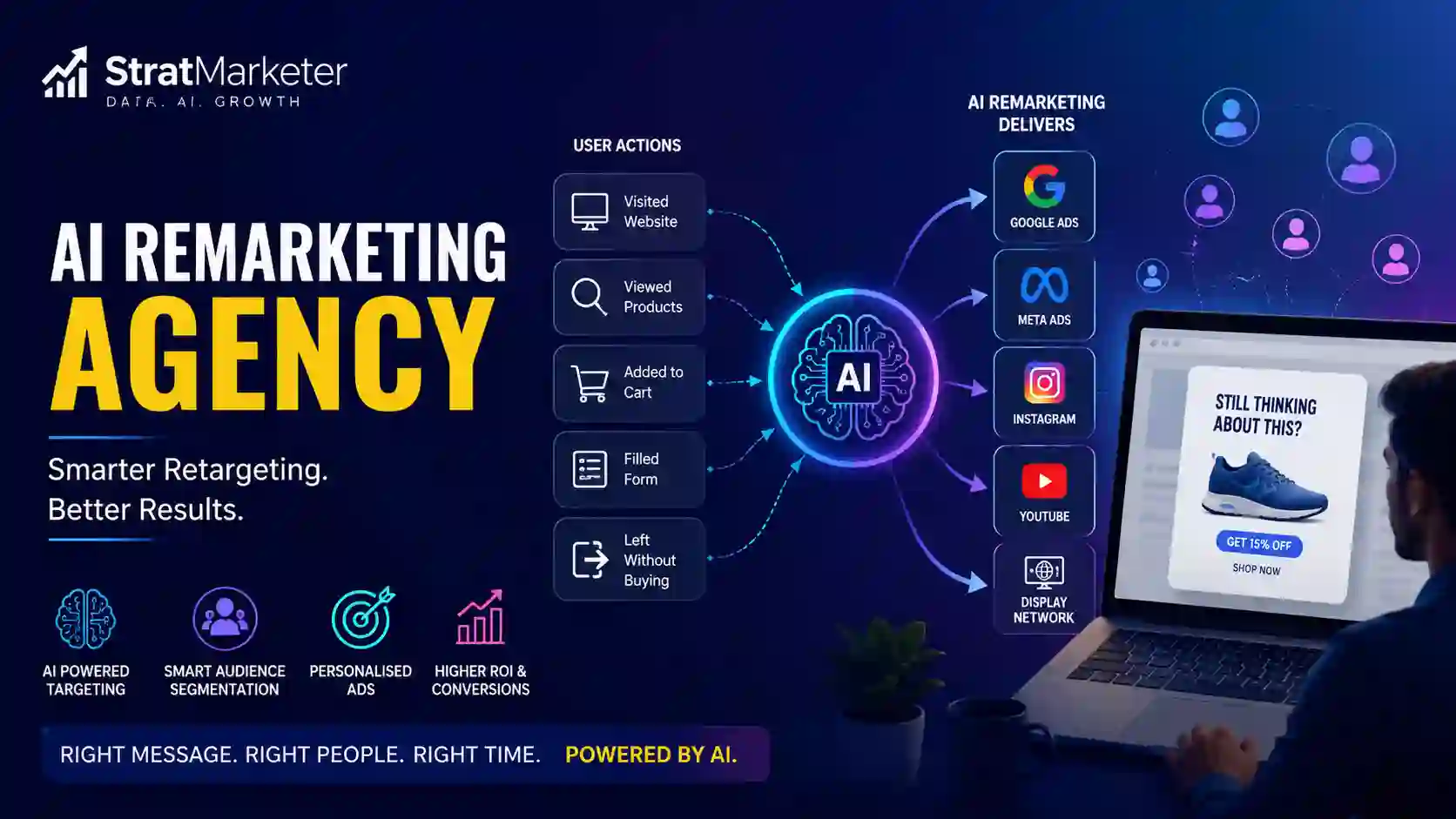
An AI remarketing agency helps businesses reconnect with people who have already interacted with their website, ads, products, landing pages, or other digital touchpoints. Instead of showing the same advertisement to everyone who visited a website, the agency uses artificial intelligence to understand what different visitors did and decide who should see which message, when, and through which advertising channel.
That difference sounds small, but it matters a lot once a business has enough traffic.
Someone who visited a product page for 30 seconds is not necessarily worth treating the same way as someone who added that product to their cart, reached the checkout page, and left without paying. Both are technically remarketing audiences, but their intent is very different.
A good AI remarketing agency works around this difference.
AI systems can examine behavioural signals such as pages viewed, products searched, previous purchases, time spent on a page, engagement with advertisements, device behaviour, location signals where legally and technically available, and previous interactions with a brand. These signals can then be used to create audience groups or predict which users are more likely to return and convert.
For example, consider an Indian online furniture store. A visitor checks three office chairs, spends several minutes comparing them, but leaves without buying. Another visitor lands on the homepage and leaves within a few seconds. Sending both users the same discount advertisement would be a poor use of the advertising budget.
The first person may simply need a reminder about the chair they were considering. The second person may not have shown enough interest to justify repeated advertising.
This is where AI can make remarketing more selective.
It can help identify patterns that are difficult to manage manually when thousands of visitors are moving through a website every week. The system can assign audiences based on behaviour, update those audiences as users interact again, and support decisions around bids, creatives, timing and frequency.
There is still human judgement involved. I would be cautious about agencies that make it sound as if AI simply switches on and takes over the campaign. It does not work that way in serious advertising accounts.
A business still needs the right tracking, sensible campaign structure, useful creative assets, clear conversion events and enough quality data. If those things are poor, AI has very little useful material to work with.
Why Traditional Remarketing Often Stops Working
Traditional remarketing worked remarkably well when online advertising was simpler.
A visitor came to a website, a tracking system placed them into an audience, and advertisements followed them around for a certain period. For many businesses, that alone produced conversions because the person had already shown some interest.
The problem is repetition.
A person looks at a pair of shoes once and then sees the same shoe advertisement for the next two weeks. They see it on Instagram, then on another website, then again while reading the news. After a point, the advertisement is no longer a reminder. It becomes irritating.
This is particularly noticeable in Indian markets where consumers often compare prices across several websites before making a purchase. A user may visit five competing websites, check reviews on YouTube, ask someone on WhatsApp, wait for a sale and then come back several days later.
A simple “You viewed this product” remarketing rule does not understand that journey very well.
There is another issue. Not every visitor has commercial intent.
Someone might have clicked a blog article from Google because they wanted information. Someone else may have visited a service page because a colleague sent them the link. Another visitor may have been seriously evaluating a purchase.
Treating all these people as one remarketing audience creates unnecessary impressions.
I have seen this kind of mistake particularly with lead generation businesses. A company gets a large amount of website traffic, builds one broad remarketing audience and starts advertising aggressively to everyone. The dashboard looks active, but the campaign keeps spending money on people who were never likely to become customers.
That is where I disagree with the old idea that more remarketing is automatically better. It isn’t.
Frequency can become a problem. Creative fatigue can become a problem. Poor audience exclusions can become a problem. And when these issues continue for months, businesses sometimes blame the advertising platform when the actual problem is campaign logic.
AI does not magically remove these issues, but it can help advertisers respond to them more intelligently.
How AI Changes Audience Segmentation and Remarketing
Audience segmentation is probably one of the most useful areas where AI can support remarketing.
Traditional segmentation usually depends on rules created by a marketer. Visitors who viewed a product go into one group. Cart abandoners go into another. Past customers are excluded or placed into a separate campaign.
That approach still has value. In fact, I would not throw it away.
AI adds another layer by looking for behavioural patterns within those groups.
Suppose an education company has 100,000 website visitors. A basic remarketing setup might divide them according to pages visited. AI can potentially identify that one group tends to return within three days, another group tends to convert after watching a particular video, and another group interacts with several course pages but rarely completes an enquiry form.
Those patterns can influence how audiences are treated.
A high intent visitor could receive a stronger conversion focused message. Someone still researching may receive useful information rather than an aggressive sales advertisement. Existing customers can be excluded from acquisition focused remarketing and moved into retention or cross sell campaigns.
This becomes especially useful when the customer journey is longer.
Think about a B2B software company selling services to Indian manufacturers. A person may visit the website, download a technical document, return two weeks later, read a case study and finally submit an enquiry. The conversion may not happen during the first visit.
AI can help analyse these sequences instead of looking only at the last click.
There is also predictive modelling. Advertising platforms increasingly use machine learning to estimate which users are more likely to complete a desired action. These systems can consider large numbers of signals that would be difficult for a marketer to manually evaluate.
But this is an area where I would keep expectations realistic.
AI predictions are based on available data. If tracking is incomplete, conversion events are poorly configured or the website gets very little traffic, the predictions may be weak. I might be wrong here for a particular business with unusually strong first party data, but small campaigns generally should not pretend they have the same predictive depth as a large ecommerce account.
Segmentation also needs exclusions.
A person who has already purchased a product should not necessarily keep receiving advertisements asking them to buy the exact same product. Similarly, people who have already submitted a lead form may need to be moved into a different communication journey.
Good remarketing is often about knowing who not to advertise to.
AI Remarketing Strategies for Google Ads and Social Media
Google Ads and social platforms provide different environments for remarketing, so the strategy cannot simply be copied from one channel to another.
On Google, intent can be particularly important. Someone searching for a service again after visiting a website may be much closer to making an enquiry than someone casually scrolling through social media.
AI can support bidding and audience decisions based on signals associated with conversion probability. Dynamic product advertising can also show users products connected to their previous browsing behaviour.
For an ecommerce business selling skincare products, for instance, a visitor who looked repeatedly at a particular sunscreen may receive a relevant product advertisement rather than a generic advertisement for the entire store.
That sounds obvious.
It becomes less obvious when the catalogue contains thousands of products and customer behaviour changes every day.
Social media remarketing has a different character. People may not be actively looking for the product when the advertisement appears. Creative quality and message relevance therefore become extremely important.
A visitor who watched 75 percent of a product demonstration could receive a different advertisement from someone who only opened the website once. Someone who engaged with an Instagram post might receive a softer reminder, while someone who abandoned a checkout could receive a direct purchase message.
AI can help advertisers identify these behavioural differences and decide how audiences should be approached.
For Indian businesses, language can also matter.
An advertisement for a local service may perform differently when the message reflects how people actually speak in that market. A coaching company targeting audiences in Delhi, Pune or Bengaluru may need different creative angles even when the underlying service remains the same.
AI can assist with testing variations, but the final message still needs human judgement. Local expressions can easily become awkward when generated without understanding the audience.
Another useful strategy is frequency management.
If a user has already seen an advertisement repeatedly without clicking, the system can reduce exposure or move the user into another audience. If someone is showing stronger intent, the campaign can give that person greater priority.
The goal is not to chase every visitor.
It is to spend more intelligently on the visitors who still have a realistic reason to return.
Personalised Ads, Dynamic Creatives and Better Follow Up
Personalisation is where remarketing becomes noticeable to the customer.
A generic advertisement says, “Check out our latest products.”
A more relevant advertisement might show the exact product someone viewed, a related product, a different size, a complementary item or a message based on the stage they appear to be in.
For ecommerce, dynamic creative systems can automatically pull product information from a catalogue and generate advertisements based on user behaviour.
Someone browsed running shoes.
They may see those running shoes again.
Someone purchased a pair of shoes.
They may later see socks, shoe care products or another relevant category instead of the same purchase request.
That second interaction is where many businesses leave money on the table.
Remarketing should not always mean “come back and buy the same thing.”
It can also support cross selling, repeat purchases, lead nurturing and customer retention.
For a healthcare equipment supplier, for example, someone who downloaded information about a particular machine may need a technical consultation rather than a discount. For a real estate company, someone who viewed two bedroom apartments may respond better to a message about a site visit or a new project update than a generic property advertisement.
The follow up should match the reason the person visited in the first place.
AI can help identify these patterns at scale. It can assist with deciding which creative variation should be shown, which audience should receive it and when the message should change.
But there is a limit.
Personalisation becomes uncomfortable when it feels too precise or invasive. A customer does not necessarily want an advertisement that makes it obvious the business has been tracking every small action they took.
There is a practical balance between relevance and over targeting.
I prefer remarketing that feels like a useful reminder rather than someone standing outside the shop asking why I did not buy anything.
That distinction matters more than many dashboards show.
How StratMarketer Uses AI for Remarketing Campaigns
At StratMarketer, the starting point for remarketing is not the advertisement itself. It is understanding what happened before the person left the website.
This sounds basic, but many campaigns still begin with a broad audience and a generic creative. Someone visits the pricing page, someone reads a blog, someone adds a product to the cart, and everyone ends up receiving almost the same remarketing message.
That is not how we prefer to approach it.
An AI remarketing agency needs to look at the customer journey first. StratMarketer can use behavioural signals, audience data, conversion patterns and campaign performance to create more meaningful remarketing groups.
For an ecommerce brand, that could mean separating product viewers from cart abandoners and previous customers. For a B2B company, it could mean distinguishing someone who downloaded a brochure from someone who repeatedly visited the service and pricing pages.
The advertising message can then reflect that difference.
AI can also help with creative testing. Instead of assuming one headline or visual will work for everyone, different versions can be tested against relevant audience groups. Over time, performance signals can help identify which combinations are producing stronger engagement or conversions.
There is a less glamorous part too.
Tracking needs to be checked.
If the conversion event is firing twice, if important pages are missing from audience rules, or if existing customers are not excluded properly, even an impressive looking AI campaign can make poor decisions. I have seen businesses spend weeks discussing creative performance when the real problem was tracking.
StratMarketer’s approach to AI remarketing therefore needs to combine automation with human review. AI is useful for processing large amounts of behavioural information, but a marketer still has to question whether the resulting campaign makes commercial sense.
That matters particularly for Indian businesses with mixed traffic sources, seasonal demand and customers who may take considerably longer to make a purchase.
Common Remarketing Mistakes That Waste Advertising Budgets
Remarketing can waste money quietly.
That is what makes it annoying. A campaign may keep producing impressions and clicks, while nobody notices that the underlying audience is getting weaker.
One of the most common mistakes is remarketing to everyone.
A person who visited one blog page should not automatically be treated like someone who added a product to their cart. Their intent is different, so the advertising approach should be different too.
Another problem is excessive frequency.
Seeing the same advertisement once or twice can be useful. Seeing it fifteen times in a week starts feeling less like marketing and more like harassment.
Creative fatigue is closely related. Businesses sometimes create three advertisements, run them for months and then wonder why the click through rate has fallen. Customers have already seen the message. Nothing about the advertisement feels new anymore.
Poor exclusion rules create another leak.
Imagine an online store spending money to advertise a product to people who already purchased it yesterday. This can happen when customer audiences are not updated properly.
I would also be careful with discount based remarketing.
Discounts can recover some abandoned purchases, but using a discount every time someone leaves the website can train customers to wait. A person who was already willing to buy at the original price may learn that another offer is coming.
Then there is the obsession with clicks.
A remarketing campaign can generate plenty of clicks without generating profitable customers. Looking only at CTR can hide the real issue.
An AI remarketing agency should therefore examine conversion quality, customer value, assisted conversions where relevant, frequency, audience behaviour and actual business outcomes.
One more thing gets overlooked. Not every customer needs another advertisement.
Sometimes the right decision is to stop showing the ad.
How to Choose the Right AI Remarketing Agency for Your Business
Choosing an AI remarketing agency is not really about finding the agency that uses the most AI tools.
That is probably the easiest part.
Ask what they actually do with the data.
A capable agency should be able to explain how audiences are created, what conversion signals are being used, how existing customers are handled and how campaign decisions are reviewed.
If the answer is simply “our AI optimises everything”, I would be cautious.
The agency should also understand the advertising platforms your business depends on. Google Ads, Meta and other platforms have their own audience systems, bidding models and restrictions. A good campaign needs to work within those systems rather than pretending AI exists separately from them.
Look at how they discuss measurement too.
Before starting, both sides should be clear about what counts as success. For an ecommerce business, that might include profitable revenue and repeat purchases. For a B2B company, qualified leads may matter more than raw lead volume.
A real estate company might care about site visits and serious enquiries rather than hundreds of cheap form submissions.
This is where industry understanding becomes useful.
Suppose a manufacturer sells industrial equipment with a sales cycle of several months. Expecting every remarketing campaign to produce immediate online purchases would be unrealistic. The agency should understand the longer buying process and measure progress accordingly.
Ask for examples of how they handle poor performance.
This is a surprisingly useful question.
Anyone can explain what they do when a campaign performs well. Ask what happens when frequency rises, conversions fall or an audience stops responding. You will learn more from that answer.
I would also check how often humans review automated decisions. AI should not become an excuse for nobody looking at the account.
The agency needs to be comfortable saying, “This isn’t working, let’s change it.”
What Results Should You Expect From AI Powered Remarketing?
There is no honest fixed number.
An AI remarketing agency cannot promise that adding AI will automatically double sales or cut advertising costs by a particular percentage. Anyone giving a universal figure is ignoring too many variables.
Results depend on traffic quality, product demand, pricing, landing pages, conversion rates, audience size, creative quality, sales cycle and the amount of usable data available.
AI powered remarketing can help improve the relevance of advertising by using behavioural signals and automated optimisation. It may help businesses reduce wasted impressions, identify stronger audience segments, test creative variations and adjust campaigns more efficiently.
But the starting point matters.
If a website receives very little qualified traffic, there may simply not be enough people to remarket to. If the product has weak demand, better audience segmentation cannot fix everything. If the landing page is confusing, getting someone back to it through a better advertisement will not necessarily produce a sale.
This is why I would look at several indicators rather than one impressive percentage.
Conversion rate is useful. Cost per acquisition is useful. Return on ad spend can be useful for ecommerce. Lead quality matters for service businesses. Frequency tells you whether audiences are being overexposed.
And revenue matters most when the campaign objective is commercial.
There is also a timing issue.
A customer who sees a remarketing advertisement today may purchase next week after several other interactions. Attribution can make that journey look simpler than it actually was.
So, should businesses expect AI remarketing to perform better than basic remarketing?
Often, yes, particularly when there is enough traffic and behavioural data to work with. But this does not apply everywhere. I might be wrong here in a few smaller accounts where a simple manually managed campaign can outperform a complicated setup because the audience is tiny.
Sometimes simple is better.
Frequently Asked Questions About AI Remarketing Agencies
What does an AI remarketing agency actually do?
It helps businesses reconnect with previous website visitors or customers using audience data, automation and machine learning based optimisation. The work can include segmentation, bidding, creative testing, campaign analysis and audience exclusions.
Is AI remarketing only useful for ecommerce?
No. Ecommerce is an obvious use case because product browsing creates clear behavioural signals, but service companies, SaaS businesses, education providers, real estate firms and B2B companies can also use remarketing.
The strategy simply needs to match the buying journey.
Does AI replace a digital marketing team?
Not really.
AI can process information and automate certain decisions, but campaign strategy, creative judgement, tracking checks and commercial decisions still need people. I would not hand an important advertising account to automation and walk away.
How much traffic does a business need for AI remarketing?
There is no universal minimum. The more useful behavioural data a business has, the more opportunities there are for segmentation and optimisation.
A small website may still benefit from basic remarketing, but advanced AI based approaches can be harder to justify when the audience is very small.
Can an AI remarketing agency reduce ad costs?
It can help reduce wasted advertising spend by identifying weaker audiences, managing bids and controlling exposure, but lower costs are not guaranteed.
Sometimes spending more produces more profitable customers. Cost alone is not the right measure.
Can remarketing work on Google and social media together?
Yes. Using multiple channels can help maintain continuity across the customer journey. The important part is avoiding repetitive advertising across every platform.
A person does not need to see the same message everywhere simply because the technology allows it.
How does StratMarketer approach AI remarketing?
StratMarketer focuses on understanding user behaviour, audience intent, campaign signals and conversion objectives before applying automation. AI can then support segmentation, optimisation and creative testing while human judgement remains part of campaign management.
Is AI remarketing suitable for every business?
No. That answer is less exciting, but it is the honest one. Businesses need enough relevant traffic, clear conversion goals and a customer journey where remarketing can actually influence a decision.