


AI Retail Marketing Agency for Smarter Retail Growth
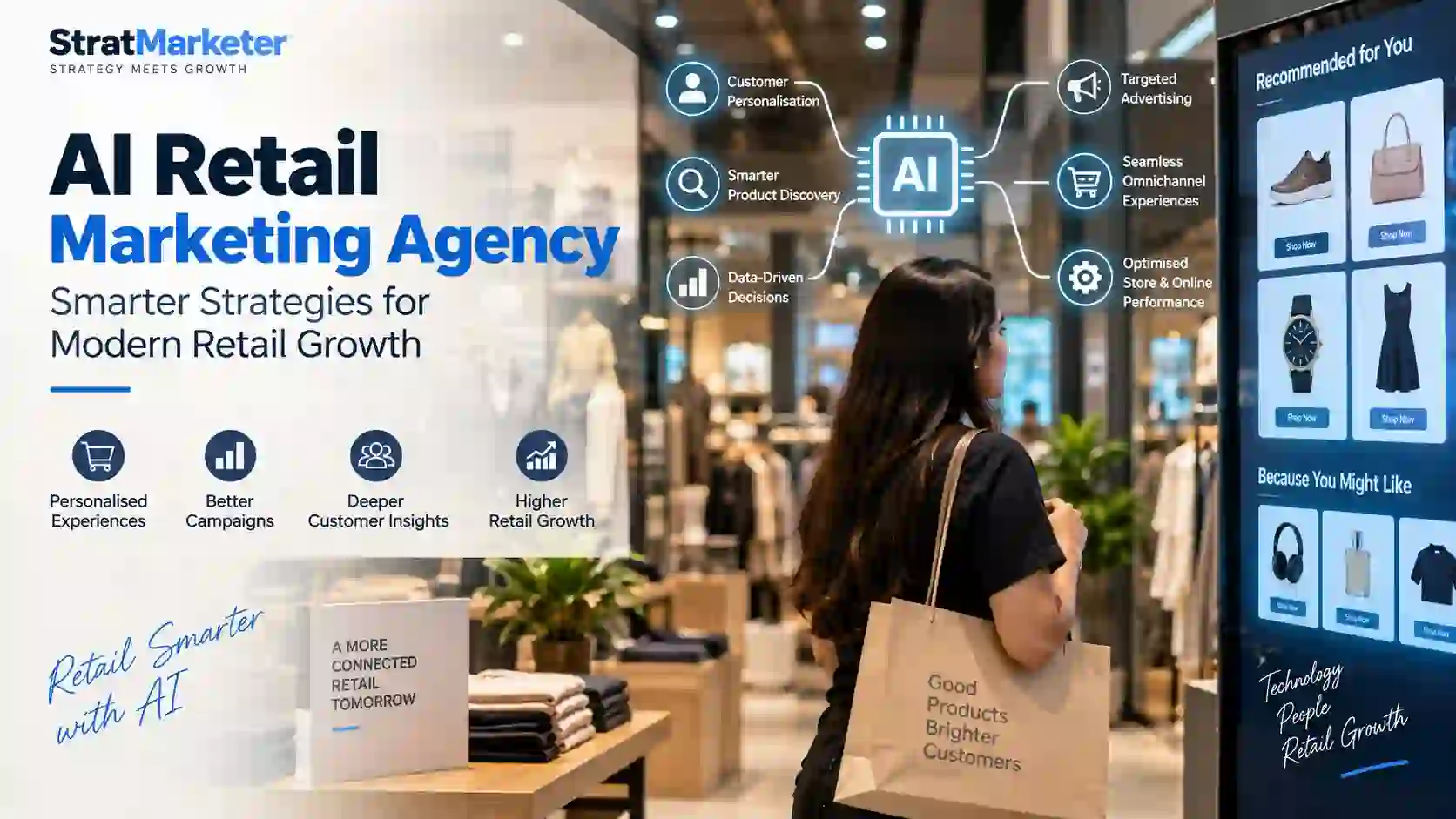
AI Retail Marketing Agency How AI Is Changing Retail Marketing
Retail marketing used to be fairly predictable. A shop launched an offer, ran some ads, sent messages to existing customers, and waited for sales. Ecommerce made the process more measurable, but it also created a new problem. There is now far more customer behaviour to understand than most retail teams can realistically process by hand.
A customer may search for a product on Google, compare prices on marketplaces, watch a short video, visit a store, leave without buying, return three days later and finally purchase through a mobile phone. Another customer may do almost the same thing but respond to a completely different message.
This is where an AI retail marketing agency becomes relevant.
The useful part of AI is not simply generating more advertisements or writing product descriptions faster. It is the ability to examine large amounts of customer and campaign information, identify patterns, and help marketing teams make decisions with more context.
But there is a catch.
Retailers often have plenty of data and very little clarity about what to do with it. Adding AI on top of that can make the situation worse if the underlying tracking, product data, customer segmentation or campaign structure is poor.
That is something I would be careful about.
Why Retail Marketing Is Changing With AI
Retail has always depended on understanding what people want and when they are ready to buy. AI has changed how quickly businesses can act on those signals.
Think about a fashion retailer with hundreds of products. Some products sell heavily during weekends. Some receive plenty of clicks but very few purchases. Some sizes keep going out of stock. A particular category may work well through Instagram but perform poorly through Google Search. Another product may sell better when shown as part of a bundle rather than as a standalone item.
A human marketing team can spot some of these patterns.
The difficulty comes when there are thousands of products, several advertising platforms, different customer groups and sales happening both online and offline.
This is where an AI retail marketing agency can bring practical value.
AI systems can help analyse customer behaviour, campaign performance, search trends, product interactions and purchase patterns at a scale that becomes difficult to manage manually.
For an Indian retailer, the situation can be even more complicated.
A clothing brand may sell through its own website, Amazon, Flipkart, physical stores and WhatsApp. Customers may discover the brand through Instagram but purchase after visiting a shop. Some customers prefer COD. Others use UPI. Some respond to discounts immediately, while premium customers may actually react negatively when a brand keeps pushing offers.
These are not just advertising problems.
They are customer behaviour problems.
An AI retail marketing agency can help connect these signals so marketing decisions are not made in isolation.
For example, imagine a home decor retailer noticing that traffic to a particular lamp has increased sharply. A basic marketing approach might simply increase the advertising budget.
An AI-supported approach may look deeper.
Is the increase coming from organic search or paid traffic? Are people spending time on the product page? Are they adding the lamp to their cart but abandoning checkout? Is the product frequently being viewed alongside another product? Are customers searching for the same lamp using different terms? Is there a pricing issue?
The answer might not be “spend more on ads”.
It could be that the product page needs better photography, the shipping information is unclear, or customers want to see the product in a room before buying.
That distinction matters.
I have seen marketing teams get uncomfortable when a campaign does not perform and immediately blame the creative. Sometimes the creative is fine. The offer is wrong. Sometimes the offer is fine and the landing page is the problem. Sometimes the campaign is reaching people who were never likely to purchase.
AI does not magically solve this.
It gives the team more ways to investigate it.
What an AI Retail Marketing Agency Actually Does
The phrase AI retail marketing agency can sound more complicated than the work actually is.
At its core, the agency still has to understand marketing fundamentals. Customer acquisition, search behaviour, advertising, content, conversion, retention and measurement do not disappear because AI is involved.
AI sits around these activities and helps marketers process information, automate selected tasks and make faster decisions.
For a retail business, that can cover several areas.
One is customer segmentation.
Instead of treating every visitor as one large audience, an AI retail marketing agency may help separate customers based on behaviour. A first-time visitor who only viewed products is different from someone who has purchased three times in the last six months. Someone who abandoned a cart yesterday is different from someone who has not interacted with the brand for eight months.
The communication should not necessarily be the same.
AI can also help identify patterns in product performance.
Suppose a retailer has 2,000 products. Marketing teams cannot manually review every product’s impressions, clicks, conversion rates, search terms and customer interactions every morning.
AI tools can flag unusual changes.
A product suddenly receives more search interest. Another product has falling conversion despite stable traffic. A category is attracting visitors but generating very little revenue. These signals can be brought to the marketer’s attention.
The marketer still decides what to do.
That human layer matters.
An AI retail marketing agency may also work with paid advertising. Campaign data from Google, Meta and other platforms can be analysed to identify audience and creative patterns. AI can assist with variations of ad copy, product messaging and creative concepts.
But producing 50 versions of an advertisement does not automatically make the campaign better.
That is one area where I disagree with the common excitement around AI marketing. More output is not the same thing as better marketing. Retailers do not need endless variations that say essentially the same thing.
They need useful variations based on actual customer behaviour.
AI can also support SEO.
Retail websites often contain thousands of product and category pages. Product names may be inconsistent. Descriptions may be thin. Important category pages may not target the language customers actually use.
An AI retail marketing agency can analyse search behaviour and help identify content opportunities, product taxonomy problems and gaps across category pages.
The agency still needs people who understand search intent.
Otherwise, the website becomes a pile of AI-written pages that technically contain keywords but do not help anyone.
Where AI Fits Into Retail Customer Journeys
A retail customer journey is rarely a straight line.
Someone may see a reel in the morning, search the product at night, read reviews the next day, compare two brands, visit a store and purchase later.
AI can be useful at different points in this journey.
At the discovery stage, it can help identify the topics, search terms, products and creative themes attracting attention.
At the consideration stage, it can help personalise product recommendations or identify which product information customers appear to need.
At the purchase stage, AI can help analyse abandonment patterns, pricing behaviour and conversion signals.
After purchase, it can support retention campaigns, product recommendations and customer communication.
The important point is that AI should not be treated as one big marketing machine.
It is more useful as a collection of tools working around different parts of the customer journey.
Consider an Indian electronics retailer.
A customer searches for wireless headphones and lands on a category page. The customer then filters products by price, opens three products and leaves.
The next visit may show similar headphones or a comparison-focused message.
If the customer later purchases a particular model, the retailer can use that purchase behaviour to understand what related products might be useful. Perhaps a protective case or charging accessory is relevant.
This sounds simple.
At scale, it becomes much harder.
Thousands of customers are behaving differently every day.
An AI retail marketing agency can help retailers analyse these journeys and build marketing actions around them.
There is also a less obvious use.
AI can help identify where customers are getting stuck.
If customers repeatedly visit a product page, read specifications and leave without buying, that behaviour is worth investigating. Perhaps the price is too high. Perhaps reviews are missing. Perhaps the return policy is unclear. Perhaps customers simply need better product demonstrations.
AI can identify the pattern.
It cannot always explain the reason.
That still requires human judgement, customer research and sometimes a very basic conversation with the sales team.
And honestly, those conversations can reveal things dashboards never show.
Using Customer Data Without Making Marketing Feel Robotic
Personalisation is one of the strongest reasons retailers consider AI.
It is also one of the easiest areas to get wrong.
Nobody wants to receive a message that feels like the brand is watching every move they make.
A customer browses a pair of shoes once and suddenly receives five messages about those shoes. Another customer buys a product and immediately receives three irrelevant recommendations.
That is not useful personalisation.
It feels mechanical.
An AI retail marketing agency should use customer information with some restraint.
For example, a beauty retailer could identify that a customer regularly buys a particular category every few months. Instead of sending constant promotional messages, the brand could communicate closer to the likely replenishment period.
That feels more natural.
The same principle applies to product recommendations.
If someone buys a laptop, showing them a laptop again is usually pointless. Showing a suitable laptop bag, mouse or warranty option may make more sense.
But even that should depend on context.
Premium customers may value convenience more than discounts. Price-sensitive customers may respond to offers. New customers may need reassurance about delivery and returns before they care about cross-selling.
AI can help identify these patterns.
The brand has to decide how aggressively to act on them.
There is also a privacy issue that should not be brushed aside. Retailers should be clear about how customer information is collected and used, and marketing systems need appropriate controls around access and handling of personal data.
The technology may be clever.
The customer experience still has to feel respectful.
I might be wrong here, but I think many retailers are currently overestimating how much personalisation customers actually want. Sometimes a relevant message at the right moment is enough. You do not need to make every banner, email and WhatsApp message look as though the system knows the customer personally.
That can become uncomfortable very quickly.
AI for Retail SEO, Paid Ads and Product Discovery
Search has become more complicated for retailers.
Customers no longer discover products only through traditional Google searches. They may use marketplace search, social platforms, video platforms, AI assistants and product recommendation systems.
Retailers therefore need product information that is clear, consistent and useful across different discovery environments.
An AI retail marketing agency can help analyse this ecosystem.
For SEO, the work may begin with product and category architecture.
A retailer selling furniture, for example, may have categories such as sofas, sectional sofas, recliner sofas and fabric sofas. Customers may search using completely different language.
Some may search for “3 seater sofa”. Others may search for “small sofa for living room”. Another customer may search for “comfortable sofa under 30000”.
These are different expressions of demand.
AI can help analyse large keyword sets and group related search behaviour. But the final content still needs to sound like something a real retailer would say.
Product pages deserve similar attention.
A product description should answer practical questions.
What is it made from? Who is it suitable for? What size is it? How does it work? What comes in the package? How long does delivery take? What happens if the customer wants to return it?
I would rather see a retailer with 500 genuinely useful product pages than 5,000 pages produced only because an AI system found additional keywords.
Paid advertising has a similar issue.
AI can help identify patterns across campaigns, audiences and creatives. It can assist with copy variations and analysis. It can also help marketers work through large datasets faster.
But retail advertising still depends heavily on fundamentals.
Product price matters.
Availability matters.
Delivery matters.
Reviews matter.
Creative matters.
And the offer matters.
If a competitor sells the same product for ₹2,000 less, no amount of automated ad copy is going to permanently hide that problem.
Product discovery is also becoming more visual.
Retailers selling fashion, furniture, jewellery, food products and consumer electronics increasingly need strong images and videos because customers often decide whether something is worth exploring before they read the full description.
An AI retail marketing agency can support the production and testing of these assets, but the content still needs to represent the actual product.
That sounds obvious, yet it is surprisingly easy to create marketing material that looks better than the product itself.
That creates another problem.
Expectations rise.
The customer clicks the advertisement, receives something that looks different, and trust drops.
For StratMarketer, the more practical way to approach AI retail marketing is to connect technology with the actual commercial situation. A retailer with weak product data does not need more automation first. A retailer with strong traffic but poor conversion may need a different intervention. A retailer with good conversion but weak repeat purchases has another problem altogether.
AI can help in all three cases.
The work is not identical.
And that is probably the part of AI retail marketing agency work that gets overlooked most often. The technology can be shared, but the marketing problem usually is not.
Sometimes the best decision is also to leave an automation alone for a while and watch what customers actually do.
That feels slower.
It can save a lot of wasted work.
Personalisation Across Ecommerce and Physical Retail
Personalisation in retail is often discussed as if it means showing a customer a product with their name attached to it. It is much broader than that.
A customer who has bought running shoes twice may not need to see another generic shoe advertisement. They may respond better to socks, sportswear, insoles or a reminder when a replacement is likely. A customer who has only visited the website once should probably not receive the same communication.
This is where an AI retail marketing agency can help retailers make better use of behavioural information.
Online stores have an obvious advantage here because they can capture clicks, searches, product views, cart activity, purchases and repeat visits. Physical retail is harder. A person can walk into a store, ask a salesperson several questions, look at five products and leave without the business knowing much about that interaction.
Unless the retailer has systems in place to connect those interactions.
A jewellery store in Jaipur, for example, may know that a customer purchased a ring last year, but the real value may come from understanding the broader relationship. Was the customer buying for a wedding? Was it a gift? Did they enquire about other products? Did they return later?
The data may be incomplete.
That is normal.
An AI retail marketing agency should not pretend that incomplete information is complete. It can work with available signals, but the gaps still matter.
For ecommerce brands, personalisation can happen on the website itself. Product recommendations can change based on browsing or purchase behaviour. Search results can become more relevant. Recently viewed products can be surfaced again. Content can be adjusted according to broad customer groups.
For physical retail, the approach is different.
Retailers may use loyalty programmes, purchase history, location based information where appropriately collected, store level sales patterns and customer preferences to understand demand.
A supermarket chain, for instance, may notice that certain products sell together more frequently in one neighbourhood than another. That can influence promotions, inventory planning and local messaging.
It does not mean every customer needs a completely different advertisement.
That would be excessive.
Good personalisation is sometimes quite boring. The customer sees something relevant and simply gets on with their day.
There is another useful distinction. Personalisation is not the same as discounting.
Many Indian retailers fall into this trap. If the customer has purchased before, they receive another discount. Then another one. Eventually the customer starts waiting for the next offer before buying.
AI can identify that behaviour too.
A better system may distinguish between customers who need a price incentive and customers who simply need the right product or a convenient reminder.
I prefer that approach because constant discounting can quietly damage a retailer’s pricing discipline.
But it does not apply everywhere. A value focused fashion retailer may genuinely depend on frequent promotional activity, while a premium furniture or jewellery brand may have very different customer expectations.
The technology is the same.
The commercial logic is not.
Where AI Retail Marketing Can Go Wrong
AI can make retail marketing faster.
It can also make mistakes faster.
That second part gets less attention.
One common problem is poor data. If product information is inconsistent, customer records are duplicated or conversion tracking is unreliable, an AI system is working with weak foundations.
It may still produce impressive looking analysis.
That does not make the analysis correct.
Suppose an ecommerce retailer has two product records for the same item. One shows 400 purchases and another shows 250. An automated system may treat them as separate products and draw conclusions about demand that are simply wrong.
Small data problems can create surprisingly large marketing decisions.
Another issue is over-personalisation.
A customer does not necessarily want a brand to remember every product they viewed.
There is a line between relevance and intrusion.
I have seen marketers get excited about extremely specific targeting because the system can technically do it. That is not enough reason to use it. If the customer experience starts feeling watched, the campaign may create the opposite reaction from what the retailer expected.
AI generated content is another area that needs supervision.
Product descriptions can be generated quickly, but the system may invent specifications, misunderstand materials or make claims that the retailer cannot support.
This becomes particularly serious in categories where product claims matter.
Healthcare products, cosmetics, food products and certain consumer goods require careful review. A marketing team cannot simply assume that an AI generated statement is safe because it sounds professional.
Then there is creative sameness.
If every retailer uses AI to produce similar headlines, similar images and similar promotional language, the internet starts filling up with content that feels interchangeable.
The customer notices.
Not consciously every time, perhaps, but they notice.
Another problem is automation without a clear purpose.
A retailer may connect AI tools to email, WhatsApp, advertising, CRM and website recommendations simply because those integrations are available. Suddenly customers are receiving messages from five different systems that do not know what the others are doing.
One customer receives an abandoned cart email, a WhatsApp reminder and a promotional message on the same day.
That is not sophisticated marketing.
It is poor coordination with automation added on top.
An AI retail marketing agency has to be careful about this. The goal should not be to automate every customer interaction. Some things are better left manual.
There are also measurement problems.
If an AI system recommends a product and that customer later buys it, who gets credit? The recommendation engine? The email campaign? The Google ad the customer clicked two days earlier? The Instagram post they saw last week?
Retail attribution is messy.
AI does not remove that mess.
Sometimes it makes the reporting look cleaner than reality, which is worse because people start trusting the dashboard.
How StratMarketer Approaches AI Retail Marketing
At StratMarketer, the starting point should be the retail problem rather than the AI tool.
That distinction sounds small, but it changes the work.
A retailer might say, “We need AI for marketing.”
The useful question is different.
What is currently not working?
Maybe the website receives traffic but product pages convert poorly. Maybe paid campaigns generate sales but acquisition costs are rising. Maybe repeat purchases are weak. Maybe the retailer has a large customer database but sends the same message to everyone.
Each situation needs a different response.
An AI retail marketing agency should first understand the customer journey, product range, existing marketing channels and available data.
Then the technology has somewhere sensible to fit.
For an ecommerce retailer, that could mean using AI to analyse product performance, customer segments, search behaviour and campaign data. The output might lead to changes in SEO, paid advertising, product recommendations or retention campaigns.
For a retailer with physical stores, the work may involve a different set of signals.
Store level sales, customer purchase patterns, loyalty information and regional behaviour can provide useful context. The objective is not necessarily to turn every offline interaction into a digital record. Sometimes the better use of AI is identifying patterns across stores and categories.
One practical example is inventory and marketing coordination.
Imagine a retailer has a product performing well in online advertising but limited stock in several locations. Increasing the campaign budget without considering availability could create wasted demand.
Marketing and inventory cannot operate as completely separate departments.
AI can help identify that connection, but someone still has to make the business decision.
StratMarketer can also use AI for content workflows, including product content, advertising variations, SEO research and campaign analysis. But the generated material needs review.
This is especially important for Indian retail because product information often comes from multiple sources. Manufacturer descriptions, distributor spreadsheets, marketplace listings and internal catalogues may all contain slightly different information.
AI can organise that information.
It should not blindly decide which version is true.
Another area worth discussing is regional behaviour.
A retail campaign that works in Mumbai may not behave the same way in Jaipur, Bengaluru or a smaller Tier 2 city. Pricing sensitivity, language preferences, delivery expectations and product demand can vary.
AI can help identify these differences when enough data exists.
It should not invent them when the data does not.
That is an important boundary.
I would also avoid making AI the face of every campaign. Customers do not need to know that an algorithm selected a recommendation or helped create an advertisement. They care whether the product is right, the price is reasonable and the buying experience is easy.
That is still retail marketing.
AI simply gives the marketing team more ways to work with the information.
Measuring AI Retail Marketing Beyond Clicks and Sales
Clicks are easy to report.
They are not always useful.
Sales are obviously important, but even sales can hide what is happening underneath.
An AI retail marketing agency should look at the full commercial picture.
Suppose a campaign generates ₹10 lakh in sales. That sounds good until you discover that ₹8 lakh came from existing customers who were already likely to purchase.
The campaign may have contributed something, but perhaps not as much as the headline number suggests.
Retail measurement should therefore look at customer acquisition, repeat purchases, average order value, conversion rates, margin where available, return behaviour and customer lifetime patterns.
The exact metrics depend on the business.
A fashion retailer may care heavily about repeat purchases and returns. A furniture company may have longer purchase cycles and higher order values. A grocery retailer may focus much more on frequency and basket size.
AI can help bring these measures together.
It can also help identify anomalies.
A campaign may show stable revenue but declining profit because discounting has increased. A product may have rising conversion but increasing returns. A customer segment may be purchasing more frequently but only after heavy promotional offers.
These details matter.
I have always been slightly suspicious of dashboards that make every marketing activity look successful. Real retail businesses are rarely that clean.
There are bad weeks.
There are stock problems.
There are campaigns that simply do not work.
There are products that looked promising and then sat on shelves.
The measurement system should be able to show that rather than smoothing everything into a positive story.
Another useful metric is time to insight.
If a retailer previously needed several days to analyse campaign and sales data, and AI reduces that work to a few hours, that has practical value even if revenue does not immediately jump.
The marketing team can react sooner.
But even here, I would not claim that faster analysis automatically creates better decisions. People can make bad decisions very quickly too.
The better question is whether the additional information is changing what the team actually does.
Are budgets being moved based on meaningful evidence?
Are weak product pages being fixed?
Are customer groups being treated differently when the data supports it?
Are repeat customers receiving more relevant communication?
Are campaigns being stopped when they are clearly wasting money?
Those are much more useful questions than asking how many AI generated assets were produced this month.
Frequently Asked Questions About AI Retail Marketing Agency
What is an AI retail marketing agency?
An AI retail marketing agency combines conventional retail marketing with AI supported analysis, automation and personalisation. It can work across SEO, paid advertising, customer segmentation, product discovery, content, ecommerce and retention.
The exact services depend on the retailer’s needs.
Is an AI retail marketing agency only useful for ecommerce businesses?
No.
Physical retailers can also use AI for customer analysis, campaign planning, store level performance analysis, loyalty marketing and demand patterns.
The available data is simply different from ecommerce data.
Can AI personalise marketing for every retail customer?
Technically, highly detailed personalisation is possible.
That does not mean it is always sensible.
Customers can become uncomfortable with excessive targeting, and retailers can create communication fatigue. Good personalisation should have a clear customer benefit.
Can AI improve retail SEO?
It can assist with keyword research, search intent analysis, product categorisation, content development and identifying gaps across large ecommerce websites.
Human review is still necessary, particularly for product specifications and claims.
Does StratMarketer use AI to create retail content?
AI can support parts of the content workflow at StratMarketer, including research, content variations and analysis. The final material should still be reviewed for accuracy, brand context and actual customer usefulness.
Can AI help reduce retail advertising costs?
It can help identify inefficient campaigns, audiences, products and creative patterns.
But there is no automatic guarantee of lower advertising costs. Product pricing, competition, margins, landing pages and customer demand still influence the economics.
Is AI retail marketing suitable for small Indian retailers?
It can be, but the approach should match the scale of the business.
A small retailer with limited customer data may benefit more from better tracking, local search, customer retention and campaign measurement before investing heavily in complex AI systems.
How long does it take to see results from AI retail marketing?
There is no reliable single timeline.
Paid advertising changes can sometimes be measured relatively quickly. SEO, customer retention and personalisation usually need more time and enough customer activity to produce meaningful patterns.
Our Services
Contact Us
- Paonta Sahib, Himachal Pradesh, India
- +91-8700998508
- support@stratmarketer.com
Start From Here
These two options make it easy for you to get the information you want.