


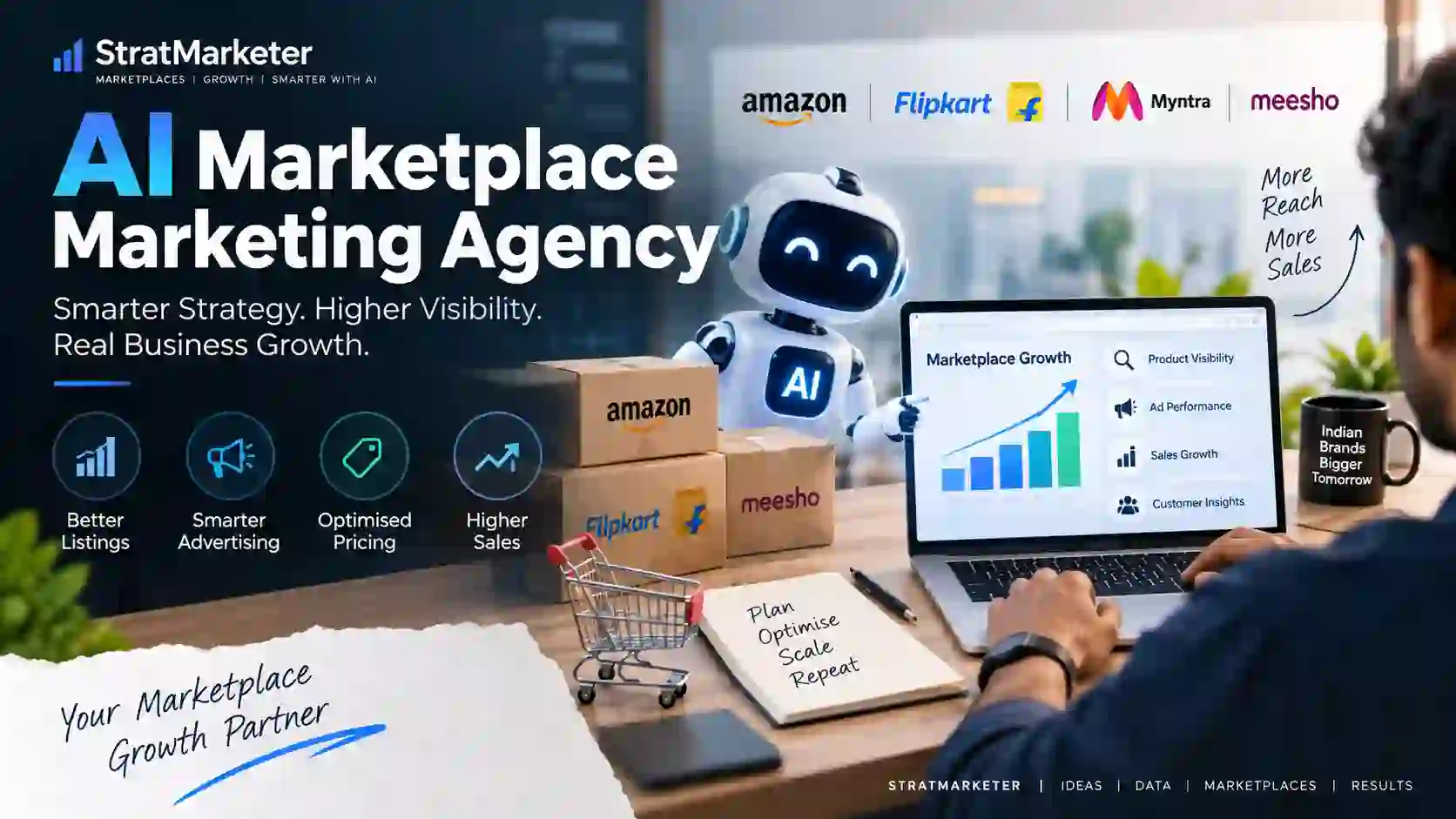
AI Marketplace Marketing Agency for Indian Brands
Why Marketplace Marketing Is Changing With AI
Selling on an online marketplace used to look deceptively simple. Upload the product, add a few images, write a description, set a price and wait for orders.
Anyone who has actually managed a marketplace account knows how quickly that idea falls apart.
A product can have good reviews and still lose visibility. A listing can receive thousands of impressions and barely convert. A small change in price can alter the economics of an entire campaign. Stock can run out just when advertising starts working. And sometimes a product that looked like a clear winner on paper simply does not move.
This is where an AI marketplace marketing agency becomes relevant.
The important change is not that artificial intelligence can write product descriptions. That part is already common. The bigger change is that AI is becoming part of the decision making layer around marketplace selling.
Amazon India itself now provides sellers with AI based tools covering areas such as listing optimisation, pricing recommendations and inventory planning. Its Listing IQ can assess listings and generate content suggestions, while Pricing IQ provides pricing recommendations based on fees, competition and margins. Amazon also provides Restock+ for inventory recommendations.
That tells us something useful.
Marketplace platforms themselves are moving towards systems where sellers do not have to depend entirely on manual analysis.
Flipkart has been moving in the same direction. Its NXT Insights platform provides sellers with information around pricing, selection, returns and market trends, along with AI based recommendations. In August 2026, Flipkart also announced Saarthi, combining an AI powered campaign dashboard with agency support for sellers.
So the role of an AI marketplace marketing agency is not simply to introduce another AI tool into a seller’s workflow.
It is to make sense of several moving parts at the same time.
Consider an Indian personal care brand selling a face serum. The team may have ten or twenty SKUs, different pack sizes, different margins and different levels of customer demand. The marketing team may be looking at advertising performance while the operations team watches inventory and the founder watches revenue.
The problem is that these things are connected.
If the agency increases ad spending on a product with limited stock, the campaign may look successful for a few days while creating a stock problem. If it pushes a discount without considering fees and return rates, sales can increase while contribution margins become worse.
AI can identify patterns quickly. It cannot automatically understand every business decision.
That distinction matters.
I would be particularly careful about treating AI recommendations as instructions. A marketplace account contains plenty of numbers, but not every number carries the same business meaning. A high click through rate can look encouraging until you realise that the product page is converting poorly. A low advertising cost can look attractive until you see that the campaign is spending only on branded searches that were already generating demand.
This is where human judgement still has a place.
An AI marketplace marketing agency can use automation for repetitive analysis while keeping commercial decisions under human review. That combination is far more useful than allowing a software dashboard to decide everything.
And yes, there is some irritation involved here.
Many sellers have already tried AI generated content and found that the output sounds polished but says very little. Marketplace customers do not buy products because a description contains impressive words. They buy because the product appears relevant, trustworthy, reasonably priced and suitable for their particular need.
That part has not changed.
What an AI Marketplace Marketing Agency Actually Does
The phrase AI marketplace marketing agency can sound broader than it really is.
At a practical level, the work usually sits across marketplace search, catalogue quality, advertising, pricing, customer behaviour, reporting and testing.
The agency first needs to understand the marketplace account itself.
Which products are actually selling?
Which products are getting impressions but not clicks?
Which products get clicks but fail to convert?
Which keywords are producing orders?
Which campaigns are spending without enough commercial value?
Are returns unusually high for a particular SKU?
Is the product regularly going out of stock?
Is the price competitive after shipping and marketplace fees?
These questions are not glamorous. They are where much of the useful work happens.
An AI marketplace marketing agency can use AI to process large amounts of marketplace data much faster than a person manually reviewing spreadsheets every morning. It can flag unusual changes, identify patterns across SKUs and surface products that deserve closer attention.
But the agency still needs to ask why the pattern exists.
Suppose a kitchen appliance receives a sudden increase in impressions but sales remain flat. An automated system might recommend increasing the advertising budget because demand appears to be rising.
A human marketer might look at the listing and notice something else.
The competitor has dropped its price by ₹300.
Or perhaps the main product image does not clearly show the size.
Or customers are repeatedly asking whether the appliance works with a particular voltage or utensil type.
The data showed the symptom. Human review found the problem.
That is the relationship I would expect from a capable AI marketplace marketing agency.
The agency may also work on catalogue structure. Amazon, for example, requires sellers to provide information such as titles, images, variations, bullet points and descriptions when creating listings. Its current seller guidance also recommends improving listing information to support product discoverability.
AI can help analyse those fields at scale.
Imagine a brand with 600 SKUs.
A person can manually review them, but it becomes difficult to maintain consistency. AI can identify missing attributes, repeated wording, weak descriptions, possible keyword gaps and differences between high performing and low performing listings.
The marketer then decides what should actually be changed.
That last part should not be skipped.
An AI marketplace marketing agency should also understand advertising economics. Amazon’s advertising systems already use machine learning to identify products that may be more likely to engage customers, and its advertising recommendations can suggest products for campaigns.
Flipkart also offers CPC and Smart ROI campaign options, while its seller guidance makes it clear that advertising performance depends on factors such as catalogue quality, stock, pricing and reviews.
That is important because advertising does not exist separately from the product page.
You cannot permanently solve a weak conversion problem by buying more traffic.
An AI marketplace marketing agency should therefore look at the complete path from search impression to product click to purchase and then, where data permits, repeat behaviour.
Sometimes the right decision is to spend more.
Sometimes it is to stop spending.
Sometimes the advertising campaign is not the real problem at all.
Where AI Fits Into Amazon, Flipkart and Other Marketplaces
Every marketplace has its own interface, ranking signals, advertising products and seller policies. AI does not remove those differences.
An AI marketplace marketing agency working across Amazon and Flipkart has to understand the individual platform rather than applying one universal formula.
Amazon, for example, provides Sponsored Products and Sponsored Brands, and sellers can use advertising to place products in prominent shopping locations. Amazon also considers factors beyond advertising when determining Featured Offer eligibility, including price competitiveness, product availability and shipping conditions.
This creates an interesting situation.
A seller may ask an AI marketplace marketing agency to improve advertising performance, but the actual issue may be outside the campaign.
If the product is not competitively priced, has weak availability or suffers from poor delivery conditions, increasing bids is not necessarily the answer.
AI is useful here because it can bring several variables together.
The same thinking applies to Flipkart.
Flipkart’s current seller ecosystem includes advertising tools, analytics and AI based seller support. Its recently launched Saarthi programme includes campaign intelligence that can analyse product level performance, generate alerts and provide optimisation recommendations while keeping sellers in control of the final decisions.
This is probably where marketplace marketing is heading.
Not AI replacing the marketplace manager.
AI helping the marketplace manager notice things earlier.
For an Indian brand selling across several platforms, this can become particularly useful. A product might sell strongly on Amazon but struggle on Flipkart. Another product may have strong Flipkart demand but weak Amazon conversion.
The mistake is assuming the same listing, price and advertising logic should work everywhere.
It often does not.
Regional demand can also complicate things. A home appliance may perform differently in Delhi, Mumbai and smaller Tier 2 markets because purchasing patterns, climate, household structures and delivery expectations are not identical.
AI can identify patterns in available data, but someone still needs to interpret them.
There is another area where AI is becoming more interesting. Amazon Ads now supports Sponsored Products campaigns extending beyond Amazon to selected external sites, apps, conversational experiences and Amazon creators in India and other markets. Amazon says these placements can use shopping and browsing signals to determine relevance.
That means marketplace advertising is no longer necessarily confined to the traditional marketplace search page.
For an AI marketplace marketing agency, this creates more opportunities but also more complexity.
The agency needs to know where the customer first discovers the product, where the customer compares it and where the final purchase happens.
A customer might see a product in an external placement, search for the brand later, compare three marketplace listings and then purchase through a different channel.
Attribution gets messy.
I might be wrong here if I make it sound like every marketplace will move at the same pace. They will not. Some platforms will provide sophisticated AI tools quickly. Others may remain much more manual. Seller category, account size and available data will also change what is practical.
The principle still holds.
AI works best when it reduces the time between noticing a marketplace problem and investigating it.
Product Listings, Search Visibility and AI Assisted Optimisation
Product listing work is probably the area where people most visibly notice AI.
Give an AI system a product name and a few specifications and it can produce a title, bullet points, description and sometimes creative suggestions within seconds.
That sounds useful.
It is useful.
But it can also create a lot of rubbish very quickly.
An AI marketplace marketing agency needs to be careful here because marketplace content has a very specific job. It should help the customer understand what the product is, why it is relevant and what limitations or specifications matter before purchase.
A listing for a pressure cooker, for example, should not spend half its copy describing how the product will “revolutionise your culinary journey”.
Nobody searching for a pressure cooker needs that.
They need to know the capacity, material, compatibility, warranty, safety features and perhaps whether it works with induction cooking.
This is where good marketplace optimisation becomes quite practical.
Amazon’s own listing guidance calls for titles, images, variations, bullet points and descriptions, with product information structured according to its listing requirements.
An AI marketplace marketing agency can audit those elements across hundreds of products.
It can compare the language used by strong and weak listings.
It can identify terms customers appear to use.
It can spot missing product attributes.
It can create alternative versions for testing.
But there is a limit.
AI does not physically use the product.
It may not know that the zipper on a particular bag feels stiff. It may not understand that a colour looks different in normal indoor lighting. It may describe a food product using generic claims that are unsuitable under applicable marketplace or regulatory requirements.
That is why human review is not just a formality.
For search visibility, keyword relevance still matters, but keyword stuffing is not a substitute for a useful listing. Search systems are increasingly capable of understanding relationships between words and product attributes.
The better question is not, “How many times can we insert this keyword?”
It is, “Does this listing clearly answer the reason someone searched for this product?”
An AI marketplace marketing agency can help answer that at scale.
For example, imagine a brand selling cotton bedsheets. The seller may initially optimise around “cotton bedsheet”. But customer behaviour may reveal interest around double bed size, thread count, deep pocket, machine washability, summer use or specific colour combinations.
The listing should reflect actual product attributes and genuine customer needs.
Not every popular search term belongs in the listing.
That distinction saves brands from a lot of poor catalogue decisions.
AI can also help with image analysis. It can review whether required product views are present, identify inconsistent backgrounds, compare image sequences and flag missing information. Amazon’s current Listing IQ product specifically evaluates listing quality and can generate optimised titles, images and A+ Content.
Still, an AI generated image or product visual should never invent a product feature.
That sounds obvious.
It is not always obvious when a large catalogue is being processed automatically.
One incorrect visual showing an extra accessory can create customer complaints, returns and marketplace issues. A technically impressive system can still create a very ordinary business problem.
That is why I prefer AI assisted optimisation over completely automated optimisation.
The distinction is small in wording but quite large in practice.
Using Customer and Marketplace Data Without Losing the Human Side
Marketplace data can become addictive.
There is always another dashboard.
Clicks. Impressions. Orders. Conversion rate. Advertising cost. Return rate. Search terms. Product views. Session data. Inventory. Pricing. Reviews.
Then someone asks why sales are down.
The answer is usually not sitting inside one metric.
An AI marketplace marketing agency can help connect these pieces. It can identify unusual movement, compare periods, group products by behaviour and surface relationships that would be tedious to find manually.
But customer behaviour still needs interpretation.
Suppose an Indian footwear brand notices that one sandal has a high return rate. AI might identify the SKU immediately.
The next question is more interesting.
Why?
Maybe customers find the size smaller than expected. Maybe the product photographs make the sole appear thicker. Maybe the description uses an incorrect fit term. Maybe the product is attracting customers looking for a completely different type of footwear.
The return number is not the problem.
It is a clue.
This is one of the areas where an AI marketplace marketing agency can provide useful human judgement. Reviews, search terms, product questions and returns can be read together instead of being treated as separate reports.
Customer language is especially valuable.
People often tell brands exactly what is wrong, but not in the vocabulary used by marketers.
A customer might write, “Looks good but handle became loose after two weeks.”
That sentence can be more useful than a dashboard showing a two percent increase in returns.
Another customer might say, “Good for small kitchen but too small for family of five.”
Now the brand has information about expectation, product positioning and possibly listing communication.
AI can classify thousands of such comments and identify repeated themes. A marketplace marketer can then decide whether the issue requires a listing change, product change, packaging change or customer support response.
Flipkart has also described its use of AI and advanced search analytics to understand customer needs and support seller decisions, particularly as ecommerce expands among Tier 2 and Tier 3 consumers.
That Indian context matters.
Marketplace customers are not one uniform group.
A buyer in Bengaluru may shop differently from a buyer in a smaller town. A premium skincare customer may read every ingredient detail while another customer mainly wants to know whether the product is genuine and arrives safely.
An AI marketplace marketing agency should therefore avoid treating customer data as just numbers.
There is also a privacy and trust question that should not be brushed aside. Brands need to use customer information within the rules and permissions that apply to the marketplace and the data source. More data is not automatically better data.
And there is a practical problem I have seen repeatedly in marketplace discussions.
Teams sometimes collect huge amounts of information but fail to act on the obvious issue.
The dashboard gets bigger.
The product stays the same.
That is not useful.
The purpose of an AI marketplace marketing agency should be to make marketplace decisions clearer, not to produce another layer of reports that nobody has time to read. A seller should be able to look at the work and understand what needs attention, why it matters and what should be tested next.
Sometimes the answer will be an AI recommendation.
Sometimes it will be something much less exciting, such as fixing the main product image, correcting a specification, reducing an unnecessary bid or keeping enough stock for the campaign that is already working.
That part of marketplace marketing has never really changed.
AI For Marketplace Advertising, Pricing and Campaign Decisions
Marketplace advertising becomes complicated very quickly once a brand has several products, multiple campaigns and different margins across SKUs. An AI marketplace marketing agency can help make sense of that complexity, particularly when the account is producing more data than a person can comfortably review every day.
Take a simple Amazon campaign. A product may receive 8,000 impressions, 420 clicks and 28 orders. At first glance, the campaign appears reasonably healthy. But those numbers alone do not tell us whether the campaign is commercially useful.
The selling price might be ₹1,499. The product margin may be only ₹280. Marketplace fees, advertising costs, returns and discounts can reduce that further.
This is where campaign decisions need more than a dashboard.
AI can analyse search terms, product performance, spend patterns and historical conversion behaviour. It can flag campaigns where spend is rising without a similar movement in orders. It can also identify products where advertising appears to be supporting organic sales.
An AI marketplace marketing agency can then use these signals to decide what deserves attention.
I prefer this approach over blindly automating bids.
There is a temptation to let software increase bids whenever conversion probability looks strong. That can work in some situations. It can also become expensive surprisingly quickly, particularly for products with low margins.
A product selling at ₹699 cannot be treated financially like a product selling at ₹4,999.
Pricing creates another layer.
Amazon India has introduced AI based pricing recommendations through Pricing IQ, which considers factors such as fees, competition and seller margins when generating recommendations. Inventory planning tools such as Restock+ also use predictive signals to recommend replenishment quantities and timing.
The useful part is not simply receiving a recommended price.
It is understanding why the recommendation makes sense.
Suppose a brand drops its price by ₹100 and sales increase by 18 percent. That sounds positive until the contribution margin is calculated. If the additional sales are not enough to compensate for the lower margin, the business may have created more revenue without creating enough profit.
AI can identify the relationship between price and demand.
The commercial team still has to decide what level of margin is acceptable.
Campaign structure matters too. An AI marketplace marketing agency may separate products based on their role rather than treating every SKU equally. Some products are traffic generators. Some have strong margins. Some are seasonal. Some are new and need data before their advertising potential can be understood.
A newly launched product should not necessarily be judged using the same expectations as a product with two years of sales history.
This is where marketplace advertising becomes less mechanical.
The campaign tells you what happened.
The wider business context tells you what to do about it.
Pricing, advertising and stock also influence each other. If advertising suddenly performs well and inventory is limited, continuing to increase spend may not be sensible. You might sell through the available stock and then lose momentum while waiting for replenishment.
I have seen teams get excited about a campaign finally working, only to realise that the warehouse could not support the demand.
It is an annoying problem to have, but it is still a problem.
An AI marketplace marketing agency should therefore connect advertising decisions with pricing, inventory, product ratings and conversion rather than managing paid campaigns in isolation.
Common Mistakes Brands Make With AI Marketplace Marketing
The first mistake is assuming AI means automation.
It does not.
AI can automate many tasks, but marketplace marketing still needs judgement.
One common problem is publishing AI generated listings without proper review. The wording may look polished, yet important product details can be missing or occasionally incorrect. For a marketplace seller, that is not a harmless writing error.
A wrong specification can create returns.
A misleading feature can create customer complaints.
An exaggerated claim can create compliance concerns.
An AI marketplace marketing agency should have a review process before AI generated content reaches a live product page.
The second mistake is treating AI output as fact.
If an AI system identifies a product as a high potential SKU, the team should still check the underlying numbers. Was the product temporarily discounted? Did a competitor go out of stock? Was there a seasonal spike? Did an external campaign send unusual traffic?
The reason matters.
Another mistake is feeding poor data into an AI system and expecting good recommendations.
This is basic, but it gets overlooked.
If product costs are wrong, inventory data is incomplete and campaign attribution is messy, AI can process all of it very efficiently and still give you a poor answer.
Garbage in, garbage out is still true.
There is also a tendency to overfocus on keywords.
An AI marketplace marketing agency may use AI to identify search terms, but that does not mean every high volume keyword should be inserted into the listing.
Imagine a brand selling a premium herbal shampoo. A broad keyword may have significant search volume, but if the shoppers behind that keyword are looking for a very different product, the traffic can create poor conversion.
More traffic is not automatically better.
I would also be cautious about excessive experimentation.
AI makes it easy to generate five titles, ten bullet point variations, several advertising structures and multiple creative concepts. The temptation is to test everything.
But if too many things change at once, it becomes difficult to understand what actually caused the result.
A marketplace team needs enough experimentation to learn, not so much that the account becomes impossible to interpret.
Another mistake is ignoring customer complaints because the overall rating looks good.
A product can have a 4.3 star rating and still have a recurring problem hidden inside hundreds of reviews. AI can help categorise review themes, but someone should read enough actual comments to understand the context.
The wording customers use can be surprisingly revealing.
One more issue is the obsession with ROAS.
A campaign with a 6x ROAS is not automatically better than a campaign with 3x ROAS.
If the first product has very low margins and the second has healthy contribution margins, the financial picture can be completely different.
This is where an AI marketplace marketing agency should be careful with simplified performance claims.
A dashboard can make a business look healthy.
The bank account has a different way of judging it.
How StratMarketer Approaches AI Marketplace Marketing
At StratMarketer, the useful starting point is not the AI tool.
It is the marketplace problem.
That distinction sounds small, but it changes the work.
If a brand says, “Our Amazon sales have fallen,” the first question should not be which AI software can solve it. The account needs to be examined across traffic, rankings, pricing, advertising, stock availability, reviews, conversion and product level performance.
Only then does it make sense to decide where AI can help.
As an AI marketplace marketing agency, StratMarketer can use AI where the amount of information makes manual work slow or inconsistent.
For example, a large catalogue can be reviewed for missing attributes, repetitive content, inconsistent product terminology and potential listing weaknesses. Search and campaign data can be analysed to identify patterns across products rather than looking at each SKU separately.
But the output needs human interpretation.
A product listing is not just a collection of keywords. A campaign is not just a collection of clicks. A price is not just a number compared with competitors.
Each one has a commercial reason behind it.
Consider an Indian consumer electronics brand with 150 marketplace SKUs. A manual review may identify obvious problems, but finding relationships between advertising spend, conversion, stock availability and product ratings becomes increasingly difficult as the catalogue grows.
AI can narrow the field.
Instead of asking a marketer to inspect all 150 products, the system can highlight the 15 that show unusual changes or possible opportunities.
Then the marketer investigates those 15.
That is a much more sensible use of AI.
StratMarketer can also look at marketplace advertising as part of the broader customer journey. A customer might first encounter a product through paid advertising, return later through marketplace search and eventually purchase after reading reviews.
The last click does not always tell the full story.
This matters particularly for higher priced products where customers need more consideration before purchasing.
Another part of the approach is testing.
Not every AI recommendation should go live immediately. Where practical, changes can be tested against a previous baseline. Listing improvements, campaign adjustments, pricing changes and creative variations need to be evaluated based on the type of change being made.
There is no single testing formula that fits every marketplace.
I might be wrong here, but I think agencies sometimes make AI sound more mysterious than it really is. A lot of useful AI marketplace work is actually quite ordinary. It is faster analysis, better pattern recognition, cleaner workflows and less time spent digging through spreadsheets.
The clever part is knowing where not to use it.
If a customer complaint can be understood by reading ten reviews, there is no reason to build an elaborate AI workflow around it.
If 20,000 rows of marketplace data need to be examined, the situation is different.
That is where the technology earns its place.
Measuring Marketplace Performance Beyond Sales and ROAS
Sales matter.
Obviously.
But sales alone can hide problems.
Imagine two products both generating ₹10 lakh in monthly marketplace revenue. One produces healthy contribution margins with low return rates. The other relies on heavy discounts, expensive advertising and has a high return rate.
Calling both equally successful because revenue is the same would be misleading.
An AI marketplace marketing agency should therefore look at several layers of performance.
Area | What it can reveal |
Revenue | Overall marketplace demand |
Conversion rate | How effectively traffic becomes orders |
Advertising cost | Cost of acquiring marketplace sales |
Contribution margin | Whether sales are commercially worthwhile |
Return rate | Possible product or expectation problems |
Average selling price | Pricing movement over time |
Organic sales | Dependence on paid traffic |
Inventory availability | Whether demand can actually be fulfilled |
Review trends | Changes in customer satisfaction |
Repeat purchase | Potential long term customer value |
The exact metrics will vary by category.
For a grocery brand, repeat purchase can be extremely important. For furniture, repeat purchase may be less frequent, so other indicators can matter more.
This is where AI can help bring fragmented information together.
Suppose advertising ROAS falls from 5x to 3.5x.
That looks negative.
But perhaps organic sales have increased substantially, the product ranking has improved and total contribution has remained healthy. In that case, judging the campaign only by ROAS may produce the wrong interpretation.
The reverse can also happen.
ROAS may look excellent because the campaign is capturing customers who were already searching specifically for the brand. The account appears efficient, but incremental demand is limited.
An AI marketplace marketing agency can compare these signals and help create a more complete picture.
Search visibility is another useful measurement.
A product can generate sales today while becoming increasingly dependent on paid traffic. If organic discovery keeps falling, the brand may eventually have to spend more just to maintain the same revenue.
That is not necessarily a crisis, but it is something worth noticing early.
Inventory deserves attention too.
A product that repeatedly goes out of stock may show strange performance patterns. Sales fall, advertising efficiency changes, ranking can be affected and the historical data becomes harder to interpret.
A simple revenue chart will not explain that.
The best marketplace measurement systems therefore look at the business as a connected system rather than a collection of isolated numbers.
And sometimes the most useful metric is simply whether the seller can explain why sales changed.
If nobody knows why the numbers moved, the dashboard has not really done its job.
Frequently Asked Questions About AI Marketplace Marketing Agency
What is an AI marketplace marketing agency?
An AI marketplace marketing agency helps brands manage and optimise marketplace marketing using artificial intelligence alongside human strategy. The work can include product listing optimisation, search analysis, marketplace advertising, pricing analysis, customer review analysis, reporting and performance testing.
The important point is that AI is used as part of the process rather than treated as a replacement for marketplace expertise.
Can an AI marketplace marketing agency manage Amazon and Flipkart together?
Yes, but the strategy should not simply be copied from one platform to another.
Amazon and Flipkart have different seller systems, advertising formats, data environments and customer behaviour. An AI marketplace marketing agency can create a broader marketplace strategy while adapting the execution to each platform.
Can AI write Amazon product listings?
Yes. AI can generate titles, bullet points, descriptions and other catalogue content. Amazon itself now offers AI based listing assistance through Listing IQ.
But generated content should be checked before publication. Product specifications, claims, dimensions and compatibility details need to be accurate.
Does AI automatically improve marketplace rankings?
No.
AI can help analyse search behaviour, listing quality, product attributes and other factors, but marketplace rankings depend on the platform’s own systems and many product and customer signals.
Anyone promising automatic ranking improvements simply because AI is being used deserves careful questioning.
Is AI useful for marketplace advertising?
Yes, particularly when there is a large amount of campaign and product data to analyse.
AI can help identify spending patterns, search term opportunities, products with unusual performance and areas where campaigns may need attention. The final advertising decision should still consider margins, stock and business objectives.
Can AI help with marketplace pricing?
It can.
Amazon India already provides AI based pricing recommendations through Pricing IQ. Such tools can consider competition, fees and other marketplace factors when making recommendations.
A brand should still define its acceptable margin and pricing position before accepting an automated recommendation.
Is ROAS enough to measure marketplace marketing?
No.
ROAS tells you something important about advertising efficiency, but it does not tell you everything about profitability, organic sales, returns, inventory availability or customer value.
For some products, contribution margin and repeat purchase may matter much more.
How does StratMarketer use AI in marketplace marketing?
StratMarketer can use AI to analyse marketplace data, review product catalogues, identify optimisation opportunities, support advertising decisions and understand customer behaviour at scale.
The practical focus should remain on the business problem first and the technology second.
Should every marketplace task be automated?
No.
Some tasks are ideal for automation because they involve repetitive analysis. Others require product knowledge, commercial judgement or direct understanding of customer behaviour.
The difficult part is often deciding where automation should stop.
Is AI marketplace marketing suitable for Indian sellers?
It can be particularly useful for sellers managing large catalogues, multiple campaigns or several marketplace channels.
For a small seller with ten products, sophisticated automation may not always be necessary. For a brand managing hundreds of SKUs and significant advertising budgets, the amount of data can justify a much deeper AI assisted workflow.
Our Services
Contact Us
- Paonta Sahib, Himachal Pradesh, India
- +91-8700998508
- support@stratmarketer.com
Start From Here
These two options make it easy for you to get the information you want.