


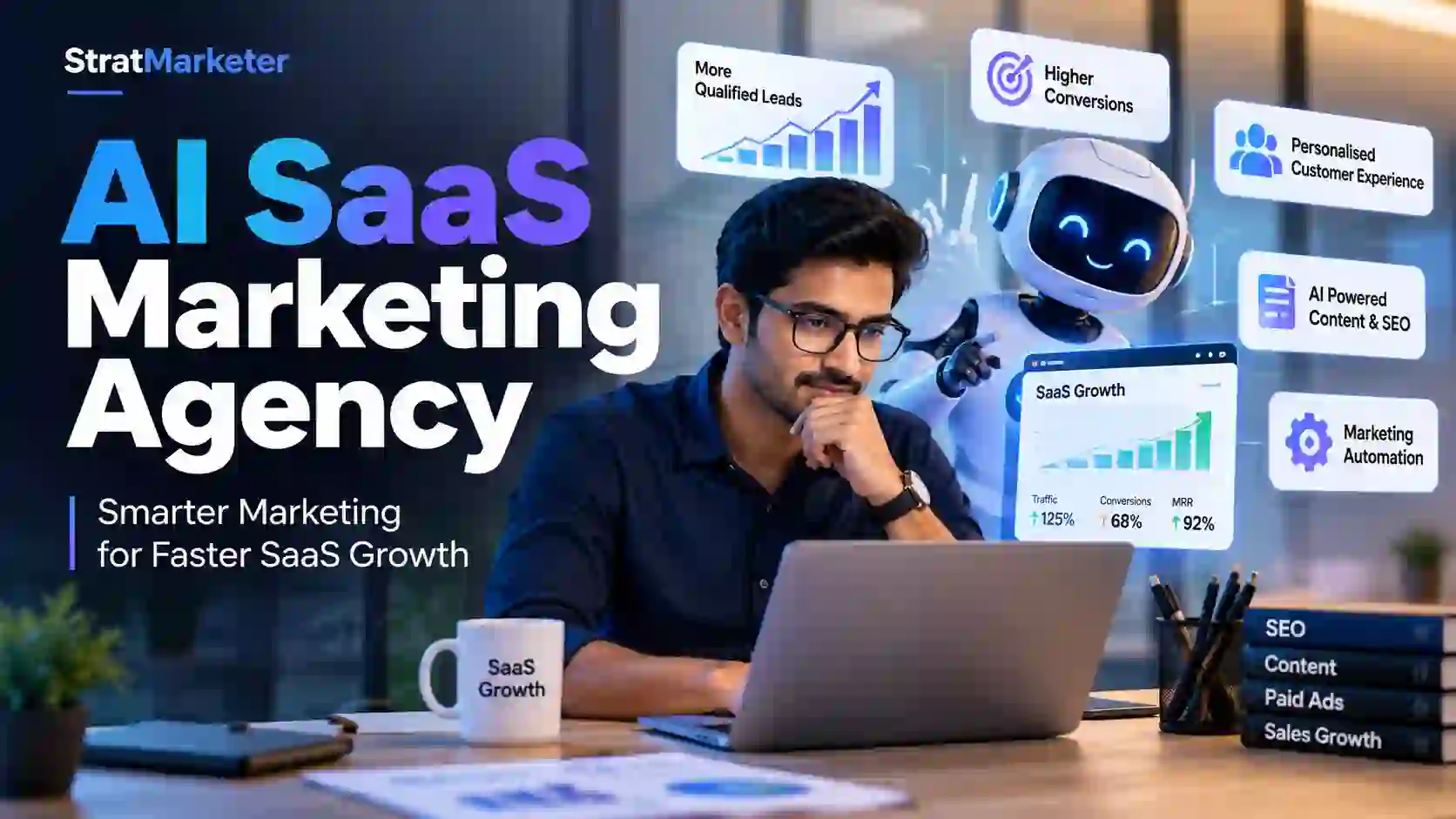
AI SaaS Marketing Agency for Smarter Growth
Why SaaS Marketing Is Changing With AI
SaaS marketing has never been only about getting more visitors to a website. A SaaS company can have thousands of monthly visitors and still struggle to convert enough users into trials, demos, subscriptions, or long term customers. The difficult part is usually understanding what people need at each stage and then giving them the right information before they lose interest.
This is where an AI SaaS marketing agency can become useful.
AI is changing how SaaS companies research audiences, analyse customer behaviour, create content, personalise communication, manage campaigns and identify opportunities across the funnel. But there is an important distinction here. AI is not replacing marketing thinking. It is changing how quickly a marketing team can gather information and act on it.
For SaaS companies, that distinction matters.
A B2B software product may have a six week sales cycle, while a self serve productivity application may expect a visitor to sign up within minutes. An enterprise platform may need several decision makers to agree before a purchase. A smaller SaaS product might depend almost entirely on product led growth.
The same AI process cannot work for all of them.
An experienced AI SaaS marketing agency looks at the product, market, buying behaviour and existing acquisition channels before deciding where AI actually belongs. Sometimes the right use is predictive lead scoring. Sometimes it is content research. Sometimes it is simply finding patterns in customer conversations that the marketing team has been overlooking.
I have seen SaaS marketing teams spend weeks producing content around keywords that looked attractive in a spreadsheet but had very little connection with actual buying intent. AI can reduce that waste, but only when someone understands the commercial context behind the data.
There is another change happening quietly.
Search itself is becoming more fragmented. People still use traditional search engines, but they are also asking AI systems questions, comparing software through conversational tools, reading community discussions and looking for detailed product answers before visiting a vendor website.
That means SaaS marketing increasingly has to answer questions, not just target keywords.
A page explaining how a product solves a specific operational problem can be more useful than another broad article about the category. For example, a project management SaaS company may get better commercial value from explaining how to manage approval workflows across five departments than from publishing another generic article about “project management software”.
AI can help identify those gaps.
But it can also create a mess very quickly.
If every SaaS company starts publishing AI generated articles based on the same surface level information, search results become repetitive. Customers notice it too. The writing starts sounding strangely similar, product claims become vague and the company loses some of the credibility it was trying to build.
So yes, AI changes SaaS marketing. It does not remove the need for judgement.
What an AI SaaS Marketing Agency Actually Does
The phrase sounds simple, but the work behind it is not.
An AI SaaS marketing agency typically works across several parts of the marketing operation where software, automation and machine learning can reduce manual effort or reveal patterns that are difficult to spot manually.
That can include market research, SEO, content strategy, paid advertising, lead qualification, customer segmentation, email marketing, conversion optimisation and reporting.
But I would not start with AI.
That is one area where agencies sometimes get carried away.
The first question should be, “Where is the marketing process currently losing money or time?”
Suppose a SaaS company receives 2,000 trial registrations every month. That sounds healthy until the company discovers that only a small percentage of those users reach the key activation event.
In that situation, producing another 50 blog posts is probably not the first thing I would look at.
I would want to understand which users activate, which users disappear, what actions they take before conversion and where the biggest behavioural differences appear.
AI can help analyse those patterns across large datasets. It can segment users based on behaviour, identify unusual drop offs and support predictive models that help marketing and sales teams decide where human attention is worth spending.
The same principle applies to paid advertising.
A SaaS business might have hundreds of ad variations running across Google, Meta or LinkedIn. Looking at clicks and cost per lead gives only part of the picture. An AI assisted system can bring together campaign data, landing page behaviour and downstream conversion information to help identify which traffic is actually producing valuable customers.
That is a very different question from asking which advertisement received the most clicks.
An AI SaaS marketing agency may also use AI for content research. This can involve analysing search queries, customer questions, competitor positioning, sales calls, support tickets and product documentation to identify topics that deserve attention.
The human marketer still needs to decide what should be published and how the company should talk about it.
That part should not disappear.
I am particularly cautious about using AI to create product claims without a proper review process. A SaaS product may support a feature in one plan but not another. An integration might work only through a specific workflow. A pricing page might have changed last month. Small inaccuracies can create unnecessary sales objections.
Marketing teams sometimes discover this only after publishing hundreds of pages.
By then, cleaning everything becomes painful.
A better agency process connects AI with human review. AI handles research, pattern recognition, classification and repetitive work where appropriate. Experienced marketers handle positioning, factual validation, messaging and decisions that affect the brand.
That division is much more practical.
Where AI Fits Into SaaS Customer Acquisition
Customer acquisition for SaaS is rarely one straight journey.
Someone might discover a product through Google, read three articles, watch a product video, leave the website, return through a branded search two weeks later, sign up for a trial and only become interested after receiving a product education email.
Another person may see a LinkedIn post, visit the pricing page and book a demo immediately.
Both are legitimate customers.
AI can help SaaS marketers understand these different journeys without treating every visitor as the same person.
One useful application is audience segmentation.
Instead of dividing visitors only by industry or company size, behavioural signals can be considered. Pages visited, feature interest, product usage, email interaction, trial activity and previous engagement can provide a much richer picture.
For example, imagine a SaaS accounting platform attracting both freelancers and mid sized businesses. A visitor who spends time reading about multi user permissions, approval workflows and accounting integrations is showing a very different intent from someone reading a basic article about invoice creation.
The messaging should reflect that difference.
AI can help identify these patterns at scale.
Lead scoring is another area where AI can be useful. Traditional scoring often assigns fixed points to actions such as downloading an ebook, visiting a pricing page or opening an email. That approach is easy to understand, but customer behaviour is rarely that neat.
An AI assisted model can examine historical customer data and identify combinations of behaviours associated with higher conversion rates.
For a SaaS company, that might mean noticing that customers who invite two or more team members during a trial are more likely to subscribe. Or perhaps users who connect a particular integration within the first three days tend to retain longer.
Those signals can then influence marketing communication.
A customer who has not reached an important activation event might receive educational content. Someone showing strong purchase intent might be directed towards a sales conversation. An active account might receive information about advanced features.
The point is not to automate every message.
The point is to make the messages more relevant.
There is also an important role for AI in paid acquisition. SaaS advertising can become expensive because the value of a customer often appears much later than the initial click. A campaign generating inexpensive leads may look successful until the sales team reports that those leads rarely become paying customers.
This is where customer quality becomes more important than lead volume.
An AI SaaS marketing agency can help connect campaign data with downstream events, provided the business has reliable tracking and enough historical information. Without that foundation, AI is often just making confident guesses from incomplete information.
And this is where I might be wrong here: marketers sometimes assume that more data automatically means better AI decisions. It does not. Bad tracking at scale simply gives you a larger pile of bad information.
That mistake is surprisingly common.
Turning Product Data Into Better Marketing Decisions
SaaS companies have one advantage that many traditional businesses do not have. Their products generate behavioural data continuously.
Users log in. They use features. They invite colleagues. They stop using certain functions. They upgrade. They cancel. They return after emails. They spend five minutes on one workflow and barely touch another.
That information can tell marketers a lot.
The problem is that marketing teams often look at product data only when something goes wrong.
An AI SaaS marketing agency can help bring product behaviour into regular marketing decisions.
Consider a SaaS platform used by HR teams. Suppose users who configure employee onboarding workflows during their first week have a much higher likelihood of becoming long term customers.
That observation could influence several areas at once.
The website could explain onboarding workflows more clearly. Paid campaigns could mention that capability. Trial emails could encourage new users to set up their first workflow. Product tours could prioritise it. Sales teams could ask prospects whether they currently have a similar process.
One product insight can affect the whole acquisition and activation system.
That is where AI becomes more interesting than simple content generation.
It can find relationships that a human team may not notice because the data is spread across CRM records, analytics platforms, product events and campaign reports.
There is a practical challenge, though.
Data quality.
If one platform records a trial user as “lead”, another records the same person as “subscriber”, and the product analytics system uses a completely different identifier, the resulting analysis becomes unreliable.
I have seen businesses blame marketing for poor conversion when the real issue was fragmented tracking.
It is frustrating because the dashboards look busy and sophisticated while nobody can answer a basic question such as, “Which acquisition source produced customers who stayed for twelve months?”
Before bringing AI into a SaaS marketing operation, tracking needs some discipline.
That does not mean building a giant analytics project before doing anything. It means identifying the few business events that actually matter.
For many SaaS businesses, these may include:
Website visit.
Trial registration.
Product activation.
Key feature adoption.
Demo request.
Subscription.
Upgrade.
Cancellation.
Renewal.
Once those events are connected properly, AI can be used to examine patterns across them.
It can also help identify churn signals.
A customer who suddenly reduces usage, stops inviting team members and does not use a core feature may need attention. Marketing alone cannot solve every retention problem, but it can support customer education and re engagement when the signals are clear.
This is one reason I prefer product led SaaS marketing that stays close to actual customer behaviour. A beautiful campaign does not mean much if the product data is telling you that users are getting stuck somewhere completely different.
Sometimes the uncomfortable answer is the useful one.
AI for SaaS Content, Search and Demand Generation
Content remains important for SaaS companies, but the volume game is becoming harder to justify.
Publishing hundreds of lightly researched articles around every possible keyword may create a large website, but size alone does not establish authority.
A good AI SaaS marketing agency can use AI to make content research faster without allowing the machine to become the actual strategist.
Start with the questions customers repeatedly ask.
Sales calls are valuable here. Support conversations are valuable too. Product reviews, community discussions, competitor comparisons and search queries can reveal language that customers actually use.
That language is often much better than the terminology invented inside a marketing meeting.
For example, a SaaS company may describe its product as an “automated workflow orchestration platform”. Customers might simply search for “how to stop approval requests getting lost in email”.
The second phrase has much stronger human context.
AI can analyse large collections of these conversations and identify recurring problems. It can group related questions, identify missing topics and help marketers understand where content could support the buying journey.
But the article itself still needs substance.
A SaaS content page should explain something properly. It should include real product context where relevant, practical examples, limitations and answers to the questions that usually appear after the first answer.
Search engines are not the only reason for this.
Potential customers read these pages.
If the content feels like it was produced only to catch search traffic, people can usually tell.
There is also a growing need to make SaaS content understandable to AI powered search systems. Clear definitions, direct answers, structured information and consistent product terminology can make it easier for search systems and conversational tools to interpret what a company actually offers.
This does not mean stuffing a page with keywords.
Quite the opposite.
A page about SaaS customer onboarding should explain onboarding. It should not repeat “AI SaaS marketing agency” every few sentences just because it is the target keyword. That would make the writing worse and probably make the reader leave.
Still, search intent matters.
A person searching for an AI SaaS marketing agency may not simply want an agency definition. They may be trying to understand whether AI can reduce customer acquisition costs, whether their existing marketing stack is suitable for automation, how AI can support SaaS SEO, or whether they need a specialised team rather than a general digital marketing agency.
Content should address those underlying questions.
Demand generation is another area where AI can support better decisions.
Instead of waiting for someone to search for a product category, SaaS marketers can identify topics and audiences showing early interest. AI can help analyse engagement patterns, account behaviour and content interactions to identify segments that may need more education.
For B2B SaaS, this can become especially useful when several people from the same company interact with a brand.
One person reading an article is one signal.
Four people from the same organisation reading product documentation, pricing information and integration pages is a different signal.
That does not automatically mean they are ready to buy. It does suggest that the account deserves closer attention.
This is where marketing and sales should work together instead of operating from separate dashboards.
StratMarketer can approach this by combining SEO, content, paid acquisition, automation, conversion analysis and AI based marketing workflows around the actual SaaS buying journey. The exact mix depends on the product. A self serve SaaS product and an enterprise SaaS platform should not receive the same marketing system simply because both happen to use subscription pricing.
One final concern.
AI makes it very easy to produce more content than a team can properly maintain. Old feature descriptions remain online. Pricing references become outdated. Integration information changes. Competitors launch new features. Then the website quietly becomes a collection of half accurate pages.
That is not a small problem.
For SaaS companies, trust can disappear over details.
A potential customer may forgive a blog post that feels slightly dated. They are less likely to ignore incorrect information about product functionality when they are deciding whether to put their business processes inside the software.
So the useful question is not really how much AI a SaaS marketing team can use.
It is where AI can help the team understand customers better, act sooner and spend less time on work that does not require a human being.
And sometimes the answer is less automation than expected.
Personalisation Without Making SaaS Marketing Feel Robotic
Personalisation sounds easy when you look at it from a dashboard. Show one message to one audience, another message to another audience, and suddenly the campaign is supposed to feel more relevant.
Real customers are not that simple.
Someone may be the founder of a SaaS company, but that does not tell you what they need today. They might be researching pricing, comparing competitors, trying to reduce support workload, or simply looking for an integration their existing software does not provide.
This is where an AI SaaS marketing agency can use customer signals without turning every interaction into an obvious automated sales sequence.
A simple example is email communication during a SaaS trial.
Sending the same five emails to every new user is easy, but it ignores behaviour. A person who has already used three important features does not need the same introduction as someone who registered seven days ago and has barely logged in.
AI can help identify these differences.
The communication can then change according to what the user has actually done.
That might mean sending a product education email after a user reaches a particular stage, showing a relevant case study to someone researching a specific use case, or changing the call to action for a visitor who has already visited the pricing page several times.
The important thing is restraint.
I strongly prefer useful personalisation over clever personalisation. Calling someone by their first name is not meaningful if the rest of the message has nothing to do with their situation.
A SaaS company selling CRM software, for instance, might segment customers by company size, sales process and product usage rather than simply using industry labels. A five person startup and a 500 person sales organisation may both technically belong to the same industry, but their buying concerns can be completely different.
AI can help process those differences.
Human judgement decides what to do with them.
There is another side to this that marketers sometimes overlook. Too much personalisation can feel intrusive. If a company appears to know every page someone visited, every feature they clicked and exactly how long they stayed there, the experience can become uncomfortable.
The customer does not need to know everything the marketing system knows.
They just need the next interaction to be useful.
That distinction becomes particularly important in India, where SaaS businesses increasingly serve customers across very different company sizes and digital maturity levels. A communication approach that works for a technology startup in Bengaluru may not make sense for a traditional manufacturing company using the same software.
Context matters.
And sometimes the best personalisation is simply explaining the product clearly.
Common Problems With AI Led SaaS Marketing
AI can solve certain marketing problems very well. It can also create new ones.
The first issue is poor input.
If customer data is incomplete, duplicated or incorrectly categorised, AI does not magically repair it. It may find patterns, but those patterns can be misleading.
Imagine a SaaS company with separate systems for website analytics, CRM activity and product usage. If the customer identifiers do not match properly, the marketing team may think three different people are interacting with the company when they are actually looking at one account across multiple systems.
The report can still look impressive.
The decision can still be wrong.
This is one reason an AI SaaS marketing agency should examine the marketing infrastructure before promising sophisticated automation.
The second problem is overproduction.
AI makes content cheap in terms of time. That can tempt teams to publish too much. Soon there are 300 articles covering similar subjects, several versions of the same landing page and a pile of AI written social posts nobody internally wants to approve.
More content does not automatically mean more demand.
Sometimes it just means more pages to maintain.
I have a particular concern with SaaS content that makes broad claims without product evidence. Statements such as “save hours every week”, “increase productivity” or “reduce costs” may sound harmless, but they become weak when there is no explanation of how the product produces those outcomes.
Specificity is harder.
It is also more believable.
Another issue is hallucinated information. AI systems can generate details that sound completely reasonable but are simply incorrect. For SaaS companies, this can affect feature descriptions, integrations, pricing, security claims and technical documentation.
That is not something I would leave to an automated publishing workflow.
There is also a strategic problem.
Companies sometimes buy AI tools before deciding what marketing problem they are actually trying to solve. The result is a collection of software subscriptions and automated workflows that nobody fully owns.
The technology becomes the project.
It should be the other way around.
And then there is the human side.
Sales teams may not trust AI generated lead scores. Content teams may dislike automated writing. Product teams may object when marketing describes features inaccurately. Founders may expect instant growth because an agency has introduced AI into the process.
These disagreements are normal.
The answer is not to force everyone into the same workflow. Marketing systems work better when the people using them understand why a particular automation exists and what it is supposed to accomplish.
AI is powerful, but it is not magic dust.
That sounds obvious, yet it is one of the easiest things to forget when the technology is moving quickly.
How StratMarketer Approaches AI SaaS Marketing
At StratMarketer, the practical starting point should be the SaaS business itself, not the AI tool being used.
The first thing to understand is how the product is sold.
Is it self serve?
Does it require a demo?
Is there a free plan?
Is the sales cycle short or does procurement take months?
Which feature actually causes users to stay?
What happens between the first website visit and the first payment?
These questions may sound basic. They are not.
They determine almost everything that follows.
For one SaaS company, SEO and content may be the main acquisition engine. For another, paid search and LinkedIn campaigns may matter more. A product led company may need serious attention on activation and onboarding before spending more money on acquisition.
An AI SaaS marketing agency should be able to work across these situations without forcing every client into the same template.
StratMarketer can bring AI into research, content planning, campaign analysis, audience segmentation, marketing automation, SEO and conversion optimisation where it makes practical sense.
For example, AI can help analyse large sets of search queries and customer questions to identify recurring themes. Those findings can then inform content planning.
It can help classify leads according to behaviour and engagement.
It can assist with campaign analysis when there are too many variables for a marketing team to review manually every day.
It can also support content production, but the final material should still be checked against the product, customer and actual business context.
That last part matters.
A generic AI generated SaaS article can be written in minutes. A useful article that understands a particular product, customer problem, integration and buying objection takes more thought.
The same principle applies to automation.
If a lead has downloaded one whitepaper, that does not necessarily mean they need a sales call. If an account has multiple employees engaging with high intent pages and several users are active inside the product, that may justify a different response.
The system should recognise those differences.
StratMarketer’s role is not simply to put AI between a company and its customers. The purpose is to use AI where it helps the marketing team understand behaviour and make better decisions, while keeping important communication human.
There will always be work that should remain manual.
Some sales conversations are too nuanced to automate properly. Some brand decisions need experience rather than pattern recognition. Some customer objections cannot be understood from a spreadsheet.
That is fine.
Not everything needs automation.
Measuring SaaS Marketing Beyond Leads and Traffic
Leads are easy to report.
Traffic is even easier.
Neither tells the whole story.
A SaaS company can generate thousands of visitors and hundreds of leads while acquiring very few customers who stay long enough to make the economics work.
This is why an AI SaaS marketing agency should look beyond surface level campaign metrics.
The first useful question is often what happens after acquisition.
Suppose Google Ads generates 500 trial registrations. That number sounds encouraging until the business discovers that only 30 users reach the activation stage.
Now compare that with another campaign producing 250 trials, of which 80 become activated users.
The second campaign may deserve much more attention, even though its initial lead volume is lower.
The exact metrics depend on the SaaS model, but useful measures can include trial to activation rate, activation to paid conversion, customer acquisition cost, customer lifetime value, churn, retention, expansion revenue and payback period.
For product led SaaS, product engagement can be especially important.
Which action indicates that a user has understood the product?
Creating a project?
Inviting a team member?
Connecting an integration?
Publishing the first workflow?
Using the product several times during the first week?
That activation event should be connected to marketing analysis where possible.
For sales led SaaS, the measurement may look different. Marketing might need to understand qualified pipeline, opportunity conversion, sales cycle length and revenue generated from particular acquisition sources.
The key is not to collect every possible metric.
That usually creates another dashboard nobody checks.
I would rather have ten metrics that people actually understand than fifty numbers that look sophisticated and do not influence a decision.
There is also a danger in measuring AI itself.
A company might celebrate the fact that AI reduced content production time by 70 percent.
Fine.
But what happened to organic traffic quality? Did qualified leads increase? Did conversion improve? Did customers actually find the content useful?
Saving time is valuable only when the saved time is used for something that matters.
This is where SaaS marketing measurement becomes uncomfortable sometimes. A campaign may look successful at the top of the funnel while producing weak customers. Another campaign may appear expensive because the initial cost per lead is high but generate accounts with strong retention.
I might be wrong here in specific industries, but I have generally found that SaaS marketing becomes clearer once the team stops treating lead volume as the final destination.
The customer is the destination.
Everything before that is evidence.
Frequently Asked Questions About AI SaaS Marketing Agency
What is an AI SaaS marketing agency?
An AI SaaS marketing agency helps software companies use artificial intelligence alongside established marketing methods such as SEO, paid advertising, content marketing, automation, conversion optimisation and customer analysis.
The exact services depend on the SaaS business. There is no sensible reason for every company to use the same AI workflow.
How can an AI SaaS marketing agency help with customer acquisition?
It can support audience research, campaign analysis, lead scoring, content strategy, SEO, personalisation and marketing automation.
AI can also help identify patterns in customer behaviour that may be difficult to analyse manually when the company has a large amount of data.
Can AI replace a SaaS marketing team?
Not completely.
AI can handle or assist with many repetitive analytical and production tasks, but positioning, product understanding, strategic decisions, customer conversations and factual review still need people.
In some cases, the team may become smaller or spend less time on repetitive work. That is different from removing human judgement altogether.
Is AI useful for SaaS SEO?
Yes, when used carefully.
AI can help analyse search queries, identify content gaps, group related topics and support research. It can also help marketers understand questions customers are asking.
But producing large amounts of generic AI content is not the same thing as building useful SaaS SEO.
How does AI help with SaaS personalisation?
AI can analyse behaviour, customer segments and engagement signals to help determine which message or experience may be more relevant.
For example, active trial users can receive different communication from users who registered but have not completed an important product action.
Does every SaaS company need AI marketing?
No.
That would be too broad a claim.
A SaaS company with poor tracking, unclear positioning or weak product activation may need to fix those areas before adding sophisticated AI workflows. Technology cannot compensate for a broken basic process.
How does StratMarketer use AI for SaaS marketing?
StratMarketer can combine AI with SEO, content marketing, paid acquisition, automation, audience analysis, conversion optimisation and performance measurement.
The approach should depend on the SaaS product, its customers, sales process and existing marketing setup rather than simply adding AI tools because they are available.
What should a SaaS company check before hiring an AI SaaS marketing agency?
Look beyond the list of AI tools.
Ask how the agency understands your product, how it measures customer quality, how it handles factual review, what happens to your existing marketing data and how success will be measured after the initial lead or trial.
Those answers usually tell you more than a long list of software platforms.
Can AI help reduce SaaS marketing costs?
It can reduce the time spent on research, analysis and repetitive marketing tasks, and it may help identify inefficient campaigns or poor quality acquisition sources.
But cost reduction should not be assumed. AI tools, data infrastructure and implementation also have costs.
The real question is whether the system helps the business make better marketing decisions.
What makes SaaS marketing different from ordinary digital marketing?
SaaS marketing often involves recurring revenue, product trials, activation, retention, upgrades and longer customer relationships.
Getting someone to click an advertisement is only an early step. The marketing system needs to understand what happens after that click, especially when customer value depends on continued product usage.
That is where an AI SaaS marketing agency can become useful, but only when the technology stays connected to the actual customer journey.
Our Services
Contact Us
- Paonta Sahib, Himachal Pradesh, India
- +91-8700998508
- support@stratmarketer.com
Start From Here
These two options make it easy for you to get the information you want.