


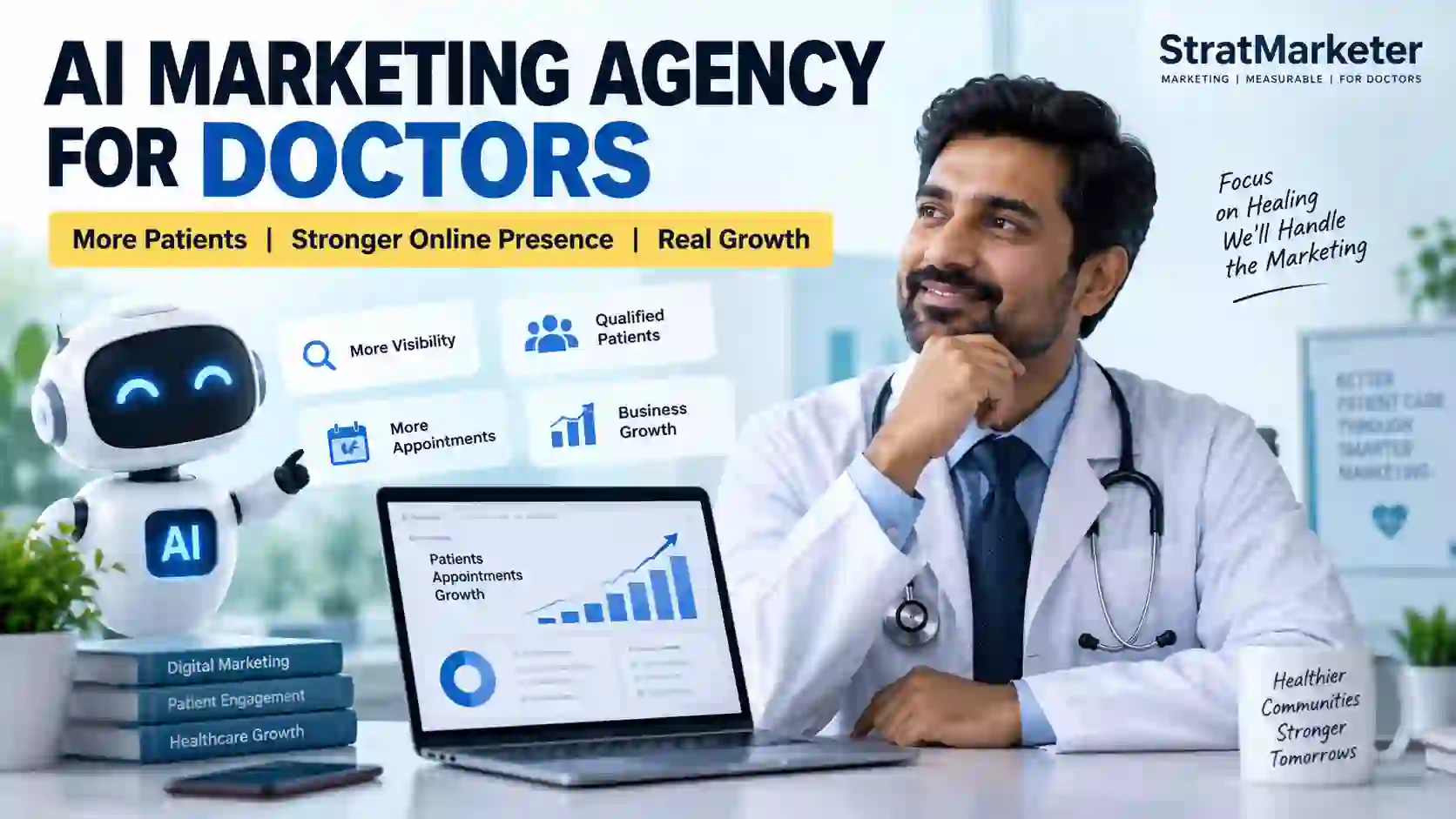
AI Marketing Agency for Healthcare: Smarter Patient Growth with StratMarketer
1. Why Doctors Are Looking Beyond Traditional Healthcare Marketing
Doctors are facing a different kind of patient behaviour today. Earlier, many patients depended heavily on referrals from family doctors, relatives, friends, or nearby residents. Those sources still matter, especially in smaller Indian cities, but the patient journey has changed. Someone experiencing back pain may first search online. A parent looking for a paediatrician may compare doctors, read reviews, check clinic timings, and then call. Even a patient who receives a personal recommendation often searches for the doctor before booking an appointment.
This is one reason an AI marketing agency for doctors is becoming relevant. Traditional marketing methods can create awareness, but they often struggle to understand what happens between a patient’s first online search and the actual appointment enquiry.
For doctors, this gap can be frustrating.
A clinic may receive website visitors but very few appointment calls. A Google Ads campaign may generate enquiries from people outside the preferred service area. The clinic staff may spend time responding to messages that never become appointments. Meanwhile, another nearby practice with better online visibility keeps appearing when patients search for the same treatment.
Marketing healthcare services is also not the same as marketing clothing or consumer products. Trust matters more. Patients may take several days or weeks before contacting a specialist. For certain treatments, they may search repeatedly and use different questions each time.
That is where AI can help analyse patterns that are difficult to track manually.
An AI marketing agency for doctors can use technology to study search behaviour, website interactions, enquiry patterns and advertising performance. The purpose should not simply be to automate everything. Personally, I think that approach is where many healthcare marketing campaigns start going wrong. Patients do not want to feel as though they are speaking with a machine when they are worried about a health issue.
The better approach is to use AI in the background while keeping communication human.
For example, a dental clinic may notice that many visitors search for information about dental implants but leave the website without booking. AI based analysis may identify common content gaps, frequently searched questions, or pages where users lose interest. The doctor can then improve the information available to patients rather than simply increasing advertising spend.
This doesn’t apply everywhere, of course. A well-established doctor with a strong referral network may not need aggressive digital marketing. But even established practices increasingly need accurate information, visible online profiles and a website that patients can actually understand.
The shift is happening gradually, not overnight.
2. What an AI Marketing Agency for Doctors Actually Does
There is some confusion around the term AI marketing agency for doctors. Many people assume it means using ChatGPT to write a few blog posts or automatically generating social media captions. That is a very limited understanding of how AI can support healthcare marketing.
A serious AI marketing agency for doctors should look at multiple parts of the patient’s digital journey.
This can include analysing what potential patients search for, identifying gaps in a clinic’s online presence, improving website content, supporting local SEO, reviewing advertising performance, automating certain repetitive processes and studying the quality of incoming enquiries.
For example, suppose an orthopaedic clinic in Chandigarh receives 100 online enquiries in a month. On paper, that may look positive. But what if 40 of those enquiries are irrelevant, 25 come from outside the doctor’s service area, and another 20 are looking for treatments the clinic does not provide?
The real problem is not the number of leads.
It is the quality of the enquiries.
An AI marketing agency for doctors can help identify these patterns and adjust marketing campaigns accordingly. Search terms, audience behaviour and enquiry conversations can reveal whether the clinic is attracting the right people.
AI can also help with content research. Patients rarely search using medical terminology alone. A doctor may use a specific clinical term, while a patient searches for a symptom, a treatment concern or a simple question. Understanding this difference matters when developing website content.
For instance, someone may search for “best treatment for knee pain while climbing stairs” rather than searching for a formal diagnosis. Content that answers real patient concerns can sometimes perform better than content filled with technical medical language.
Of course, there is an important limitation here. AI should not independently make medical claims or create clinical advice without professional review. An experienced AI marketing agency for doctors should understand this boundary.
I have seen healthcare content become uncomfortable to read because marketing teams try too hard to sound medically authoritative. Sometimes the result is inaccurate. Sometimes it is technically correct but completely disconnected from what a patient is actually trying to understand.
The doctor’s expertise still has to lead.
AI should support the marketing process, not replace medical judgement.
3. How AI Can Help Doctors Understand Patient Search and Enquiry Behaviour
Patient behaviour is rarely as simple as searching for a doctor and immediately booking an appointment.
Someone searching for a dermatologist may first look up their symptoms. Later they may search for possible treatment options. After that, they may compare nearby clinics, check reviews, visit a doctor’s website and only then make an enquiry.
This is where an AI marketing agency for doctors can help create a clearer understanding of the journey.
AI based tools can analyse large amounts of search and behavioural information more quickly than manual analysis. They can help identify recurring questions, changing search patterns, content opportunities and potential reasons why website visitors are not converting into enquiries.
Consider a fertility clinic. Patients may search for different things depending on where they are in their decision-making process. Some are looking for basic information. Others are comparing treatment options. Some are searching specifically for a specialist in their city.
Treating all these people as the same audience would be a mistake.
An AI marketing agency for doctors can help separate these patterns and develop content or campaigns that better match different levels of patient intent.
Enquiry behaviour can also reveal useful information. If the same question repeatedly appears in WhatsApp messages or website forms, that may indicate missing information on the website. If patients frequently ask about consultation fees, availability or treatment processes, the clinic may need clearer communication before the enquiry stage.
Small details like this matter.
I might be wrong here, but many clinics focus too much on generating more leads when the actual issue is poor handling of existing patient interest. A clinic receiving 30 relevant enquiries and responding properly may perform better than one receiving 300 low-quality messages.
AI can help analyse enquiry sources and patterns, but it cannot replace good clinic operations.
A slow response from the reception desk is still a slow response.
4. Using AI for Medical Website Content, SEO and Local Search Presence
A doctor’s website is often treated like a digital brochure. It contains a profile, qualifications, a few services and a contact number. Then nothing changes for years.
That approach is becoming less useful.
Patients expect to find answers before contacting a clinic. Search engines also need enough useful information to understand what the doctor or medical practice actually provides. An AI marketing agency for doctors can support research and analysis when improving these areas.
For SEO, AI can help identify the language patients use while searching for symptoms, treatments and specialists. It can also assist with analysing content gaps and organising information around common patient questions.
But there is a line that should not be crossed.
Automatically publishing dozens of AI-written medical articles without review is not a good healthcare marketing strategy. In fact, I strongly disagree with agencies that treat content volume as the main measure of success for doctors.
Medical content requires accuracy and accountability.
A better process is to use AI for research, pattern identification and content support while ensuring that the final information reflects genuine medical expertise. The doctor’s input becomes especially important when discussing procedures, treatment suitability, risks and patient expectations.
An AI marketing agency for doctors may also work on local search visibility. This can involve improving location information, clinic details, service descriptions, frequently asked questions and content relevant to patients searching within a particular city or surrounding area.
For example, a gastroenterologist in Delhi may have patients searching for the doctor from several different localities. The marketing strategy should reflect realistic patient travel behaviour rather than randomly adding every nearby location name to website pages.
That kind of SEO becomes messy very quickly.
Local search visibility also depends on consistency. Clinic information, appointment details and contact channels need to remain accurate. A patient finding an outdated phone number after searching for an urgent consultation is not a small issue.
An AI marketing agency for doctors can help monitor and organise digital information, but regular human checking remains necessary.
This is one of those areas where automation sounds better than it actually is.
5. AI in Patient Lead Generation and Appointment Enquiries
For many doctors and clinics, lead generation simply means receiving more phone calls or form submissions. But healthcare enquiries need more attention than that.
A person asking about a cosmetic procedure may be ready to book immediately. Someone researching a chronic condition may need information first. Another person may simply be looking for general medical advice and may never become a clinic patient.
An AI marketing agency for doctors can help understand these differences and create a more practical lead generation process.
AI can support advertising analysis by identifying which campaigns generate meaningful enquiries and which ones create unnecessary costs. It can help study patterns in website forms, chatbot conversations, calls and other enquiry channels, depending on how the clinic manages its data.
For paid advertising, AI can also help with audience analysis and campaign optimisation. But healthcare advertising requires caution. Aggressive messaging, misleading promises or unrealistic treatment outcomes can damage patient trust very quickly.
I would rather see a doctor’s clinic generate fewer but relevant enquiries than attract large numbers of people through exaggerated advertising claims.
Appointment enquiry automation can also be useful for repetitive tasks. Basic information about clinic timings, consultation availability and appointment procedures may be handled more efficiently through properly designed systems. This can reduce pressure on reception teams.
However, not every patient interaction should be automated. A worried patient discussing a serious health concern may need reassurance and human communication, and a badly designed chatbot can create irritation rather than convenience.
That awkward gap between automation and real care is something healthcare businesses need to think about carefully, because the technology may be efficient while the experience still feels cold, and patients remember that.
An AI marketing agency for doctors should therefore look beyond lead numbers. The better questions are: Are the enquiries relevant? Are patients receiving accurate information? Is the clinic responding quickly? Are marketing activities creating trust before the first appointment?
Sometimes the answer is not in the campaign.
Sometimes it is sitting with the receptionist’s missed calls, an outdated website page, or a patient who searched three times and never found a clear answer.
6. How Doctors Can Use AI for Google Ads and Paid Healthcare Campaigns
Paid advertising can bring doctors and clinics in front of people who are actively looking for medical services. But spending money on Google Ads without understanding search intent can become expensive very quickly. A clinic may receive plenty of clicks while getting very few genuine appointment enquiries.
This is where an AI marketing agency for doctors can make paid campaigns more practical.
AI can assist with analysing search behaviour, identifying patterns in keyword performance, reviewing audience responses and detecting which campaigns are producing useful enquiries. Instead of looking only at clicks and impressions, the focus can move towards what happens after the patient reaches the website or landing page.
For example, a dermatologist may run campaigns for acne treatment, hair treatment and cosmetic procedures. These services can attract completely different types of search behaviour. A person searching for basic acne information may not be ready to book a consultation. Someone searching specifically for a dermatologist in their city may have much stronger appointment intent.
Treating both searches in the same way can waste advertising money.
An AI marketing agency for doctors can help identify these differences and structure campaigns around actual patient intent. Search terms can be reviewed regularly, low-quality traffic can be identified, and campaigns can be adjusted based on the kind of enquiries they produce.
Google Ads also provides automated features, including bidding and campaign optimisation tools. These can be useful, but doctors should not assume automation will automatically understand the quality of a patient enquiry.
This is important.
An advertising system may identify a particular campaign as successful because it generates a high number of form submissions. But if many of those enquiries are irrelevant, duplicate or unrelated to the doctor’s services, the campaign may not actually be helping the practice.
I have some concern about blind automation here. Technology can optimise towards the wrong outcome if the wrong outcome is being measured.
For healthcare campaigns, success should usually be connected to meaningful actions such as relevant appointment requests, consultation enquiries or qualified calls. The exact measurement will depend on the clinic and the services being promoted.
An AI marketing agency for doctors can also help analyse ad copy and landing page performance. Sometimes the problem is not the advertisement itself. A patient clicks the ad and reaches a page that is confusing, too technical or missing basic information.
A landing page for a medical service should not read like an aggressive sales page.
Patients often want to understand the doctor, the treatment area, the consultation process and what they should reasonably expect. Overpromising may increase short-term clicks but can create trust problems later.
This may not apply everywhere, especially for highly established practices where patients already understand the service. Still, for most clinics trying to attract new patients online, the gap between an advertisement and the actual patient experience deserves attention.
Paid campaigns work best when AI supports better decisions rather than simply spending the budget faster.
7. Personalisation and Automation in the Patient Journey
Patients do not all arrive at a doctor’s website with the same level of understanding.
Some already know which specialist they need. Others are confused. Some want an appointment immediately, while others are simply trying to understand whether their symptoms require medical attention.
This creates an opportunity for thoughtful personalisation.
An AI marketing agency for doctors can help businesses analyse different stages of patient interaction and provide relevant information based on what the person is looking for. This does not mean collecting unnecessary personal information or making patients feel monitored. That would be uncomfortable, and rightly so.
Personalisation can be much simpler.
For example, a patient visiting a cardiology clinic website may search for consultation details, preventive health information or a specific cardiac service. The website and follow-up communication can be organised to make relevant information easier to access.
Automation can also help with repetitive communication. Appointment confirmations, reminders, follow-up messages and basic clinic information can often be managed through automated systems.
This can reduce the workload on clinic staff.
But I would not automate everything.
Healthcare involves situations where people are anxious, confused or scared. An automated response that works perfectly for appointment timing may feel completely inappropriate when someone is asking a serious question. Doctors and clinics need to decide where automation is useful and where human communication must take over.
An AI marketing agency for doctors should help create these boundaries rather than treating every patient interaction as another marketing workflow.
There is also the issue of follow-up. Some patients enquire but do not book immediately. Others may forget to complete an appointment request. A properly designed follow-up process can remind interested patients about available consultation options without becoming repetitive or intrusive.
Nobody enjoys receiving the same promotional message three times.
Personalisation works when it feels helpful. It starts failing when patients can clearly see that a system is trying too hard to push them towards an appointment.
8. Common Risks Doctors Should Consider Before Using AI for Marketing
AI can save time, support analysis and automate repetitive marketing work, but it also introduces risks. Doctors should not assume that every tool labelled as AI is suitable for healthcare marketing.
One major concern is inaccurate content.
AI generated text can sound convincing even when the information is incomplete or incorrect. This becomes particularly risky when creating medical content. A doctor should review information related to treatments, medical conditions, procedures and patient guidance before publication.
An AI marketing agency for doctors should have a proper review process for this work.
Another risk involves patient privacy. Marketing systems may handle website enquiries, appointment information and other sensitive interactions. Doctors need to understand what data is being collected, where it is stored and who can access it.
More data is not always better.
Some agencies also create an unnecessary dependency on automation. Everything gets connected to a tool, and after a few months nobody inside the clinic understands what is actually happening. If the system breaks, the staff are left trying to manage processes they never fully understood.
That is not efficient. It is fragile.
An AI marketing agency for doctors should explain its systems in simple terms. The doctor or clinic management team should know what tools are being used and why.
There is also a risk of using generic AI content across multiple healthcare websites. This can create repetitive information that does not reflect the doctor’s actual experience or clinical approach.
I have seen this kind of content in other industries too, and it has a strange effect. Everything sounds professional, but nothing sounds like anyone actually meant it.
Doctors should be careful about that.
AI is useful, but its output should not become the doctor’s voice.
9. What to Check Before Hiring an AI Marketing Agency for Doctors
Choosing an AI marketing agency for doctors should involve more than comparing monthly packages.
The first thing worth checking is whether the agency understands healthcare communication. Marketing medical services requires more care than promoting most commercial products. Claims, treatment descriptions and patient communication should be handled responsibly.
Ask how the agency uses AI.
This question is more useful than asking whether they use AI.
Some agencies use it mainly for research and analysis. Others automate content production, advertising decisions and communication workflows. The doctor should understand where human review takes place.
It is also worth checking how the agency measures performance.
If the agency reports only website traffic, impressions and social media reach, the picture may be incomplete. These numbers can be useful, but doctors generally need to know whether marketing is attracting relevant enquiries and supporting appointment growth.
An AI marketing agency for doctors should be willing to discuss the difference between activity and actual business outcomes.
Doctors should also ask about content quality. Who reviews medical information? How are treatment claims handled? Will the agency create generic content, or will it work with the doctor’s knowledge and experience?
Another important point is transparency.
The agency should explain what it is doing without hiding behind complicated technology terms. AI systems can be technical, but the marketing strategy itself should still be understandable.
I might be wrong here, but if an agency cannot explain its process clearly to a doctor, there is a reasonable chance the process is either unnecessarily complicated or not very clear even to the agency.
Past experience and relevant case studies can also help, although every medical practice is different. A successful campaign for a cosmetic clinic may not work in the same way for a neurologist or a multispeciality hospital.
Earlier I said that AI can help identify patterns quickly, and I still believe that. But this is where the idea can break. Patterns are useful only when there is enough reliable information behind them. A small clinic with limited data may not benefit from complex AI systems in the same way as a large healthcare organisation.
Sometimes a simpler marketing setup is better.
That is worth saying clearly.
10. How StratMarketer Supports Doctors with AI Based Marketing
StratMarketer works with businesses looking to use AI as part of their wider digital marketing activities rather than treating AI as a separate solution that magically fixes everything.
For doctors and healthcare practices, the starting point should be understanding the existing situation. How do patients currently find the clinic? What information are they searching for? Which marketing channels generate genuine enquiries? Where are potential patients dropping off?
From there, an AI marketing agency for doctors can support areas such as SEO, content development, paid advertising, local search visibility, lead generation, marketing automation and performance analysis.
StratMarketer can help doctors build a more organised digital presence while using AI to analyse marketing opportunities and repetitive processes. The aim is not to remove the human side of healthcare marketing. If anything, automation should leave more room for the clinic team to focus on actual patient communication.
The work may include improving website content based on real patient search behaviour, identifying opportunities for better local visibility, analysing advertising performance and building systems for handling and tracking enquiries.
As an AI marketing agency for doctors, StratMarketer can also support healthcare businesses in understanding which marketing activities are producing meaningful engagement and which ones are simply creating numbers on a report.
Because doctors have different specialities, patient behaviour also differs. A skin clinic, dental practice, orthopaedic specialist and fertility centre will not necessarily need the same marketing process. The strategy should depend on the services offered, competition, location and the way patients make decisions.
There is no single AI formula for every doctor.
And honestly, that may be the most important thing to remember. AI can analyse faster, automate routine work and help marketers spot patterns, but patients still choose doctors based on trust, clarity, experience and the confidence they feel before making that first appointment. Technology can support that process. It cannot manufacture it.
Our Services
Contact Us
- Paonta Sahib, Himachal Pradesh, India
- +91-8700998508
- support@stratmarketer.com
Start From Here
These two options make it easy for you to get the information you want.