


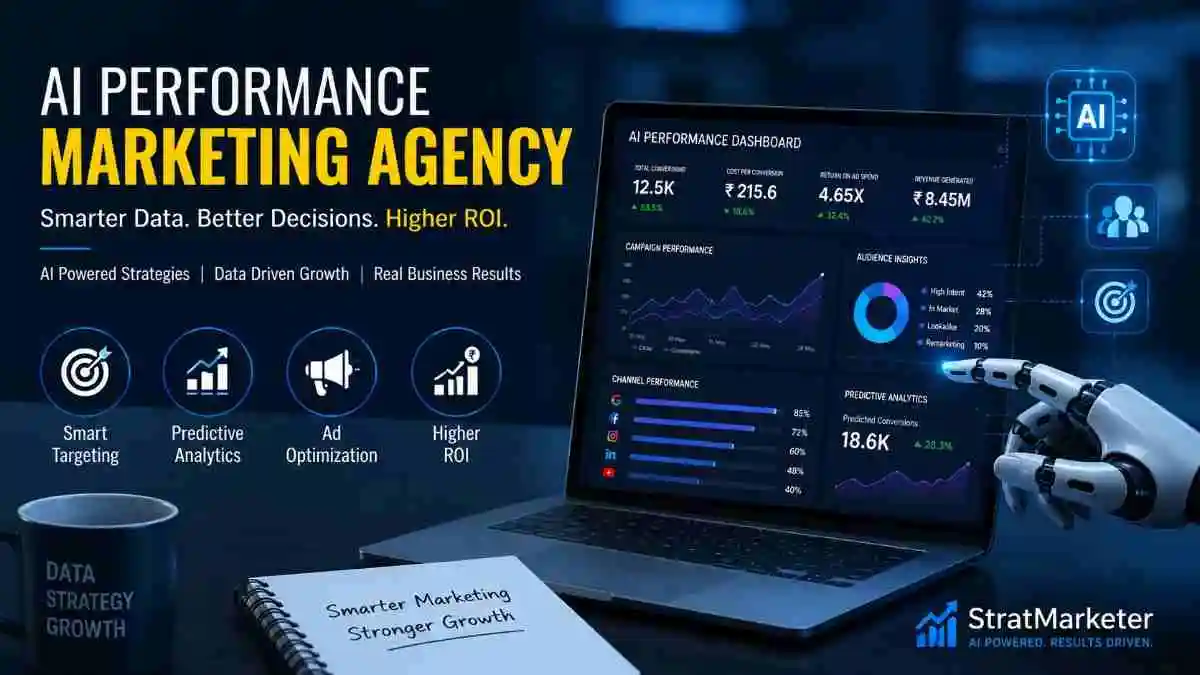
What Makes an AI Performance Marketing Agency Different From a Traditional Digital Marketing Agency?
Businesses have always wanted one thing from marketing. Spend less, reach the right people, and generate more sales. Traditional digital marketing has certainly helped companies build an online presence through SEO, social media, paid advertising, email campaigns, and content marketing. But the way decisions are made has changed significantly over the last few years.
An AI performance marketing agency approaches marketing from a completely different angle. Instead of relying mainly on manual analysis, historical reports, and human assumptions, it uses artificial intelligence to process massive amounts of campaign data in real time. This allows marketers to identify trends, predict customer behaviour, optimise budgets, and adjust campaigns much faster than traditional methods.
A traditional agency may review campaign performance every week or at the end of the month before making changes. An AI performance marketing agency continuously monitors signals such as click patterns, conversion rates, audience engagement, device usage, browsing behaviour, and purchasing intent. This helps campaigns adapt while they are running rather than after valuable budget has already been spent.
The difference becomes even more visible when managing large advertising accounts. Imagine an ecommerce brand running hundreds of products across Google Ads, Meta Ads, and other platforms. A human team can analyse reports, but it takes time. AI can identify underperforming ads, suggest new audience segments, detect budget wastage, and highlight profitable opportunities almost instantly.
That does not mean AI replaces experienced marketers.
In my experience, businesses often misunderstand this part. They assume AI can simply run campaigns without human involvement. I have rarely seen that work well. AI makes recommendations based on patterns and probabilities, but experienced marketers still decide the overall business strategy, creative messaging, pricing offers, and customer positioning. The strongest results usually come from combining intelligent automation with experienced decision making.
An AI performance marketing agency also focuses far more on measurable business outcomes. Instead of celebrating impressions or page likes, the conversation shifts towards customer acquisition cost, return on ad spend, lead quality, customer lifetime value, and revenue growth. Every campaign decision is linked to a business objective.
This is why many companies now expect more than basic campaign management. They want marketing systems that learn, improve, and become more efficient over time rather than repeating the same manual optimisation process month after month.
Why Businesses Are Shifting Towards AI Performance Marketing Instead of Conventional Advertising
Advertising costs continue to rise across almost every major digital platform. Whether a business is promoting products through Google Ads, Meta, LinkedIn, or YouTube, competition has increased, making it more expensive to acquire customers.
This is one of the biggest reasons businesses are choosing an AI performance marketing agency over traditional advertising approaches.
Conventional advertising often depends on broad audience targeting, manual keyword selection, fixed bidding strategies, and periodic campaign reviews. While these methods still have value, they struggle to keep pace with rapidly changing customer behaviour.
Consumer interests change quickly. A campaign that performs well today may become inefficient within days if competitors adjust pricing, launch new offers, or seasonal demand shifts. AI systems can detect these changes much faster than manual reporting.
I once worked with a retailer who believed increasing ad budget would automatically increase sales. It sounded logical at first. After looking deeper, we realised nearly 35 percent of the advertising spend was reaching audiences who had almost no buying intent. Better targeting generated stronger results without increasing the budget.
Situations like this are becoming common.
Businesses are beginning to realise that marketing success depends less on spending more money and more on spending it intelligently.
An AI performance marketing agency helps achieve this by continuously analysing thousands of performance signals, including customer interactions, audience quality, conversion likelihood, search intent, historical behaviour, and campaign efficiency. Instead of reacting after performance drops, AI can often identify early indicators before they become expensive problems.
Another reason companies are making this shift is speed.
Marketing teams no longer have the luxury of waiting several weeks before optimising campaigns. Product launches, seasonal offers, competitor promotions, and customer expectations move much faster now. AI enables marketers to respond with greater agility while maintaining consistency across multiple advertising channels.
That said, I might be wrong here because this does not apply everywhere.
Some local businesses with very small advertising budgets may still achieve satisfactory results using simple manual campaigns managed by experienced professionals. AI is not automatically the answer for every business. Its biggest advantage usually appears when campaign complexity increases, customer data grows, or businesses want to scale across multiple channels without losing efficiency.
How AI Uses Data, Customer Behaviour, and Predictive Analytics to Improve Campaign Performance
Every digital interaction creates valuable information.
Someone searches for a product, visits a website, watches a video, abandons a shopping cart, clicks an advertisement, downloads a brochure, or submits an enquiry. Individually these actions may seem ordinary, but together they reveal behavioural patterns that help marketers understand buying intent.
An AI performance marketing agency collects and analyses these signals to build a much clearer picture of how customers move through the buying journey.
Rather than relying only on demographics such as age or location, AI studies behavioural indicators. It looks at browsing habits, previous purchases, engagement levels, search history, time spent on specific pages, repeat visits, device preferences, and many other variables that humans would struggle to process manually at scale.
This allows advertising campaigns to become increasingly personalised.
For example, two users searching for the same product may receive different advertisements because their previous online behaviour suggests different purchase intentions. One customer may be ready to buy immediately, while another may still be researching options. AI helps deliver messaging that matches each stage of the customer journey.
Predictive analytics takes this even further.
Instead of only explaining what happened yesterday, predictive models estimate what is likely to happen next. They identify audiences most likely to convert, estimate future sales trends, forecast campaign performance, and recommend budget allocation across different platforms.
I would still be cautious, though.
Predictions are based on historical patterns, and markets do not always behave logically. Sudden economic changes, viral social trends, competitor pricing, or unexpected events can quickly change customer behaviour. AI can reduce uncertainty, but it cannot eliminate it.
A strong AI performance marketing agency understands these limitations and combines predictive insights with practical business experience. Human judgement still matters when evaluating creative direction, understanding cultural preferences, launching new products, or responding to situations where historical data offers very little guidance.
Companies like StratMarketer recognise that successful performance marketing is not simply about algorithms making decisions. It is about using AI to support smarter planning, faster optimisation, and better business outcomes while experienced marketers continue to guide the overall strategy based on market realities and customer expectations.
The Core Services You Should Expect From an AI Performance Marketing Agency
Choosing an AI performance marketing agency should not be about finding someone who simply knows how to run advertisements. Most agencies can launch campaigns. The real difference lies in how they optimise, analyse, and improve those campaigns over time.
A good agency starts by understanding business objectives before touching any advertising platform. Every business has different priorities. An ecommerce brand may focus on increasing online sales, while a B2B company may care more about qualified leads than the number of enquiries. AI works best when it has a clear business goal to optimise towards.
Paid advertising management remains one of the biggest services offered by an AI performance marketing agency. This usually includes Google Ads, Meta Ads, LinkedIn Ads, YouTube Ads, and other digital platforms where customer acquisition depends on accurate targeting and continuous optimisation.
Audience segmentation has also become far more sophisticated. Instead of grouping customers only by age or location, AI identifies behavioural patterns, purchase intent, browsing history, previous interactions, and engagement signals to build more relevant audiences.
Creative testing is another area where AI has changed the process. Businesses no longer need to guess which advertisement will perform better. Multiple headlines, visuals, videos, and calls to action can be tested simultaneously. The strongest combinations receive more budget while weaker creatives are gradually phased out.
Landing page optimisation is often ignored, and honestly, I still find that surprising. Businesses sometimes spend thousands on advertising while sending visitors to pages that load slowly, contain confusing messaging, or make enquiry forms unnecessarily complicated. No amount of AI can completely fix a poor customer experience after the click.
A reliable AI performance marketing agency also provides conversion tracking, attribution analysis, reporting dashboards, budget forecasting, customer journey analysis, remarketing campaigns, and marketing automation. These services work together rather than operating independently.
There is one more thing that deserves attention.
Many agencies proudly advertise AI without explaining where it is actually being used. Businesses should ask practical questions. Is AI helping with bidding? Audience discovery? Predictive analysis? Creative optimisation? Reporting? If the answers remain vague, the technology may simply be a marketing phrase instead of a working capability.
Common Performance Marketing Mistakes That Increase Ad Spend and Reduce ROI
Performance marketing is often described as measurable marketing. That is true.
But being measurable does not automatically make it profitable.
One mistake I see repeatedly is treating advertising budget as the solution to every performance problem. When campaigns struggle, many businesses increase spending before understanding why conversions have dropped. Sometimes the issue has nothing to do with advertising. It could be slow website speed, poor product pricing, weak landing pages, or an enquiry process that frustrates visitors.
Another common mistake is tracking the wrong metrics.
High impressions and thousands of clicks may look impressive in reports, but if qualified leads are not increasing, those numbers offer very little business value. A capable AI performance marketing agency focuses on metrics that directly influence revenue rather than vanity statistics.
Businesses also underestimate audience fatigue.
Showing the same advertisement repeatedly to the same people eventually reduces engagement. Click through rates decline, advertising costs increase, and overall campaign performance begins to weaken. AI can detect these patterns much earlier by monitoring engagement signals and recommending creative refreshes before performance drops significantly.
Ignoring first party customer data is another expensive mistake. Existing customers, previous enquiries, abandoned carts, and website visitors often represent some of the highest quality audiences available. Yet many businesses continue targeting only completely new users while overlooking people who have already shown genuine interest.
I have also seen companies pause campaigns after only a few days because results were slower than expected. That can become expensive in its own way. Performance marketing usually requires enough data for meaningful optimisation. Making large decisions too early sometimes prevents campaigns from reaching their potential.
Still, I would not say every campaign needs weeks before changes are made. Some problems become obvious within hours. Incorrect tracking, broken landing pages, or irrelevant targeting should never be left running simply because someone believes campaigns need more time. Experience helps distinguish between temporary fluctuations and genuine performance issues.
How to Choose the Right AI Performance Marketing Agency for Long Term Business Growth
Finding an AI performance marketing agency is relatively easy today.
Finding one that consistently delivers measurable business growth is much harder.
The first thing I would examine is whether the agency talks more about technology than business outcomes. AI is useful, but businesses do not invest in artificial intelligence for its own sake. They invest because they want better lead quality, lower acquisition costs, stronger return on advertising spend, and sustainable revenue growth.
Case studies reveal a lot about an agency’s approach. Instead of looking only at percentage increases, understand the context. Which industry was involved? How long did improvement take? What problems were solved? Were the results achieved through better targeting, stronger creative strategy, improved conversion tracking, or website optimisation?
Transparency matters just as much.
A trustworthy AI performance marketing agency explains both successful campaigns and challenges. No experienced marketer wins every campaign. Digital advertising changes constantly, customer behaviour evolves, and competitors introduce new strategies. Agencies that promise guaranteed rankings, guaranteed leads, or guaranteed sales deserve careful questioning.
Communication is another factor that businesses often ignore until problems appear.
Regular reporting should explain why performance changed, not simply present graphs. Business owners should understand what actions were taken, what experiments were performed, and what improvements are planned next.
I might be wrong here because every company has different expectations, but I usually prefer agencies that ask difficult business questions before discussing advertising platforms. Questions about profit margins, customer lifetime value, sales process, average order value, and operational capacity usually indicate that the agency understands business beyond campaign management.
Long term growth rarely depends on one successful advertisement. It comes from continuous testing, customer understanding, strategic planning, and disciplined optimisation over many months.
How StratMarketer Helps Businesses Scale With AI Powered Performance Marketing Strategies
StratMarketer approaches performance marketing with a simple principle. Every campaign should contribute to measurable business growth rather than generating activity that looks impressive on reports but produces little commercial value.
As an AI performance marketing agency, StratMarketer combines experienced marketing professionals with AI powered analysis to help businesses make faster and more informed decisions across multiple digital channels.
The process begins with understanding business objectives, customer behaviour, competitors, and current marketing performance. Instead of applying identical campaign structures to every client, strategies are developed around the company’s industry, target audience, sales cycle, and growth goals.
AI supports campaign management in several practical ways. It helps analyse customer intent, identify high value audience segments, optimise bidding strategies, monitor advertising performance, forecast trends, and highlight opportunities that may otherwise remain hidden inside large datasets.
StratMarketer also focuses heavily on creative testing because successful performance marketing is not driven by targeting alone. Different headlines, visuals, videos, landing pages, and offers are continuously evaluated to understand which combinations generate stronger engagement and higher conversion rates.
Another strength is cross channel integration. Customers rarely interact with a brand through a single platform. Someone may discover a business through Google Search, watch product videos on YouTube, see remarketing advertisements on social media, and finally submit an enquiry after several interactions. StratMarketer builds campaigns that recognise this customer journey instead of treating every platform as an isolated marketing channel.
What I appreciate about this approach is that AI remains a supporting tool rather than replacing strategic thinking. Technology helps process information quickly, but experienced marketers continue making business decisions based on customer psychology, market conditions, and commercial objectives.
That balance usually produces more reliable long term results than relying entirely on automation.
AI Performance Marketing Trends That Are Changing Customer Acquisition and Digital Advertising
The role of an AI performance marketing agency continues to expand because digital advertising itself is changing rapidly. Platforms are becoming more automated, customer expectations are increasing, and privacy regulations are reshaping how marketers collect and use data.
One noticeable trend is the growing importance of predictive audience modelling. Instead of relying only on past customer behaviour, AI now estimates which users are most likely to convert based on multiple behavioural signals. This allows businesses to focus budgets where conversion probability is higher.
Automation in campaign optimisation has also become much more advanced. Bid adjustments, budget allocation, audience expansion, and creative recommendations increasingly happen through machine learning models that respond much faster than manual campaign management.
First party data has become significantly more valuable as browsers and advertising platforms reduce reliance on third party tracking technologies. Businesses that build strong customer databases through enquiries, purchases, loyalty programmes, and direct interactions are likely to gain an advantage over competitors relying entirely on external audience targeting.
Creative production is changing too. AI assists marketers by generating variations of headlines, ad copy, images, and video concepts that can be tested much faster than traditional creative workflows. Human creativity still matters because customers respond to emotion, trust, and authenticity, but AI reduces the time required to experiment with multiple campaign ideas.
Voice search, conversational AI, and personalised search experiences are also influencing customer acquisition. Users increasingly expect faster, more relevant answers instead of browsing through multiple pages before making a decision.
There is something slightly uncomfortable about how quickly all this is moving.
Sometimes I wonder if businesses are becoming too dependent on automation. Then I see how much time experienced marketers save by letting AI handle repetitive analysis while they focus on strategy and customer understanding. So perhaps the concern is not AI itself. It is using AI without enough human judgement.
That distinction feels increasingly important every year.
Questions Every Business Should Ask Before Hiring an AI Performance Marketing Agency
Hiring an AI performance marketing agency is not just about comparing pricing or looking at attractive presentations. The right partner should understand your business as deeply as they understand advertising platforms. Before signing any agreement, take time to ask questions that reveal how the agency actually works.
Ask how they define success. If the answer revolves around clicks, impressions, or followers, dig deeper. A reliable AI performance marketing agency should be talking about qualified leads, customer acquisition cost, return on ad spend, revenue, and long term profitability.
Find out how AI is being used in their process. Some agencies mention AI on every page of their website, but very little changes behind the scenes. Ask whether AI is helping with audience targeting, bid optimisation, predictive analytics, creative testing, reporting, or campaign automation. Specific answers usually indicate genuine expertise.
Request examples from businesses that are similar to yours. A strategy that worked for an online fashion brand may not deliver the same results for a manufacturing company or a healthcare provider. Industry experience can reduce the learning curve and avoid unnecessary experimentation.
Another important question is about reporting. You should know how often reports will be shared, what metrics will be included, and whether someone will explain the numbers instead of simply emailing a dashboard.
It is also worth asking how they respond when campaigns do not perform as expected. Every experienced marketer has handled campaigns that needed major adjustments. What matters is how quickly problems are identified, what testing process follows, and how decisions are made using data rather than assumptions.
Do not forget to ask who will actually manage your account. Sometimes businesses hire an agency after speaking with senior consultants, only to find that day to day campaign management is handled by someone with very limited experience.
I would also ask one simple question.
“What would make you advise us not to run paid campaigns right now?”
The answer can reveal a lot. A trustworthy AI performance marketing agency will sometimes recommend improving the website, fixing conversion tracking, refining offers, or strengthening landing pages before increasing advertising spend. That level of honesty is often more valuable than hearing promises of instant growth.
Frequently Asked Questions About AI Performance Marketing Agency
What does an AI performance marketing agency do?
An AI performance marketing agency manages digital advertising campaigns using artificial intelligence along with human expertise. AI helps analyse customer behaviour, automate optimisation, improve targeting, and increase campaign efficiency while marketers focus on strategy and business goals.
Is AI performance marketing suitable for small businesses?
Yes, provided the business has clear objectives and realistic expectations. Small businesses can benefit from better audience targeting and smarter budget allocation. However, if the website or sales process has major issues, those should usually be addressed first.
Does AI replace digital marketing experts?
No. AI supports decision making by processing large volumes of data quickly, but experienced marketers still create strategy, interpret results, understand customer psychology, and make commercial decisions that machines cannot fully replicate.
How long does it take to see results from an AI performance marketing agency?
It depends on the industry, competition, campaign objectives, and available data. Some optimisations may improve performance within a few weeks, while sustainable growth often develops over several months as campaigns collect more data and continuous testing takes place.
Which advertising platforms can an AI performance marketing agency manage?
Most agencies manage Google Ads, Meta Ads, LinkedIn Ads, YouTube Ads, Microsoft Ads, and other digital advertising platforms. The choice depends on where your target customers spend their time and how they make buying decisions.
Can AI reduce advertising costs?
It can improve efficiency by identifying better audiences, optimising bids, and reducing wasted spend. That does not always mean lower total advertising costs. Sometimes businesses spend more because campaigns are producing stronger returns. Higher investment can make sense if profitability also increases.
How do I know if an AI performance marketing agency is the right fit?
Look beyond technology claims. Review case studies, ask about reporting processes, understand how AI is used, evaluate communication, and see whether the agency takes time to understand your business before recommending campaigns. Those conversations usually tell you more than any sales presentation ever will.