


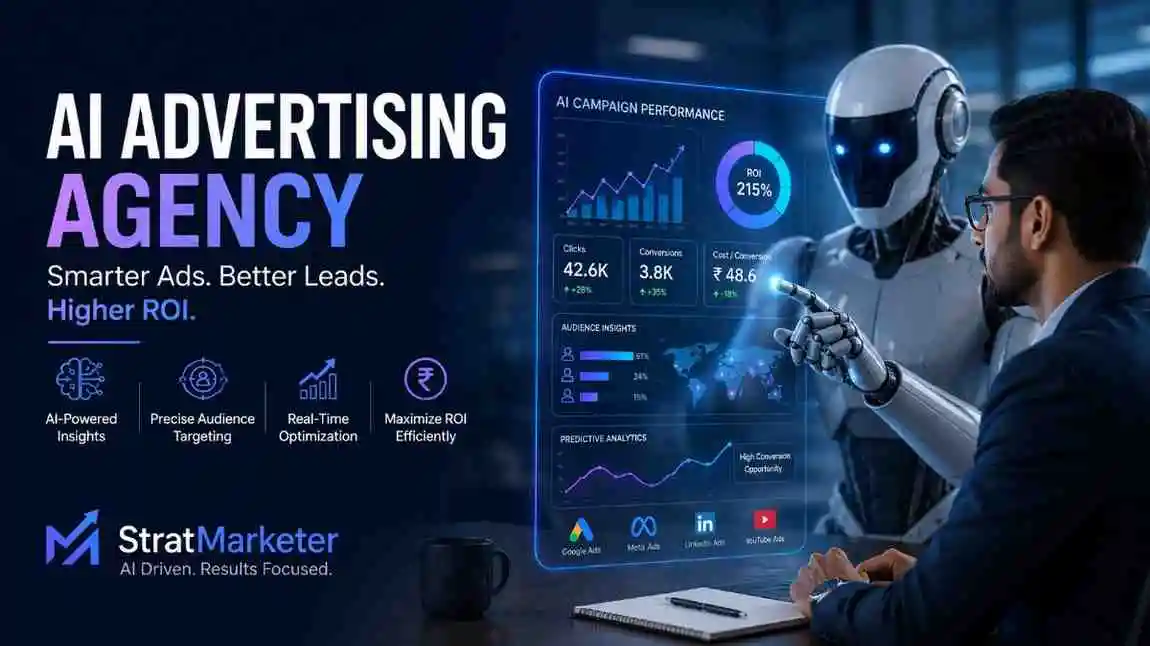
What Makes an AI Advertising Agency Different From a Traditional Advertising Agency?
Not very long ago, most advertising decisions depended heavily on experience, instinct, and historical campaign reports. A marketing manager would review last month’s numbers, discuss ideas with the agency, approve creatives, and wait several weeks before understanding whether the campaign was actually working. That process still exists in many places, but the pace of digital advertising has changed dramatically.
An AI advertising agency approaches advertising differently. Instead of relying only on manual analysis, it combines artificial intelligence, automation, predictive analytics, and human expertise to make faster and more informed decisions throughout a campaign. Rather than waiting for campaigns to underperform before taking action, AI can identify patterns early and recommend adjustments while the campaign is still running.
That does not mean artificial intelligence replaces marketers. It doesn’t. In my experience, the businesses that get the best results are the ones where experienced marketers use AI as a decision support system instead of treating it as an automatic solution.
A traditional advertising agency often spends significant time manually analysing audience reports, testing creatives one after another, adjusting bids, and preparing performance reports. An AI advertising agency automates many of these repetitive tasks so specialists can focus on strategy, customer psychology, creative messaging, and business growth.
Think about an online furniture retailer preparing for a festive sale. A conventional approach might launch one campaign for everyone interested in furniture. An AI driven strategy can automatically separate customers based on browsing behaviour, previous purchases, price sensitivity, location, device usage, and even the likelihood of completing a purchase. Each audience may receive different advertisements, different budgets, and different bidding strategies without requiring constant manual intervention.
The speed of optimisation is another major difference.
Digital advertising platforms generate thousands of data points every day. Manually reviewing all of them is almost impossible. AI systems continuously analyse campaign performance and highlight opportunities that humans may overlook. This allows marketers to react much faster when customer behaviour changes.
I have also noticed something that many business owners misunderstand. They assume AI advertising simply means using ChatGPT or generating ad copy with artificial intelligence. That is only a tiny part of the picture. A professional AI advertising agency uses AI across campaign planning, audience research, bid management, predictive analysis, creative testing, conversion tracking, reporting, and performance forecasting.
Of course, AI has limitations. Customer emotions, brand storytelling, cultural understanding, and creative judgement still require experienced marketers. This is exactly why the strongest agencies combine intelligent technology with human decision making instead of depending entirely on automation.
Why Businesses Are Moving Towards AI Driven Advertising Instead of Guesswork
Advertising costs have increased across almost every major digital platform. Whether a business advertises on Google, Meta, LinkedIn, YouTube, or emerging platforms, wasting budget has become much more expensive than it was a few years ago.
This is one of the biggest reasons businesses are turning to an AI advertising agency.
Business owners no longer want advertising decisions based on assumptions. They want evidence. They want to understand why one campaign succeeds while another fails. More importantly, they want continuous improvements instead of waiting until the campaign ends.
AI helps make this possible by analysing massive amounts of behavioural data in real time. It identifies patterns that would take people hours or even days to discover manually. Customer interests change. Search behaviour changes. Competitor activity changes. AI systems can detect many of these shifts almost immediately.
I remember speaking with the owner of a coaching institute who believed his advertisements were underperforming because of poor creative design. After reviewing the campaign, the bigger issue turned out to be audience targeting. Most of the advertising budget was reaching people outside his service area. Fixing the audience settings improved lead quality without increasing overall spend. AI tools helped identify that mismatch much faster than manual reporting would have.
That said, AI is not magic. I might be wrong here because every business behaves differently, but I’ve seen companies expect artificial intelligence to fix weak offers, poor landing pages, or unrealistic pricing. It cannot. If the business fundamentals are weak, even the smartest advertising algorithms will struggle.
Another reason businesses prefer AI driven advertising is the ability to test multiple variations simultaneously. Headlines, visuals, calls to action, audience segments, placements, and bidding strategies can all be evaluated continuously. Instead of making one large decision every month, marketers make hundreds of smaller improvements throughout the campaign.
The result is usually better efficiency, lower wasted spend, and more reliable decision making.
There is also growing pressure on marketing teams to justify every advertising expense. Business owners increasingly ask questions such as where the leads came from, which keywords converted best, which audience generated the highest revenue, and which campaign should receive more budget next month. AI powered reporting helps answer these questions with far greater clarity than traditional reporting methods.
Perhaps the biggest shift is psychological rather than technical.
Businesses are becoming less interested in advertising activity and more interested in measurable business outcomes. They care less about impressions alone and more about enquiries, qualified leads, sales, customer acquisition cost, and long term profitability.
That change has made the role of an AI advertising agency far more valuable than simply creating advertisements.
How an AI Advertising Agency Uses Data, Automation, and Customer Behaviour to Improve Campaign Performance
Every digital advertisement creates data.
Every click, search query, website visit, product view, enquiry, abandoned cart, completed purchase, returning visitor, and conversion adds another layer of information about customer behaviour. The challenge has never been collecting data. The real challenge is understanding what that data actually means.
This is where an AI advertising agency creates measurable value.
Instead of looking only at surface level metrics such as impressions or clicks, AI systems analyse deeper behavioural signals. They identify which audience segments are more likely to convert, which advertisements lose effectiveness over time, which keywords attract high quality customers, and which campaigns deserve additional investment.
Automation plays an equally important role.
Many advertising tasks that previously required daily manual work can now be managed intelligently through automated systems. Budget allocation, bid adjustments, audience expansion, performance alerts, reporting, and campaign optimisation happen continuously while marketing specialists monitor the overall strategy.
One interesting example comes from ecommerce businesses. Two customers may visit the same product page. One spends thirty seconds reading specifications before leaving. The other compares products, watches the product video, returns twice within a week, and finally adds the item to the cart. Their behaviour is completely different. AI models recognise these patterns and help marketers build separate remarketing strategies for each type of visitor.
Traditional campaign management often treats both visitors similarly.
An AI advertising agency understands that customer journeys rarely follow a straight line. People research, compare, hesitate, return later, and sometimes purchase weeks after the first interaction. Analysing these behavioural journeys helps improve campaign performance over time.
I have occasionally seen businesses become obsessed with automation. They automate everything possible and assume the system will continue producing excellent results forever. That usually doesn’t last. Markets change, competitors react, customer expectations evolve, and advertising platforms introduce new features regularly. Human oversight still matters.
The strongest advertising strategies usually combine machine speed with human judgement.
At StratMarketer, this balance forms the foundation of campaign management. AI assists with analysing patterns, forecasting opportunities, optimising budgets, and identifying trends, while experienced marketing professionals focus on strategic thinking, creative direction, customer intent, and long term business growth.
Sometimes the numbers tell one story. Customer conversations tell another.
Ignoring either one is rarely a good idea.
Core Services You Should Expect From an AI Advertising Agency
Not every agency offering AI powered advertising delivers the same level of service. Some simply use AI tools to write ad copy and create images, then call themselves an AI advertising agency. That is a very limited use of artificial intelligence.
A genuine AI advertising agency builds AI into almost every stage of campaign planning and optimisation while keeping experienced marketers in control of important decisions.
Campaign strategy comes first.
Before any advertisement goes live, the agency should understand your business model, ideal customers, buying cycle, competitors, and revenue goals. Without that foundation, even advanced AI systems will optimise the wrong objective.
Audience research is another core service. AI analyses customer behaviour across multiple platforms to identify people who are most likely to engage with your business. Instead of targeting broad interests alone, campaigns become more focused on real buying intent.
Creative testing is equally important. Rather than running one advertisement for weeks, an AI advertising agency continuously tests different headlines, visuals, videos, descriptions, calls to action, and landing page combinations. Small improvements across multiple elements often produce a significant increase in conversions.
Campaign automation saves both time and advertising budget. AI helps manage bidding strategies, adjusts budgets between campaigns, pauses underperforming advertisements, and highlights opportunities before problems become expensive.
Predictive analytics is something many businesses overlook. Historical performance data helps forecast which campaigns are likely to perform well, which audiences may require additional investment, and when seasonal demand is expected to increase. These predictions are never perfect, but they are often far more reliable than relying only on intuition.
Reporting should also be different.
Instead of sending complicated spreadsheets every month, a professional AI advertising agency explains what actually happened, why it happened, and what should happen next. Numbers without interpretation rarely help business owners make better decisions.
Landing page optimisation is another service that deserves more attention. I’ve seen businesses blame advertisements when the real issue was a confusing website or a slow checkout process. AI can identify user behaviour patterns, but improving the customer experience still requires thoughtful design and marketing expertise.
Many agencies now integrate advertising with CRM systems, email automation, WhatsApp marketing, and lead nurturing workflows. That creates a smoother customer journey instead of treating advertising as a separate activity.
Personally, I feel businesses should avoid agencies that promise fully automated advertising with almost no human involvement. That sounds attractive at first, but marketing is still about understanding people. AI processes information quickly. People understand emotion.
Both matter.
Industries That Benefit the Most From Working With an AI Advertising Agency
Almost every industry can benefit from smarter advertising, but the impact is usually greater in businesses where customer behaviour generates large amounts of digital data.
Ecommerce businesses are among the biggest beneficiaries. Thousands of customer interactions happen every day through product searches, abandoned carts, repeat purchases, and browsing activity. An AI advertising agency can use these signals to improve product recommendations, remarketing campaigns, and customer acquisition strategies.
Healthcare providers, wellness clinics, and diagnostic centres also benefit because patients often spend considerable time researching before making appointments. AI helps identify which campaigns generate enquiries that actually become consultations instead of simply increasing website traffic.
Real estate developers and property consultants work with long buying cycles. Buyers compare locations, pricing, amenities, and financing options over several weeks or months. AI driven remarketing keeps the business visible throughout that journey without wasting advertising spend on people who have already lost interest.
Educational institutions, coaching centres, and online learning platforms use AI to understand which courses attract the highest quality leads and which student segments respond best during different admission periods.
Manufacturing companies have traditionally depended on exhibitions and sales teams, but that is changing. Many industrial buyers now begin supplier research online. An AI advertising agency helps manufacturers reach procurement managers, distributors, exporters, and business owners through highly targeted campaigns.
Professional service firms such as legal consultants, chartered accountants, architects, financial advisors, and business consultants also benefit because AI identifies audiences based on professional interests, business intent, and previous engagement.
Hospitality businesses, restaurants, travel companies, automobile dealerships, fitness centres, and local service providers increasingly rely on AI powered advertising to reach nearby customers who are actively searching for their services.
I should add one thing though.
Not every business needs highly complex AI systems immediately. A small neighbourhood bakery with limited advertising goals may achieve excellent results with a simpler strategy. This may not apply everywhere, and I might be wrong here because local markets behave differently, but buying sophisticated technology before understanding your customers rarely solves the real problem.
Sometimes better messaging creates more growth than better algorithms.
Common Advertising Mistakes Businesses Make Before Switching to an AI Advertising Agency
One mistake appears again and again.
Businesses often believe more advertising budget automatically means more sales.
Unfortunately, advertising platforms do not work that way. If campaigns target the wrong audience, increasing spend usually increases waste as well.
Many companies also focus almost entirely on clicks. High click numbers look impressive in reports, but clicks do not pay salaries or generate business growth. An experienced AI advertising agency pays closer attention to qualified leads, customer acquisition costs, conversion rates, repeat purchases, and lifetime customer value.
Another common mistake is running identical advertisements for every audience.
A first time visitor, an existing customer, and someone who abandoned their shopping cart should rarely receive the same message. AI helps personalise communication according to where customers are in their buying journey.
Some businesses ignore conversion tracking altogether. They know people are clicking advertisements but cannot identify which campaigns actually generate enquiries or sales. Without accurate tracking, every future decision becomes partly guesswork.
Creative fatigue is another issue.
The same advertisement shown repeatedly eventually loses effectiveness. AI identifies declining engagement much earlier than manual reporting and recommends fresh creative variations before campaign performance drops significantly.
I remember working with a local retail business that insisted one advertisement had worked well for nearly a year. Technically, it was still generating clicks, but conversion rates had quietly fallen month after month. Nobody noticed because they were only looking at traffic reports. It was frustrating because the warning signs had been there all along.
Businesses also underestimate landing pages. They spend weeks perfecting advertisements while directing visitors to websites that load slowly or make it difficult to submit an enquiry. No amount of optimisation can fully compensate for a poor customer experience after the click.
Then there is the expectation that AI will fix everything.
It will not.
If pricing is unrealistic, customer service is inconsistent, product quality disappoints buyers, or sales teams respond after three days, even the best AI advertising agency will struggle to produce meaningful results.
I used to think campaign optimisation solved most advertising problems. Now I’m less certain. Quite often the bottleneck exists somewhere inside the business rather than inside the advertising platform.
That realisation is uncomfortable.
How to Choose the Right AI Advertising Agency for Long Term Business Growth
Choosing an AI advertising agency should never be based only on pricing or attractive presentations.
The first thing to evaluate is whether the agency understands your industry. Every market behaves differently. The advertising strategy that works for a fashion brand may fail completely for a manufacturing company or a B2B software provider.
Ask how they use AI in real campaigns.
If every answer revolves around AI generated content, they are probably using only a small part of what artificial intelligence can actually do. A capable AI advertising agency should explain audience analysis, predictive modelling, campaign automation, attribution, conversion tracking, performance forecasting, and ongoing optimisation in practical language.
Transparency matters just as much.
You should know how advertising budgets are allocated, which metrics define success, how often campaigns are reviewed, and what happens if performance declines.
Look beyond case studies as well. Anyone can showcase successful projects. Ask about campaigns that struggled and what the team learned from those situations. Honest agencies usually speak more openly about failures because experience rarely comes only from success.
Communication style deserves attention too.
Some agencies disappear after launching campaigns and return only at the end of the month with a report. Others work collaboratively, explain decisions clearly, and involve clients in strategic planning. Long term partnerships usually develop through consistent communication rather than occasional updates.
Technology is important, but so is curiosity.
Advertising platforms evolve constantly. Customer behaviour changes. Privacy regulations continue to influence data collection. The right AI advertising agency should continuously adapt instead of relying on methods that worked several years ago.
One sentence I hear quite often is, “Our AI handles everything.”
Honestly, that worries me a little.
Marketing still requires judgement, context, and conversations with real people. Software cannot attend your sales meetings or understand every concern your customers mention before making a purchase.
Why StratMarketer Combines AI Technology With Human Marketing Expertise
At StratMarketer, artificial intelligence is viewed as a powerful assistant, not a replacement for experienced marketers.
Every business has different objectives. Some need qualified leads. Others focus on ecommerce sales, local enquiries, franchise expansion, brand awareness, or B2B lead generation. Building campaigns without understanding those priorities usually leads to disappointing outcomes, regardless of how advanced the technology may be.
That is why StratMarketer begins with business understanding before campaign automation.
The team uses AI to analyse audience behaviour, identify market opportunities, optimise bidding strategies, monitor campaign performance, generate actionable insights, and improve reporting. These technologies process enormous volumes of data far faster than any human team could manage manually.
But important strategic decisions remain human.
Marketing specialists evaluate customer psychology, review creative messaging, study competitors, interpret campaign trends, and adjust strategies based on changing business goals. AI supports these decisions with evidence rather than replacing professional judgement.
This balanced approach also reduces unnecessary advertising spend. Instead of reacting after campaigns lose momentum, AI systems continuously monitor performance signals while marketers decide how those insights should influence future strategy.
StratMarketer works across Google Ads, Meta Ads, LinkedIn advertising, YouTube campaigns, display advertising, remarketing, performance marketing, and integrated digital marketing strategies. Rather than treating each platform separately, campaigns are aligned around common business objectives and measurable outcomes.
One thing I appreciate about this approach is that it accepts technology has limits.
AI can identify trends, estimate probabilities, and automate repetitive work. It cannot build trust with customers on its own. It cannot understand every regional buying behaviour, every emotional trigger, or every business conversation happening outside the advertising dashboard.
Good advertising has always been about people.
That part hasn’t really changed. I don’t think it will anytime soon. Or maybe I’m underestimating how quickly technology is moving. I’m honestly not completely sure.
Questions You Should Ask Before Hiring an AI Advertising Agency
Hiring an AI advertising agency is not just about outsourcing your advertising. You are trusting another team with your marketing budget, customer acquisition, and in many cases, your business growth. A few honest questions at the beginning can save months of frustration later.
Start by asking how the agency actually uses AI.
Many agencies mention artificial intelligence because it sounds modern, but their day to day work remains almost entirely manual. A professional AI advertising agency should be able to explain how AI supports audience research, campaign optimisation, bidding strategies, predictive analysis, reporting, and performance improvement without filling the conversation with technical jargon.
Ask how success will be measured.
If every answer focuses on impressions or clicks, keep asking questions. Those numbers have their place, but most businesses care about qualified leads, sales, revenue, customer acquisition cost, and return on advertising spend.
Find out who will manage your campaigns.
Some agencies assign experienced strategists during the sales process and hand campaigns over to junior executives after signing the agreement. There is nothing wrong with junior professionals learning, but you should know who is making important decisions when your advertising budget is involved.
Ask how often campaigns are reviewed.
Digital advertising changes quickly. Waiting until the end of the month to identify problems can become expensive. A reliable AI advertising agency should monitor campaigns continuously and make timely improvements instead of relying only on monthly reports.
Request examples from businesses similar to yours.
Every industry behaves differently. A campaign that works brilliantly for an ecommerce brand may produce very different results for a manufacturing company or a healthcare clinic.
Do not hesitate to ask about failures.
I actually trust agencies a little more when they openly discuss campaigns that did not perform well and explain what they learned from those experiences. Every experienced marketer has made mistakes. Pretending otherwise usually feels unrealistic.
Another useful question is how the agency handles changes in advertising platforms. Google, Meta, LinkedIn, and other platforms regularly introduce new features and update their algorithms. Continuous learning matters because strategies that worked two years ago may not deliver the same results today.
Also ask who owns the advertising accounts and campaign data.
Your business should always have access to its own advertising assets. That transparency becomes extremely important if you decide to change agencies in the future.
One final thought.
If an AI advertising agency guarantees a specific number of leads or promises first page dominance within days, be cautious. Digital advertising involves many variables outside anyone’s complete control. Confidence is valuable. Absolute certainty usually deserves another look.
Frequently Asked Questions About AI Advertising Agency
What does an AI advertising agency do?
An AI advertising agency uses artificial intelligence together with human marketing expertise to plan, manage, optimise, and improve digital advertising campaigns across platforms such as Google Ads, Meta Ads, LinkedIn Ads, YouTube, and display networks. AI helps analyse customer behaviour, automate repetitive tasks, improve targeting, and increase campaign efficiency.
Is an AI advertising agency better than a traditional advertising agency?
For many businesses, yes. An AI advertising agency can process larger volumes of campaign data, identify trends faster, and optimise campaigns more frequently than traditional manual methods. However, the best results usually come from agencies that combine AI with experienced marketers instead of relying only on automation.
Can AI reduce advertising costs?
AI can help reduce wasted advertising spend by improving audience targeting, bid management, budget allocation, and campaign optimisation. It cannot guarantee lower costs because competition, industry demand, and customer behaviour also influence advertising performance.
Which businesses should hire an AI advertising agency?
Ecommerce brands, manufacturers, healthcare providers, educational institutions, SaaS companies, real estate firms, professional service businesses, and local businesses can all benefit from working with an AI advertising agency. The exact strategy depends on business goals rather than company size alone.
Does AI replace advertising experts?
No.
Artificial intelligence supports marketers by analysing data, recognising patterns, and automating repetitive work. Human expertise is still essential for strategy, creativity, brand positioning, customer psychology, and business decision making.
How long does it take to see results from an AI advertising agency?
Some campaign improvements may appear within a few weeks, especially when existing campaigns require optimisation. Consistent business growth usually takes longer because campaigns need time to collect reliable data, test creative variations, and refine audience targeting.
What advertising platforms does an AI advertising agency manage?
Most professional AI advertising agencies manage campaigns across Google Ads, Meta Ads, Instagram, Facebook, LinkedIn Ads, YouTube Ads, display advertising, remarketing campaigns, and other digital advertising platforms based on the client’s objectives.
Why should businesses choose StratMarketer as their AI advertising agency?
StratMarketer combines AI powered campaign analysis with experienced marketing professionals who understand customer behaviour, business strategy, creative communication, and performance marketing. Instead of depending entirely on automation, StratMarketer uses AI to support smarter decisions while keeping business objectives at the centre of every advertising campaign.