


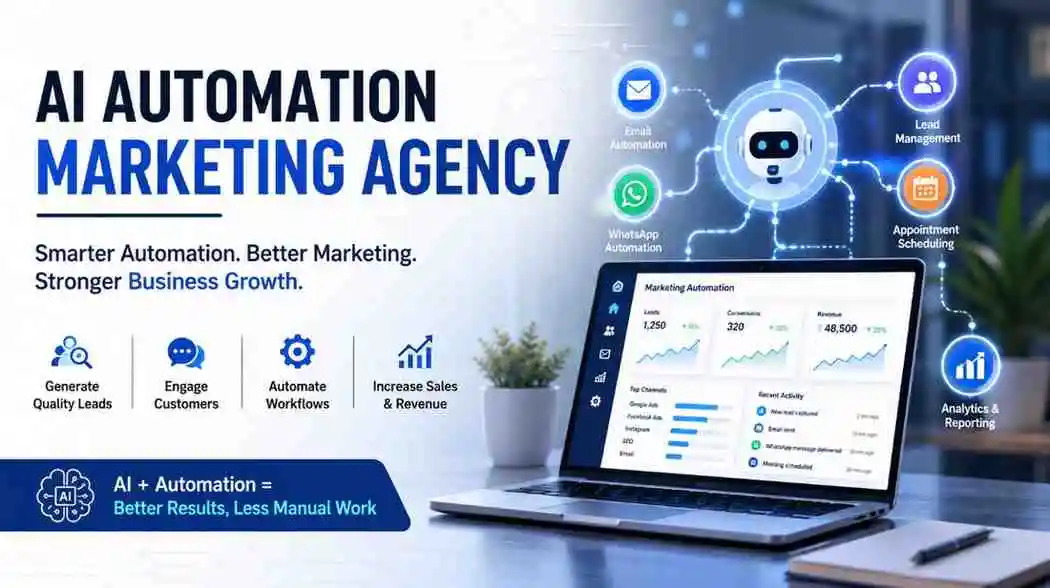
Why Businesses Are Turning to an AI Automation Marketing Agency Instead of Traditional Digital Marketing
Not long ago, most businesses judged marketing by a few numbers. Website traffic, social media followers, and the number of leads collected every month. If those numbers looked good, everything seemed to be working. Today, that approach is becoming less reliable because customers expect much faster responses, more personalised communication, and a smoother buying journey.
This is one of the biggest reasons businesses are choosing an AI automation marketing agency instead of relying only on traditional digital marketing methods.
Traditional digital marketing still has value. Search engine optimisation, paid advertising, social media management, email marketing, and content creation remain important. The problem is that many of these activities are still managed manually. Teams spend hours assigning leads, sending follow up emails, updating CRMs, creating reports, and responding to common customer enquiries. As a business grows, these repetitive tasks begin consuming more time than actual strategy.
An AI automation marketing agency focuses on removing those repetitive processes through intelligent automation while making marketing campaigns more efficient. Instead of waiting for someone to manually respond to every enquiry, AI powered systems can qualify leads, schedule appointments, personalise emails, trigger WhatsApp messages, and route customers to the right sales representative within seconds.
I’ve seen this happen with a manufacturing company that generated enquiries through Google Ads. Every evening, sales executives downloaded lead sheets, sorted them manually, and contacted prospects the next morning. By then, many potential customers had already spoken with competitors. The advertising campaign itself wasn’t failing. The follow up process was.
That is where automation changes everything.
Customers today rarely buy after seeing a single advertisement. They visit a website, compare options, watch videos, read reviews, ask questions, leave, and often return several days later. Managing this entire journey manually becomes difficult as enquiries increase.
An experienced AI automation marketing agency builds systems that keep conversations moving without requiring constant manual effort. Leads receive relevant information automatically based on their interests, behaviour, and stage in the buying process. Sales teams can then spend more time speaking with qualified prospects instead of chasing every enquiry.
I might be wrong here because this doesn’t apply to every business. A small neighbourhood shop with a handful of customers each day may not need advanced automation. But once enquiries begin arriving from multiple channels such as Google Search, social media, WhatsApp, websites, and email, manual marketing usually starts creating delays that directly affect revenue.
Another reason businesses are moving towards AI automation is consistency.
People forget.
Employees change.
Processes break.
Automation doesn’t eliminate human involvement, but it reduces the chances of important leads being ignored because someone was on leave or simply forgot to follow up.
Businesses are also becoming more conscious about marketing costs. Hiring additional staff for repetitive administrative work isn’t always practical. An AI automation marketing agency helps companies automate many routine marketing activities while allowing existing teams to focus on higher value work such as sales conversations, relationship building, and business development.
Interestingly, traditional digital marketing and AI automation are not competitors. They work best together.
SEO still attracts visitors.
Paid advertising still generates enquiries.
Content still builds trust.
Social media still creates awareness.
AI automation simply connects everything into one continuous customer journey instead of treating each marketing activity as a separate task.
That shift is exactly why more businesses are choosing an AI automation marketing agency as their long term marketing partner.
What Does an AI Automation Marketing Agency Actually Do for Modern Businesses?
Many business owners hear the word AI and immediately think about chatbots or automated content generation. In reality, the role of an AI automation marketing agency goes much further than that.
Its primary job is to help businesses reduce manual work while improving the way marketing, sales, and customer communication operate together.
Think about what happens after someone fills out a website enquiry form.
In many businesses, an employee receives an email notification, copies the details into a spreadsheet, assigns the lead, sends a confirmation message, schedules a follow up, and updates the CRM later. Every one of these small tasks consumes time.
An AI automation marketing agency redesigns this entire workflow.
The lead enters the CRM automatically.
A personalised acknowledgement email is sent immediately.
A WhatsApp message confirms the enquiry.
The appropriate salesperson receives a notification.
A follow up reminder is created.
If the prospect doesn’t respond, another sequence begins automatically after a few days.
The customer experiences faster communication, while the business reduces manual effort significantly.
This is only one example.
Modern marketing involves dozens of platforms working together. Businesses use websites, Google Ads, Meta Ads, LinkedIn, email marketing software, customer relationship management systems, analytics tools, payment gateways, appointment schedulers, and messaging platforms.
Without automation, employees constantly switch between applications just to complete routine work.
An experienced AI automation marketing agency connects these systems so information flows automatically across the business.
Lead nurturing is another area where automation creates measurable improvements.
Not every visitor is ready to buy immediately. Some need more information, while others compare several providers before making a decision. Instead of allowing these prospects to disappear, automated workflows continue educating them through relevant emails, helpful resources, product information, case studies, and reminders.
Eventually, many of these prospects return when they are ready to purchase.
Customer segmentation also becomes much more effective.
Rather than sending identical messages to everyone, automation identifies customer interests, behaviour, previous purchases, and engagement patterns. Someone interested in local SEO receives different communication from someone looking for AI customer support automation or performance marketing services.
That level of personalisation would be extremely difficult to maintain manually once a business begins scaling.
Another responsibility of an AI automation marketing agency is improving reporting and decision making.
Business owners often receive large spreadsheets filled with marketing data but struggle to understand what those numbers actually mean.
Automation platforms collect information from multiple marketing channels and generate meaningful dashboards that highlight lead sources, campaign performance, customer behaviour, conversion rates, and return on investment. Instead of spending hours preparing reports, teams can use their time to improve campaigns.
One point that often gets overlooked is internal efficiency.
Many businesses focus only on customer automation, but internal workflows matter just as much. AI powered systems can automate proposal generation, appointment scheduling, internal notifications, lead assignments, reporting, customer onboarding, and recurring marketing activities.
Less manual work usually means fewer mistakes.
Although I said earlier that automation improves consistency, I have also seen businesses automate everything without thinking carefully. That’s where problems begin. Customers still expect genuine conversations when making important purchasing decisions. Automation should support human relationships, not replace them entirely.
A capable AI automation marketing agency understands this balance. It automates repetitive tasks while allowing real people to step in when expertise, trust, and meaningful discussions are needed.
The businesses seeing the best results are rarely the ones using the most AI tools. They are the ones using automation thoughtfully.
How AI Automation Changes Lead Generation, Customer Engagement, and Sales Follow Up
Generating leads has never been the biggest challenge.
Converting them usually is.
Many businesses spend substantial budgets on SEO, paid advertising, and social media campaigns but still struggle because enquiries aren’t handled quickly or consistently. By the time someone follows up, the prospect may already be speaking with another company.
An AI automation marketing agency addresses this problem by improving every stage after a lead is generated.
The moment someone submits an enquiry, automation can trigger multiple actions simultaneously. Confirmation emails are sent instantly. WhatsApp messages acknowledge the request. Sales teams receive immediate notifications. CRM records are updated automatically. Appointments can even be scheduled without manual coordination.
These small improvements create a much better first impression.
Lead qualification also becomes smarter.
Instead of treating every enquiry equally, AI analyses available information such as customer interests, enquiry type, previous interactions, website behaviour, and engagement history. High priority leads can be routed directly to experienced sales representatives, while early stage prospects enter educational nurturing campaigns.
This saves considerable time for sales teams.
Customer engagement also changes because communication becomes continuous rather than reactive.
Someone downloads a guide today.
Visits pricing pages three days later.
Opens an email next week.
Requests a consultation after watching a product video.
Automation recognises these behaviours and responds accordingly without requiring employees to monitor every interaction manually.
I’ve noticed that businesses often underestimate how much revenue is lost simply because follow ups stop after one or two attempts. Customers are busy. Sometimes they genuinely intend to respond but forget.
An AI automation marketing agency creates structured follow up journeys that continue professionally without becoming intrusive. Prospects receive timely reminders, useful content, answers to common questions, and invitations to reconnect when appropriate.
This increases the likelihood of conversion while maintaining a positive customer experience.
Sales teams also benefit from better preparation.
Instead of receiving only a name and phone number, they can see previous website visits, downloaded resources, email engagement, chat history, and marketing interactions before making contact. Conversations become more relevant because representatives understand the customer’s interests beforehand.
At the same time, existing customers shouldn’t be ignored.
Automation helps businesses maintain relationships after the sale through onboarding sequences, satisfaction surveys, renewal reminders, product recommendations, educational content, and customer support workflows. This often improves retention and creates additional sales opportunities.
Still, I wouldn’t suggest automating every conversation.
Some discussions need patience.
Some need empathy.
Some simply need another human being on the other end of the call.
The strongest businesses combine intelligent automation with experienced people. An AI automation marketing agency helps create that balance, ensuring technology handles repetitive work while employees focus on conversations that genuinely influence customer decisions.
Core Services You Can Expect from an AI Automation Marketing Agency
Every agency seems to mention AI these days. Sometimes it is just another marketing term added to a service page. The actual work behind it is often no different from what agencies have been doing for years.
That is why businesses should look beyond the word “AI” and understand what an AI automation marketing agency is genuinely expected to deliver.
The first service is marketing automation strategy.
Most businesses already have several tools in place. They use a website, CRM, Google Ads, Meta Ads, email software, WhatsApp, analytics platforms, and perhaps an appointment booking system. The problem is these tools usually operate independently. An experienced AI automation marketing agency studies existing workflows and identifies where automation can eliminate delays, repetitive work, and manual errors.
Lead management is another essential service.
Generating enquiries is only the beginning. Every lead should move through a defined process without depending entirely on manual effort. AI powered workflows automatically capture enquiries from multiple sources, assign them to the right salesperson, trigger instant responses, schedule follow ups, and keep customer records updated.
Customer communication automation has become equally important.
Businesses receive enquiries through websites, WhatsApp, social media, email, live chat, and phone calls. Responding consistently across every platform is difficult when handled manually. Automation allows businesses to maintain quick and relevant communication while still giving human teams control over important conversations.
Content and campaign automation also play a growing role.
An AI automation marketing agency can automate email campaigns, customer nurturing sequences, remarketing audiences, personalised offers, and behaviour based messaging. Instead of sending identical promotions to every customer, businesses communicate according to each customer’s interests and buying stage.
Analytics and reporting deserve more attention than they usually receive.
I have seen companies spend hours every week preparing reports that nobody actually reads. Automation collects campaign performance, lead quality, conversion data, customer journeys, and revenue insights into dashboards that decision makers can understand without searching through multiple spreadsheets.
Another valuable service is CRM automation.
When customer information stays organised, sales conversations improve. Automated CRM systems update records, track interactions, schedule reminders, assign follow up tasks, and maintain complete customer histories without requiring employees to enter every detail manually.
Workflow automation often extends beyond marketing itself.
Proposal generation.
Appointment confirmations.
Internal notifications.
Customer onboarding.
Review requests.
Repeat purchase reminders.
These operational improvements may not appear exciting from the outside, but they remove a surprising amount of administrative work inside growing businesses.
Earlier I mentioned that automation creates consistency. I still believe that. But I have also watched businesses automate complicated processes before fixing basic operational problems. Automation simply makes existing systems faster. If those systems are already disorganised, AI will not magically repair them.
A capable AI automation marketing agency understands that technology should simplify business operations, not complicate them.
Industries That Benefit the Most from AI Powered Marketing Automation
One question comes up quite often.
“Is AI automation only useful for technology companies?”
Not at all.
Almost every industry that manages customer enquiries, appointments, repeat communication, or ongoing sales conversations can benefit from working with an AI automation marketing agency.
Real estate is one of the strongest examples.
Property enquiries arrive throughout the day from websites, property portals, social media campaigns, and paid advertisements. Prospective buyers expect immediate information about pricing, locations, floor plans, and site visits. Automated systems respond instantly, schedule appointments, qualify buyers, and ensure no enquiry remains unattended for long.
Healthcare businesses are adopting automation as well.
Hospitals, clinics, diagnostic centres, and wellness providers use automated appointment reminders, patient follow ups, enquiry management, and educational communication. Patients appreciate faster responses, while healthcare teams spend less time handling routine administrative tasks.
Educational institutions face similar challenges.
Schools, colleges, coaching centres, and training institutes receive admission enquiries across multiple channels. AI powered workflows help manage applications, counselling appointments, reminders, document collection, and student communication throughout the admission process.
Manufacturing companies sometimes believe automation is only relevant for ecommerce businesses. I used to think that years ago, although the market has changed considerably.
Manufacturers often receive quotation requests, distributor enquiries, dealership applications, and export enquiries from different platforms. An AI automation marketing agency helps organise these enquiries, prioritise high value opportunities, and maintain structured follow ups until business discussions progress.
Professional service firms also benefit.
Law firms, chartered accountants, architects, financial consultants, marketing agencies, and business advisors depend heavily on appointments and client relationships. Automation simplifies scheduling, proposal sharing, client onboarding, document reminders, and ongoing communication without reducing the personal nature of professional services.
Ecommerce businesses perhaps experience the most visible impact.
Cart abandonment.
Product recommendations.
Order confirmations.
Shipping updates.
Customer feedback.
Repeat purchase campaigns.
All these activities become faster and more personalised through automation.
Retail businesses are gradually adopting similar systems for loyalty programmes, promotional campaigns, customer feedback, and personalised offers.
I might be wrong here because not every local business needs advanced AI workflows immediately. A small family owned store serving walk in customers may achieve very little from complex automation. Business size, customer behaviour, and sales processes matter far more than industry alone.
That said, any organisation managing a growing number of customer interactions will usually find clear value in partnering with an AI automation marketing agency.
Common Mistakes Businesses Make Before Hiring an AI Automation Marketing Agency
Hiring an AI automation marketing agency is a business decision, not simply a software purchase. Unfortunately, many companies approach it with unrealistic expectations.
The biggest mistake is believing AI will solve every marketing problem overnight.
If a website attracts very little traffic, automation cannot create customers from nowhere. If products are overpriced or customer service is poor, AI cannot permanently hide those weaknesses.
Automation improves processes. It does not replace business fundamentals.
Another common mistake is choosing agencies based entirely on software demonstrations.
Many automation platforms look impressive during presentations. Colourful dashboards and automated workflows attract attention quickly. But businesses should ask a different question.
How will this improve our actual customer journey?
The answer matters much more than the software itself.
Ignoring internal processes is another expensive mistake.
Some businesses automate enquiry management while sales teams continue following different procedures manually. Others automate marketing without updating their CRM or organising customer data first. These disconnected systems usually create confusion instead of efficiency.
Cost often becomes the only deciding factor.
Selecting the cheapest AI automation marketing agency may reduce initial investment, but poor implementation often creates larger expenses later. Broken workflows, incomplete integrations, and unreliable reporting waste both time and opportunities.
I’ve also noticed businesses purchasing several AI tools before understanding why they need them. New platforms appear almost every week, and it becomes tempting to keep adding software. After a few months, employees are switching between multiple applications that barely communicate with each other.
That gets frustrating.
Training is another area businesses frequently overlook.
Even excellent automation systems require employees to understand how workflows operate, when manual intervention is necessary, and how customer data should be managed. Without proper adoption, even sophisticated automation becomes underused.
One concern I have is that some agencies promise complete automation with almost no human involvement. Personally, I disagree with that approach. Sales, negotiations, relationship building, and complex customer conversations still depend heavily on people.
Technology should support those conversations, not replace them.
How to Choose the Right AI Automation Marketing Agency for Long Term Business Growth
Choosing an AI automation marketing agency involves much more than comparing pricing or software features.
Start by understanding your own business.
Where are leads getting delayed?
Which repetitive tasks consume the most employee time?
What customer complaints appear repeatedly?
Automation works best when it addresses clearly identified business problems instead of being implemented simply because AI has become popular.
Experience matters.
An agency that understands customer journeys, marketing strategy, CRM systems, automation platforms, SEO, paid advertising, and sales processes will usually create better long term outcomes than one specialising only in software implementation.
Ask about business workflows rather than individual tools.
Good agencies spend time understanding existing operations before recommending solutions. They rarely begin conversations by promoting a specific platform. Instead, they explore how customers discover the business, how enquiries are handled, how sales teams operate, and where manual bottlenecks exist.
Look for practical implementation experience.
Case studies.
Industry examples.
Workflow demonstrations.
Actual business improvements.
These reveal far more than broad promises about artificial intelligence.
Transparency is equally important.
A reliable AI automation marketing agency explains what automation can realistically achieve and where manual involvement remains necessary. If every answer sounds too perfect, I would probably ask more questions before making a decision.
Scalability should also influence your choice.
Businesses change.
Marketing channels expand.
Customer expectations evolve.
Automation systems should adapt without requiring complete replacement every year.
Support after implementation often determines long term success.
Automation requires monitoring, optimisation, testing, and occasional adjustments as business processes change. Agencies that remain involved after deployment usually deliver better results than those treating automation as a one time project.
Earlier I suggested automation creates consistency, and I still stand by that. Yet I have seen businesses become so dependent on automated workflows that employees stop paying attention altogether. That is where things begin to slip. Technology still needs oversight.
Perhaps that balance is harder to maintain than many people admit.
How StratMarketer Helps Businesses Build Smarter Marketing and Automation Systems
Every business has its own way of generating enquiries, communicating with customers, and managing sales. Because of that, no two automation strategies should look exactly the same.
This is where StratMarketer approaches things differently.
Instead of introducing technology first, StratMarketer begins by understanding how a business currently operates. The team studies existing marketing channels, customer touchpoints, lead handling processes, sales workflows, and internal operations before recommending automation opportunities.
As an AI automation marketing agency, StratMarketer focuses on connecting marketing and business operations rather than treating them as separate functions.
Website enquiries can flow directly into CRM systems.
Paid advertising leads can trigger immediate follow ups.
WhatsApp conversations can be organised alongside email communication.
Sales teams receive qualified leads faster, while business owners gain clearer visibility into campaign performance.
The objective is not simply to automate tasks.
It is to reduce delays, improve customer experience, and help teams spend more time on meaningful conversations instead of repetitive administration.
StratMarketer also combines automation with broader digital marketing services such as SEO, paid advertising, content marketing, social media marketing, website optimisation, and conversion improvement. This creates connected marketing systems where every channel supports the next stage of the customer journey instead of operating independently.
Another strength is flexibility.
Some businesses require only basic lead automation.
Others need advanced CRM integration, customer nurturing, reporting dashboards, appointment scheduling, or AI powered communication workflows.
Solutions are built around business requirements rather than forcing every client into the same process.
I wouldn’t claim automation is the answer to every marketing challenge. No agency should. Strong products, good customer service, and clear business positioning still matter enormously.
What an AI automation marketing agency like StratMarketer can do is help businesses remove unnecessary manual work, improve consistency across customer interactions, and create marketing systems that continue supporting growth as the business expands.
And sometimes that quiet operational improvement makes a bigger difference than the most expensive advertising campaign.
Questions to Ask Before Partnering with an AI Automation Marketing Agency
Choosing an AI automation marketing agency is not only about comparing pricing or checking which software they use. The quality of the strategy, implementation, and ongoing support will have a much bigger impact on your business than the automation platform itself.
Before making a decision, spend some time asking questions that reveal how the agency actually works.
How will AI automation fit into our existing marketing and sales process?
Every business has different workflows. A good agency should explain how automation will integrate with your current website, CRM, advertising campaigns, email marketing, and customer communication instead of asking you to rebuild everything from scratch.
What repetitive tasks can realistically be automated?
Not every activity should be automated. Ask the agency to identify which processes will save the most time and which customer interactions should continue to involve your team.
Which marketing tools and CRM platforms do you support?
Your automation system should connect with the software you already use whenever possible. Replacing every tool often creates unnecessary cost and complexity.
How will leads be captured, qualified, and assigned?
An experienced AI automation marketing agency should clearly explain how enquiries from websites, Google Ads, social media, WhatsApp, and other channels will move through your sales process.
Can you show examples from businesses similar to ours?
Case studies, workflow demonstrations, or practical examples often reveal far more than marketing presentations.
How will we measure success?
Instead of focusing only on website traffic or lead volume, ask how the agency measures response time, conversion rates, customer engagement, sales efficiency, and return on investment.
Who manages the automation after launch?
Business processes change over time. Automation systems also require updates, testing, and optimisation. Make sure you understand what level of ongoing support is included.
How much human involvement will still be required?
Personally, I think this is one of the most important questions. Any agency promising complete hands off marketing through AI should probably be challenged. Technology can automate repetitive work, but meaningful customer relationships still depend on people.
The answers to these questions usually tell you much more than a list of software features ever will.
Frequently Asked Questions About AI Automation Marketing Agency
What is an AI automation marketing agency?
An AI automation marketing agency helps businesses automate repetitive marketing, sales, and customer communication tasks using artificial intelligence and workflow automation. The goal is to improve efficiency, reduce manual work, and create a smoother customer journey.
Is an AI automation marketing agency suitable for small businesses?
Yes, but it depends on the business. Companies receiving regular enquiries from websites, social media, paid advertising, or WhatsApp often benefit the most. Very small businesses with limited customer interactions may only need basic automation initially.
Can AI automation replace a marketing team?
No. AI supports marketing teams by handling repetitive tasks such as lead routing, follow up emails, appointment scheduling, and reporting. Strategy, creativity, relationship building, and sales conversations still require human expertise.
What services does an AI automation marketing agency usually provide?
Most agencies offer marketing automation strategy, CRM integration, lead management, email automation, WhatsApp automation, AI chatbots, customer nurturing workflows, campaign automation, analytics dashboards, and reporting.
How does AI automation improve lead generation?
Automation does not generate leads by itself. Instead, it ensures that every lead receives a faster response, follows a structured nurturing process, and reaches the right salesperson without unnecessary delays.
Can AI automation work with our existing CRM?
In many cases, yes. Most modern CRM platforms can integrate with automation tools, allowing businesses to manage leads, customer communication, and sales activities from a central system.
How long does it take to implement marketing automation?
The timeline depends on business size and workflow complexity. A basic setup may take a few weeks, while larger organisations with multiple systems and departments may require several months for full implementation.
What industries benefit the most from an AI automation marketing agency?
Real estate, healthcare, education, manufacturing, ecommerce, financial services, professional consulting, hospitality, and service based businesses often see strong results because they handle large numbers of customer enquiries and follow ups.
Will automation make customer communication feel robotic?
Not if it is implemented correctly. Good automation handles routine communication while allowing your team to step in whenever customers need personalised advice or detailed discussions.
Why choose StratMarketer as your AI automation marketing agency?
StratMarketer combines AI powered automation with SEO, paid advertising, content marketing, website optimisation, and customer journey strategy. Instead of automating isolated tasks, the focus is on building connected marketing systems that help businesses respond faster, manage leads efficiently, and support long term business growth.