


Why Businesses Are Looking Beyond Traditional Marketing Agencies Today
For years, businesses relied on conventional marketing agencies to manage their websites, advertising, SEO, and social media. That approach still has value, but the way customers search, compare, and make buying decisions has changed dramatically. This shift is one of the biggest reasons why many companies are now looking for an AI based marketing company instead of depending only on traditional marketing methods.
A few years ago, ranking on Google with a handful of keywords and running basic social media campaigns could generate consistent enquiries. Today, the competition is much stronger. Businesses are competing across Google Search, AI search platforms, social media, video content, marketplaces, voice search, and multiple advertising networks at the same time. Managing all these channels manually often becomes slow, expensive, and inconsistent.
I remember working with a local manufacturing business that spent months creating blog content without analysing what customers were actually searching for. Their traffic kept increasing, but enquiries barely moved. After introducing AI assisted keyword research, search intent analysis, and content optimisation, the business started attracting visitors who were genuinely interested in their products instead of random website traffic. The strategy changed. More importantly, the results changed.
This is where an AI based marketing company makes a noticeable difference. Instead of relying on assumptions, AI helps analyse customer behaviour, search trends, competitor activities, and campaign performance much faster than manual processes alone. Human expertise is still essential, but decisions become more informed because they are backed by meaningful data rather than guesswork.
Another reason businesses are moving away from traditional agencies is speed. Markets change quickly. Consumer interests shift. Search behaviour evolves. Advertising costs fluctuate almost every week. AI powered systems can identify these changes early and help businesses respond before opportunities disappear.
Traditional agencies often separate SEO, paid advertising, content writing, website optimisation, and analytics into different departments. While that structure works in some cases, it sometimes creates communication gaps. An experienced AI based marketing company usually integrates these activities into a connected strategy where each marketing channel supports the others.
Business owners are also expecting more transparency than before. They want to understand why campaigns succeed or fail, where their marketing budget is being spent, and what improvements are happening month after month. AI makes reporting more detailed and easier to interpret, allowing businesses to make faster decisions without waiting for lengthy manual reports.
Of course, AI is not a magic solution. I might be wrong here because this doesn’t apply everywhere, but businesses that expect AI to replace marketing expertise often end up disappointed. Artificial intelligence can process enormous amounts of information, yet it cannot fully understand customer emotions, local buying behaviour, or business goals without experienced professionals guiding the strategy.
That balance between technology and human judgement is becoming one of the defining characteristics of a reliable AI based marketing company.
What an AI Based Marketing Company Actually Does and Why It Matters
Many people hear the phrase AI based marketing company and imagine software doing everything automatically. That isn’t how successful AI marketing actually works.
An AI based marketing company combines artificial intelligence with experienced marketers, SEO specialists, content strategists, designers, advertising experts, and data analysts. AI handles repetitive analysis, pattern recognition, forecasting, and automation, while people make strategic decisions based on business objectives and customer behaviour.
Think about keyword research. Earlier, marketers manually reviewed hundreds of search terms before deciding what content to create. Today, AI tools can analyse thousands of keywords, identify emerging search patterns, group topics by user intent, and uncover opportunities much faster. Human experts then decide which opportunities make the most business sense.
The same applies to content marketing.
Instead of writing articles simply because competitors are doing the same, an AI based marketing company studies what users are actually asking, how search intent changes throughout the buying journey, and what information helps customers make confident decisions. Content becomes more useful rather than simply longer.
Advertising has also changed significantly.
Paid campaigns across Google Ads, Meta Ads, LinkedIn, YouTube, and other platforms generate enormous amounts of performance data. AI helps analyse click behaviour, audience engagement, conversion rates, budget allocation, and campaign trends almost instantly. This allows marketers to pause underperforming campaigns, scale successful ones, and test new creative ideas much more efficiently.
Customer behaviour analysis is another important area.
Many businesses know how many people visit their website but struggle to understand why visitors leave without making an enquiry. AI can identify patterns such as pages with high exit rates, confusing user journeys, abandoned forms, or declining engagement. These insights help businesses improve their websites based on actual visitor behaviour instead of assumptions.
Predictive analytics is becoming increasingly valuable as well. An experienced AI based marketing company can identify seasonal demand, estimate campaign performance, forecast customer acquisition costs, and recognise changing search trends before they become obvious. These predictions are never perfect, but they often help businesses plan marketing investments more effectively.
Automation also saves considerable time.
Routine activities like lead qualification, email nurturing, customer segmentation, reporting, CRM updates, chatbot interactions, and campaign monitoring can be automated without sacrificing quality. Marketing teams then spend more time solving business problems instead of repeating manual tasks.
Still, there is something I have noticed over the years. Businesses sometimes become so fascinated by automation that they forget customers are still human. AI can write content, generate reports, or recommend advertising strategies, but trust is built through genuine expertise, honest communication, and consistent customer experiences.
That is probably why the most successful AI based marketing company doesn’t sell artificial intelligence alone. It combines technology with practical marketing knowledge, industry experience, and continuous learning because algorithms change, customer behaviour changes, and even the smartest AI systems occasionally misunderstand what people actually want.
How Artificial Intelligence Is Changing SEO, Content, Advertising, and Customer Acquisition
Artificial intelligence is no longer an experimental technology used only by large corporations. Businesses of every size are using AI to improve visibility, attract qualified customers, and make marketing decisions with greater confidence. As a result, the role of an AI based marketing company has expanded far beyond simple automation.
Search engine optimisation is probably where the impact is most visible.
SEO today is not only about placing keywords on a page. Search engines evaluate user intent, content quality, topical relevance, page experience, authority, and overall usefulness. AI helps marketers process massive amounts of search data, identify missing content opportunities, cluster related topics, and optimise websites based on evolving search behaviour.
For example, if several related searches begin gaining popularity within a particular industry, AI systems can detect these patterns much earlier than manual research. An experienced AI based marketing company can then create relevant content before competitors fully recognise the opportunity.
Content creation has also evolved.
Businesses once focused on publishing as many articles as possible. That strategy often produced repetitive content with little value for readers. AI now helps research customer questions, analyse competitor coverage, identify information gaps, and organise complex topics more effectively.
Still, this is where I sometimes disagree with businesses chasing automation too aggressively.
Some organisations expect AI to replace experienced writers entirely. In practice, purely AI generated content often lacks practical experience, local understanding, and the subtle judgement that builds credibility. The strongest content usually comes from combining AI research with human expertise, editing, and real industry knowledge.
Advertising has become significantly more intelligent as well.
Modern advertising platforms already use machine learning to optimise bidding, targeting, and audience segmentation. An AI based marketing company takes this further by analysing campaign performance across multiple channels, identifying creative patterns that influence conversions, testing different messaging approaches, and allocating budgets based on measurable outcomes.
This reduces wasted spending while improving the quality of leads entering the sales process.
Customer acquisition has become more personalised too.
Instead of showing identical advertisements to every potential customer, AI helps businesses understand where each user is within the buying journey. Someone researching a product for the first time needs different information than someone comparing suppliers before making a purchase. Personalised marketing improves engagement because people receive content that matches their immediate needs.
AI also strengthens lead nurturing after visitors arrive.
Chatbots answer common questions instantly. Email automation sends relevant information based on customer behaviour. CRM systems prioritise qualified leads. Website recommendations become more relevant. These small improvements collectively create a smoother customer experience.
Having said that, technology cannot solve every marketing problem.
I said earlier that AI improves efficiency, and I still believe that. But there are situations where even the most advanced AI struggles. Businesses with unclear positioning, weak products, or unrealistic expectations rarely succeed simply because they adopt new technology. Marketing becomes more efficient, not miraculous.
Sometimes the issue isn’t the marketing at all.
That distinction matters, and any experienced AI based marketing company should be honest enough to recognise it before recommending another tool or another campaign.
Key Services You Should Expect from an AI Based Marketing Company
Not every company offering AI marketing services actually works like an AI based marketing company. Some simply use AI writing tools and present them as a complete solution. Others automate reports but still follow the same old marketing process behind the scenes.
A capable AI based marketing company builds an entire marketing ecosystem where artificial intelligence supports research, planning, execution, optimisation, and reporting without replacing human thinking.
Search engine optimisation usually sits at the centre of that ecosystem. AI assists with keyword research, search intent analysis, competitor tracking, technical SEO audits, content gap identification, internal linking opportunities, and topical authority planning. Instead of targeting isolated keywords, the focus shifts towards building complete subject expertise that search engines and users both value.
Content marketing is another major service.
Businesses need website pages, blogs, landing pages, product descriptions, email campaigns, social media content, videos, and frequently asked questions. AI speeds up research and content planning, but experienced writers still refine the messaging so it sounds trustworthy rather than mechanical. I’ve seen businesses publish hundreds of AI generated blogs in a few months, only to realise later that none of them answered real customer questions properly. Quantity looked impressive. Results didn’t.
Paid advertising has changed as well.
An experienced AI based marketing company manages campaigns across Google Ads, Meta Ads, LinkedIn Ads, YouTube, and other platforms using predictive bidding strategies, audience segmentation, creative testing, and continuous optimisation. AI analyses performance much faster than manual reporting, allowing campaign adjustments before advertising budgets are wasted.
Website optimisation deserves equal attention.
Many businesses spend heavily on marketing but ignore the website experience. AI can analyse user behaviour, identify drop off points, measure page engagement, detect navigation issues, and recommend improvements that increase conversions. Sometimes changing a contact form or simplifying a service page creates more enquiries than increasing advertising budgets.
Marketing automation is another important service.
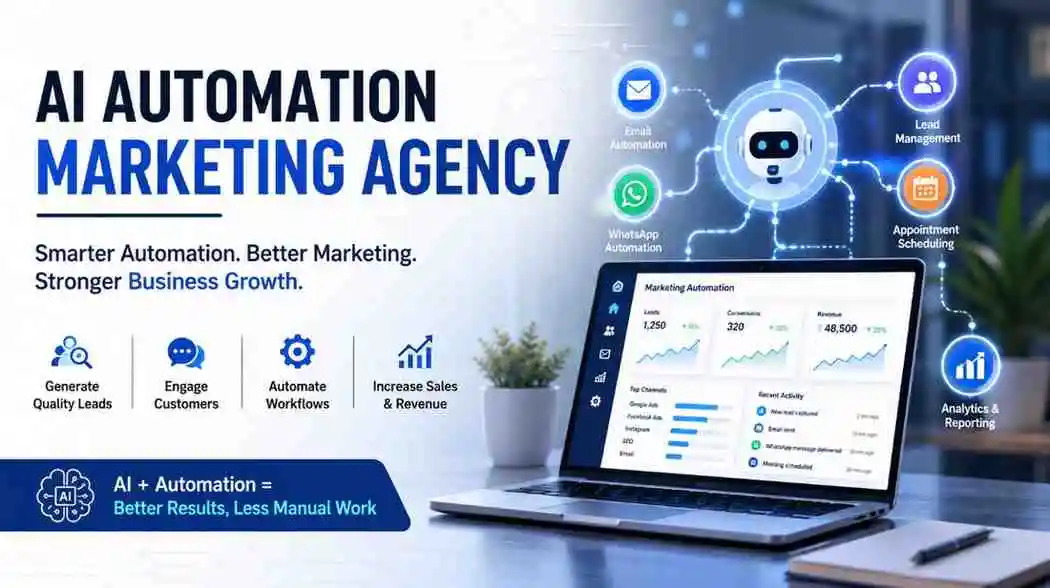
Email nurturing, WhatsApp campaigns, CRM integration, chatbot management, lead scoring, customer segmentation, appointment scheduling, and follow up sequences can all be automated intelligently. This doesn’t remove the human element. It simply ensures that potential customers receive timely communication instead of waiting several days for a reply.
Analytics and reporting have become far more detailed.
Instead of reviewing isolated metrics like traffic or impressions, an AI based marketing company connects website behaviour, lead quality, conversion rates, advertising performance, customer acquisition costs, and revenue insights into one reporting system. Business owners gain a clearer understanding of what is actually contributing to growth.
Some agencies also provide AI powered creative production, video optimisation, reputation management, local SEO, Google Business Profile optimisation, voice search optimisation, answer engine optimisation, and generative search optimisation as businesses adapt to changing search behaviour.
That list sounds extensive because it is.
But I have one concern. Businesses sometimes request every possible marketing service before understanding which activities genuinely support their goals. More services do not automatically create better results. Sometimes fewer, executed consistently, outperform everything else.
Common Business Challenges That AI Powered Marketing Can Solve
Most businesses don’t start searching for an AI based marketing company because artificial intelligence sounds exciting. They usually reach that point after facing the same marketing problems for months or even years.
One of the most common issues is poor quality leads.
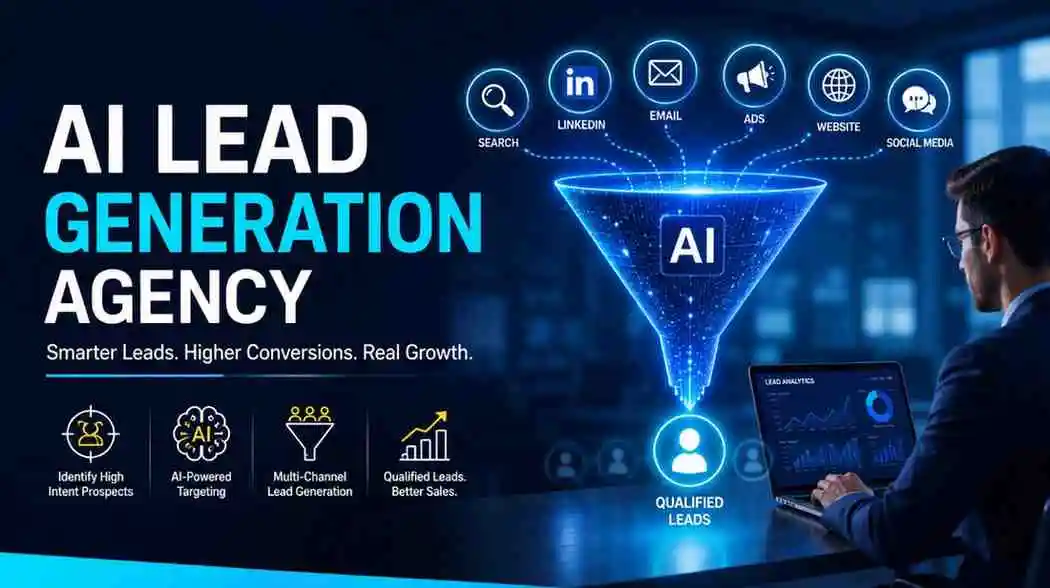
Many businesses receive enquiries from people who have little interest in buying, cannot afford the product, or simply wanted information. AI helps analyse customer behaviour, previous conversions, search intent, and engagement patterns to attract visitors who are more likely to become paying customers.
Another challenge is inconsistent marketing performance.
Traffic increases one month and drops the next. Advertising performs well for a short period before costs rise sharply. Social media engagement fluctuates without any obvious explanation. AI identifies patterns hidden inside campaign data, making it easier to understand why performance changes instead of reacting blindly.
Content planning becomes easier too.
Businesses often publish articles based on assumptions or competitor activity rather than customer demand. AI analyses search behaviour, identifies recurring questions, groups related topics, and recommends content opportunities aligned with different stages of the customer journey.
Time is another challenge.
A growing business cannot spend hours manually reviewing campaign reports, replying to repetitive customer enquiries, organising CRM records, or preparing weekly analytics. Automation reduces these repetitive tasks, allowing teams to focus on strategy, customer relationships, and business development.
Customer retention is frequently overlooked.
Most companies invest heavily in acquiring new customers but communicate very little after the first purchase. AI powered email automation, personalised recommendations, loyalty campaigns, and behaviour based follow ups help businesses maintain long term relationships instead of constantly replacing lost customers.
Decision making also improves.
Rather than relying purely on instinct, an AI based marketing company combines historical data, predictive analysis, and market trends to support better marketing decisions. Predictions are not guarantees, of course. Markets remain unpredictable.
Actually, I should qualify that.
Earlier I suggested AI helps businesses make better decisions, and I still believe it does. But there are industries where historical data changes so quickly that predictions become less reliable. Consumer behaviour after major policy changes or unexpected economic shifts can surprise even sophisticated AI systems.
So judgement still matters.
One thing that frustrates me is seeing businesses blame marketing for problems that originate elsewhere. If pricing is unrealistic, customer service is poor, or the product fails to solve a real problem, AI cannot compensate for those weaknesses. Marketing may attract attention, but keeping customers depends on the business itself.
How to Choose the Right AI Based Marketing Company for Long Term Growth
Finding an AI based marketing company is not difficult anymore. Finding one that genuinely understands business growth takes considerably more effort.
The first thing I usually recommend is looking beyond technology.
Every agency today claims to use AI. That statement alone says very little. Ask how AI is actually used within their marketing process. Do they use it for research, campaign optimisation, reporting, customer analysis, automation, content planning, or simply to generate blog posts? Their answer often reveals how mature their approach really is.
Experience within your industry also matters.
A company that understands manufacturing businesses may approach marketing differently from one specialising in ecommerce, healthcare, education, or professional services. Industry experience helps marketers recognise buying behaviour, seasonal demand, compliance issues, and customer expectations more quickly.
Look carefully at their reporting process.
A reliable AI based marketing company should explain not only what happened during the month but why it happened, what was learned, and what actions will follow. Reports filled with impressions and clicks alone rarely help business owners make meaningful decisions.
Communication style deserves attention as well.
Marketing requires ongoing discussion, adjustments, and sometimes difficult conversations. If an agency promises guaranteed rankings, instant leads, or effortless success without understanding your business first, I would become cautious.
Perhaps I’m being slightly sceptical because I’ve seen these promises before.
Transparency around AI usage is becoming increasingly important too. Businesses should understand where automation is applied and where experienced professionals remain involved. Strategy, customer messaging, creative thinking, and business positioning still require human judgement.
Scalability is another consideration.
Your marketing requirements today may look very different from those two years later. An experienced AI based marketing company should be capable of expanding services as your business grows rather than forcing you to change agencies whenever new marketing channels become important.
Finally, pay attention to curiosity.
The agencies I trust most ask far more questions than they answer during initial conversations. They want to understand customers, competitors, profit margins, sales cycles, operational capacity, and business goals before suggesting campaigns.
That usually tells me they are solving business problems instead of selling marketing packages.
Mistakes Businesses Often Make Before Hiring an AI Marketing Partner
Choosing an AI based marketing company has become an important business decision, yet many organisations still approach it with unrealistic expectations.
The biggest mistake is believing AI will fix every marketing problem automatically.
Artificial intelligence improves research, automation, optimisation, and analysis. It does not replace clear business positioning, quality products, competitive pricing, or good customer service. Businesses expecting instant growth simply because AI is involved often become disappointed.
Another common mistake is selecting the lowest priced agency.
Marketing is an investment that influences customer acquisition, brand perception, and long term revenue. Extremely low pricing sometimes reflects limited expertise, excessive automation, or poor strategic involvement. Cost matters, but value matters much more.
Some businesses focus entirely on tools.
They ask which AI platforms the agency uses before asking about marketing strategy, industry experience, or customer understanding. Tools change constantly. Strategic thinking remains valuable regardless of software.
Ignoring long term planning creates problems too.
An AI based marketing company should help businesses build sustainable visibility through SEO, content, brand authority, paid advertising, customer retention, and marketing automation together. Focusing only on short term advertising campaigns may produce immediate enquiries, but growth often becomes inconsistent once budgets decrease.
Businesses also underestimate the importance of collaboration.
Sometimes agencies request product information, customer insights, sales feedback, or technical details but receive very little cooperation. Marketing performs best when businesses actively share knowledge instead of expecting agencies to guess everything correctly.
I might be wrong here because every organisation works differently, but the strongest marketing partnerships I have seen always involved regular conversations rather than occasional reports.
Another mistake is chasing every new trend.
AI changes rapidly. New platforms appear almost every month. Not every feature deserves immediate adoption. A reliable AI based marketing company evaluates whether new technologies genuinely support business objectives before recommending them.
There is one more point that rarely receives enough attention.
Businesses often ask, “How quickly can we rank?” Very few ask, “How will we convert that traffic into customers once it arrives?”
The second question usually has the bigger impact.
And sometimes I still think people underestimate that.
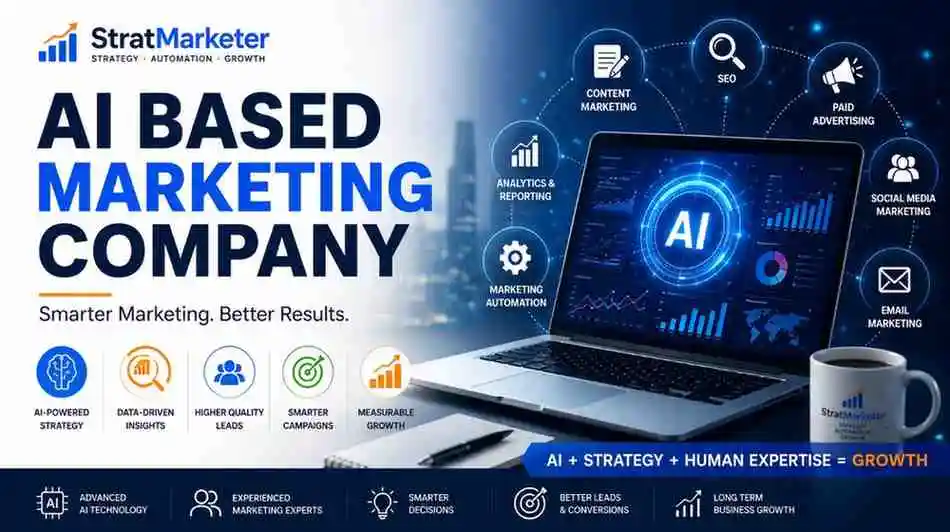
How StratMarketer Combines AI, Marketing Strategy, and Human Expertise to Deliver Better Results
Technology alone has never built a successful marketing campaign. At the same time, relying only on manual processes is becoming increasingly difficult as search behaviour, advertising platforms, and customer expectations continue to change. That is why StratMarketer approaches every project by combining practical marketing experience with intelligent AI systems instead of treating them as separate things.
As an AI based marketing company, StratMarketer begins by understanding the business before discussing marketing channels. Every industry has a different buying journey. A manufacturing company, a healthcare clinic, a software provider, and a local service business all attract customers differently. Applying the same strategy everywhere usually produces average results.
The first stage involves research.
AI helps analyse search trends, customer intent, competitor activity, website performance, and market opportunities much faster than traditional methods. Instead of spending days collecting information manually, the team can identify patterns that help shape a more informed marketing strategy.
That information is only the starting point.
Experienced marketers review the findings, question the data, compare it with real business objectives, and decide which opportunities deserve attention. Sometimes AI recommends a keyword with impressive search volume, but if that keyword attracts the wrong audience, pursuing it makes little business sense.
Content strategy is another area where StratMarketer focuses heavily.
Rather than producing articles simply to increase website pages, content is planned around real customer questions, buying intent, and topical authority. An AI based marketing company should never create content just because software suggests it. People still expect useful answers written with genuine understanding.
Search engine optimisation follows the same philosophy.
Technical SEO, content optimisation, internal linking, search intent mapping, answer engine optimisation, generative engine optimisation, local SEO, and user experience improvements work together instead of operating independently. Search visibility grows more sustainably when these activities support one another.
Paid advertising also benefits from AI assisted optimisation.
Campaign data across Google Ads, Meta Ads, LinkedIn Ads, and other platforms is analysed continuously to identify audience behaviour, creative performance, bidding opportunities, and conversion patterns. Human specialists then adjust campaign strategy based on business goals rather than chasing vanity metrics.
Automation is introduced where it genuinely improves efficiency.
Lead nurturing, CRM workflows, chatbot interactions, email sequences, reporting, and customer segmentation become faster without making communication feel robotic. Prospective customers still expect thoughtful conversations when making important buying decisions.
One aspect I appreciate about this approach is that it accepts limitations.
AI produces recommendations. It does not understand every local market, customer emotion, or business challenge automatically. Sometimes the best decision comes from experience rather than prediction. I have seen campaigns succeed because someone ignored a data trend and trusted years of industry knowledge instead.
This may not apply everywhere, but I still believe the strongest AI based marketing company is not the one using the most advanced software. It is the one that knows when technology should lead and when human judgement should take over.
That balance is what StratMarketer aims to bring into every marketing partnership.
What the Future of AI Driven Marketing Means for Businesses Across Different Industries
Artificial intelligence is already changing marketing, but I don’t think we have reached the most significant changes yet.
Search itself is evolving.
People are beginning to ask complete questions instead of typing short keywords. AI powered search experiences, conversational search, voice assistants, and answer based search are encouraging businesses to create content that solves problems instead of simply matching keywords. That changes how every AI based marketing company approaches SEO.
Content will probably become more personalised as well.
Instead of showing identical website pages to every visitor, businesses may increasingly present information based on customer interests, previous interactions, location, industry, or buying stage. AI makes this level of personalisation possible without manually creating hundreds of different experiences.
Advertising is becoming smarter too.
Campaigns already adjust bids, audiences, and placements automatically. Future improvements will likely focus even more on predicting customer intent before users actively begin searching for products or services.
That sounds impressive.
It also raises questions.
Businesses will need to balance automation with privacy, transparency, and responsible data usage. Customers are becoming more aware of how their information is collected and used. Trust may become just as important as technology.
Different industries will experience these changes differently.
Manufacturing businesses may benefit from AI powered lead qualification and technical content generation. Healthcare organisations may use AI for patient communication while maintaining strict regulatory standards. Ecommerce brands will continue using predictive recommendations, inventory forecasting, and personalised shopping experiences. Professional service firms may rely more heavily on educational content supported by AI assisted research.
Small businesses should not assume these technologies are only for large corporations.
Cloud based AI tools have become far more accessible than they were only a few years ago. Even local businesses can now automate customer communication, analyse marketing performance, improve website visibility, and optimise advertising without maintaining large internal marketing teams.
Still, I wonder sometimes if businesses are becoming slightly too dependent on automation.
Earlier I said AI would shape the future of marketing, and I believe that remains true. Yet there will probably be moments when businesses deliberately choose more human communication because customers become tired of automated interactions.
That feels like a contradiction.
Maybe it is.
Or maybe successful marketing has always been about finding the balance rather than choosing one side completely.
The businesses that adapt thoughtfully instead of chasing every trend are likely to benefit the most from working with an experienced AI based marketing company over the coming years.
Frequently Asked Questions About AI Based Marketing Company
What is an AI based marketing company?
An AI based marketing company combines artificial intelligence with professional marketing expertise to improve SEO, content marketing, paid advertising, automation, customer analysis, and lead generation. AI supports decision making, while experienced marketers develop strategies based on business objectives.
Is AI marketing suitable for small businesses?
Yes. Many AI powered marketing tools are now affordable for startups and small businesses. The right strategy often matters more than the size of the business.
Can an AI based marketing company replace traditional marketing?
Not completely. AI improves efficiency, research, and automation, but human creativity, strategic thinking, customer understanding, and business experience remain essential for successful marketing.
How does AI improve SEO?
AI helps analyse search intent, identify keyword opportunities, optimise website content, detect technical SEO issues, monitor competitors, and recognise changing search trends more quickly than manual analysis.
Does AI create all the marketing content?
It can generate drafts and research information, but experienced writers should review, edit, and improve the content to ensure accuracy, originality, and relevance. Human expertise is still important.
How long does it take to see results from an AI based marketing company?
The timeline depends on the marketing activity. Paid advertising can generate enquiries relatively quickly, while SEO, content marketing, and brand authority usually require several months of consistent work.
What industries benefit the most from AI marketing?
Manufacturing, ecommerce, healthcare, education, real estate, professional services, finance, hospitality, technology, and local service businesses can all benefit from working with an AI based marketing company when strategies are adapted to their specific market.
Why should businesses choose StratMarketer as their AI based marketing company?
StratMarketer combines AI powered insights with experienced marketing professionals to create practical strategies across SEO, content marketing, paid advertising, automation, local SEO, and performance marketing. The focus remains on sustainable business growth, qualified lead generation, and measurable results instead of relying on automation alone.