


What Is an AI CRM Automation Agency and Why Does It Matter for Businesses?
For many businesses, the CRM looks fine on paper. Leads are being added, salespeople are making calls, emails are going out, and customer details are sitting somewhere inside the system. Yet when you ask a simple question like, “What happened to the leads that came in last week?”, the answer can become surprisingly unclear.
Some leads are followed up late. Some are contacted once and forgotten. A few are sitting untouched because nobody noticed them. Customer information may also be scattered across forms, WhatsApp conversations, email, spreadsheets and the CRM itself.
This is where an AI CRM automation agency can become useful.
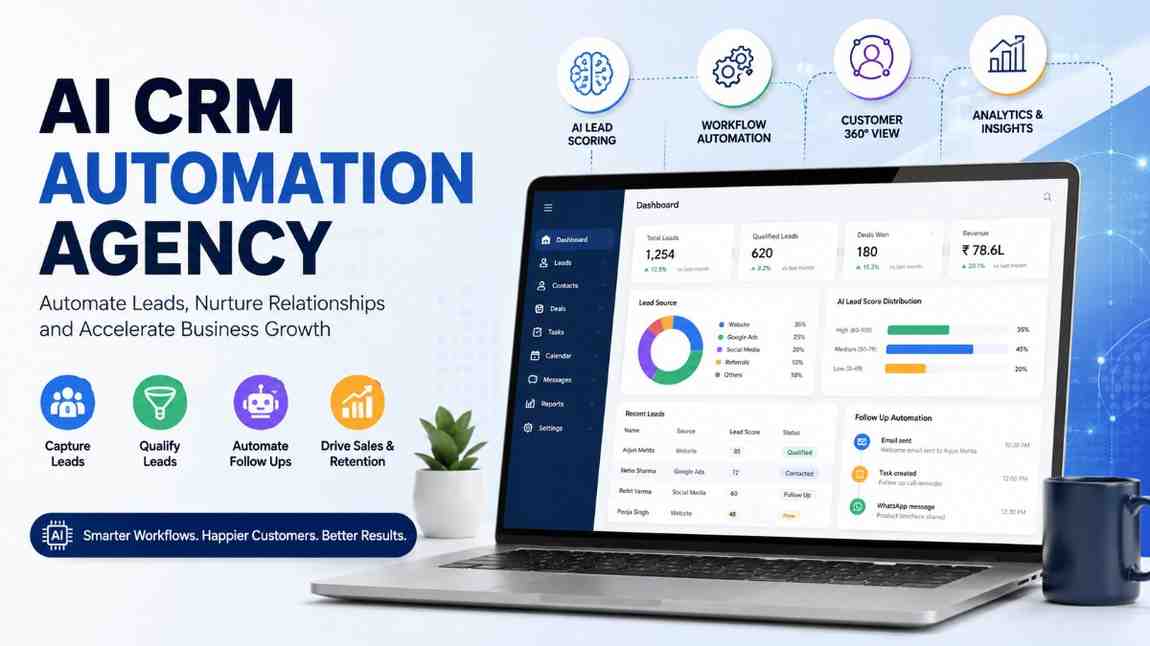
An AI CRM automation agency helps businesses connect their CRM with automated workflows, artificial intelligence, lead management systems and customer communication tools. The purpose is not simply to add AI because it sounds modern. The real purpose is to reduce repetitive work and make sure important customer actions do not depend entirely on someone remembering to do them.
A good CRM automation setup can identify a new enquiry, assign it to the right salesperson, classify the lead, trigger a follow up, update the customer record and alert the team when human attention is required.
That sounds simple.
In practice, getting these things right takes some thinking.
I have seen businesses spend money on CRM software and then continue maintaining separate Excel sheets because the CRM was never configured around the actual sales process. That is one of the more frustrating situations because the software is not necessarily the problem. The workflow is.
An AI CRM automation agency looks at that gap.
Instead of treating the CRM as just a database, the agency works on how information moves through the business. A lead comes in. Someone needs to respond. Someone needs to qualify it. A proposal may need to be sent. Follow ups need to happen. The customer may ask questions. The sales stage needs to change. Eventually the deal is won or lost.
AI and automation can handle parts of this journey without asking employees to repeat the same administrative tasks every day.
For an Indian business, this can be particularly useful when enquiries arrive through several channels. A company may receive leads from Google Ads, its website, Instagram, WhatsApp, IndiaMART, Justdial, email and referrals. Without a properly connected CRM, the sales team can end up working from several places at once.
That is when leads start slipping.
An AI CRM automation agency can help bring these interactions into a more organised system. Depending on the CRM and business requirements, AI can assist with lead scoring, customer segmentation, message drafting, enquiry classification, sales reminders and customer support workflows.
But there is an important distinction here.
AI should not be treated as a replacement for the sales team.
A customer enquiring about a ₹20 lakh industrial machine does not necessarily want to have a long conversation with a chatbot. They may want a knowledgeable person to call them. Automation should help that person respond faster and with better information.
That is where I prefer practical CRM automation over complicated setups. If a workflow looks impressive but the sales team avoids using it, it has failed.
How AI CRM Automation Changes the Way Businesses Manage Leads and Customers
Traditional CRM management depends heavily on manual activity.
A salesperson receives a lead, opens the CRM, enters the details, chooses a stage, adds notes and sets a reminder. Then the salesperson follows up. After the call, another update is made.
Do this for 30 or 50 leads every day and the administrative workload becomes significant.
An AI CRM automation agency can reduce many of these repetitive steps by allowing systems to perform routine actions automatically.
Suppose a potential customer fills out a website enquiry form. Instead of simply sending the information to a shared inbox, an automated CRM workflow can create the contact record, identify the source, categorise the enquiry and assign the lead to an appropriate salesperson.
The system can then send an acknowledgement to the customer.
The salesperson receives an alert.
A follow up task is created.
If there is no response after a defined period, another reminder can be triggered.
This is not particularly glamorous technology. But it solves a very real business problem.
Speed matters in lead management.
A person who submits an enquiry during working hours may expect a response fairly quickly. If the company responds two days later, the potential customer may already be talking to another supplier.
AI can also help when lead volume becomes difficult for a team to process manually.
For example, a real estate company may receive enquiries from people looking for different property types. One person may want a ready to move flat. Another may be interested in commercial property. Someone else may only be asking about pricing.
AI can help classify these enquiries based on the information provided and route them into suitable CRM workflows.
The same principle applies to education companies, healthcare businesses, financial service providers, B2B manufacturers, SaaS companies and professional service firms.
The workflow changes according to the business.
A manufacturing company might need enquiry classification based on product category, quantity and location.
A coaching company might need automation around course interest, consultation booking and follow up.
A real estate company may need lead scoring based on budget, property preference and buying timeline.
A AI CRM automation agency works on these differences rather than simply installing a standard workflow for everyone.
There is another useful change.
CRM automation can give businesses a better view of what is actually happening with customers.
Without automation, managers often rely on salespeople to update records correctly. Some do it carefully. Some update everything at the end of the week. Some forget.
That creates poor reporting.
If CRM stages are not updated consistently, sales forecasts become unreliable. A deal shown as “hot” may actually have gone cold three weeks ago.
AI cannot magically solve poor data either. This is one area where people sometimes expect too much from the technology.
Bad data going into an automated system usually creates bad automation coming out.
So before adding AI, the underlying CRM needs sensible fields, stages, ownership rules and workflows.
Why Businesses Are Moving Beyond Basic CRM Software
A basic CRM can store customer information.
That is useful, but storage alone does not create a better sales process.
Modern CRM systems increasingly include automation and AI features that can help businesses interpret customer activity and take routine actions.
For example, if a lead opens several emails, visits a pricing page and then downloads a product brochure, those activities can become signals for the sales team.
The CRM can potentially increase the lead’s priority or alert a salesperson.
Similarly, when an existing customer has not purchased for a long period, an automated workflow can remind the account manager to check in.
These small actions can make a difference because customer relationships are often lost through neglect rather than one major mistake.
An AI CRM automation agency can connect these signals with business processes.
The important word here is connection.
AI sitting separately from the CRM is not especially useful. The real value comes when AI works with customer records, communication tools, sales processes and business rules.
This may include integrations with email platforms, WhatsApp systems, websites, lead forms, calendars, customer support tools and advertising platforms.
For example, imagine a digital marketing agency receiving 100 enquiries in a month.
Without automation, someone may manually copy lead information from forms into the CRM, check the source, assign the lead and send an initial message.
With a properly configured workflow, much of this can happen automatically.
The team then spends more time speaking with qualified prospects rather than moving information between systems.
I would still be careful with the phrase “fully automated sales”.
I do not think most businesses should aim for that.
Sales involves trust, negotiation, objections and judgement. A CRM can remember that a customer needs a callback. It cannot always understand why that customer is hesitant to buy.
That part still belongs to people.
What Does an AI CRM Automation Agency Actually Do?
The work usually begins before any automation is built.
A reliable AI CRM automation agency first needs to understand how the business currently handles leads and customers.
Where do enquiries come from?
Who receives them?
How quickly are they contacted?
What happens when the lead does not respond?
When does a lead become qualified?
Who prepares the proposal?
What happens after a proposal is sent?
What happens when a customer buys?
And what happens when the customer disappears?
These questions sound basic, but they expose many CRM problems.
Once the process is understood, the agency can identify which activities should remain manual and which can be automated.
Some workflows may involve simple rules.
Others may use AI.
For example, assigning every website enquiry to a salesperson based on location may not require AI at all. A straightforward CRM rule can handle it.
But analysing an enquiry containing a long customer message and identifying its likely product requirement may benefit from AI.
This distinction matters because businesses sometimes use AI where ordinary automation would be cheaper, more reliable and easier to maintain.
I prefer using AI where it genuinely helps with interpretation or decision support. Not every CRM button needs an AI label.
StratMarketer can approach CRM automation from this practical angle by looking at the business process first and then deciding where AI and automation make sense.
Common CRM Problems Businesses Face Before Using AI Automation
The first problem is usually not a lack of software.
It is inconsistent usage.
One salesperson updates the CRM after every call. Another keeps notes in WhatsApp. Someone else maintains a spreadsheet. The manager then has to piece everything together during the weekly meeting.
This happens more often than people admit.
A business may have paid for an expensive CRM and still have poor visibility into its pipeline.
The second problem is missed follow ups.
A lead may initially appear promising. The salesperson speaks to the customer once, gets busy with another enquiry and forgets to call back.
Nobody deliberately ignores the customer.
The system simply depends on memory.
Automation is very good at solving memory problems.
A CRM can create reminders, schedule follow ups and escalate overdue activities. AI can also help determine which interactions deserve greater attention based on available customer information.
The third problem is duplicate or incomplete customer data.
A company may have the same customer listed under slightly different names. Phone numbers may be entered incorrectly. Emails may be missing. Sales notes can be vague.
This becomes painful when the business grows.
A salesperson sees one record. The support team sees another. Marketing has a third version.
Customer experience suffers quietly.
The fourth issue is poor lead qualification.
Not every enquiry deserves the same amount of sales effort.
Consider a B2B manufacturer receiving enquiries from distributors, small traders, students and serious buyers. If every lead is treated identically, the sales team spends time on low value conversations while stronger opportunities wait.
AI based classification can help identify patterns and organise leads into useful categories.
It does not mean every AI score is correct.
The score should be treated as an indication, not a final judgement.
Another common issue is disconnected communication.
A lead may first contact the business through the website, then send a WhatsApp message, then call the office.
If these interactions are not connected to the CRM, the customer may have to repeat the same information to different people.
That feels careless from the customer’s side.
It also creates unnecessary work internally.
There is one CRM problem that is often ignored because it is less technical.
Employees may simply dislike the system.
If updating a customer record takes too long, people will avoid doing it. If every call requires five fields and three screens, adoption falls.
I have seen this happen with sales teams that were perfectly capable of using software but had been given a workflow designed by someone who had never actually made a sales call.
That kind of irritation stays with the team.
An AI CRM automation agency should therefore look at usability as much as automation.
A workflow needs to fit the way people actually work.
Sometimes the best automation is removing a field nobody needs.
Sometimes it is automatically updating a CRM stage after a defined customer action.
Sometimes it is simply making sure that the right salesperson gets the right lead without waiting for someone in the office to forward an email.
And sometimes the business is not ready for sophisticated AI at all.
That is fine.
I might be wrong here, because every industry behaves differently, but in my experience businesses get more value when they first fix basic CRM discipline and then introduce AI where there is a genuine need.
There is also a less visible problem.
As customer records grow, managers can become surrounded by numbers but still lack useful information. Fifty leads, twenty open deals and ten follow ups may look productive. But if most of those leads have not been contacted properly, the numbers do not mean much.
This is where automation can bring some order, but only if the underlying process is sensible.
Where AI CRM Automation Makes the Most Practical Difference
The strongest use cases are usually repetitive activities that happen frequently and require some degree of consistency.
Lead capture is one.
Lead assignment is another.
Follow up reminders are another.
Customer segmentation can also benefit from automation, particularly when the business has a large customer database.
AI can assist with analysing customer messages, identifying intent, summarising conversations and preparing information for sales representatives.
For example, instead of asking a salesperson to read through a long enquiry thread before calling a prospect, the CRM could provide a short summary of what the customer wants, what was discussed and what action is pending.
That saves a few minutes.
Do it hundreds of times and the saving becomes meaningful.
Customer support is another area where CRM automation can help. Frequently asked questions can be handled automatically, while complex queries can be routed to a human agent.
The line needs to remain clear, though.
If the customer is angry about a delayed delivery or a billing dispute, endlessly sending automated messages can make the situation worse.
Human intervention should happen early when the situation requires judgement or empathy.
This is one place where I disagree with the idea that every customer interaction should be automated.
Some conversations should remain human.
A good CRM system should help the team know when to step in, not keep the team away from customers.
For Indian businesses, WhatsApp based communication also deserves attention because many sales conversations already happen there. When properly integrated with CRM workflows, these conversations can become part of the broader customer record rather than remaining trapped in individual phones.
That can be particularly useful when salespeople leave the organisation. The customer history should belong to the business, not disappear with the employee’s phone.
Still, integration needs to be handled carefully, especially around customer consent, data access and message policies.
AI CRM automation is not simply about sending more messages.
It is about making the right information available at the right point in the customer journey.
A sales team should know who needs attention.
A manager should know where deals are getting stuck.
A customer should not have to explain the same requirement three times.
And the CRM should quietly handle the repetitive work in the background.
That is probably the most useful way to look at an AI CRM automation agency. Not as a company that adds AI to a CRM for the sake of technology, but as a partner that examines where customer and sales processes are wasting time, then uses automation and AI where they actually fit.
Some workflows will work beautifully.
Others will need adjustment after the sales team starts using them. That is normal. The first version of a CRM workflow rarely survives contact with real customers completely unchanged. One field gets ignored, one reminder turns out to be annoying, one lead category makes no sense and then someone says, “Can we just make this simpler?”
Usually, that person is right.
AI Lead Capture, Qualification and Follow Up Through CRM Automation
The first place where an AI CRM automation agency can make a noticeable difference is lead handling. Not because capturing a lead is difficult, but because businesses often lose track of what happens after the lead arrives.
A customer may fill out a website form at 10 in the morning. Another may message through WhatsApp in the afternoon. A third may come through a Google Ads campaign. Someone from the sales team then copies details into the CRM, calls when possible and promises to follow up later.
That last part is where things start going wrong.
A busy salesperson does not always forget a lead completely. More often, the follow up gets pushed down the list. Then another enquiry arrives. Then a meeting. Then lunch. By evening, the promising lead is sitting quietly in the CRM.
An AI CRM automation agency can build a process where this does not depend entirely on memory.
A website form can automatically create a CRM record. The source can be recorded. The enquiry can be classified. The lead can be assigned to a salesperson. A follow up task can be created immediately.
If the customer has provided enough information, AI can also help interpret the enquiry.
Suppose an industrial equipment company receives this type of enquiry: “We need around 50 units for our new facility in Gujarat. Please share pricing, delivery time and installation details.”
There is useful information hidden inside that message. Product requirement, approximate quantity, location and buying questions are all present.
Instead of treating it as another generic enquiry, an AI enabled CRM workflow can identify these details and present them to the sales representative.
That does not replace the salesperson.
It simply means the salesperson starts the conversation with some context.
Lead qualification is another area where automation can help. A business can define useful criteria such as location, budget, product interest, company size, expected purchase timeline or type of enquiry. AI can help interpret unstructured responses and place leads into appropriate categories.
But I would not allow an automated score to become the final decision.
A lead marked as low priority by an algorithm may still become a valuable customer. The system should assist judgement rather than pretending to be better than the person responsible for the sale.
Follow up automation is usually simpler and often more reliable.
If a proposal is sent and there is no response for three days, the CRM can create a reminder. If another week passes, the system can alert the account manager. If the customer responds, the workflow can stop or change depending on the response.
This sounds ordinary.
That is exactly why it works.
A lot of sales leakage comes from ordinary things being missed repeatedly.
An AI CRM automation agency can also help create different follow up paths for different types of leads. A high value B2B enquiry should not receive the same communication sequence as someone who downloaded a brochure but has not shown any buying intent.
The difference matters.
Connecting Sales, Marketing and Customer Support With AI CRM Automation
One of the biggest CRM problems in growing companies is that different teams have different versions of the customer.
Marketing knows where the lead came from.
Sales knows what the prospect discussed.
Customer support knows what happened after purchase.
The customer, meanwhile, expects all three teams to understand the same history.
When these systems are disconnected, the customer ends up doing the work.
They explain the requirement to marketing. Then explain it again to sales. After purchase, they may have to repeat it to support.
A properly configured AI CRM automation agency can help connect these stages so information moves between teams more naturally.
Imagine a customer arriving through a paid search campaign. Marketing captures the lead and the CRM records the campaign source. The lead then becomes qualified and is assigned to sales. The salesperson adds notes about the customer’s requirement. Once the deal is closed, customer support can access the relevant information instead of starting from an empty record.
This creates continuity.
It also makes marketing reporting more useful.
A campaign generating 500 leads may look successful. But what if only five become paying customers?
The CRM needs to connect the lead source with what happens later.
That is where sales and marketing integration becomes important. An AI CRM automation agency can help businesses track lead movement from acquisition through qualification, proposal, conversion and customer retention.
AI can add another layer by analysing customer interactions and identifying patterns.
For example, a company may notice that leads from one campaign frequently ask about pricing before booking a consultation. That could indicate that the marketing message needs to provide more clarity.
Or customer support conversations may reveal repeated questions about installation. Marketing and sales teams can then use that information in their communication.
This is where CRM data becomes more than a contact list.
It becomes a record of how customers actually interact with the company.
Customer support can also benefit from automated routing. A billing query can go to the accounts team. A technical issue can go to technical support. A sales enquiry from an existing customer can be sent to the relevant account manager.
AI can help classify messages when the customer’s wording is not neatly organised.
Still, there should be boundaries.
If someone writes an emotional complaint about a serious service problem, sending three automated replies because the workflow has not identified the urgency can damage trust.
I have a strong preference for escalation rules in such situations. Automation should know when to stop.
A human being should be brought in when the situation needs judgement.
How AI CRM Automation Helps Indian Businesses Reduce Manual Work
Indian businesses often operate with a mix of modern software and very old habits.
A company may have a CRM, WhatsApp conversations, Excel sheets, email threads and handwritten notes all being used at the same time. It is not unusual. People use whatever helps them get the work done.
The trouble starts when these systems stop communicating with each other.
A salesperson may copy a phone number from WhatsApp into Excel, then later enter it into the CRM. Another employee may copy the same information into a Google Sheet.
That is not productive work.
It is data movement.
An AI CRM automation agency can reduce this repetitive handling by connecting the systems that employees already use.
For example, when a lead enters through a website, the CRM can create the customer record automatically. When a sales meeting is booked, the calendar event can be linked to the CRM. When the meeting happens, a follow up task can be generated.
If a customer replies to a message, the relevant workflow can be updated.
The aim is not to automate every employee activity.
It is to remove the small repeated tasks that consume time throughout the day.
Consider an Indian real estate company with a team of ten sales executives. If each salesperson spends even 30 minutes daily updating spreadsheets, checking reminders and moving information between systems, the business is losing several working hours every day.
That is where automation has a clear financial argument.
The same applies to education consultants, clinics, financial service companies, manufacturers, software firms, automobile dealers and professional service providers.
Lead assignment can be automated.
Reminder creation can be automated.
Customer categorisation can be automated.
Routine notifications can be automated.
CRM updates based on defined actions can be automated.
AI can then be used for tasks involving interpretation, such as summarising conversations, classifying enquiries or identifying customer intent.
This distinction is important.
I have seen companies try to automate a process that was already unnecessarily complicated. They ended up with a very clever system nobody wanted to use.
That is an expensive mistake.
Sometimes removing three steps is better than automating all three.
Another benefit is reduced dependency on individual employees. When customer information stays inside the CRM and workflows are properly configured, the business does not lose its entire history when one salesperson leaves.
This matters in India because sales teams can change quickly in some industries.
A customer who has been speaking with one employee for six months should not suddenly become a stranger to the company because that employee has moved to another job.
The CRM should carry the relationship forward.
There are also less obvious time savings. Managers do not need to chase salespeople for every update. Salespeople do not need to remember every follow up. Marketing does not have to ask sales where every lead came from.
The system handles much of the checking.
And that quiet reduction in administrative work is often more valuable than flashy AI features.
AI CRM Automation for Lead Nurturing, Customer Retention and Repeat Sales
Getting a lead is only the beginning.
Many businesses concentrate heavily on acquisition and then become surprisingly passive after the first sale.
A customer buys once. The invoice is raised. The product is delivered. Everyone moves on.
That is a missed opportunity, particularly for businesses with repeat purchase cycles.
An AI CRM automation agency can help create customer nurturing workflows based on what the customer has already done.
A nutraceutical brand, for example, may have customers who purchase products regularly. A CRM can track purchase history and trigger appropriate communication based on the business’s actual customer journey.
A B2B supplier may know that a customer usually reorders every few months. Instead of waiting for the customer to remember, the account manager can receive a reminder before the expected reorder period.
A software company may identify customers who are not using important features. The CRM can create a task for customer success to check whether they need help.
This is where retention becomes practical.
AI can also help identify changes in customer behaviour. A previously active customer may suddenly stop responding. Another customer may repeatedly contact support about the same issue.
These signals can be useful.
They do not automatically mean the customer is going to leave, but they tell the team where attention may be needed.
Lead nurturing works in a similar way.
Not every prospect is ready to buy immediately. Someone researching industrial machinery today may purchase six months later. Someone enquiring about a commercial property may still be comparing locations.
A good CRM should remember this.
Automated nurturing can keep the business present without forcing salespeople to manually remember every prospect.
The communication still needs to make sense, though.
Nobody wants to receive five generic messages simply because they once downloaded a brochure.
This is where AI can help personalise communication based on available CRM information, but there should always be sensible frequency limits.
I would rather send one useful message than ten automated reminders.
Retention also depends on timing.
A customer who has just purchased may need onboarding information. Later, they may need support. After some time, there may be an opportunity for another product or service.
These moments can be built into CRM workflows.
The system can remind the team when human contact matters.
That is often more effective than trying to make the entire relationship automated.
And there is an emotional side to this. Customers can tell when a company is only sending messages because a software rule says so. It feels mechanical very quickly.
How StratMarketer Approaches AI CRM Automation for Different Business Needs
StratMarketer’s approach to AI CRM automation should begin with the business process, not with a list of AI features.
That sounds obvious, but it is where many CRM projects go off track.
A business does not need an AI CRM automation agency simply because another company has installed an AI chatbot or automated email sequence.
The first question should be different.
Where are leads being lost?
Where is the sales team spending unnecessary time?
Which customer activities are being handled manually?
Where is information getting stuck between departments?
What does management currently struggle to see?
The answers determine the automation.
For a service business, the priority may be lead capture, qualification, appointment booking and follow ups.
For a manufacturing company, enquiry classification, distributor management, quotation follow ups and repeat orders may matter more.
For an education business, enquiry routing, counselling appointments, student nurturing and admission follow ups may be central.
For an ecommerce or consumer brand, customer segmentation, retention and repeat purchase workflows may have greater importance.
There is no sensible reason to force all of them into one CRM model.
StratMarketer can approach these requirements by mapping the existing customer journey and identifying the points where automation can remove repetitive work.
The next part is technology selection and integration.
The CRM needs to work with the systems the business already relies on. Depending on the setup, that can include websites, forms, email, WhatsApp, calendars, advertising platforms, customer support systems and other business applications.
Then come the actual workflows.
A new lead may be captured automatically.
The CRM may assign ownership.
AI may classify the enquiry.
The salesperson may receive an alert.
A follow up task may be created.
The customer may receive an acknowledgement.
If the lead remains inactive, another action may be triggered.
If the customer responds, the workflow can change.
This is the kind of sequence that makes an AI CRM automation agency useful in day to day operations.
But implementation should not end when the workflow is switched on.
Real users will expose problems quickly.
A salesperson may say the notifications are too frequent. Another may point out that a particular lead category is wrong. Marketing may discover that campaign data is not passing correctly. Customer support may need additional information before taking over a customer.
These details matter.
The CRM needs to be adjusted based on actual usage.
I might be wrong here, and this may not apply everywhere, but I generally think the best CRM automation projects look less impressive from the outside because they quietly remove friction instead of putting AI everywhere.
There will still be manual work.
There should be.
A good salesperson should spend time speaking with customers, negotiating and understanding requirements. A support executive should be able to handle a difficult customer personally. A manager should still review important opportunities.
The system simply takes care of the repetitive parts around those conversations.
And sometimes the most useful automation is almost boring. A lead gets assigned correctly. A reminder appears at the right time. A customer history is available when someone opens the record. A sales manager can finally see which enquiries have been ignored.
That may not make for a dramatic technology story.
But when a team is handling hundreds of enquiries every month, those small things start to matter quite a lot.
There is always a temptation to add one more workflow, one more AI feature, one more integration. Then the CRM becomes complicated again.
That is where restraint matters.
If the sales team cannot understand what the system is doing, the system has become another problem. The best setup is usually the one people actually use every day, even when nobody is talking about it.
That is probably the point worth remembering when evaluating an AI CRM automation agency. Ask what will become easier for your team after the implementation, not how many AI features the proposal contains.
Because the real test comes on an ordinary Tuesday morning when twenty new enquiries arrive and nobody has time to manually organise them.
How to Choose the Right AI CRM Automation Agency for Your Business
Choosing an AI CRM automation agency should not start with comparing how many AI tools an agency uses. That can be misleading.
The better question is whether the agency understands how your business actually handles leads, sales and customers.
A CRM project can look impressive during a presentation. Dashboards are shown, automation workflows are demonstrated, AI features are discussed and suddenly the whole system seems ready to solve everything.
Then the sales team starts using it.
That is when the real problems appear.
A salesperson may find that entering a lead takes too many steps. Marketing may discover that campaign information is not reaching the CRM properly. Customer support may not have access to the information they need. A reminder that looked useful during the demonstration may become irritating when it fires for every small enquiry.
So, before choosing an AI CRM automation agency, look at the practical side.
Start With Your Actual CRM Problems
Write down what is going wrong today.
Are leads being missed?
Are salespeople forgetting follow ups?
Are customer records spread across different platforms?
Does marketing struggle to see which leads actually become customers?
Is your team spending too much time entering information manually?
Do managers lack a clear view of the sales pipeline?
These questions give you a starting point.
An agency that immediately recommends a particular CRM without understanding these problems may be more interested in implementing software than solving the business issue.
A good AI CRM automation agency should first understand your existing process.
Ask them to map what happens from the moment a customer makes an enquiry until the sale is closed.
For example, a business may receive a lead through its website. The lead goes to email. Someone forwards it to sales. The salesperson calls. Notes are kept in WhatsApp. A quotation is prepared separately. A reminder is written in a notebook.
It sounds messy when written down.
But this is how many real businesses operate.
The agency should be able to look at this process without making you feel foolish about it. Businesses grow in stages. Systems often become complicated because people were trying to get work done quickly.
The job is to make the process workable, not lecture the team.
Check Whether They Understand Your Industry
CRM automation is not identical across industries.
A real estate company may care about property preferences, budgets, site visits and booking stages.
A manufacturing company may need product requirements, quantities, technical specifications, quotations and distributor management.
A professional services firm may need consultation bookings, proposals, contracts and recurring client communication.
An education company may focus on enquiries, counselling, course selection and admission follow ups.
Ask the agency whether they have handled workflows similar to yours.
They do not necessarily need experience in your exact industry. But they should be able to understand your sales cycle without needing every basic concept explained.
This is one area where I would be cautious.
An agency can be technically excellent and still create a poor CRM workflow if it does not understand how your salespeople actually work.
Ask What They Will Automate and What They Will Not
This question is surprisingly useful.
A good AI CRM automation agency should be able to explain which activities should remain with people.
For example, lead capture can often be automated.
Lead assignment can often be automated.
Follow up reminders can be automated.
Routine customer notifications can be automated.
But a complex negotiation may need a salesperson. An unhappy customer may need a support executive. A high value business enquiry may require direct communication from a senior person.
If an agency says everything can be automated, I would be concerned.
Automation is not the objective.
Useful automation is.
Understand How AI Will Actually Be Used
Ask specific questions.
Will AI classify incoming enquiries?
Will it summarise customer conversations?
Will it help score leads?
Will it generate response drafts?
Will it identify customer intent?
Will it assist with customer segmentation?
The answers should connect to your business needs.
If the agency keeps talking about AI without explaining what the AI will actually do inside the CRM, you are probably looking at technology being sold as a concept rather than a business solution.
There is also no need to use AI for every task.
A simple rule can assign leads according to location. There is no reason to make that unnecessarily complicated with AI.
AI becomes more useful when the system has to interpret information, identify patterns or work with unstructured customer messages.
That distinction can save money and reduce future maintenance problems.
Look at Integration Capabilities
Most businesses do not use their CRM in isolation.
Your website may generate leads.
Google Ads or Meta Ads may generate enquiries.
WhatsApp may be used by the sales team.
Email may be used for proposals.
Calendars may be used for appointments.
Customer support may have another system.
The AI CRM automation agency should explain how these systems will connect.
Ask what happens when a new website enquiry arrives.
Where does it go?
How is the customer identified?
Who receives it?
How is the source recorded?
What happens if the customer replies?
What happens after a sales call?
What happens when the deal is closed?
These practical questions reveal much more than a general discussion about CRM software.
Ask About Data Security and Access
CRM systems contain valuable business information.
Customer names, phone numbers, email addresses, sales records, quotations, conversations and purchase histories may all be stored inside the system.
Ask who will have access to this information.
Ask how user permissions are managed.
Ask what happens when an employee leaves.
Ask how backups and data recovery are handled.
Also ask whether third party tools will receive customer information as part of the automation.
This is particularly important when AI services are involved.
The agency should be able to explain the data flow in plain language.
If the answer becomes unnecessarily complicated, keep asking questions.
Do Not Choose Only on Price
Cost matters, especially for small and medium businesses.
But the cheapest CRM automation project can become expensive if the system needs to be rebuilt later.
Suppose an agency creates a basic workflow for ₹50,000 and another proposes ₹1.5 lakh after spending more time understanding your sales process.
The lower quote may look attractive.
But if your team cannot use the system properly, the saving does not mean much.
At the same time, expensive does not automatically mean better.
I have seen proposals where the technology sounded far more sophisticated than the actual business requirement. A company that needed simple lead routing and follow ups was being offered an unnecessarily elaborate automation setup.
That is not good consulting.
Ask for a clear explanation of what you are paying for.
Check Their Approach to Testing
CRM automation should be tested before it becomes part of daily operations.
Ask whether the agency will test different scenarios.
What happens when a lead enters?
What happens if the email address is missing?
What happens if the same customer submits the form twice?
What happens if a salesperson does not update the lead?
What happens when a customer replies?
What happens if a lead needs to be reassigned?
These situations are not edge cases in the real world.
They happen.
A good AI CRM automation agency should also provide a period for adjustments after implementation. Your team will discover things during actual use that nobody could predict during the initial discussion.
Speak to the People Who Will Actually Use the CRM
This is often skipped.
Management approves the CRM. An agency builds it. Then the sales team is told to start using it.
That is backwards.
Talk to the salespeople before finalising the workflow.
Ask what they currently struggle with.
Ask what information they need before calling a lead.
Ask which CRM fields they find unnecessary.
Ask what slows them down.
The people using the CRM every day can identify problems that are invisible from a management dashboard.
If the agency is willing to involve them early, that is generally a positive sign.
Ask What Happens After Implementation
CRM automation is not something you should completely forget after launch.
Businesses change.
Sales processes change.
Products change.
Teams change.
New communication channels get added.
A workflow that works today may need adjustment six months later.
Ask whether the AI CRM automation agency provides ongoing support, optimisation and troubleshooting.
Also ask what happens if you want to add a new workflow later.
You do not want every minor change to become a completely new project.
StratMarketer can position its AI CRM automation work around this practical requirement by looking at the business process, identifying suitable automation opportunities and building workflows around actual customer and sales activities.
The important part is not simply getting a CRM running.
It is getting the team to use it consistently.
That is where the difference usually shows.
Frequently Asked Questions About AI CRM Automation Agencies
What does an AI CRM automation agency do?
An AI CRM automation agency helps businesses connect their CRM with automation and AI based workflows.
This can include lead capture, lead qualification, lead assignment, follow ups, customer segmentation, sales reminders, customer support routing, conversation summaries and other CRM related processes.
The exact work depends on the business.
Is an AI CRM automation agency only useful for large companies?
No.
Small and mid sized businesses can benefit as well, particularly when the team is handling a growing number of leads manually.
A company with five salespeople can have CRM problems just as easily as a company with 500 employees.
In fact, smaller teams sometimes notice the time savings more quickly because every employee is handling multiple responsibilities.
Can AI CRM automation replace salespeople?
No, and businesses should be suspicious of anyone promising that it will.
AI can automate repetitive tasks, organise information and assist with lead qualification. It can also help salespeople prepare for customer conversations.
But sales still involves judgement, trust, negotiation and understanding the customer’s situation.
Those things cannot simply be handed over to a CRM.
What CRM platforms can an AI CRM automation agency work with?
It depends on the agency and the CRM platform.
Common CRM environments include Salesforce, HubSpot, Zoho CRM, Microsoft Dynamics and other specialised platforms.
The important question is not whether the agency knows a long list of CRM names.
Ask whether they can work with the CRM your business already uses or help you select an appropriate one.
How does AI help with lead qualification?
AI can analyse information provided by a prospect and identify signals such as product interest, company type, location, budget indicators or buying intent.
It can then help classify leads according to rules defined by the business.
However, the result should generally support the salesperson rather than make an irreversible decision automatically.
Can CRM automation work with WhatsApp?
Yes, depending on the CRM, WhatsApp setup and available integrations.
Businesses can use CRM workflows to organise enquiries, assign conversations, create follow up tasks and maintain customer information.
The exact implementation depends on the communication platform and the business’s requirements.
How much does AI CRM automation cost in India?
There is no sensible single price.
The cost depends on the CRM platform, number of users, integrations, workflow complexity, AI requirements, data migration and ongoing support.
A simple lead capture and follow up system will cost much less than a CRM connected with multiple business systems and complex AI workflows.
Ask for the project to be divided into clear components rather than accepting one unexplained figure.
How long does CRM automation implementation take?
Simple workflows can sometimes be implemented relatively quickly.
More complicated projects involving several integrations, data migration and custom workflows take longer.
The agency should give you a realistic implementation timeline after understanding your current systems.
Be cautious if someone promises a complicated CRM transformation without first examining your existing process.
What information should I give an AI CRM automation agency before starting?
Give them a clear picture of how your business currently handles enquiries and customers.
Useful information includes lead sources, sales stages, current CRM setup, communication channels, team structure, follow up process, customer support process and reporting requirements.
Even a simple diagram of your current process can be useful.
Is CRM automation useful if my team already uses Excel?
It can be.
Excel may be perfectly adequate for certain small operations. But when lead volume increases or several people need to access and update customer information, spreadsheets can become difficult to manage.
The decision should be based on the complexity of the process, not simply on whether Excel is being used.
How do I know if my business is ready for AI CRM automation?
Look at the repetitive problems first.
If leads are being missed, follow ups are inconsistent, customer information is scattered, sales reporting is unreliable or employees spend too much time updating records, automation may be worth considering.
You do not need a huge customer database.
You need a process where automation can solve a genuine problem.
Should I choose a CRM first or an AI CRM automation agency first?
It depends on your situation.
If you already use a CRM, an agency can assess whether it can be configured properly before recommending a replacement.
If you are starting from scratch, it is often better to define the business process first and then choose the CRM and automation setup around it.
Choosing software first and trying to force the business into it later can create unnecessary problems.
Can an AI CRM automation agency improve customer retention?
It can support retention by helping businesses remember important customer events, identify inactive customers, organise follow ups and create relevant communication workflows.
But retention is not only a technology issue.
Product quality, service, pricing and customer experience still matter.
A CRM can remind you to call a customer. It cannot make a poor product suddenly good.
What should I ask before hiring an AI CRM automation agency?
Ask how they understand your current process, what they plan to automate, how AI will be used, which integrations are required, how data will be handled, how testing will happen and what support is provided after implementation.
Also ask them to explain the workflow in simple language.
If the proposed system cannot be explained without a long technical presentation, I would pause.
The CRM should make the business easier to manage, not create another layer of confusion.
There is no perfect automation setup. A workflow will need changes once real customers and real salespeople start using it. That is normal. What matters is whether the agency understands that and builds the system so it can be adjusted without rebuilding everything from scratch.
For StratMarketer, the useful question is not how much AI can be added to a CRM. It is where AI and automation can remove unnecessary manual work while keeping important customer conversations human. That difference may sound small, but it can decide whether a CRM becomes something the team actually relies on or just another piece of software sitting unused.