


What Is an AI High Ticket Lead Generation Agency and Why Businesses Are Looking at It Now
Selling a high ticket product or service is very different from selling something a customer can buy within a few minutes. A person looking for a ₹2,000 product may click an ad, compare two options and place an order. Someone considering a ₹5 lakh consulting engagement, a commercial property service, enterprise software, industrial equipment, financial consultancy or a specialised B2B service usually behaves differently. They ask more questions. They take longer. Several people may be involved in the decision.
This is where an AI high ticket lead generation agency becomes useful.
An AI high ticket lead generation agency combines traditional lead generation methods with artificial intelligence, automation and customer behaviour data to identify people who are more likely to become serious buyers. The idea is not simply to collect more names and phone numbers. It is to bring better prospects into the sales process and give the sales team enough information to understand what those prospects actually want.
That distinction matters.
I have seen businesses become very excited after receiving 300 or 400 leads from a campaign, only to discover that most of them were asking for the cheapest possible option, had no buying authority or were not even looking for the service being advertised. The marketing report looked excellent. The sales team was irritated.
That is usually where the conversation about lead quality starts.
An AI high ticket lead generation agency may use several signals to assess a prospect. These can include the pages they visit, the content they consume, the forms they complete, their company information, search behaviour, engagement with advertisements and their responses during an initial qualification process.
For example, suppose an Indian business provides industrial automation consulting to manufacturing companies. A visitor who reads a general blog about automation is useful, but not necessarily a sales lead. Another visitor who spends time on a page about plant automation audits, downloads a technical document and requests a consultation has a much stronger commercial signal.
AI can help separate these behaviours at scale.
The technology itself is not magic. This is important because there is a lot of confusion around AI marketing right now. An AI high ticket lead generation agency still needs good positioning, useful content, sensible advertising, proper landing pages and a sales process that does not waste the opportunity once the lead arrives.
AI simply allows many of these activities to be connected and analysed faster.
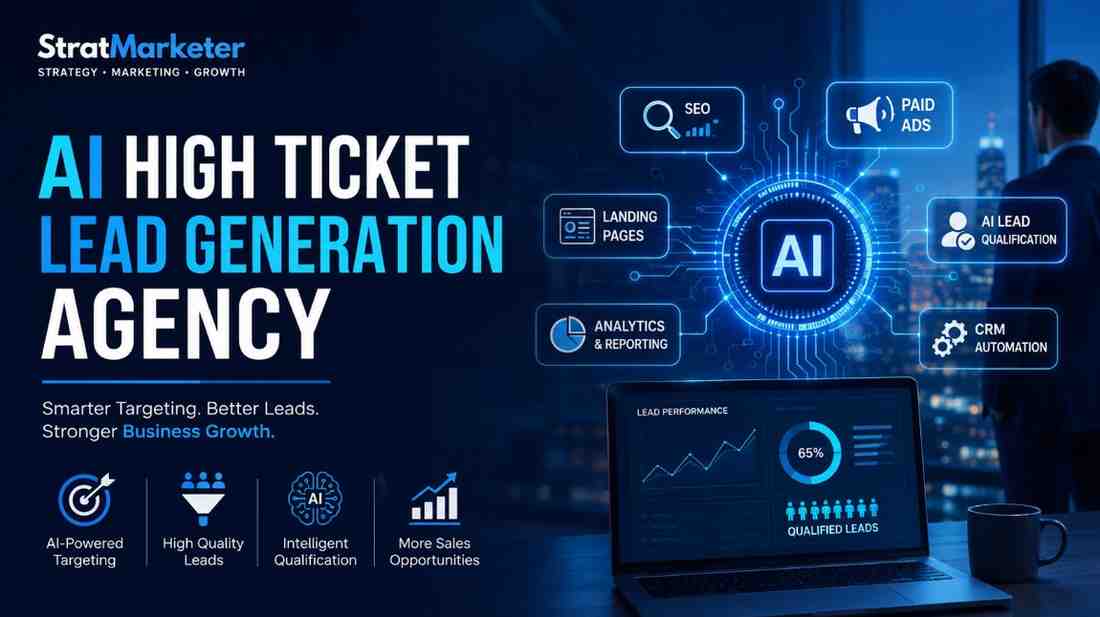
For StratMarketer, this can mean bringing together SEO, paid advertising, social media, content marketing, landing page optimisation, CRM workflows, AI based lead qualification and automated follow ups rather than treating each channel as a separate activity.
A high ticket buyer rarely follows a neat journey. Someone may discover a company through Google, check its LinkedIn page later, read three articles, return through a remarketing advertisement and finally speak to a sales representative through WhatsApp. If each interaction sits in a different system, the business gets a fragmented picture of that prospect.
An AI high ticket lead generation agency can help connect those signals.
There is also a practical reason businesses are paying attention to this approach. Advertising costs have become difficult to ignore in many sectors, while sales teams cannot spend their entire day calling every enquiry that arrives. When a company sells expensive services, even a small number of good opportunities can be more valuable than a large database of weak leads.
I might be wrong here for some low involvement industries, because volume can still matter enormously. But for consulting, professional services, B2B solutions, real estate, financial services and specialised technology, chasing every lead equally is usually a poor use of sales time.
The real question is not, “How many leads did we generate?”
It is, “How many of those leads had a genuine reason to speak with us?”
That is the shift behind an AI high ticket lead generation agency.
Why High Ticket Businesses Struggle to Generate Qualified Leads Consistently
The biggest problem is often not a lack of enquiries. It is the gap between an enquiry and an actual buying opportunity.
A high ticket business may receive website forms every day. Some people want pricing. Some are researching the market. Some are students looking for information. Some are competitors. Some are genuinely interested but are six months away from making a decision. A few may be ready to talk to sales today.
The difficulty is identifying which is which without wasting hours.
Many companies also build their marketing around traffic rather than buying intent. They celebrate impressions, clicks and website visitors because these numbers are easy to show in a monthly report. But a consulting company cannot pay salaries with impressions.
This is where I usually disagree with the idea that generating more leads automatically solves a sales problem. It does not. If the targeting is weak, more leads simply create more work for the sales team.
Consider a real type of situation common in Indian B2B markets. A company offers engineering consultancy for a large manufacturing project. Its website starts ranking for broad keywords related to manufacturing consultancy. Traffic increases. The enquiry count rises. Yet many enquiries come from students, job seekers, small businesses with budgets nowhere near the project requirement, or people looking for a completely different service.
The company technically generated leads.
Commercially, very little changed.
An AI high ticket lead generation agency approaches this problem differently by looking beyond the first conversion. A form submission is treated as an initial signal rather than proof that somebody is a qualified prospect.
The quality of the offer also matters. If the landing page says only “Contact us for the best solution”, it gives the visitor very little reason to trust the business. High ticket buyers need more substance. They may want to know the company’s experience, industries served, process, project examples, timelines, technical capability and what happens after the first consultation.
This is particularly relevant in India, where buyers often compare several vendors through WhatsApp before they make a decision. A person may fill in a form on one website, call another company and ask a third company for a quotation on the same afternoon.
The first response does not always win.
The company that understands the requirement properly often has a better chance.
Another issue is slow follow up. A lead generated at 11 in the morning may receive a call at 5 in the evening. By then, the prospect may have spoken to two competitors. For high value services, this delay can become expensive.
Automation can help here, but it should not turn the customer experience into a string of robotic messages. An AI high ticket lead generation agency can use automated workflows to acknowledge an enquiry, collect missing information, assign the prospect to the right sales person and trigger a relevant follow up. The human salesperson can then enter the conversation with some context.
That is much more useful than sending a generic “Dear Sir, we received your enquiry” message.
There is another uncomfortable problem. Businesses sometimes target people who cannot realistically afford the service because their advertising message is too broad. If the minimum project value is ₹10 lakh, the marketing should communicate enough about the nature of the engagement to discourage people expecting a ₹50,000 solution.
Some companies are afraid of mentioning this because they think it will reduce enquiries.
It probably will.
And that can actually be a good thing.
A smaller number of relevant enquiries can give the sales team more time to work properly on serious opportunities. An AI high ticket lead generation agency should therefore be judged by the commercial quality of the pipeline, not simply the number of form submissions produced every month.
How AI High Ticket Lead Generation Agencies Identify Better Prospects
AI becomes genuinely useful when there is enough information to work with.
A good AI high ticket lead generation agency does not simply place an AI chatbot on a website and call the process intelligent. Prospect identification involves several layers, and much of the useful work happens quietly in the background.
The first layer is audience definition.
A business needs to know who it actually wants. For a B2B consulting company, that could mean promoters, directors, procurement teams, plant heads or project managers in particular industries. For a premium real estate company, it could involve investors, business owners or families looking for properties above a certain value.
Without this clarity, AI has very little meaningful direction.
Once the audience is defined, AI systems can analyse behavioural signals. Someone who visits a service page once is different from someone who returns four times, reads a case study, checks pricing information and submits a consultation request.
The second visitor has demonstrated more intent.
This does not guarantee a sale, of course.
That distinction is important because lead scoring systems can become overconfident. A prospect might show strong online behaviour simply because they are researching the market. I have seen this happen with technical B2B services where one person reads almost every article on a website but has no authority to purchase anything.
So AI signals should support sales judgement, not replace it.
An AI high ticket lead generation agency can assign different values to different actions. A general blog visit may carry little weight. A service page visit may carry more. A detailed enquiry may carry significantly more. A request for a proposal or consultation can be treated as a stronger commercial signal.
The exact scoring model depends on the business.
AI can also help identify patterns that are difficult to notice manually. For example, leads from one industry might have a much higher consultation-to-sale rate than leads from another industry. A certain landing page may generate fewer enquiries but significantly more qualified opportunities. One advertising message may bring cheaper leads while another brings fewer but better prospects.
These patterns can influence future targeting.
This is where an AI high ticket lead generation agency can work alongside CRM data. Instead of judging campaigns only by cost per lead, the business can begin looking at metrics such as qualified lead rate, sales accepted leads, consultation bookings, proposal rate and eventually revenue generated from different acquisition sources.
The process can also include AI powered conversations.
A visitor may ask a chatbot about pricing, eligibility, project timelines or service availability. Rather than immediately pushing the person toward a sales call, the system can ask sensible qualifying questions. What type of service is required? What is the approximate project size? What is the expected timeline? Is the person looking for implementation, consulting or a quotation?
These questions should be short and relevant.
Nobody enjoys filling a ten field form just to ask one basic question.
AI can then pass the collected information to the CRM or sales team. A salesperson does not start from zero. They can see what the prospect asked and what information has already been provided.
That small difference can change the quality of the conversation.
Another area is predictive lead scoring. Once a company has enough historical data, AI can identify characteristics commonly associated with successful customers. It might find that leads from particular industries, locations, company sizes or campaign sources convert at higher rates.
But historical data has its own weakness.
If the business has been targeting the wrong audience for years, AI may simply learn the wrong pattern. This is one reason I would never hand over lead qualification completely to an algorithm. The system needs regular human review, especially when the sales team notices something the dashboard does not.
And sometimes the best prospect does not look impressive digitally.
A senior business owner may spend five minutes on the website and then call directly. A younger researcher might spend an hour reading every page and never buy. Behaviour tells a story, but it does not tell the whole story.
That is why the strongest AI high ticket lead generation agency setups combine machine analysis with human sales judgement. AI can process thousands of signals quickly. People still understand hesitation, urgency, trust and context better in many high value conversations.
There is no perfect lead score.
There is only a better-informed sales decision, and even that can change by Monday morning when the market moves, a competitor changes pricing or the buyer suddenly postpones the project.
Using SEO, Paid Ads and AI Together for High Ticket Lead Generation
SEO and paid advertising are often treated as two completely separate marketing activities. For high ticket businesses, I do not think that works very well.
A serious buyer can discover a company through Google search, click a paid advertisement a few days later, read a case study and then return directly to the website. If these interactions are measured separately, the business may assume that SEO generated one lead and paid advertising generated another. In reality, it could be the same person moving through different stages of research.
This is one reason an AI high ticket lead generation agency needs to look at the complete customer journey.
SEO brings people who are already searching for answers. That search may be informational, commercial or very specific. Someone searching for “industrial project consultant” is not necessarily ready to hire anybody. Someone searching for “techno economic viability report consultant for bank loan” has a much clearer reason for visiting a service page.
The content needs to reflect that difference.
A good SEO strategy for high ticket services should not be built only around high volume keywords. Sometimes a keyword with 200 monthly searches can be more commercially useful than one with 10,000 searches because the smaller audience has a stronger reason to contact the business.
Paid advertising works differently.
Google Ads can place a company in front of people with immediate commercial intent. Meta advertising can create awareness and retarget people who have already interacted with the company. LinkedIn can be useful for certain B2B audiences where job roles and company characteristics matter.
AI can sit across these activities and help identify patterns.
Suppose StratMarketer is generating leads for an Indian professional services company. SEO brings 60 enquiries in a month, while paid campaigns bring another 100. Looking only at volume, paid advertising appears better. But after connecting the CRM data, the business finds that 15 SEO leads become sales opportunities while only 8 paid leads reach that stage.
The cheaper lead source is not automatically the better one.
This is where an AI high ticket lead generation agency can help marketing teams move from simple lead counting to opportunity analysis. Search terms, landing page behaviour, audience signals, campaign data and CRM outcomes can be examined together.
Content also has a role here.
A high ticket buyer often needs more evidence before contacting a company. Service pages explain what the company does. Detailed articles answer questions. Case studies show experience. Comparison content helps people evaluate alternatives. FAQs remove small doubts that otherwise keep a prospect from making contact.
Paid advertising can then bring relevant visitors into this content ecosystem.
I prefer this approach to sending every advertisement directly to a generic contact page. It is easy to set up, but it often wastes good traffic. Someone searching for a complex service may not be ready to “Get Started” after seeing one advertisement.
They may simply want to understand whether the company knows what it is doing.
AI can help identify which content is assisting conversions and which pages are being ignored. It can also help generate variations of ad messages and landing page copy, but human review still matters. A machine can produce ten versions of an advertisement in minutes. That does not mean all ten deserve to be published.
In fact, some AI generated advertising copy sounds so polished that it immediately feels suspicious.
For high value services, trust is worth more than clever wording.
SEO also takes time. Paid advertising can bring immediate traffic, but it stops when the budget stops. Organic search can continue bringing visitors after the original content has been published, although rankings are never guaranteed.
An AI high ticket lead generation agency therefore needs to understand that SEO and paid media are not substitutes. They can support each other when the strategy is connected properly.
AI Lead Qualification and Filtering Before Sales Teams Get Involved
There is a point in every high ticket sales process where somebody has to decide whether a lead deserves a sales conversation.
Traditionally, this is done by a salesperson.
That creates a problem when the enquiry volume increases. A sales person may spend 20 minutes speaking with someone who was never a realistic buyer, while a genuinely interested prospect is waiting for a callback.
AI lead qualification can take some of that early work away from the sales team.
An AI high ticket lead generation agency may use forms, chat systems, CRM data and behavioural information to understand the basic quality of an enquiry before assigning it to sales.
For example, imagine a company selling a ₹15 lakh business consulting programme. A lead comes through an advertisement and provides only a name and phone number. The system knows almost nothing.
Another person says they operate a manufacturing company, explains the business problem, mentions that they are looking for a solution within the next two months and requests a consultation.
These two leads should not be treated identically.
The second person has given stronger buying signals.
Qualification does not always need to be complicated. In many cases, four or five sensible questions are enough. What service are you looking for? What is the approximate project size? When are you planning to start? What is the main problem you want to solve? Are you the decision maker or are you researching on behalf of someone else?
The answers can help determine what happens next.
Some leads can go directly to sales. Others can receive educational content. Some may need a follow up later. A few should simply be filtered out.
This saves time, but there is another benefit that gets less attention. Qualification can also make the sales conversation better.
A salesperson who knows that a prospect is looking for a specific service, has already reviewed the pricing information and wants to begin within 30 days can prepare before calling.
That is much better than opening the CRM and asking, “So, what exactly are you looking for?”
I have seen businesses lose good leads because of this basic problem. The prospect had already explained everything in the enquiry form, but nobody had read it properly.
The technology was not the main issue. The process was.
An AI high ticket lead generation agency should therefore treat qualification as part of the sales workflow, not just another automation feature.
There are risks too. AI can make incorrect assumptions. A lead may provide incomplete information. Someone may deliberately enter a low budget simply because they do not want to disclose it. A serious buyer may also be reluctant to answer too many questions before speaking to a human.
So filtering needs some flexibility.
A lead should not be rejected simply because it does not match an ideal customer profile perfectly.
I might be wrong here in industries where historical data is extremely reliable, but I would still keep a human review layer for high value opportunities. Losing one ₹20 lakh client because an automated scoring model classified the enquiry incorrectly is a very expensive lesson.
How CRM Automation and AI Follow Ups Help Reduce Lead Leakage
Lead leakage sounds technical, but the problem is painfully simple.
Someone makes an enquiry and nobody follows up properly.
It happens in small companies and large companies. A sales person gets busy. A WhatsApp conversation is forgotten. Someone sends a quotation but does not call again. A lead is marked as “later” in the CRM and then disappears into that strange place where old enquiries go.
High ticket sales make this particularly costly because one missed follow up can represent a significant amount of potential revenue.
An AI high ticket lead generation agency can connect lead generation with CRM automation so that the next action is not dependent entirely on someone’s memory.
A new enquiry can automatically enter the CRM. The source can be recorded. Qualification information can be attached. The appropriate salesperson can be assigned. A reminder can be created. If there is no response, another follow up can be scheduled.
Simple things.
Yet simple things are often where businesses leak the most leads.
AI can make these workflows more responsive. The follow up does not have to be identical for every person. A prospect who requested a proposal should receive a different message from someone who downloaded an information guide.
A person who stopped responding after discussing pricing may need a different approach altogether.
This is where customer context becomes important.
A useful AI system can look at the previous conversation and suggest the next message or action. It can remind the sales person why the prospect contacted the company, what information was discussed and what remains unresolved.
But I strongly dislike the idea of fully automated follow ups for high value sales.
A few reminders are fine. A machine pretending to be a salesperson for weeks is another matter.
If someone has received four messages and has not replied, sending a fifth message that says “Just checking in” is rarely a brilliant sales strategy. Sometimes the correct action is to stop.
CRM automation should help salespeople remember the right things. It should not make customers feel chased.
For StratMarketer, the useful role of AI is to connect marketing activity with what happens after the lead is generated. If a campaign produces enquiries but sales never updates the CRM, the system eventually loses the ability to understand which campaigns are actually producing customers.
That creates a reporting problem too.
Marketing may say, “We generated 500 leads.”
Sales may say, “Only 25 were worth talking to.”
Both statements can be technically true.
The CRM should help explain the gap.
Personalised Content, Landing Pages and Messaging for High Value Buyers
High ticket buyers rarely respond well to vague promises.
They want relevance.
A manufacturing company looking for technical consulting has different concerns from a real estate investor. A hospital considering a specialised service will ask different questions from an ecommerce company looking for an advertising partner.
Yet many websites speak to all of them with exactly the same message.
That is a missed opportunity.
An AI high ticket lead generation agency can use audience information and behavioural signals to make the experience more relevant. A visitor from a particular industry can be shown content that speaks directly to the problems of that industry. A returning visitor can be guided toward a consultation or case study instead of being shown the same introductory message again.
Personalisation does not have to mean using someone’s name everywhere.
Sometimes it simply means showing the right information at the right point.
For example, a landing page aimed at Indian manufacturing businesses might discuss project timelines, technical evaluation, compliance requirements and implementation concerns. A page aimed at professional service firms could focus more on lead quality, sales cycles, consultation bookings and customer acquisition costs.
The core service may be identical.
The conversation is not.
AI can help identify which topics different audiences engage with. It can also assist with creating content variations, analysing page behaviour and finding gaps in existing messaging.
But this needs restraint.
I have seen landing pages become overloaded with personalisation because the marketing team wants to demonstrate that the technology is working. The visitor ends up seeing too many messages, popups and recommendations.
That does not feel personal.
It feels watched.
For high value buyers, trust should remain the priority. A clean landing page with strong evidence can outperform a complicated page filled with automated elements.
The content itself also needs depth. A person considering a large purchase may want to see actual examples, service details, limitations, process information and answers to difficult questions.
Do not hide the difficult parts.
If a project normally takes eight weeks, say so. If certain clients are not suitable, explain why. If pricing depends on project scope, explain what affects the price.
This kind of honesty can reduce low quality enquiries.
It can also make the sales team’s job easier because the prospect arrives with more realistic expectations.
An AI high ticket lead generation agency can help deliver this content across search, advertising, email, CRM and social channels. But the message should remain consistent with what the business can actually deliver.
No AI system can repair a weak offer.
It can only distribute the weakness faster.
Measuring Lead Quality, Sales Opportunities and Cost Per Qualified Lead
This is where many lead generation reports become misleading.
A company spends ₹2 lakh on marketing and receives 400 leads. The cost per lead is ₹500.
Sounds good.
But suppose only 12 leads become genuine sales opportunities and two become customers. The ₹500 figure tells us almost nothing useful about the health of the campaign.
An AI high ticket lead generation agency should therefore look beyond cost per lead.
Cost per qualified lead is more meaningful. Even that is not enough.
Businesses should also look at how many qualified leads become sales opportunities, how many opportunities receive proposals, how many proposals become customers and how much revenue those customers eventually generate.
The numbers can look very different from the original lead generation report.
For example, Campaign A may produce 200 leads at ₹600 each. Campaign B produces 60 leads at ₹1,500 each.
Campaign A looks cheaper.
But if Campaign A generates only eight qualified opportunities while Campaign B generates 15, the more expensive campaign may actually be doing better.
This is why an AI high ticket lead generation agency should connect advertising platforms with CRM and sales data wherever possible.
The important question is not just where the lead came from.
It is what happened after the lead arrived.
SEO might generate fewer leads but a stronger conversion into consultations. Google Ads might generate more enquiries but a lower qualified lead rate. LinkedIn might cost more per enquiry but produce larger contracts.
These differences matter.
There is also a time lag in high ticket sales. A lead generated this month may become a customer three months later. In some B2B industries, the cycle can be much longer.
So judging a campaign after seven days can produce a completely wrong conclusion.
This is one area where AI can help by connecting historical information and identifying patterns over time. It can highlight campaigns that repeatedly generate poor quality enquiries and identify sources that produce fewer but stronger opportunities.
Still, the final commercial judgement should involve people.
A dashboard can tell you that a lead has a high score. A salesperson may know that the company has no budget approved yet. Another lead may have a mediocre score but come from a company with a strong reputation and a clear need.
Numbers are useful.
They are not the entire story.
I would also track the reason leads are rejected. No budget. Wrong service. Wrong location. No decision making authority. Not ready. Duplicate enquiry. Competitor. Student or job seeker. Poor fit.
After a few months, these rejection reasons can reveal problems in the marketing itself.
If half the leads are being rejected because they expect a cheaper service, the issue may not be sales qualification. The advertisement or landing page may simply be attracting the wrong expectation.
That is an important distinction.
An AI high ticket lead generation agency should keep looking backwards from sales outcomes to marketing inputs. If the sales team repeatedly says the leads are poor, do not simply ask salespeople to follow up harder.
Question the campaign.
Question the offer.
Question the landing page.
Sometimes question the keyword itself.
And yes, this can be uncomfortable. Marketing teams do not always enjoy discovering that a campaign with excellent click through rates is producing weak business opportunities. But that information is more useful than another attractive monthly report.
The real value of AI high ticket lead generation is found when these pieces begin speaking to each other. Search behaviour, advertising data, website activity, qualification, CRM activity and sales outcomes can form one connected picture.
Not a perfect picture.
Just a more honest one.
How StratMarketer Approaches AI High Ticket Lead Generation for Indian Businesses
For Indian businesses selling expensive products or services, lead generation cannot be treated like a simple traffic exercise. The sales cycle is usually longer, buyers ask more questions and trust has a bigger role in the final decision.
This is where StratMarketer approaches AI high ticket lead generation differently.
The starting point should be the business, not the software.
Before deciding which AI tools to use, the team needs to understand what the company sells, who normally buys it, what the average deal value looks like, how long a sales cycle takes and where previous leads have gone wrong.
A ₹5 lakh consulting service and a ₹50 lakh industrial solution should not have the same lead generation process simply because both are considered high ticket.
The first practical step is understanding the ideal customer.
For an Indian B2B company, this could involve company size, industry, location, decision maker, project requirement and expected budget. For a premium service business, the buying signals may be different. The important thing is to define the commercial fit before asking AI to find prospects.
StratMarketer can then bring SEO, paid advertising, content, social media, landing pages, AI based qualification and CRM automation into the same lead generation system.
SEO has a particularly important role when buyers are researching a complicated purchase. A person looking for a specialised service may spend weeks reading before making contact. The website therefore needs useful service pages, detailed articles, comparison information, FAQs and evidence of actual experience.
This is not about publishing dozens of shallow articles.
One detailed page that answers the questions a serious buyer actually has can be more useful than ten generic posts.
Paid advertising can work alongside this. Search campaigns can capture people already looking for a service, while other advertising channels can help reach specific audiences and bring previous website visitors back into the conversation.
AI can then help analyse which audiences, keywords, advertisements and pages are producing stronger leads.
The word “stronger” matters here.
StratMarketer should not judge an AI high ticket lead generation campaign only by the number of forms submitted. The more useful question is what happens after the form.
Does the prospect meet the basic criteria?
Did they request a consultation?
Did sales accept the opportunity?
Was a proposal sent?
Did the deal move forward?
This creates a connection between marketing activity and actual sales conversations.
Lead qualification is another important part of the process. A new enquiry can be evaluated using information provided through forms, website conversations and previous interactions. Some prospects may be ready for a sales call, while others need more information before they are contacted.
This can reduce the amount of time sales teams spend chasing unsuitable enquiries.
There is still a human role.
I would not recommend giving every qualification decision to an AI system. High value buyers are complicated. Someone might have a smaller online footprint but hold significant purchasing authority. Another person may behave like a highly engaged prospect but have no budget or decision making power.
AI should help the team notice patterns.
People should still make important decisions.
StratMarketer can also use CRM automation to make sure promising leads do not disappear after the first enquiry. A reminder can be created when a salesperson needs to follow up. A prospect can receive relevant information after a consultation request. Sales teams can see the source of the enquiry and previous interactions before making contact.
This sounds basic, but it is often where money is lost.
A company may spend heavily to acquire a lead and then respond several hours later because nobody noticed the notification.
That is frustrating to watch.
The other important part is personalisation. An Indian manufacturing company, healthcare organisation, real estate business and professional consultancy will not respond to the same message. Their buying concerns are different.
The landing page should reflect that.
The content should reflect that.
Even the qualification questions may need to change.
StratMarketer can use audience and behavioural information to make these experiences more relevant without turning the website into an overcomplicated collection of popups and automated messages.
Sometimes simple is better.
The final part is measurement. Lead generation should be connected with CRM and sales data so that the business can understand cost per qualified lead, sales opportunities, proposal rates and customer acquisition cost.
That changes the conversation.
Instead of saying, “We generated 300 leads,” the business can ask, “How many of those leads were actually worth pursuing?”
That is a much harder question.
It is also the more useful one.
How to Choose the Right AI High Ticket Lead Generation Agency for Your Business
Choosing an AI high ticket lead generation agency is not simply a matter of comparing monthly packages.
Two agencies can use similar tools and still produce completely different results.
The first thing I would examine is whether the agency understands high ticket sales cycles. If someone talks only about traffic, clicks and lead volume, I would be cautious.
Ask what happens after the lead is generated.
A good agency should be interested in qualification, sales opportunities, CRM movement, follow ups and eventually revenue. If the agency cannot explain how it plans to connect marketing activity with sales outcomes, the reporting may remain disconnected from the actual business.
The second thing is industry understanding.
An agency does not need twenty years of experience in your exact industry, but it should be able to understand your buyers quickly. If you sell industrial equipment, the agency should understand that a plant manager, procurement head and business owner may influence the same purchase differently.
If you sell premium consulting, the person downloading your guide may not be the person signing the agreement.
These details matter.
Ask how the agency defines a qualified lead.
This is one of the simplest questions and one of the most revealing.
If the answer is simply “someone who fills out the form”, that is not really qualification.
A better process considers factors such as requirement, buying timeline, commercial fit, decision making authority and service suitability. The exact criteria will depend on the business.
You should also ask how AI is actually being used.
Some agencies use the word AI everywhere while the underlying process is still ordinary lead generation with a chatbot added to the website.
There is nothing wrong with using a chatbot.
The problem is calling that an AI lead generation system without explaining what else happens.
Ask whether AI is used for audience analysis, lead scoring, content personalisation, campaign analysis, qualification, CRM workflows or follow up recommendations. Ask what data the system uses and where human review remains involved.
Transparency matters here.
I would also look carefully at the reporting.
A monthly report showing impressions, clicks and leads can look impressive while saying very little about sales performance.
Ask for numbers such as qualified lead rate, sales accepted leads, consultation bookings, proposal rate and customer acquisition cost. If your sales cycle is long, ask how the agency handles delayed conversions.
This is particularly important for Indian businesses because high value sales can involve several rounds of discussion, negotiation and approval.
The cheapest lead is rarely the best lead.
Another point is the agency’s approach to landing pages and content. If the agency wants to send every advertisement to the same generic contact page, ask why.
High ticket buyers need information.
They may want case studies, service details, industry expertise, FAQs, pricing factors, timelines and proof before they speak with sales. A strong AI high ticket lead generation agency should understand this rather than trying to force every visitor into an immediate enquiry.
There is also the question of communication.
If your agency uses AI to qualify leads but your sales team receives incomplete or confusing information, the technology has not solved much.
The CRM should contain enough context for the salesperson to understand where the lead came from, what the person was interested in and what action is expected next.
Ask how follow ups are handled too.
Automated reminders can be useful. Fully automated sales conversations can become annoying very quickly. I prefer systems where AI handles repetitive coordination while humans handle important conversations.
That balance may change depending on the business.
And do not ignore the agency’s own website and communication.
If an agency promises sophisticated AI lead generation but cannot clearly explain its own process, that is worth noticing. You do not need a complicated presentation. You need clear answers.
What kind of leads do you generate?
How do you qualify them?
How do you measure quality?
What happens when lead quality drops?
How does the CRM connect with marketing?
Who reviews the AI decisions?
What does the sales team receive?
What happens after a lead is generated?
These questions tell you more than a long list of AI tools.
For StratMarketer, the right approach to AI high ticket lead generation should remain connected to the business’s actual sales process. SEO, paid advertising, content, landing pages, AI qualification and CRM automation are useful pieces, but none of them should operate in isolation.
A company may need more leads.
Another may actually need fewer leads and better qualification.
That difference is easy to miss when the entire conversation is built around lead volume.
I might be wrong about one thing here. Some businesses genuinely need scale first because their sales teams are capable of filtering large volumes efficiently. But for most high ticket businesses, especially where every sales conversation takes time, I would rather see a smaller pipeline with real commercial potential than a spreadsheet full of names nobody has time to call.
And sometimes the problem is not lead generation at all.
It is the offer, the response time, the sales process, the pricing or simply the fact that the wrong people are being approached.
An agency worth working with should be willing to say that.
Even when the answer is uncomfortable.