


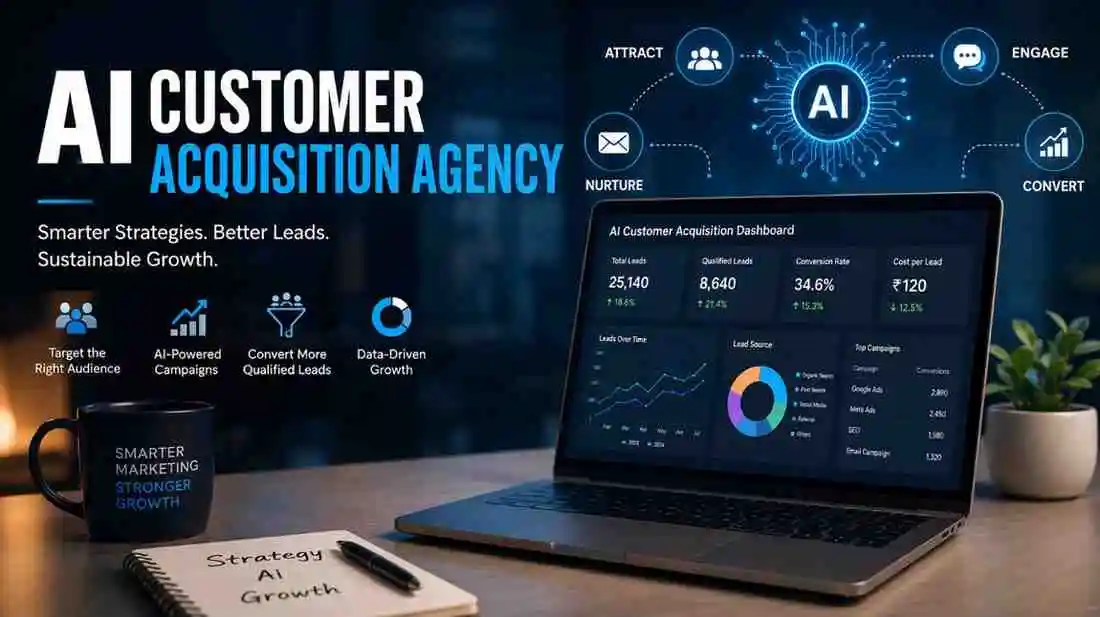
Why Businesses Are Looking for an AI Customer Acquisition Agency Instead of Traditional Marketing
Finding new customers has never been simple, but it has certainly become more complicated over the last few years. Buyers no longer follow a straight path. They search on Google, ask AI assistants for recommendations, compare reviews, watch videos, scroll through social media, visit websites several times, and then leave without making a decision. Many businesses invest heavily in marketing during this process, yet still struggle to generate qualified enquiries.
That is one of the biggest reasons companies are turning to an AI customer acquisition agency instead of relying only on traditional marketing methods. Traditional campaigns often depend on assumptions, broad audience targeting, and manual optimisation. They can still work, but they usually react after data arrives rather than adapting while customer behaviour is changing.
An experienced AI customer acquisition agency approaches the problem differently. Instead of treating SEO, paid advertising, content marketing, email campaigns, and automation as separate activities, AI helps connect them into one customer acquisition system. Every interaction contributes useful insights that can improve the next one.
I remember working with a local manufacturing company that spent a significant monthly budget on paid advertisements. Traffic looked impressive on paper, but sales enquiries remained inconsistent. The issue wasn’t the number of visitors. The wrong people were reaching the website. Once customer behaviour, search intent, and conversion patterns were analysed together, the business reduced wasted spending and began attracting visitors who actually needed their services.
This happens more often than many business owners realise.
Consumer expectations have also changed. People expect faster responses, personalised communication, useful content, and smooth website experiences. They rarely wait for slow websites or generic follow up emails anymore. An AI customer acquisition agency helps businesses respond to these expectations by using intelligent automation without removing the human element from marketing.
Another important difference is decision making.
Traditional marketing teams often rely on monthly reports before making campaign changes. AI systems can identify patterns much earlier. They may detect declining engagement, changing search behaviour, or shifting customer interests before these trends become obvious through manual reporting.
That doesn’t mean AI replaces marketers.
In fact, I think businesses sometimes expect too much from automation alone. AI can process enormous amounts of information, but understanding customer emotions, local buying behaviour, and industry specific challenges still requires human judgement. The best results usually come when experienced marketers work alongside AI rather than handing everything over to software.
This may not apply equally to every industry, but businesses facing intense online competition are increasingly recognising that customer acquisition requires faster analysis, better personalisation, and continuous optimisation. That combination is exactly why an AI customer acquisition agency has become an important growth partner rather than just another marketing service provider.
What an AI Customer Acquisition Agency Actually Does Behind the Scenes
Many business owners hear the phrase AI customer acquisition agency and immediately imagine chatbots or automated advertisements. The reality is much broader.
Most of the valuable work happens where customers never see it.
An experienced AI customer acquisition agency begins by understanding the business itself. It studies the target audience, customer buying behaviour, competitors, existing marketing performance, website data, sales process, and content gaps before recommending any campaign.
Only after this research does AI begin supporting the marketing process.
For example, AI tools can identify search trends that indicate growing customer demand. They can analyse which keywords generate enquiries rather than just website visits. They can examine how users move across different pages and identify where potential customers lose interest before completing an enquiry form.
These insights allow marketers to make better decisions instead of relying on guesswork.
Content creation also changes significantly.
Rather than publishing random blog posts every week, an AI customer acquisition agency builds content around actual customer questions, buying intent, competitor gaps, and emerging search behaviour. This creates content that attracts visitors at different stages of the buying journey instead of chasing traffic alone.
Advertising becomes more efficient as well.
AI helps evaluate audience behaviour, campaign performance, bidding strategies, creative variations, and conversion quality much faster than manual analysis. Instead of simply increasing advertising budgets, campaigns can gradually improve based on real customer interactions.
Lead qualification is another area where AI makes a noticeable difference.
Many businesses receive enquiries that never become customers. AI can analyse behavioural signals, previous interactions, demographic information, browsing activity, and engagement patterns to identify which leads are more likely to convert. Sales teams can then spend more time speaking with genuinely interested prospects instead of contacting every enquiry with the same priority.
Customer nurturing is equally important.
Someone visiting a website today may not purchase immediately. An AI customer acquisition agency helps businesses remain visible through personalised email campaigns, remarketing advertisements, educational content, automated follow ups, and relevant recommendations until the customer is ready to make a decision.
One mistake I often notice is businesses expecting AI to produce instant growth without improving their website or sales process. It rarely works that way. If the landing page creates confusion or enquiry forms are unnecessarily complicated, AI cannot solve those basic business problems on its own.
Technology makes strong systems stronger. It doesn’t magically repair weak ones.
How AI Changes the Complete Customer Acquisition Journey from Discovery to Conversion
Customer acquisition used to be viewed as a fairly straightforward marketing funnel. Businesses generated awareness, collected leads, followed up with prospects, and closed sales.
Today’s customer journey is rarely that predictable.
A buyer might first read a blog, then forget about the company for two weeks, later watch a YouTube video, compare several competitors, ask an AI assistant for recommendations, return through Google Search, read customer reviews, and finally submit an enquiry after multiple visits.
This is where an AI customer acquisition agency provides a major advantage.
Instead of treating each marketing channel independently, AI connects information across multiple customer touchpoints. Every interaction helps improve future communication, allowing businesses to understand what influences purchasing decisions throughout the complete journey.
The discovery stage itself has evolved.
Customers now search through traditional search engines, AI powered search experiences, voice assistants, video platforms, social media, business directories, and online communities. An AI customer acquisition agency helps businesses build visibility across these channels rather than depending on one traffic source.
As visitors move into the research stage, AI helps personalise their experience.
Different users often receive different content recommendations, landing pages, product suggestions, or educational resources based on their interests and previous behaviour. This creates a more relevant experience without making interactions feel forced.
During consideration, AI assists businesses by identifying hesitation points.
Perhaps visitors repeatedly leave after viewing pricing pages. Maybe mobile users abandon enquiry forms more often than desktop users. Sometimes customers spend several minutes comparing service pages but never contact the business. AI helps identify these behavioural patterns, allowing marketers to improve the overall customer experience.
Conversion optimisation becomes more precise too.
Rather than making decisions based on assumptions, an AI customer acquisition agency continuously analyses which headlines, calls to action, landing pages, advertising creatives, and customer journeys produce better quality enquiries. Small improvements across multiple touchpoints often generate much stronger long term results than a single major campaign.
Retention also influences customer acquisition more than many businesses expect.
Satisfied customers generate referrals, repeat purchases, online reviews, and positive word of mouth. AI can help identify customers likely to purchase again, recommend suitable follow up communication, and improve long term customer relationships.
Still, I sometimes wonder if businesses have become a little too obsessed with automation. AI can certainly improve efficiency, but trust is still built through honest conversations, useful expertise, responsive service, and consistently delivering what was promised. Technology supports those relationships. It doesn’t replace them.
That balance between intelligent automation and genuine human understanding is where a capable AI customer acquisition agency creates the greatest value for businesses looking to achieve sustainable customer growth.
The Core Services You Should Expect from an AI Customer Acquisition Agency
Not every AI customer acquisition agency works in the same way. Some focus only on paid advertising. Others specialise in automation software. A few simply add the word AI to their existing services without changing how they actually work.
That is usually where businesses become disappointed.
A capable AI customer acquisition agency should build a complete customer acquisition system rather than offering disconnected marketing activities. Every service should support the same objective, bringing qualified prospects into the business and helping convert them into paying customers.
Search visibility remains one of the strongest foundations. Customers still begin their buying journey with questions. They search for products, compare services, and look for businesses they can trust. That makes SEO, content strategy, Search Experience Optimisation, Answer Engine Optimisation, and Generative Engine Optimisation important parts of long term customer acquisition.
Paid advertising also has an important role.
AI powered campaign management allows advertising budgets to be allocated more intelligently by analysing user intent, conversion behaviour, audience quality, and campaign performance in real time. Instead of chasing clicks, the focus shifts towards generating enquiries that actually have commercial value.
Content marketing becomes more strategic as well.
A strong AI customer acquisition agency develops blogs, landing pages, videos, case studies, comparison pages, FAQs, and educational resources based on customer intent rather than publishing content simply to maintain activity. People often need confidence before they buy, and useful content quietly builds that confidence.
Marketing automation deserves equal attention.
Many enquiries never become customers because follow ups stop too early. AI powered automation can personalise emails, send reminders, recommend relevant resources, and nurture prospects based on their behaviour. The communication feels more timely because it responds to customer actions rather than fixed schedules.
Website optimisation is another service that is often overlooked.
I’ve seen businesses spend lakhs on advertising while sending visitors to websites that load slowly or confuse users within seconds. No amount of AI can compensate for a poor customer experience. A reliable AI customer acquisition agency reviews user journeys, landing pages, conversion paths, page speed, forms, and calls to action before increasing marketing spend.
Analytics ties everything together.
Instead of measuring vanity metrics such as impressions or page views alone, agencies should focus on customer acquisition cost, lead quality, conversion rate, lifetime customer value, and revenue generated. Those numbers tell a much more honest story.
I still believe human judgement matters here. Dashboards explain what happened. They rarely explain why people behaved that way.
Common Customer Acquisition Mistakes That Slow Business Growth
Businesses often assume customer acquisition problems begin with marketing.
Many times, they start somewhere else.
One of the most common mistakes is trying to reach everyone. A company selling specialised industrial equipment should not market itself the same way as a local café or a clothing brand. Yet broad targeting continues to waste advertising budgets across many industries.
An AI customer acquisition agency usually begins by narrowing the audience instead of expanding it.
Another mistake is expecting immediate results from every marketing activity.
SEO takes time. Content needs authority. Trust develops gradually. Even paid campaigns often require testing before they consistently generate profitable enquiries. Businesses that change direction every few weeks rarely collect enough data to improve performance.
I remember speaking with the owner of a furniture showroom who had hired three different marketing agencies within a single year. Every agency launched fresh campaigns, redesigned landing pages, changed keywords, and introduced new messaging before the previous strategy had enough time to mature. Unsurprisingly, nothing delivered consistent growth.
Sometimes patience becomes part of the strategy.
Ignoring existing customers is another expensive mistake.
Many businesses become completely focused on acquiring new leads while overlooking referrals, repeat purchases, customer reviews, and recommendations from satisfied clients. Existing customers often become the most affordable source of future business, yet they receive the least attention.
Website quality also affects customer acquisition more than businesses expect.
Complicated navigation, outdated content, missing trust signals, poor mobile experience, and lengthy enquiry forms quietly reduce conversions. Owners often blame advertising platforms when the actual problem sits on their own website.
Then there is data.
Some companies collect enormous amounts of marketing data but rarely analyse it properly. Others make decisions based entirely on intuition. Neither approach works particularly well. An experienced AI customer acquisition agency combines measurable insights with practical business understanding.
I might be wrong here because every business operates differently, but I have noticed that companies chasing quick marketing tricks often spend more over time than those investing steadily in long term customer acquisition.
And sometimes businesses simply make things harder than they need to.
How Different Industries Benefit from AI Powered Customer Acquisition Strategies
Customer acquisition looks different across industries because customers make decisions differently.
Someone purchasing software may spend weeks comparing options. A patient searching for a healthcare provider wants credibility before anything else. A manufacturer usually evaluates technical capability, certifications, pricing, and long term reliability before making contact.
That is why an AI customer acquisition agency avoids applying identical strategies everywhere.
Professional service firms such as consultants, legal advisors, chartered accountants, and financial experts often benefit from educational content combined with authority building. Prospective clients rarely make decisions after seeing a single advertisement. They prefer businesses that demonstrate expertise consistently.
Healthcare organisations rely heavily on trust.
Hospitals, clinics, diagnostic centres, and wellness brands need accurate information, strong local visibility, positive reviews, and accessible patient communication. AI helps identify common patient questions while improving local search performance and appointment generation.
Manufacturing companies have slightly different priorities.
Decision makers usually research suppliers extensively before sending enquiries. Technical blogs, case studies, product documentation, certification details, and comparison content become extremely valuable. An AI customer acquisition agency helps manufacturers remain visible during this lengthy research process.
Educational institutions also benefit.
Students and parents consume information across multiple channels before choosing courses. AI can personalise communication, recommend relevant programmes, automate enquiry management, and support admissions without making interactions feel robotic.
Real estate businesses depend on timing.
Potential buyers may explore properties for months before contacting developers. AI supports remarketing, personalised follow ups, location based campaigns, and customer segmentation throughout this longer buying cycle.
Ecommerce brands perhaps experience the fastest feedback.
Customer behaviour changes daily. Advertising performance shifts quickly. Product demand fluctuates. AI helps businesses react much faster than manual optimisation usually allows.
Earlier I mentioned that AI improves almost every customer acquisition process. I still believe that. But there are businesses where relationships remain far more important than automation. Small family businesses, niche B2B suppliers, and local service providers often grow because people know and trust them personally. AI should strengthen those relationships, not replace them.
That distinction matters.
What to Look for Before Choosing an AI Customer Acquisition Agency
Choosing an AI customer acquisition agency should never depend only on pricing.
The lowest quotation often becomes the most expensive decision later.
Begin by understanding how the agency approaches customer acquisition. Ask whether they build complete growth systems or simply manage isolated campaigns. Businesses usually need connected strategies rather than disconnected marketing services.
Experience matters too.
An agency that understands your industry will usually recognise customer behaviour, sales cycles, buying objections, and seasonal demand much faster than one learning everything from scratch.
Transparency should never be negotiable.
A dependable AI customer acquisition agency explains why campaigns are being launched, what metrics matter, how success will be measured, and where improvements are expected. If reporting feels intentionally confusing, that should raise concerns.
Look closely at their technology as well.
AI tools change constantly. Agencies should stay current without chasing every new platform that appears online. Practical implementation is far more valuable than collecting software subscriptions.
Communication often becomes the deciding factor.
Businesses should receive regular strategy discussions rather than automated reports filled with technical terminology. Marketing works better when agency teams understand sales challenges, operational constraints, and customer feedback directly from business owners.
Case studies also deserve attention.
Instead of looking only at traffic growth, examine whether previous clients improved lead quality, customer acquisition cost, conversion rates, or revenue. Those outcomes indicate meaningful business impact.
I sometimes see agencies promising guaranteed rankings or guaranteed lead numbers. Personally, I become cautious when I hear absolute guarantees because digital marketing involves too many variables outside anyone’s control.
Perhaps healthy scepticism is useful here.
How StratMarketer Combines AI, Marketing Strategy, and Human Expertise to Acquire High Quality Customers
Businesses today need more than visibility.
They need qualified conversations with people who are genuinely interested in buying.
That is the philosophy behind StratMarketer. Rather than treating SEO, paid advertising, content marketing, automation, website optimisation, and analytics as separate services, the team builds an integrated customer acquisition framework where every marketing activity supports the next stage of the buyer journey.
As an AI customer acquisition agency, StratMarketer begins by understanding the business itself. Customer personas, competitor positioning, search intent, website performance, conversion bottlenecks, and sales objectives are analysed before campaigns are launched. This reduces unnecessary marketing activity and keeps the focus on acquiring customers with genuine purchase intent.
AI supports faster decision making throughout the process.
Search behaviour, campaign performance, audience engagement, conversion data, and customer interactions are analysed continuously to identify opportunities for improvement. Instead of waiting until the end of the month, campaigns evolve as meaningful insights emerge.
Content also plays a central role.
StratMarketer creates educational articles, landing pages, comparison content, local SEO assets, service pages, FAQs, and authority building resources that answer real customer questions while supporting long term organic visibility. The objective is not simply attracting traffic but attracting people who are actively researching solutions.
Paid media follows the same philosophy.
Campaigns across Google Ads, Meta, LinkedIn, and other relevant platforms focus on audience quality, enquiry generation, and conversion efficiency rather than vanity metrics. AI assists with optimisation, but experienced marketers continue making strategic decisions based on business objectives and customer behaviour.
Marketing automation completes the system.
Qualified prospects receive relevant follow ups, personalised communication, remarketing campaigns, and nurturing sequences designed to maintain engagement without overwhelming potential customers. Sales teams receive better prepared leads because much of the early education has already taken place.
One thing I appreciate is that StratMarketer does not position AI as a replacement for human expertise. Technology processes information quickly. Experienced strategists interpret that information within the context of the client’s industry, competition, customer expectations, and long term business goals.
That combination often produces stronger and more sustainable customer acquisition than relying entirely on automation or entirely on manual marketing.
Some strategies work immediately. Others take months before the results become obvious.
And honestly, that is probably how lasting business growth has always worked.
Emerging AI Customer Acquisition Trends Businesses Should Pay Attention to
Customer acquisition is changing much faster than it did even a few years ago. Businesses that once depended only on Google rankings or paid advertisements are now competing across AI powered search platforms, conversational assistants, video platforms, marketplaces, and social communities. The journey has become less predictable, and honestly, that makes marketing both more interesting and a little frustrating.
One trend that stands out is the growth of AI assisted search. People are no longer typing only short keywords into search engines. They are asking complete questions and expecting detailed answers. That means businesses need content that genuinely solves problems instead of simply repeating keywords. An experienced AI customer acquisition agency understands this shift and creates content that works for both traditional search engines and AI generated search experiences.
Personalisation is becoming another major factor.
Customers increasingly expect businesses to understand what they need without making them repeat the same information every time they interact. AI helps personalise website experiences, email campaigns, recommendations, and follow ups based on customer behaviour. When done properly, it feels helpful rather than intrusive.
Predictive analytics is also becoming more practical.
Instead of waiting to see which campaigns succeed, AI models can identify patterns that suggest which audiences are more likely to convert, which content topics deserve attention, or where marketing budgets should be adjusted. Businesses still need human judgement to interpret those insights, but decisions become much more informed.
First party data is receiving greater attention too.
As privacy regulations continue evolving and third party tracking becomes less reliable, businesses are investing more in collecting data directly from their own customers through websites, enquiries, newsletters, customer interactions, and CRM systems. An AI customer acquisition agency can use this information responsibly to improve targeting without depending entirely on external platforms.
Automation is becoming more intelligent as well.
Earlier, automation usually meant sending scheduled emails or triggering simple workflows. Today’s AI systems can adapt communication based on user actions, engagement levels, purchase intent, and previous conversations. Prospects receive information that matches where they are in the buying process instead of receiving identical messages.
Video continues to influence customer acquisition.
Short videos, educational demonstrations, webinars, and customer success stories often help businesses build trust before the first sales conversation. AI now assists with content planning, editing, subtitles, translations, and performance analysis, making video marketing more accessible even for smaller businesses.
Voice search and conversational search deserve attention too.
People increasingly speak to devices the same way they speak to another person. Search queries are becoming longer and more specific. Businesses that optimise content around natural language are likely to remain more visible as this behaviour continues to grow.
Earlier, I said AI helps businesses make faster marketing decisions. I still believe that. But speed alone is not enough. If every company starts using the same AI tools with the same prompts, their marketing may begin looking strangely similar. That worries me a little because originality still matters.
Perhaps the businesses that perform best in the coming years will not be the ones using the most AI. They may simply be the ones using AI thoughtfully while keeping their own experience, customer understanding, and personality intact.
That thought stays with me sometimes.
Frequently Asked Questions About AI Customer Acquisition Agency
What is an AI customer acquisition agency?
An AI customer acquisition agency helps businesses attract, nurture, and convert customers by combining artificial intelligence with SEO, paid advertising, content marketing, automation, analytics, and conversion optimisation. The goal is not just generating traffic but acquiring customers who are genuinely likely to buy.
How is an AI customer acquisition agency different from a traditional marketing agency?
Traditional agencies often manage separate marketing channels independently. An AI customer acquisition agency connects customer data, automation, behavioural insights, and AI driven analysis to improve decisions across the entire customer journey.
Can small businesses benefit from an AI customer acquisition agency?
Yes. Small businesses often have limited marketing budgets, so improving targeting, reducing wasted spending, and generating higher quality enquiries can make a noticeable difference. The strategy may be smaller, but the principles remain the same.
Does AI replace human marketers?
No.
AI can analyse large amounts of information quickly, but it cannot replace business experience, creativity, customer relationships, or strategic thinking. The strongest results usually come from combining AI with experienced marketing professionals.
How long does it take to see results?
It depends on the marketing channels being used.
Paid advertising may generate enquiries relatively quickly, while SEO and content marketing usually require several months to build momentum. Sustainable customer acquisition is normally a gradual process rather than an overnight success.
Which industries benefit the most from an AI customer acquisition agency?
Manufacturing, healthcare, education, real estate, ecommerce, financial services, technology companies, professional services, SaaS businesses, and local service providers can all benefit. The exact strategy changes according to customer behaviour and industry requirements.
What services should I expect from an AI customer acquisition agency?
Most established agencies provide SEO, content marketing, paid advertising, website optimisation, marketing automation, lead nurturing, conversion rate optimisation, analytics, customer journey mapping, and AI supported campaign management as part of their customer acquisition strategy.
How do I choose the right AI customer acquisition agency?
Look beyond pricing. Evaluate industry experience, transparency, reporting quality, strategic thinking, technical expertise, case studies, and communication style. A good agency should understand your business goals before recommending marketing tactics.
Why should businesses consider StratMarketer as their AI customer acquisition agency?
StratMarketer combines AI powered analysis with experienced marketing strategy to help businesses acquire qualified customers through SEO, paid media, content marketing, automation, website optimisation, and continuous performance improvement. Rather than focusing only on traffic, the team works towards generating meaningful business growth through sustainable customer acquisition.