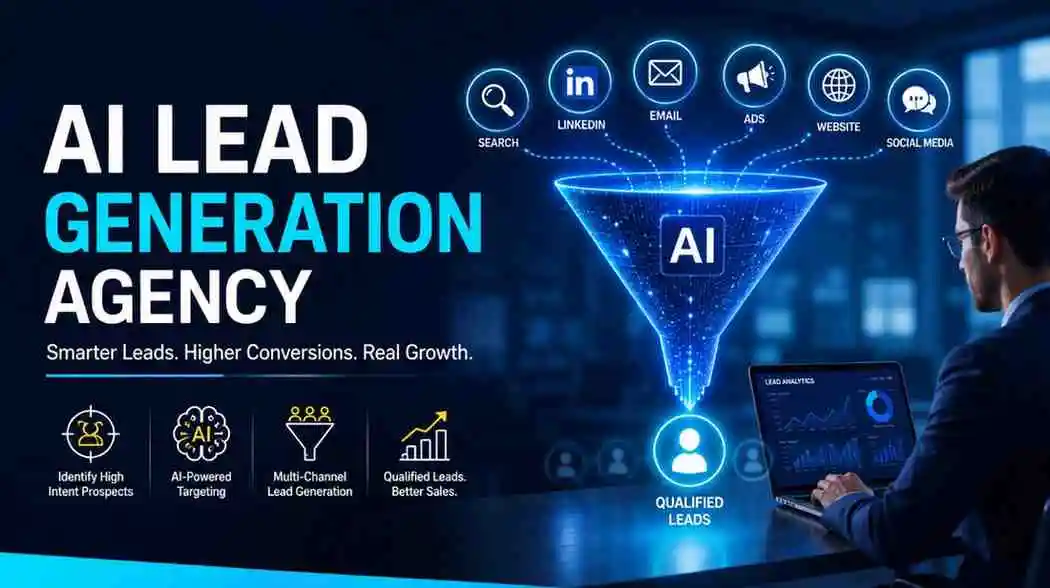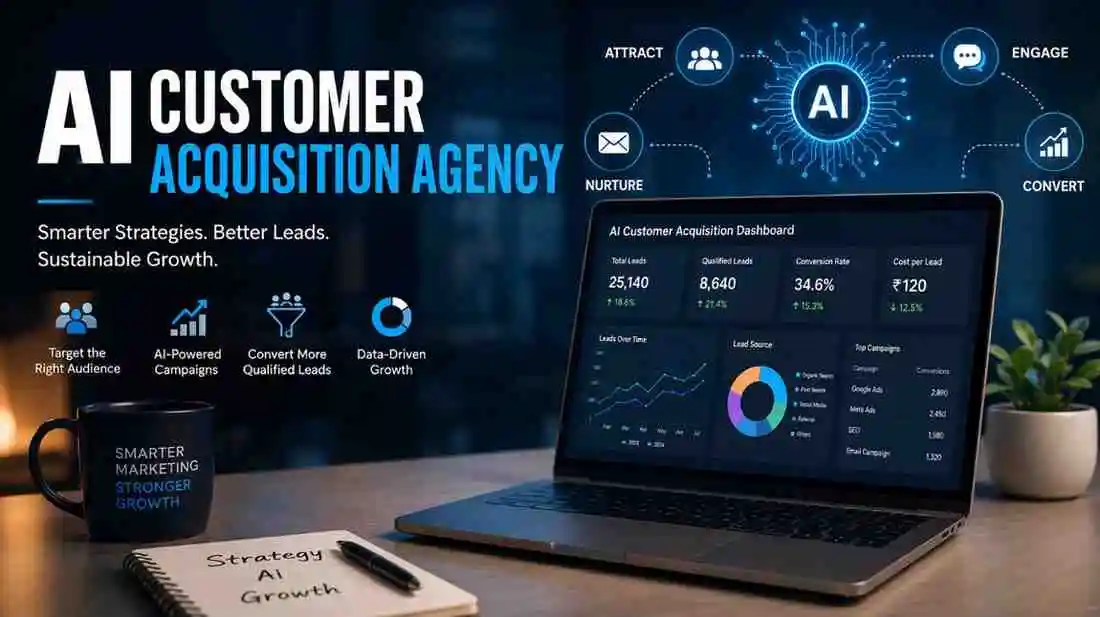



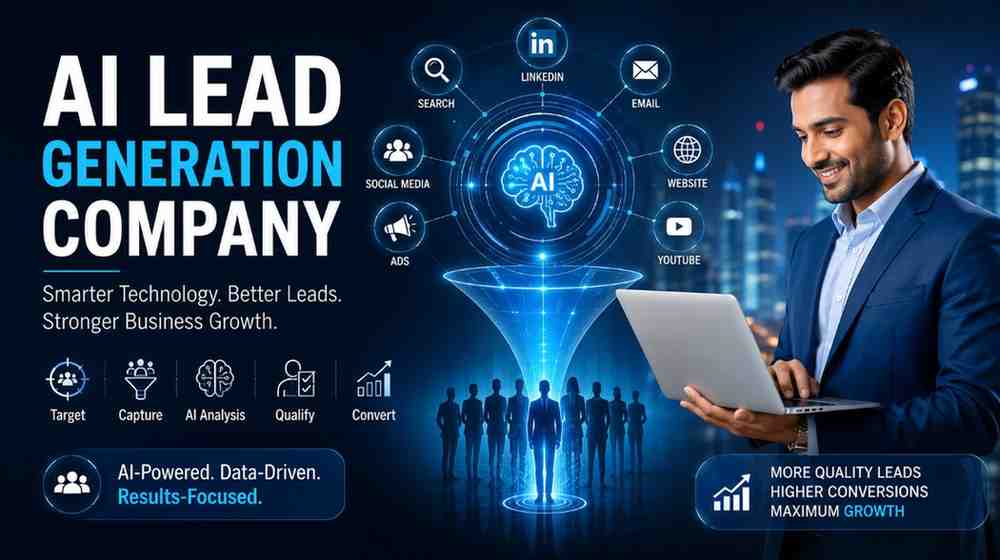
What Makes an AI Lead Generation Company Different From Traditional Lead Generation?
For years, businesses relied on fairly simple methods to generate leads. Cold calling, purchased databases, trade shows, referral networks, email blasts, newspaper advertisements, and website enquiry forms were considered enough. Those methods still have a place, but the way people buy has changed. Buyers compare options, read reviews, ask AI assistants for recommendations, watch videos, visit multiple websites, and often make up their minds long before speaking to a salesperson.
That shift is exactly why an AI lead generation company works differently.
Instead of treating every visitor or prospect the same, an AI driven approach studies behaviour, intent, engagement, and historical patterns. It becomes easier to identify who is genuinely interested and who is simply browsing. That difference saves time for both the marketing and sales teams.
I have seen this with small Indian businesses as well. A manufacturing company in Gujarat once collected hundreds of enquiries every month through paid advertisements. On paper, the numbers looked impressive. In reality, most enquiries were either irrelevant or came from people with no purchasing intent. Their sales team spent hours making calls that never turned into business. Once they began filtering prospects based on buying signals instead of just enquiry forms, the quality of conversations improved noticeably.
That is where an AI lead generation company stands apart. The objective is not just to increase the number of leads. It is to increase the number of leads that actually have the potential to become customers.
Traditional lead generation usually follows a fixed process. A campaign is launched, enquiries arrive, and sales teams contact everyone. There is very little intelligence between those steps.
An AI based process introduces multiple layers of analysis. It studies website behaviour, search intent, interaction history, demographics, campaign performance, CRM data, content engagement, and even the timing of user actions. All these signals help prioritise leads that deserve immediate attention.
Another important difference is speed.
Manual prospecting often depends on people collecting information, updating spreadsheets, sending emails, and following up one by one. An AI lead generation company automates much of this work without removing human decision making. Marketing teams can react faster because insights are generated almost instantly.
Personalisation has also changed dramatically.
Earlier, businesses often sent the same email to thousands of contacts. Today, AI makes it possible to create communication based on industry, job role, previous interactions, interests, or buying stage. Prospects receive messages that are more relevant to their needs instead of generic promotional content.
I used to think automation alone was enough. Over time, I realised that isn’t always true. Automation without strategy often creates more noise than results. The businesses that perform well are usually those where AI supports experienced marketers rather than replacing them.
An experienced AI lead generation company combines technology with human understanding. AI identifies opportunities, while experts interpret data, refine campaigns, improve messaging, and adjust strategies according to business goals.
Perhaps the biggest difference is that traditional lead generation measures activity, while AI focuses more on outcomes.
Clicks are useful.
Website visits are useful.
Downloads are useful.
But qualified opportunities and revenue matter much more.
That is where businesses begin seeing the real value.
Why Businesses Are Shifting Towards AI Powered Lead Generation Instead of Manual Prospecting
Business owners today face a common challenge.
There are more marketing channels than ever before, yet finding genuine customers often feels harder.
People no longer rely on one platform before making a buying decision. Someone may discover a company through Google, watch YouTube videos, read LinkedIn posts, compare competitors, ask an AI assistant for recommendations, and only then submit an enquiry. Tracking that journey manually has become almost impossible.
This is one of the biggest reasons businesses are partnering with an AI lead generation company.
AI helps organise large amounts of customer information into meaningful patterns. Instead of guessing which campaigns are working, businesses gain clearer visibility into where qualified prospects come from and what influences their decisions.
Cost efficiency is another reason.
Many companies continue investing heavily in advertisements that generate enquiries but not customers. Marketing budgets disappear quickly when campaigns focus only on traffic instead of buyer intent.
An AI lead generation company continuously analyses campaign performance and reallocates effort towards channels that generate stronger commercial outcomes.
Sales productivity also improves.
When sales representatives spend most of their day speaking with unqualified prospects, motivation drops. High quality lead scoring allows teams to prioritise conversations with people who have demonstrated genuine buying intent.
That simple change often improves conversion rates.
Not because sales teams suddenly become better.
Because they spend their time on the right opportunities.
Consumer expectations have changed too.
People expect quick responses, relevant recommendations, personalised communication, and seamless digital experiences. Businesses that still depend entirely on manual follow ups struggle to meet those expectations consistently.
AI powered automation helps maintain speed without sacrificing relevance.
Still, I wouldn’t say manual prospecting has disappeared.
In certain industries, especially enterprise sales or highly specialised B2B services, personal relationships remain extremely important. Sometimes a thoughtful phone call achieves more than weeks of automated campaigns. This may not apply everywhere, and I might be wrong here depending on the industry, but I rarely recommend replacing experienced sales professionals with automation alone.
The stronger approach is combining both.
AI identifies opportunities.
Humans build trust.
That combination usually produces better long term business relationships than relying entirely on either method.
How an AI Lead Generation Company Identifies High Intent Prospects Across Multiple Channels
One of the biggest misconceptions is that lead generation begins when someone fills out a contact form.
It usually starts much earlier.
Long before someone becomes a lead, they leave small digital signals across different platforms. Search queries, website visits, downloaded resources, repeated page views, video engagement, email interactions, social media activity, return visits, pricing page visits, and product comparisons all reveal varying levels of buying intent.
An experienced AI lead generation company brings these signals together instead of viewing them separately.
Imagine someone searching for a solution on Google.
They visit your website.
Leave without contacting you.
Return three days later through LinkedIn.
Read two case studies.
Watch a product demonstration.
Visit your pricing page twice.
Download a brochure.
That behaviour tells a much stronger story than a single website visit.
AI systems recognise these behavioural patterns and assign value based on historical conversion data. Prospects showing stronger intent receive higher priority, allowing sales teams to engage at the right time.
Cross channel visibility is becoming increasingly valuable because customers rarely stay on one platform.
Search engines.
Social media.
Email.
YouTube.
Business directories.
Industry forums.
AI helps connect those interactions into one customer journey.
I remember reviewing lead reports for a service company where nearly every enquiry looked identical inside the CRM. After deeper analysis, we found that customers who had watched more than half of the company’s educational videos converted at almost twice the rate of visitors who came directly from display advertisements. Nobody had noticed that pattern earlier because the data was scattered across different platforms.
That changed how future campaigns were planned.
Intent analysis also reduces unnecessary follow ups.
Instead of contacting every prospect repeatedly, businesses can focus on individuals showing stronger engagement while nurturing others until they become ready.
There is another benefit that doesn’t receive enough attention.
Prediction.
AI doesn’t simply analyse what already happened. It estimates which prospects are more likely to convert based on similarities with previous successful customers.
No prediction is perfect.
Markets change.
Customer behaviour changes.
Economic conditions change.
Sometimes even the best scoring model misses obvious opportunities. That still happens.
But compared to relying purely on instinct or manually reviewing spreadsheets, an AI lead generation company gives businesses a far more reliable foundation for making marketing and sales decisions.
And strangely enough, some of the best leads still arrive in completely unexpected ways. Sometimes no algorithm sees them coming. That part of business has never really disappeared.
The Complete AI Lead Generation Process From Research to Qualified Sales Opportunities
Most people think lead generation starts with running advertisements or sending emails.
It doesn’t.
An experienced AI lead generation company spends a surprising amount of time understanding the market before launching a single campaign. Skipping this stage is one of the biggest reasons businesses end up with plenty of enquiries but very few customers.
The process usually begins with audience research.
Who is the ideal customer?
What problem are they trying to solve?
How do they search online?
Which platforms influence their buying decisions?
Those answers shape everything that follows.
AI helps analyse search trends, competitor positioning, customer behaviour, website analytics, CRM records, and historical campaign data much faster than traditional research methods. Instead of relying only on assumptions, businesses can make decisions using actual behavioural patterns.
Once the audience becomes clearer, an AI lead generation company builds customer segments based on factors like industry, company size, location, interests, previous interactions, and buying intent.
Not every prospect needs the same message.
A manufacturing company looking for automation software expects different information from a retail business searching for digital marketing support. Personalised communication almost always performs better because it feels relevant rather than promotional.
The next stage focuses on attracting potential customers.
Organic search, content marketing, paid advertising, LinkedIn outreach, YouTube, social media campaigns, email marketing, webinars, landing pages, and remarketing campaigns often work together instead of operating independently.
This is something I strongly believe after managing multiple campaigns.
Businesses often expect one channel to do everything. They want Google Ads alone to generate sales or SEO alone to fill their pipeline. That rarely works for long. Good lead generation usually comes from several marketing channels supporting each other.
As prospects begin interacting with the business, AI continuously monitors behaviour.
Which pages do they visit?
How much time do they spend?
Did they download a guide?
Did they return several times?
Did they request pricing?
Did they abandon the enquiry form halfway through?
These small actions create a behavioural profile.
An AI lead generation company uses those signals to score leads according to their likelihood of converting. Prospects showing stronger commercial intent move higher in priority, while others continue receiving educational content until they are ready.
Lead nurturing becomes equally important.
Many businesses lose opportunities because they expect immediate decisions. In reality, buyers often need weeks or months before making a purchase.
AI powered workflows help maintain consistent communication through emails, educational articles, videos, case studies, newsletters, and follow ups without overwhelming potential customers.
Eventually, qualified prospects reach the sales team.
Instead of spending valuable hours contacting every enquiry, sales representatives can focus on conversations with people who have already demonstrated genuine interest.
That simple shift changes productivity.
And honestly, sometimes it changes morale too.
Sales teams usually enjoy selling.
They rarely enjoy chasing people who were never interested in the first place.
AI Tools, Automation, and Human Expertise That Work Together to Generate Better Leads
There is a common misconception that artificial intelligence replaces marketers.
From what I have seen, the opposite is often true.
The better the technology becomes, the more important experienced decision making seems to become.
An AI lead generation company uses AI to process information at a speed that humans simply cannot match. Customer behaviour, search intent, campaign performance, demographic trends, website interactions, email engagement, CRM history, and advertising data can all be analysed simultaneously.
That saves an enormous amount of time.
But information alone does not create results.
Someone still has to interpret those insights, understand the business, recognise market conditions, and make sensible decisions.
AI might recommend increasing advertising spend because conversion rates are improving.
An experienced strategist may notice that product availability is limited and decide to slow campaigns temporarily instead.
That judgement comes from experience rather than algorithms.
Automation also plays an important role.
Routine activities such as lead scoring, email sequences, appointment scheduling, CRM updates, chatbot responses, remarketing campaigns, and reporting can happen automatically.
Businesses respond faster.
Customers receive timely communication.
Marketing teams spend less time on repetitive tasks.
Still, automation has limits.
I remember reviewing an automated email campaign that addressed every prospect by the wrong company name because of a CRM mapping error. Thousands of emails had already been sent before anyone noticed.
Technology works brilliantly.
Until it doesn’t.
That incident reminded everyone that human oversight remains essential.
An effective AI lead generation company combines automation with continuous monitoring rather than assuming technology will always make perfect decisions.
Content creation follows the same principle.
AI can help generate ideas, analyse search behaviour, suggest content topics, and identify information gaps. Experienced writers and marketers then shape that material into useful resources that genuinely answer customer questions.
The same applies to advertising.
AI helps optimise bidding strategies and audience targeting.
Humans decide the overall direction.
Personally, I become slightly uncomfortable whenever businesses describe AI as a complete replacement for marketing teams. Perhaps that approach works somewhere, but I have rarely seen sustainable growth built entirely on automation.
Technology accelerates good strategy.
It does not replace it.
Common Lead Generation Mistakes Businesses Make Before Hiring an AI Lead Generation Company
Many businesses assume their biggest problem is not getting enough leads.
Quite often, the real problem is something else.
The leads are arriving.
They simply are not converting.
One mistake appears repeatedly across different industries.
Businesses chase volume instead of quality.
Receiving one thousand enquiries may sound impressive during monthly reporting, but if only a handful become paying customers, those numbers create a false sense of success.
An experienced AI lead generation company usually focuses on improving lead quality before trying to increase lead volume.
Another common mistake is ignoring customer intent.
Every website visitor is treated the same.
Every enquiry receives identical follow up.
Every email contains the same message.
That approach worked years ago when customer journeys were simpler. Today’s buyers expect communication that reflects where they are in the decision making process.
Poor data management creates another challenge.
Duplicate records, outdated contact information, incomplete CRM entries, disconnected marketing platforms, and inconsistent reporting make it difficult to understand what is actually working.
AI performs best when businesses maintain reasonably clean and organised data.
Without that foundation, even advanced systems struggle to produce reliable recommendations.
There is another issue that receives surprisingly little attention.
Many companies invest heavily in generating traffic while neglecting their own website.
Visitors arrive.
They become confused.
Important information is missing.
Contact forms are difficult to complete.
Pages load slowly.
Then everyone blames marketing.
Sometimes the website itself is quietly reducing conversions.
I might be overstating this a little because every business is different, but I have seen attractive advertising campaigns fail because the landing page created unnecessary friction.
Another mistake is expecting instant results.
Businesses often hire an AI lead generation company and expect qualified opportunities within a few days. Certain campaigns produce quick outcomes, especially paid advertising, but building predictable lead generation systems usually requires continuous testing, optimisation, and learning.
Markets evolve.
Customer behaviour changes.
Competitors react.
Strategies need adjustment.
That process never really stops.
And yes, occasionally everyone gets frustrated.
Industries That Benefit the Most From Working With an AI Lead Generation Company
Almost every industry can benefit from smarter lead generation, but the impact is often greater in businesses where customer acquisition depends on trust, education, or longer buying cycles.
Professional service firms are a good example.
Consultants, chartered accountants, legal firms, financial advisors, architects, and business service providers rarely close deals after a single interaction. Prospective clients compare expertise, read case studies, evaluate credibility, and often return several times before making contact.
An AI lead generation company helps identify those returning visitors and nurtures them until they are ready to speak with the business.
Healthcare and wellness businesses have also seen significant changes.
Hospitals, diagnostic centres, clinics, dental practices, fitness brands, and wellness companies now compete for attention online. Educational content, appointment reminders, personalised communication, and local search visibility all contribute to attracting higher quality enquiries.
Real estate is another sector where AI has become increasingly valuable.
Property buyers visit multiple websites, compare locations, calculate budgets, watch virtual tours, and revisit listings repeatedly before making decisions. AI helps track those interactions and identify prospects who are progressing towards purchase.
Manufacturing businesses often assume digital lead generation is only suitable for consumer brands.
I disagree.
Industrial manufacturers, machinery suppliers, exporters, chemical companies, packaging businesses, and engineering firms frequently generate excellent B2B opportunities through content marketing, SEO, LinkedIn outreach, and targeted advertising.
Education companies also benefit.
Universities, coaching institutes, online learning platforms, skill development organisations, and training providers receive enquiries from students at different stages of decision making. AI helps personalise communication based on interests, preferred courses, and engagement history.
Technology companies perhaps gain the most.
Software providers, SaaS businesses, IT consultants, cybersecurity firms, cloud service companies, and AI solution providers often manage long sales cycles involving multiple stakeholders.
An AI lead generation company simplifies this process by identifying buying intent, nurturing decision makers, and helping sales teams prioritise opportunities that deserve immediate attention.
Of course, not every business requires sophisticated AI systems on day one.
A small local business with limited marketing activity may first benefit from improving its website, Google Business Profile, and customer communication before investing heavily in advanced automation.
That isn’t always the popular opinion.
But it has often proved practical.
How StratMarketer Helps Businesses Build a Scalable AI Driven Lead Generation System
At StratMarketer, the objective is not simply to generate more enquiries.
The focus is on creating a lead generation system that continues improving as more customer data becomes available.
As an AI lead generation company, StratMarketer begins by understanding how a business currently attracts customers. Existing marketing channels, website performance, customer behaviour, competitor activity, conversion data, and sales processes are analysed before recommending new strategies.
That prevents businesses from investing in tactics that may not suit their industry.
Instead of depending on one marketing channel, StratMarketer builds an integrated system where SEO, paid advertising, content marketing, social media, email marketing, landing page optimisation, automation, CRM integration, and AI powered analytics work together.
Each channel supports the others.
Organic traffic strengthens paid campaigns.
Content improves search visibility.
Remarketing reconnects with previous visitors.
Automation ensures timely follow ups.
The system gradually becomes more efficient.
AI is used to identify high intent prospects, analyse campaign performance, improve audience targeting, personalise communication, and optimise lead scoring. Human strategists then review these insights, adjust messaging, refine targeting, and align marketing efforts with actual business objectives.
That combination matters.
Because marketing decisions should never depend entirely on software.
StratMarketer also places significant emphasis on measurement.
Instead of celebrating impressions or clicks alone, attention remains focused on qualified leads, customer acquisition costs, conversion rates, revenue contribution, and long term business growth.
There is another part that clients sometimes overlook.
Sales and marketing need to communicate regularly.
If sales teams report that enquiries are becoming stronger, marketing can reinforce those campaigns. If lead quality drops, adjustments happen quickly rather than months later.
The feedback loop becomes part of the strategy.
No lead generation system remains perfect forever.
Customer expectations change.
Search behaviour changes.
AI models improve.
Competitors adapt.
That is why StratMarketer continuously reviews campaign performance instead of assuming yesterday’s strategy will continue producing tomorrow’s results.
Some businesses expect a single campaign to solve every growth challenge.
In practice, sustainable lead generation usually comes from consistent refinement, careful observation, and plenty of small improvements that quietly accumulate over time. Sometimes they are almost invisible until you compare the business six months later.
Questions Every Business Should Ask Before Choosing an AI Lead Generation Company
Choosing an AI lead generation company is not very different from choosing a long term business partner. The wrong decision can waste months of effort, while the right one can build a predictable pipeline of qualified opportunities.
Many businesses make their decision after seeing attractive presentations or hearing promises about thousands of leads every month. I understand why that happens. Those promises sound convincing. But after working with businesses across different industries, I have become much more interested in how a company generates leads than how many leads it claims it can deliver.
Start by asking how they define a qualified lead.
The answer tells you a lot.
Some agencies count every form submission as a lead. Others qualify prospects based on buying intent, budget, industry, decision making authority, or previous engagement. Those definitions produce very different results.
Ask what technology they use and, more importantly, how they use it.
An experienced AI lead generation company should be able to explain where AI fits into audience research, campaign optimisation, lead scoring, automation, reporting, and customer nurturing. If every answer revolves around AI without mentioning strategy or human expertise, I would probably be cautious.
Request examples from businesses similar to yours.
That does not necessarily mean the same industry, although that helps. It means companies with comparable sales cycles, customer profiles, or marketing challenges.
Another important question concerns ownership.
Who owns the marketing data?
Who controls the CRM?
Who has access to advertising accounts?
Businesses sometimes discover much later that they have very little control over information generated during campaigns. Sorting that out afterwards can become unnecessarily complicated.
Reporting deserves attention as well.
Good reports should explain what happened, why it happened, and what changes will be made next. Large spreadsheets full of numbers rarely help business owners make better decisions.
Ask how success will be measured.
Personally, I become slightly uncomfortable when an agency focuses almost entirely on impressions, clicks, or website traffic. Those metrics have value, but businesses ultimately invest in marketing to generate revenue.
A reliable AI lead generation company should discuss qualified leads, conversion rates, customer acquisition costs, return on investment, and long term growth.
Another useful question is surprisingly simple.
What happens if campaigns stop performing well?
Markets change.
Competitors increase advertising budgets.
Customer behaviour shifts.
Search algorithms evolve.
A good partner should already have a process for testing, learning, and adapting rather than continuing with the same strategy regardless of performance.
I also recommend asking who will actually manage your account.
Sometimes senior experts handle sales meetings while day to day campaign management is passed to inexperienced teams. That arrangement does not always create problems, but businesses deserve clarity before signing any agreement.
One final thought.
If an AI lead generation company guarantees a fixed number of customers every month without understanding your business, industry, pricing, or competition, I would pause before moving forward. Marketing contains too many variables for absolute guarantees.
Perhaps I am being overly cautious.
Then again, experience usually makes people a little cautious.
Frequently Asked Questions About AI Lead Generation Company
What does an AI lead generation company do?
An AI lead generation company helps businesses attract, identify, qualify, and nurture potential customers using artificial intelligence, automation, analytics, and human marketing expertise. The objective is not simply to generate more enquiries but to deliver prospects with a higher likelihood of becoming paying customers.
Is AI lead generation suitable for small businesses?
Yes. Small businesses can benefit from AI powered lead generation, especially when marketing budgets are limited and every enquiry matters. The approach can improve targeting, reduce wasted advertising spend, and help prioritise high intent prospects.
How is an AI lead generation company different from a traditional marketing agency?
A traditional agency may focus primarily on running campaigns, while an AI lead generation company combines campaign management with predictive analytics, behavioural insights, automation, lead scoring, and continuous optimisation to improve lead quality and conversion potential.
How long does it take to see results?
Paid advertising campaigns can generate enquiries within days, while SEO and content driven lead generation often require several months. The timeline depends on competition, industry, website quality, and existing marketing activity.
Can AI replace human sales teams?
No. AI can automate repetitive tasks, analyse customer behaviour, prioritise leads, and improve marketing efficiency. Building trust, handling negotiations, and closing complex deals still depend heavily on experienced sales professionals.
Which industries benefit the most from an AI lead generation company?
Professional services, healthcare, manufacturing, education, technology, real estate, finance, SaaS, B2B companies, and ecommerce businesses often see strong results because AI helps manage longer customer journeys and identifies buying intent more accurately.
Does AI lead generation only work with paid advertising?
No. An AI lead generation company can support SEO, content marketing, social media, email marketing, LinkedIn outreach, organic search, referral campaigns, remarketing, and other digital channels. AI simply helps these activities become more efficient and data informed.
Why should businesses choose StratMarketer as their AI lead generation company?
StratMarketer combines AI powered technology with experienced marketing strategy to create scalable lead generation systems. Rather than focusing only on lead volume, the team works to improve lead quality, optimise customer acquisition, integrate multiple marketing channels, and support long term business growth through continuous analysis and refinement.
Some marketing trends disappear surprisingly fast.
I am not convinced this one will. Even if the tools change over the next few years, businesses will still need better ways to find the right customers instead of simply finding more customers. That part feels unlikely to change.