


Why Businesses Are Choosing an AI B2C Lead Generation Agency Instead of Traditional Marketing
Consumer buying behaviour has changed faster in the last few years than many businesses expected. People no longer move from seeing an advertisement to making a purchase in a straight line. They compare products, read reviews, watch videos, ask AI assistants, visit websites multiple times, and often disappear before returning days or weeks later. Because of this, many businesses have started working with an AI B2C lead generation agency instead of depending only on traditional marketing methods.
Traditional marketing still has value. Billboards, newspaper advertisements, cold calling, and generic email campaigns can create awareness. But awareness alone rarely generates qualified leads consistently. Businesses today need to understand who is ready to buy, who is only researching, and who needs more nurturing before making a decision. That level of understanding is difficult without AI.
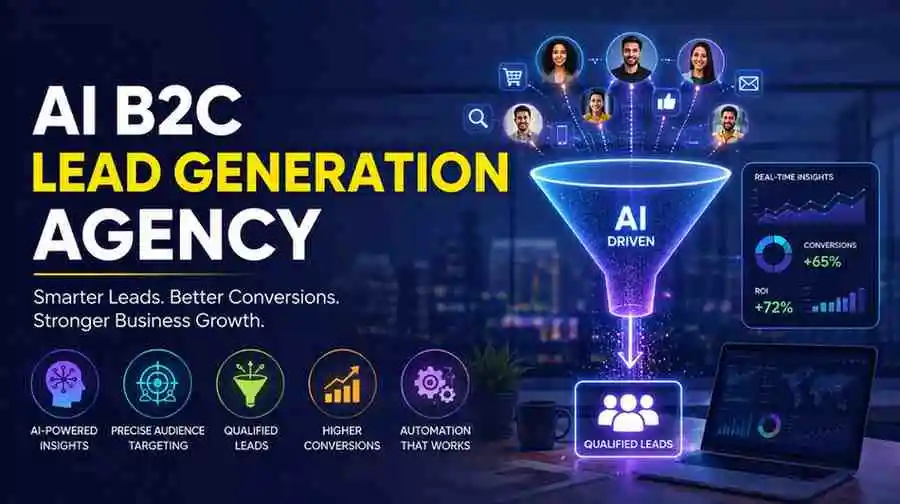
An AI B2C lead generation agency combines artificial intelligence with SEO, paid advertising, content marketing, marketing automation, customer data analysis, and predictive insights. Instead of showing the same message to everyone, AI helps personalise communication based on browsing behaviour, purchase history, demographics, interests, and engagement patterns.
Take the example of an online furniture brand. Earlier, it might have promoted the same sofa advertisement to every visitor. Today, AI can recognise whether someone was browsing office chairs, dining tables, or premium sofas. Each visitor receives different recommendations, different offers, and sometimes even different landing pages. That simple change often improves lead quality significantly.
Businesses are also under pressure to reduce customer acquisition costs. Advertising budgets are increasing while consumer attention keeps shrinking. Spending money on people who never intend to buy is becoming expensive. An experienced AI B2C lead generation agency focuses on identifying users with stronger buying intent, helping businesses spend their marketing budget more efficiently.
Another reason businesses are shifting is speed. AI processes thousands of customer interactions far quicker than manual analysis. Instead of waiting weeks to understand campaign performance, marketers can adjust targeting, creatives, bidding strategies, and audience segmentation almost in real time.
Perhaps the biggest difference is consistency. Traditional campaigns often depend heavily on manual decision making. AI continues learning from customer behaviour and keeps refining audience targeting, lead scoring, and conversion opportunities without starting from scratch every time.
How AI Changes the Way B2C Customers Are Identified, Qualified, and Converted
Finding consumers is no longer the difficult part. Almost every business can generate website visitors or social media traffic with enough advertising budget. The real challenge is identifying which visitors are likely to become customers.
This is where an AI B2C lead generation agency works differently.
AI analyses thousands of behavioural signals that would be impossible to monitor manually. It looks beyond simple clicks or page views. It studies session duration, browsing paths, repeat visits, abandoned carts, search intent, previous purchases, device usage, location patterns, content engagement, email interactions, and many other signals before estimating purchase intent.
Instead of treating every visitor equally, AI groups users into meaningful audience segments.
For example:
- First time visitors exploring products.
- Returning users comparing prices.
- Customers showing high purchase intent.
- Existing buyers likely to purchase again.
- Visitors who abandoned their checkout process.
Each group receives different communication based on its position in the buying journey.
Lead qualification also becomes much smarter.
Rather than asking sales teams to contact every enquiry, AI assigns priority scores based on behaviour and conversion probability. Sales representatives spend more time speaking with people who are genuinely interested instead of chasing every enquiry equally.
Conversion optimisation improves as well.
Landing pages can automatically adapt according to user interests. Product recommendations become more relevant. Email sequences respond to customer actions instead of following fixed schedules. Chatbots answer questions instantly while collecting valuable customer information for future marketing.
I’ve seen businesses struggle because they believed more leads automatically meant more sales. It rarely works that way. Sometimes reducing lead volume while improving lead quality delivers much better business results.
This may not apply everywhere, especially for businesses selling impulse purchase products, but for most brands selling higher value products or services, better qualified leads almost always outperform larger volumes of poor quality enquiries.
An experienced AI B2C lead generation agency understands that successful lead generation is not simply about increasing traffic. It is about helping the right customer arrive at the right moment with the right message.
The Biggest Challenges Businesses Face While Generating High Quality Consumer Leads
Generating consumer leads looks easy from the outside. Platforms promise instant enquiries, automated campaigns, and quick growth. Reality feels different.
One of the biggest problems businesses face is attracting the wrong audience.
A campaign may generate thousands of website visitors, yet very few become paying customers because the targeting was too broad. Businesses celebrate traffic numbers while sales teams complain about poor quality leads.
Another common issue is fragmented customer data.
Customer information often remains scattered across websites, CRM systems, social media platforms, email software, WhatsApp conversations, and advertising accounts. Without connecting these data sources, understanding the complete customer journey becomes difficult.
Many businesses also struggle with changing consumer behaviour.
Someone may click a Facebook advertisement today, search on Google tomorrow, watch YouTube reviews later, and finally make a purchase after reading customer testimonials several days later. Traditional attribution models fail to capture this complex buying journey accurately.
I might be wrong here, but I think many businesses still underestimate how much consumer trust affects lead generation. Better targeting cannot compensate for weak websites, slow loading pages, confusing messaging, or poor customer reviews.
Privacy regulations are creating another challenge.
As third party cookies disappear and users become more conscious about data privacy, businesses cannot depend entirely on old targeting methods. First party data, customer consent, and AI based predictive modelling are becoming increasingly important for maintaining lead quality.
There is also the issue of marketing fatigue.
Consumers see hundreds of advertisements every day. Repeating identical creatives eventually reduces engagement. AI helps identify creative fatigue earlier and supports continuous optimisation before campaign performance starts declining.
Finally, measuring success remains a major concern.
Many businesses still judge campaigns only by the number of leads generated. An experienced AI B2C lead generation agency looks beyond lead counts. It measures qualified leads, customer acquisition cost, conversion rates, customer lifetime value, repeat purchases, and overall return on marketing investment.
Sometimes fewer leads generate higher profits.
That sounds contradictory at first, but businesses that focus on lead quality instead of vanity metrics usually build more sustainable growth over time.
Essential Services You Should Expect from an AI B2C Lead Generation Agency
Not every agency using AI delivers the same value. Some simply add AI tools to existing marketing processes and call themselves an AI agency. Others completely redesign how customer acquisition works by combining automation, predictive analysis, and customer intelligence across every marketing channel.
A capable AI B2C lead generation agency should begin with understanding the business instead of launching advertisements immediately. Every business has different customers, different buying cycles, and different conversion triggers. A strategy that works for an online fashion brand may fail completely for a healthcare provider or an education platform.
One of the most valuable services is AI driven audience research. Rather than relying only on age, gender, or location, AI identifies behavioural patterns that indicate buying intent. It helps businesses focus on people who are more likely to become customers instead of simply increasing website traffic.
Search Engine Optimization remains another important service. Organic traffic often delivers visitors with stronger purchase intent because they are actively searching for products or solutions. AI helps identify emerging search trends, content gaps, and keyword opportunities much faster than manual research.
Paid advertising is equally important. An experienced AI B2C lead generation agency continuously optimises Google Ads, Meta Ads, YouTube campaigns, and other paid channels using AI based bidding strategies, audience refinement, and creative testing.
Marketing automation is something many businesses underestimate. Following up manually with hundreds of enquiries becomes difficult as businesses grow. Automated email sequences, WhatsApp campaigns, chatbot conversations, and personalised remarketing help businesses stay connected without overwhelming their sales teams.
Landing page optimisation also deserves attention. Sometimes advertisements perform well but conversions remain poor because landing pages fail to answer customer questions or create trust. AI heatmaps, user behaviour analysis, and conversion testing help improve these pages continuously.
Analytics and reporting should never be limited to clicks or impressions. Businesses should receive meaningful insights about lead quality, customer acquisition costs, conversion rates, and revenue contribution rather than vanity metrics.
I have seen companies invest heavily in advertising while ignoring their CRM. Good leads were entering the system, but delayed follow ups meant competitors closed those customers first. Technology alone cannot solve poor business processes.
How AI, SEO, Paid Ads, Social Media, and Automation Work Together for Better Lead Generation
One of the biggest mistakes businesses make is treating every marketing channel separately.
SEO works independently.
Paid advertising has different goals.
Social media follows another strategy.
Email marketing sits somewhere else.
That approach usually creates disconnected customer experiences.
An AI B2C lead generation agency brings these channels together into a single lead generation system.
It often begins with SEO. Customers searching on Google are already expressing intent. Optimised content helps attract visitors who are looking for solutions rather than casually browsing.
Some visitors convert immediately.
Many do not.
Instead of losing those visitors, paid remarketing campaigns reconnect with them across Google Display Network, Facebook, Instagram, YouTube, and other platforms. AI decides which audience should receive which advertisement based on previous interactions.
Social media then supports trust building.
Consumers frequently visit Instagram profiles, YouTube channels, LinkedIn pages, or customer reviews before making purchasing decisions. Educational content, customer success stories, demonstrations, and testimonials reduce hesitation.
Marketing automation continues the conversation after someone submits an enquiry.
Confirmation emails.
WhatsApp reminders.
Product recommendations.
Appointment scheduling.
Abandoned cart recovery.
Customer feedback requests.
Everything happens automatically while remaining personalised.
Earlier I believed SEO alone could generate enough leads for most businesses. Experience changed that opinion. SEO produces excellent long term results, but combining it with AI powered advertising and automation usually creates much stronger growth because each channel supports the others instead of competing.
That doesn’t mean every business needs every marketing channel from day one.
Sometimes starting with two well managed channels produces better results than spreading budgets across six different platforms.
Key Technologies and Customer Data Signals That Improve B2C Lead Quality
Consumer behaviour leaves thousands of digital signals behind.
Every page visited.
Every product viewed.
Every search performed.
Every email opened.
Every advertisement clicked.
Every abandoned shopping cart.
Individually, these actions may not mean much. Together, they tell a detailed story about purchase intent.
An experienced AI B2C lead generation agency combines these behavioural signals with artificial intelligence to improve lead quality instead of simply increasing lead volume.
Customer Relationship Management systems become the foundation because they store customer history across multiple interactions.
AI powered analytics platforms then analyse this information to identify patterns that humans often miss.
Predictive lead scoring estimates which enquiries deserve immediate attention.
Behavioural segmentation groups similar customers together.
Recommendation engines personalise product suggestions.
Natural language processing analyses chatbot conversations and customer support interactions.
Marketing automation platforms respond automatically based on customer behaviour rather than fixed schedules.
Website behaviour tracking also provides valuable insights.
Businesses can understand which pages customers visit before converting, where visitors leave the website, how long they stay, which devices they use, and which content influences purchasing decisions.
First party data has become increasingly valuable because businesses can no longer depend entirely on third party cookies.
Collecting customer information ethically through website interactions, newsletter subscriptions, enquiries, loyalty programmes, and purchase history helps businesses build stronger marketing strategies while respecting user privacy.
Technology is important.
Good judgement still matters.
AI can identify patterns, but businesses still need people who understand customers, markets, and buying behaviour before making strategic decisions.
Common Mistakes Businesses Make When Hiring an AI B2C Lead Generation Agency
Many businesses begin searching for an AI B2C lead generation agency after experiencing disappointing results from traditional marketing.
Unfortunately, some repeat the same mistakes during the hiring process.
One common mistake is selecting an agency purely because it promises a large number of leads.
Lead quantity tells only part of the story.
One hundred poor quality enquiries rarely outperform twenty highly qualified customers.
Another mistake is asking only about AI tools.
Businesses often become impressed by software names without understanding how those tools fit into an overall marketing strategy. AI is useful only when supported by experienced marketers who know how to interpret data and make practical decisions.
Some companies also ignore reporting transparency.
If an agency cannot clearly explain where leads come from, how campaigns perform, and what improvements are being made each month, it becomes difficult to measure success.
Businesses sometimes expect immediate results from every channel.
Paid advertising may generate enquiries quickly.
SEO requires patience.
Content marketing builds authority over time.
Marketing automation becomes more effective as customer data grows.
Expecting identical timelines across every activity often leads to unrealistic expectations.
Another concern is relying entirely on automation.
AI can automate many repetitive tasks, but customer relationships still require human understanding. Complex enquiries, pricing discussions, and personalised consultations usually need experienced professionals.
I get slightly uncomfortable when agencies promise guaranteed rankings or guaranteed lead numbers. Marketing depends on competition, budgets, customer demand, seasonality, and many variables that nobody controls completely.
How StratMarketer Helps Businesses Build Scalable AI Powered B2C Lead Generation Systems
StratMarketer approaches lead generation as a connected growth system rather than a collection of individual marketing services.
Instead of focusing only on advertisements or website traffic, the team works to understand how customers discover businesses, compare alternatives, make purchasing decisions, and return for future purchases.
As an AI B2C lead generation agency, StratMarketer combines AI driven customer insights with SEO, paid advertising, content marketing, social media marketing, conversion rate optimisation, and marketing automation to create a consistent lead generation process.
The strategy starts with understanding customer behaviour.
Who are the ideal customers?
Which marketing channels influence them most?
Where do they leave the buying journey?
What information helps them make decisions?
Answers to these questions shape every campaign.
AI supports audience segmentation, predictive lead scoring, campaign optimisation, and customer journey analysis, while experienced marketing professionals continuously refine messaging, creative assets, and conversion strategies.
SEO attracts users actively searching for products and services.
Paid advertising expands reach among high intent audiences.
Content builds credibility.
Marketing automation ensures enquiries receive timely follow ups.
Analytics connect every stage so businesses can measure qualified leads, customer acquisition costs, revenue, and long term marketing performance instead of isolated campaign metrics.
Scalability is another important focus.
As businesses grow, lead generation systems should grow with them without creating unnecessary manual work. AI powered workflows, integrated CRM systems, automated nurturing, and continuous optimisation help maintain efficiency while supporting higher lead volumes.
Every business grows differently.
That is probably why fixed marketing formulas rarely last very long. A strategy that performs exceptionally well today may require adjustments six months later as customer behaviour, competition, and technology continue to change.
How to Measure the Success of an AI B2C Lead Generation Agency Beyond Lead Volume
Many businesses judge an AI B2C lead generation agency by one number.
How many leads did we receive this month?
Although lead volume is important, it rarely tells the complete story. Five hundred enquiries that never become paying customers are far less valuable than fifty enquiries that consistently generate revenue.
A better way to evaluate an agency is by looking at the entire customer acquisition process.
Lead quality should be the first metric. Sales teams can quickly identify whether enquiries match the target audience or whether campaigns are attracting people with little purchasing intent. If sales representatives spend most of their time filtering unsuitable enquiries, the marketing strategy probably needs refinement.
Customer acquisition cost is another critical measurement. Generating more leads means little if advertising costs rise faster than revenue. A successful AI B2C lead generation agency continuously works to reduce acquisition costs while maintaining or improving lead quality through better audience targeting, creative testing, and campaign optimisation.
Conversion rates reveal how efficiently visitors move through the buying journey. Businesses should monitor website visitor to lead conversion, lead to qualified lead conversion, qualified lead to customer conversion, and repeat purchase rates. These numbers often provide deeper insights than overall traffic or enquiry counts.
Sales velocity is equally valuable. AI powered automation, CRM integration, and intelligent follow up systems can shorten the time between the first enquiry and the final purchase. Faster sales cycles improve cash flow and help businesses scale more efficiently.
Customer lifetime value deserves attention as well. Some marketing campaigns generate customers who purchase only once, while others attract loyal customers who return repeatedly and recommend the business to others. Measuring long term customer value provides a more accurate picture of marketing performance.
Retention and engagement metrics also matter. Open rates, repeat website visits, customer reviews, referral rates, subscription renewals, and repeat purchases indicate whether marketing attracts the right audience instead of simply increasing short term enquiries.
I have seen businesses celebrate record lead numbers while sales teams struggled to convert those enquiries. After reviewing the data, the real issue was poor audience targeting rather than poor sales performance. That experience reinforced an important lesson. Marketing should always be measured by business outcomes rather than marketing activity alone.
Ultimately, the success of an AI B2C lead generation agency should be measured by revenue growth, customer quality, profitability, and sustainable business growth instead of lead volume by itself.
Frequently Asked Questions About Choosing an AI B2C Lead Generation Agency
What does an AI B2C lead generation agency do?
An AI B2C lead generation agency helps businesses attract, qualify, nurture, and convert potential customers using artificial intelligence, SEO, paid advertising, content marketing, social media, marketing automation, and customer data analysis.
How is an AI B2C lead generation agency different from a traditional marketing agency?
Traditional agencies often manage individual marketing channels independently. An AI driven agency combines customer data, automation, predictive analytics, and machine learning to optimise the complete customer journey and improve lead quality.
Can AI replace human marketers?
No. AI automates repetitive tasks, analyses large amounts of customer data, and identifies patterns quickly, but experienced marketers are still essential for strategy, creativity, messaging, and business decisions.
Which businesses benefit most from an AI B2C lead generation agency?
Ecommerce brands, healthcare providers, educational institutions, real estate companies, financial service providers, fitness businesses, travel companies, consumer product brands, home service providers, and subscription based businesses often benefit from AI powered lead generation.
How long does it take to see results?
Paid advertising can generate enquiries within days or weeks. SEO, content marketing, and organic brand authority usually require several months before producing consistent long term results. The timeline depends on competition, budget, industry, and existing online presence.
Does AI improve lead quality or only increase lead volume?
A well implemented AI strategy focuses on improving lead quality first. Predictive lead scoring, behavioural analysis, audience segmentation, and marketing automation help businesses attract customers who are more likely to convert.
What should businesses ask before hiring an AI B2C lead generation agency?
Ask about their experience, reporting process, AI capabilities, campaign optimisation methods, CRM integration, case studies, communication process, lead qualification strategy, and how they measure business success beyond clicks and impressions.
Why is SEO still important when using AI for lead generation?
SEO attracts high intent users who are actively searching for products or services. AI makes keyword research, content planning, and search trend analysis more efficient, but organic visibility remains one of the strongest long term sources of qualified B2C leads.
How does StratMarketer help businesses generate better B2C leads?
StratMarketer combines AI powered customer insights with SEO, paid advertising, social media marketing, content creation, conversion rate optimisation, CRM integration, and marketing automation to build scalable lead generation systems that focus on qualified customers, measurable business growth, and long term return on investment.