


What Is an AI Sales Automation Agency and Why Businesses Need One
For many businesses, the problem is not a complete lack of leads. The bigger problem is what happens after someone fills out a form, sends a WhatsApp message, asks for a quotation, or shows interest in a service.
The enquiry comes in. Someone from the sales team notices it much later. A call is made, but the prospect does not answer. The follow up gets pushed to tomorrow. Then tomorrow becomes next week.
This is where an AI sales automation agency can become useful.
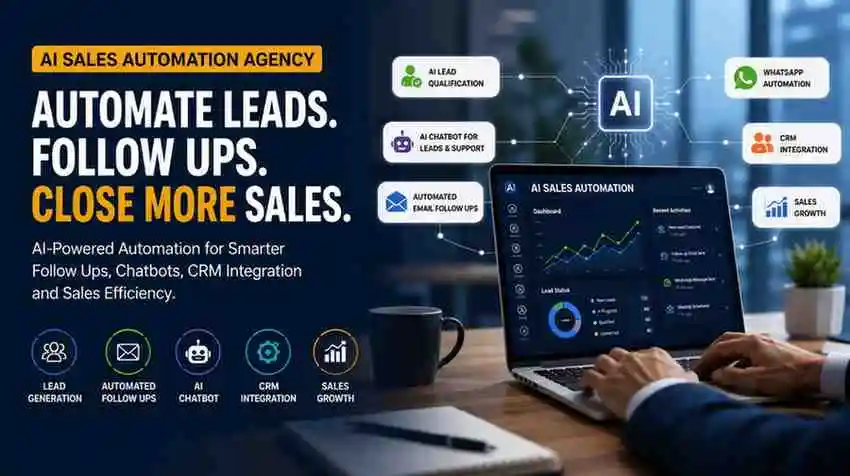
An AI sales automation agency helps businesses use artificial intelligence, automation platforms, CRM systems, chatbots, email, WhatsApp and other sales tools to handle repetitive parts of the sales process. The aim is not to replace salespeople. Good automation should give salespeople more time to speak with prospects who are actually worth speaking to.
That distinction matters.
I have seen businesses spend heavily on Google Ads and social media campaigns while their sales follow up is still being managed through spreadsheets and personal reminders. It creates a strange situation where the marketing team is doing its job, but the business still feels that leads are poor.
Sometimes the leads are not the real problem.
The process is.
An AI sales automation agency looks at what happens between the first enquiry and the final sales conversation. It can identify where leads are being lost, which questions are repeated every day, where follow ups are delayed and which parts of the sales journey can be handled automatically.
For an Indian business, this can be particularly useful when enquiries arrive through several channels at once. A manufacturing company might receive enquiries from its website, IndiaMART, Google, WhatsApp and sales representatives. A real estate company may receive leads from property portals, Meta Ads and its own website. A B2B service company may receive enquiries through LinkedIn, email and contact forms.
Managing all of this manually becomes difficult surprisingly quickly.
An AI sales automation agency can connect these touchpoints and create a more organised flow. A new lead can enter the CRM, receive an immediate response, answer basic qualifying questions and then be assigned to the right salesperson.
The salesperson gets context instead of just a phone number.
That small difference can change the quality of the sales conversation.
What does an AI sales automation agency actually do?
The term sounds complicated, but much of the work is quite practical.
An AI sales automation agency studies the existing sales process first. It may look at how leads arrive, how quickly the team responds, what information is collected, how follow ups happen, how quotations are sent and how inactive prospects are handled.
Then automation is introduced where it makes sense.
For example, suppose a solar equipment company receives 100 enquiries in a month. The sales team may spend a lot of time asking basic questions such as project location, system size, commercial or residential requirement, budget and installation timeline.
A chatbot or automated form can collect some of this information before the salesperson gets involved.
The sales executive then receives something like this:
Prospect needs a 50 kW commercial solar system. Location is Jaipur. Installation expected within three months. Has already received one quotation. Wants financing options.
That is much more useful than:
Name: Rajesh
Phone: 6230036947
Source: Website
The second lead may still become a customer, but the salesperson has to do all the discovery work again.
This is one of the practical reasons businesses work with an AI sales automation agency.
The technology is not the difficult part anymore. Deciding what should be automated and what should remain human is usually harder.
Why businesses are moving towards AI sales automation
Sales teams lose a lot of time on repetitive activity.
Checking new enquiries. Sending the same introduction message. Updating CRM records. Asking basic qualifying questions. Sending reminders. Following up with prospects who have gone silent. Finding old conversations. Preparing simple reports.
None of these tasks are necessarily difficult.
They are just repetitive.
An AI sales automation agency can automate parts of this work so that salespeople spend more time on negotiation, relationship building and closing conversations.
There is another reason businesses are paying attention to this now. Customers expect quick responses.
If somebody submits a website enquiry at 10:30 PM, the sales executive may not be available. That does not mean the business has to remain completely silent until morning.
An automated response can acknowledge the enquiry, answer common questions and collect relevant information.
It is not pretending to be a salesperson.
It is simply making sure the prospect is not left wondering whether anyone received the enquiry.
For high value B2B sales, that first response can also help filter serious prospects from casual enquiries.
A company selling industrial machinery does not need its senior sales manager calling every person who asks, “Please send price.”
The prospect may need to provide industry, application, required capacity, location and expected purchase timeline first.
Automation can collect those details.
Then the sales team can decide where to spend its attention.
How AI Sales Automation Is Changing the Modern Sales Process
Traditional sales processes often depend heavily on individual salespeople.
One salesperson may be excellent at follow ups. Another may forget them. One keeps detailed CRM notes. Another has everything inside WhatsApp. One calls prospects regularly. Another waits for the customer to come back.
This creates inconsistency.
AI sales automation changes the process by moving some of these activities from individual memory into systems.
That does not mean every sales interaction should become automated.
Actually, I disagree with that approach.
A business that tries to automate every customer conversation can quickly start sounding robotic. If a customer is discussing a complicated industrial purchase worth several lakhs, they usually want to speak to a person. They want someone who understands the situation, not another automated message asking them to “select option 1”.
The better approach is selective automation.
Let technology handle repetitive work.
Let people handle judgement.
This is where an AI sales automation agency can add practical value.
From lead capture to lead understanding
Earlier, many businesses treated lead generation as the end goal.
Get the enquiry.
Send it to sales.
Done.
But the real process starts after that.
AI tools can analyse information submitted by prospects and organise it into useful categories. A lead can be marked as high, medium or low priority based on information such as company size, requirement, budget, location, urgency or previous interactions.
These systems are not always right.
That needs to be said clearly.
AI can misunderstand a message. A prospect who appears low intent may actually be a serious buyer who is still researching. Another person may sound highly interested but have no real purchase plan.
So lead scoring should support sales judgement, not replace it.
A good AI sales automation agency knows this limitation and builds human review into the process.
Faster lead response
Response time matters, especially when a prospect is actively comparing vendors.
Suppose someone searches for a digital marketing agency, visits three websites and submits enquiry forms on all three.
The company that responds quickly has a better chance of starting the conversation while the requirement is still fresh.
Automation can help here.
A new enquiry can trigger an immediate acknowledgement email, WhatsApp message or chatbot conversation. The system can collect basic information and notify the salesperson.
The salesperson can then call with some understanding of the requirement.
This is far better than discovering the lead the next afternoon in an Excel file.
Automated follow ups without losing the human touch
Follow up is one of the most neglected areas in sales.
Not because salespeople do not understand its importance. They are simply busy.
A prospect may say, “Call me next Monday.”
The salesperson remembers.
Sometimes.
An AI sales automation agency can create follow up sequences based on the sales stage.
A new enquiry may receive an initial response. If there is no reply, another message can be sent after an appropriate interval. If the prospect engages, the automated sequence can stop and the salesperson can take over.
For a quotation, the follow up could be different.
For an inactive prospect, different again.
This sounds basic, but businesses often lose good opportunities because nobody knows who was supposed to follow up.
I have seen this happen with service companies where the owner personally handles sales. Twenty enquiries arrive in a busy week, five get proper follow ups, six receive late responses and the rest quietly disappear.
The owner later says, “Leads are not converting.”
That conclusion may be wrong.
The follow up process may simply be broken.
AI sales automation and CRM systems
A CRM becomes much more useful when it is connected to automation.
Without proper usage, a CRM can become another database that nobody updates.
With automation, information can move into the CRM from forms, chatbots, email campaigns and other sources. Activities can be recorded, reminders can be triggered and sales stages can be updated based on defined actions.
An AI sales automation agency may also connect CRM systems with other business tools.
For example:
Website enquiry → CRM → AI qualification → salesperson notification → follow up → quotation → reminder → sales conversation → customer.
The exact process depends on the business.
A real estate company and a medical equipment supplier should not have the same automation workflow simply because both want more sales.
Their buying cycles are different.
Their customers ask different questions.
Their sales teams work differently.
That is why copying an automation template without understanding the business usually causes trouble later.
AI Lead Generation and Qualification for Better Sales Opportunities
Lead generation has changed considerably.
Businesses now use SEO, paid advertising, social media, content marketing, LinkedIn, WhatsApp, email campaigns and several other channels to attract potential customers.
But generating a lead is only one part of the job.
The difficult question is:
Is this actually a sales opportunity?
An AI sales automation agency can help businesses answer that question faster by introducing automated qualification into the lead management process.
AI can qualify leads before the salesperson calls
Imagine a company selling commercial interior design services.
A new website visitor submits an enquiry.
Instead of immediately assigning the lead to a senior salesperson, the system can ask a few relevant questions.
What type of property is involved?
Where is it located?
What is the approximate area?
Is the project new or renovation?
When do you expect the work to begin?
What stage is the project currently at?
These answers provide useful context.
The system can then classify the enquiry based on predefined criteria.
A lead with a confirmed commercial property, large project size and near term requirement may receive high priority.
Someone asking only for general pricing may receive a different workflow.
This does not mean the second person is useless.
It simply means the sales team does not need to treat both enquiries in exactly the same way.
AI lead scoring needs supervision
This is one area where I would be careful.
Businesses sometimes assume AI lead scoring is automatically accurate because the word AI is attached to it.
It isn’t.
The quality of the scoring depends on the information available, the rules used and how the system learns from previous outcomes.
If a business tells its system that company size is the strongest buying signal, but its actual customers tend to come from smaller firms, the scoring can become misleading.
The system may confidently prioritise the wrong prospects.
That is why an AI sales automation agency should periodically review actual sales outcomes against automated scores.
Which leads became customers?
Which ones did not?
Were high scoring leads really better?
Were some low scoring leads repeatedly closing?
The answers should feed back into the process.
This is where human experience still matters a lot.
AI can identify buying signals
A prospect may not say, “I am ready to buy.”
But their behaviour can suggest increasing interest.
They may visit the pricing page several times. Download a brochure. Ask for technical specifications. Reply to an email. Book a consultation. Ask about delivery timelines.
Individually, these actions may not mean much.
Together, they can indicate stronger buying intent.
AI systems can help identify patterns across these interactions and notify the sales team when a lead becomes more active.
For B2B businesses with longer sales cycles, this can be useful.
A machinery buyer may spend weeks comparing specifications before speaking to a supplier. A software buyer may involve several people before making a decision. A real estate investor may return to the same property details repeatedly before booking a visit.
The sales team should not necessarily call after every website visit.
That can become irritating.
But when several meaningful signals appear together, a timely human follow up can make sense.
AI lead generation does not mean buying random lists
This is worth mentioning because some businesses still connect automation with bulk lead collection.
AI should not be an excuse to scrape thousands of irrelevant contacts and send them generic messages.
That is not good sales automation.
It is just spam at a larger scale.
A sensible AI sales automation agency should focus on the quality of the sales journey, not simply the number of contacts entering a CRM.
For an Indian B2B business, 50 relevant enquiries from companies with genuine requirements can be far more valuable than 2,000 poorly matched leads.
This becomes especially important in sectors such as manufacturing, consulting, industrial products, education, healthcare services and real estate, where sales conversations often require context.
Where Indian businesses need to be careful
Indian sales environments have their own quirks.
WhatsApp is a major communication channel. Customers often prefer calling instead of filling out long forms. Some decision makers want pricing immediately. Others will not respond to email but will reply to a WhatsApp message within ten minutes.
Then there is the language issue.
A customer may type in English, Hindi, Hinglish or a regional language in the same conversation.
An automated system needs to handle that sensibly.
I might be wrong here, but I do not think every business needs an elaborate AI sales stack. For some small companies, a well configured CRM, WhatsApp workflow and sensible follow up automation may do more good than adding five different AI tools.
More technology does not automatically mean better sales.
Sometimes it just means more things for somebody to maintain.
There is also the matter of customer data, access controls and consent. Businesses need to think carefully about what information is being collected, where it is stored and who can access it, particularly when CRM systems, messaging platforms and AI services are connected.
That part is not exciting.
It still matters.
What the sales team actually gains
When automation is implemented properly, the biggest benefit may not be the number of messages sent automatically.
It is the reduction in scattered work.
A salesperson should ideally know:
Who is the prospect?
What do they want?
When did they enquire?
What has already been discussed?
What objection did they raise?
What should happen next?
An AI sales automation agency can help bring those pieces together.
Then the salesperson can focus on the part machines are still not very good at: understanding people in messy situations.
A customer may say the price is too high, but the actual concern may be delivery time. Another may ask for a discount because they are comparing suppliers. Someone may appear uninterested because the internal purchase approval has been delayed.
These situations need judgement.
No workflow builder can completely remove that.
And perhaps it should not.
StratMarketer’s role, in this context, is not simply to put AI tools around an existing sales process and call the job finished. The more useful approach is to look at how leads currently enter the business, where they slow down, what salespeople repeatedly do manually and which conversations genuinely require a person.
Because automation can make a bad process faster too.
That is the uncomfortable part.
A business can spend money on AI, connect the CRM, create chatbot flows and automate follow ups, yet still have poor sales performance if the offer is weak, the targeting is wrong or the sales team does not know how to handle qualified enquiries.
So the technology needs to fit the commercial reality.
And there will always be exceptions. A high value customer who has dealt with the company for years may not want an automated qualification sequence at all. They may simply want to call the owner and talk.
That should be allowed.
One thing I have become more cautious about is the belief that AI will somehow remove the need for salespeople. It may remove some repetitive sales tasks, certainly. But complex buying decisions still involve trust, negotiation, uncertainty and sometimes plain human reassurance.
A machine cannot always tell when a customer is saying “I will think about it” because they need time and when they are saying it because they have already decided no.
That difference can be worth lakhs.
And sometimes the best automation is knowing when to stop automating.
Automated Lead Follow Ups Through AI and CRM Integration
Getting a lead is only the beginning. What happens in the next few hours and days often decides whether that enquiry becomes a serious sales conversation or disappears quietly.
This is where automated follow ups become useful.
An AI sales automation agency can connect lead sources with a CRM and create follow up workflows based on what the prospect actually does. A person who submits a website form can receive an immediate acknowledgement. If there is no response, the system can send a suitable reminder later. If the prospect replies, the automated sequence can stop and the salesperson can take over.
That sounds simple, but the difference between a simple reminder and a sensible follow up system is quite large.
For example, imagine a company selling industrial equipment in India. Someone enquires about a machine and asks for specifications. Sending the same “Just following up on our previous message” every two days is not useful. The prospect may still be comparing models, waiting for management approval or checking installation requirements.
The follow up should reflect that.
A CRM connected with AI can retain the conversation history, enquiry details, sales stage and previous actions. This gives the salesperson some context before contacting the prospect.
Instead of asking, “What were you looking for?”, the salesperson can start with the actual requirement.
That feels more human, ironically because the automation is handling the boring part in the background.
Follow ups based on sales stages
Not every lead needs the same sequence.
A new enquiry might receive an introductory response. A qualified lead may receive technical information. Someone who has received a quotation may need a different follow up. A prospect who has gone silent for three weeks may need a softer reactivation message rather than another sales pitch.
An AI sales automation agency can create different workflows for these situations.
The CRM becomes the place where the system knows what stage the prospect is in.
This is particularly useful for businesses with long sales cycles. A commercial real estate enquiry, software implementation project, manufacturing order or financial consulting engagement may take weeks or months to close.
Human memory is not reliable enough for all of these follow ups.
I have seen sales teams maintain reminders in notebooks, WhatsApp chats and Excel sheets at the same time. It works until the team gets busy. Then someone leaves the company, a phone is replaced, or an important enquiry gets buried under fifty new conversations.
That is when businesses start realising that the problem was never just lead generation.
It was lead management.
AI can decide when a human should step in
Good automation should not keep sending messages endlessly.
If a prospect replies with a question, requests a call or asks for a quotation, the system should recognise that the conversation has moved into a human stage.
The salesperson can then take over.
This is one of the areas where I prefer a hybrid approach. Fully automated sales conversations may look impressive in a demonstration, but they can become frustrating in real situations, particularly for high value purchases.
A customer does not want to explain the same technical requirement to a chatbot three times.
The system should know when to get out of the way.
AI Chatbots for Sales Enquiries, Customer Support and Lead Capture
AI chatbots have moved well beyond the old website popups that asked, “How may I help you?” and then offered three unrelated buttons.
A properly configured AI chatbot can understand common questions, provide useful information, collect lead details and route enquiries to the right person.
For an AI sales automation agency, chatbots can become an important part of the lead capture process.
Consider a company that provides commercial interior design services. Website visitors may ask about project costs, timelines, locations served, design services, materials or previous work.
A chatbot can handle many basic questions without forcing a salesperson to respond manually every time.
But the useful part comes after the question.
The chatbot can ask for project type, approximate area, location, expected start date and contact details.
Now the business has an enquiry with context.
Chatbots can capture leads outside business hours
This matters in India because people do not always enquire during office hours.
A business owner may be researching vendors at night. Someone may submit a form on Sunday. A customer may send a WhatsApp message while travelling.
Waiting until the next working day can create unnecessary friction.
An AI chatbot can acknowledge the enquiry immediately.
It can say what the business does, answer common questions and collect enough information for the sales team to continue later.
It does not need to pretend that a human is available when nobody is.
That honesty is important.
Chatbots can help with repetitive customer support
Sales and support often overlap.
A customer may ask about delivery status, service coverage, documentation, payment methods or basic product information. If every question has to be answered manually, the sales or support team spends hours repeating information already available on the website.
An AI chatbot can handle these routine interactions.
For example, an Indian manufacturing company could configure its chatbot to answer questions about product categories, minimum order quantities, basic delivery information and enquiry procedures.
For complex technical questions, the chatbot can collect the request and route it to a person.
That division makes sense.
Simple questions can be automated.
Important questions should reach someone who knows what they are talking about.
WhatsApp needs a different approach
In the Indian market, WhatsApp cannot simply be treated like another email channel.
People use it casually and expect fairly quick replies.
An AI sales automation agency can connect suitable WhatsApp workflows with CRM systems so that enquiries, follow ups and conversation history are not scattered across individual employee phones.
But businesses need to be careful with message frequency and consent.
Nobody enjoys receiving five automated WhatsApp messages because they once asked for a price.
Automation without restraint becomes irritation.
And irritation does not convert well.
How AI Sales Automation Helps Sales Teams Save Time and Reduce Manual Work
Salespeople spend a surprising amount of time doing work that has little to do with selling.
Copying contact details.
Updating CRM records.
Sending standard emails.
Checking whether a prospect replied.
Setting reminders.
Preparing basic reports.
Searching for previous conversations.
Following up with people who never responded.
These tasks are necessary, but they do not necessarily need a salesperson’s full attention.
An AI sales automation agency can automate many of these activities.
The exact amount of time saved varies by business, so I would avoid throwing around dramatic percentage claims without seeing the actual workflow. A company receiving 30 enquiries a month has very different automation needs from a business handling 3,000.
The point is not a magic number.
The point is removing repetitive work where it makes practical sense.
Salespeople can focus on conversations
Suppose a sales executive receives 40 qualified enquiries each month.
If the CRM automatically records the lead source, requirement, previous communication and next follow up date, the salesperson starts each call with better information.
That reduces the amount of administrative work around the call.
They can spend more time asking useful questions.
What is stopping the customer from buying?
Who is involved in the decision?
What timeline are they working with?
What alternative are they considering?
What would make the purchase easier?
These are sales questions.
Updating a spreadsheet is not.
AI can prepare information before a sales call
AI can also summarise previous conversations.
If a prospect has exchanged several emails, filled out a form and spoken with a salesperson earlier, an AI system can create a short internal summary.
For example:
The prospect is a manufacturing company in Pune. They are looking for two production machines. Technical specifications were shared last week. Their concern is installation time. Purchase decision expected after internal approval.
The salesperson does not have to read twenty messages before the call.
This is one of the more practical uses of AI in sales.
It is not flashy.
It simply saves time.
Manual data entry creates hidden problems
There is another issue that businesses often overlook.
When salespeople have to manually enter everything into the CRM, some of them eventually stop doing it properly.
Not because they are careless.
They are busy.
One person records detailed notes. Another enters only the customer’s name. Another keeps everything in WhatsApp.
After a few months, management has a CRM full of incomplete information.
Automation can reduce this friction by capturing information from forms, conversations and connected systems.
But the workflow still needs to be designed properly.
Bad automation creates bad data faster.
That is something I have become fairly cautious about after seeing businesses connect tools simply because they were available.
Integrating AI Sales Automation With CRM, Email, WhatsApp and Other Tools
An AI sales automation agency rarely works with one tool alone.
Modern sales processes are spread across several platforms.
A website may generate leads. Google Ads may bring paid enquiries. Meta Ads may generate another stream. WhatsApp may handle conversations. Email may carry quotations. The CRM stores sales records. The sales team may use calendars for appointments.
If these systems do not communicate with each other, information gets fragmented.
Integration brings them together.
A basic flow could look like this:
Website enquiry enters the CRM. The prospect receives an immediate acknowledgement. AI qualifies the enquiry. The relevant salesperson receives a notification. Follow up tasks are created. Email or WhatsApp communication is recorded. The sales stage changes as the conversation progresses.
The exact setup depends on the business.
CRM integration is the foundation
The CRM should ideally become the central record for customer and prospect information.
Popular CRM platforms can be connected with websites, email systems, forms, calendars and communication tools.
AI can then work on top of that information.
For example, the system could identify leads that have not received a follow up within the expected period.
Or it could summarise a long conversation before a salesperson makes a call.
Or it could classify enquiries based on the information provided.
The CRM should not become a dumping ground.
If the sales team cannot understand what is happening inside it, the integration has not solved much.
Email automation still has an important role
Email remains useful for B2B sales, particularly when the buying process involves quotations, proposals, technical documents or internal approvals.
AI can assist with drafting follow ups, summarising conversations and suggesting suitable responses.
But there should still be human review for important commercial communication.
I would not recommend allowing AI to automatically send every sales email without supervision, especially where pricing, contractual terms or technical commitments are involved.
One wrong sentence can create a much bigger problem than one missed follow up.
WhatsApp and CRM integration
For many Indian businesses, this is where the setup becomes particularly useful.
A prospect can send a WhatsApp enquiry. The conversation can be associated with the relevant customer record. Salespeople can see previous interactions and follow up without depending entirely on one employee’s phone.
This becomes important when teams grow.
The owner may initially manage every WhatsApp conversation personally. Later, there are five salespeople, then ten. Suddenly the same approach becomes difficult to manage.
The CRM needs to become the shared memory.
WhatsApp should remain a communication channel, not the entire sales database.
Connecting calendars and appointment systems
If a business schedules consultations, product demonstrations, property visits or sales calls, calendar integration can reduce another layer of manual work.
A qualified prospect can receive a booking option. Once the meeting is booked, the CRM can update the record and the salesperson can receive the necessary information.
After the meeting, follow up tasks can be created.
It is a small workflow, but across hundreds of enquiries it can save a lot of administrative effort.
How StratMarketer Approaches AI Sales Automation for Indian Businesses
StratMarketer approaches AI sales automation from the sales process first and the technology second.
That distinction is important.
There is a temptation to start with tools. A business hears about an AI chatbot, CRM automation platform or AI lead scoring system and immediately wants to add it.
But the first question should be different.
Where are sales opportunities currently getting lost?
Maybe leads are not contacted quickly enough.
Maybe salespeople are spending too much time answering repetitive questions.
Maybe the CRM is not being updated.
Maybe WhatsApp conversations are completely disconnected from the company’s sales records.
Maybe there are plenty of enquiries but nobody has a proper follow up system.
These problems need different solutions.
Understanding the existing sales journey
StratMarketer can begin by looking at how a lead moves through the business.
Where does the enquiry come from?
Who receives it?
How quickly is it contacted?
What information is collected?
How is the lead qualified?
What happens when the prospect does not respond?
When does a salesperson take over?
How are quotations followed up?
What happens after the first meeting?
These questions are more important than choosing an AI tool.
For an Indian B2B company, the workflow may involve website forms, Google Ads, WhatsApp, phone calls and a CRM. For a real estate business, property portals may also be involved. For a service company, LinkedIn and email could be more important.
The automation should fit the business.
Not the other way around.
Combining AI with human sales teams
StratMarketer’s approach is based on using AI where it is genuinely useful while keeping human involvement where judgement matters.
Lead capture can be automated.
Basic qualification can be automated.
Routine follow ups can be automated.
CRM updates can be partly automated.
Conversation summaries can be generated by AI.
But negotiation, complex objections, relationship building and important commercial decisions should usually remain with the sales team.
That balance is important for Indian businesses because sales often depend heavily on trust and direct communication.
A customer may want to speak to the founder. A procurement manager may need a technical discussion. A distributor may want to negotiate territory terms. A large project may involve several decision makers.
These are not situations where a chatbot should be allowed to run the entire conversation.
Starting small instead of automating everything
I prefer starting with one obvious problem.
If follow ups are being missed, fix follow ups first.
If lead qualification is taking too much time, automate qualification.
If WhatsApp enquiries are getting lost, connect the communication process with the CRM.
Then measure what changed.
After that, another workflow can be added.
This approach is less exciting than launching a huge AI system on day one, but it is usually easier for sales teams to actually adopt.
And adoption matters.
A technically excellent automation that salespeople avoid using is still a failed project.
What StratMarketer should ultimately be judged on
An AI sales automation agency should not be judged simply by how many AI tools it connects.
The more useful questions are practical.
Are leads being responded to faster?
Are salespeople spending less time on repetitive tasks?
Are qualified enquiries reaching the right person?
Are follow ups being missed less often?
Does the sales team have better information before speaking to a prospect?
Can management see where opportunities are getting stuck?
Those are the things that matter.
AI itself is not the achievement.
A cleaner sales process is.
And even then, I would still review the system regularly. Customer behaviour changes. Sales teams change. Products change. What worked six months ago may become annoying later. An automated message that once felt helpful can start feeling repetitive when customers begin receiving too many of them.
So the process needs occasional human judgement.
There is no clever shortcut around that.
Sometimes a salesperson simply needs to pick up the phone and talk to the customer. That still works. Maybe more often than the AI industry would like to admit.
How to Choose the Right AI Sales Automation Agency for Your Business
Choosing an AI sales automation agency is not really about finding the company with the longest list of AI tools. That is usually the easiest part.
The difficult question is whether the agency understands how your sales process actually works.
A business may have a website, CRM, WhatsApp, email campaigns, paid advertising and a sales team, but if these systems are working separately, adding another AI platform will not magically solve the problem.
Before hiring an AI sales automation agency, start with the sales process itself.
Where are leads coming from? How quickly are they contacted? Who qualifies them? What happens after the first conversation? How many follow ups are normally required? Where do prospects stop responding? How are quotations handled? What information does the salesperson need before making a call?
If an agency asks these questions before discussing software, that is generally a good sign.
If the first conversation is mostly about how many AI tools they can integrate, I would be slightly cautious.
Look for actual sales process experience
AI automation and sales automation are not exactly the same thing.
Someone can understand CRM workflows, APIs and chatbots without understanding why a prospect stopped responding after receiving a quotation.
An experienced AI sales automation agency should understand both sides.
For example, a manufacturing business may have a sales cycle of several weeks because the buyer needs technical specifications, internal approval and commercial negotiation. A real estate company may have hundreds of enquiries but only a small percentage of genuinely qualified prospects. A digital marketing agency may need to understand business size, budget, existing marketing activity and decision making authority before assigning a lead to a senior salesperson.
These businesses need different workflows.
A generic automation package may not fit any of them particularly well.
Ask what they plan to automate
This sounds obvious, but ask the agency to explain exactly what will be automated.
Will website enquiries enter the CRM automatically?
Will leads receive an immediate response?
Can AI qualify enquiries?
Will follow ups be triggered based on the sales stage?
Can WhatsApp conversations be connected with the customer record?
Will salespeople receive notifications?
Can the system stop automated messages once a salesperson takes over?
Will quotations and proposal follow ups be tracked?
These questions reveal whether the agency has thought through your sales journey or is simply presenting a software demo.
A good AI sales automation agency should be able to explain the workflow in plain language.
You should understand what happens when a lead enters the system.
Check how human involvement is handled
This is a big one.
Do not choose an agency that treats human salespeople as a problem that AI needs to remove.
Complex sales still require people.
If a customer is buying industrial machinery, a property worth several crores, a long term software contract or a specialised consulting service, the conversation may involve negotiation, technical questions and trust.
AI can prepare the salesperson.
It should not necessarily replace the salesperson.
Ask the agency where human intervention happens in the workflow.
If the answer is “everything can be automated”, I would question that.
I might be wrong in some industries, but for high value B2B sales, fully automated conversations still have obvious limits.
Ask how they handle CRM integration
Your CRM is likely to become the centre of the automation process.
Ask which CRM platforms the agency has worked with and how information will move between systems.
A proper setup should consider lead sources, customer records, sales stages, communication history, follow up tasks and reporting.
It should also avoid duplicate records.
Imagine a prospect fills out your website form twice, speaks to a salesperson on WhatsApp and later replies to an email campaign. If the system creates four separate records, the automation has created another problem instead of solving one.
CRM hygiene matters more than most flashy AI demonstrations.
Understand data and access requirements
An AI sales automation agency may need access to your CRM, website, email systems, WhatsApp tools, analytics platforms and other business applications.
You should know what information is being collected and where it is being processed.
Ask about user permissions, account ownership, access controls, data retention and what happens when the engagement ends.
The business should retain control of its important accounts and records.
Do not hand over everything without understanding who owns what.
Ask how success will be measured
This is where an agency conversation should become practical.
Do not settle for vague promises about “more leads” or “better conversions”.
Ask what the automation is expected to change.
For example:
Lead response time
Follow up completion rate
Qualified lead percentage
Salesperson productivity
Appointment booking rate
Lead to opportunity conversion
Opportunity to customer conversion
Time spent on manual CRM work
These numbers will vary by business.
A company selling high value industrial equipment cannot be judged in exactly the same way as a company selling low ticket consumer products.
The right AI sales automation agency should first understand your existing numbers and then establish realistic expectations.
Ask for examples relevant to your industry
A case study is useful only when it has some connection to your situation.
If you run a B2B manufacturing company, a case study about an ecommerce store may tell you very little about how the agency handles long sales cycles, technical enquiries or multiple decision makers.
Ask what happened in the actual project.
What was automated?
What was left manual?
What problems appeared during implementation?
What changed after the system went live?
The last question is especially important.
Real automation projects rarely go perfectly from day one.
There may be duplicate leads, incorrect chatbot answers, CRM mapping issues or salespeople who forget to use a new workflow.
An agency that openly discusses these practical problems is often more credible than one that presents every project as effortless.
Consider StratMarketer based on the problem, not just the tools
For businesses considering StratMarketer, the same principle applies.
The starting point should be the sales problem.
If leads are being lost because nobody follows up, the solution should focus on follow up automation.
If sales teams spend too much time answering basic questions, AI chatbots and qualification workflows may help.
If customer information is scattered across WhatsApp, email and spreadsheets, CRM integration may be the more urgent requirement.
There is no need to automate something simply because an AI tool can do it.
That can become expensive very quickly.
A sensible AI sales automation agency should be willing to say that a particular automation is unnecessary when the existing process already works.
That kind of answer is sometimes more valuable than another software recommendation.
Frequently Asked Questions About AI Sales Automation Agencies
What is an AI sales automation agency?
An AI sales automation agency helps businesses use AI, CRM systems and automation tools to manage repetitive sales activities.
This can include lead capture, lead qualification, follow ups, chatbots, CRM updates, email workflows, WhatsApp automation, appointment scheduling and sales reporting.
The exact services depend on the business.
How can an AI sales automation agency help generate more sales?
Automation does not automatically create demand.
What it can do is help a business handle existing sales opportunities more effectively.
For example, leads can receive faster responses, prospects can be qualified earlier, follow ups can happen more consistently and salespeople can receive better information before contacting a lead.
If the business already receives relevant enquiries but loses opportunities through poor follow up, automation can have a meaningful effect.
If there are no suitable leads coming in, automation alone will not fix that.
Can AI replace salespeople?
Not completely, and businesses should be cautious about anyone promising that it will.
AI can handle repetitive tasks and assist with lead qualification, communication and administrative work.
Salespeople are still important for negotiation, relationship building, complex objections and high value buying decisions.
The better model is usually AI supporting the sales team rather than AI pretending to be the entire sales team.
Can AI automate WhatsApp sales follow ups?
Yes, suitable WhatsApp automation can be connected with CRM and sales workflows.
A business can use automated messages for enquiry acknowledgements, reminders, basic information and selected follow ups.
However, message frequency, customer consent and escalation to a human salesperson need to be considered carefully.
Sending automated messages repeatedly can make the business look careless rather than efficient.
Is AI sales automation useful for small businesses?
It can be.
A small business may not need a complicated AI system. Sometimes a CRM, automated lead capture, simple qualification questions and structured follow ups are enough.
In fact, I often think small businesses should start with the simplest workflow that solves the immediate problem.
There is no prize for having the most complicated automation setup.
How much does an AI sales automation agency charge?
There is no single standard price.
The cost depends on the number of systems involved, CRM requirements, chatbot complexity, AI features, integrations, lead volume, custom workflows and ongoing management.
A basic automation setup will naturally cost less than a system connecting multiple lead sources, CRM platforms, WhatsApp, email, AI qualification and reporting.
Ask for the complete scope before comparing prices.
How long does it take to implement AI sales automation?
Simple workflows can be implemented relatively quickly.
More complicated systems can take longer because CRM data, integrations, sales stages and communication workflows need to be configured and tested.
The testing stage should not be rushed.
A chatbot giving incorrect information or a follow up system sending messages to the wrong customer can create more damage than having no automation at all.
Does AI sales automation work with existing CRM software?
Often, yes.
The exact possibilities depend on the CRM and the other platforms being used.
An AI sales automation agency can connect forms, email, chatbots, WhatsApp, calendars and other tools where suitable integrations or APIs are available.
Before starting, check whether the agency has experience with the specific CRM your business already uses.
Replacing a CRM is not always necessary.
Can AI qualify leads automatically?
Yes.
AI can analyse information provided by a prospect and classify leads using factors such as requirement, location, company size, budget, urgency or engagement.
But automated qualification should be reviewed regularly.
The system can make mistakes, especially when the information supplied by the prospect is incomplete.
A lead scoring model should be treated as assistance for the sales team, not absolute truth.
What should I automate first?
Start with the task that causes the clearest sales problem.
If leads are not being contacted quickly, automate lead routing and first response.
If salespeople forget follow ups, automate reminders and follow up sequences.
If the team answers the same questions repeatedly, consider an AI chatbot.
If customer information is scattered, focus on CRM integration.
Do not start by automating everything.
That usually creates confusion.
Is an AI sales automation agency useful for B2B companies?
Yes, particularly when B2B sales involve multiple conversations and longer buying cycles.
AI can help organise lead information, track follow ups, summarise conversations, qualify enquiries and remind salespeople about pending opportunities.
It is especially useful when a business has enough sales activity that manual tracking is becoming unreliable.
What is the biggest mistake businesses make with sales automation?
Automating a poor sales process.
If the offer is unclear, lead targeting is weak, salespeople do not follow a proper process or customer information is inaccurate, adding AI will not magically correct everything.
It may simply make the existing problems happen faster.
That is why the agency should understand the business before building the automation.
Should every sales conversation be automated?
No.
That approach usually goes too far.
Routine enquiries can be automated. Complex conversations should generally have human involvement.
The customer should be able to reach a person without fighting through layers of automation.
That sounds like a small thing, but anyone who has spent ten minutes trying to reach support through an endless chatbot will understand why it matters.
How do I know whether my business is ready for an AI sales automation agency?
Look at your current sales process.
If leads are being missed, follow ups are inconsistent, salespeople spend too much time on repetitive administration, customer information is scattered or the team struggles to respond quickly, automation may be worth considering.
If you receive only a few enquiries each month and your existing process is working well, a large automation project may not be necessary.
Sometimes the right decision is to wait.
That is also a decision.
What should I ask an AI sales automation agency before hiring them?
Ask what they would automate, which systems they need access to, how they will integrate with your CRM, where human intervention remains, how customer data is handled, what happens if the automation fails and how success will be measured.
Also ask what they would not automate.
That last question can tell you quite a lot about how they think.
The right AI sales automation agency should leave you with a clearer sales process, not simply a collection of new software subscriptions. For an Indian business, that difference matters because sales still happen through phone calls, WhatsApp conversations, personal relationships and long discussions that do not fit neatly into an automation diagram.
Technology can organise those conversations.
It cannot remove the need to understand them.